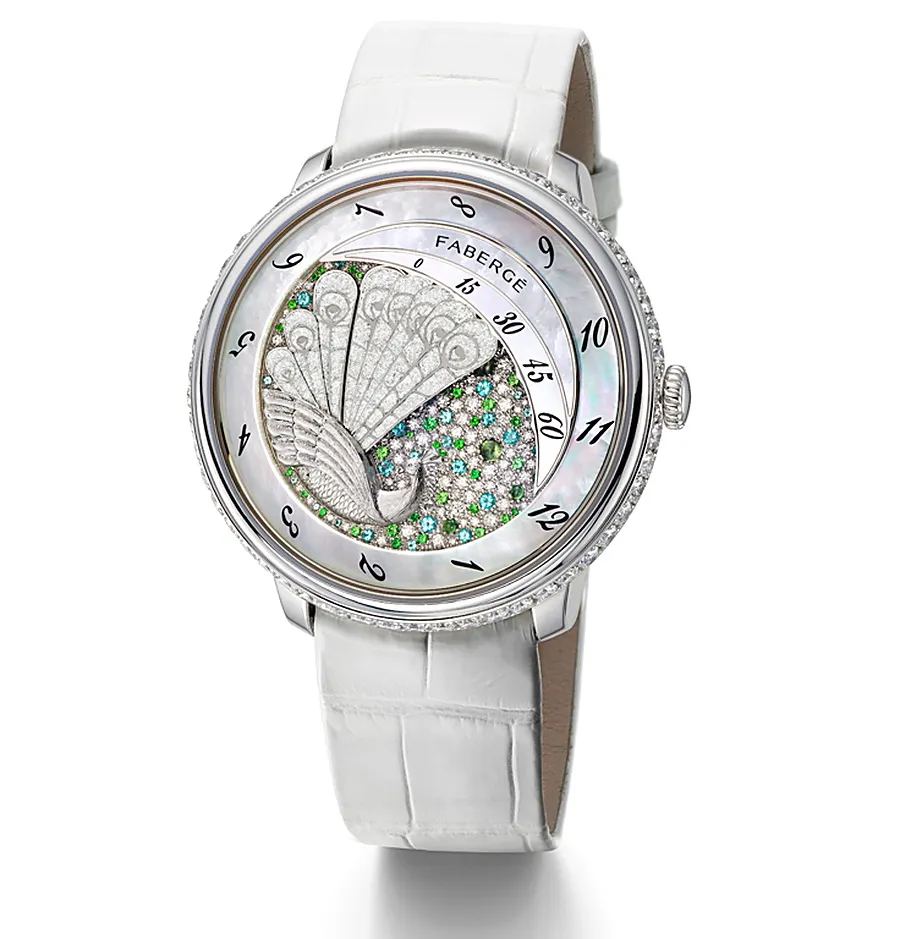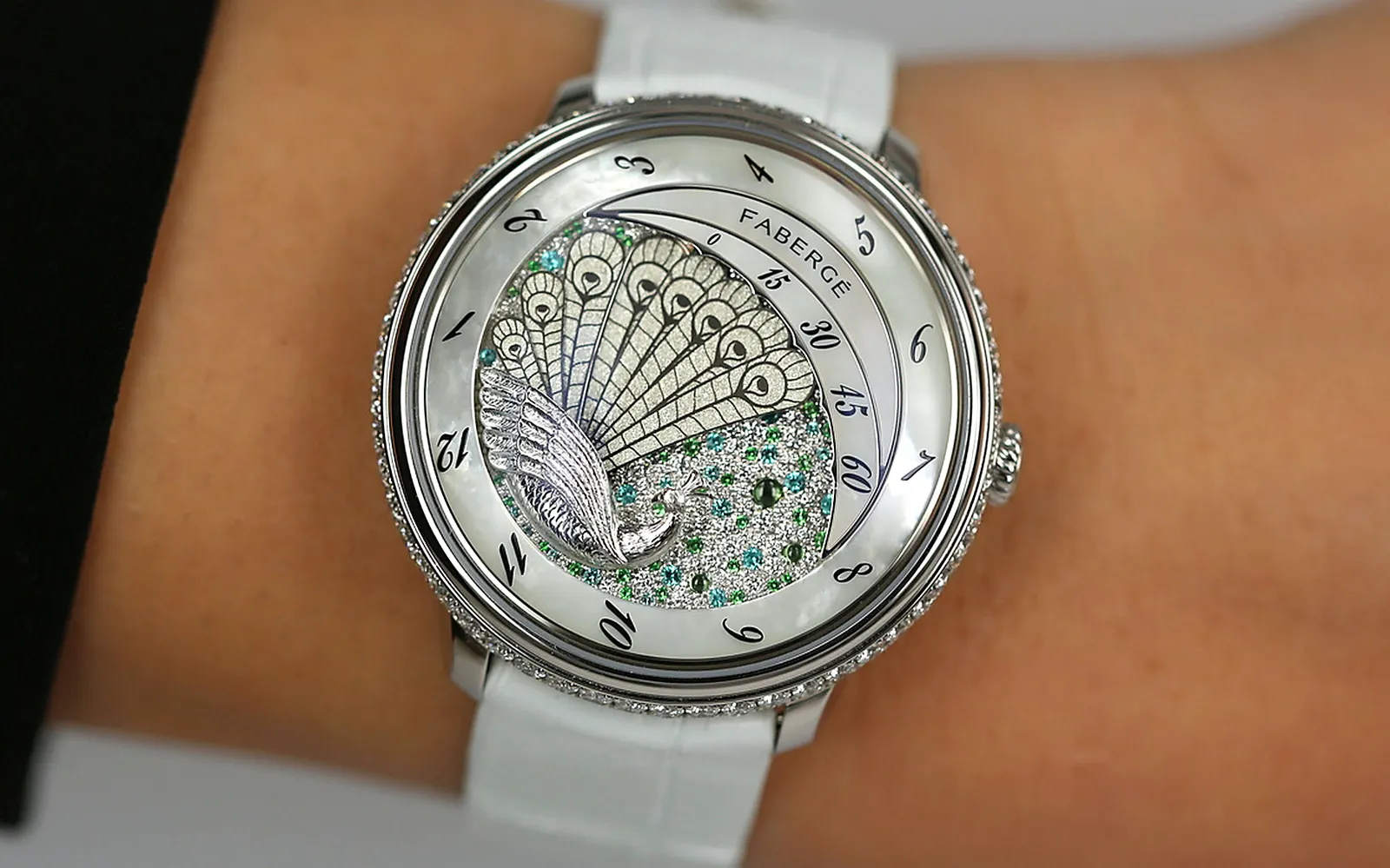
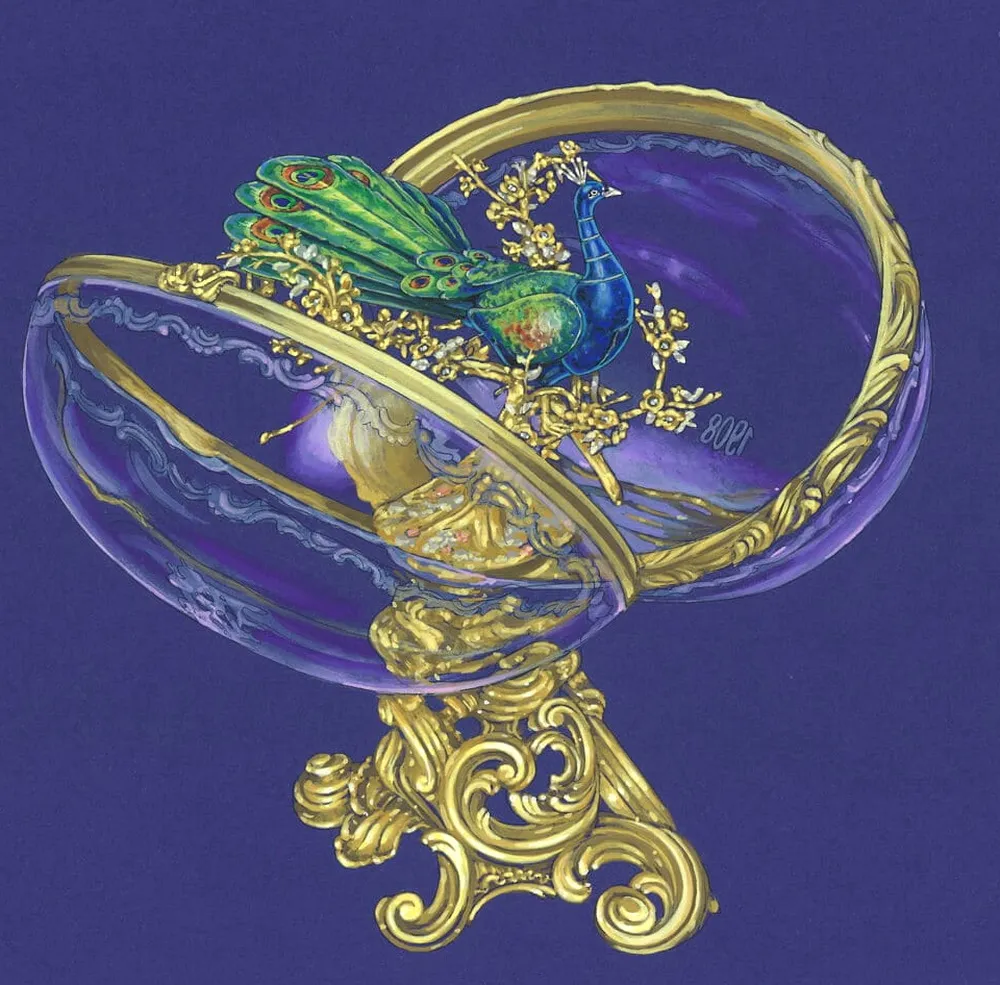
In the spring of 1908, as the freezing winter of St Petersburg gave way to the breaking ice of the Neva, a carriage drew up in the courtyard of the Winter Palace. The guards of Tsar Nicholas II received with due reverence the velvet box that had come from the famous workshop at 24 Bolshaya Morskaya Street. Inside it lay a miracle of craft, offered as an Easter gift to the Tsar’s mother, the Dowager Empress Maria Feodorovna: the 1908 Imperial Peacock Egg.
Maria Feodorovna was passionately attached to the immense eighteenth-century Peacock Clock she had admired in the Winter Palace. It was the work of the English goldsmith James Cox, a present from Potemkin to Catherine the Great, and it is today the most magnificent automaton in the Hermitage. Peter Carl Fabergé knew about that passion and gave his master automaton maker Dorofeiev a task close to impossible: to fit a spectacle built on the scale of a state room into the palm of a hand. Dorofeiev worked for three full years on the bird itself and on its prototypes. The measure of a craft is not how large it can build but how far it can shrink the same thing.
The outer shell of the egg was carved from a single piece of transparent rock crystal and bound with gilded silver wire. Opened at the clasp on top, it fell into two halves, each framed by a mount in the Rococo style. Inside stood a tree of engraved gold whose flowers were made of enamel and precious stones, and on its branches perched a mechanical peacock of gold and enamel, a hundred and ten millimetres long.
The working principle of the automaton was hidden here: the mechanism was not in the tree but inside the bird’s own body. The peacock is lifted from the branches and wound, and when it is set on a flat surface it begins to strut with a proud air, moves its head and spreads and closes its enamelled tail like a fan. In a year without electricity and without digital microscopes, made with nothing but loupes, hand files and a watchmaker’s lathe.
In the century since, empires have fallen, maps have changed and the egg has changed hands. In 1927 the Soviet state’s Antikvariat sold it, along with nine other Imperial eggs, to Wartski in London; in 1949 the Swiss Dr Maurice Sandoz bought it, and in 1955 it was given to the Édouard and Maurice Sandoz Foundation in Lausanne. A Russian Easter present now stands in the vitrine of a Swiss foundation.
When Fabergé wanted to carry the magic of that 1908 automaton onto a wrist, it went to the most contrary movement architect in independent watchmaking: Jean-Marc Wiederrecht, founder of the Agenhor atelier in Geneva. The calibre and the complication were developed from scratch for this watch and for Fabergé alone, and they carry two separate patent applications.
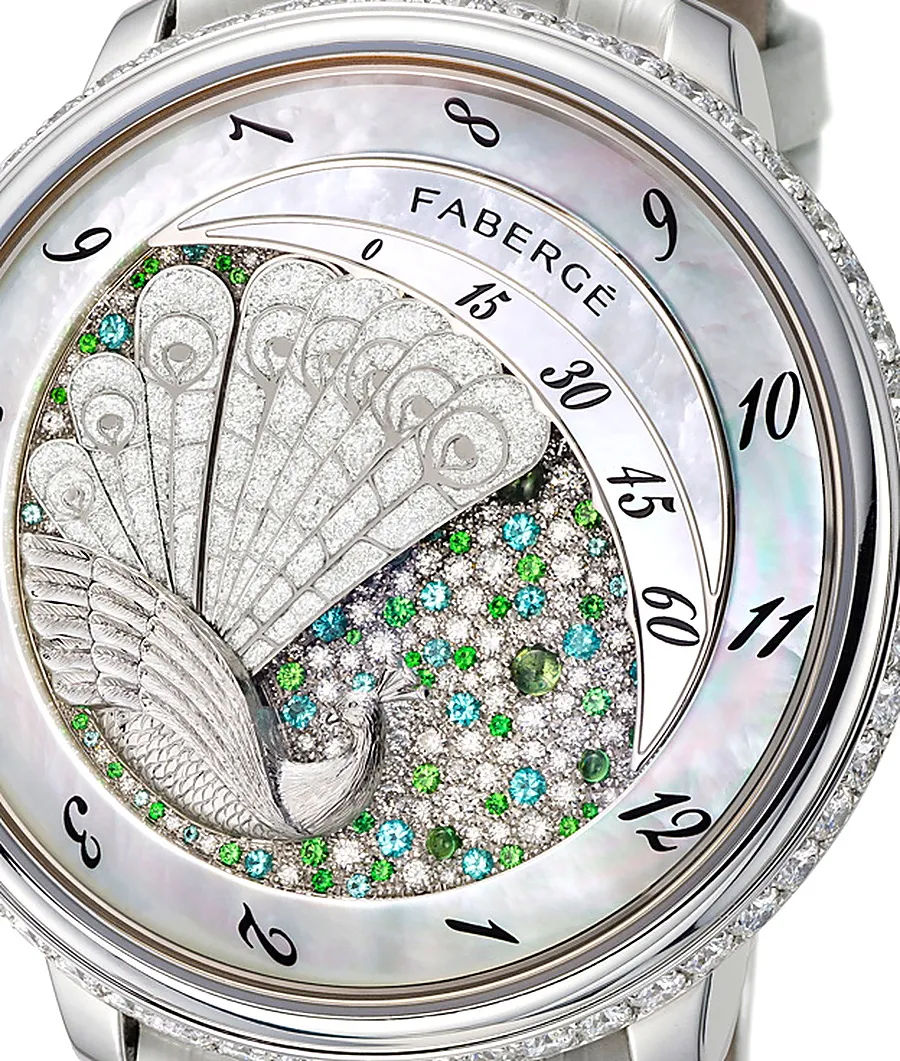
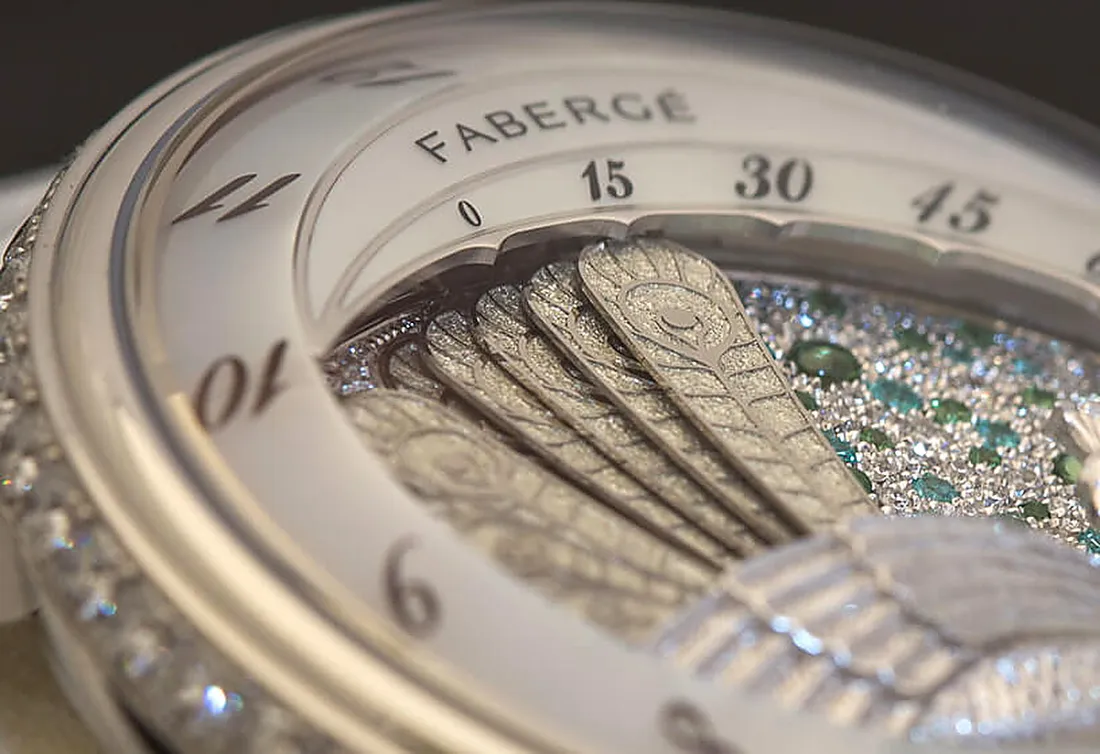
Wiederrecht threw out the received wisdom of hour and minute hands entirely. There is no conventional minute hand on the dial; the minutes are shown by the opening tail of a hand-carved peacock sitting in the lower left corner. And here is the hard part: each of the four feathers that make up the tail moves at the same moment, but each at a different speed. Imitating the opening of a fan is easy; doing it at four different speeds, all tied to a single mainspring, is another matter.
When the minute reaches sixty, the feathers close in perfect agreement within a fraction of a second and the tail returns to zero. That retrograde leap is the most dramatic moment on the dial, and it happens once an hour.
The hour function has been removed from the centre altogether. The hours are written on a mother-of-pearl band turning around the outer edge of the dial, and that band turns counterclockwise; the time is read from the numeral standing in line with the winding crown at three o’clock. The band is connected directly to the mainspring barrel, because there is no other way to turn a mass that wide smoothly and without a jolt. And the opening of the feathers depends on the turning of that band: as the hour advances, the tail unfurls. To show time with a hand gives you information; to show it with the opening of a tail obliges you to watch.
format_quote"The measure of a craft is not how large it can build but how far it can shrink the same thing."
Hasan Bekmezci
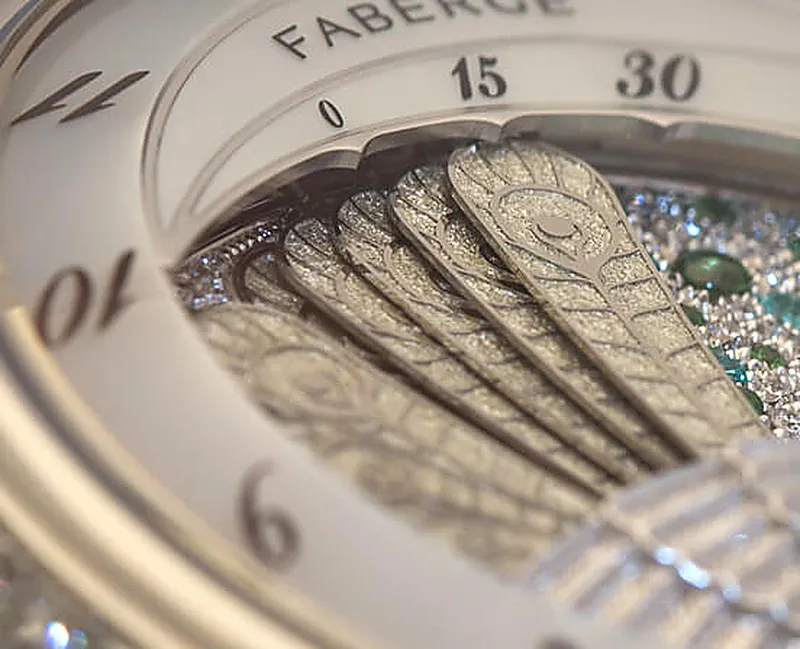
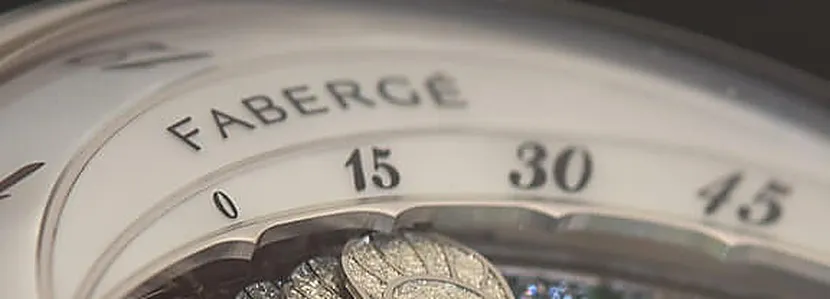
This mechanical theatre sits inside a jewelled case, and that case is at least as talkative as the movement.
The case is thirty-eight millimetres across, in platinum. Fifty-four brilliant-cut diamonds are set into the bezel, one point eight three carats in all. The dial is eighteen-carat gold and carries three separate families of stone: a hundred and twenty-seven brilliant-cut diamonds, thirty-one Paraiba tourmalines and fifty-seven tsavorites. Which is to say that the sea of green and turquoise at the peacock’s feet is not paint or enamel but stones set one by one. The most honest way of imitating the colour in a bird’s feathers is to carry that colour.
The crystal is domed; looking at the dial gives you the sense of holding a pebble, because the dome both magnifies and softens. The caseback is sapphire, and every finish on the hand-wound calibre is left in plain sight.
That synthesis found its answer in Geneva in 2015: the Lady Compliquée Peacock won the Ladies’ High-Mech prize at the Grand Prix d’Horlogerie de Genève, watchmaking’s most prestigious ceremony. For a jewellery house to take a mechanical prize means that house has been weighed as a watchmaker and not only as a jeweller.
format_quote"To show time with a hand gives you information; to show it with the opening of a tail obliges you to watch."
Hasan Bekmezci
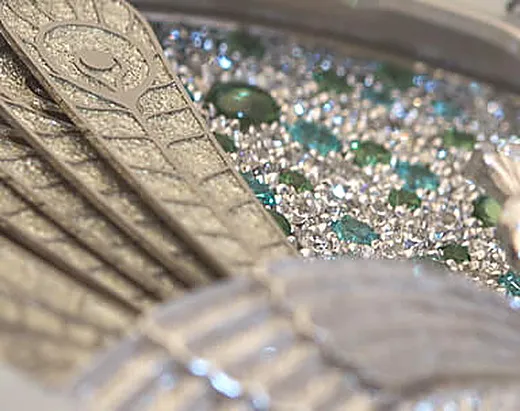
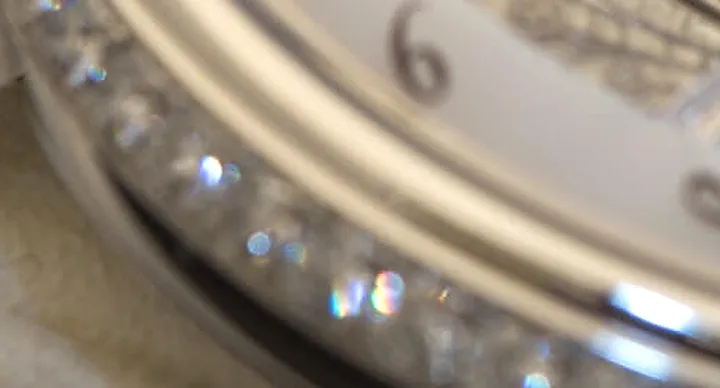
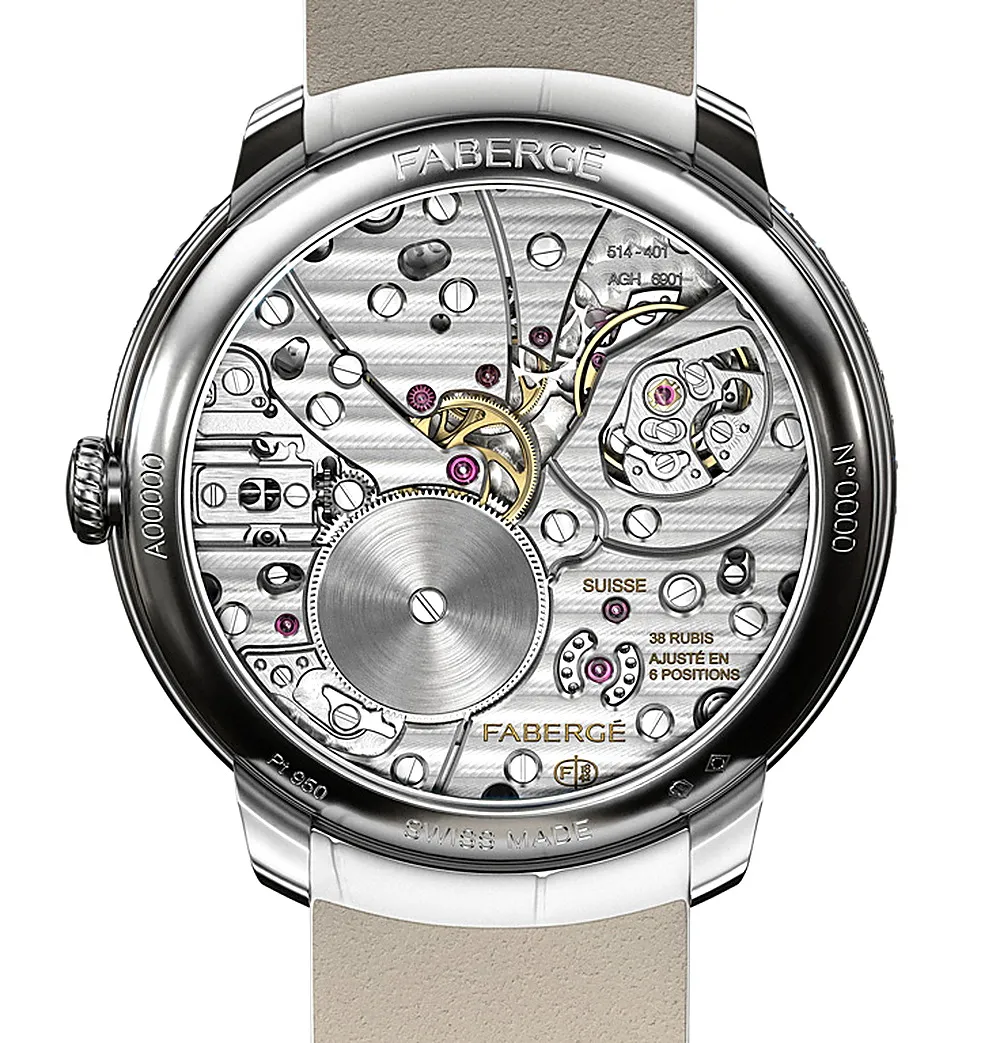
The Lady Compliquée Peacock is the last link in a line running from the automaton Peter Carl Fabergé hid inside an egg in 1908 to the modern gear geometry of Jean-Marc Wiederrecht.
And although a century separates the two works, both do the same thing: they take looking at the time out of the realm of necessity and turn it into watching a performance that opens itself again every hour.
format_quote"For a jewellery house to take a mechanical prize means that house has been weighed as a watchmaker and not only as a jeweller."
Hasan Bekmezci