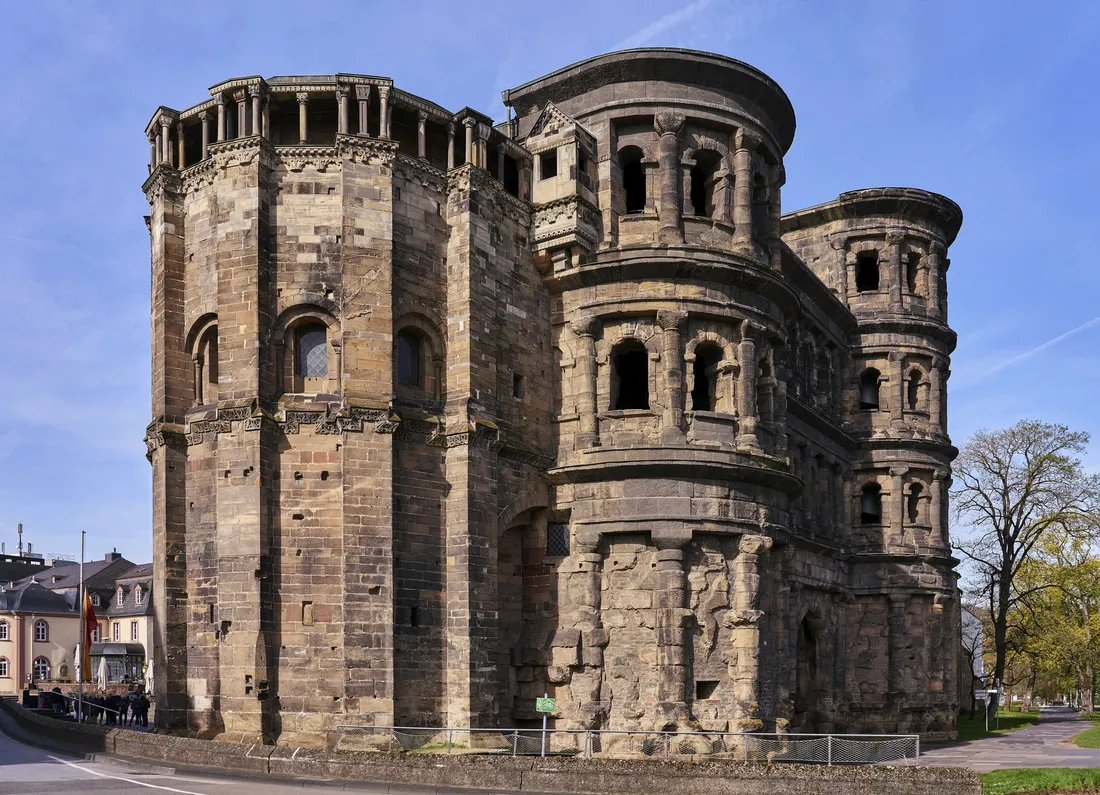
On a damp and misty late afternoon in Trier two German intellectuals stood side by side: the old Roman historian Professor Wilhelm von Berg, and the novelist Maximilian Roth, working out the closing scenes of his last book. In front of them rose the black giant that has watched empires rise and fall in silence since the year 170: the Porta Nigra. That heavy, consecrated city gate Rome built without a single drop of mortar, binding sandstone blocks weighing tonnes to one another with nothing but iron clamps.
Wilhelm leaned on his stick and looked at the blocks, darkened by centuries of soot and rain. “Rome,” he said in a low but carrying voice, “believed it could crush time under the sheer mass of these stones, Maximilian. It looked for continuity in weight.”
“And those clamps are gone,” he added. “The irons, bedded in lead, were prised out one by one in the Middle Ages, melted down and sold. Those holes are what is left of them. This gate stands without the binder that was supposed to hold it up.”
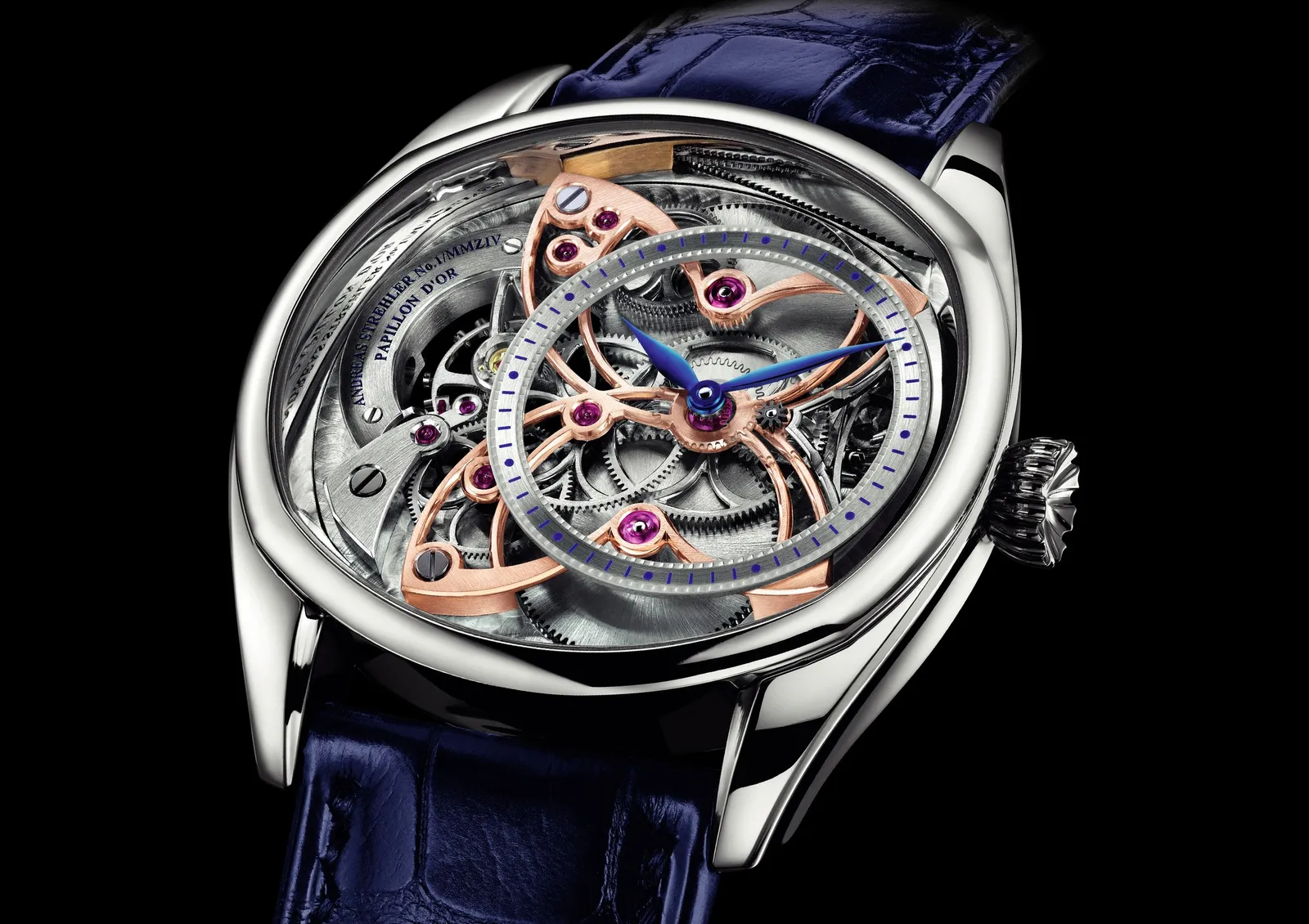
Maximilian pulled back his sleeve and uncovered the object on his wrist. Beneath the domed sapphire crystal a marvel of micro-engineering glinted in silver: an Andreas Strehler, the Papillon d’Or.
The novelist summarised, in his own words, the thought Thomas Mann built around time in The Magic Mountain: that time, which we believe we are measuring, exists in truth only as a current inside the mind, and that the monuments we raise to hold it are largely an attempt to carve our own mortality into stone.
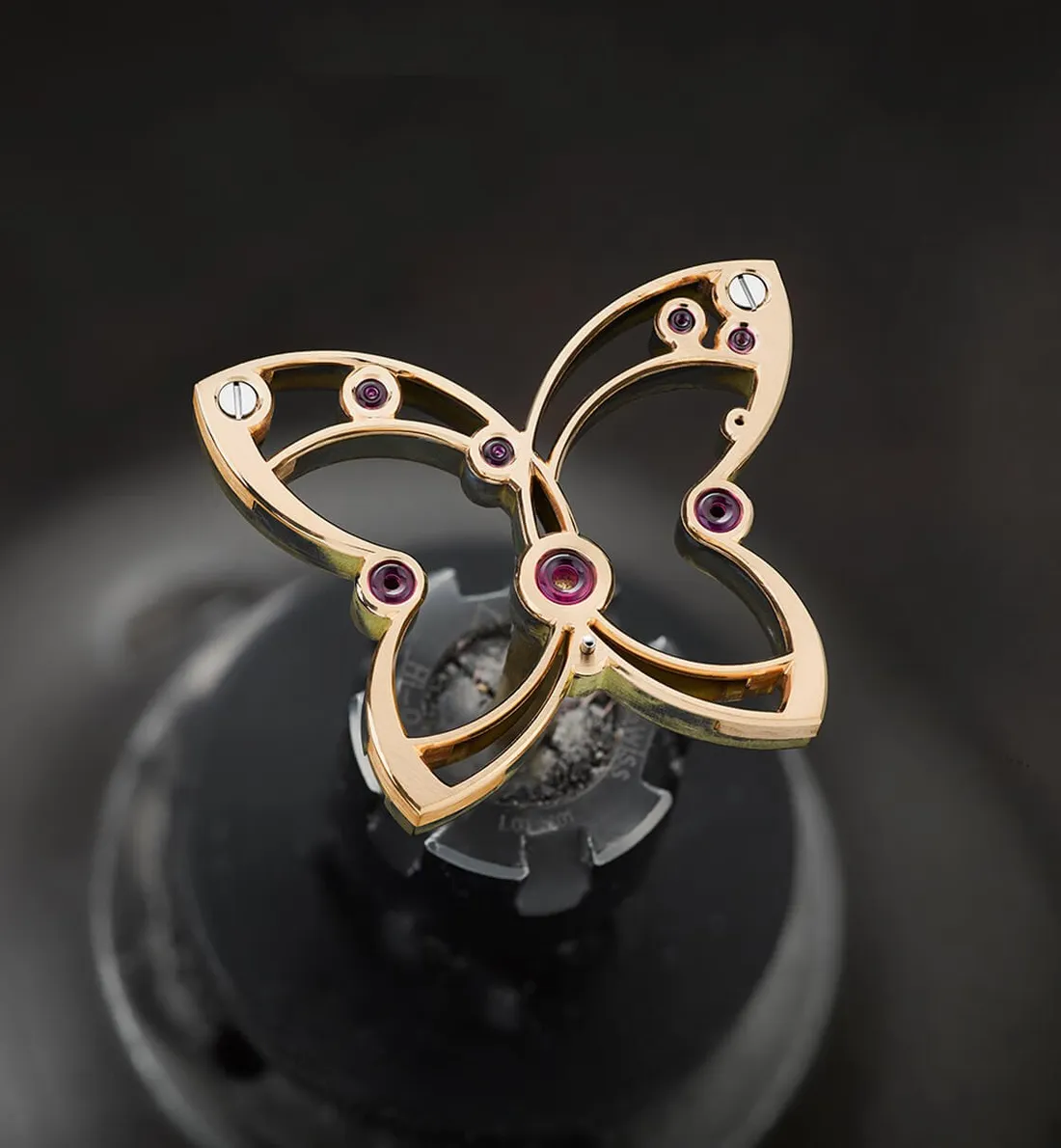
“Look, Wilhelm,” Maximilian went on, pointing at the butterfly-shaped bridge. “Rome tried to imprison time in stone; Strehler has laid it completely open. There is no dial covering the movement on this watch, only a slender ring suspended in the middle. Above and below that ring you look straight at the wheels, the barrels, the gearing.”
“And what is the ring standing on?”
“On the butterfly. Those solid gold wings are not ornament; they are the bridge of the movement, the load-bearing part that holds the wheels in place. The same piece carries the gear train and holds the dial ring in the air. Rome bound its blocks with iron clamps and those clamps were invisible. Strehler has taken the binder and put it in the most visible place on the watch. Every outer contour of it is bevelled by hand and polished to a mirror.”
Wilhelm brought his eye close to this architecture on a microscopic scale. Fine blue lines were printed around the dial ring; at the centre stood two steel hands turned blue by heat.
“From a distance I took them for rotating discs,” he said.
“Everyone does,” said Maximilian. “Because two large transparent wheels turn under the butterfly, and since you can see through them they look like discs. But they are not discs; they are gear wheels made of sapphire crystal. On the hardness scale sapphire comes immediately after diamond, so its teeth are not cut but ground away, and a mistake cannot be undone. Turning a wheel of glass is harder than polishing a bridge of gold.”
“Why glass?”
“So that you can see. A gear wheel normally hides whatever is beneath it. In sapphire it hides nothing.”
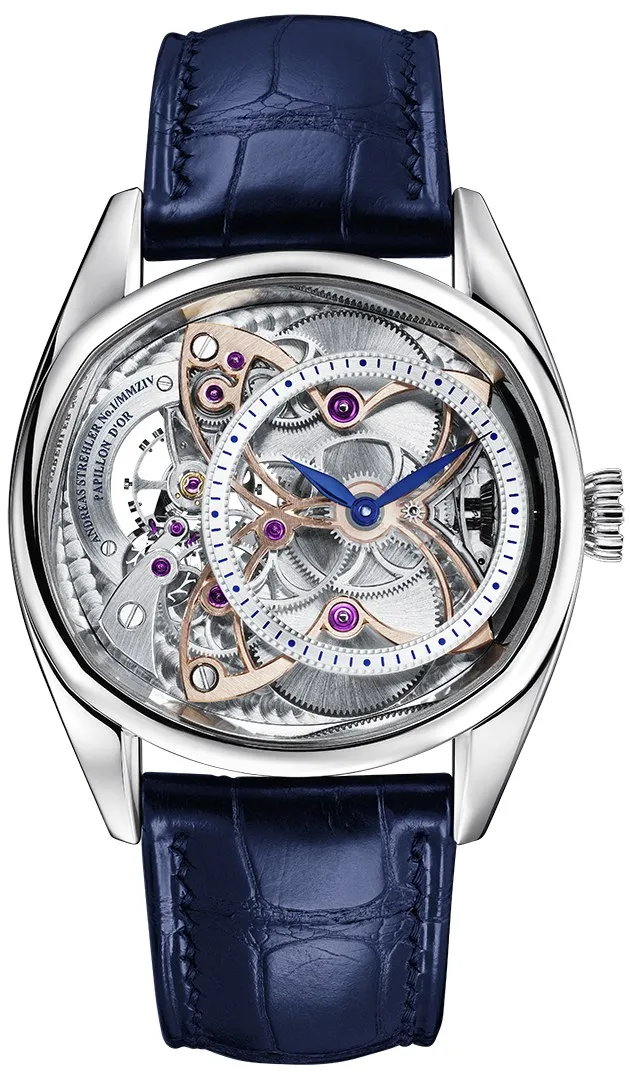
“And the blue of those hands,” said Wilhelm. “Is it painted?”
“No, heated. At around three hundred degrees a transparent oxide film a few hundred nanometres thick forms on the surface of the steel. Light reflects both off the top of that film and off the metal underneath, the two reflections interfere, and a colour appears according to the thickness of the layer. First straw yellow, then violet, then that midnight blue.”
“That reminds me of something.”
“It should. The most striking colours on a butterfly’s wing work the same way. The metallic blue of the Morpho is not a pigment; it comes from microscopic ridges on the scale, spaced about two hundred nanometres apart. A hundred-year-old Morpho in a museum drawer is still the blue of its first day, because it has no dye to lose. So the butterfly here is not a play on words, Wilhelm: the blue in the wing and the blue in the hand obey the same optical law. In both, the colour is not in the substance but hidden in the thickness of a layer, and both refuse to fade for the same reason.”

“Extraordinary,” the historian murmured. “Empires fall from loss of torque, Maximilian. As Rome grew, the power reaching the furthest province from the centre grew weaker. Is a mainspring not the same? Strong when fully wound, weak as it runs down.”
“Exactly so, and Strehler attacks the problem on two levels. First, instead of one barrel he fits two, connected in parallel; sharing the same load between two springs means each is stretched less, and the curve they deliver together is flatter. The seventy-eight hour reserve comes from that. And the house says the energy stored in the two barrels would in fact last considerably longer, which means the reserve is declared not by where the spring runs out but by where the power is still even.”
“And the second?”
“His own stopwork. The classical solution is the Maltese cross, but it moves in steps, so it disturbs the power delivered, and its bearing is fragile. In its place Strehler uses a ring with internal teeth running freely in an eccentric cut-out inside the barrel, and one long tooth on the arbor pinion acting as a blocking finger. The mechanism stops itself both before full winding and before full unwinding, and it does so with a continuous, very small friction rather than a sudden impact. The mainspring never reaches its extremes; it works only in the flattest middle of the curve.”
“I was expecting you to say constant force,” said Wilhelm.
“And here one must be honest. Strehler’s most talked-about invention is a constant force device called the remontoir d’égalité, which uncouples the escapement from the gear train completely: the energy is no longer governed by how full the mainspring is but by a small spring re-tensioned once every second. But that mechanism is in the Sauterelle, the Lune Exacte and the Trans-Axial Tourbillon. It is not in the Papillon d’Or. Here the same job is left to the double barrel and that stopwork working together.”
“Then what is this watch’s own signature?”
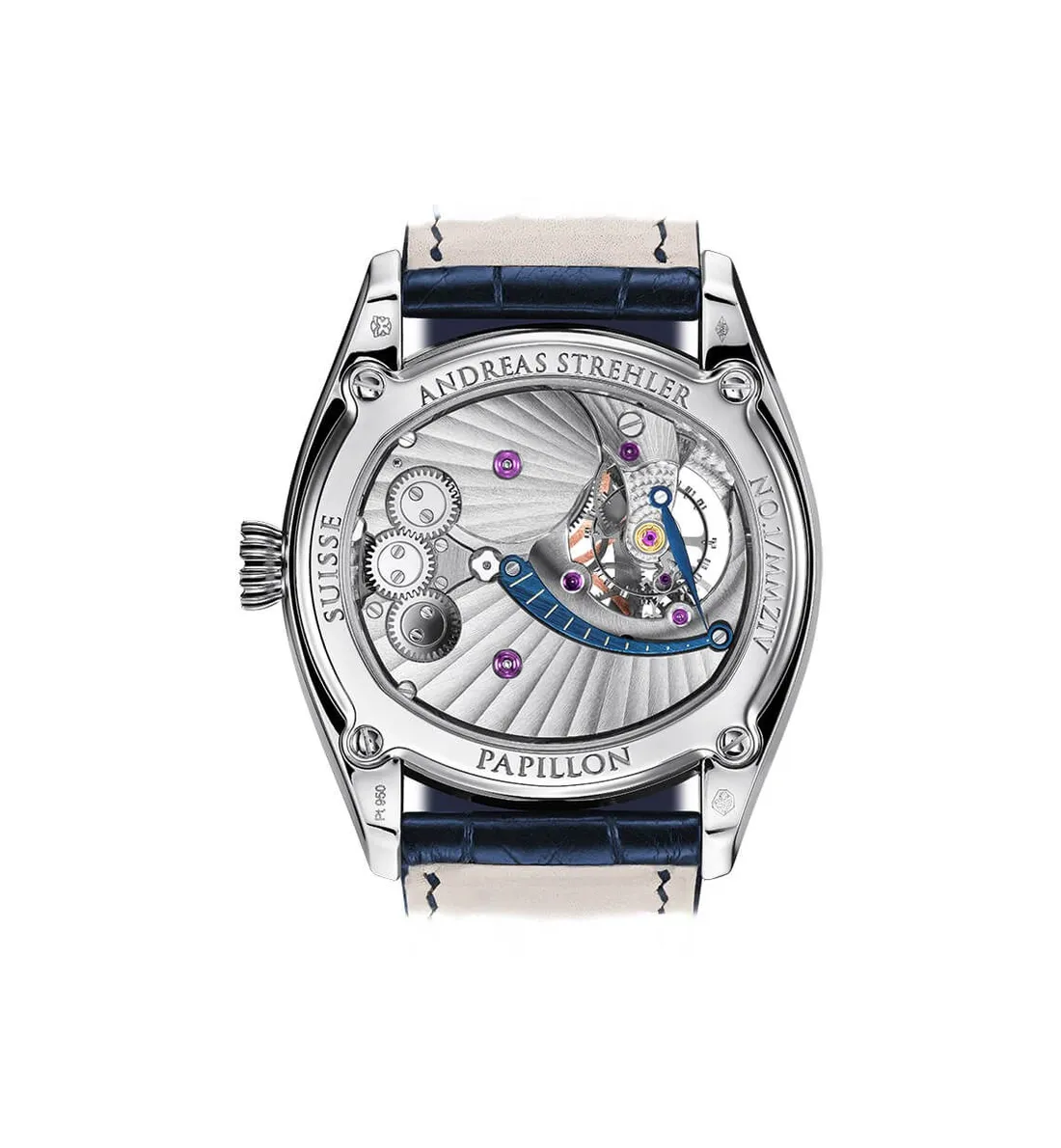
Maximilian turned it over. Above the radially grained movement lay a slender blue hand.
“The power reserve display. It looks ordinary from outside, but behind it works what is probably the smallest differential gear in the world. Like the differential on a car’s rear axle, it makes a third motion out of two. How much you have wound the spring and how much the watch has spent happen at the same time and in opposite directions; the differential takes the difference and hands it to the pointer as a single number. The one in a car fills your palm; this one is smaller than a lentil, and it is built with true conical gear wheels of Strehler’s own design.”
“Give me the numbers too,” said the historian.
“The case is forty-one millimetres wide, forty-seven point two long and ten thick, in 18 carat rose gold or platinum. The movement is tonneau-shaped: a hundred and sixty-two parts, twenty-seven jewels, three oscillations a second. Wound by hand; there is no automatic rotor, and if there were it would cover the butterfly.”
“And who is this man?”
“An independent watchmaker working in a town called Sirnach in the canton of Thurgau. An apprenticeship in Frauenfeld, the watchmaking school in Solothurn, then four years at Renaud et Papi as head prototypist. Then his own workshop. He has developed movements for Chronoswiss, H. Moser & Cie, Maurice Lacroix and Harry Winston, so he is inside a great many watches that do not carry his name. The most precise moon indication ever fitted to a wristwatch is also his; its deviation is one day in two million years.”

In the massive shadow of the Porta Nigra, Rome’s petrified past stood face to face with Strehler’s living micro-architecture. One a frozen heap of stone trying to suppress time; the other a micro-mechanical poem displaying the bones and muscles of time on the wings of a golden butterfly.
Handing the watch back, Wilhelm said his last word: “Rome hid the binder inside the wall and it was prised out at the first opportunity. This man has set the binder in plain sight. To remove it now would be to destroy the thing you came to look at.”

format_quote"Rome hid the binder inside the wall and it was prised out at the first opportunity. Strehler set the binder in plain sight; to remove it now would be to destroy the thing you came to look at."
Hasan Bekmezci