format_quote"The divine alliance of the greatest and the smallest: the dance of plasma in the highest layer of the sky and the microscopic creatures in the pitch darkness of the ocean. With this art of enamel imprisoned inside cells of gold, Patek Philippe offers us not merely the time, but that immense station of contemplation within the universe."
Hasan Bekmezci
On the bridge of a red-hulled icebreaking research vessel pushing through a stormy polar sea, a mesmerising veil of green and violet light was rippling in defiance of the pitch darkness outside. On the wooden table beside the window stood a Patek Philippe Dome Table Clock, an object generally taken to be the summit of Swiss high horology.
The ship’s senior astrophysicist, Dr Aksel, and the marine biologist Dr Selim held steaming mugs of coffee and looked in turn at the Grand Feu cloisonné enamel on the clock and at the divine order behind the glass.
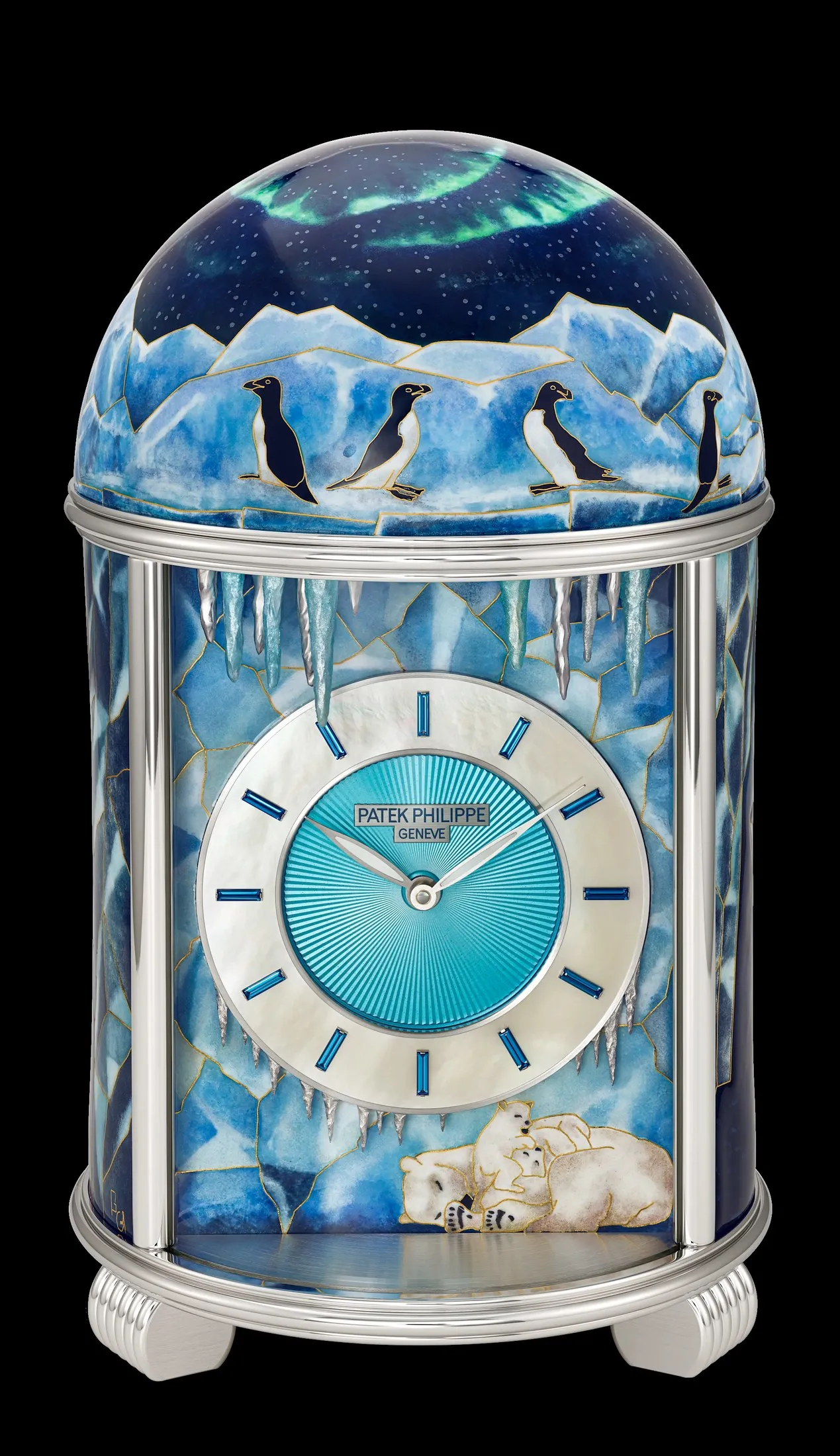
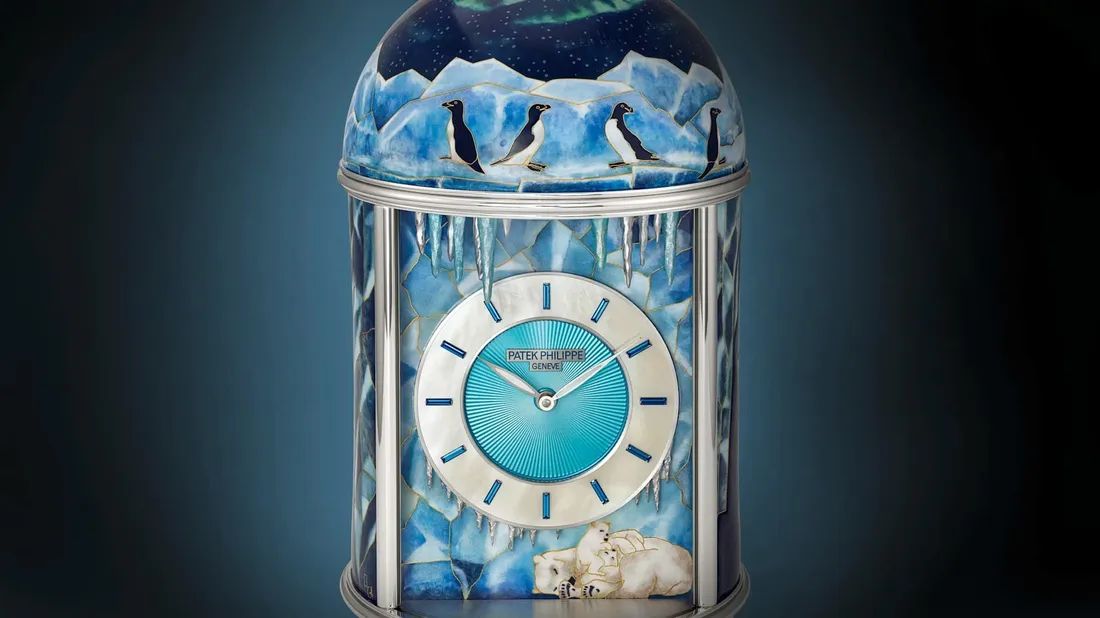
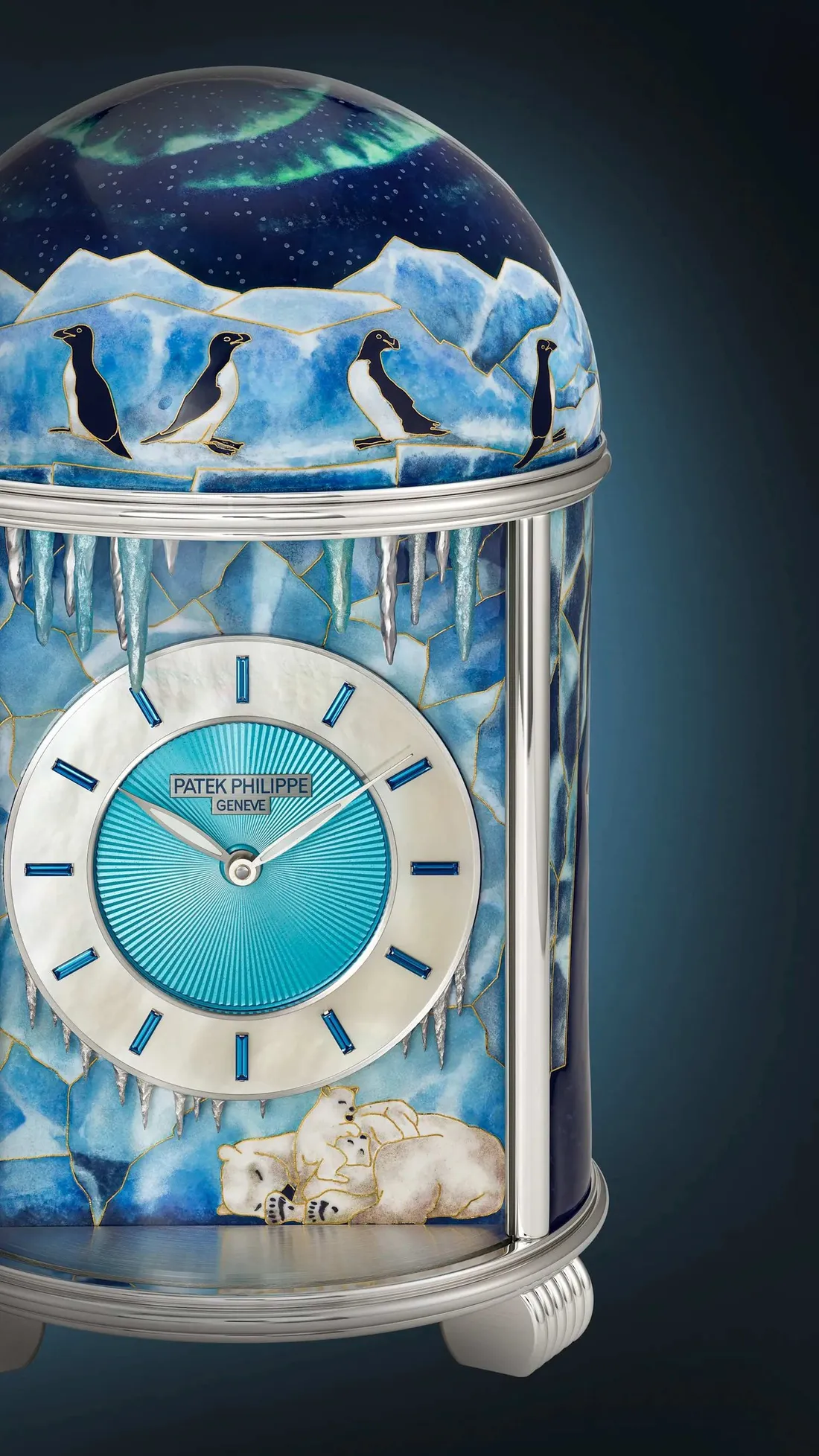
The clock’s identity card was short, and as heavy as it was short. Reference 20212M-001, named “Fauna on the ice floe”, production run: one. A unique piece. A silver dome twenty-one and a half centimetres tall and thirteen wide, with a heart inside it that turns on its own for a year at a time.
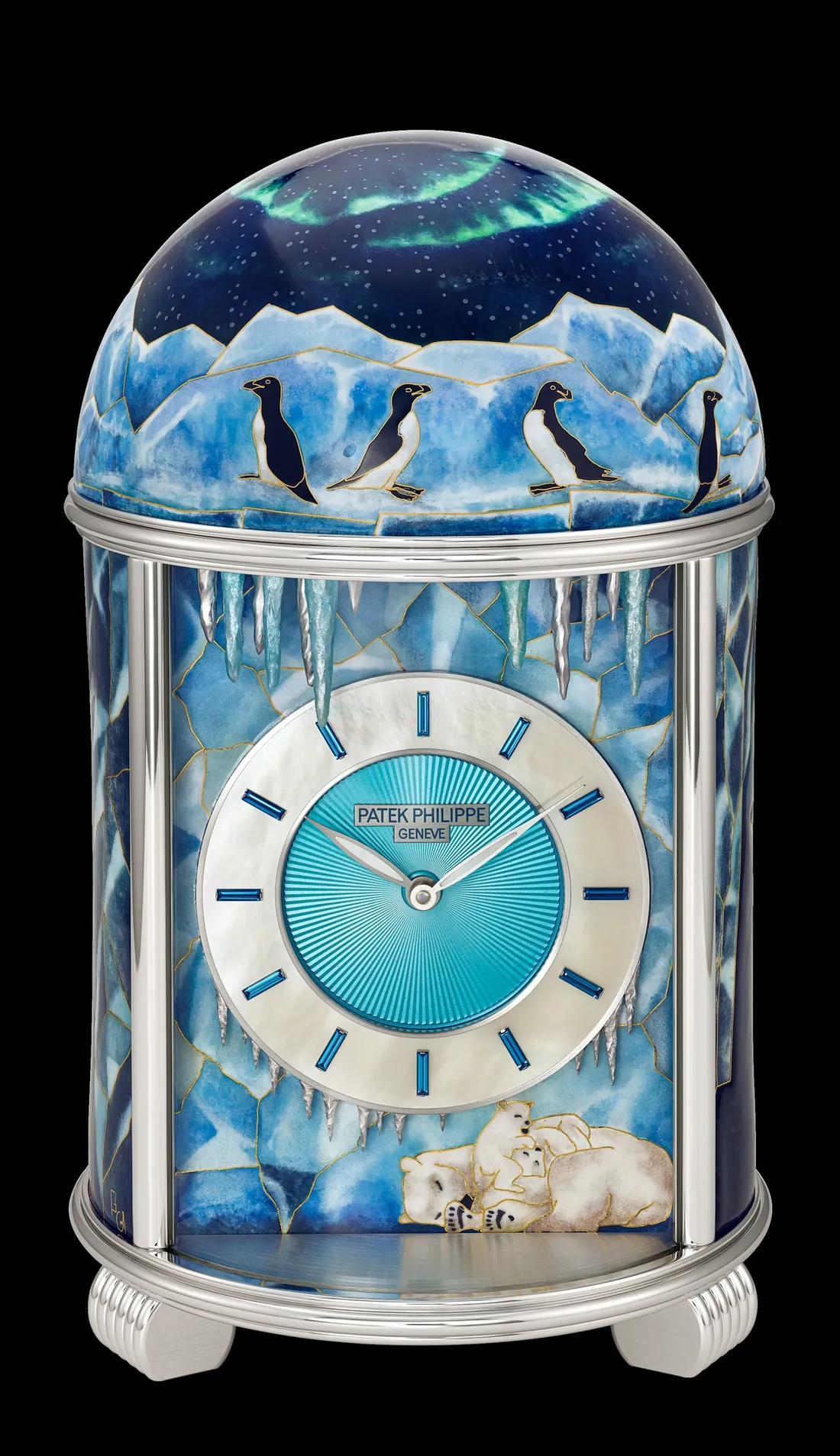
“Aksel, look at the enamelling up there, curling like a green veil,” said Selim. “It is as though the sky were burning behind the glass. How can anyone see this aurora borealis and not be brought to a state of wonder?”
Aksel took a sip of his coffee and smiled.
“That festival of light you are watching is an immense duel between the Sun and the Earth’s magnetic shield, Selim. Charged electrons and protons torn off the Sun are flung towards us at something like four hundred kilometres a second, which is more than a million and a half kilometres an hour. On stormy days that speed doubles. Without the magnetosphere our atmosphere would be scorched away. But our planet’s magnetic field deflects those particles towards the poles.”
“Deflects them how?”
“Think of opening an umbrella in a hailstorm. The umbrella does not destroy the hail; it simply moves it to the edges, and you stay dry. The magnetosphere does not destroy either, it moves things to the edge. And the edge is the poles.”
“Why exactly towards the poles?”
“Because that is where the field lines come down vertically. A charged particle cannot cut freely across a magnetic field line; it is obliged to spiral along it. Picture a bead threaded onto a wire: the bead can slide back and forth along the wire but it cannot leave it. Particles behave the same way. At the equator the lines run parallel to the ground, so the particle cannot get down into the atmosphere; at the pole the line dives straight down, and that wire carries the particle all the way in. This is why the light does not appear everywhere on Earth but forms a crown, a ring, around each pole.”
Selim was quiet for a while, then added in a lower voice:
“There is a phrase in the holy book, in the word of the Creator, Aksel: that the sky was made a guarded canopy. For years I took that sentence for a figure of speech. Now I am watching, through this glass, the light that canopy gives off while defending itself. It seems the roof really is there; we can only see it at the moment it is struck.”
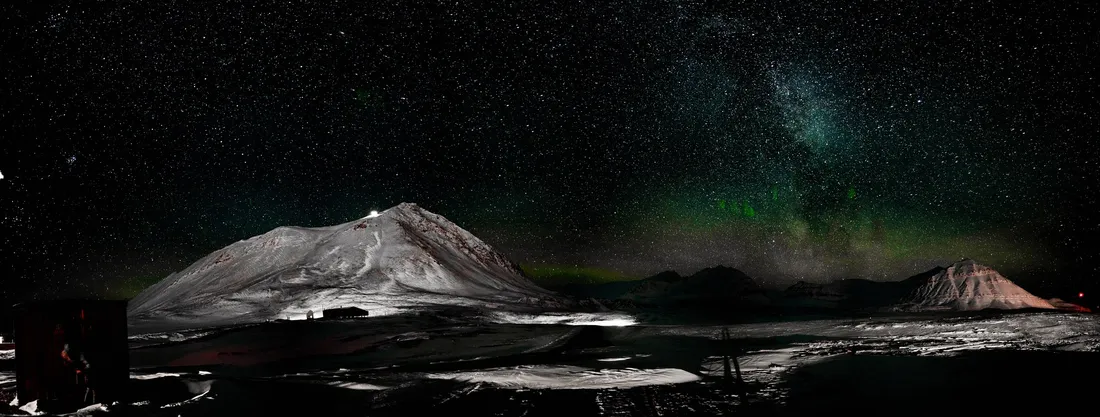
“And what decides the colour?” asked Selim, looking at the green ribbons on the dome.
“Two things: which atom is struck, and at what altitude. Between one hundred and three hundred kilometres, atomic oxygen gives you that famous green. Higher up, between two hundred and four hundred kilometres, it is oxygen again, but this time it glows deep red. The violets and blues come from nitrogen. So we owe the red not to nitrogen but to oxygen in its high-altitude state.”
“The same atom gives two different colours?”
“Yes, and the reason is beautifully delicate. When an oxygen atom is excited by a collision it does not glow at once; to produce the green it must wait about three quarters of a second. Think of a bell that rings late: you strike it, but the sound only comes out after nearly a second. And if something knocks into you in the meantime, the bell never rings at all. Low down, the air is dense, so the atom is hit by another particle before it can complete that three quarters of a second, and it gives up its energy silently. Only above a hundred kilometres does the air thin out enough for the atom to be left alone, and then the bell rings. The waiting time for red light is closer to two minutes, which is why you only ever see red at the very top, in something close to vacuum.”
“So the colour in the sky is not a matter of temperature but of patience.”
“Precisely. Or think of it this way: on a crowded ferry, if somebody tries to whisper something to you, the jostling cuts the sentence short. In an empty hall the same whisper is finished. High altitude is that empty hall.”
“And that tells us...”
“That the dance is not a random shimmer, it is the trace left by a shield doing its work. The light is not the shield itself; it is the proof that the shield is working.”
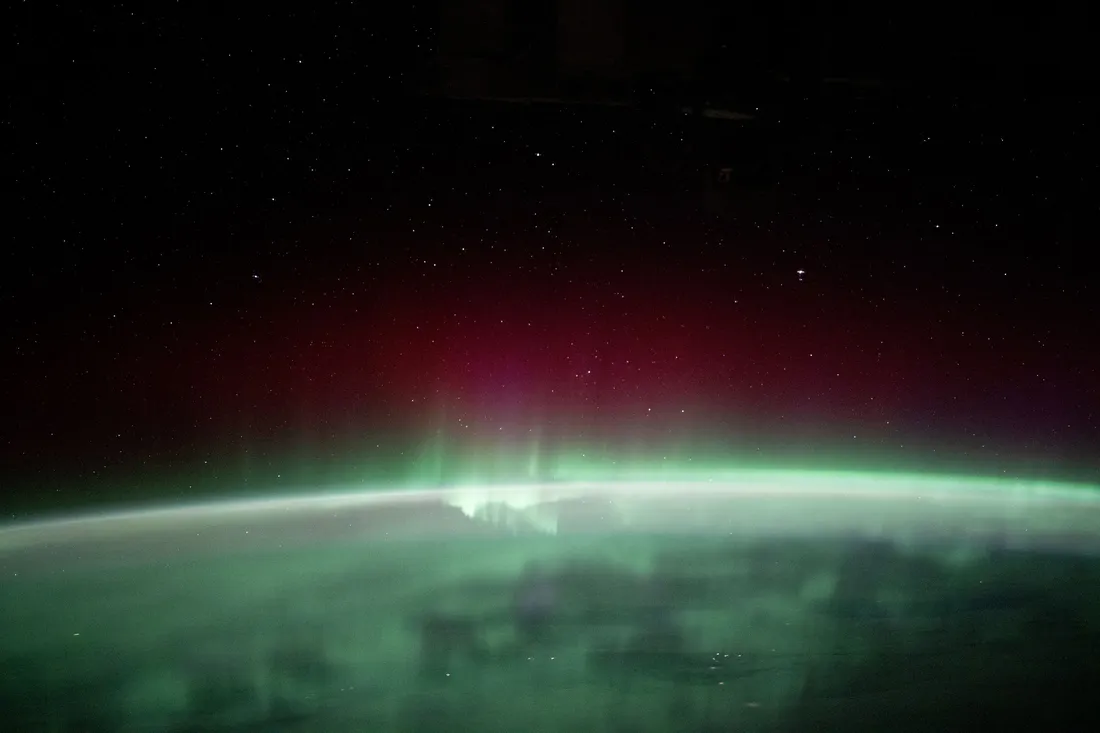
“Let me add one more thing,” said Aksel. “This light is not equally strong every night. The Sun has a breath of about eleven years; its spots multiply, its magnetic field tangles, and then it calms again. Near the peak, when a vast cloud of plasma is thrown off the Sun and strikes the Earth, the ring of light widens towards the equator and becomes visible from latitudes that would normally never see it.”
“How big can the biggest be?”
“In the storm of 1859 the light was seen as far south as the Caribbean, and telegraph lines threw sparks that day; some operators disconnected their batteries and worked their instruments on the current in the air alone. If the same event happened now it would test everything we have built, from power grids to satellites. So that lovely green curtain is also a warning lamp.”
Selim brought his finger close to the tiny green cells on the dome, separated by their threads of gold.
“Patek Philippe’s enameller bent that solid gold wire exactly the way the field lines bend, and paid his respects to this physics while firing the green enamel. But Aksel, look at the deep water in the lower part of the clock. Do you see how the largest plasma mechanism above joins the smallest biological particle below?”
The Whale Pump: The Ocean’s Invisible Lift
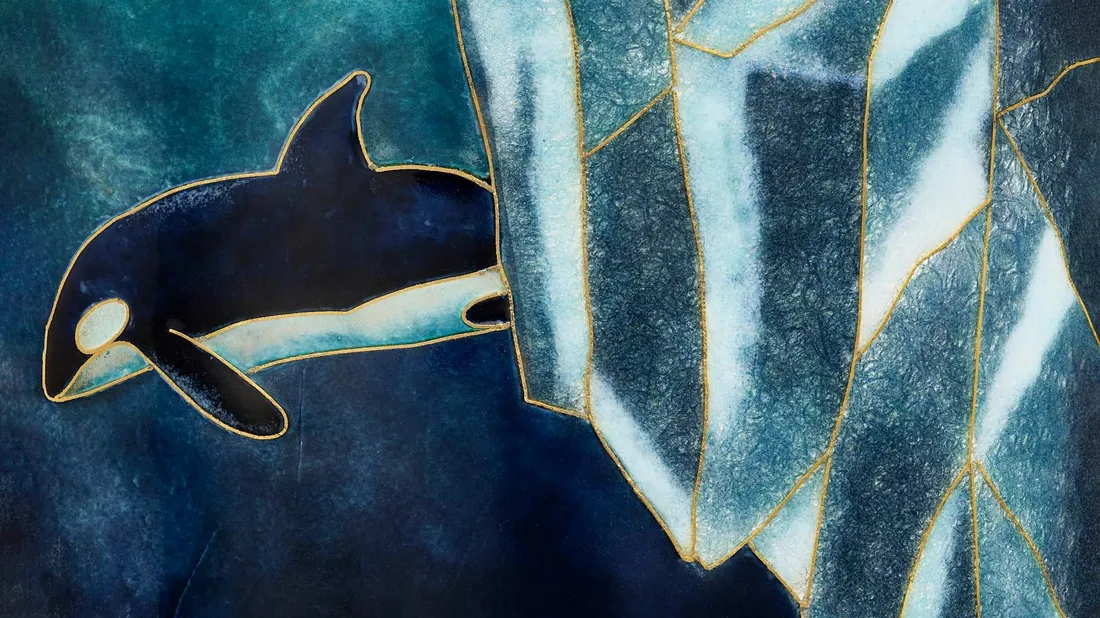
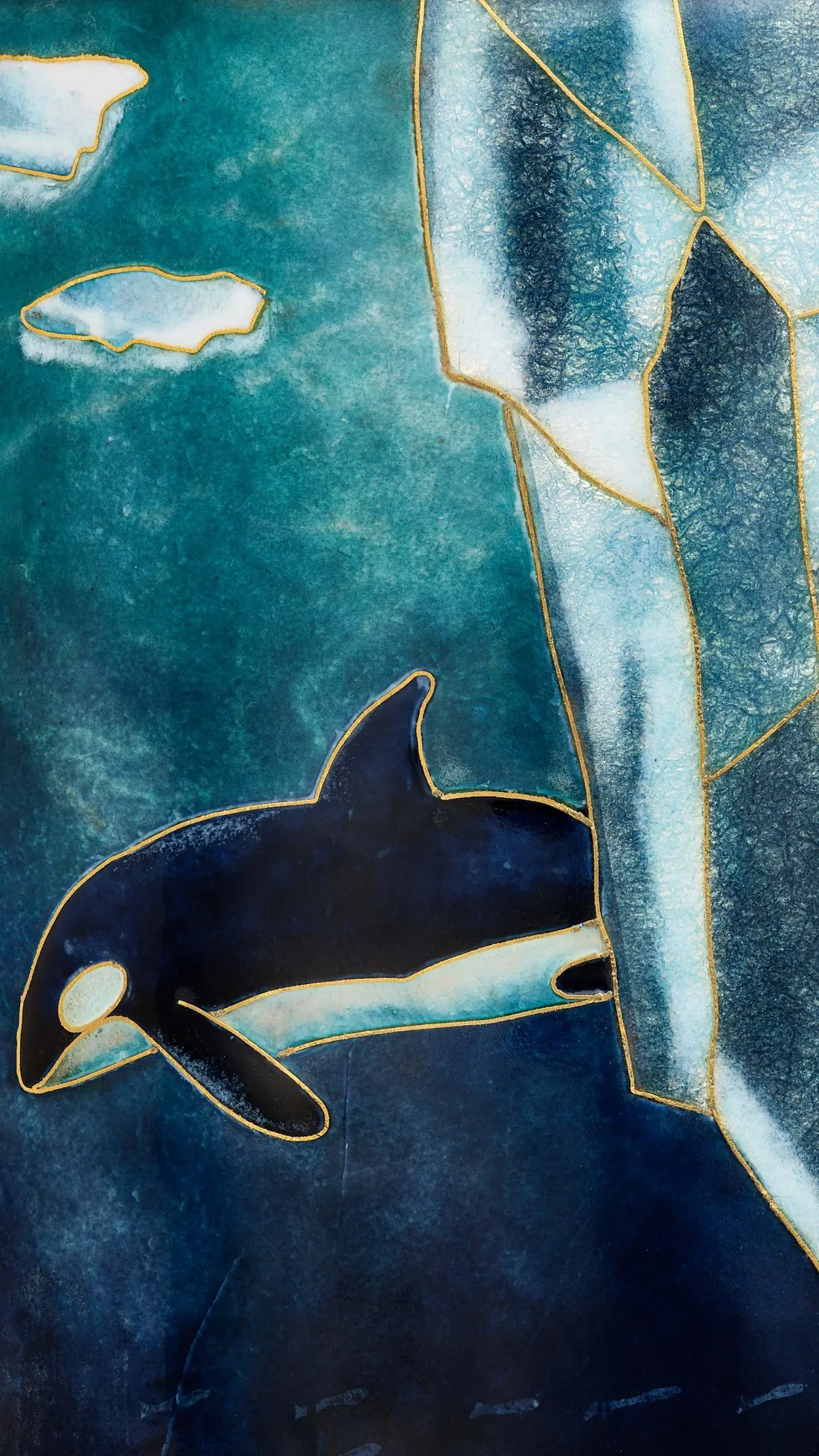
He pointed to the killer whales swimming in the deep blue beneath the icebergs on the back of the clock, and to the great whales at the surface.
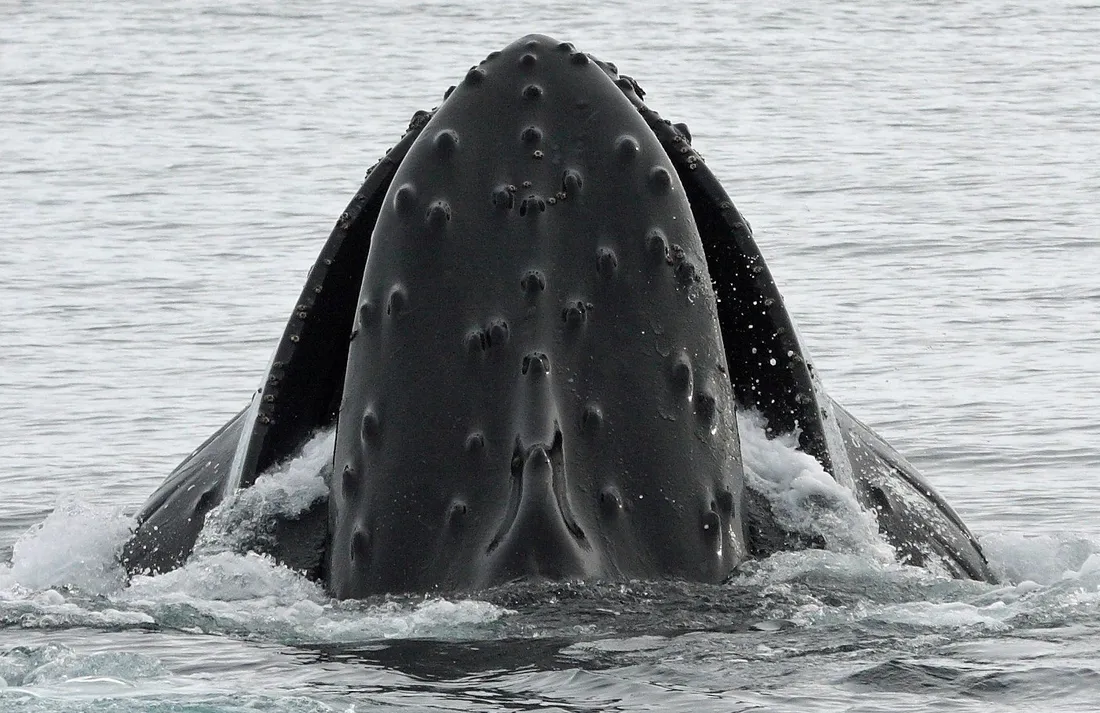
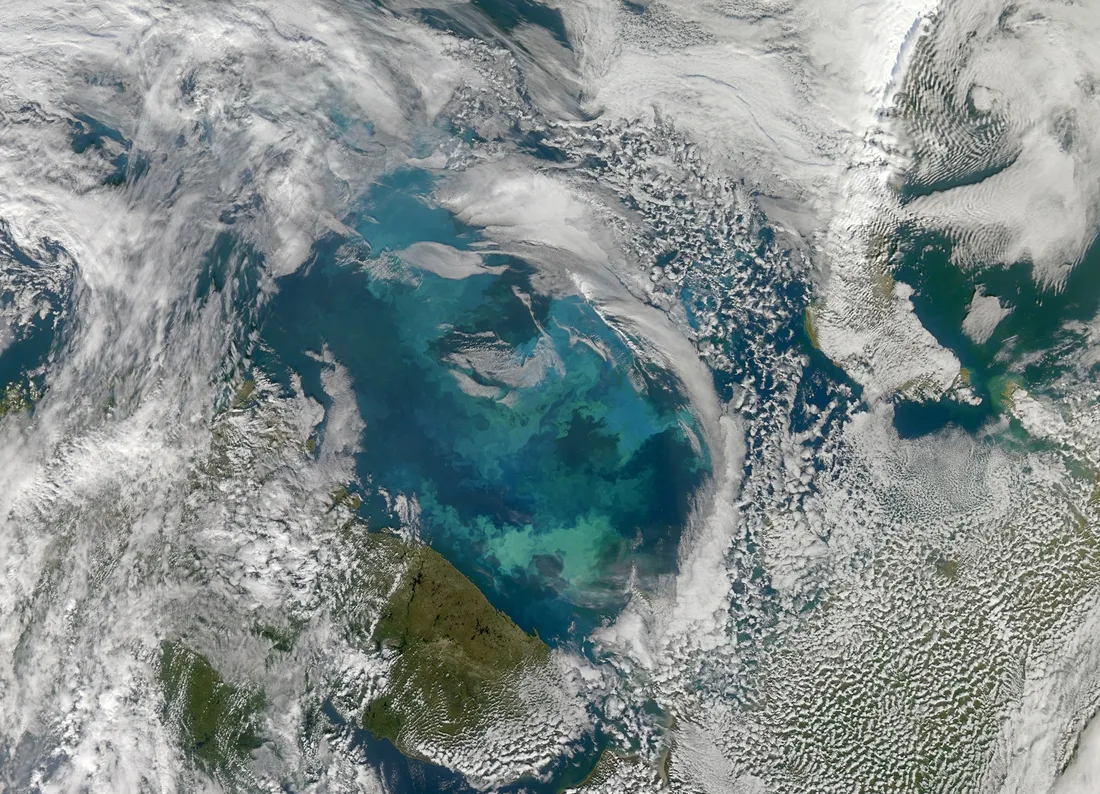
“Here is what truly drives me to contemplation: the staggering alliance of the largest and the smallest, the whale pump. Think of it, Aksel. An enormous whale weighing tonnes feeds in the darkness hundreds of metres below the surface and then comes up to breathe. When it surfaces it releases, through its excrement, the nitrogen and the iron of those deep waters, which are rich in minerals but starved of sunlight, into the upper layer where the light reaches. This biological fertilisation makes the phytoplankton, single-celled plants on a microscopic scale, explode into bloom.”
“Wait a moment,” said Aksel. “The ocean is already water. Why should it need fertiliser?”
“Because the ocean’s problem is not water, it is chemistry. A plant has to live at the surface, because light only reaches the first hundred metres. But nutrients fall. Every creature that dies, every particle of waste, sinks under gravity and takes the nitrogen, the phosphorus and the iron down with it. The upper layer of the ocean is therefore full of light but hungry; the lower layer is full of food but blind. Between them lies a permanent difference in density that acts like a lid and prevents mixing.”
“Like a library with no lift. The books are in the basement and the reading lamp is in the attic.”
“Exactly. Or picture a house whose kitchen is in the cellar and whose dining room is in the loft: both rooms fully equipped, and no staircase between them. The whale is that staircase. It eats below and empties above. What gravity takes down, the whale carries up. Science first measured this in 2010 on the whales of the Gulf of Maine, and what it found was this: the whales brought more nitrogen to the surface than all the rivers emptying into that gulf combined.”
“And why does iron matter so much?” asked Aksel. “I follow the nitrogen, but iron?”
“Because in the Southern Ocean the real bottleneck is iron. Nitrogen and phosphorus are abundant down there, and yet the water is clear and empty. Science calls such regions high-nutrient, low-chlorophyll waters. You have every part in front of you but one screw is missing, so the machine cannot be assembled. That screw is iron. And it is almost impossible for iron to reach those waters from land, because there is no land around them, only sea.”
“And the whale carries the screw.”
“It does. And something else needs saying: the pump we see today is the shadow of the real one. In the twentieth century industrial whaling took millions of whales out of the oceans; in some species the population fell by close to ninety-nine per cent. So by the time we discovered this cycle, we had already largely switched it off. Science often works this way: we learn what a system was for after we have broken it.”
“Like pulling a wheel out of a watch and only then working out what it did.”
“Just so. Sperm whales have been calculated to release tens of tonnes of iron a year into the Southern Ocean. Consider what that means: a whale eats a squid a thousand metres down, takes the iron in that squid’s tissue into its body, rises and releases it. An element locked in the darkness below is brought up into the light by the digestive system of a mammal.”
“And there is migration too, I imagine.”
“There is, and it is larger still. Whales feed at the poles and give birth in the tropics, so they move nutrients not only vertically but horizontally, across thousands of kilometres. It is called the great whale conveyor belt. And when they die their bodies sink; tonnes of carbon stay down there for centuries. A whale fall feeds an entire specialised community on the sea floor for decades. So a whale is a carrier both alive and dead.”
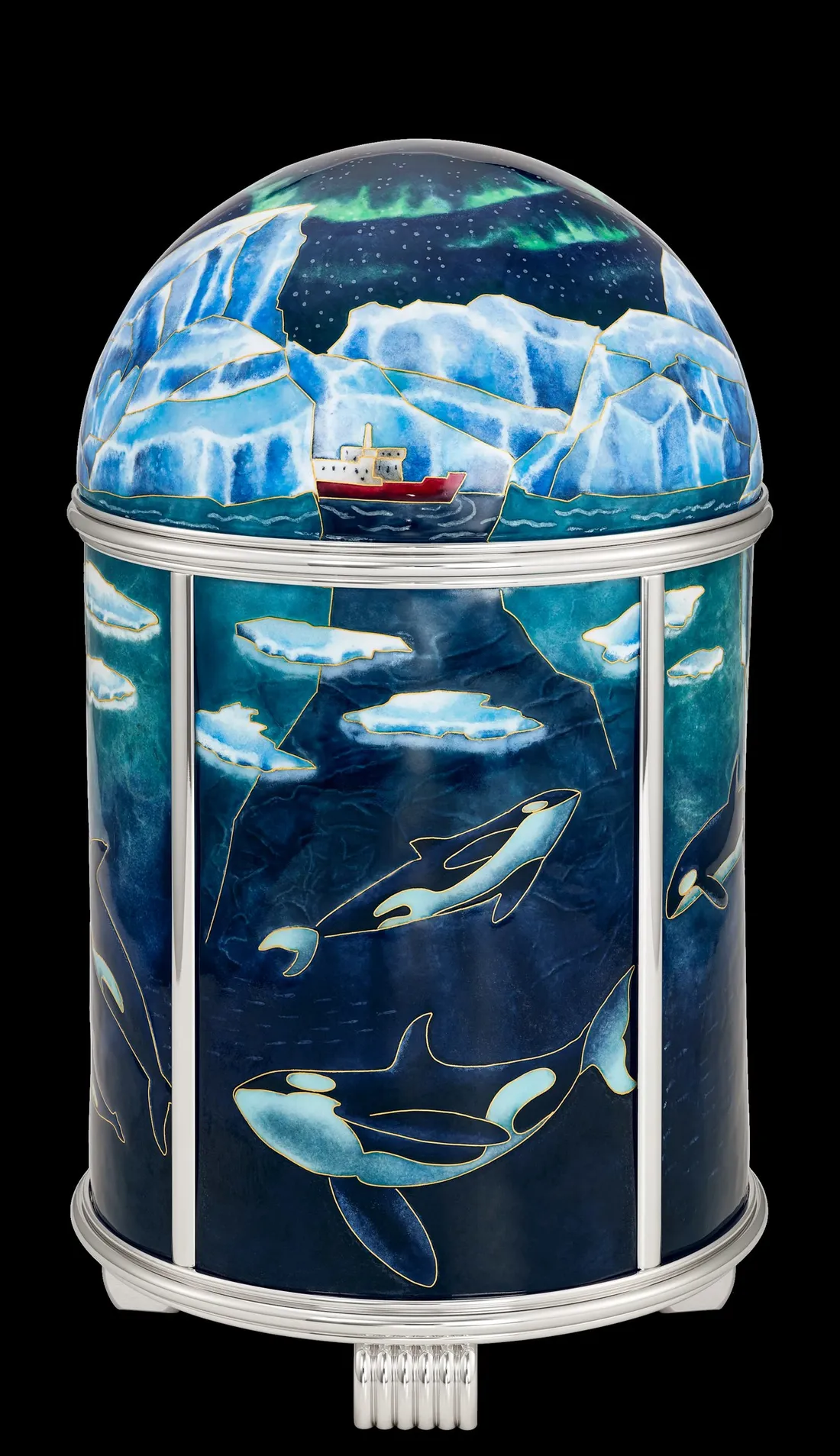
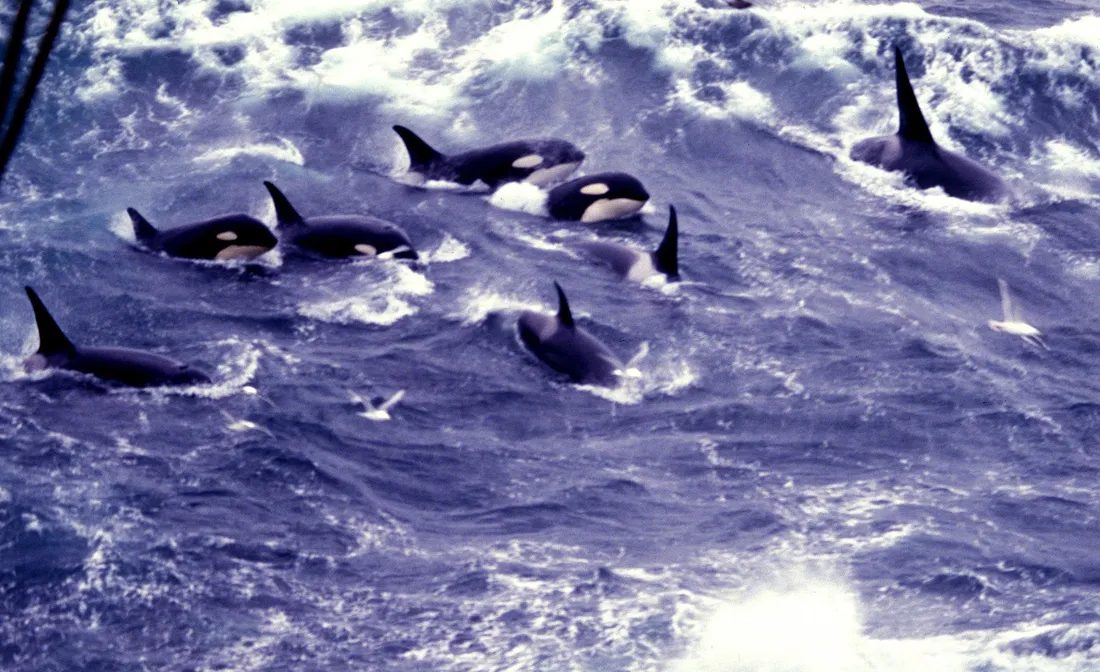
“And what are these orcas doing here?” said Aksel, looking at the black and white bodies on the enamelled surface.
“They stand for the top of the chain. The orca is not a whale but the largest dolphin on Earth, and the ocean’s apex predator. But an apex predator’s job is not only to hunt; it is to decide how much of everything else there will be. The orca holds the seal numbers, the seals hold the fish, the fish hold the krill. Break one link at the top and every link below it first swells and then collapses.”
“Like a watch movement.”
“Exactly. Take out one wheel and the watch does not run fast, it stops.”
One Breath in Two: The Air Made by the Invisible
Aksel could not take his eyes off the details on the clock.
“So the largest creature on the planet feeds the most microscopic one?”
“Exactly that,” said Selim with excitement. “And do you know what those invisible phytoplankton do? They absorb carbon dioxide from the atmosphere and, entirely on their own, produce at least half of the oxygen that humanity and every other living thing breathes, by some estimates as much as eighty per cent. One of every two breaths we take is owed to the whale in the depths and to the microscopic phytoplankton. Krill eat those phytoplankton; fish and the penguins standing in a row on that dome consume the krill.”
“How does something so small do something so large?”
“Because the numbers are beyond imagining, but the real reason is speed. We are speaking of a mass equal to about one per cent of all the plant matter on Earth. Think of a forest: it grows once in fifty years and that mass simply stands there for fifty years. The phytoplankton mass is replaced about once a week. One is a slow-growing forest, the other a lawn mown and regrown every week. The way to do a great deal with very little material is to turn the material over very often.”
“What does one of them look like?”
“Some are glassmakers, some are shepherds. Diatoms build their bodies out of sand, which is to say silica; under the microscope each one looks like a crystal box cut by hand. And then there is Prochlorococcus, discovered only in 1988, a thousandth of a millimetre across and probably the most numerous photosynthesising organism on the planet. The reason it was found so late is its size: it was slipping straight through the holes in the filters. Rather like trying to collect dust in a fishing net.”
“Something is bothering me,” said Aksel. “Does all that oxygen stay in the air?”
Selim put his mug down on the table.
“No, and this is the most delicate part of the whole business. Almost all of the oxygen produced by phytoplankton is spent again by the bacteria that decompose them after they die. Production and consumption cancel out. The reason the atmosphere we breathe exists at all is that a small fraction of that organic matter was buried in the sediment before it could decay.”
“How should I picture that?”
“Picture a man who spends very nearly everything he earns. The salary comes in every month and it goes out every month. But every month he puts a few parts in a thousand aside. Over a lifetime that tiny remainder builds into a considerable sum. The oxygen in the atmosphere is that sum: the total of a small balance that escaped rotting, accumulated over billions of years.”
“So the air we breathe is the interest on a balance that escaped rotting.”
“You could put it that way. And the conveyor belt that carries that balance is turned by the whales and by the whole chain running down to the krill.”
“Tell me a little about krill. That must be the link under the penguins on the dome.”
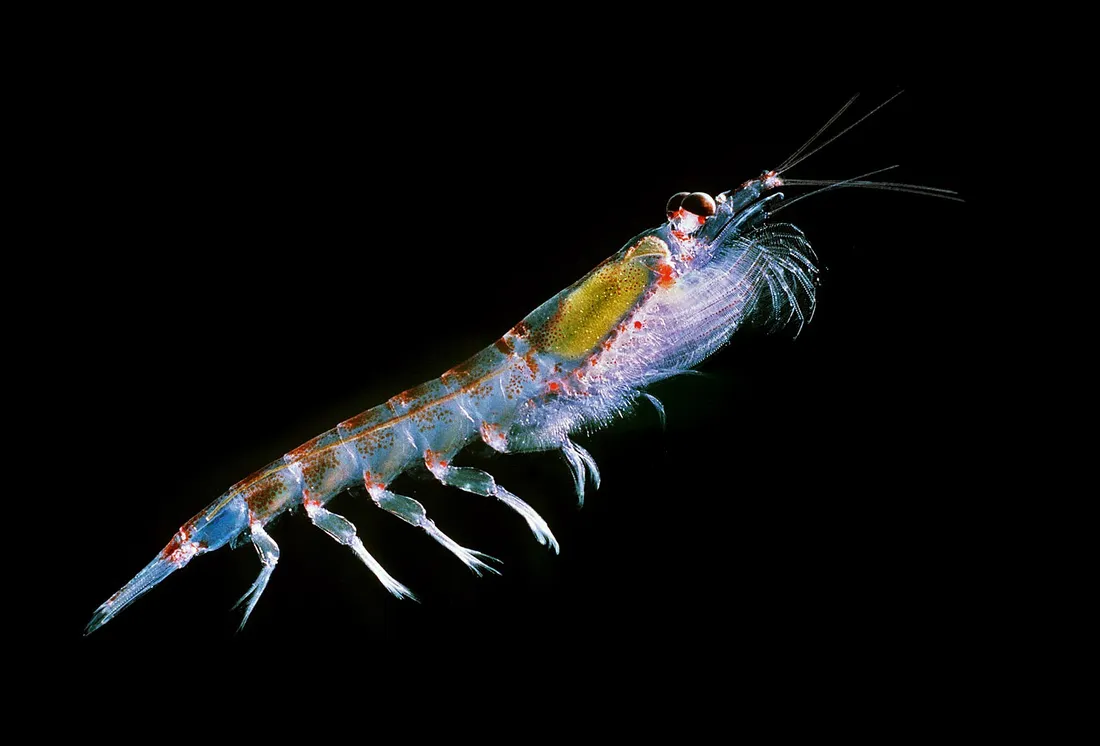
“It is. Antarctic krill is a semi-transparent crustacean six centimetres long. On its own it looks insignificant, but by total mass it is one of the most abundant animal species on Earth, and its swarms can stretch for kilometres. It is the real gatekeeper, taking the energy of the phytoplankton up to the next floor: whales, seals, penguins and many fish all pass through that same door. And it has a job nobody expects. It rises to the surface every night to feed, descends to the depths by day and excretes down there. So it does the reverse of what the whale does, daily, and in billions of individuals: it carries carbon from the surface downward.”
“That must be the largest migration on the planet.”
“Vertically, yes. Every day, every night, in every ocean. Nobody sees it, and it is the most crowded regular movement in the living world.”
Penguins: The Living Bridge Between Ocean and Land
Selim paused here, pointing to the penguin figures around the edge of the dome, and went deeper.
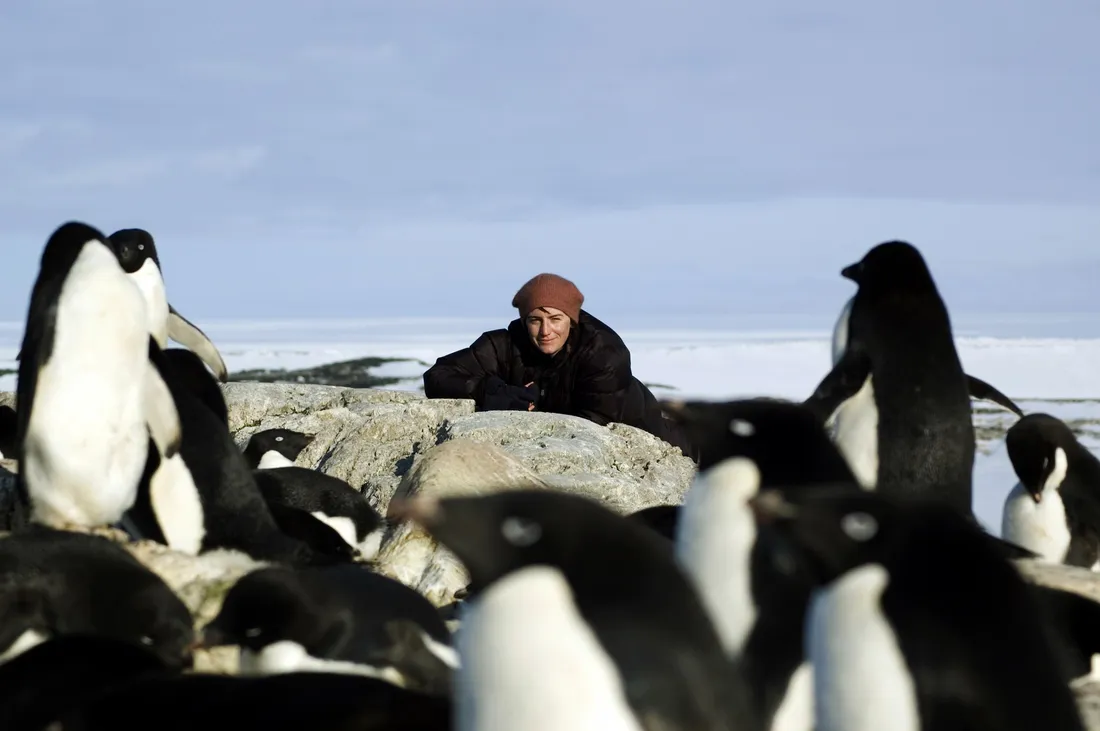
“Penguins are not merely charming creatures, Aksel; they are the only living biological bridges carrying the ocean’s vast organic wealth onto the dead rock of the land. The land masses and frozen crags of the poles are utterly barren in organic matter, nitrogen and phosphorus; they are sterile deserts of stone. Penguins consume thousands of tonnes of krill and fish beneath the sea, and then, returning to their breeding colonies on land, they leave tonnes of guano behind. Penguin guano is so rich in ammonia and phosphate that the polar winds spread it for kilometres and build what is called ornithogenic soil, soil made by birds.”
“A bird’s droppings make soil?”
“They do, because there is no other source there. Think of it like this: a rocky island with no harbour, no fields, nothing that grows, and one lorry arriving once a week. Every living thing on that island depends on what the lorry brings. Cut the lorry and the island empties. The ice-free land of Antarctica is less than one per cent of the continent, and within that narrow strip life gathers almost entirely around the colonies. The mosses and lichens clinging to those frozen barren rocks, those microscopic tardigrades and mites, can live only and exclusively thanks to this cycle of nitrogen and phosphate that the penguins carry ashore. Without penguins this line of organic supply between ocean and land is cut; no microbiological or plant life can germinate in polar soil, and the terrestrial ecosystem dies completely.”
“You said the smell of the ammonia from a colony travels for kilometres.”
“It does, and one set of measurements showed something remarkable: when that ammonia mixes into the air and rises, it multiplies the nuclei on which water vapour can condense. For a cloud droplet to form, the vapour needs a speck to cling to; without a nucleus the vapour stays vapour. Penguin ammonia supplies those specks. In other words a penguin colony partly makes its own cloud. We are talking about a chain that runs from bird droppings to weather. I remember staying silent for a long while the first time I heard it.”
“Tell me about the tardigrades too,” said Aksel. “I have heard the name but it has always sounded like a fable.”
“It is no more than half a millimetre long, it has eight legs and it lives in water. When the water is withdrawn it does not die, it stops. It expels almost all the water in its body, folds itself up like a seed into a barrel shape, and casts the delicate structures inside it into a glass-like mould made of a special sugar-like substance. Think of a flower set into resin and frozen: the flower is not dead, it simply cannot do anything. In that state its metabolism slows beyond measurement, it can wait for decades, and it survives cold near absolute zero and the vacuum of space. Let a drop of water fall on it and within hours it comes back to itself and walks on.”
“So a living thing can stop its own clock.”
“Precisely. And I do not think it is nothing that we are discussing it in front of a table clock. When the spring inside that dome runs down, the clock stops and forgets the time; when the tardigrade stops, it does not forget the time, it merely suspends it.”
Albedo: The Planet’s Mirror and Its Breaking Point
Aksel turned the clock slowly towards his own angle. On the front, a family of polar bears lay curled around one another on the ice.
“And what about these white kings on the front of the case, and that deep blue sheet of ice beneath them?”
Selim fixed his eyes on the glacier floor and began to explain the immense climate physics behind the ice.
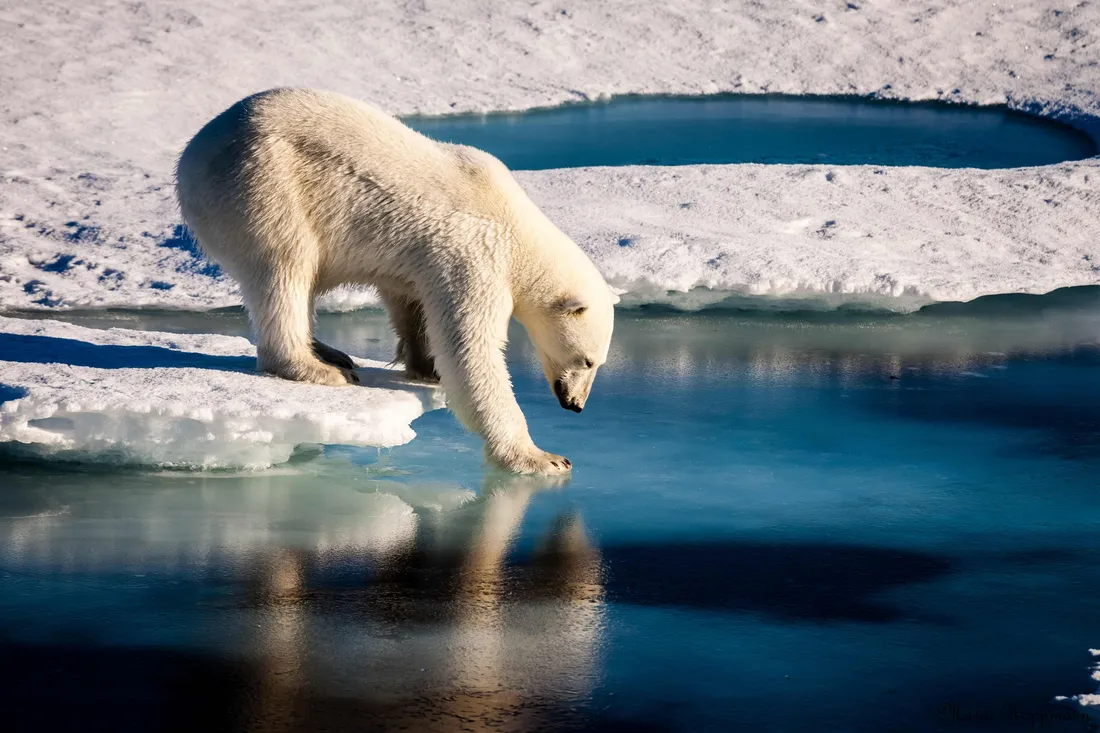
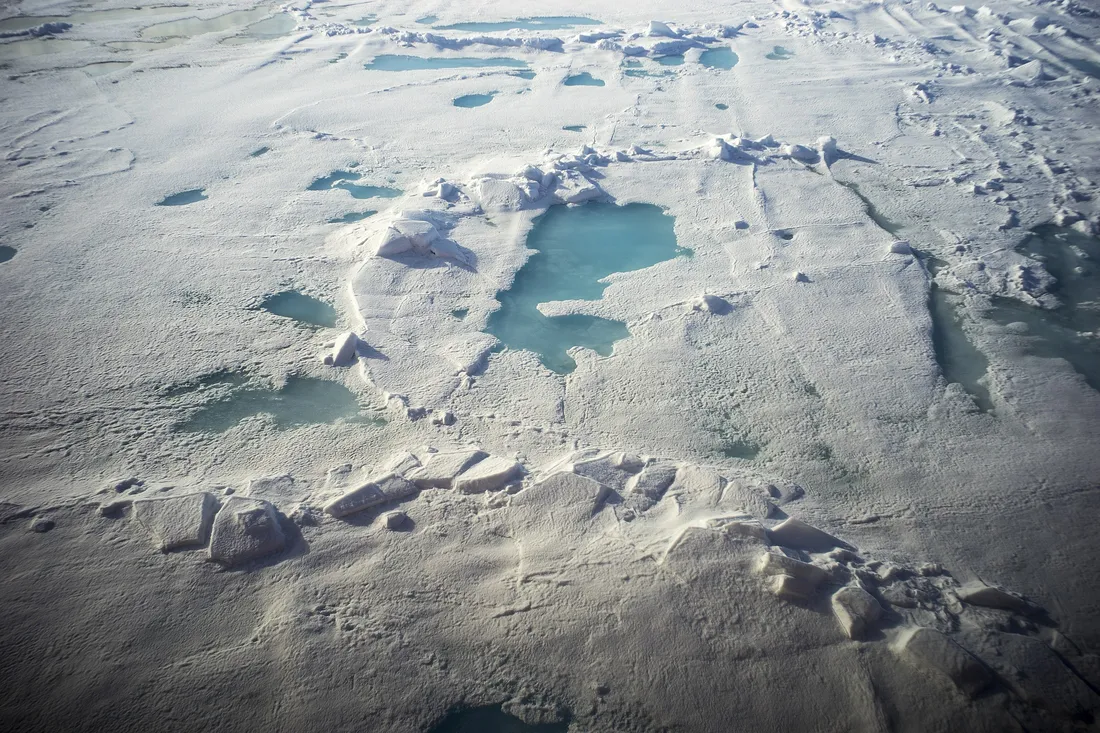
“Polar bears are the guardians at the top who hold the seal population in balance. But the real marvel is the vast mass of ice they stand on, the one engraved on the front of this clock. In physics we call it the albedo effect, and it is the finest line this planet holds between life and death.
Albedo is a surface’s capacity to reflect the sunlight falling on it. White, fresh sea ice throws between eighty and ninety per cent of the incoming radiation straight back into space like a mirror, without absorbing it at all. Polar ice is the planet’s vast protective heat shield.”
“Can you put that in a way anyone would know?”
“I can: a white shirt and a black shirt in the July sun. Both stand under the same sun, but the black one burns you. The reason is not the thickness of the cloth but its colour. On a planetary scale ice is the white shirt and open sea is the black one.”
“And when the ice melts?”
“That is exactly the point. The albedo of dark seawater is extremely low; it absorbs ninety-four per cent of the sunlight and converts that enormous energy into heat within itself. This is where the catastrophic ice-albedo feedback loop begins: as the dark ocean water warms it melts the ice around it, as the ice melts the open water surface widens, and as the surface widens the amount of heat absorbed increases by compounding.”
“We know loops like this in physics,” said Aksel. “Self-feeding systems are dangerous, because the output becomes the input again. It is what happens when you bring a microphone too close to a speaker: a small sound grows, the grown sound goes back in, and within seconds a shriek fills the room. The difference is that you can pull the microphone away.”
“And that is exactly the problem. There is one more detail: sea ice is not only a mirror, it is also a lid. Take the lid off a pot and the water evaporates faster and the kitchen warms; the ice likewise insulates the ocean’s heat from the atmosphere and kills the waves. And on its underside, directly beneath the ice, live ice algae; in spring the polar food chain begins with them. So the ice is not a lifeless covering, it is itself a habitat.”
“And it is being lost right now.”
“The poles are warming three to four times faster than the planetary average. The September sea-ice minimum has retreated by roughly thirteen per cent per decade since 1979. Once this thermal fracture goes out of control the planet’s climate is deranged; the ocean warms, the whale pump collapses, the phytoplankton vanish and the atmospheric oxygen balance is overturned. Look at it: a single mass of ice on a clock is shouting how fine a balance our universal existence rests on.”
Making the Dome: Powdered Glass Through Fire Nine Times Over
Aksel drew a long breath and began to study the craft of the clock.
“Selim, I have spent my life with measuring instruments. Explain to me how this surface was made.”
“It is called cloisonné, cell enamel,” said Selim. “First there is a wire in the craftsman’s hand, solid gold, a little thicker than a hair. He bends it with tweezers to trace every outline in the picture and sets it upright on the metal ground. On this clock, drawing the contours of the polar bears, the penguins and the killer whales took eight metres and thirty-one centimetres of gold wire, weighing close to sixteen and a half grams. The outlines of these animals are, quite literally, made of gold.”
“What is the wire there for?”
“Because what we call enamel is really coloured glass ground to powder, and when it melts in the kiln it flows. The gold wire is the barrier that stops the flow. Think of a stained glass window in a church: the lead lines that hold the coloured panes do the same job, at once support and boundary. Here each cell is a pool for its own colour. You are not painting with colour; you are putting each colour in its own room and closing the door.”
“How many colours are there here?”
“Forty-one. And they are not all of the same kind: transparent, opalescent and opaque enamels have been used together. That trio is the answer to why the ice looks real. Real ice lets light through in some places, clouds it in others and blocks it in others still. A painter imitates this with paint; an enameller does not imitate it, he uses the same physics. Light enters the transparent enamel, returns from the metal beneath it and comes back to you. This is a glow that comes from inside, not off the surface.”
“And that trembling green in the sky? Is that in cells too?”
“No, the craftsman changes hands there. The veil of the aurora is done in miniature painting on enamel, using only three colours. The reason is simple: an aurora has no edge. A cell means an edge; you cannot put something edgeless into a cell. It would be like trying to fence in a fog with wire mesh. So the brush took the boundless part of the light and the wire took the bounded part.”
“And that flaked shimmer inside the ice?”
“They call it paillonné. Fine silver leaf is buried beneath the transparent enamel. Light passes through the surface, strikes the leaf and comes back; ice behaves exactly the same way, it does not swallow the light, it refracts it inside and returns it. It is like dropping a coin to the bottom of a lake and looking down: you do not see the coin, you see the coin’s glint coming up through the water.”
“How many times do these plates go into the kiln?”
“Nine to fifteen times for each plate, at between nine hundred and nine hundred and thirty degrees. And here is the real cruelty of it: every colour melts at a different temperature. You lay down the one that melts hottest first, then the rest in descending order. But every firing reheats the older colours.”
“Say that in the language of a kitchen.”
“You are making a cake whose layers each bake at a different temperature, and every time you add a layer you have to put the whole cake back in the oven. If a lower layer burns on the fourteenth attempt, you start again from the beginning. It is the same here: if a crack appears at the fourteenth firing there is no way back, and months of work go in the bin. And the enamel shrinks as it leaves the kiln, sinking inside its cell, so the cell has to be refilled and refired. The number is not a boast, it is a necessity.”
“And why enamel at all? Why all this trouble?”
“Because enamel does not fade. An oil painting yellows over centuries, a watercolour flies off in the light. Enamel is not a pigment; the colour itself comes from metal oxides melted into the glass. Cobalt gives the blue, copper and chromium the green, gold the pink. The glass does not carry the colour, it becomes the colour. Museums hold cloisonné fragments from the fifteenth century and they stand today in their first tone. On an object that measures time they have put the one kind of colour that time cannot touch.”
“And I notice this is not a flat plate.”
“That is the hardest part. This is a dome. The surface curves in two axes at once. Bending gold wire on a flat plane already takes skill; bending it over a piece of a sphere is a different craft altogether. And powdered enamel does not want to stay on a slope, it slides. Think of the difference between decorating the top of a cake and frescoing the inside of a dome.”
“Let us come to the part that shows the time,” said Aksel. “That mother-of-pearl ring.”
“The outer ring of the dial is white mother-of-pearl. Its kinship with the pole is not only colour: like ice, mother-of-pearl is made of transparent layers stacked on one another, and it takes its colour not from pigment but from the refraction of light through those layers. The right material was chosen.”
“Are the hour markers sapphires?”
“They are not, and that is a deliberate choice. Baguette-cut blue topaz has been used, about two and a half carats in all. A sapphire blue is deep and saturated; a topaz blue is cold and icy, almost luminous. The twelve stones set around the dial were chosen so that they would read as twelve pieces of ice lying side by side.”
“And the turquoise centre?”
“Guilloché, a pattern cut by machine, opening out from the centre in rays. It recalls the way cracks in ice spread out from a point.”
“And these,” said Aksel, touching the fine pointed pieces hanging over the dial. “These are not painted.”
“They are not. They really are there. Hand-sculpted, rhodium-plated icicles, hanging both above and below the hour circle. The whole picture lives on a two-dimensional surface, and the ice alone steps out of it towards you. The hands follow the same logic: leaf-shaped, rhodium-plated and inlaid with mother-of-pearl. What shows you the time is made of the material of the landscape.”
Fire and Ice: Where the Domes Come From
“Are these domed clocks a new idea for the house?” asked Aksel.
“No, quite the opposite: they continue a very old line. Patek Philippe has been making enamelled table clocks in this shape for more than half a century, and only a few leave the workshop each year. The reason is not economic but human: very few enamellers can do this work. Cloisonné is one of those crafts that disappears together with the atelier when it closes. The house makes these clocks not for profit but to keep the master occupied, to train the apprentice and to keep the chain unbroken. It gathers them under the name Rare Handcrafts and exhibits them each spring at its own salon on the Rue du Rhône in Geneva; the exhibition is open to the public and free to enter.”
“And this year’s theme?”
“The power of nature. Standing directly opposite this dome is another one, called Magma. It depicts a volcano and it was built on the opposite logic. Here there are forty-one colours; there, only five transparent ones. Here every blue tone of water and ice was hunted down; there, a single incandescent orange. In one season the house has put one end in ice and the other in fire.”
“A meaningful pairing for the enameller too.”
“More than meaningful. Because enamel itself is a substance that has melted and set again. To depict lava you use a material that passes through the same process as lava; to depict ice you use one that refracts light the way ice does. When a kinship like that is established between subject and material, the work stops being representation and turns into a kind of witness.”
The Heart That Does Not Stop for a Year
“And what is inside?” asked Aksel. “What is running underneath all this art?”
“Caliber 17’’’ PEND. And here is where most people are mistaken: this is not a battery clock. Inside there is a fully mechanical pocket-watch movement with a mainspring, a gear train, a pallet fork and a balance wheel. Thirty-eight and a half millimetres across, three point seven millimetres thick, two hundred and fourteen parts, twenty-one jewels. The balance is Patek’s own Gyromax; the balance spring is a Breguet, with its end curved up over the body. And the movement carries the Patek Philippe Seal.”
“Explain the Gyromax a little.”
“On a classical watch you adjust the speed of the balance with an arm that shortens or lengthens the working part of the hairspring. It is like pressing your finger onto a guitar string to change the note: you are not touching the string itself, only shortening the part that vibrates. On a Gyromax there is no such arm; adjustment is made by turning small weights placed on the rim of the wheel. Turn a weight inward and the wheel turns faster; turn it outward and it grows heavier.”
“Like a skater pulling their arms in as they spin.”
“Exactly that. Same physics, same result. And the advantage is this: you never touch the hairspring.”
“The rate?”
“Eighteen thousand semi-oscillations an hour, that is two and a half full swings a second. Slow by the standards of a modern wristwatch, but a table clock is never jolted; it has no need to run fast.”
“Then who does the winding? A table clock is not wound every day.”
“And here is the whole subtlety. Fully wound, this movement can only run about fifty hours on its own. From a table clock you expect at least eight days. So inside there is a small battery and an electric motor driven by it. Note carefully: the motor does not turn the movement, it only rewinds the mainspring at intervals. Electricity is not the heart of this clock; it is the invisible hand that reaches for the winding crown every morning in place of the owner. The result is that it runs for more than a year without anyone touching it.”
“So for a year, in a place nobody sees, a balance wheel nobody hears turns on a spring nobody touches.”
“And directly above it, a polar night nobody is watching is being painted. They are both doing the same thing, Aksel: carrying on with the work even when there is no one to see.”
Two Poles Meeting Under One Dome
Aksel was silent for a while, then smiled.
“I have noticed something. There are penguins on top of the dome and polar bears on the front. But penguins live in the south and polar bears in the north. The two never stand side by side in nature. And the light on top is called the aurora borealis, the northern light.”
“So you noticed,” said Selim. “It caught me too, the first time I saw it. But then I thought about it this way: nobody has drawn a map of geography here. What has been made is a conception in which everything that lives on the ice is gathered under a single dome. The clock’s official name says as much: fauna on the ice floe. Not north, not south, but ice. Two separate stages at opposite ends of the Earth, brought together inside one hemisphere.”
“A sort of idea of the pole.”
“A sort of idea of the pole. And the idea says something truer than the geography: the same ice, the same light, the same silence. The border is one we draw.”
Aksel ran his finger over the turquoise dial of the clock.
“Tell me honestly, Selim. From the dance of plasma in the sky to the breath of a whale in the deepest ocean, from subatomic particles to the brush of a Patek Philippe craftsman, how can everything speak to everything else in such immense harmony?”
Selim looked out of the ship’s window at the lights dancing over the dark ocean.
“Because, Aksel, the mind reads this only as a physical equation. But a soul that contemplates knows that the invisible hand which makes the greatest and the smallest parts of a single system has written the same divine codes into the ocean, into the sky and into the dial of this clock. Here we are only reading one page of that great library.”
Outside, the light curled once more. For an instant the green enamel on the dome on the table found exactly the tone of the real green coming through the glass; then both went out. Inside the dome, a balance wheel nobody could hear went on turning.
format_quote"The sky was made a guarded canopy; we only recognise that roof at the moment it is struck, by the light it gives off."
Hasan Bekmezci
format_quote"What decides the colour in the sky is not temperature but patience: the atom waits for a second in which nothing collides with it, so that it can shine."