A watchmaker’s bench and an archaeological dig have more in common than they first appear to. Both are places where someone spends hours removing exactly the right amount of material, by hand, under a loupe, to reveal a shape that was always there. The difference is which direction time runs. An archaeologist brushes centuries of dust off a buried object. A watchmaker starts with raw gold and stone and works the other way, building an object up until it resembles something that was buried a very long time ago.
Four times over, in a workshop in Geneva, that second kind of dig has just been finished. Vacheron Constantin, working with the Louvre, has spent the last several years shrinking four museum objects, a fragment of sandstone, a winged stone guardian, a giant of marble, a reclining river figure, down from their real scale to a disc of gold barely three centimetres across, using nothing but hand tools, powdered glass and a great deal of patience. This is the story of where those four objects came from, and of the almost-vanished crafts it took to carve them small enough to wear.
A Manufacture and a Museum
Vacheron Constantin has kept a Métiers d’Art department alive for exactly this purpose: to make sure that engraving, enamelling, gem-setting and stone-carving survive inside a Swiss watch manufacture as living, practiced skills rather than museum footnotes themselves. In 2019 the house began a formal partnership with the Louvre, an unusual pairing on paper, a horology brand and the largest museum on earth, but a logical one in practice. The Louvre holds several thousand years of sculpture in its stores; Vacheron Constantin holds one of the last concentrations of artisans on the planet who can carve, engrave and enamel at a scale small enough to fit a wrist.
The first four watches from the partnership arrived in 2022. The four described here are the second quartet, unveiled in 2026, each one a fresh answer to a single, oddly difficult question: how do you shrink an object by a factor of fifty or more, sometimes from a statue over three metres tall down to a medallion of gold thirty millimetres wide, without it turning into a cartoon of itself. The answer, in every case, turned out to be that you cannot draw or print the object. You have to physically carve it again, in miniature, in the same family of materials, stone and metal, that the original sculptor used.

The Portrait That Broke the Rules
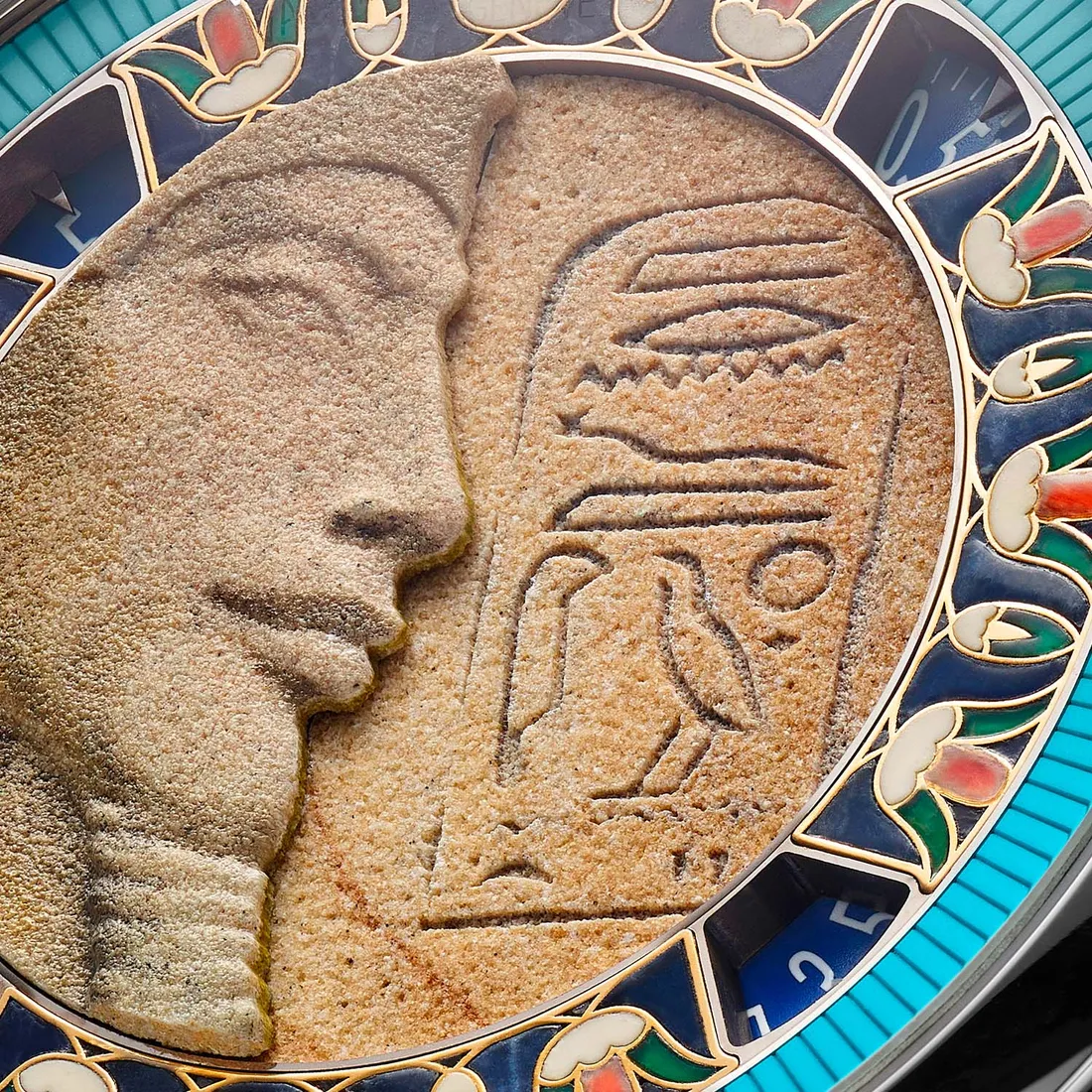
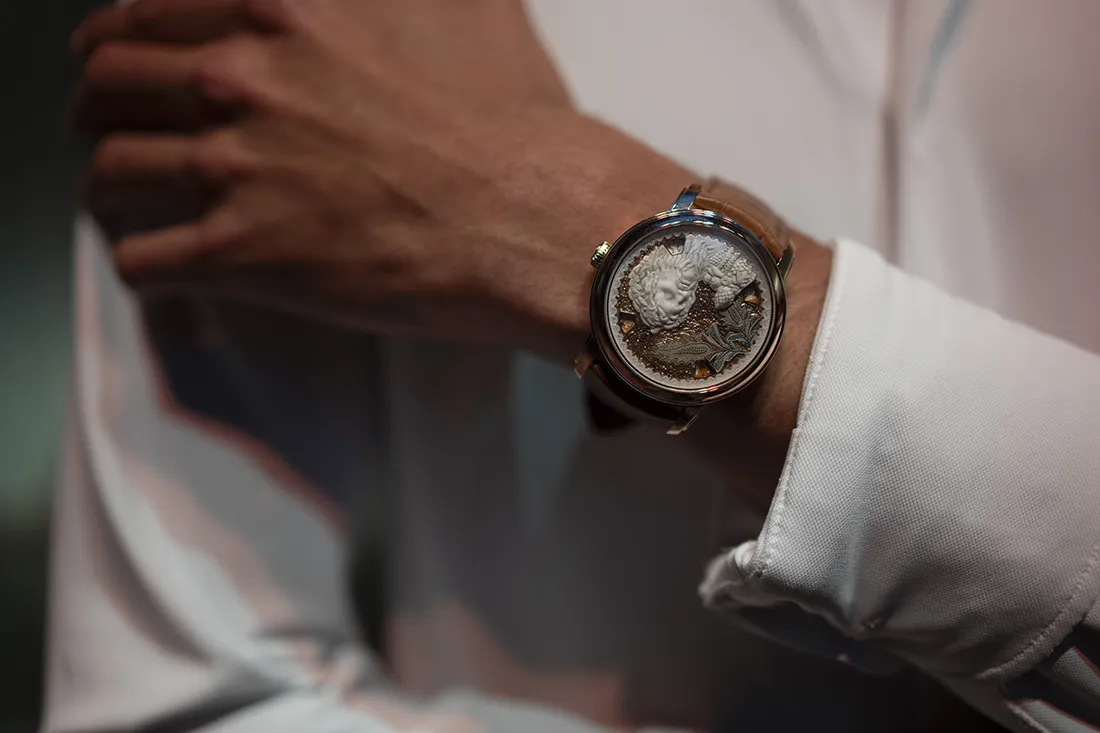
The first watch takes its dial from a sandstone fragment now kept at the Louvre, all that survives of a colossal statue that once stood at the Karnak temple complex in ancient Thebes. It shows the pharaoh Akhenaten, who ruled Egypt in the fourteenth century BCE and who, for a brief and strange stretch of Egyptian history, tore up almost every convention his civilisation’s art had followed for over a thousand years. Older pharaohs were carved as young, idealised, physically perfect rulers. Akhenaten had himself carved with an elongated skull, heavy half-closed eyes, a long sharp nose, a soft androgynous body and an exaggerated chin, an artistic style so deliberately unflattering by the old standard that Egyptologists still argue over exactly why he chose it. Historians now call the period the Amarna style, and this fragment, a face split with a carved hieroglyphic inscription beside it, is one of its most striking survivors. It reached the Louvre in 1905 through the Cairo antiquities market with almost no paperwork attached, and its authenticity as part of the original statue was only formally confirmed decades later, when Egypt gifted the piece to France outright in 1972.
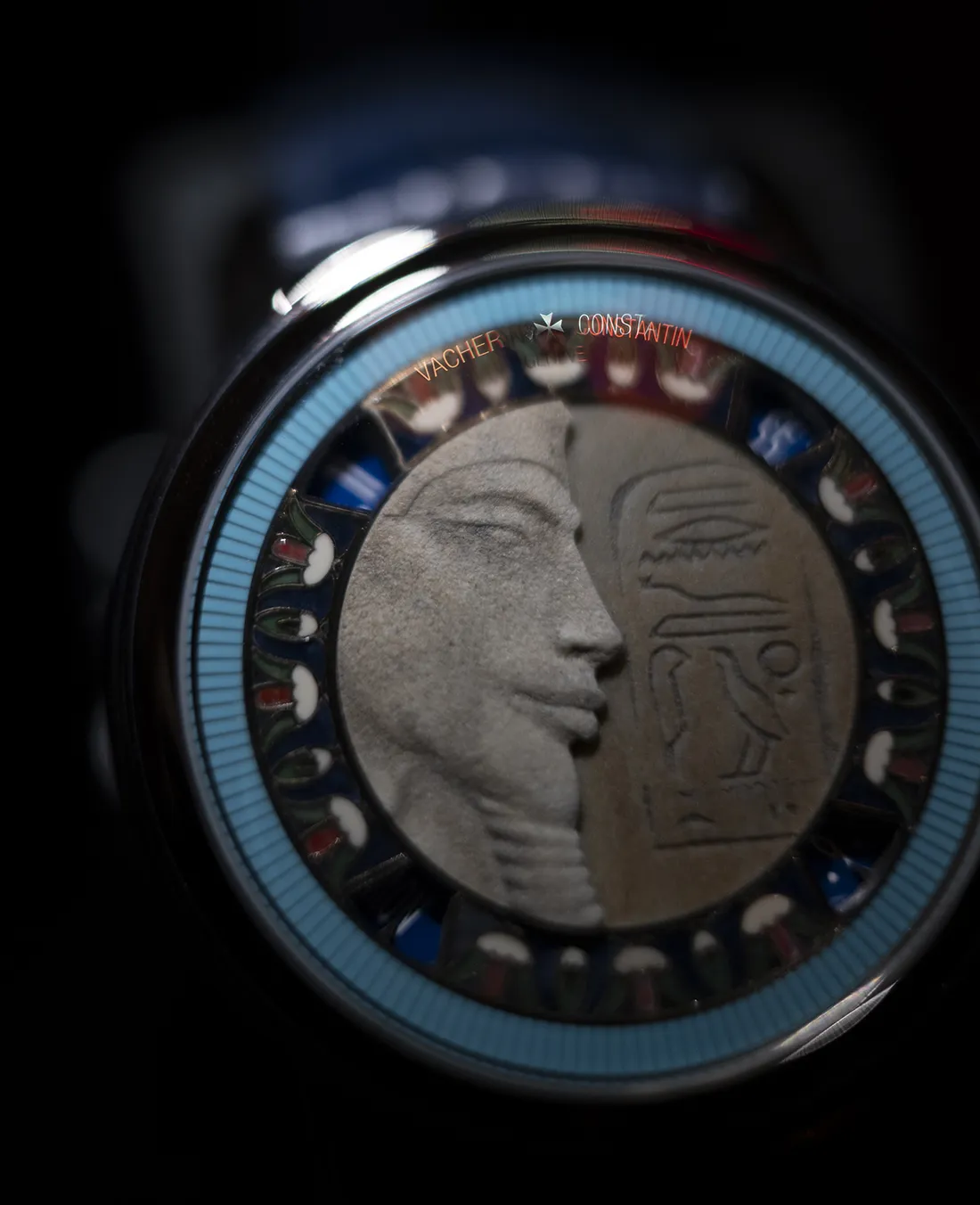
To rebuild that face on a dial, the atelier used glyptics, the old and slightly obscure art of carving miniature reliefs directly into a piece of hardstone, the same technique that produced ancient seal-stones and cameos long before it was ever used on a watch. A block of stone is carved by hand, under magnification, into the same likeness the original sculptor left in sandstone three thousand three hundred years ago, then hand-patinated afterwards, meaning its surface is deliberately aged and toned so the fresh stone looks as though it has spent those three thousand years buried and weathered, not as though it was cut last month. Around that carved medallion runs a border in champlevé enamel: the goldsmith engraves a network of shallow trenches straight into the gold, packs them with powdered coloured glass, and fires the whole dial in a kiln hot enough to melt the powder into a hard, glossy surface, which is then ground back flush with the surrounding gold and polished. Every one of those trenches has to be cut to a slightly different depth so that each colour, once fired and shrunk, sits exactly level with its neighbours. Get one wrong and the whole dial has to be re-fired, or scrapped.

The Sentinel of a Buried Palace
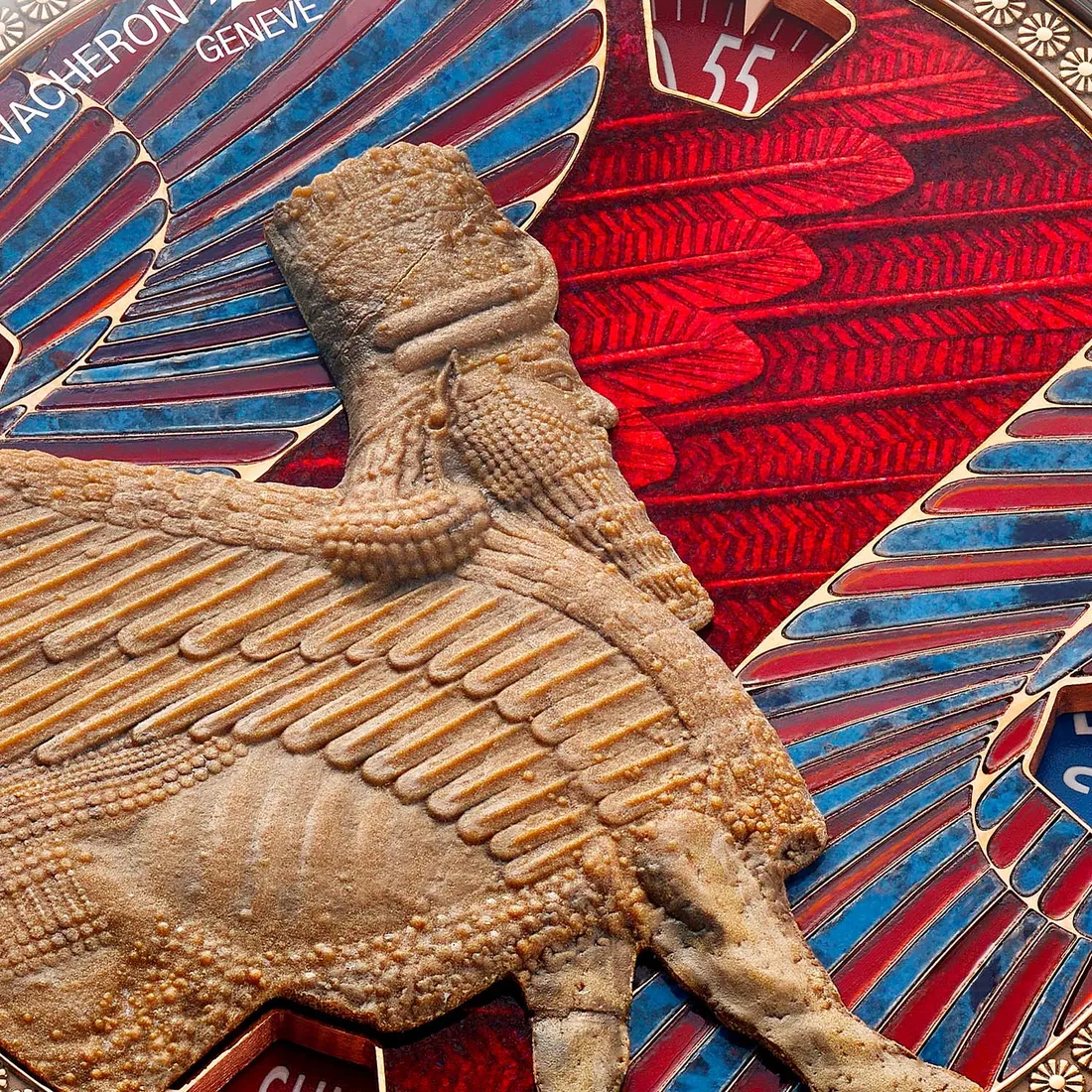
The second watch borrows its dial from one of the great guardian figures of ancient Assyria, a hybrid creature with the body of a bull or lion, a bearded human head and a pair of eagle’s wings, carved by the pair at the gates of King Sargon II’s palace at Dur-Sharrukin, in what is now northern Iraq, in the eighth century BCE. These figures were never small: the originals stood over four metres tall and weighed several tonnes each, carved so that from the front they appeared to stand still on two legs and from the side to be striding forward on four, an optical trick built directly into the stone. They stayed buried under a mound for roughly two and a half thousand years until 1843, when Paul-Émile Botta, the French vice-consul in Mosul, began digging there and uncovered the first major Assyrian site anyone in Europe had ever excavated. Because the guardian figures were too large and heavy to move whole, Botta’s team had them sawn into transportable sections on site, floated down the Tigris, and shipped the rest of the way to Paris, where the pieces were reassembled to open the world’s first dedicated Assyrian museum, at the Louvre, in 1847.
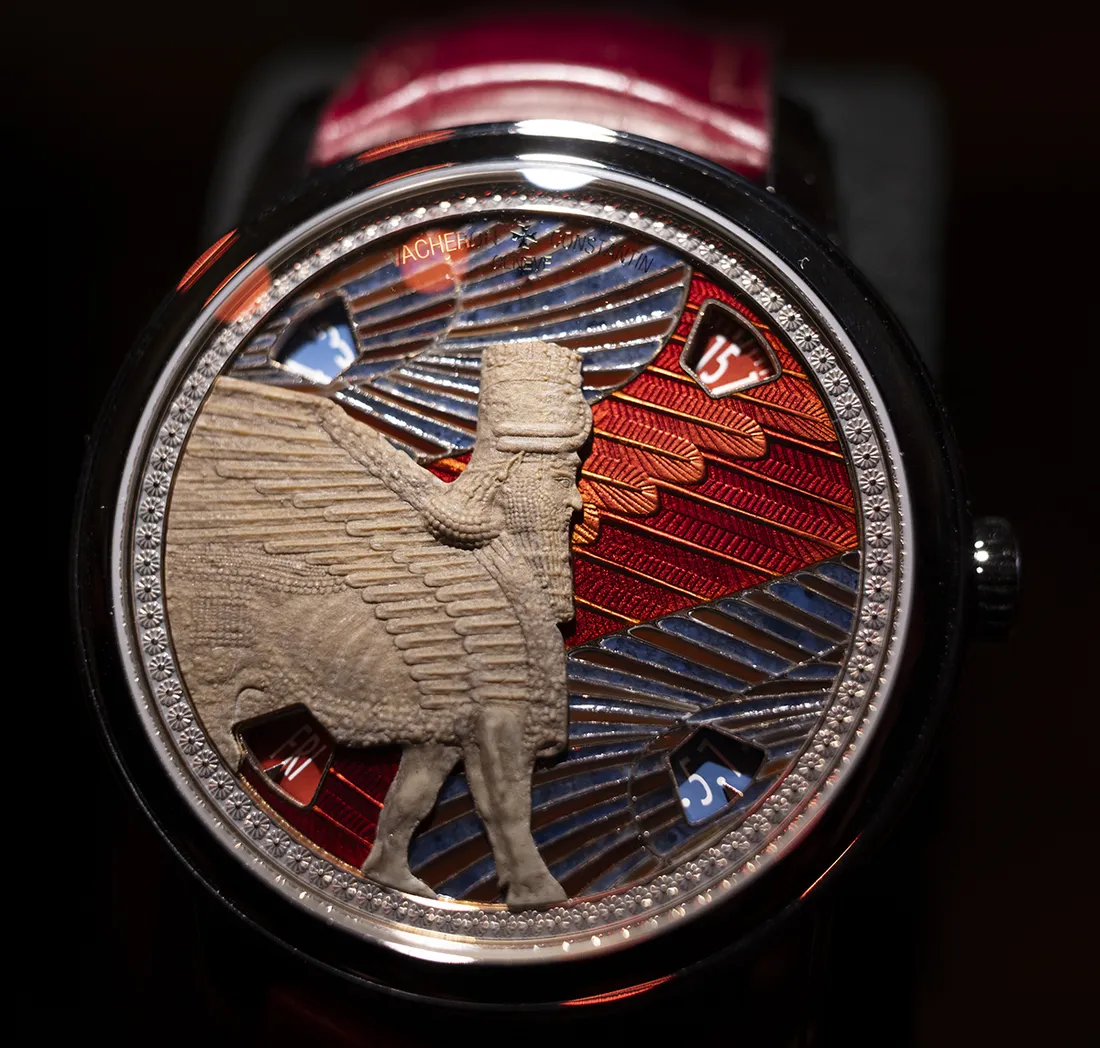
Recreating that four-metre guardian on a thirty-millimetre dial called for a second technique, stone marquetry, essentially an intarsia built from stone instead of wood: dozens of tiny tesserae of red agate and blue dumortierite are cut to exact shapes and set edge to edge inside a gold framework, like a jigsaw with no gaps and no glue showing, an art that descends from the same family as Roman opus sectile flooring and the pietre dure inlay work later perfected in Florence. Behind the guardian, the dial’s fiery red background is built in flinqué enamel, a technique where translucent coloured glass is fired over a gold surface that has first been mechanically engraved with a fine repeating pattern, so that light passes through the enamel, bounces off the engraved metal underneath and comes back out with a depth and shimmer that a flat, opaque colour could never produce. The gold rim around it all is hand engraved with a floral frieze, cut directly into the metal with a burin rather than stamped or cast.

A Giant Rediscovered in a Vineyard
The third dial takes its figure from a marble statue that once stood more than three metres tall, a Roman-era copy, probably carved in the first century CE, of a lost Greek bronze original attributed to the sculptor Kresilas around 430 BCE. It lay buried for close to two thousand years until 1797, when an art restorer named Vincenzo Pacetti found it while digging through the ruins of a Roman villa near the town of Velletri, south of Rome. Pacetti bought the giant marble figure on the spot and restored several missing pieces, part of the helmet, a forearm, the hands and feet, before it eventually entered the Louvre’s collection. Faint traces of red pigment still cling to the hair and around the eyes, a reminder that ancient marble statues were almost always painted in bright colour when new; the pale, bare stone we associate with antiquity today is really just what several thousand years of weathering left behind.
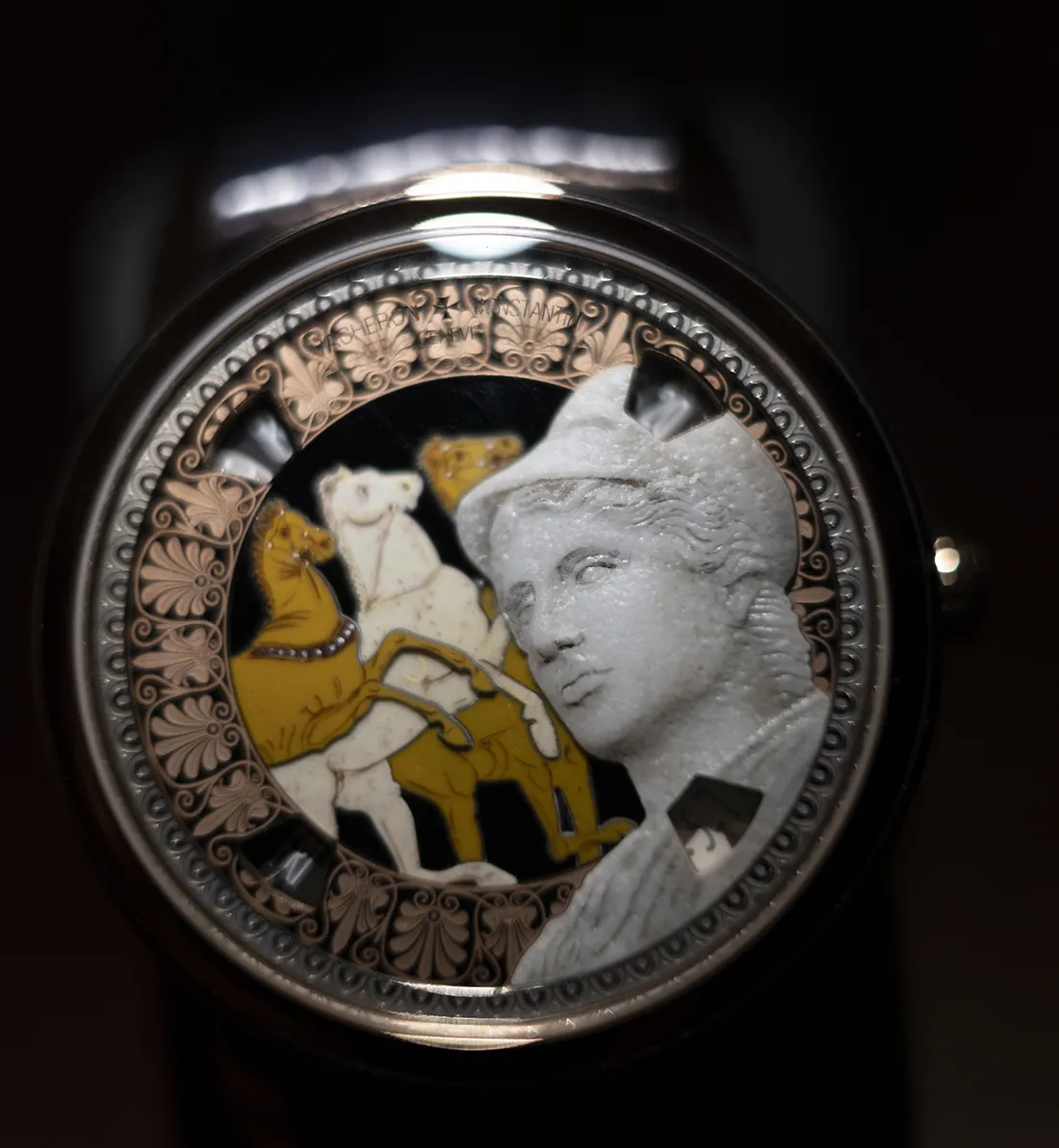
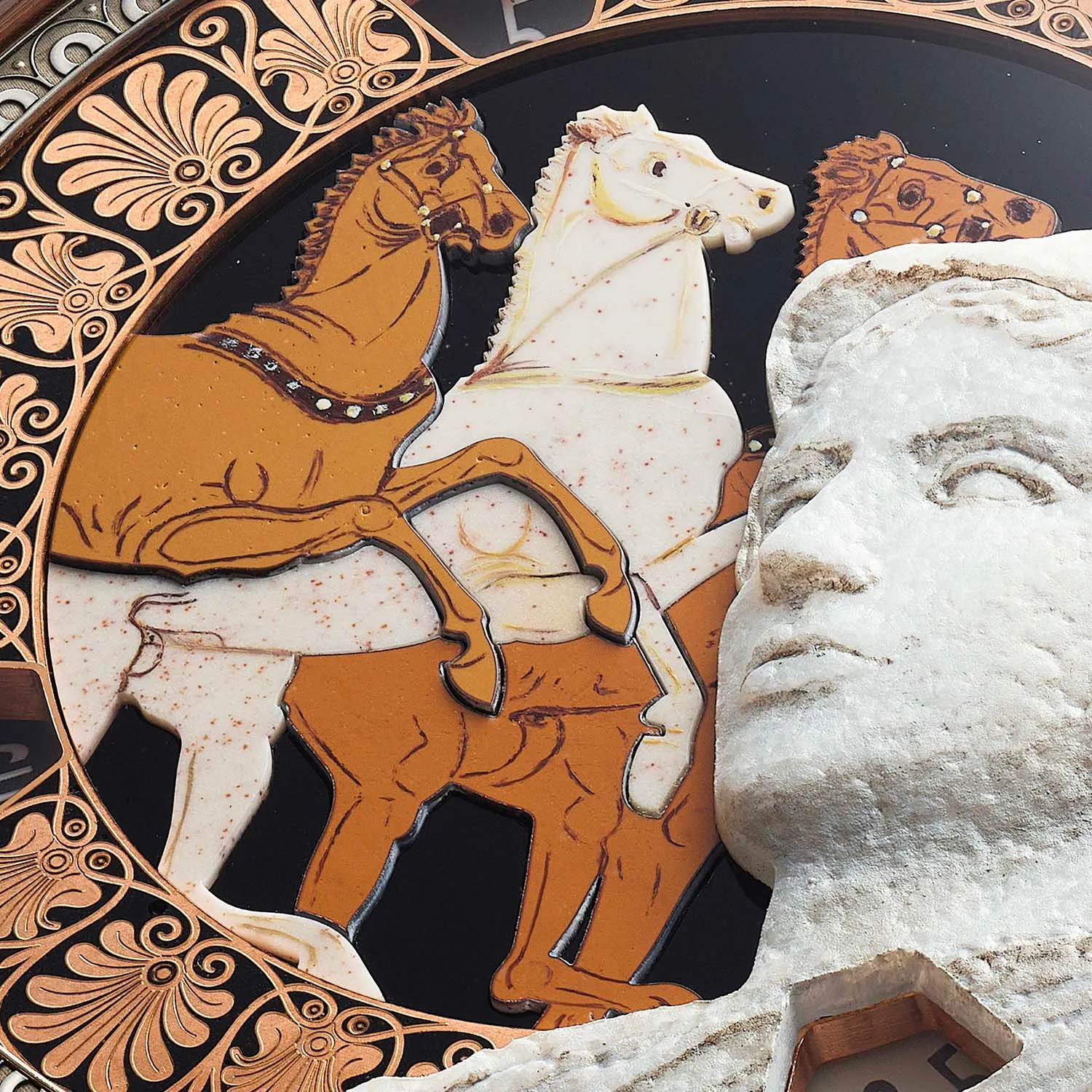
The face and helmet were carved in the same glyptics technique used on the Egyptian piece, but at a harder angle, a three-quarter profile that has to read correctly at a scale of only a few millimetres, which leaves an engraver almost no room to correct a mistake once the chisel touches the stone. Beside it runs a frieze of galloping horses, painted rather than carved, using a miniature-painting technique that deliberately echoes ancient Greek red-figure pottery, a style invented in Athens around 530 BCE in which figures were left in the natural orange-red colour of the clay against a black background, their outlines and inner details added with a fine brush rather than incised, a shift that let potters draw far more anatomical detail, muscle, motion, foreshortening, than the older black-figure technique ever allowed. The whole scene is framed by a ring of black champlevé enamel, the same carved-and-fired technique described earlier, here left in a single deep colour rather than a multicoloured pattern.
The River That Still Runs Through Rome
The fourth watch is drawn from a large reclining marble figure that once decorated the Iseum Campense, a vast religious complex built in Rome’s Campus Martius district in 43 BCE and considerably enlarged under the Flavian emperors roughly a century and a half later. The figure was carved in a format Roman sculptors used often, a reclining, bearded man crowned with reeds and cradling an overflowing vessel or a sheaf of grain, a visual shorthand ancient sculptors reached for whenever they wanted to give an abstract idea, a season, a harvest, a river, a human shape rather than an inscription. In this case the river being represented is the Tiber, the same river that still runs through Rome today. Along with a huge amount of other art, the statue was seized from Italy by Napoleon’s forces at the turn of the nineteenth century and eventually entered the Louvre’s collection, where it remains.
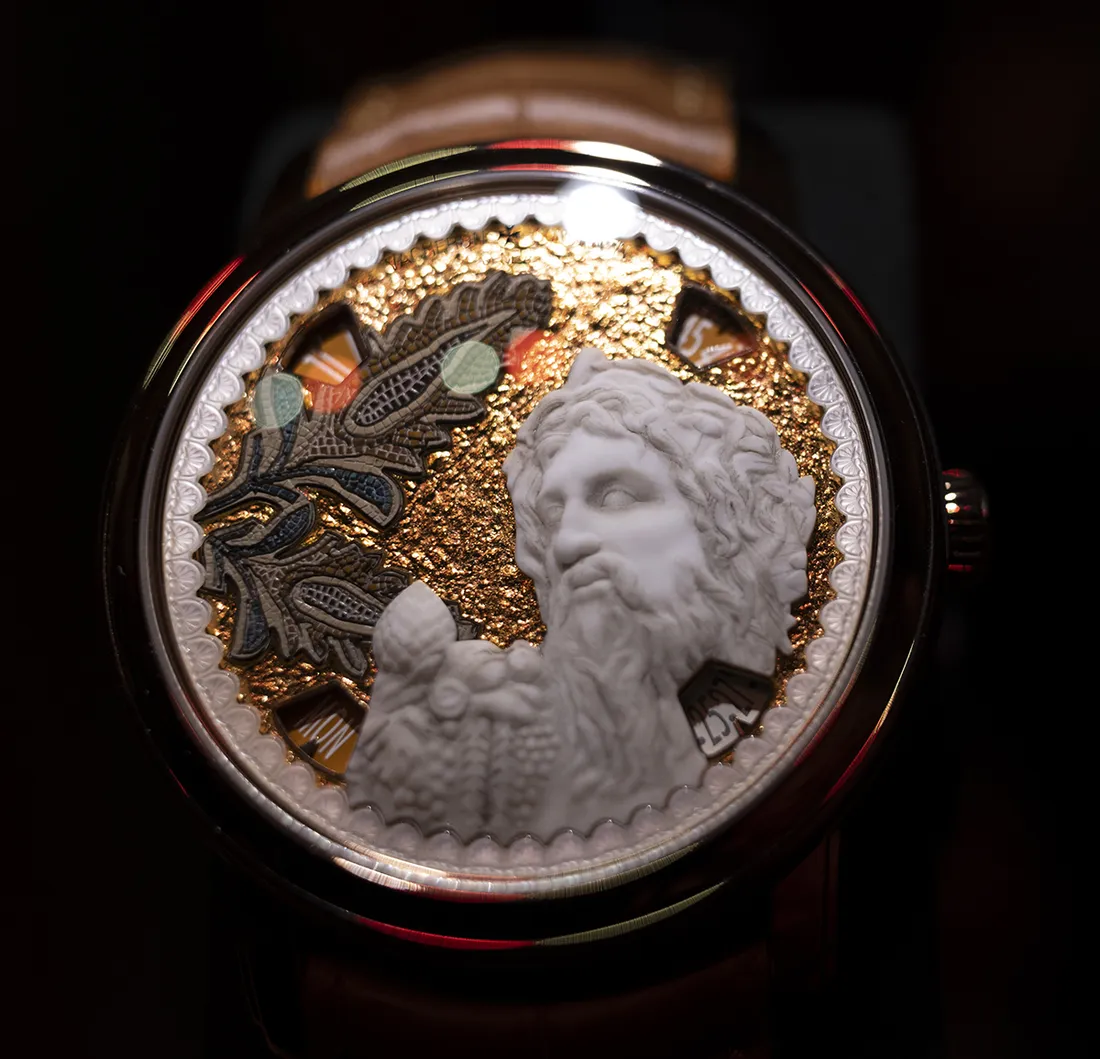
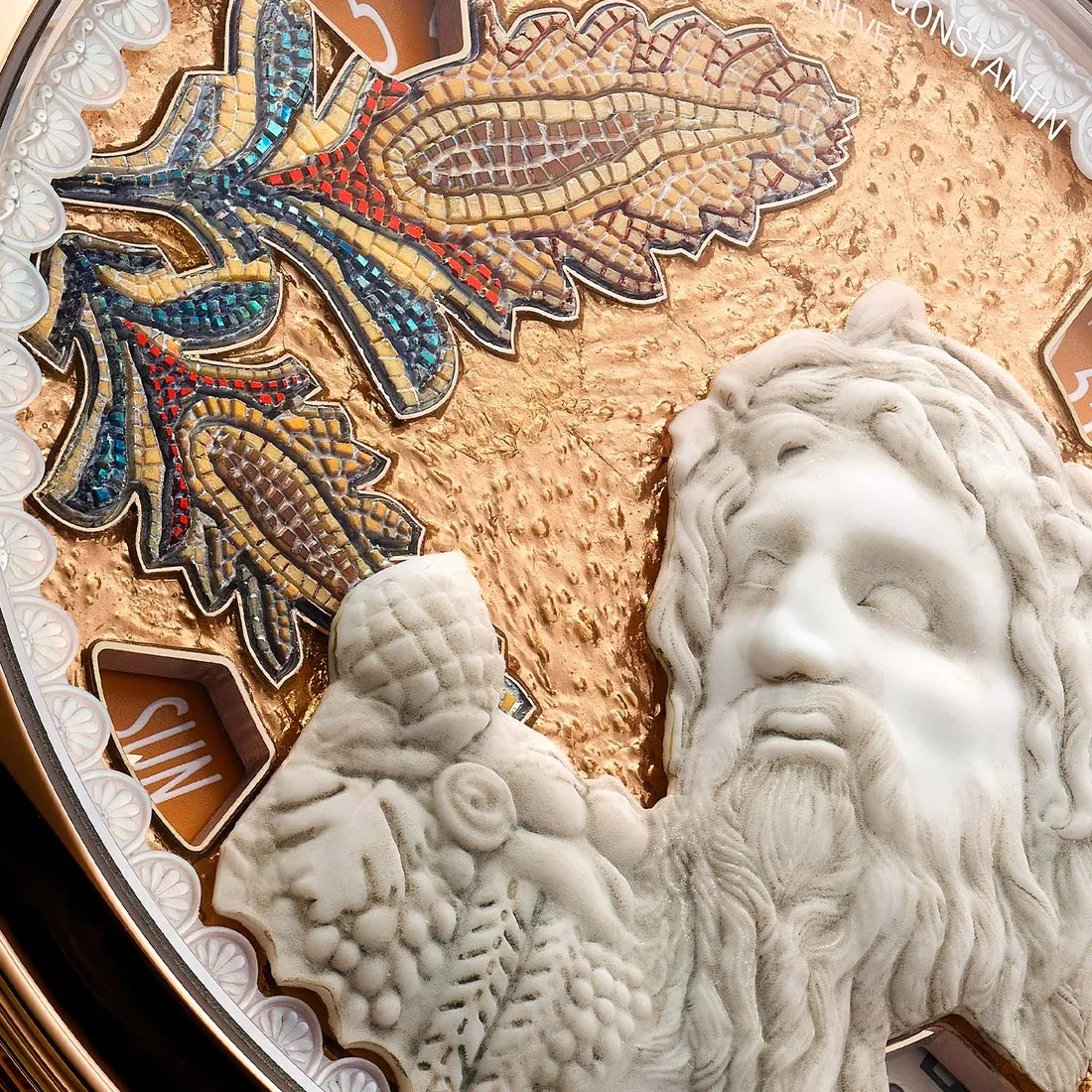
This dial layers three techniques that rarely appear together. The reclining figure itself is carved in relief using the same glyptics approach as the other three watches. The reed motif beside it is cut into a sheet of mother-of-pearl using drypoint engraving, a hand technique in which a sharp steel point scratches fine lines directly into the shell with no acid and no etching involved, a method prized specifically because mother-of-pearl is unforgiving: press a fraction too hard and the material shatters along an invisible fault line, so the engraver’s hand has to stay light and exact for the entire length of every line. Underneath it all, the gold base has been hand-grained, meaning its surface is textured with small hammered or engraved marks before a layer of translucent enamel is fired over the top, letting the gold glow through from beneath rather than sitting under a flat, opaque colour. A scattering of tiny inlaid tesserae, jasper, chrysocolla, opaline, add a secondary layer of stone mosaic to the piece, a craft with roots in the same Roman opus sectile floors that would once have covered the temple complex this figure came from.
format_quote"You cannot photograph a statue small enough to wear it. You have to carve it again, in the same stone and the same gold, and get it right the first time."
One Movement, Four Worlds
All four watches share the same movement, Calibre 2460 G4/2, a self-winding mechanism built from two hundred and thirty-seven components and twenty-seven jewels, running at 28,800 vibrations an hour with roughly forty hours of power reserve, and it exists to solve one very specific problem: how do you tell the time on a dial that a sculpture has already claimed entirely for itself. The answer is a peripheral display. Rather than hands sweeping across the centre of the dial, the hours, minutes, day and date are shown through small windows and a rotating ring built into the rim of the case, geared off the main movement but positioned at its circumference rather than stacked in the middle, so the carved and enamelled scene in the centre is never interrupted by so much as a single hand.
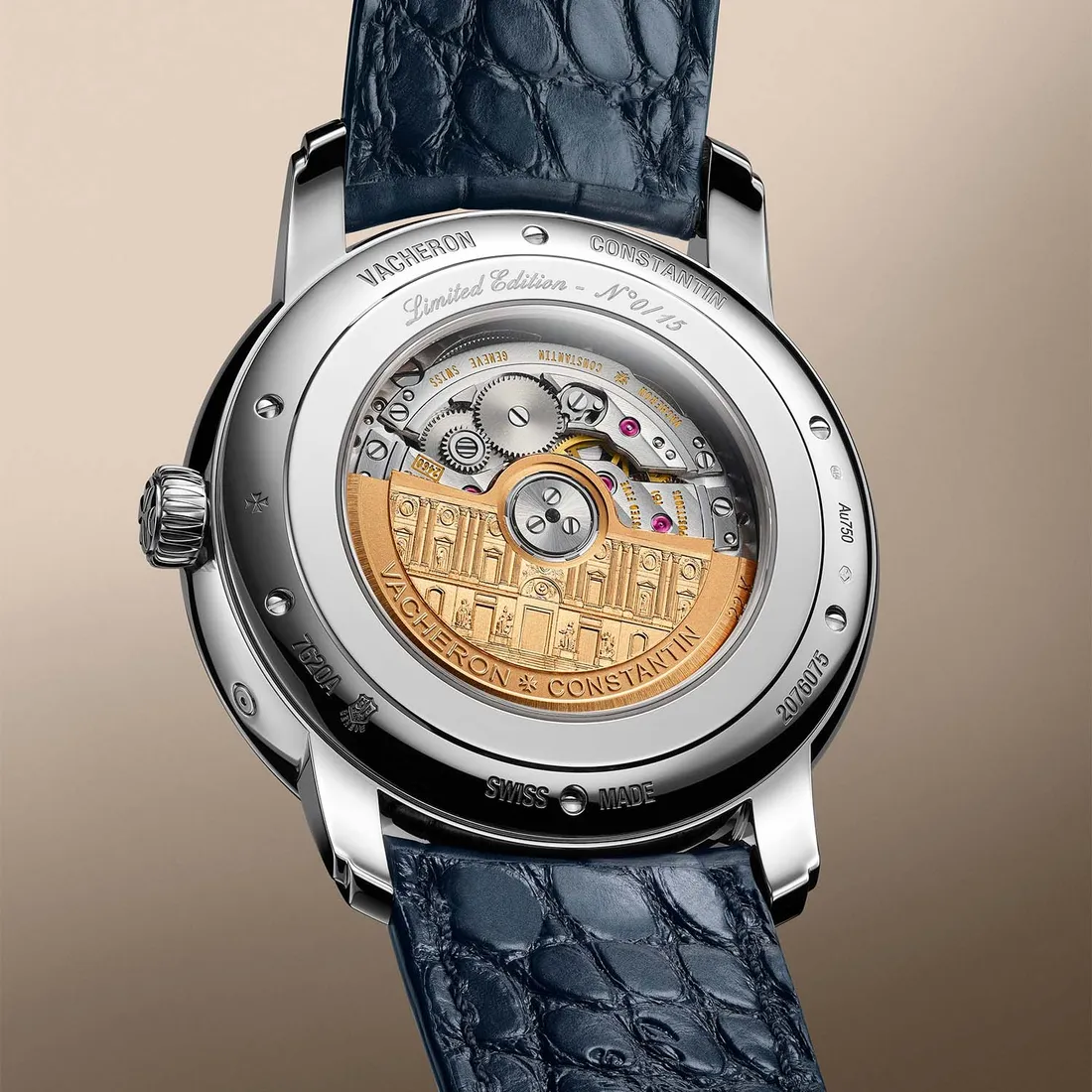
Every movement carries the Hallmark of Geneva, a quality mark that traces back to a Geneva cantonal law of 1886 setting out strict rules for finishing and local manufacture, one of the oldest watchmaking certifications still in use today. Turn any of the four watches over and the gold winding rotor is itself engraved with the Louvre’s eastern facade, its long classical colonnade rendered in miniature relief, a small signature tying the mechanism back to the museum that inspired the dial it winds. Each of the four designs is limited to fifteen numbered pieces, cased in 42mm white or pink gold, water resistant to thirty metres, with a sapphire crystal front and back so the movement, and its engraved rotor, stay visible at all times.
The Smallest Museum in the World
None of these four watches is a reproduction in the ordinary sense, a photograph, a print, a scaled-down plastic model. Each one is a re-fabrication, built from scratch in the same family of materials, stone, gold, fired glass, that the original object was made from, at roughly one fiftieth of its real size, entirely by hand. To shrink something correctly, rather than simply make it smaller, you first have to understand exactly what makes it recognisable, which lines matter and which can be simplified, which colours are load-bearing and which are decoration. That is a harder problem than it sounds, and it is really the only story these four watches are telling: that four fragments dug out of the ground in Egypt, Iraq, Italy and Rome over the last two hundred years can still be understood well enough, by hand, to be built again from nothing, small enough to wear.