Autumn 1707. A great British fleet, returning from the Mediterranean, had been making for England for days through thick fog and violent weather. At its head was Admiral Sir Cloudesley Shovell, one of the most respected seamen of his age. But there was no sun in the sky to take a sighting, nor a single star by night. This vast armada of nearly twenty ships did not, in truth, know for days exactly where it was.
On the night of 22 October, the navigators gathered in the cabin of the flagship Association. Each computed the fleet's position separately; and nearly all declared they were safely in open water, close to the mouth of the Channel. Legend has it that only one ordinary seaman dared cry out that they were dangerously near the rocks; but for a common sailor to contradict the reckoning of admirals was unthinkable in that age. And yet it was a whole navy that was wrong that night. They knew their latitude; but their longitude, their east-west place, no one could tell for certain.
In the darkness they had strayed miles from where they believed themselves to be. Ahead lay not open sea but the merciless Western Rocks of the Scilly Isles. Toward midnight the flagship Association struck the rocks at full sail and went under in less than four minutes; of her crew of nearly eight hundred, not one survived. Then the Eagle, then the Romney, then the Firebrand struck. Within a few hours four warships were shattered, and in that single night some two thousand sailors were swallowed by the freezing Atlantic.
Legend says that Admiral Shovell was cast ashore alive on the sands of Porthellick Cove; but that he was killed by a woman for the emerald ring on his finger. Yet the true murderer that night was neither the storm nor the rocks. What swallowed an entire navy was an invisible number that no one could calculate. The sea's oldest and deadliest riddle wrote its name in blood on the rocks of Scilly that night: where are we?
The Sea's Deadliest Question: Longitude
For centuries sailors could easily find latitude, their north-south position; measuring the noon height of the sun or the pole star was enough. But longitude, the east-west position, was navigation's deadliest riddle. For longitude is in truth a question of time: the Earth turns exactly fifteen degrees in an hour. If you carry aboard a watch that keeps, flawlessly, the time of the port you left, you can compare it with the local noon of the ship and calculate your longitude from the difference. The trouble was this: the pendulum clocks of that age drifted with the roll of the ship, the bite of the salt, the damp and the swings of temperature.
What was swallowed on the rocks of Scilly that night was, in truth, this very riddle: longitude. That catastrophe pushed Britain, in 1714, to declare one of the greatest scientific prizes in history, the Longitude Prize; a fortune was promised to whoever could reliably find a position at sea. And when the carpenter John Harrison finally solved the problem with the marine chronometer to which he had given his life, humankind had tamed the ocean. From that day on, a ship's most precious possession was neither its cannon nor its cargo; it was the chronometer in that felt box, for it was the very life of the crew.
The Sea's Master of Timekeepers: Ulysse Nardin
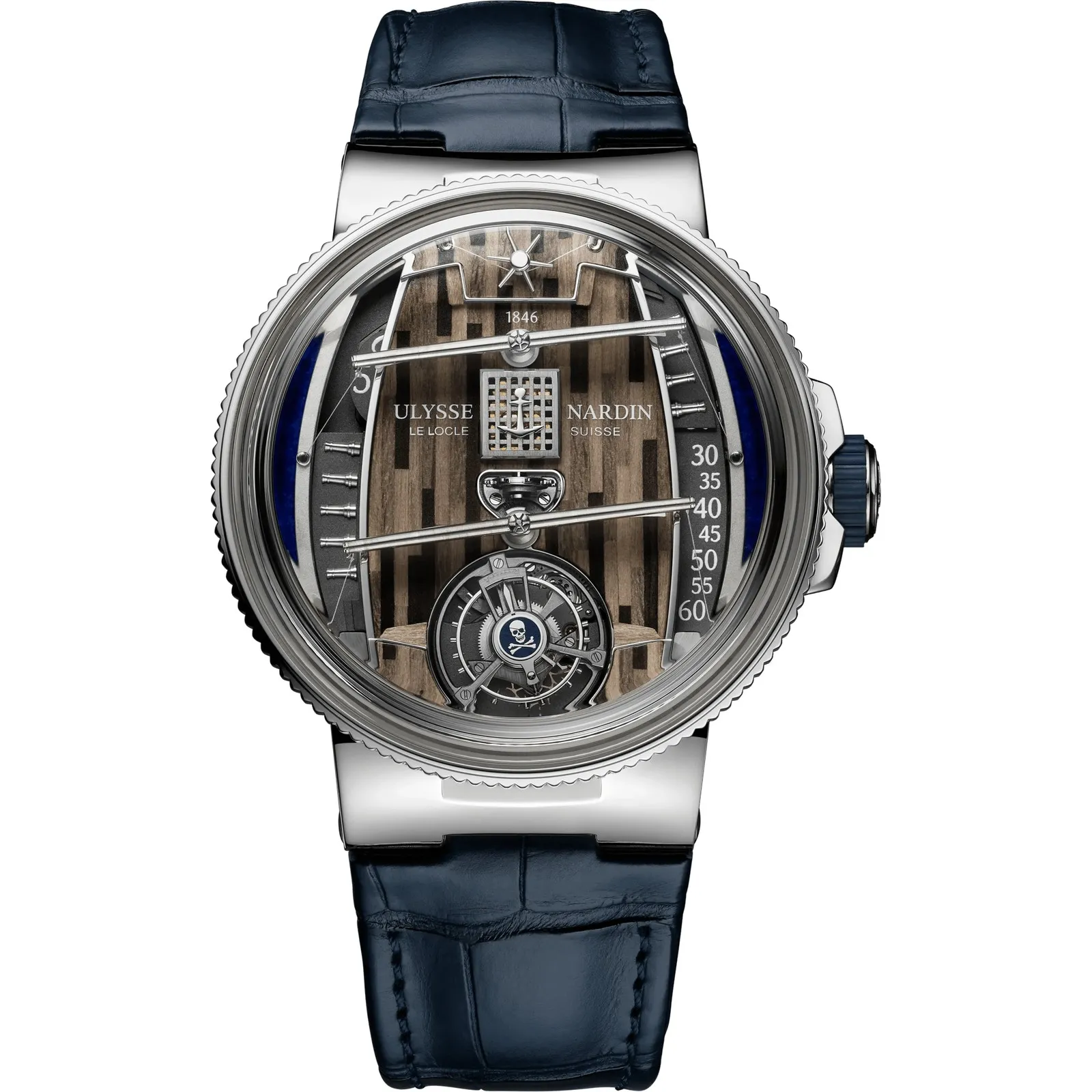
And the greatest master of these marine chronometers was Ulysse Nardin, founded in 1846 in Le Locle. The house supplied chronometers to more than fifty of the world's navies; at the demanding precision trials of the Neuchâtel Observatory it gathered more prizes than the sum of its rivals. So the brand's Marine collection is not an ornamental theme but its very blood. The Marine Corsair is the last work to crown this heritage: a corsair's tale forged in solid platinum, completing the brand's Marine trilogy, made in only thirty examples in the world, and priced above three hundred and eighty thousand Swiss francs.
A Deck Beneath the Glass
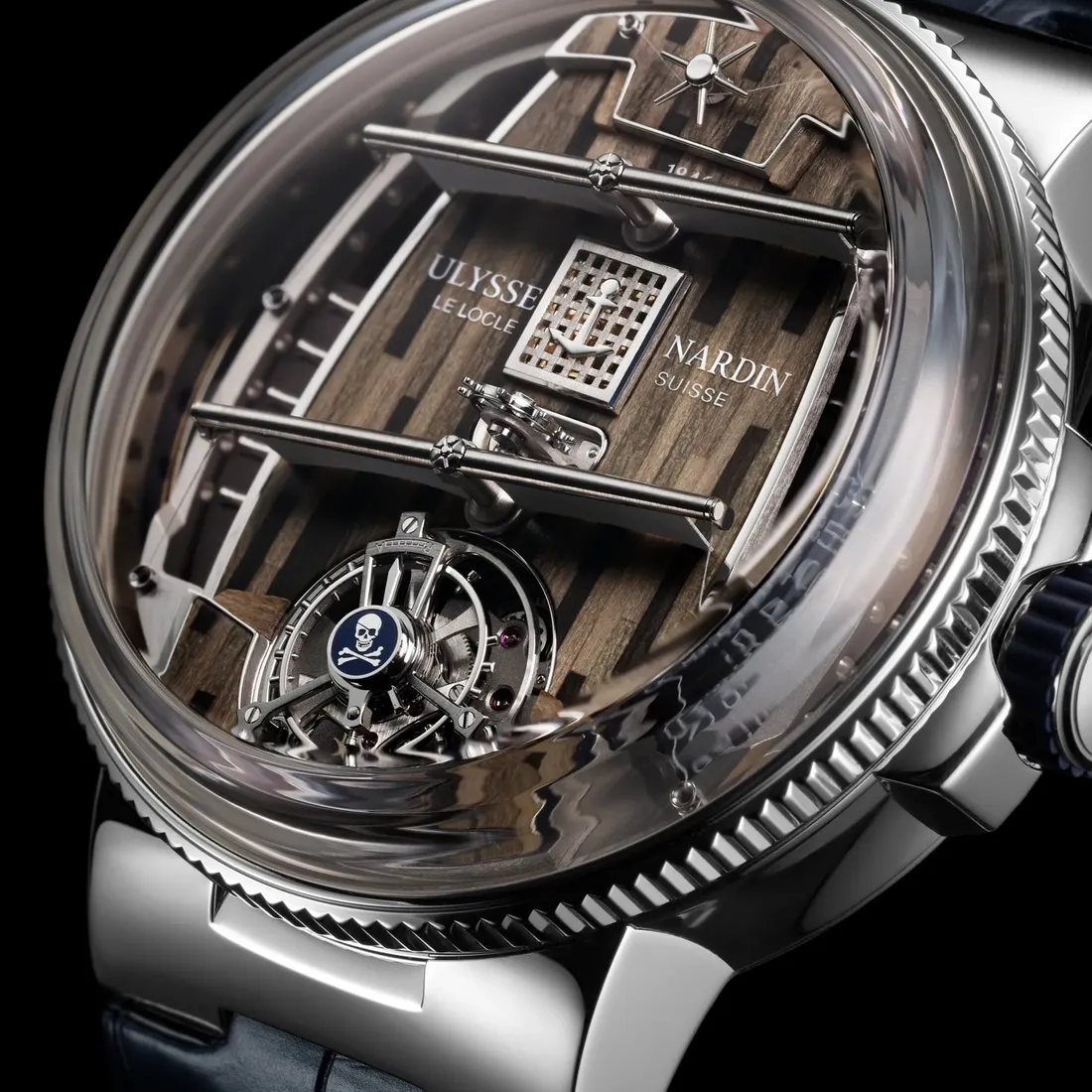
When you look at the watch, you notice that the dial is not paint but real wood. It is a marquetry of oak, laid by hand. The master splits the oak into slices as thin as paper; he chooses each piece one by one for the direction and tone of its grain, cuts it, and sets it side by side like the planks on the deck of an old ship, uniting them all upon a single surface. The aim is not a flawless shine; on the contrary, it is the lived-in, weathered texture of a deck aged by salt and sun.
Upon the dial, on a plaque bearing an anchor, stands a date like a ship's flag: 1846. The scale wrapping the right edge shows the power reserve; like a ship's sounding line, it reads off, degree by degree, how much power remains in the movement. And beneath all of this deck, in the depth of the glass, a heart beats.
A Heart that Turns Against Gravity
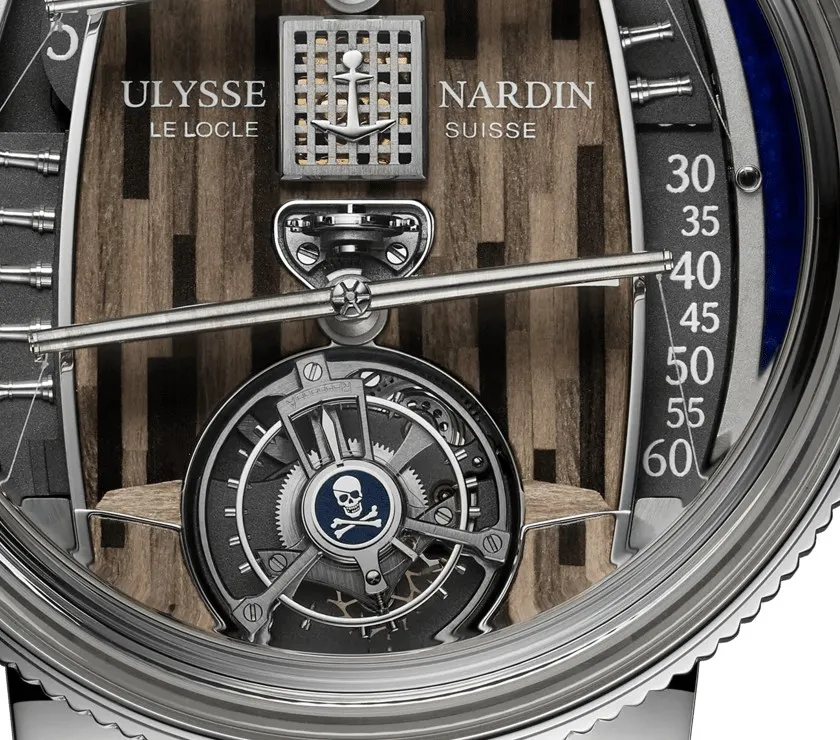
That heart is a flying tourbillon. The tourbillon was invented in 1801 by the great master Abraham-Louis Breguet; the idea was simple but ingenious. The escapement and balance, the most delicate part of the watch, are affected by gravity when held in a fixed position, now speeding the watch up, now slowing it down. Breguet placed this assembly inside a continuously turning cage; as the cage rotates, gravity's effect in every position is averaged out and cancelled. In short, the tourbillon is a way of defeating gravity.
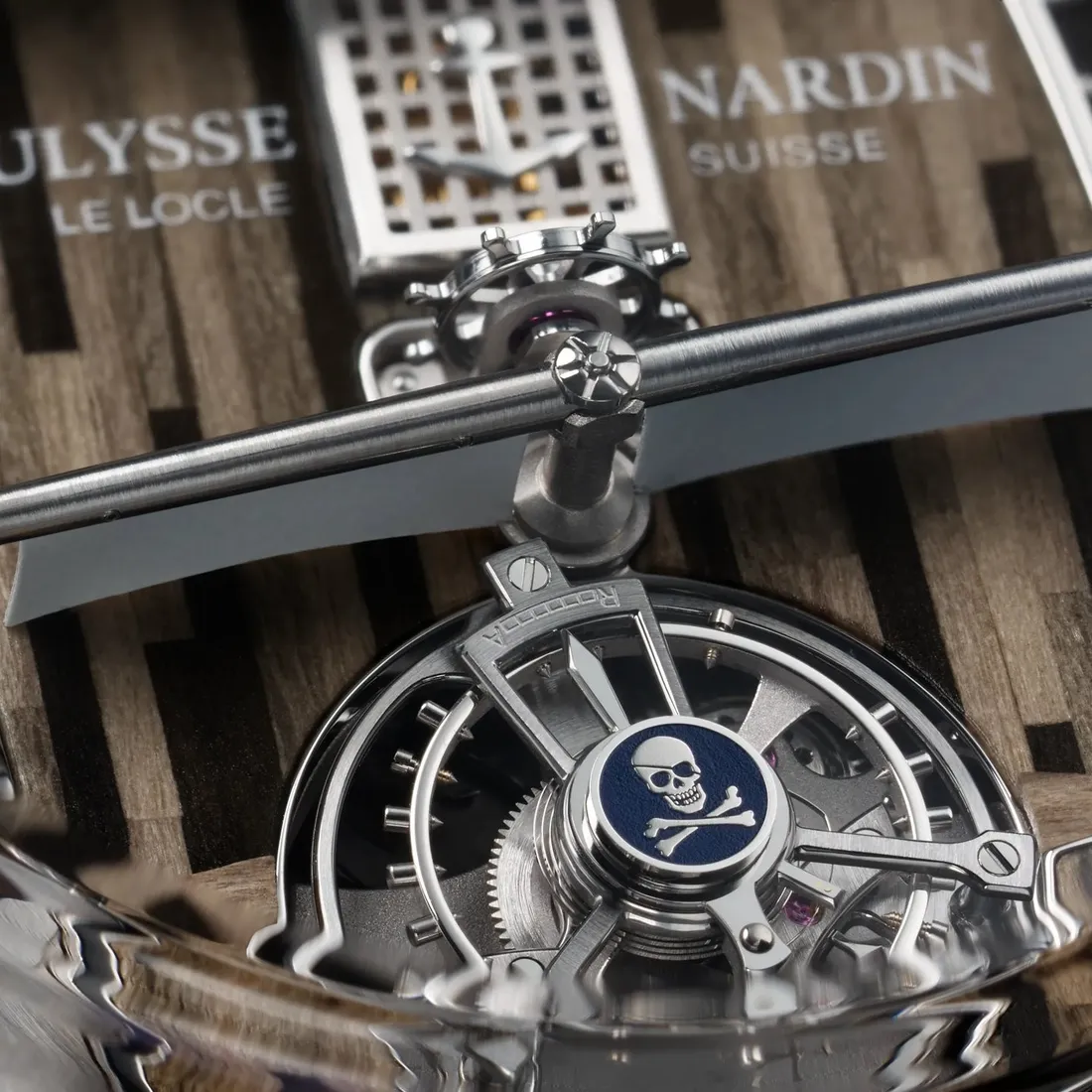
In a marine watch the meaning of this runs deep. The whole reason for the marine chronometer's existence was to keep time true despite the ceaseless roll of the ship; and the tourbillon does exactly that, telling the truth against the trickery of motion and gravity. It is called flying because there is no bridge holding its cage from above; the cage is carried only from below, so it seems to float in the void, and it is one of the most demanding feats in watchmaking. Ulysse Nardin set upon this turning cage the corsair's famous flag: a skull upon a blue ground. At the very heart of the watch, a quietly turning Jolly Roger.
A World of Six Hundred and Seventy-Four Parts
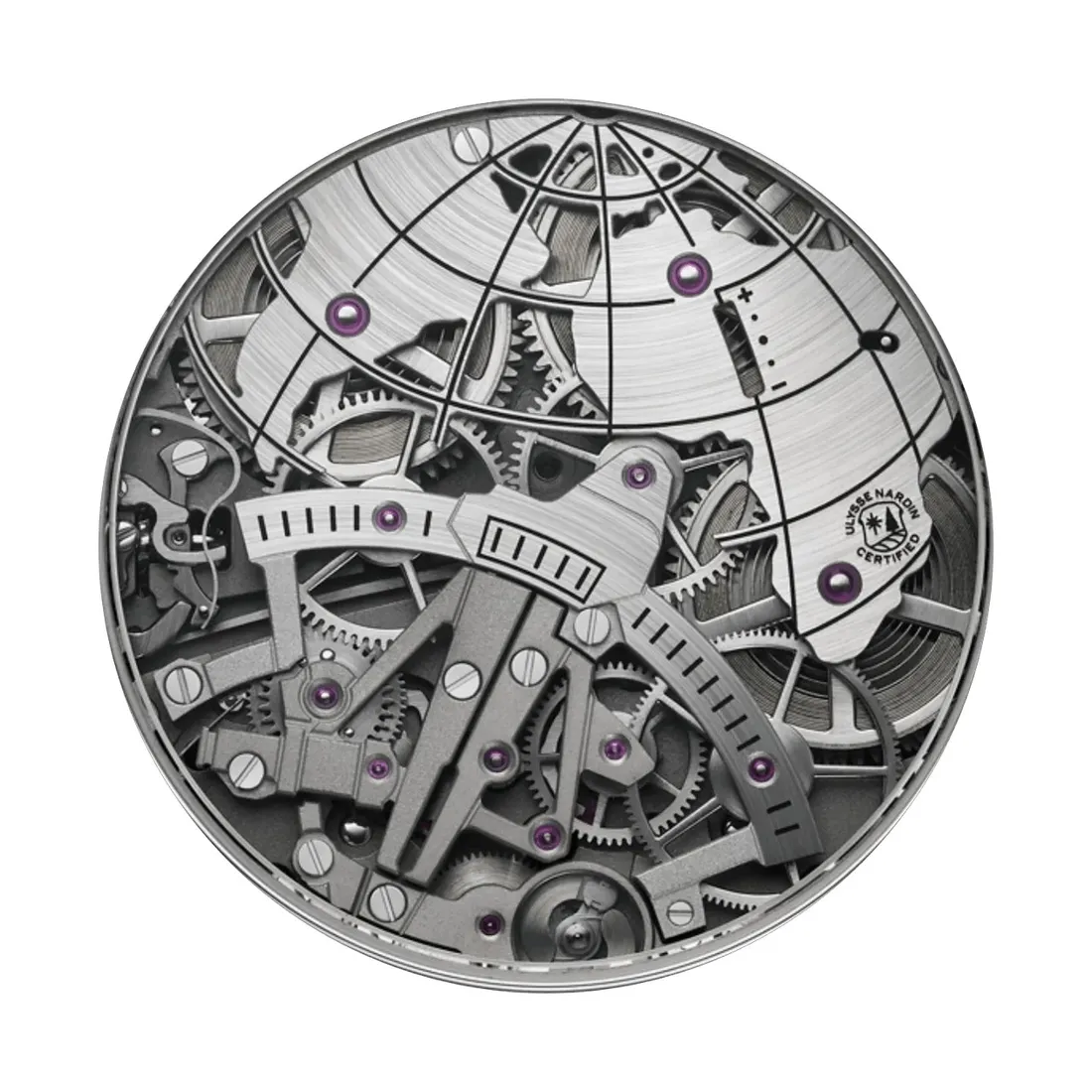
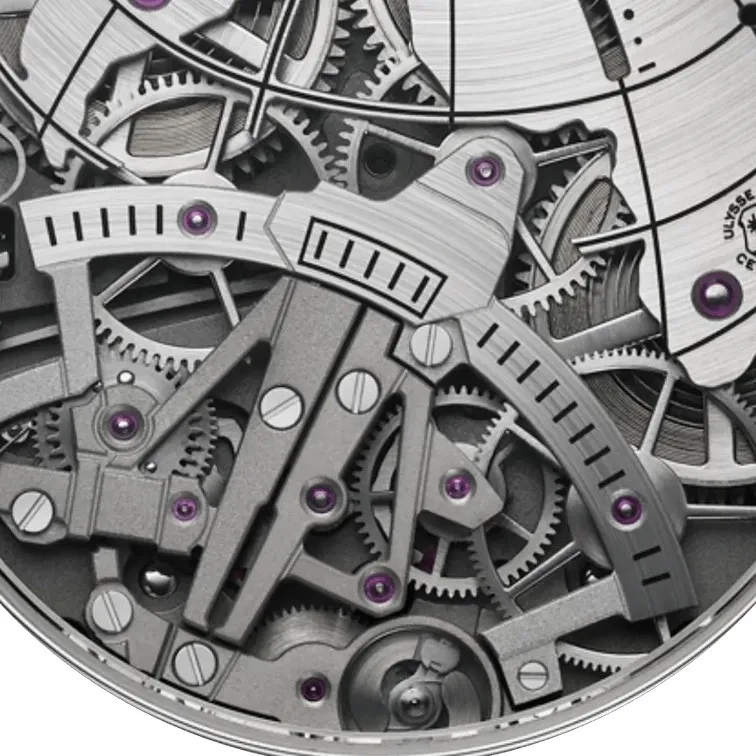
All of this is driven by the hand-wound UN-632 caliber. This thirty-seven-millimetre movement is made of six hundred and seventy-four separate parts and fifty-eight jewels; it beats at twenty-one thousand six hundred vibrations an hour and holds a forty-eight-hour power reserve. With its skeletonised bridges, its purple jewels and its hand-finished, mirror-polished edges, the back of the watch is as much a feast for the eye as its face; each wheel is like a cog of that invisible helm beneath the sea.
And the case enclosing this whole universe is forty-four millimetres of solid platinum. Platinum is the heaviest and one of the rarest of the precious metals; it is far harder to work than gold, and the dense weight it lends the wrist is a sensation all its own. To carry that weight is to carry a precious cargo, like the treasure in the hold of an old ship. And of this treasure there are only thirty in the world.
Freedom Within Order
Once, a chronometer would save the lives of an entire crew; without it the ship lost its way and men drowned. Today that vital precision is no longer a necessity but an act of homage: a salute to that heroic age when the ocean was tamed, and to that brass heart in its felt box. The Marine Corsair carries all of that heritage to your wrist.
The corsair always lived between two worlds: between law and freedom, between the fixed pole star and the boundless sea. The tourbillon, turning freely in its cage yet never losing a second, is the very image of it: perfect order within a motion that seems limitless. A deck, a compass and a flag; all beneath a single dome of glass, carrying the memory of the sea, upon the wrists of only thirty people.