A cold winter night in 1609, Padua. That day Galileo Galilei had ground glass lenses with his own hands, set them into a lead tube, and built the primitive spyglass that would change the fate of astronomy. He climbed onto his roof, turned the tube toward the Moon, and pressed his eye to it. Until that moment everyone had believed the Moon, like everything in the heavens, to be a perfect, smooth, silver sphere; for ancient doctrine had declared the sky changeless and unblemished. But what Galileo saw was something else entirely: mountains, valleys, vast craters whose shadows lengthened and shrank. The Moon was no jewel of the sky, but a real place, rugged and scarred, just like the Earth.
That single glance opened the first crack in the shell of a thousand-year-old belief. If the heavenly bodies too were made of earth, of rock, of imperfection like our own, then the sky was no distant, dull ceiling, but a living ocean waiting to be explored. But to see is, at times, a dangerous courage; and Galileo had only just begun to look.
The Treason of Four Wanderers
In January 1610 Galileo turned his spyglass toward Jupiter. Beside the planet he saw three, and the next night four, tiny points of light lined up in a row. He watched them for nights on end; the lights passed now to the right, now to the left, but never left Jupiter's side. At last he grasped the staggering truth: these little moons were turning not around the Earth, but around Jupiter. So not everything turned around the Earth. These four moons were four acts of treason against the ancient cosmos; Galileo named them, after his patrons, the Medicean stars.
Then the discoveries came like an avalanche. Venus, just like the Moon, waxed and waned through phases, from a thin crescent to full; and this could only be explained if Venus circled the Sun. The milky band we call the Milky Way dissolved, under the glass, into countless stars. Upon the surface of the Sun, that disc thought flawless, spots appeared and vanished; so even the Sun changed, and turned upon its axis. On either side of Saturn were strange ears he could not resolve; centuries later they would be understood as rings. Galileo published all this in 1610 in the Sidereus Nuncius, the Starry Messenger, and gave humanity an entirely new eye with which to see the sky.
The Copernican Revolution
What Galileo saw was not a curiosity in itself; it was proof of a far greater revolution. In 1543 the Polish astronomer Nicolaus Copernicus had placed at the centre of the universe not the Earth but the Sun. This meant the overturning of an entire worldview: the Earth, believed for centuries to be the still point around which all things turned, was in truth an ordinary planet, circling the Sun like the others. The shift from an Earth-centred to a Sun-centred understanding was written into history as the Copernican Revolution.
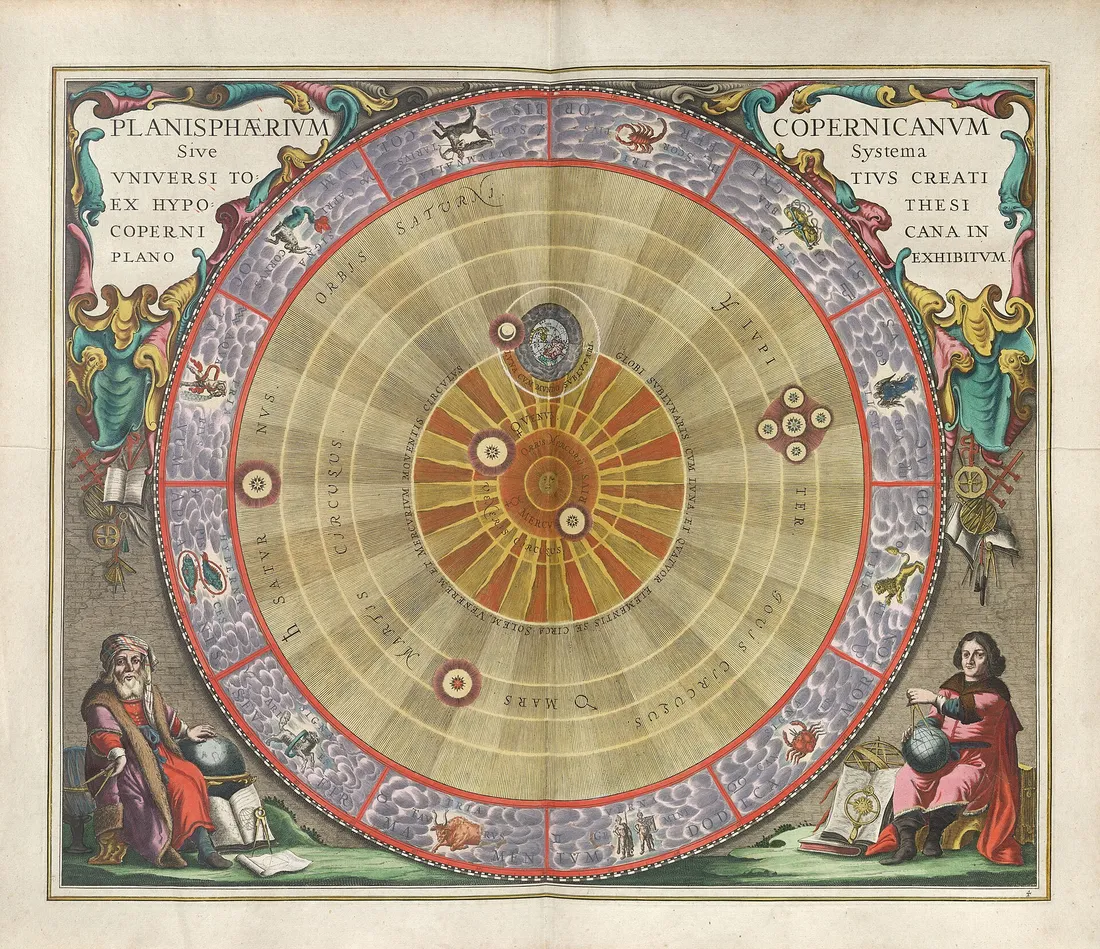
This shift changed not only astronomy but the very way humankind placed itself in the cosmos, and it lit the fuse of a greater Scientific Revolution, the moment science was born as an autonomous discipline standing on its own feet. Galileo's spyglass was the first concrete evidence, sent down from the sky, for Copernicus's bold intuition on paper. The engraving below shows that new vision of the universe: at the centre the Sun, and around it the patient circles of the turning planets.
The Book of Nature Is Written in Mathematics
But what made Galileo more than an observer, the father of modern science? His true revolution lay in his way of looking at nature. Until then, natural philosophy was verbal and qualitative: why a thing fell was debated in words and logic. Galileo, instead, measured. He wrote down how bodies fall in numbers, ratios and geometry; he turned natural philosophy from a qualitative story into a mathematical law. This insistence of his shaped the entire future of science.
He summed up this thought in his famous words: “Philosophy is written in this grand book, the universe, which stands continually open to our gaze. But the book cannot be understood unless one first learns to comprehend the language and read the characters in which it is written. It is written in the language of mathematics, and its characters are triangles, circles and other geometric figures, without which it is humanly impossible to understand a single word of it.”
And what made Galileo able to say this was what he had seen. The ratio governing the fall of a stone and the ratio holding Jupiter's moons in their orbits were one and the same; the smallest and the greatest spoke the same silent language. The universe was woven not at random but with measure, proportion, geometry. Galileo merely learned to read that language. And a book, once read, cannot help but whisper a single question too: if it is written in a language, then who wrote it? Galileo leaves the question open; but the magnificence of the order he saw calls one into a contemplation that begins where words end.
The Man Who Knelt, and the Whisper
But to see the truth did not mean one was permitted to speak it. In 1633 in Rome, the old Galileo knelt before the Inquisition and was forced to deny aloud the truth for which he had fought his whole life: that the Earth turns around the Sun. As he rose, so the legend goes, he quietly murmured: eppur si muove, and yet it moves. In the last years of his life he went blind; the man who gave humanity a new eye to see the sky surrendered his own eyes to darkness. Yet the heavens he had mapped went on turning, exactly as he had said. For truth asks no one's permission to move.
A Sky Reborn in a Sage's Hands: Ludwig Oechslin
Almost four hundred years passed. And the one who fitted these turning heavens inside a wristwatch was no ordinary watchmaker but a true sage: Ludwig Oechslin. The Swiss Oechslin is at once a watchmaker, a historian and a philosopher; a polymath holding several doctorates, reaching from the ancient languages to theoretical astronomy. Over years of labour he restored, for the Vatican, the Farnese clock, one of the most complex astronomical clocks in history; and it was there that he learned all the secrets of ancient celestial mechanics. In later years he led the MIH in La Chaux-de-Fonds, one of the world's foremost watch museums; and he became known, too, as a designer of radically simple watches made of only a handful of parts.
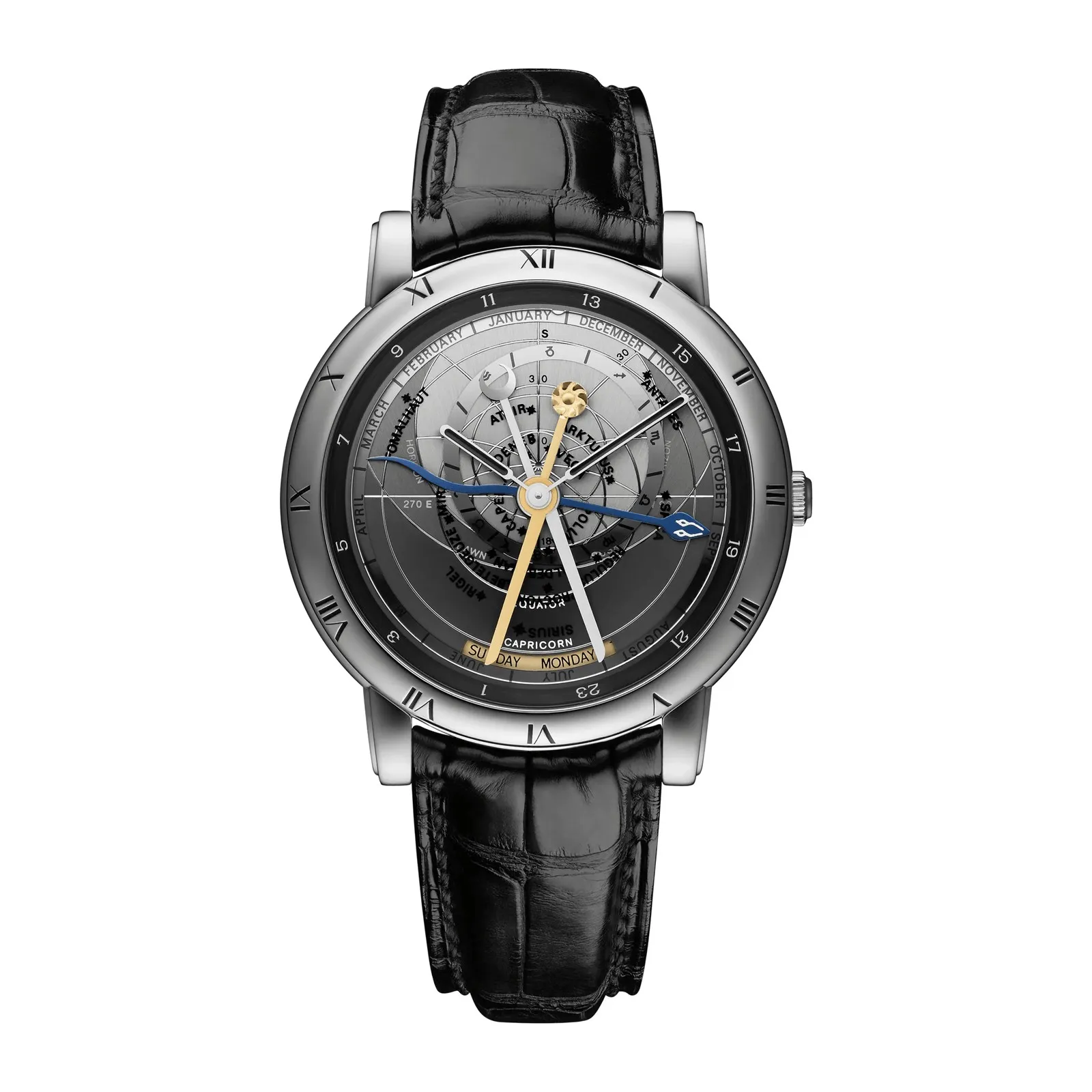
His meeting in the 1980s with Rolf Schnyder, the owner of Ulysse Nardin, gave birth to the most audacious trilogy in watchmaking history: the Trilogy of Time. The Astrolabium Galileo Galilei (1985), the Planetarium Copernicus and the Tellurium Johannes Kepler. The first, this Astrolabium bearing Galileo's name, entered the Guinness Book of Records as the most complicated wristwatch ever made by number of functions. Oechslin had set the heavens, for which Galileo suffered, turning once more in his name.
A Sky Upon a Disc
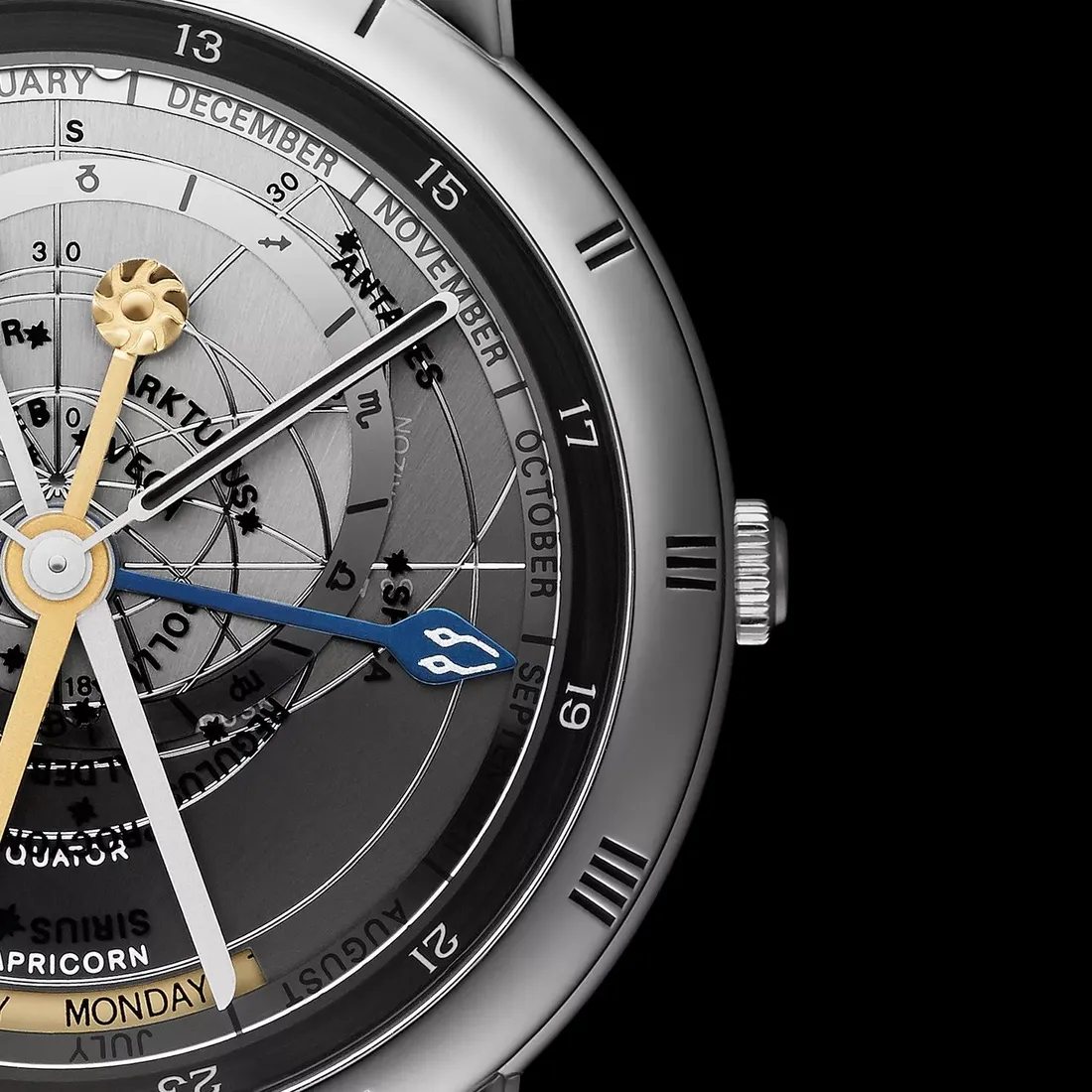
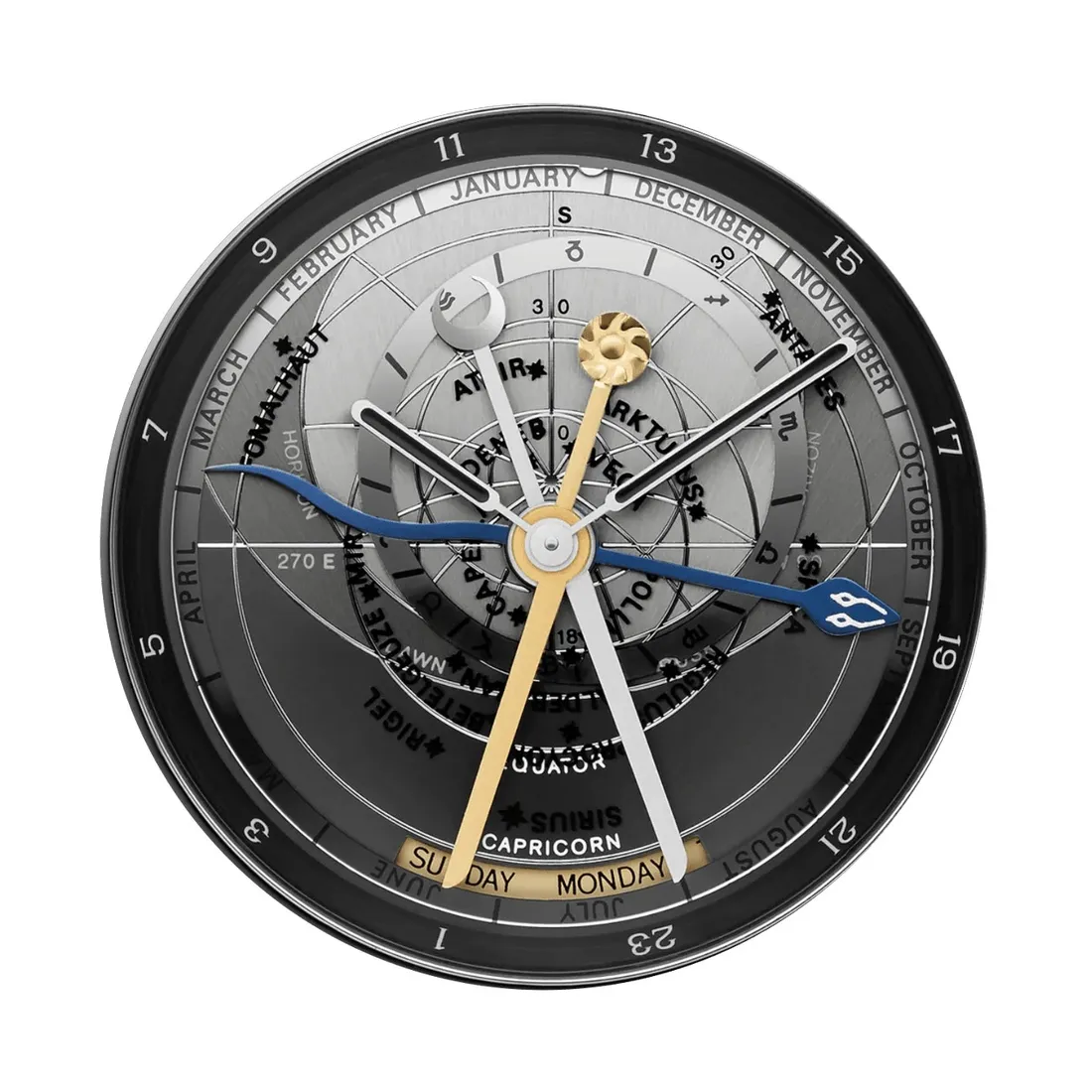
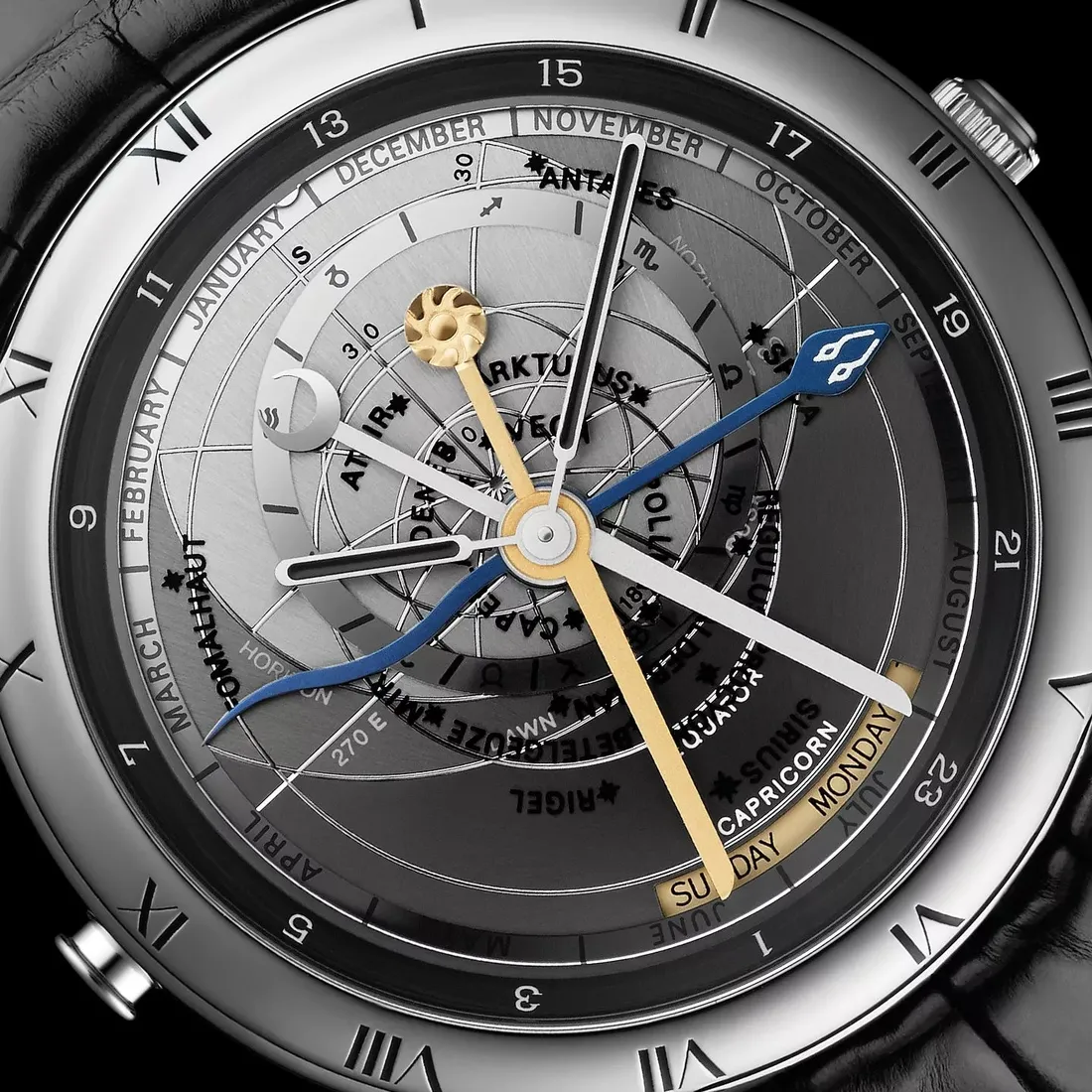
The astrolabe is a star-map of the ancient ages; a sky of brass held in the hand, used to read the positions of the stars, the Sun and the Moon. Oechslin took this thousand-year-old instrument and brought a whole sky down onto a single dial. And so the Astrolabium's dial is not read like an ordinary watch; it is a flattened sky. The hands show not merely the hour but the heavens: the rising and setting of the Sun, dawn and dusk; the phase and place of the Moon; the slow, majestic march of the fixed stars; even the eclipses of Sun and Moon.
As for that band of constellations encircling the dial, the zodiac: the zodiac is the path the Sun traces before the stars over a year, divided into twelve constellations. It is, in a sense, the Sun's address in the sky; it shows which constellation the Sun passes before in which month. The ancient astronomers read the seasons by this band; the Astrolabium carries that same band to your wrist. To raise your wrist and look is almost to look at the sky itself.
Turning the Impossible into Gears
So how did Oechslin achieve all these complex celestial motions? The secret is in turning the impossible into gears. The rhythms of the sky do not fall into whole numbers: a lunar phase lasts about 29.53 days, and the day of the fixed stars is four minutes shorter than the solar day. Oechslin translated these fractional, all but endless cycles into the tooth-counts of gear wheels; he found the combinations of teeth that bring each celestial period closest to a whole-number ratio. Think of it as expressing an unending decimal by the fraction that comes nearest to it.
And here lies the secret of the precision: the gear ratio of the hand that shows the stars is so close to the real sky that the accumulated error would need a full one hundred and forty-four thousand years to reach a single day. The 'dragon' hand that foretells eclipses points to the nodes of the Moon's orbit; when the Sun and Moon hands meet exactly upon it, an eclipse is near. All this universe is governed by the self-winding UN-99 caliber and its thirty-three jewels; like a real astrolabe with transparent layers turning one upon another, within a forty-one-millimetre case. And of this sky there are only a hundred in the world.
A Truth that Asks No Permission
Galileo was silenced; the sky was not. Today the turning cosmos for which he was tried moves quietly, without anyone's permission, upon the wrist of an ordinary person. Eppur si muove; and indeed it moves, right there upon your wrist. The watch's own words whisper the same thing: while revealing the magnificence of the sky, may astronomy help mankind rediscover the true sense of beauty.
Perhaps this is the wisdom of fitting a whole heaven onto a wrist: to make portable a single page of that great book written in the language of mathematics. And with every glance at it, to remember, in silence, how small we are, and how vast is the order we are given to glimpse from one edge.