Vacheron Constantin’s Métiers d’Art Les Masques collection proves that haute horlogerie is not only a gift for micro-mechanics but can be an object of contemplation that carries humanity’s ontological memory, its crises of taste and its pangs of existence on the wrist. On this dial, where the hour and minute hands have been given up, the accustomed flow of time is broken. The mechanism turns into instantaneous jumps in four windows around the mask, while at the centre the solid gold masks rise and the poems of Michel Butor hidden on the sapphire bring five of the great minds in the history of philosophy face to face at one assembly.
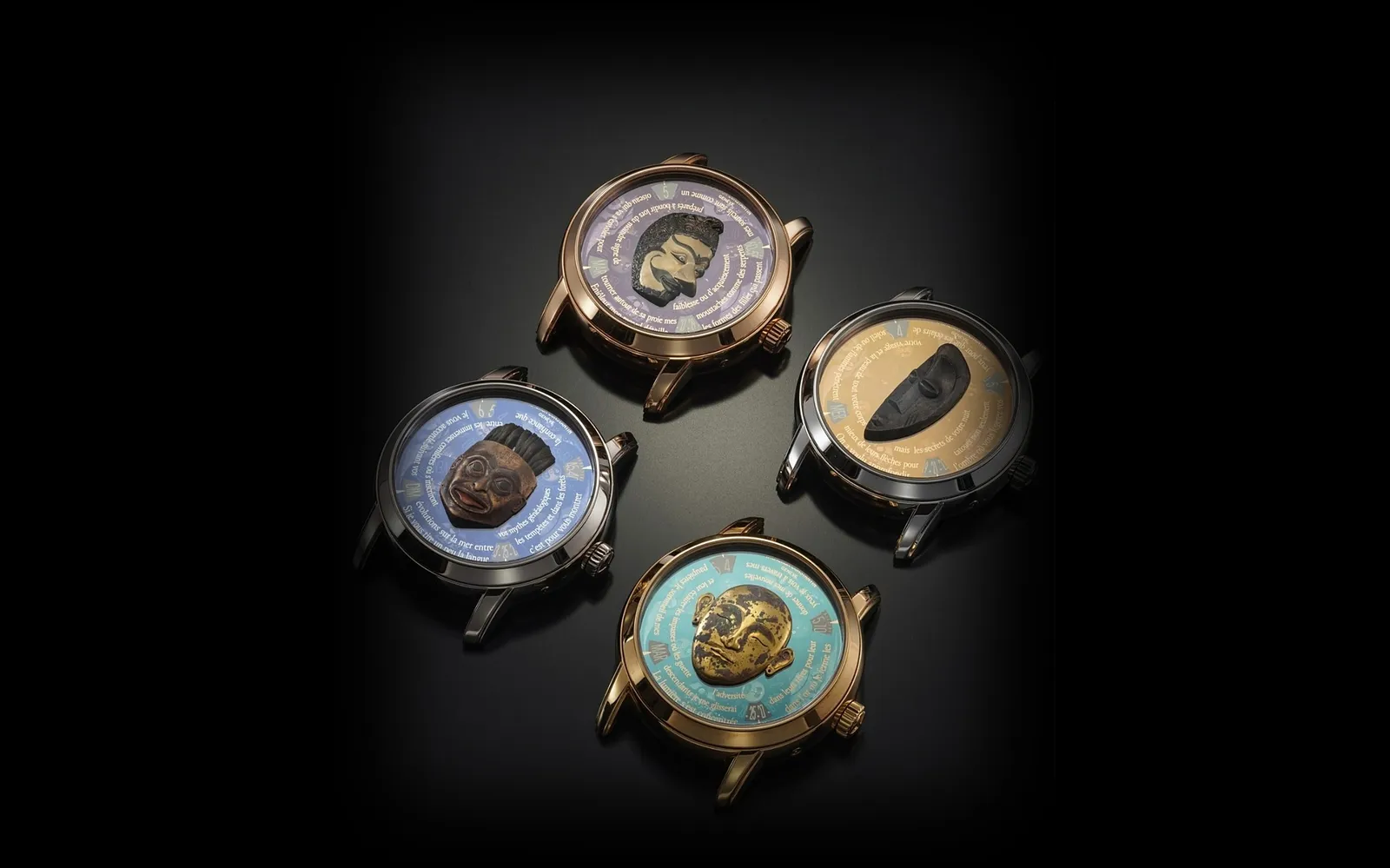
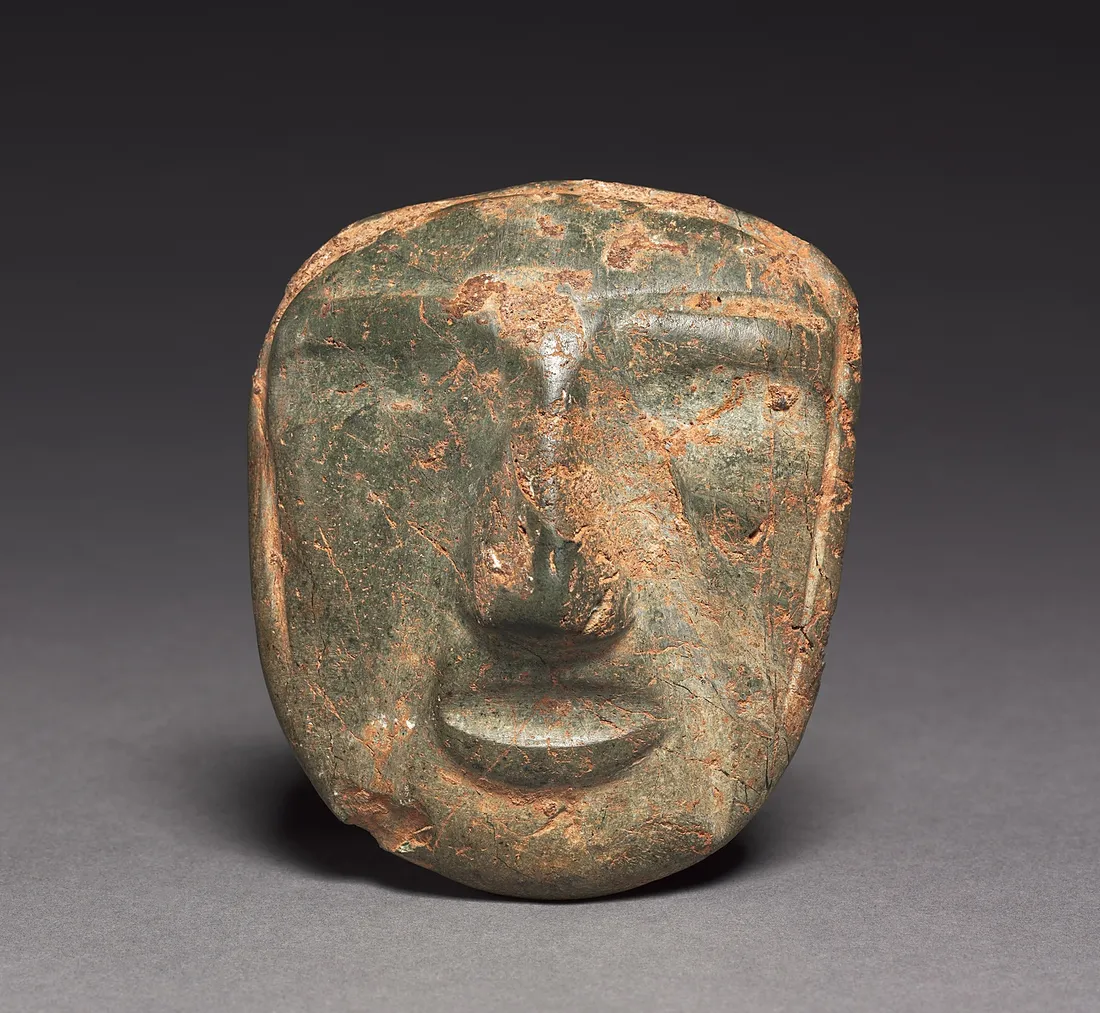
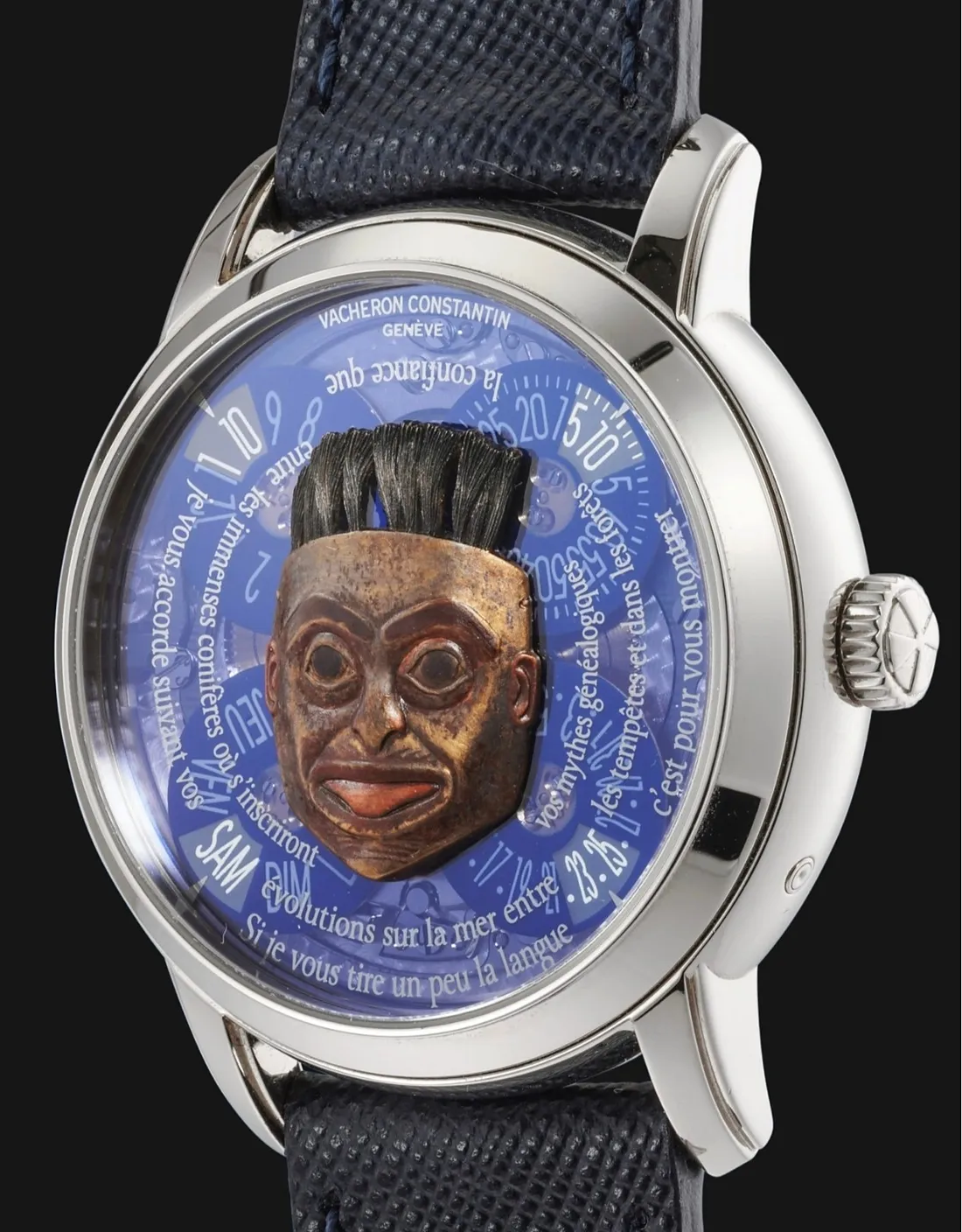
The collection was completed over three years, from 2007 to 2009, at four watches a year. Each of the four was given a continent: Asia, Africa, Oceania and the Americas. Twenty five sets were made each year; twelve watches and a hundred pieces in all. The masks on the dials are exact reductions of real objects in the Barbier-Mueller collection in Geneva. In the photograph above all four watches of one set stand together: a Qidan funerary mask from China, a face from Alaska, a face from the Congo and a dance mask from Indonesia. That is how the box was sold, four continents at once.
format_quote"Taking the hands away is an ontological decision as much as a matter of taste."
Hasan Bekmezci
The short prose poems Michel Butor wrote separately for each mask are laid onto the sapphire crystal in gold letters by vacuum metallisation, in a spiral whose end meets its beginning. At an ordinary glance they vanish entirely; only when the right angle of light is caught do they appear, glittering, across the dial. Which stands for the hidden nature of truth behind the apparent.
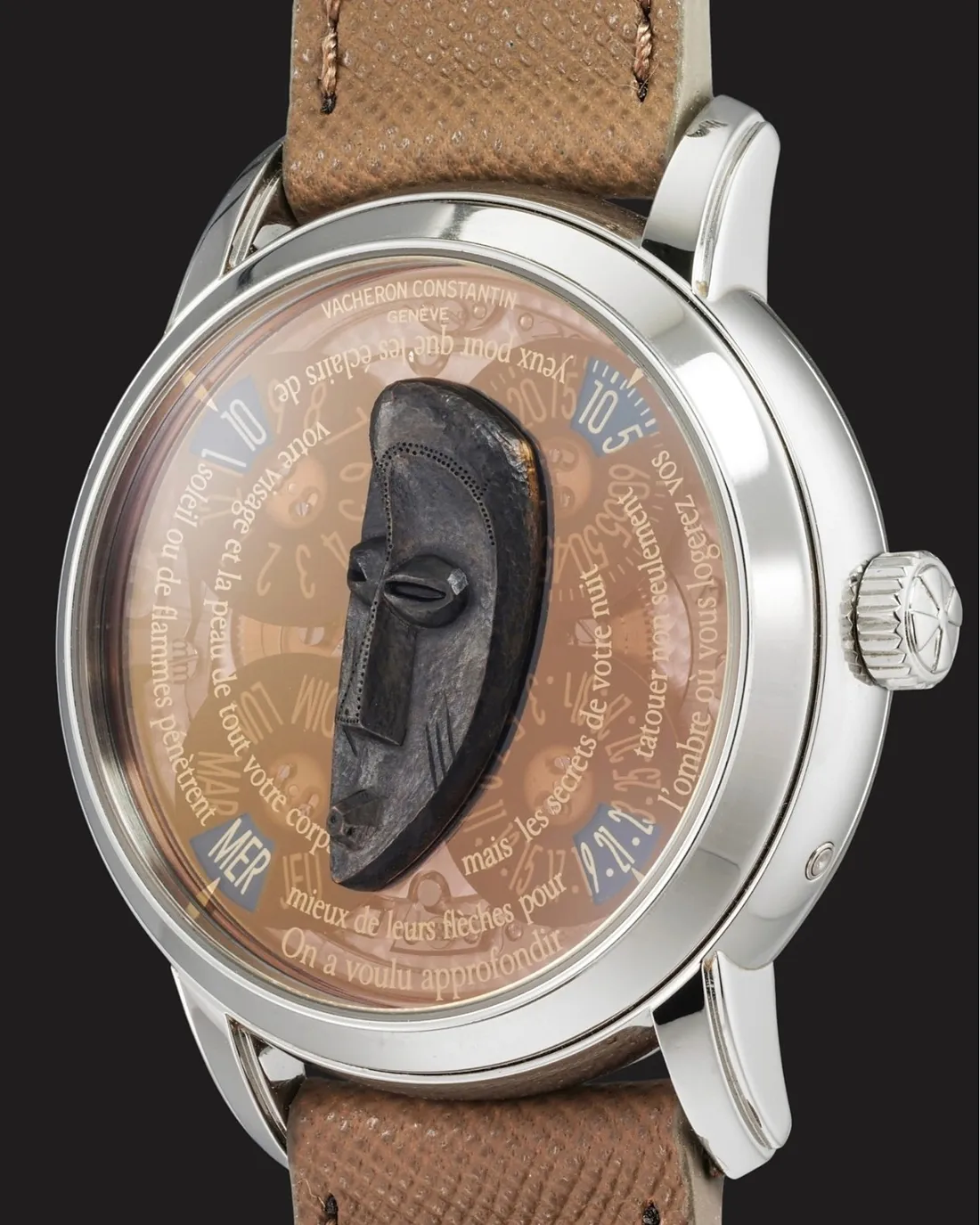
The poems are in French and we do not quote them on this page; Butor’s texts are still in copyright. But on the photographs below, where the light falls at the right angle, you can see how the letters come up out of the dials.
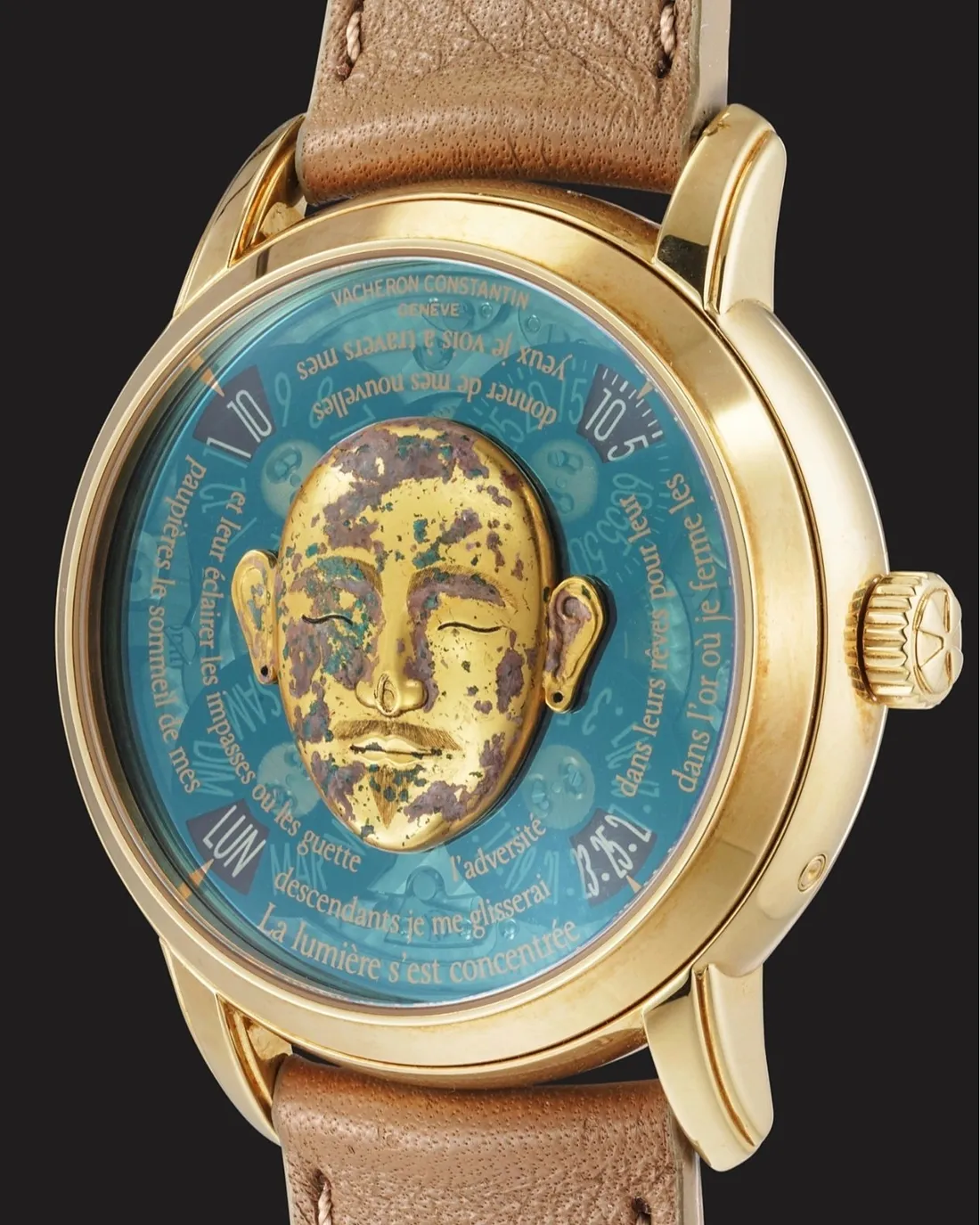
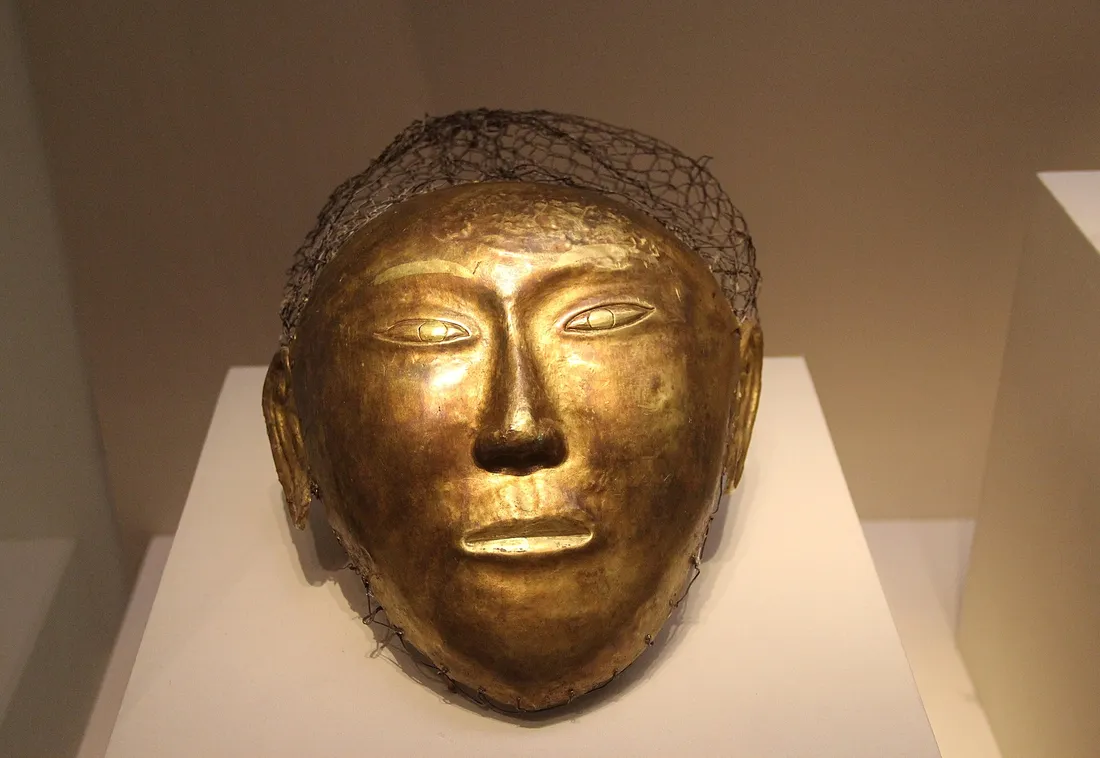
Asia’s mask comes from China: a funerary mask of the Qidan, the people who founded the Liao dynasty. The Qidan laid a mask beaten from thin metal over the faces of their dead, so that the face would be kept from decay and the identity would not scatter. The lines Butor wrote for this mask are about sleep, about eyelids closing and about light gathering at a point.
For Plato this gold mask is not a concrete object standing on a dial; it is the sign of the passage out of the shadows on the wall of the cave and into the timeless realm of the forms. The sun and the time we perceive with our senses are passing; what is real is that eternal light of the soul that appears when the eyes close.
Aristotle says his friend Plato has again taken refuge in abstractions. This structure on the dial is the inseparable unity of matter and form. The gold was a mass of potential; in the hand of the master engraver it took on form and passed into act. The flow in the poem is change itself, but that flow takes its meaning from the rational order of the mechanism.
For Ibn Rushd both the night and the flow are the unchanging mathematics of nature. The universe moves within a logical chain of causes by way of the active intellect. That time runs like a river is not an illusion but a physical necessity.
Ibn Arabi says that Aristotle and Ibn Rushd have stayed in the shell. The gold face is nothing but the self-disclosure of the truth that is the hidden treasure. The world is its reflection in His mirror; this is what his later followers would call the unity of being, a phrase he never used himself. The mask is not worn to conceal but as a veil through which that hidden beauty discloses itself.
The Ancient Master of the East reads that gold face as a seal of power inscribed on the dial by the Majestic Maker. Forgotten prayers and the night are the renewal of manifestation as time turns. The sun and the instant change, but the art of the Eternal Designer stays fresh at every moment through the renewal of likenesses.
Africa’s mask comes from the Congo. It is a face of carved wood, pigment and fire-hardened surface, held in the Barbier-Mueller, one of the largest collections of non-Western art in the world. The lines Butor wrote for this mask speak of the depth of the earth, of the moment fire touches bone, and of a light that casts no shadow.
Here Aristotle sees the concrete example of two of the four elements: earth and fire. The change of matter is explained by qualities turning into one another. Fire touching bone is the passage of matter into a new form.
Ibn Rushd says that this transformation is not accidental. The vein deep in the earth and the heat of the fire both rest on the principle of causation. Just as the wheels of the calibre 2460 G4 turn by a causation of their own, the substance of matter obeys the same rational law.
For Ibn Arabi the phrase about a light without shadow is the self-disclosure of the divine essence itself. When fire touches bone the self burns away and only He remains. That cold glitter we call time is the instantaneous flash of the breath of the Merciful.
The Ancient Master of the East sees the vein beneath the earth as a hidden vein of the power that furnishes the earth like an exhibition. And a light that illuminates without producing heat is, like the biological glow in living creatures, a sign pointing past the causes to the one who causes them.
Plato, for his part, reminds them that fire and earth are both passing forms. What matters is that the shadowless light appearing inside that darkness is light leaking in from the soul’s true homeland.
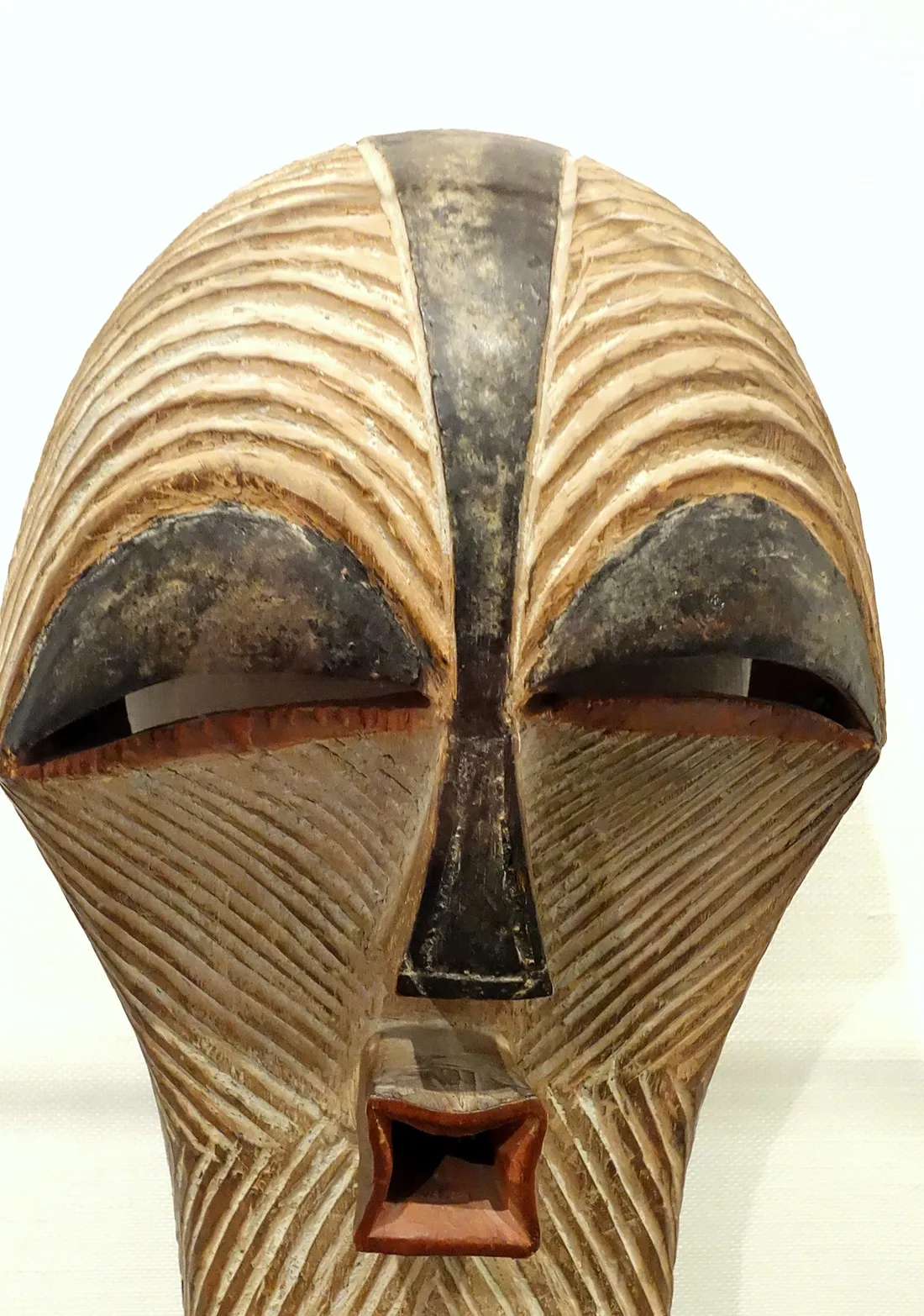
The mask of the Americas comes from Mexico, from the region of Guerrero: a face cut from stone by the Mezcala culture. It has held the same expression for more than two thousand years; the eyes and the mouth are no more than hollows, and everything else is left to the hardness of the surface. Butor’s lines for it speak of the silence at the heart of the stone and of what cannot be shaken. In the set photographed above, the watch that stands for the Americas is not the Mexican one but the face from Alaska; across its three years the collection gave more than one mask to each continent.
For Plato, though the universe comes apart the unbreakable piece stands. Because that piece is the immortality of the soul and the incorruptibility of the ideal form. The material world is condemned to ruin; the forms are eternal.
Aristotle sees in the Mezcala mask on the dial a stillness of mass. But without that potential form inside the stone, the master could not have turned it into this dial. The rebirth of the soul is the fresh disclosure of form in matter.
For Ibn Arabi the scattering universe and the shattering identity are the station of annihilation. When a person destroys their worldly self they reach that absolute silence at the heart of the stone and find subsistence. The unbreakable piece is the divine breath at the core of the human being.
The Ancient Master of the East reads that silence at the heart of the stone as the expression of an order matter could not have set up by itself. The scattering of atoms is not death but a discharge from duty. Though the exhibition of the world closes, that unbreakable piece is the unshakeable truth on the journey of the resurrection.
Ibn Rushd, for his part, sees the unbreakable piece as the common intellect of humanity. Individual identities perish and universes change; but the universal intellect and the laws of logic are never shaken.
format_quote"Time has been taken out of the shape of a line that hurries a person along."
Hasan Bekmezci
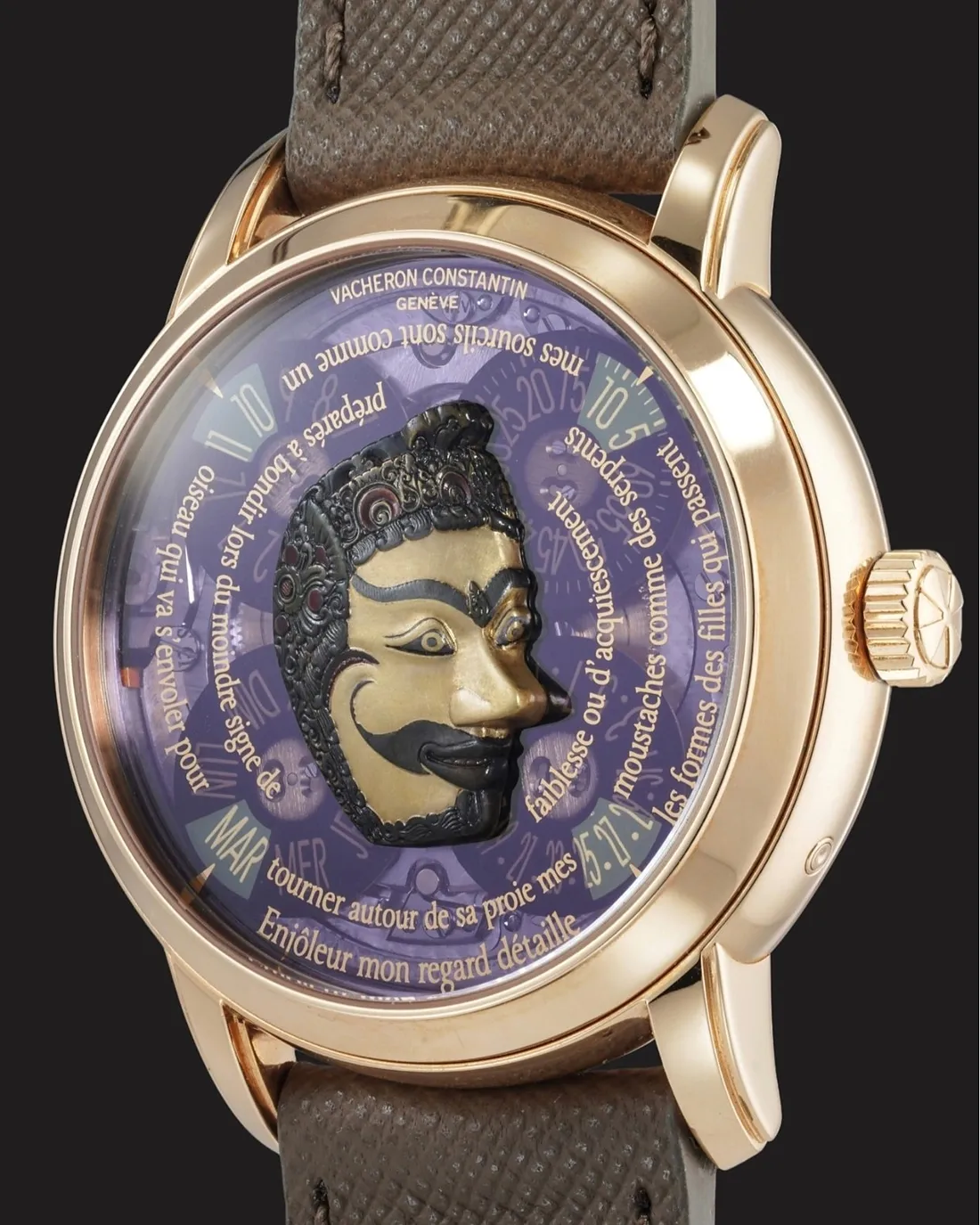
Oceania’s mask comes from Indonesia, from the island of Lombok. It is a face cut from wood, and in the mask tradition of the island it is an object that covers the face of a dancer and turns them into someone else. Butor’s lines speak of the depth of the ocean, of a tree given over to the wind, and of a gaze no place can hold.
For Ibn Arabi, that single gaze at the heart of time is the gaze of the knower who is the son of the moment. Time is not the past or the future; time is this present instant in which the self-disclosure is met.
For Plato the body is a cage for the soul, just as the mechanism is shut inside the case. But the soul, with the right kind of looking, which is to say by remembering, passes beyond that cage and rises into the timeless.
The Ancient Master of the East reads the hidden breath at the bottom of the ocean as the sign of a mercy that feeds even the least visible creature without forgetting it. And the tree giving itself over to the wind is the principle of perfect trust and surrender in nature.
For Aristotle the swaying of the tree in the wind is the principle of motion itself. Everything that moves needs a first mover that does not itself move. Like the mainspring in the mechanism, the world too has a first mover.
Ibn Rushd sees that single gaze as the intellectual intuition of the moment in which a person grasps the universe with their reason. A human being can break the cage of the senses only through rational thought and the right angle of looking.
The concrete horological facts standing behind this deep assembly are these.
Taking the hands away is an ontological decision as much as a matter of taste. Time has been taken out of the shape of a continuously turning line that hurries a person along, and turned into instantaneous jumps in four windows around the mask. One window gives the hour, one the minutes, one the day of the week and one the day of the month. The dial itself is semi-transparent sapphire, so the shadow of the mechanism beneath it is part of the picture too.
Inside runs the calibre 2460 G4, made by the Maison itself. It is self-winding, beats twenty eight thousand eight hundred times an hour, runs for forty hours and carries the Geneva Seal. The case is forty millimetres across and about twelve high; sapphire in front and behind, water resistant to thirty metres. The four watches of a set were made in yellow gold, white gold, rose gold and platinum.
The masks in the museum were scanned to the millimetre and carried onto the dial, after which Vacheron Constantin’s engravers worked blocks of solid gold by hand under the microscope, cutting back into them the grain of wood, of stone and of metal. The speckles, the stains and the wear on the surface of the dial are not decoration; they are the marks on the original.
Michel Butor’s poems are not a fixed ornament on the dial either. They are invisible until the wearer turns their wrist and drops the light onto the dial at the right angle. Which is the mechanical statement of a principle: truth discloses itself only to the angle that knows how to look at it.
format_quote"Truth discloses itself only to the angle that knows how to look at it."
Hasan Bekmezci
The Vacheron Constantin Métiers d’Art Les Masques is a museum piece that brings the cold wheels of micro-mechanics together with anthropology, philosophy and poetry.
The Maison’s own crafts page: Vacheron Constantin, Métiers d’Art