In the history of philosophy, teleology, the study of purpose, holds that behind every being, every organ and every order in the universe lies not a random process but a conscious aim, a set of principles and a divine will. The most famous and most classical name attached to this argument is without doubt William Paley. In his Natural Theology, published in 1802, Paley set out the celebrated watchmaker analogy.
If your foot struck a stone while you walked across a broad and empty heath, Paley says, you might think the stone had always lain there. But if you found on the ground a complex watch, its wheels turning in harmony with one another, with springs and hands, you could not think of it what you thought of the stone. Looking at the structure of the watch you grasp the presence of an intention and of an aim: this device was designed to show the time, and its parts were brought together for a particular purpose. And so, even if you had never seen the craftsman who made it, you accept the existence of a watchmaker as a logical necessity.
From there Paley moves to the universe. If even a simple watch cannot come about of itself and points to an intelligent maker, how could the universe and the world of living things, trillions of times more complex, more delicate and more immense than a watch, exist without a maker of wisdom? But this mechanical and theological bond does not merely prove the idea of a creator; it also yields unavoidable conclusions about the final purpose of existence, about an endless future.
One of the most basic principles in the understanding of being is that the Creator does nothing in vain. As modern science confirms, when we look at the works of art in the universe we see that in everything the shortest road, the nearest direction, the most beautiful and the lightest form is preferred; physics calls this the principle of least action.
A beam of light passing through water or through glass is refracted not at random but at the exact angle that will take the shortest time between two points. This rule, which carries Fermat’s name, says that light all but calculates the future and glides to its target by the ideal road. Bees too, when they store their honey, build not circles or squares but hexagonal cells. The hexagon is the geometric solution that gives the greatest volume for the least wax and leaves no gap at all; mathematicians were able to prove it only in 1999.

A soap bubble gliding through the air takes, once the currents let it be, the form of a perfect sphere of its own accord. For the sphere is the lightest form, the one that reduces surface area to a minimum for a given volume and spends the least surface tension and energy. The network of veins on a leaf likewise branches in the shortest logistical geometry, the one that will distribute fluid to every cell with the least resistance.


And here the reasoning the Ancient Master of the East drew attention to comes into view. That there is nothing idle or meaningless in the working of a watch shows that the mechanism carries a serious purpose. If a mechanism that has been wound and works perfectly is in the end to be abandoned to an irreparable ruin and to meaninglessness, then every purposeful motion within the system turns into its own opposite; order becomes sophistry. This immense seriousness, order and purposefulness in the visible universe shows that the mechanism was set up not for a meaningless annihilation but for an eternal felicity and a raising up. The Creator does not pull down in vain the order he founded with wisdom, and turn it into absurdity.
format_quote"That there is nothing idle or meaningless in the working of a watch shows that the mechanism carries a serious purpose."
Hasan Bekmezci
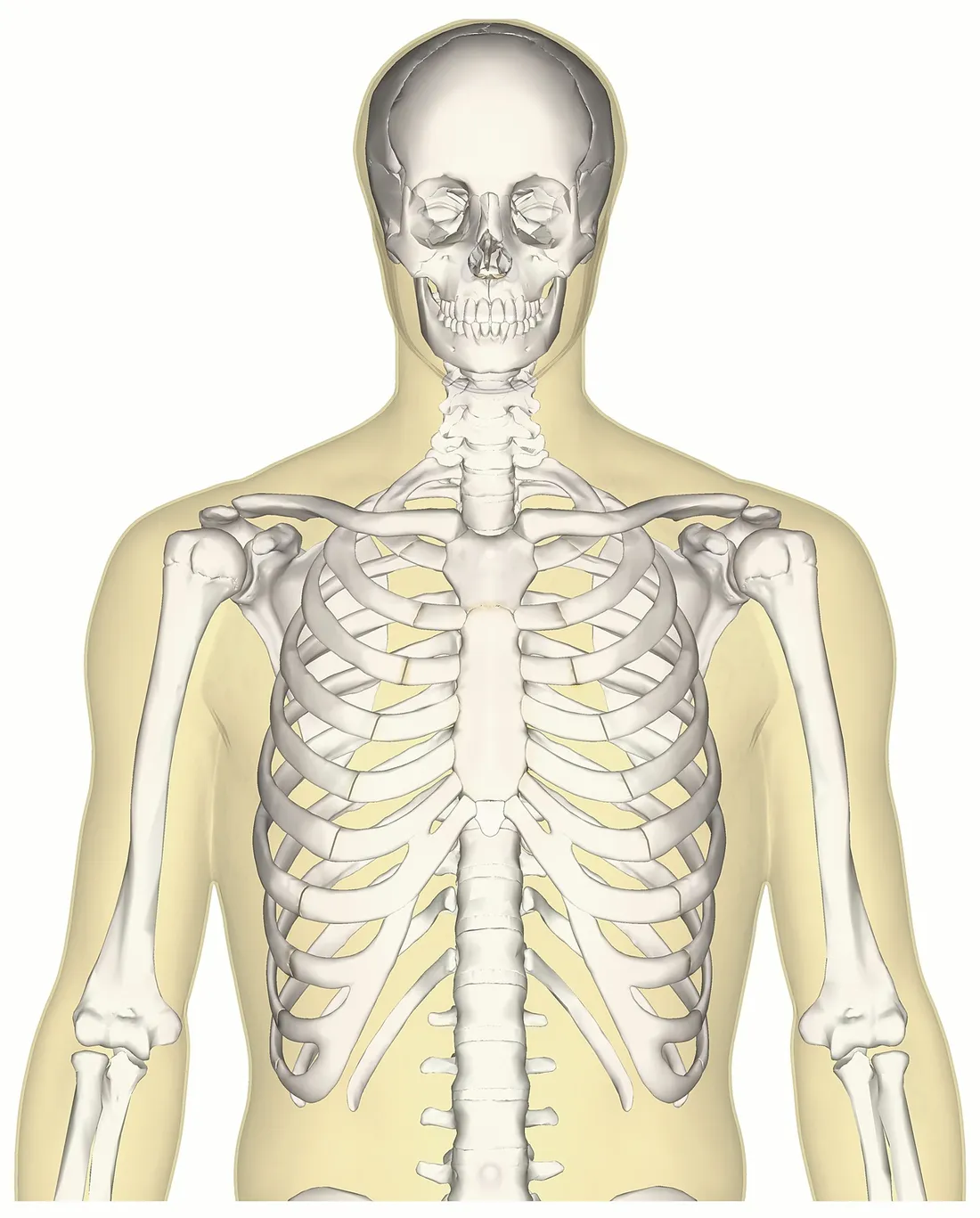
Looking at the biological structure of the human being, the small universe, we see the detail of this workmanship. There are about two hundred and six bones in the human body. Without the ribs of our chest, the heart and the lungs, our vital organs, would be crushed by the smallest blow from outside; the ribs are built as a flexible cage that widens as we breathe. The skull, rather than a single flat bone, is joined from interlocking plates with ridges and recesses, so that it both eases birth and guards the brain like armour. If our body were made of five or ten blocks of bone instead of two hundred, we could neither move, nor grip a glass, nor keep our balance.
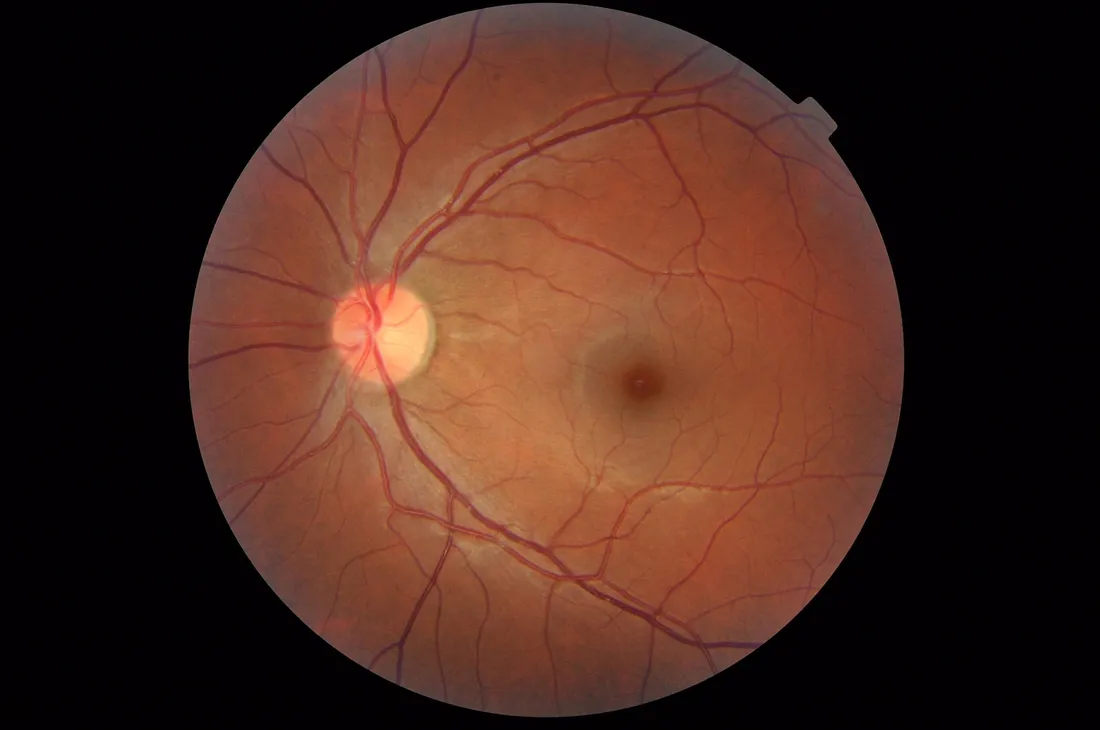
The vascular network is another layer of the same meticulousness. The arteries, veins and capillaries of a human being, laid end to end, reach a length of about a hundred thousand kilometres; that is a distance equal to two and a half journeys around the Earth. This immense network carries nourishment and oxygen to every single cell without tangling anywhere, without blocking anywhere. The arteries are the main pipeline that distributes oxygenated blood at high pressure; the veins gather the used blood back to the heart at low pressure; the capillaries are micro sieves through which the red cells can pass only in single file, and where gases are exchanged with the tissues.
The pore, the micro window, is another layer of this architecture. The millions of pores in our skin and the ion channels in every cell membrane are windows. Our body is a biochemical engine that runs without pause, and it produces heat. Without these windows the body could not throw off the heat it makes and the mechanism of sweating could not work; the core temperature of a resting body would then climb by about a degree an hour and reach a lethal point within a few hours. The cellular windows also carry the electrical signals that make the heartbeat and the waves of the brain possible, taking potassium in and throwing sodium out.
The five basic forces working inside our cells are the wheels of this factory. The first is the force of attraction: the organelles, minerals and proteins inside the cell hold together by molecular attraction instead of dispersing; the nucleus staying fixed at the centre and the chains of protein folding and drawing on one another in order to work properly are examples. The second is the force of expulsion: harmful metabolic waste, toxins and carbon dioxide are thrown out through the cell membrane. The third is the force of holding: the sugar, water and amino acids that enter are kept until they are turned into energy. The fourth is the force of shaping: each cell is given its own particular form according to the genetic code, as a neuron grows long axons and dendrites in order to carry a signal, and a red cell takes the shape of a concave disc in order to pass easily through the vessels. The fifth is the force of production: the cell divides and brings into being new cells that will renew worn tissue.
Now let us return to the dial of a mechanical watch. The rhythmic movement of the seconds announces that the minute will turn; the completion of the minute’s circuit advances the hour hand; the turning of the hour hand declares with certainty that the days and the calendar will change. The small cycle makes the great cycle necessary.
In the vast watch called the universe, the arbours and wheels of the maker of wisdom are the turning of the planets, the stars and the galaxies. The coming of the morning after the night, the raising of the earth again in the spring that follows winter, are the movement of the hands on that dial. Just as the small cycles complete and hand their turn to the greater ones, the completion of the seasons and of the life of the world is evidence that a great morning and an age of eternal felicity will dawn.
format_quote"The small cycle makes the great cycle necessary."
Hasan Bekmezci
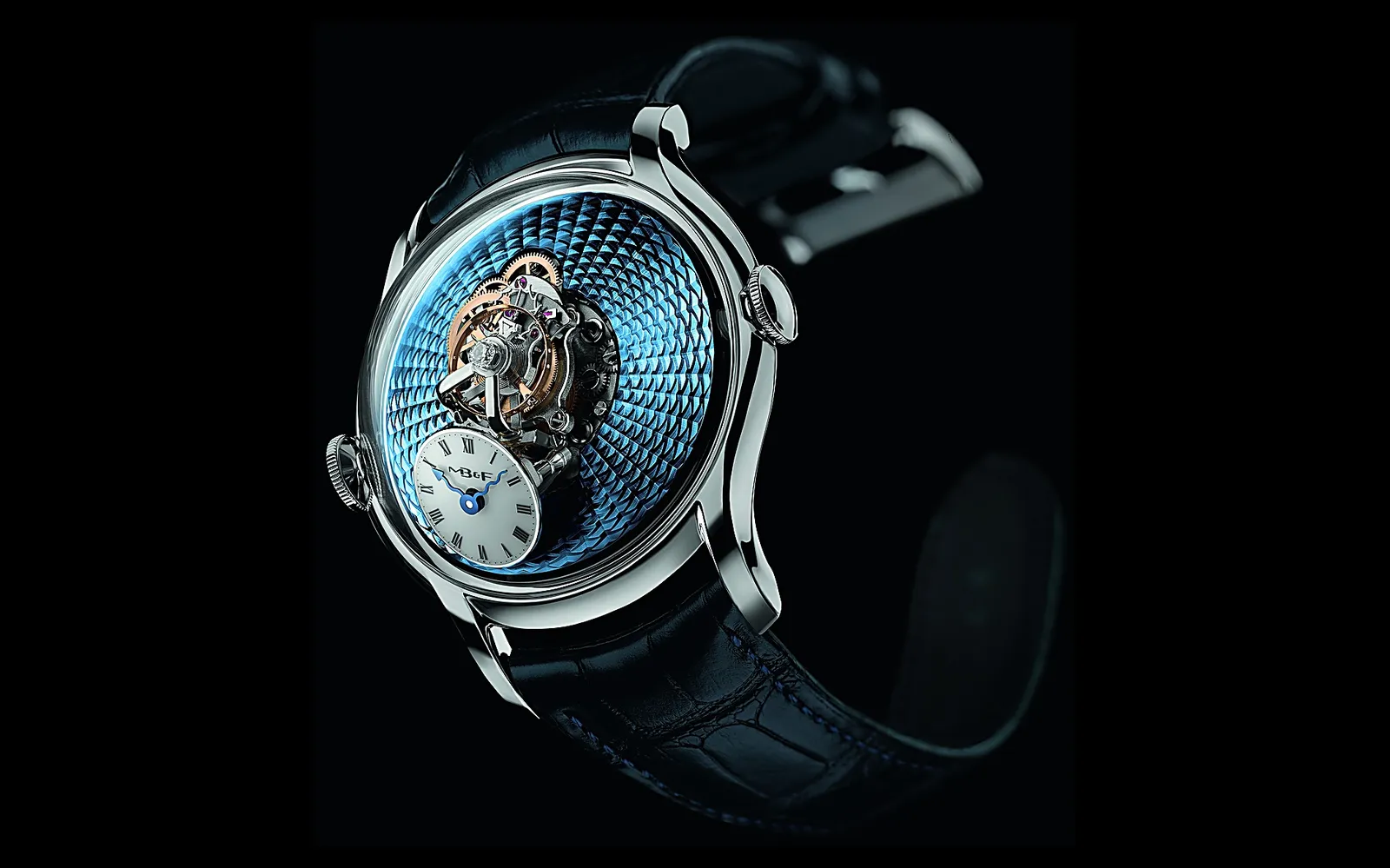
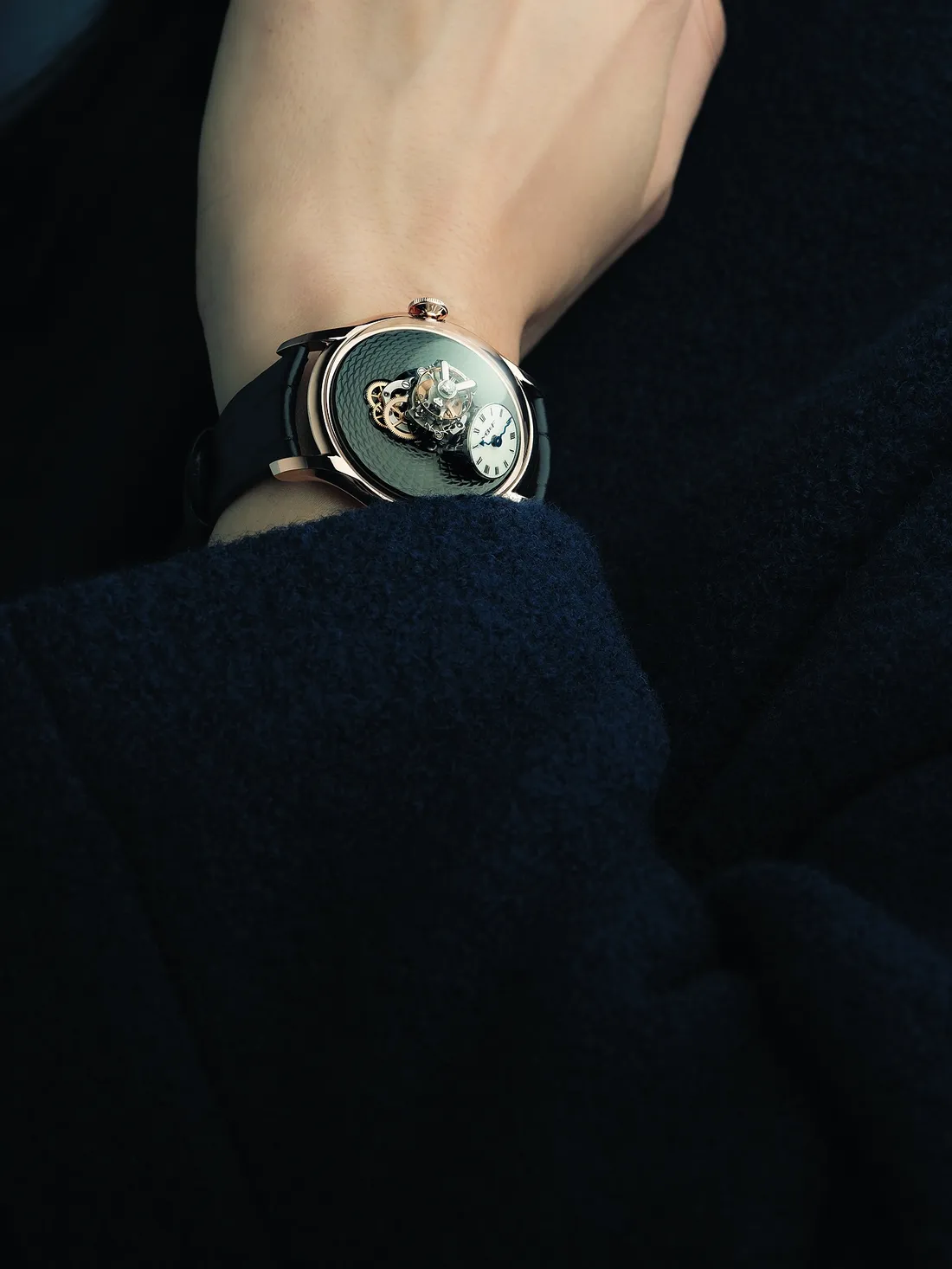
What the case of a watch and the highly complicated mechanism within it are to one another in the art of horology, the human body and the soul are to one another. The work that gives this relation its most poetic form in the fine watchmaking of our day is the MB&F Legacy Machine FlyingT Platinum. The first detail to strike you is the high domed sapphire crystal, which breaks with the flat glass of conventional watches. That transparent dome separates the delicate mechanism within from the outside world, just as the human skull guards the brain or the rib cage the heart; like the atmosphere wrapped around the universe, it takes the small cosmos inside it into keeping.
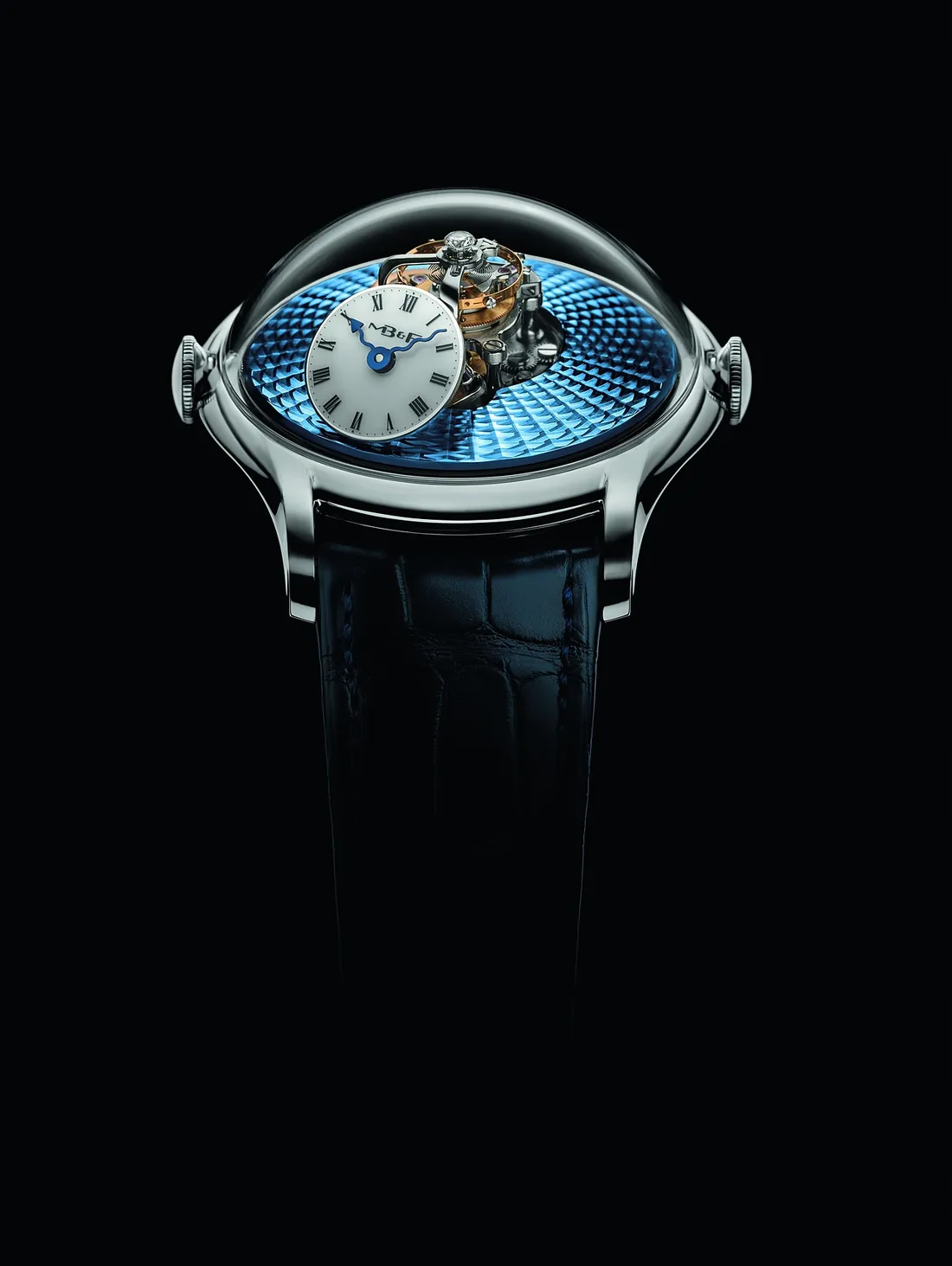
In conventional watches the tourbillon cage lies flat in the plane of the dial. In this model MB&F has set a sixty second flying tourbillon rising vertically at the centre of the mechanism. The cage shoots up like a column from the dial plate and stops just short of the apex of the sapphire dome. Supported only from below, it has no bridge above it at all; as it turns it stands in the void as though defying gravity. A single diamond fixed to the very top of the upper cage turns with it.
The hours and minutes are read not at the centre of the dial but at 7 o’clock, on a small subdial inclined at fifty degrees. That inclination is so that the time faces only the person wearing the watch; the maison describes it as an intimate communication. Maximilian Büsser says he designed this watch drawing on the women in his life, his mother above all, and that he chose the column-shaped tourbillon out of a conviction that women form the pillar of humanity.
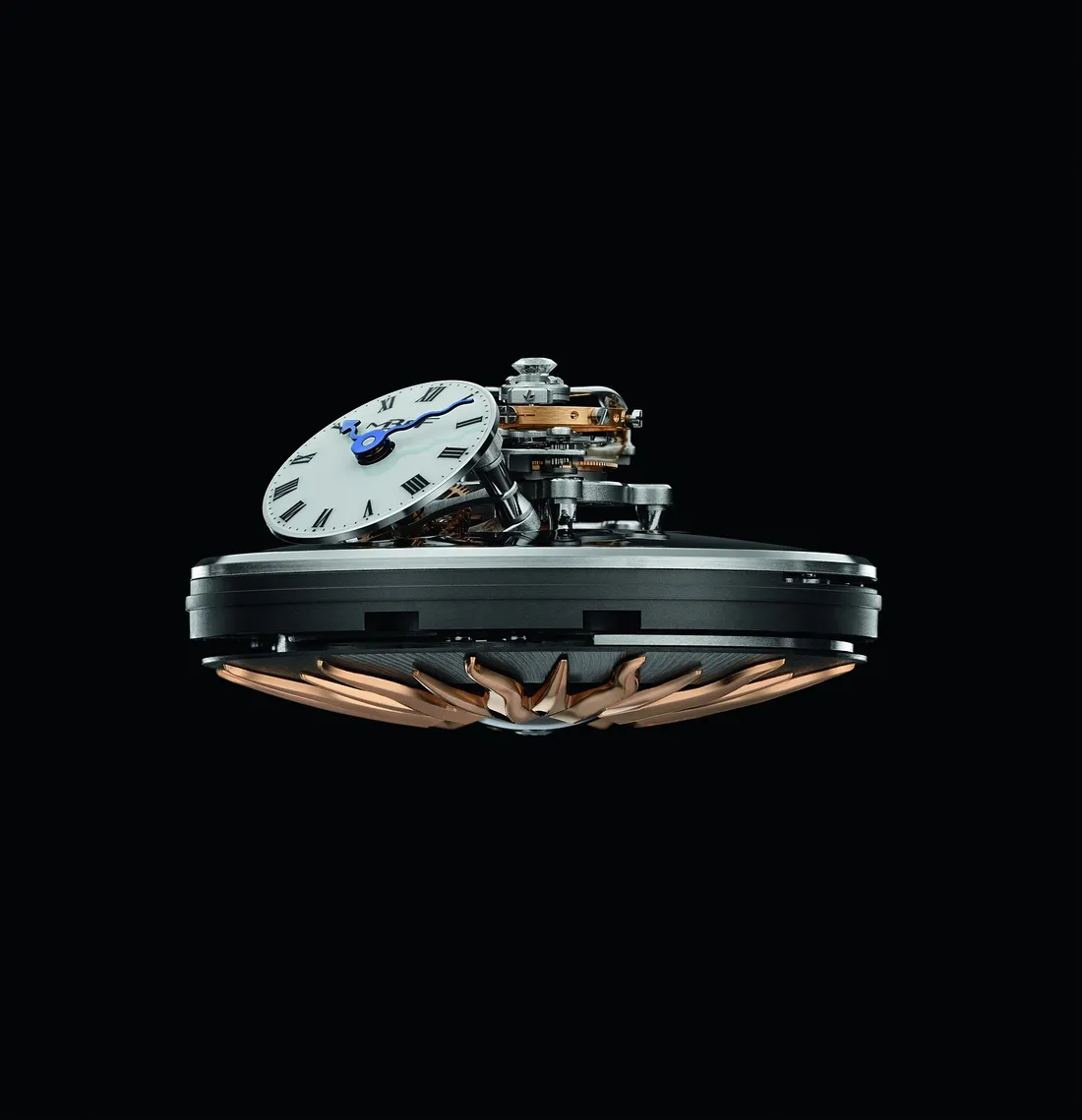
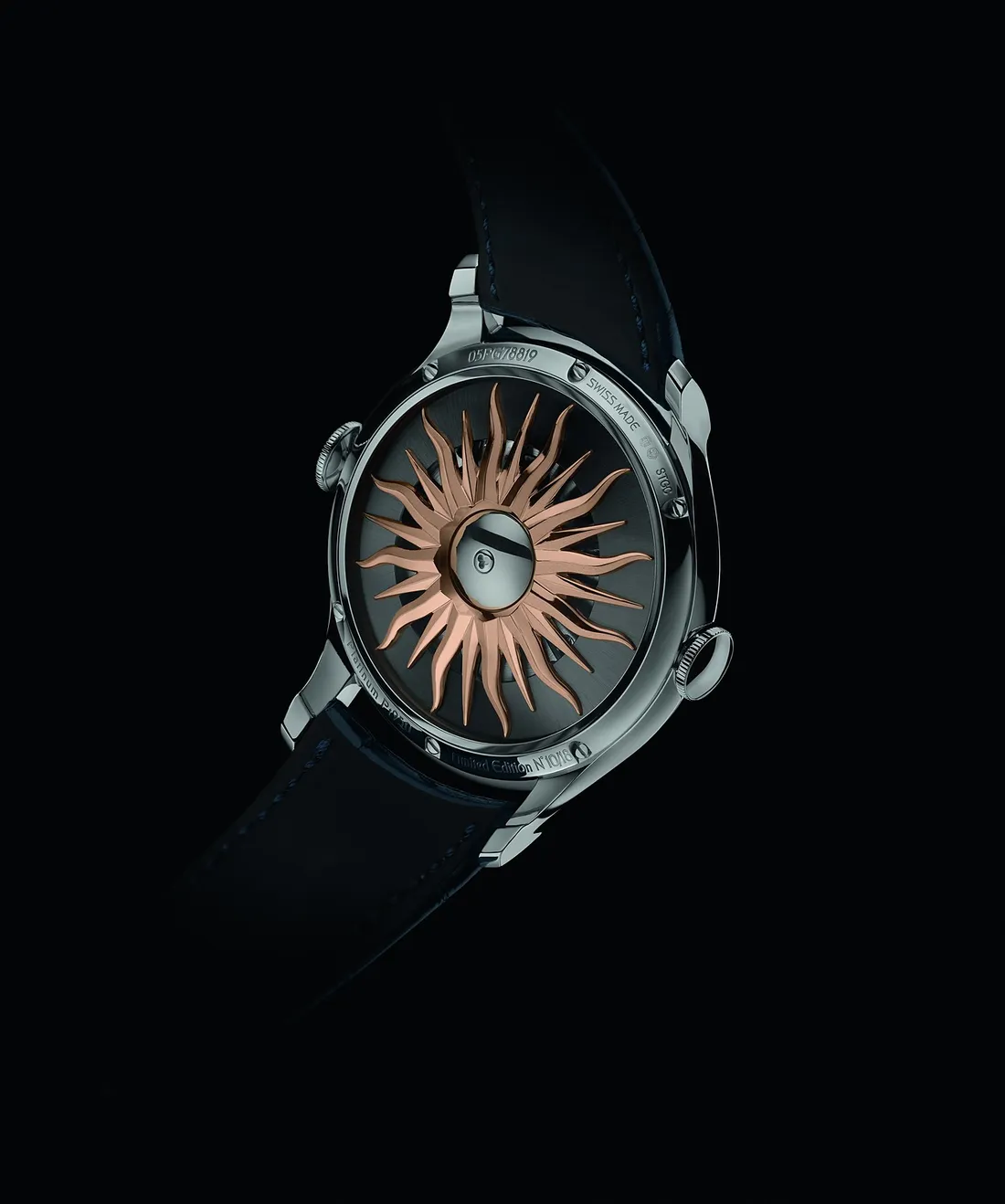
Just as the life that sits at the centre of more than two hundred bones and a hundred thousand kilometres of vessels in the human body, all the wheels of this watch and its platinum chassis have been brought together to keep that kinetic heart at the centre alive and to display it. The rotor that feeds the mechanism is shaped like a sun; Büsser says he thought of it as a life-giving source, something we gravitate towards and around.
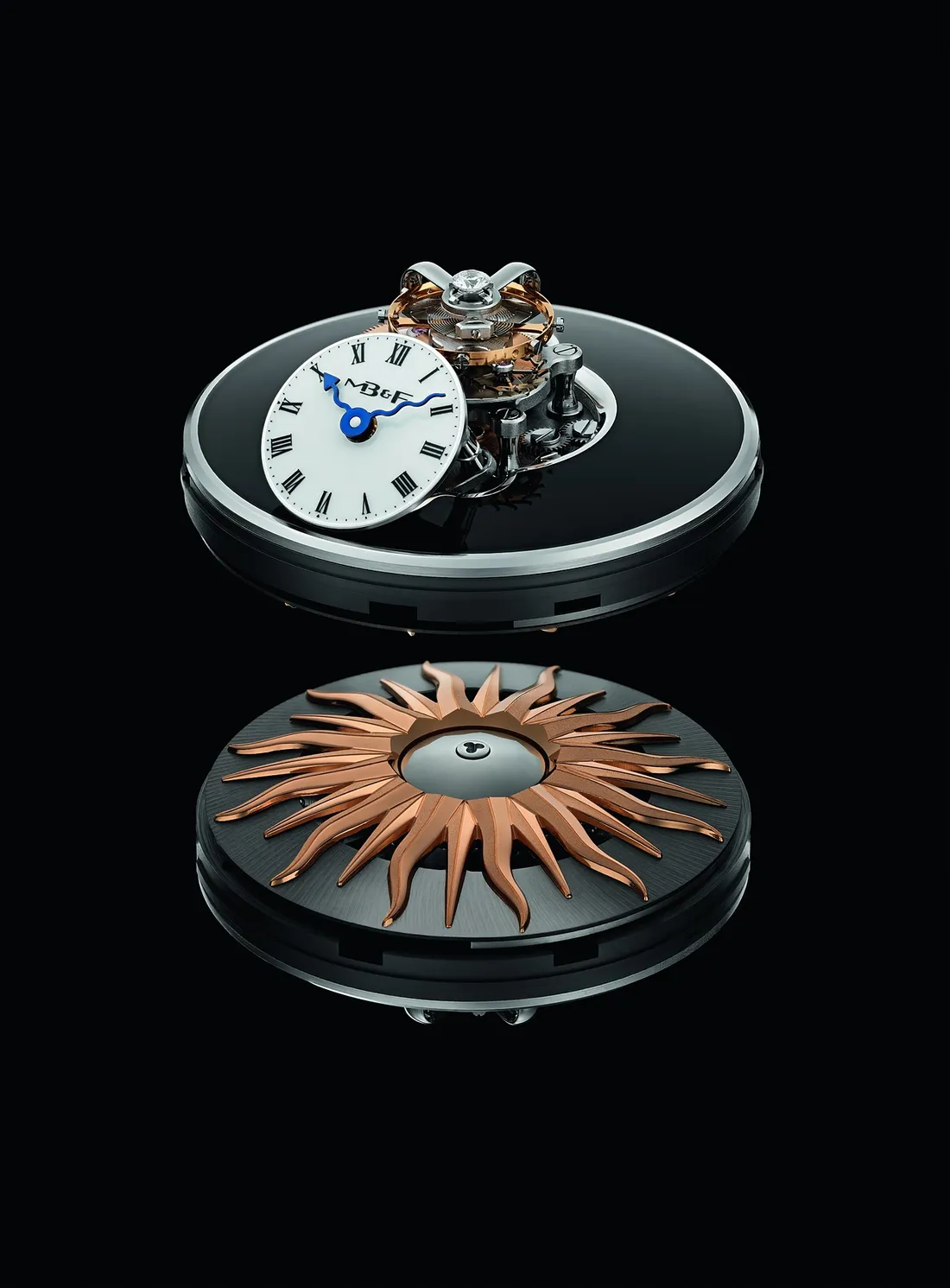
That the case is made of platinum is the horological counterpart of architectural endurance; platinum is among the heaviest and most durable of the precious metals used in jewellery. The hand-worked blue guilloché dial plate at the centre of that platinum body gives depth through thousands of small surfaces that break the light. The dimensions confirm the same balance: the case is thirty eight point five millimetres across and twenty millimetres high, built from only seventeen components, and water resistant to thirty metres. The three-dimensional vertical architecture inside it is made of two hundred and eighty components and thirty jewels, beats two and a half times a second and carries a hundred hours of power. The model was first presented in 2019; the platinum and red gold executions with guilloché dial plates are made as limited series.
Now let us ask the philosophical question. Having completed this masterpiece, with its platinum body, its hand-worked blue dial and a flying tourbillon rising vertically at its centre, is it conceivable that Maximilian Büsser and his craftsmen would dash it to the ground and break it? What mind would accept that?
The Creator who guards the garment of the body so delicately with more than two hundred bones, a hundred thousand kilometres of vessels and millions of microscopic windows, and who puts inside that guarded garment jewels worth a world, soul, mind, hopes, ideas and loves, would he dash that jewel into nothingness through death and break it? If there were no eternal felicity, all the spiritual jewels of a human being would dry up, cry out and lose their meaning.
format_quote"No detail in the universe or in human anatomy is accidental, idle or wasted."
Hasan Bekmezci
Nature is not a creator but a perfect work of art that displays his wisdom. The wonder we feel when we look beneath the transparent dome of the MB&F Legacy Machine FlyingT Platinum and watch the rhythmic, gravity-defying turn of the vertical tourbillon at its centre reaches an endless dimension when we look at our own body and at the universe. The ticking of that immense watch of the universe whispers to us that our existence will not end in nothing, but flows instead towards a perfect completion and an eternal felicity.
The watch on its maker’s own site: MB&F, Legacy Machine FlyingT