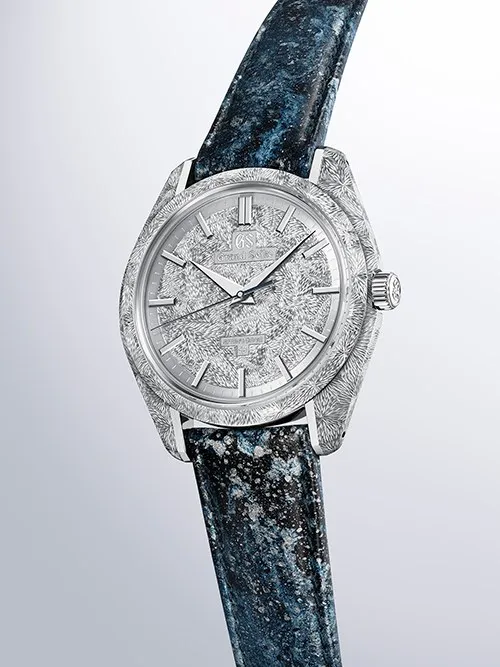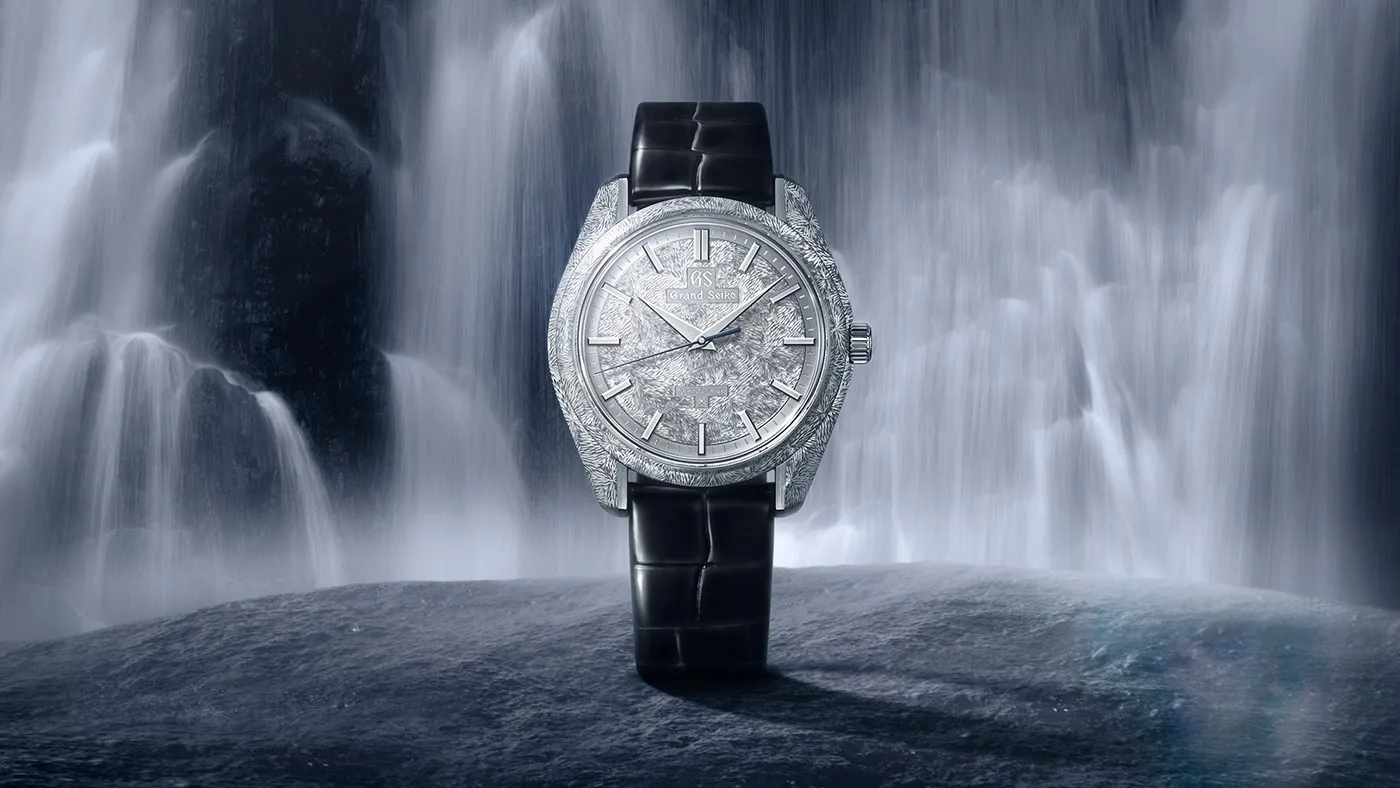
In the heart of Japan, in the Shinshu forests at the foot of the Northern Japan Alps, there is a waterfall that has flowed without pause for centuries: Tateshina. Within a primeval forest, the water bursts from the rocks and out of the earth; it neither stops nor tires; it simply flows. For anyone who gazes at it long enough, the scene eventually changes: what flows is no longer water, but time itself. Time that passes, yet is never spent.
And so, in a quiet workshop in Shiojiri, Grand Seiko's Micro Artist Studio, a team of artisans you could count on your hands, set out to do the impossible: to capture that eternal flow upon a forty-millimetre platinum disc. The result is not merely a watch; it is a waterfall that appears frozen yet flows unceasingly: the Grand Seiko Masterpiece SBGZ011.

A Waterfall Brought to the Wrist
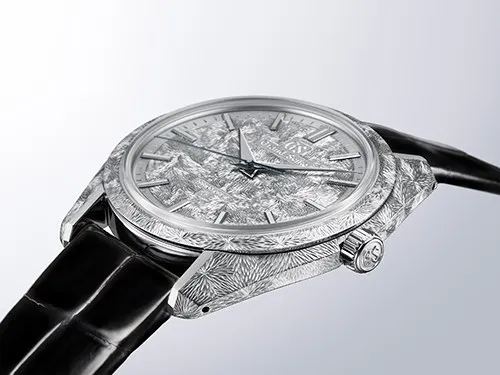
The SBGZ011 wears Grand Seiko's legendary 44GS design of 1967: a Platinum 950 case defined by flat surfaces and sharp edges, forty millimetres across yet only 9.6 millimetres thin. But what makes it a masterpiece is the landscape within and upon that case. Both the dial and the case are hand-engraved from end to end. Countless lines flowing in different directions, merging and parting again, depict the motion of a spring bursting from beneath the earth. The diamond-cut hour markers and hands, made of 14k white gold, are like the glints of light falling upon that flowing water.
Tilt the dial gently and the water truly moves: the lines catch the light, release it, and catch it again. This is water drawn not with paint, but with light.
The Hand That Carves Light: the Art of Engraving
So how does this water 'flow'? The answer lies in months of patience and in the tiny steel graver (tagane) in a master's hand. The engraver of the Micro Artist Studio cuts thousands of lines into the platinum surface, one by one, by hand. The depth and angle of each line must be in harmony with the last; for it is these lines, flowing in different directions and meeting at a point, that create the sensation of moving water. Light strikes each of these multi-directional grooves at a different angle; this is the secret of why the dial seems to 'flow' as you tilt it.
You could liken it to drawing a river with thousands of tiny chisel strokes; each stroke, like a ripple on the surface, reflects the light differently. If the master's hand trembles for an instant, if a single line goes astray, the platinum worked for months is ruined. And the water does not end at the edge of the dial; the engraving spills onto the flanks of the case, down to its lugs. So the waterfall truly overflows the dial and runs down the body of the watch.
The Flowing Second: the Secret of Spring Drive
At the heart of this watch that tells of a waterfall beats a movement found in no other brand in the world: Spring Drive. And a single detail makes it perfect for this watch: the seconds hand does not advance with a tick; it glides, ceaselessly, exactly like flowing water. This 'glide motion' is a marvel that makes the flow of time visible to the eye.
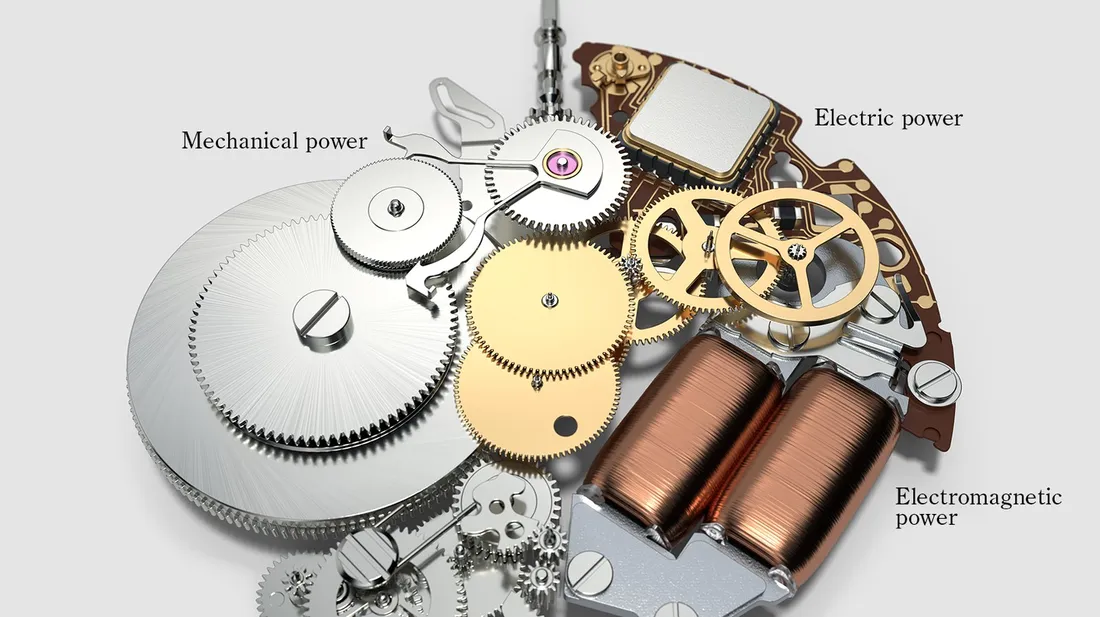
So how does it work? The soul of Spring Drive is entirely mechanical: like a classic watch, it draws its power from a hand-wound mainspring; there is no battery. But the ticking mechanical escapement of a classic watch is absent here. In its place, a 'glide wheel' driven by the mainspring turns exactly eight times per second. As this wheel spins, like a tiny mill wheel turned by a river, it generates a very small electric current. A quartz crystal, vibrating 32,768 times per second, serves as a flawless metronome. The integrated circuit (IC) compares the wheel's actual speed against this metronome, and if the wheel speeds up even slightly, it applies an invisible electromagnetic brake to hold it at precisely the right speed.
Mechanical power, electricity and an electromagnetic brake: the system that governs these three energies at once is called the Tri-Synchro Regulator. Because there is no ticking escapement, there is neither a jump nor a pause; the seconds hand flows without interruption, just like the water of Tateshina. And the result is an almost unnerving precision: only ±15 seconds a month, that is, less than a single second a day.
An 84-Hour Breath: the Calibre 9R02
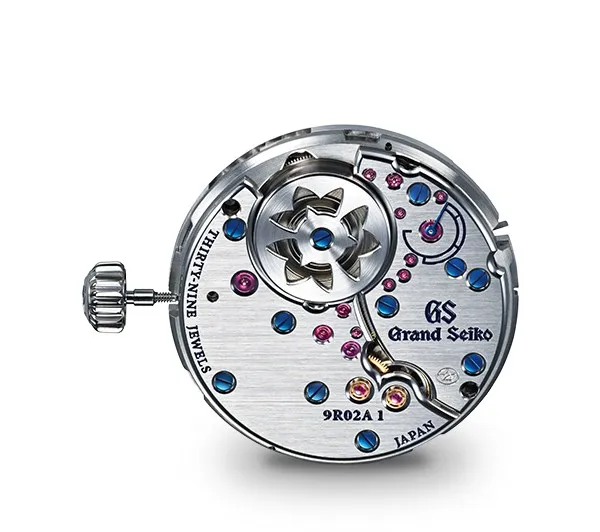
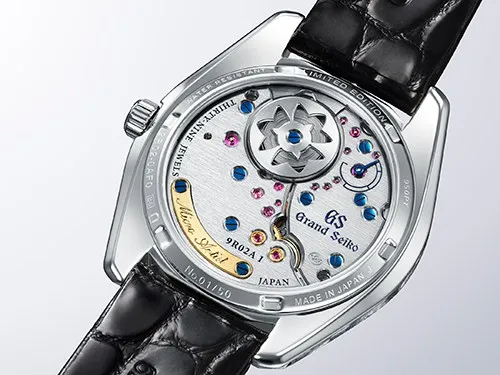
The Calibre 9R02 within the SBGZ011 is the most elegant expression of this technology. At just 4.0 millimetres thick, it is Grand Seiko's thinnest Spring Drive movement, and it is wound only by hand; so that every morning, as you turn the crown, you share a small ceremony with your watch. Inside, two separate mainsprings (a Dual Spring Barrel) work in series; this delivers power that is both longer-lasting and more even. To this is added the Torque Return System: rather than wasting the excess energy that arises when the spring is fully wound, it recovers about thirty per cent of it.
You could liken it to a mill wheel that channels its overflow back into the pond instead of letting it run to waste. The result is a full 84-hour power reserve; so if you take the watch off on Friday evening, it is still flowing on Monday morning. Upon the barrel that houses the spring is engraved a bellflower (kikyō) motif honouring Shiojiri; technology and nature meet upon the very same disc.
The Flawless Mirror: Zaratsu Polishing
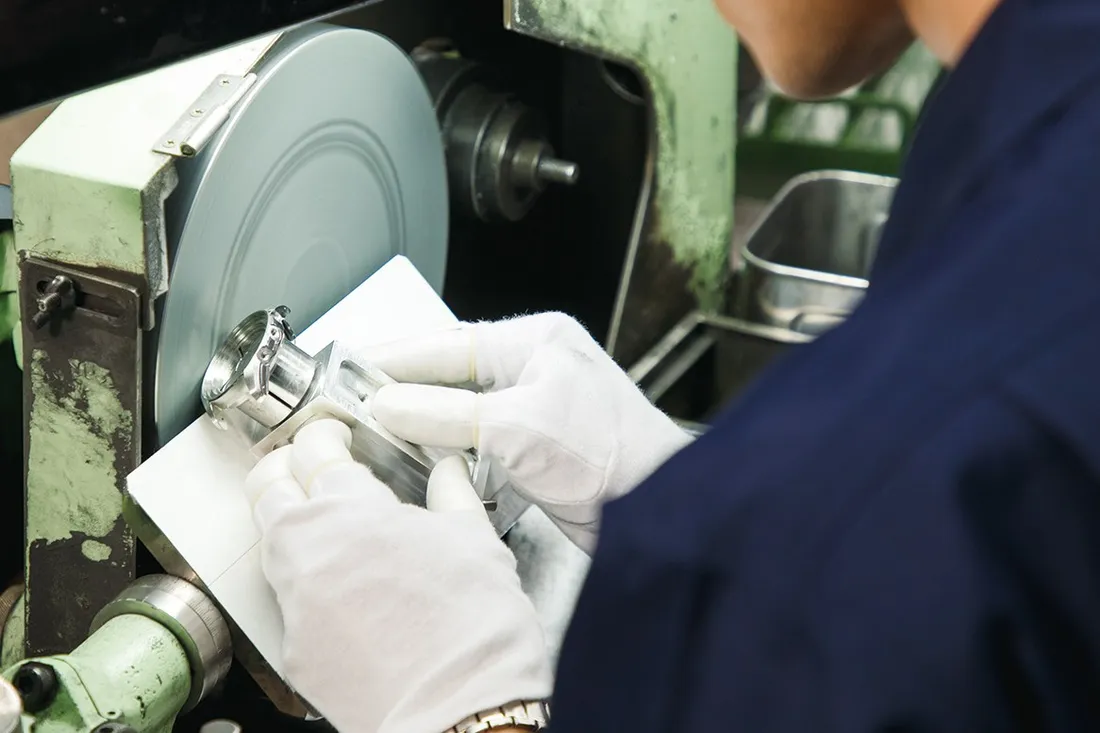
Looking at the sharp 44GS lines of this watch, you wonder how the surfaces can be so clean, the mirrors so deep. The answer is one of the most legendary techniques in Japanese watchmaking: Zaratsu polishing. This is a 'distortion-free' mirror polish achieved by pressing the case by hand against a rotating tin plate. There is no jig, no guide; the master holds each facet of the case to the plate at exactly the right angle, entirely by the feel of his hand.
And here lies the difficulty: if the angle shifts by a fraction of a degree, either the sharp edge is rounded or the mirror surface is distorted. This is why only a few masters, trained for decades and often for more than forty years, are deemed worthy of the task. The surface that emerges is so pure that it reflects, without any distortion, like black glass. It is like a swordsmith honing a blade; or like ironing a mirror perfectly flat by feel alone. On the SBGZ011, these mirror-like Zaratsu surfaces sit beside hairline-brushed surfaces as fine as a strand of hair; light slides across the sharp ridgelines just like sunlight on water, passing from shadow into light.

An Eternity for Fifty
Grand Seiko entrusts this waterfall to only 50 people worldwide. With its Platinum 950 case, its value of 86,000 euros and a rarity found only at Grand Seiko boutiques, the SBGZ011 is not an instrument but an object of contemplation. It comes with two straps: a glazed crocodile leather and a Kyoto leather with metallic reflections.
Perhaps what this watch really tells us is this: time is not a notion that ticks past; it is water that flows on, yet is never spent. On your wrist you carry a waterfall engraved over many months, a seconds hand that flows without ever stopping, and the mastery of centuries. And that water, as long as you keep looking at it, goes on flowing forever.