Langres, November 1550
In the north east of France there is a small walled town called Langres. On a November morning in 1550 the mist came over the walls and settled in the streets.
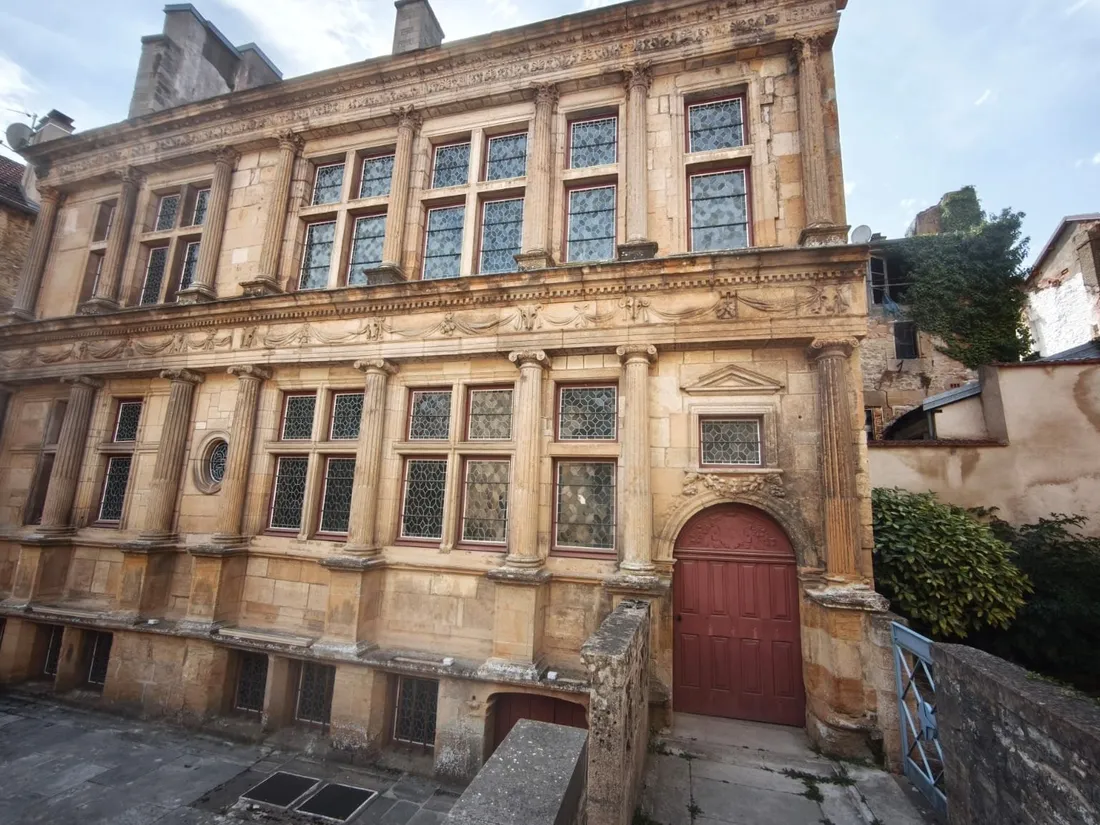
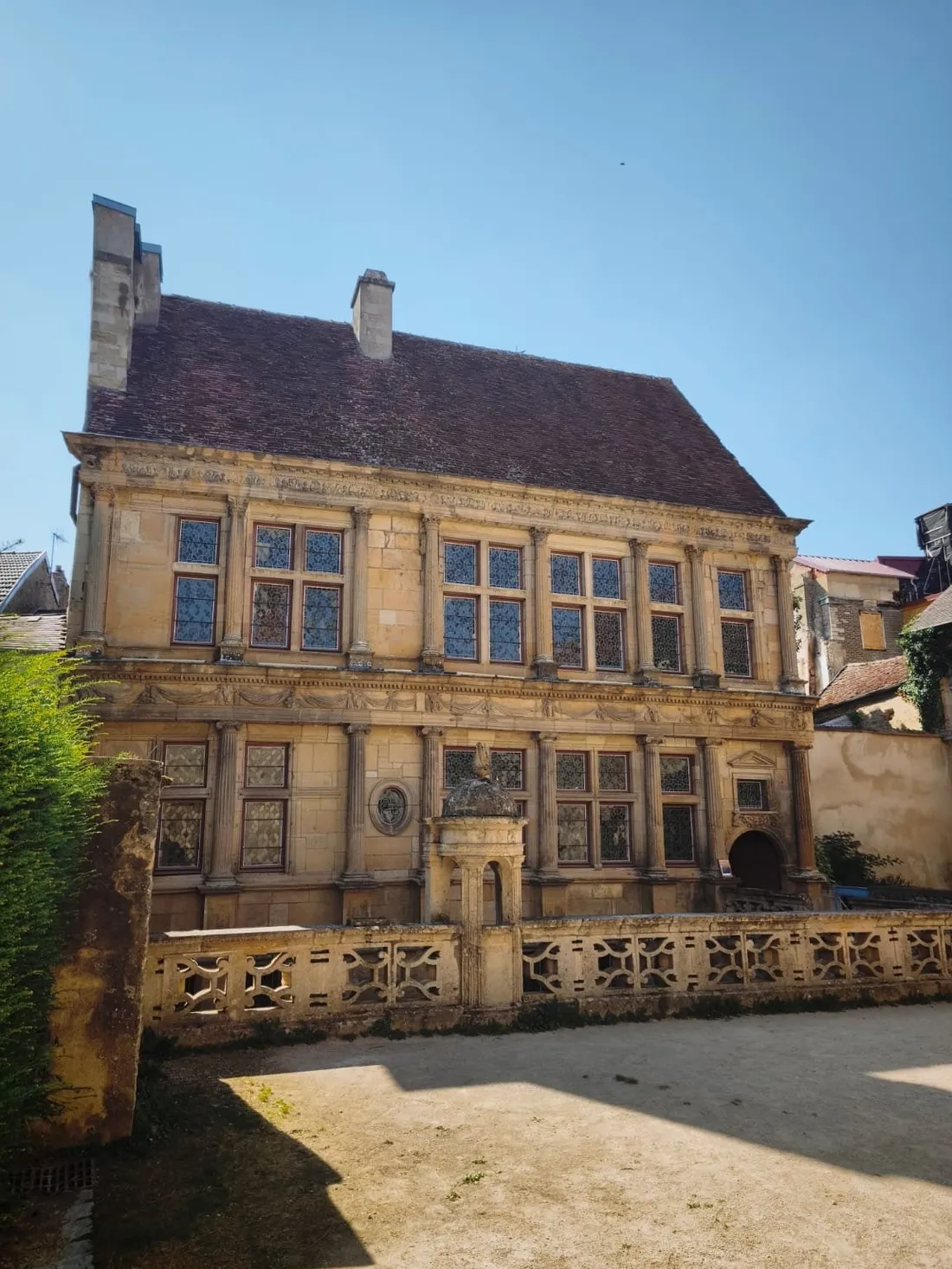
In one of those streets stood a new house. Its owner was called Claude Bégat. Bégat was neither a prince nor a bishop. He was an officer of the king. His job was to guard the keys of the town gates, and he also collected taxes. So he was rich, but he was not noble.
Bégat had a small room built for himself on the ground floor. That morning he had two guests in it: Michel de Montaigne and Federico da Montefeltro, Duke of Urbino. On the table lay maps and a celestial globe made of brass.
There Are Fifteen of Them in Europe
This room has a name: studiolo. It is an Italian word and it means small study. It was invented in Italy in the fifteenth century.
The room measures twelve and a half square metres. That is smaller than an average child's bedroom. There is a fireplace in one corner, because this was a place people actually sat in through the winter.
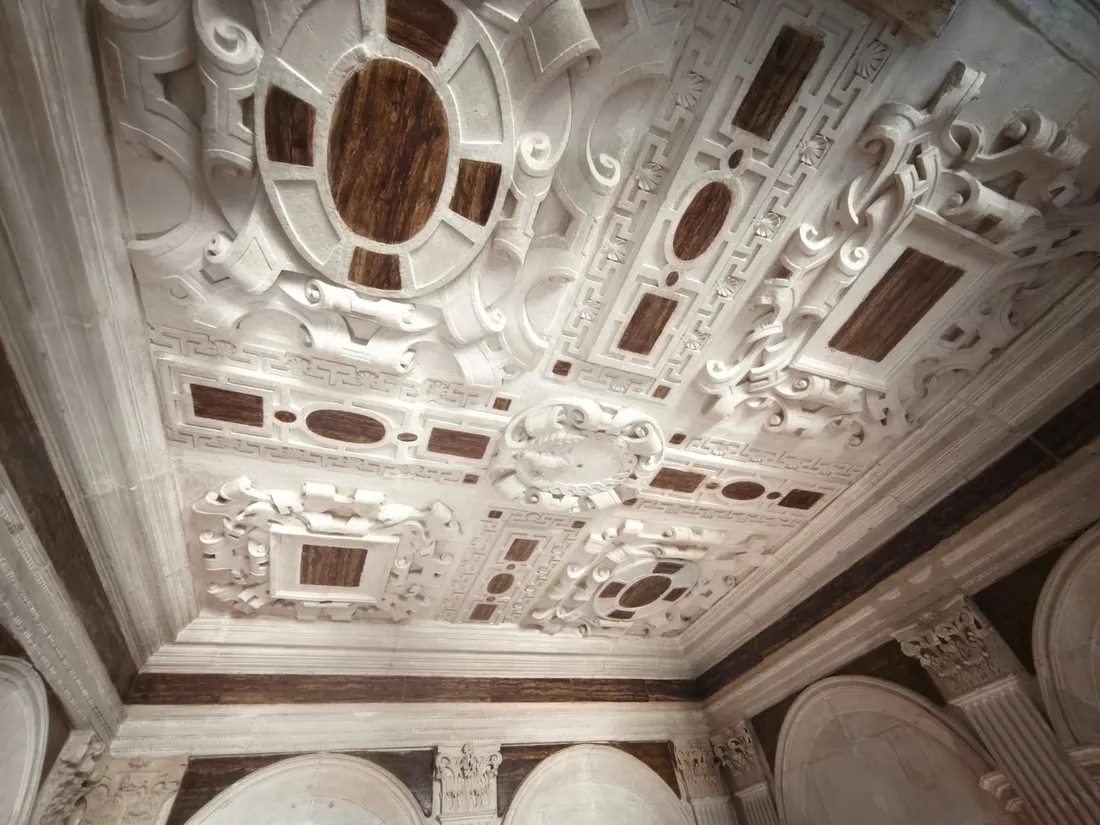
What makes the room special is not its size but its material. Everything in it is stone. The walls, the ceiling, the floor. There is not one piece that could be taken out and carried away. Bégat did not buy furniture; he had the room itself carved.
Today only about fifteen rooms of this type can be counted in Europe. Most are either in Italy or inside a palace. The one in Langres is in a small provincial town, in the house of an official. The town opened it to visitors in 2018.
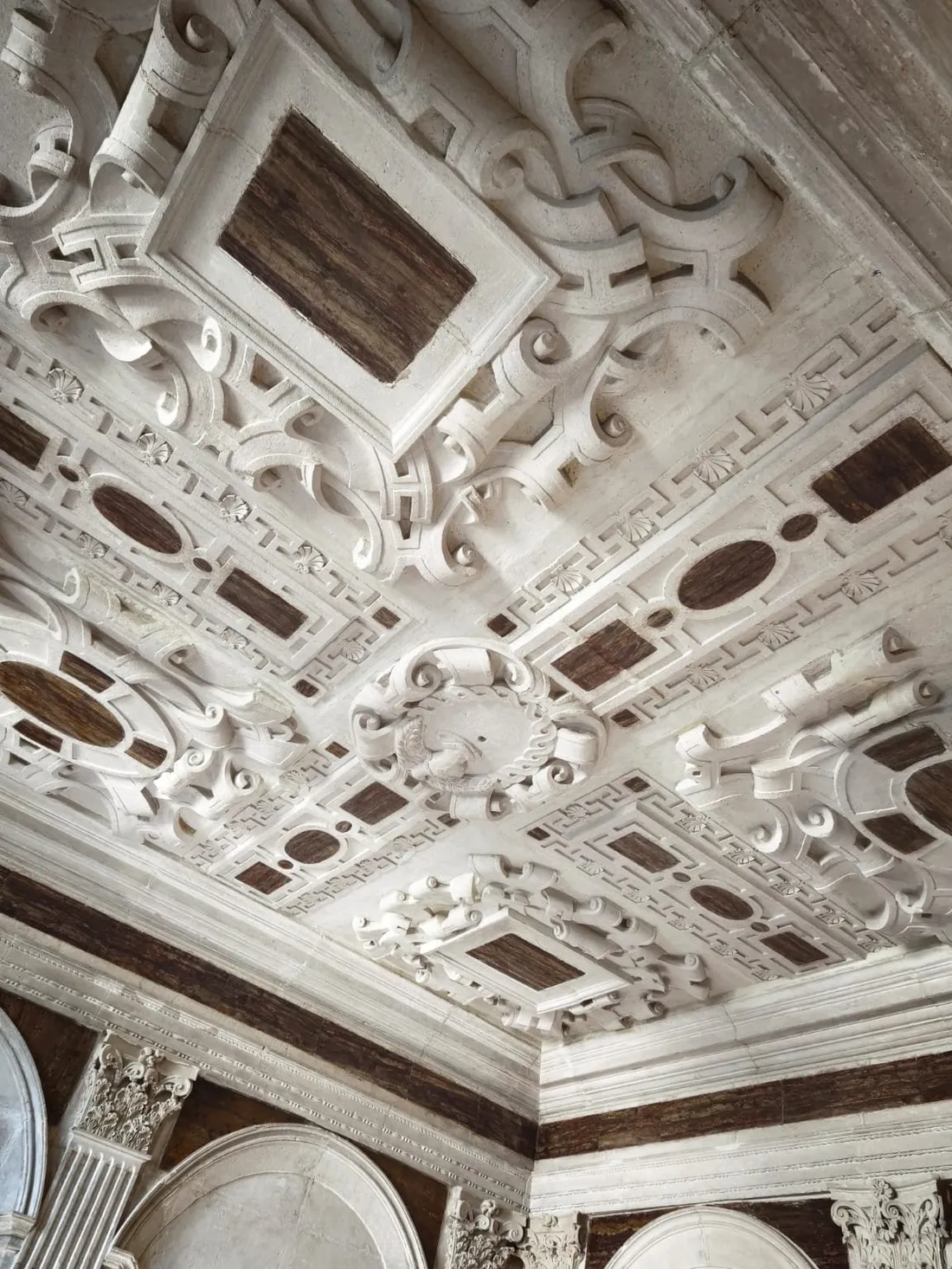
The Ceiling Is the Sky, the Floor Is Its Mirror
Bégat raised his hand towards the ceiling.
"Look up," he said. "Then look under your feet."
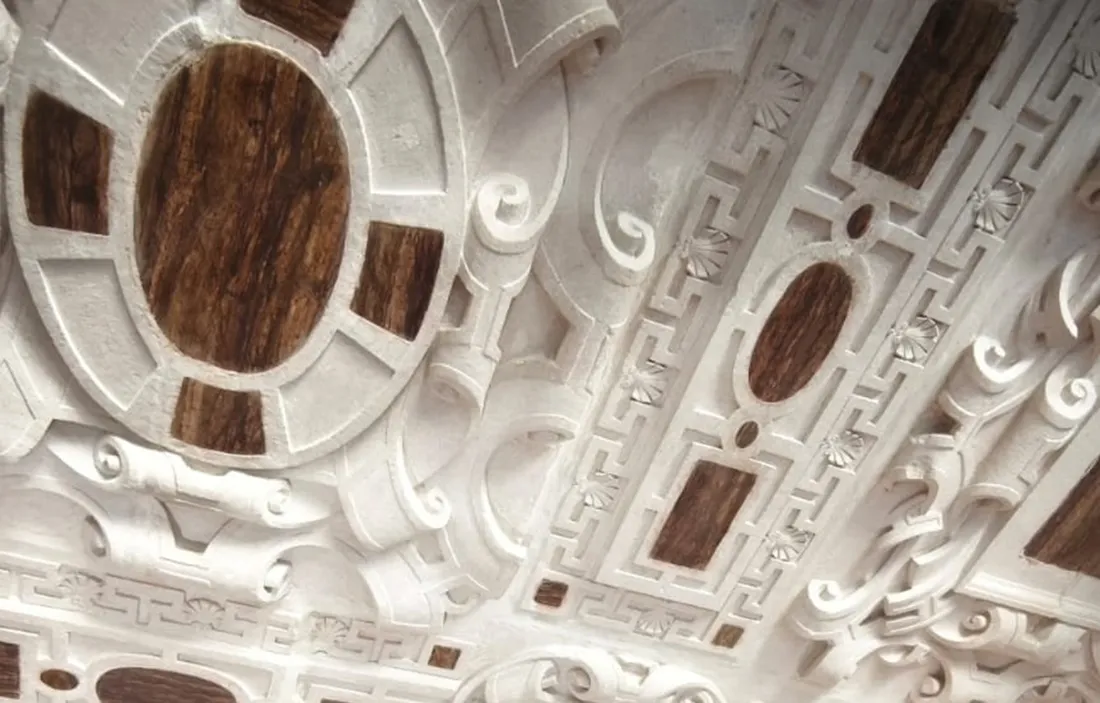
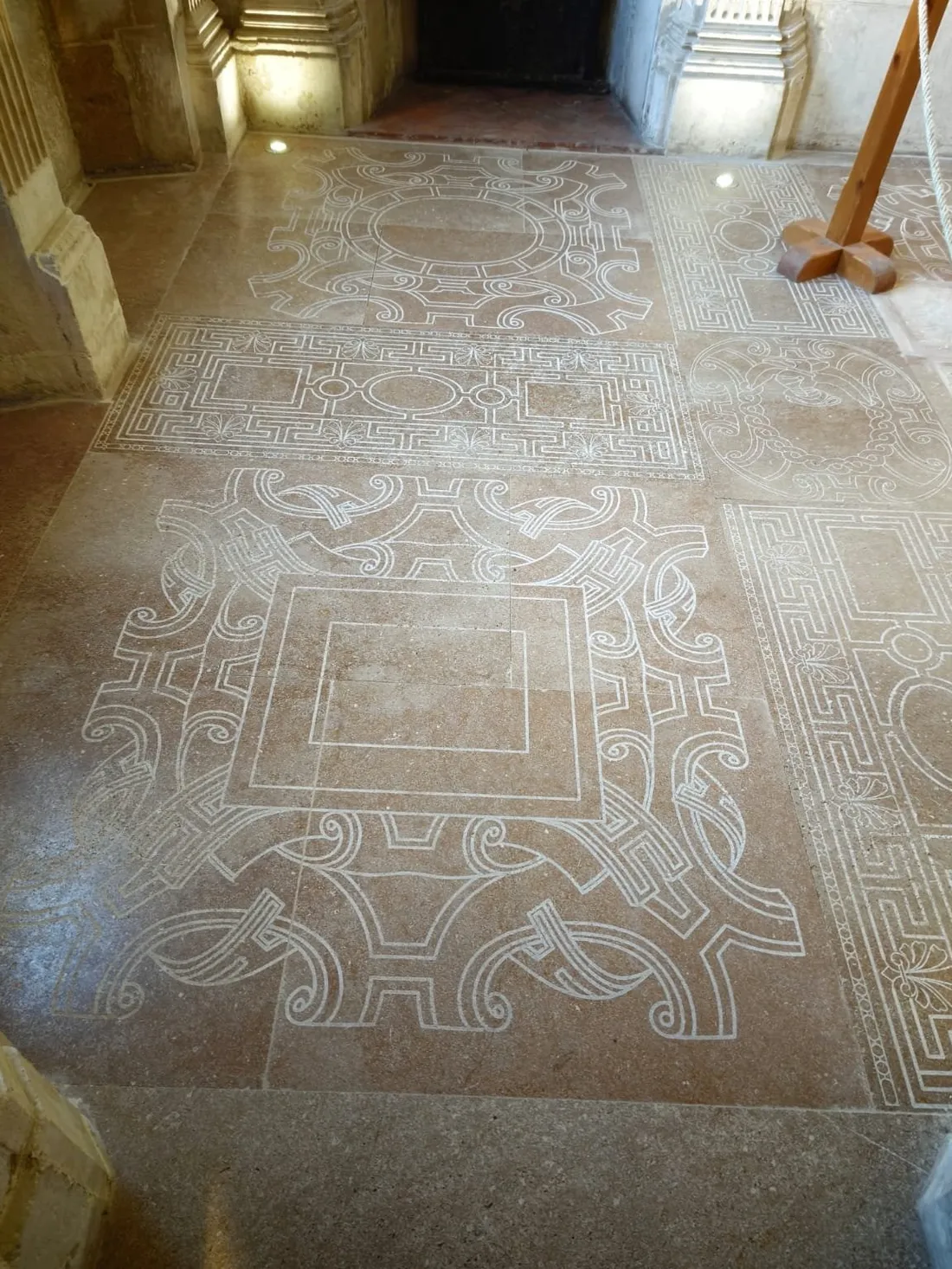
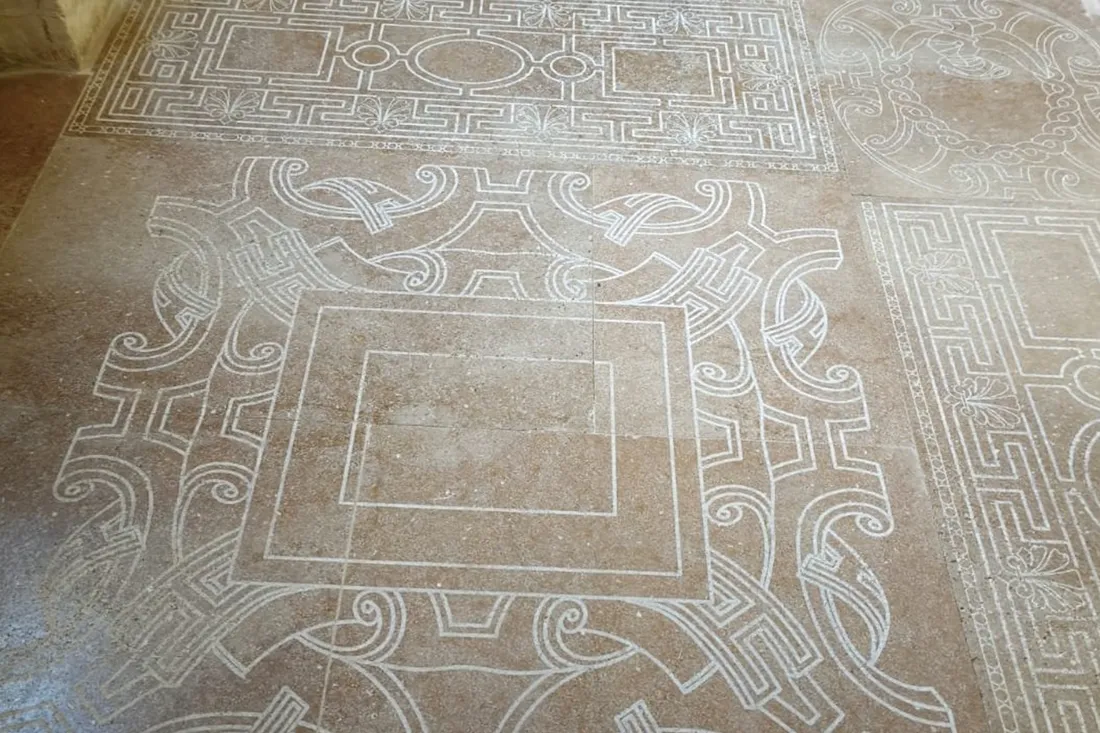
The ceiling was a surface of stone. It carried reliefs, and pieces of red and brown marble were set into the gaps. The floor held something else: fine lines cut into the stone and filled with a pale mortar.
Both said the same thing. One above, raised. One below, cut in.
"The ceiling is the sky," said Bégat. "The floor is its mirror. And the one standing in the middle is me."
In the Renaissance this idea had a name. The Latin speculum means mirror. Looking at a thing and seeing the order behind it was called speculatio. Our word speculation comes from there, though its meaning has drifted. At the time it did not mean guessing. It meant understanding something by looking at its reflection.
Montaigne looked at the pattern in the floor. The bands passed under and over one another. None of them began and none of them ended.
"An endless road," he said. "And it has been fitted inside a small square."
One Idea, Three Different Houses
Montefeltro recognised the room, because he had something like it in his own palace.
"My room in Urbino is the wooden version of this," he said. "Books and measuring instruments are shown on its walls. But all of it is inlay. Not painting. Made out of pieces of wood."
Montaigne laughed. "I shall have a room like this too," he said. "Not in stone, in books. A tower full of books."
All three were describing the same thing. One idea had appeared in three different houses: in wood at Urbino, in stone at Langres, in books in Montaigne's tower. The idea was this. Withdraw into a small room. Build a model of the large order outside inside it. Then look at the model.
The fourth house of that idea is not a room. It is a watch.
The Attics of Geneva
Two hundred years later the watchmakers of Geneva settled in the attics of the city. The reason was simple: an attic gets the most daylight. And the most expensive raw material a watchmaker has is light.
Those attic rooms were called cabinets in French, and the people who worked in them cabinotiers.
Vacheron Constantin was founded in 1755 and is today the oldest watch manufacturer in continuous production. It gave the name of those attic rooms to the department that makes its hardest and most singular pieces: Les Cabinotiers.
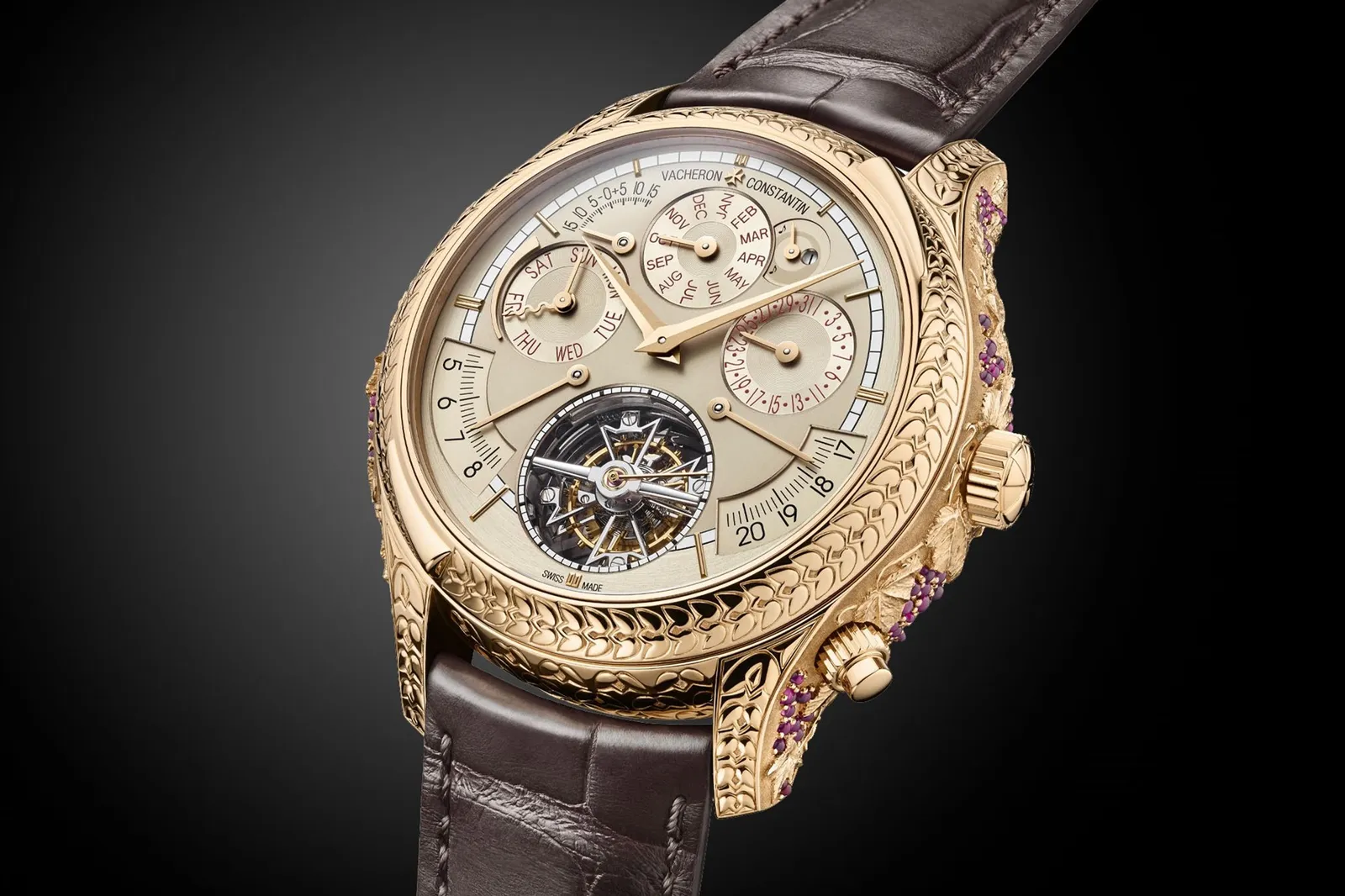
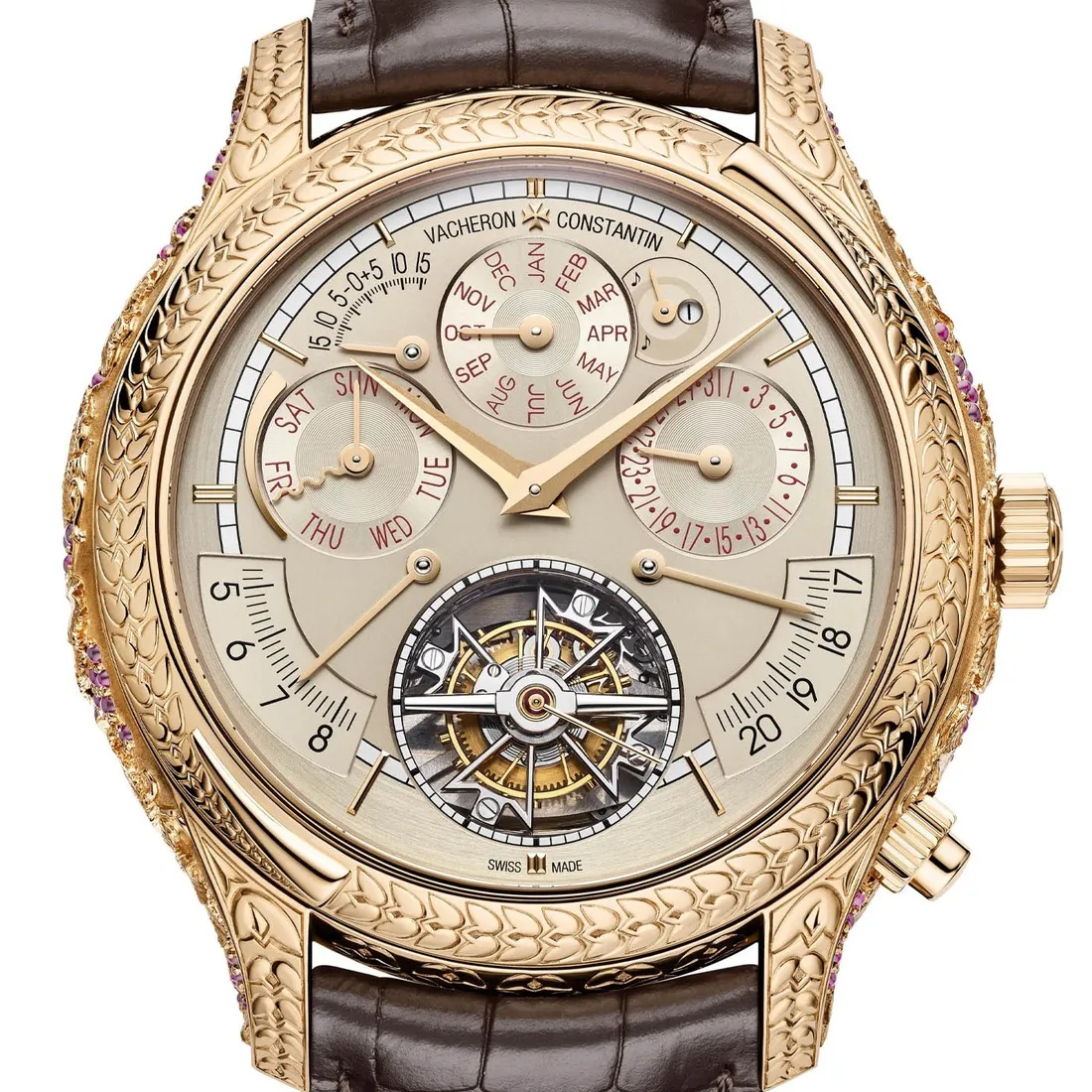
The watch in front of us came from there. It is called Les Cabinotiers Grande Complication, reference 9700C/000R-B755. A unique piece, which means there is no second one.
The case is 18 carat pink gold. It is forty seven millimetres across and nineteen millimetres tall. That is large for a wristwatch and there is no point hiding it. Put sixteen separate indications inside and the case grows to that size.
A Vineyard on the Case
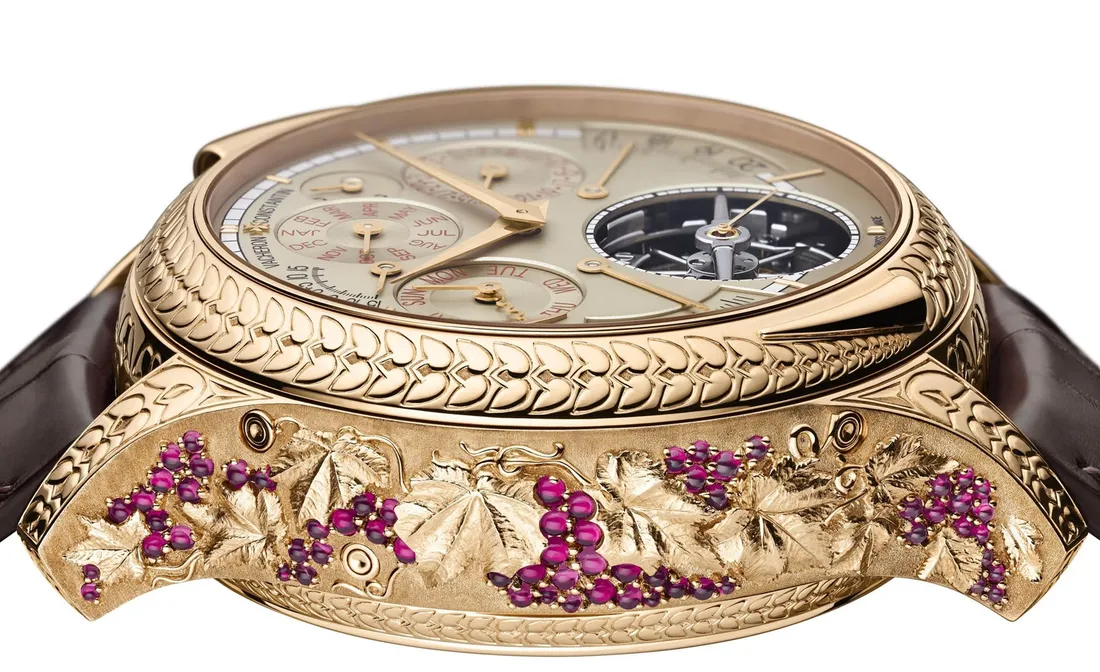
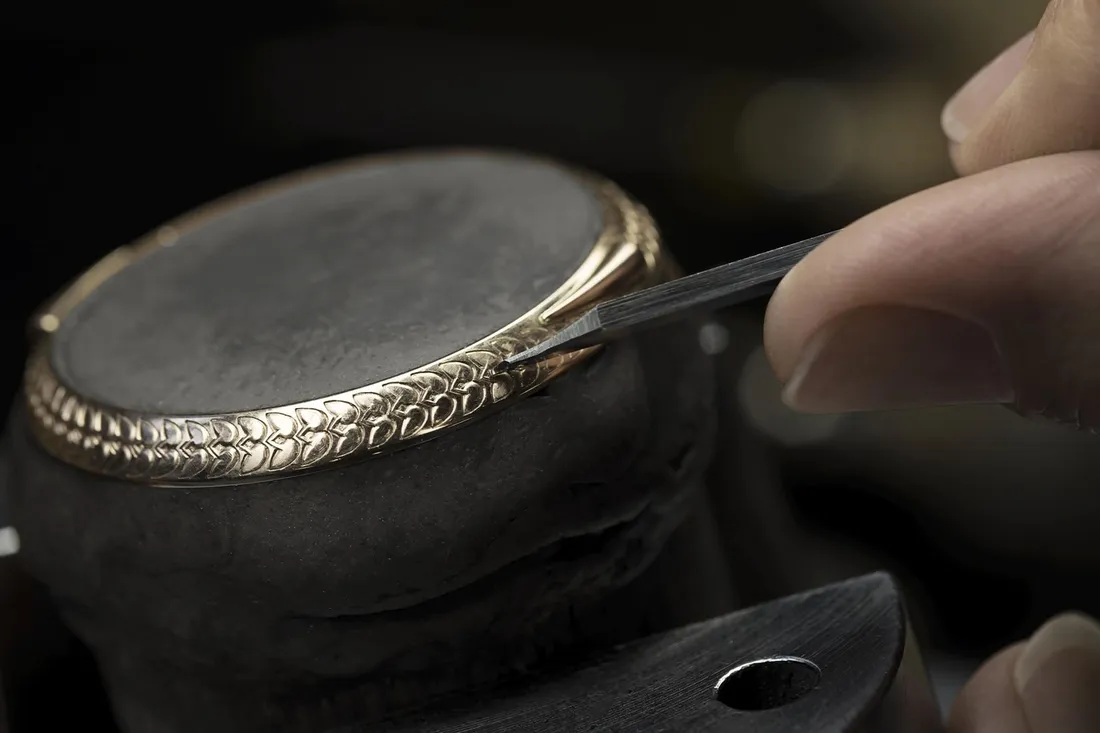
The technique on Bégat's ceiling is called low relief. Its logic is this: the craftsman does not raise the form, he lowers the ground around it. The leaf looks as though it has come forward, but what has actually moved is the background going back.
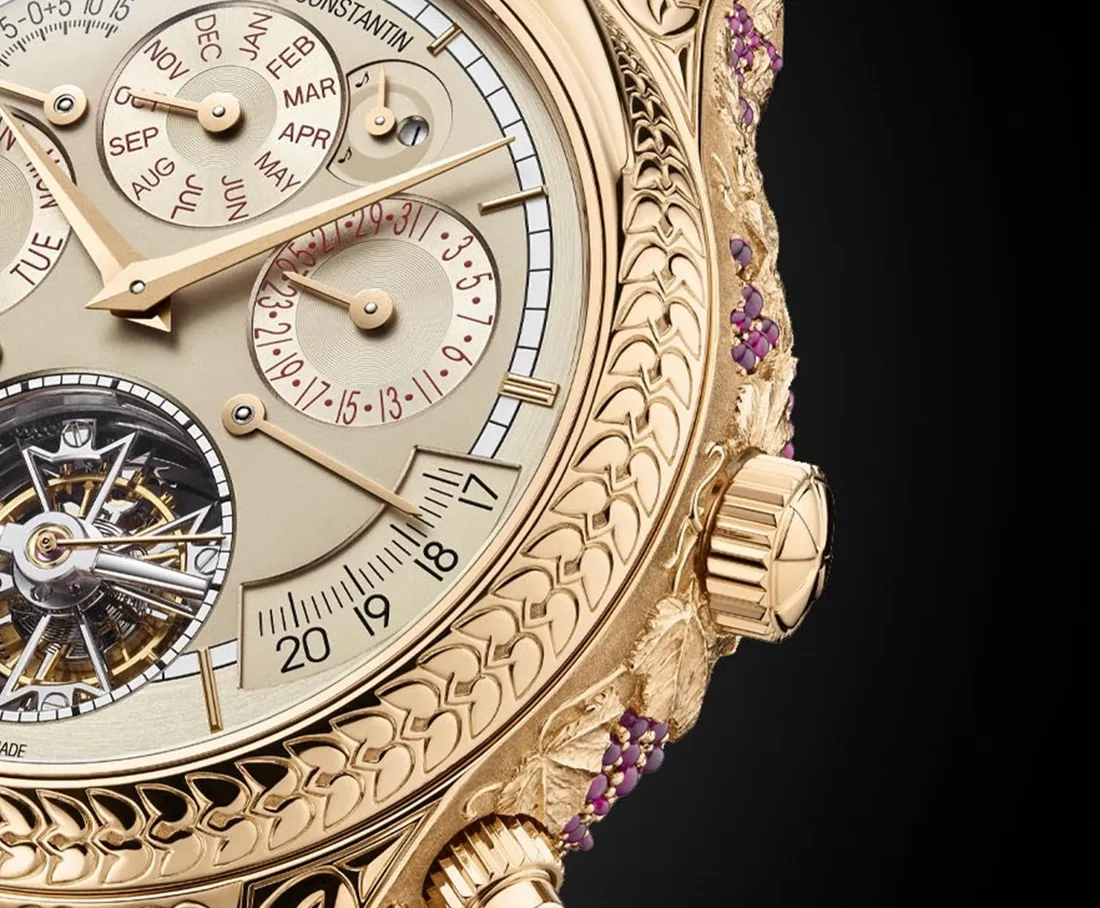
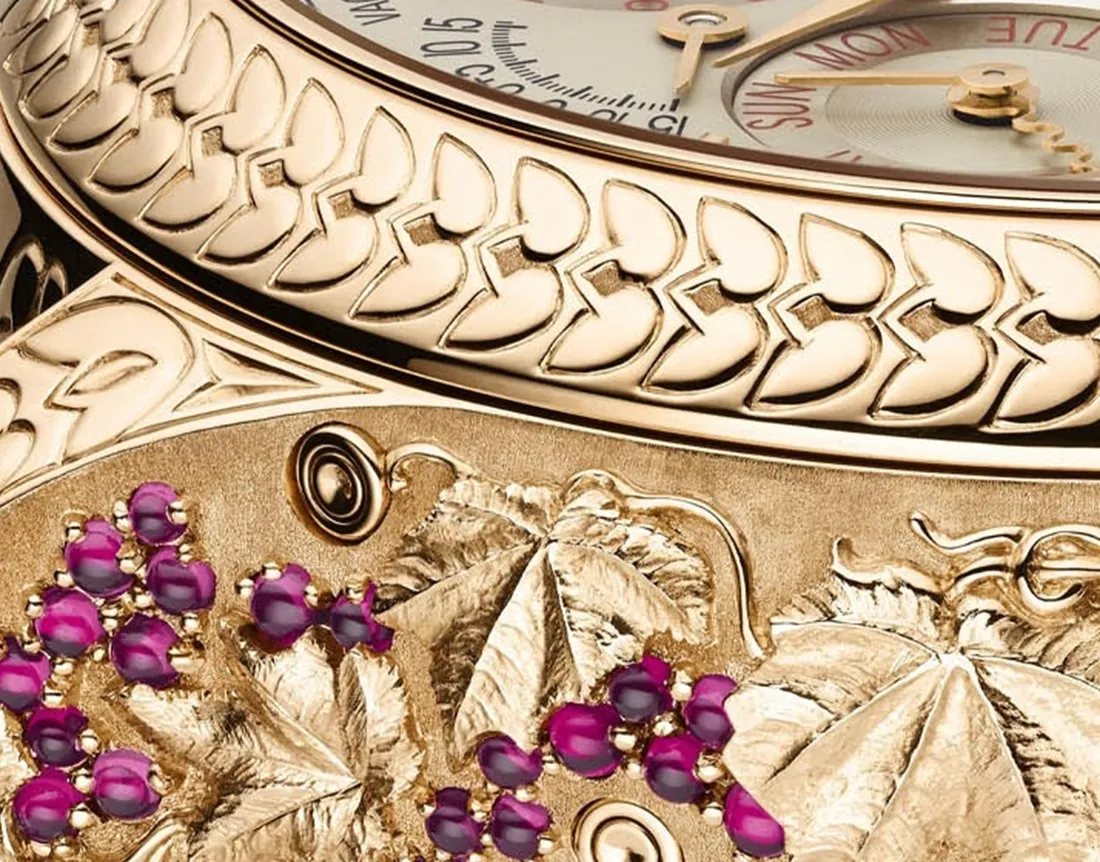
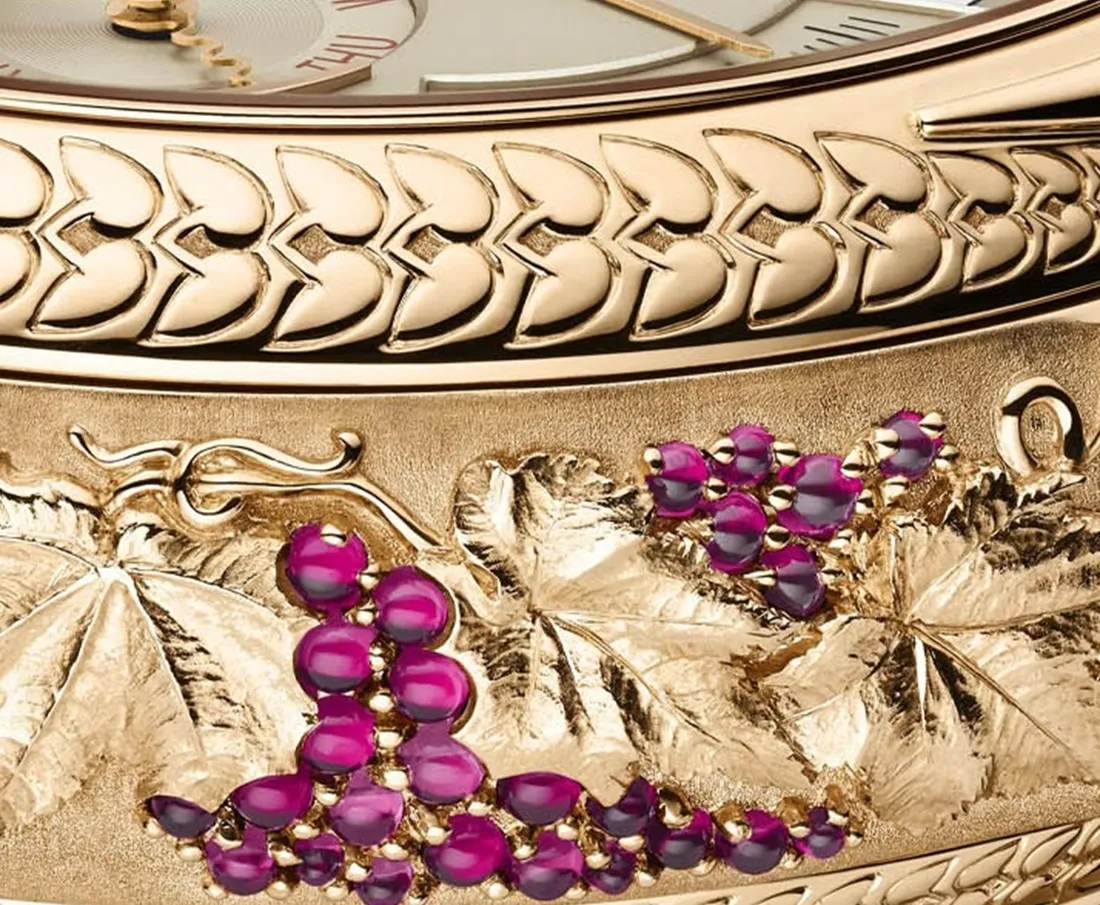
The same work has been done in gold on this watch's case. There are vine leaves on the flank of the case. The leaves are lifted slightly, and the ground between them is matted and pushed back. There is no colour. The sense of depth comes entirely from light.
The grapes are not stone either. They are one hundred and thirteen rubies. All of them are cabochon cut, which means domed on top and without facets. A faceted stone breaks light and sparkles. A cabochon gathers light inside and gives a deep colour. That is the right choice for a grape, because a grape does not sparkle.
There is one more detail. The stones are of different sizes. In a real bunch the berries get smaller towards the ends, and to imitate that the setter had to open every seat separately, at a different diameter.
The Front: Human Time
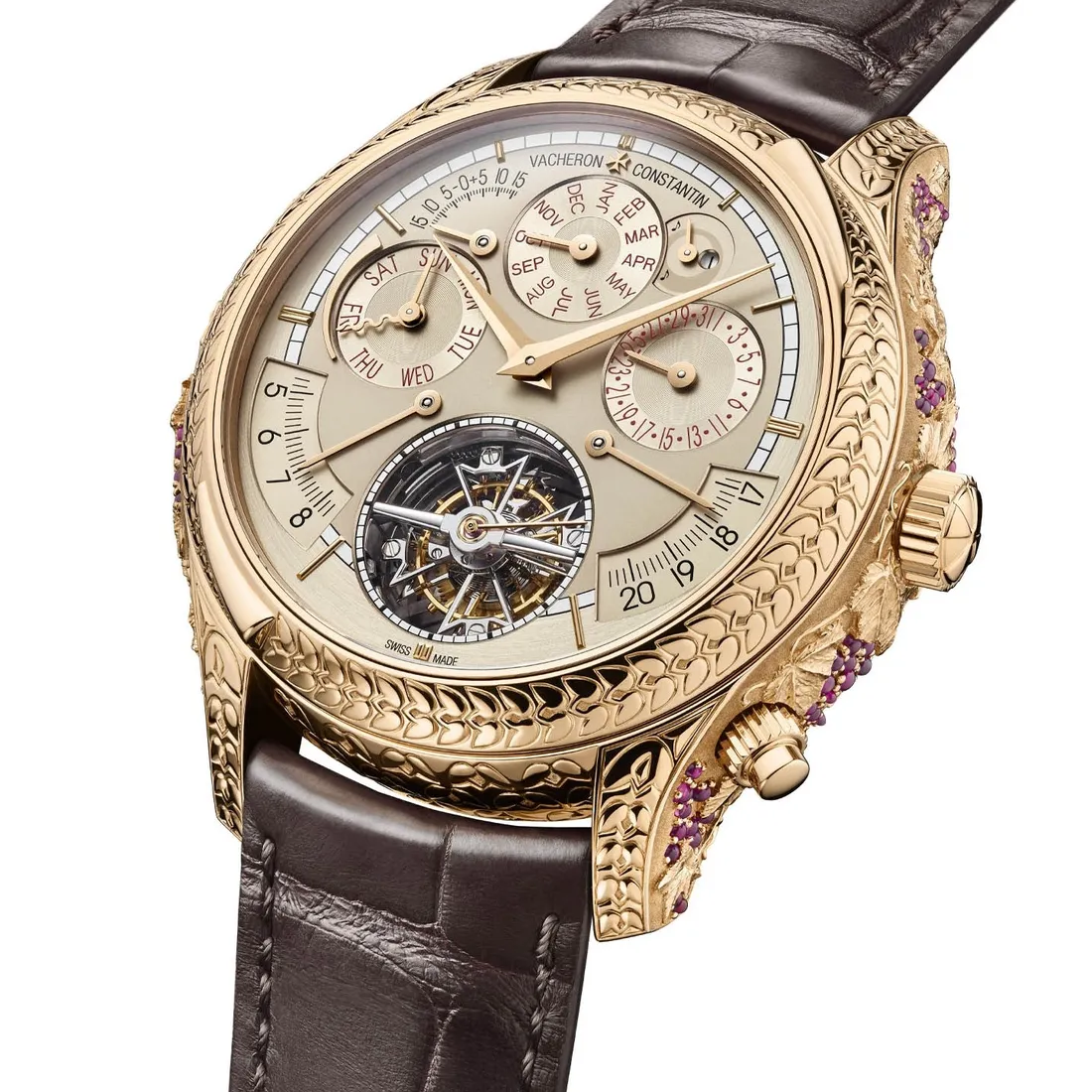
The watch has two faces. The front shows the time human beings use.
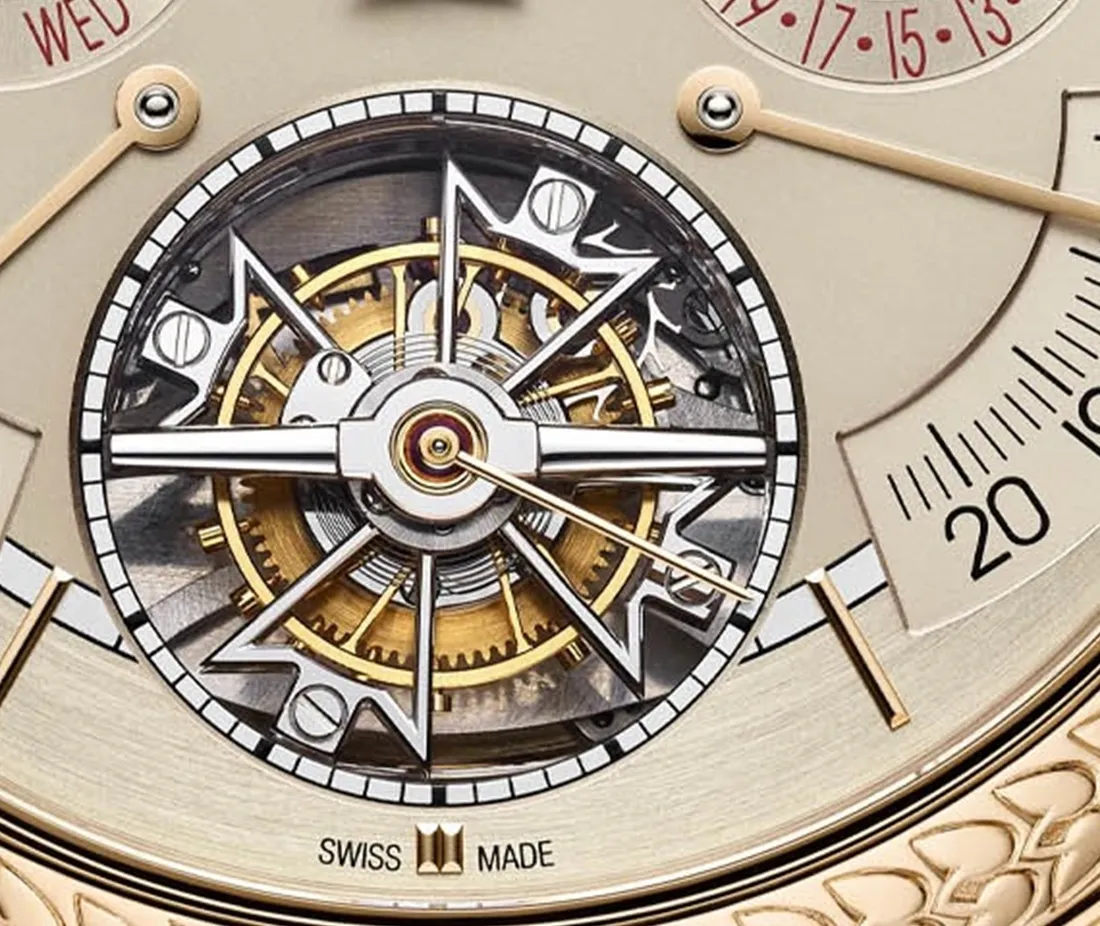
At six o'clock there is a tourbillon. A tourbillon does this: the balance is placed inside a cage, and the cage turns once a minute. Gravity makes a watch run fast in one position and slow in another. As the cage turns, all of those deviations happen in turn and cancel each other out. So a tourbillon does not erase the error; it averages it.
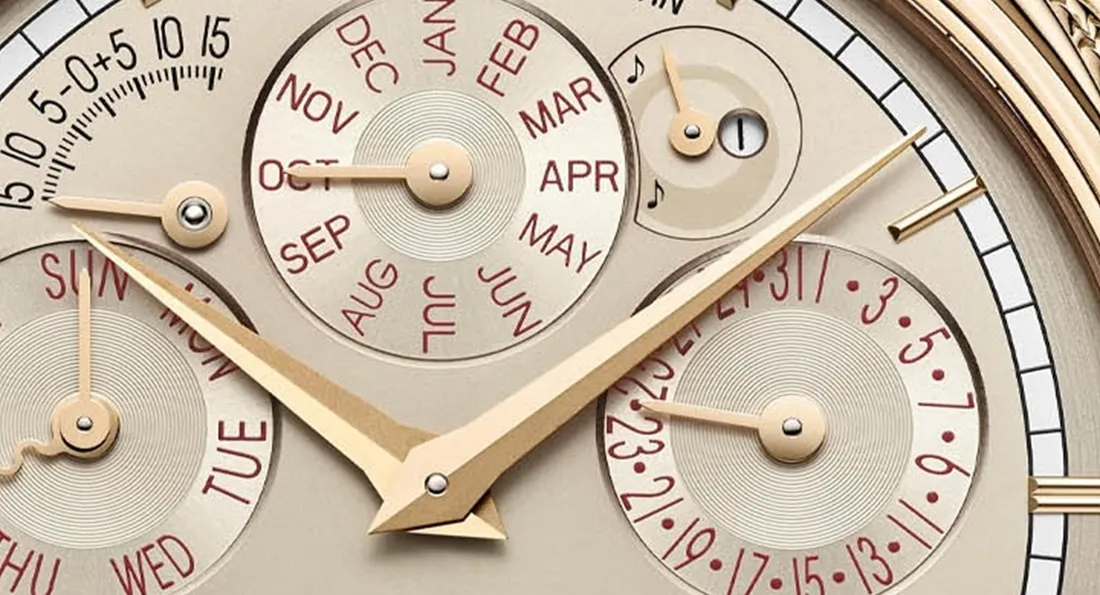
The perpetual calendar shows the day, the month and the date. It knows the leap years too. But it has a limit, and the brand states it plainly: the calendar is valid until the year 2100. The reason is this. There is a leap year every four years, but years divisible by a hundred are the exception. The year 2000 was a leap year because it also divides by four hundred. 2100 will not be. The mechanism knows the four year rule; it does not know the four hundred year exception.
Between ten and eleven o'clock there is an equation of time. This indication tells you the difference between the sun's time and our time. The difference changes through the year and wanders between minus fourteen and plus sixteen minutes. It happens because the Earth's orbit is not a perfect circle and its axis is tilted. In short, the sky never quite agrees with our clock, and this hand shows the size of the disagreement on the day.
On the left of the dial are the hours of sunrise, on the right the hours of sunset. These two scales are made for one particular latitude. Which means the watch knows the city it was ordered from.
There are also two power indications, because the watch has two separate sources of energy: one drives the going train, the other the striking mechanism.
The Back: the Time of the Sky
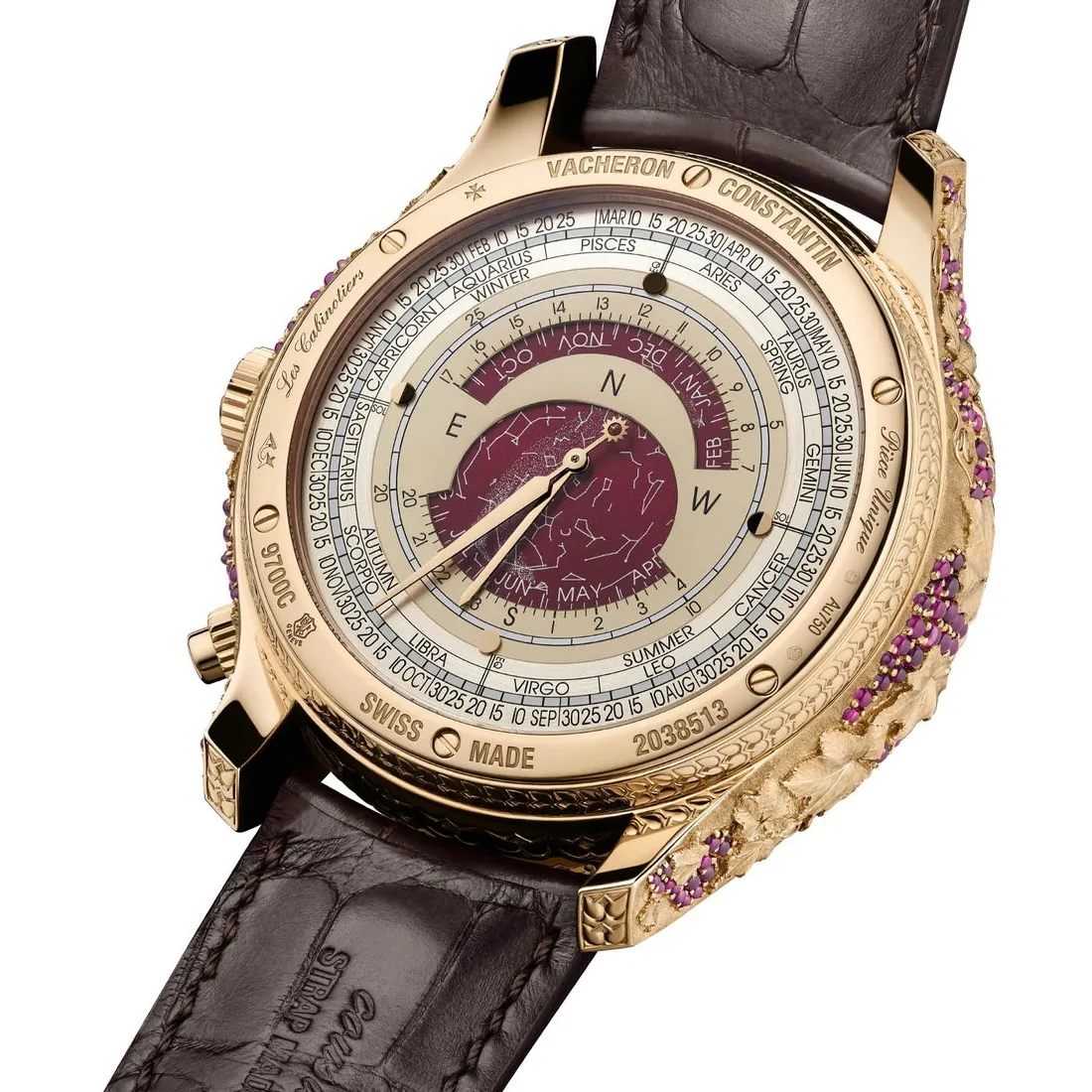
Turn the watch over and a second dial appears. This one shows not human time but the time of the sky.
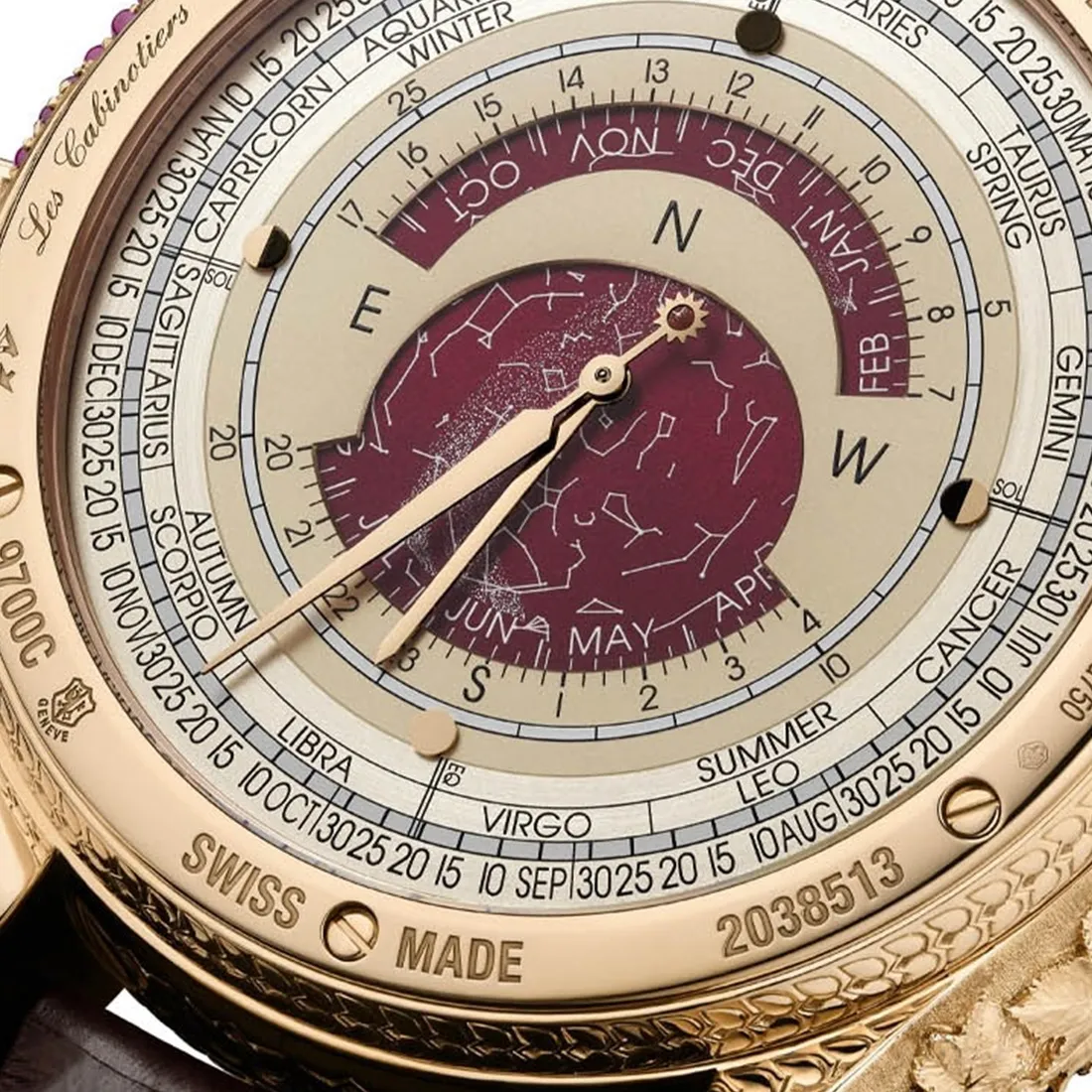
At its centre is a turning disc with the constellations of the northern hemisphere on it. The disc is wine red, so the grape theme from the case has come here as well. It turns in real time, at the same speed as the sky above your head.
The measure here is sidereal time. Put it this way. While the Earth turns once on its axis it also moves a little way around the Sun. So it has to turn a bit further to bring the Sun back to the same place. The stars are so far away that no such extra turn is needed for them. The difference is four minutes.
What those four minutes mean is this: the same star rises four minutes earlier every night. Over six months that adds up to twelve hours. It is why the sky you see in winter is not the sky you see in summer.
Around the disc there are other indications: the phases of the Moon, the zodiac, the seasons, the dates of the solstices and the equinoxes. A long hand from the centre shows the date.
So the front dial tells you today's date, and the back tells you what is above your head at this moment. Both are driven by the same wheels. Exactly like Bégat's ceiling and floor.
Eight Hundred and Thirty Nine Parts
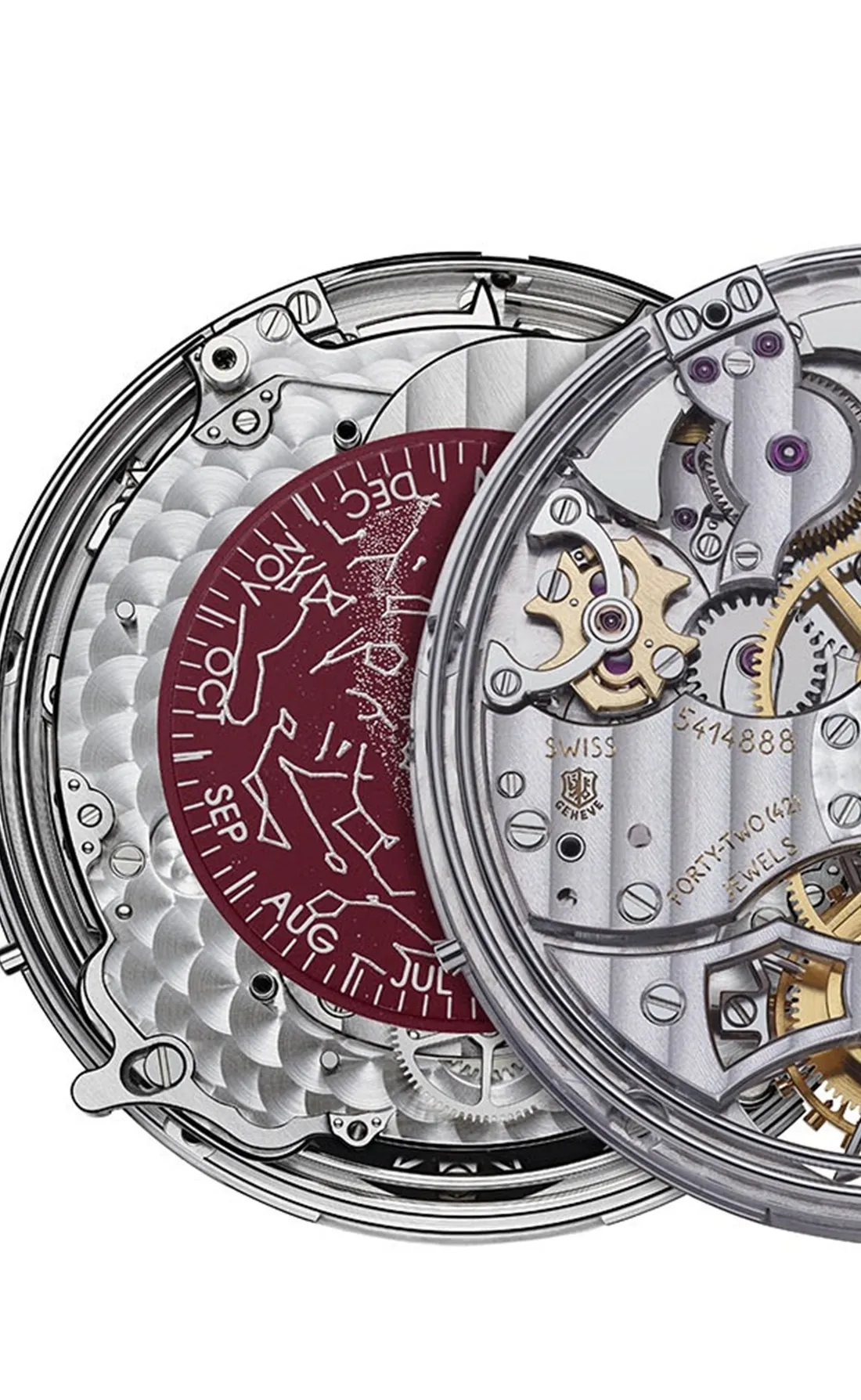
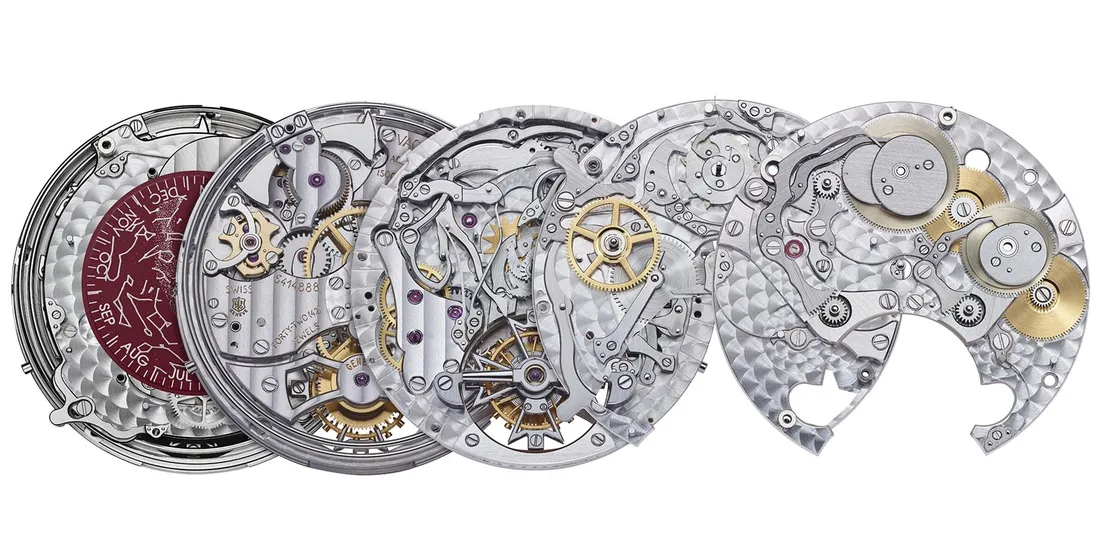
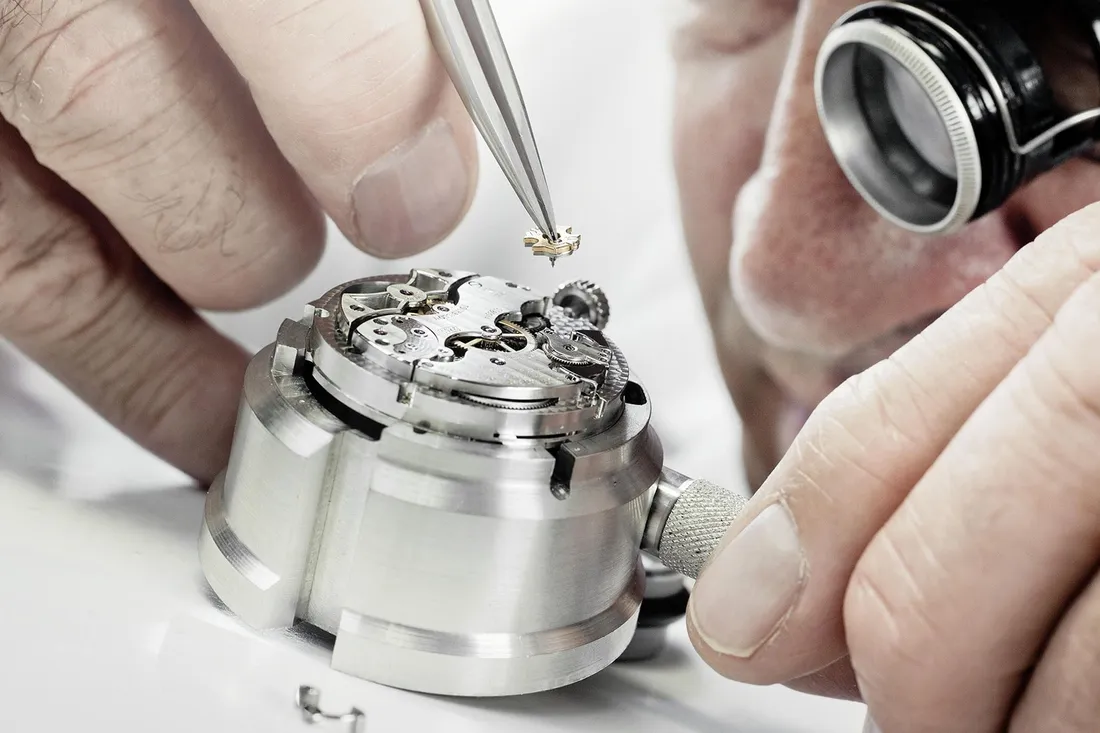
The movement is called 2755 GC16. It has eight hundred and thirty nine parts. It is thirty three millimetres across and twelve millimetres tall. The power reserve is fifty eight hours.
Its frequency is two and a half cycles a second. Today's standard is four, so this watch is deliberately slow. The reason is the striking mechanism. When a watch strikes, the balance of forces inside it is disturbed for a moment; a slow balance is less affected by that jolt.
The real difficulty in putting sixteen indications into one body is not the number of parts. The difficulty is order. All of them hang on the same spring and they can ask for energy at the same moment. Think of midnight: the calendar has to jump the day, the date and the month together, and the watch may be striking at the same time. Which is why in watches like this the real design work is not adding functions but putting them in a queue.
The watch is delivered with a corrector pen, a magnifying glass and a winding box. The price is given on request.
Two Rooms
The room in Langres is twelve and a half square metres. The watch that came out of Geneva is forty seven millimetres.
The difference in size is enormous, but the job they do is the same. Both take a piece of the large and confusing order outside and bring it down to a size a person can look at.
There is the same honesty in both. The ceiling is not the sky; it is a model of the sky. So is the disc on the back dial. One has stood for five hundred years and was never an actual sky. The other will ask for a one day correction a century from now.
Perhaps the subject of these two rooms is not the sky at all. The subject is the person standing in the middle. In Bégat's room there was a human being between the ceiling and the floor. In this watch there is a wrist between the front dial and the back.