In a cold, uncharted emptiness of the universe, two neutron stars stood at the end of their lives. Straining the fabric of spacetime, these two masses were the protagonists of a merciless tragedy, each caught in the other’s gravity. In the lap of an unavoidable fate, they began to turn around one another in the dark. With every turn they came a little closer, rippling spacetime like a series of sobs and gathering speed towards their end.
And at last the moment came where escape was impossible. The two dead giants threw themselves into each other’s arms at an unthinkable speed.
That embrace produced one of the most violent apocalypses the universe has seen: a kilonova. In the instant when light and matter exploded with a blinding cry, the boundary between violence and creation disappeared. In that white-hot furnace where two stars gave their last breath, an alchemy called the rapid neutron capture process took place. Free neutrons locked onto atomic nuclei within fractions of a second, the nuclei swallowed more than they could carry and climbed the table by decaying. The elements at the heavy end of the periodic table were built in those few seconds: gold, platinum and, the heaviest and proudest among them, osmium. For anything in the universe to be heavy, something first has to die.
Flung into the cosmic dark at close to the speed of light, these grains drifted for millions of years, until they fell into the lap of a young Earth that was still a molten sphere. Osmium loves iron; as the planet separated into layers, it sank towards the core along with the molten iron. What reaches human hands today comes from the ores that managed to stay near the surface: a residue of a few parts per million, left over from the refining of platinum and nickel. The rarest metal on earth does not really belong to the earth at all.
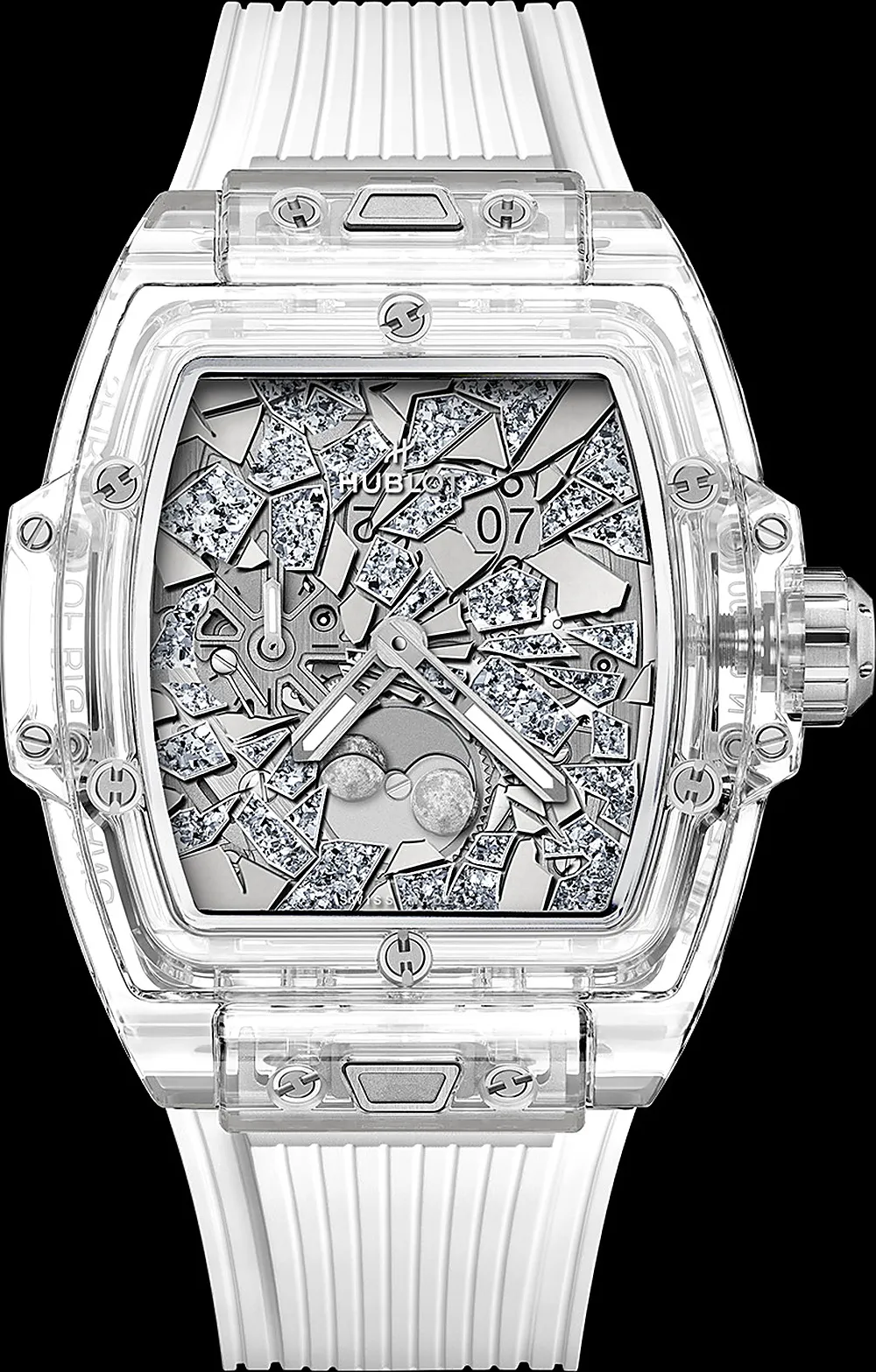
The trace of that interstellar tragedy of billions of years ago is carried onto a wrist today by Hublot’s idea of fusion.
Raw osmium is not a material you can put into a watch. It is denser than platinum, harder than steel and extremely difficult to work; in powder form it is dangerous. So Hublot does not use it directly: in a process developed with Swiss scientists in Valais, the osmium is crystallised, which is to say its atoms are settled into an ordered lattice and stabilised. The crystallised metal becomes something quite different from the grey mass it started as: a surface that breaks light and shuttles between ice blue and silver. To tame a material is not to weaken it but to give it an order.
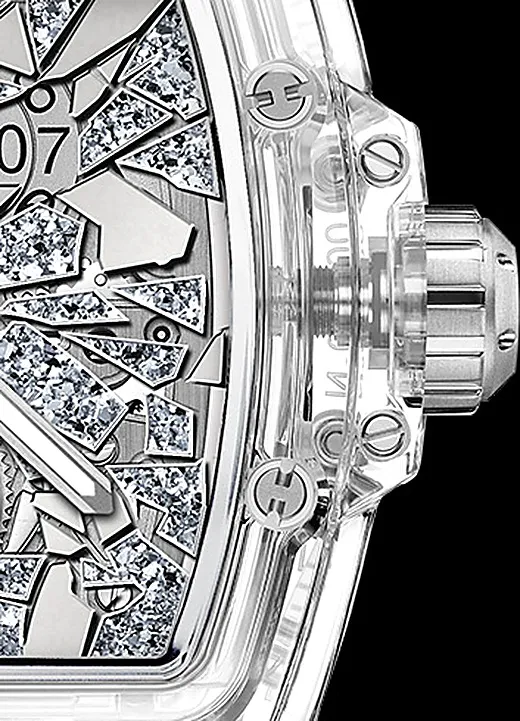
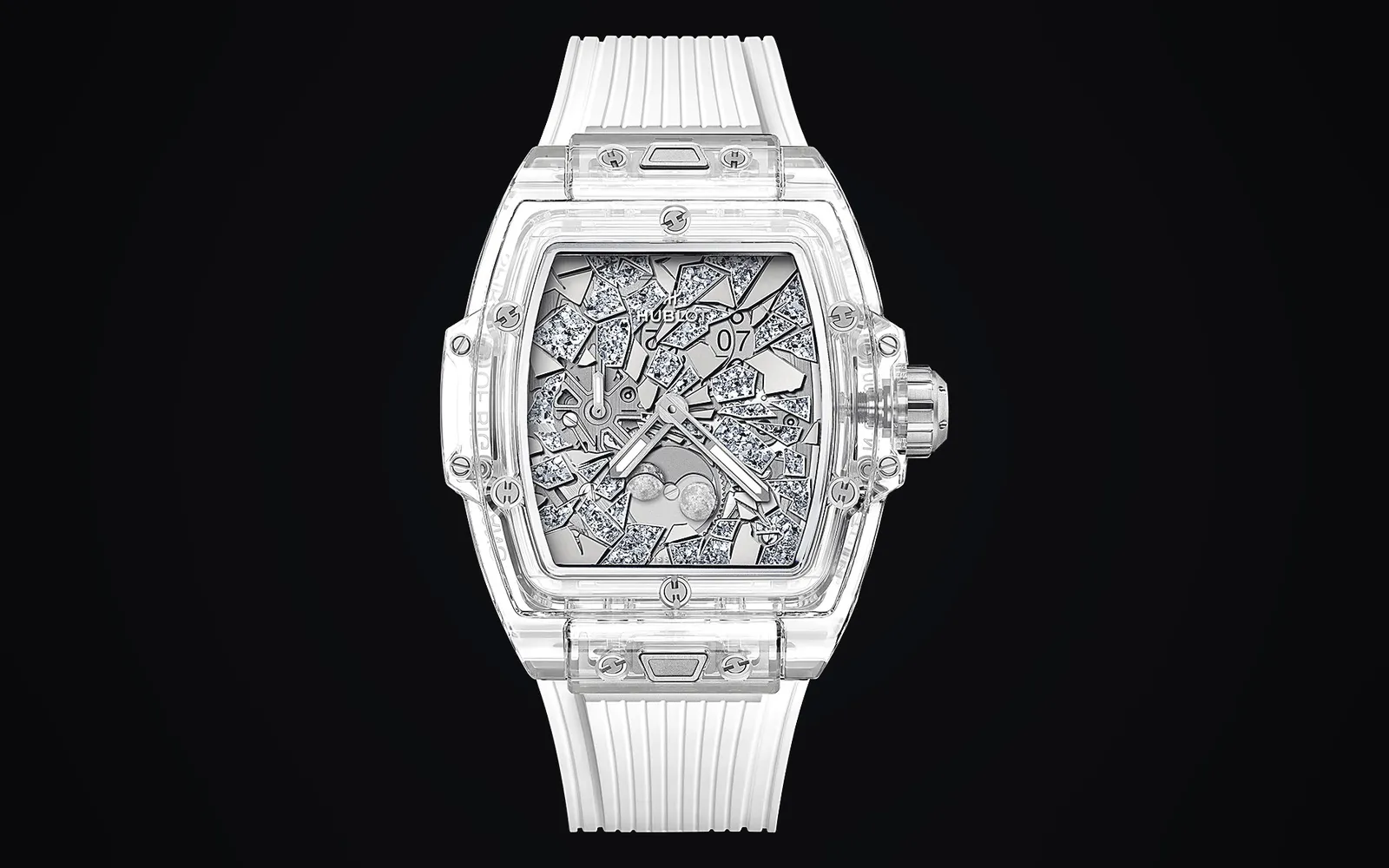
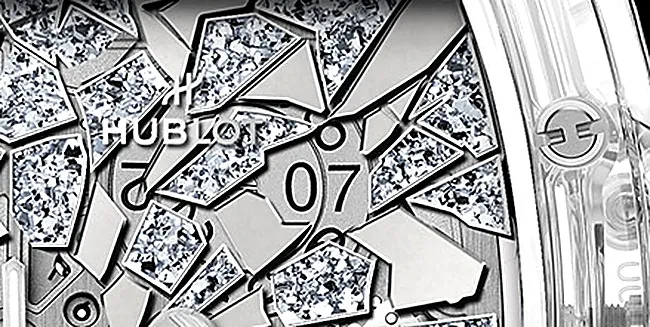
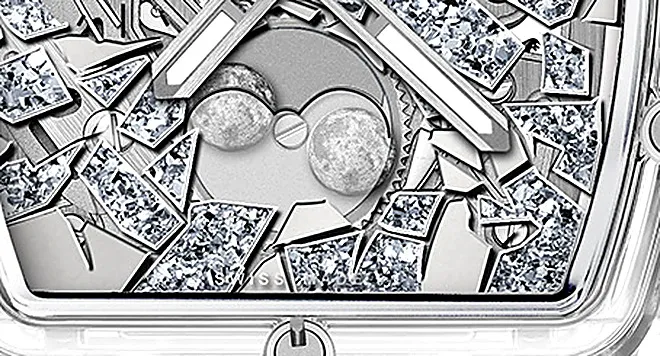
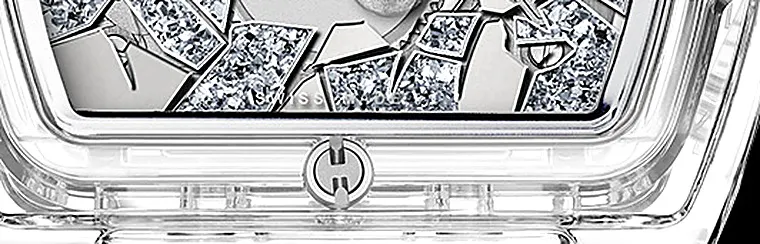
The dial is built from these crystallised osmium shards with rhodium-plated pieces set between them. The result is an image that explains the name: impact. The dial is broken into irregular angular fragments like shattered glass; some pieces swallow the light, others throw it back like a spark. Like the frozen tears of two colliding stars.
format_quote"For anything in the universe to be heavy, something first has to die."
Hasan Bekmezci
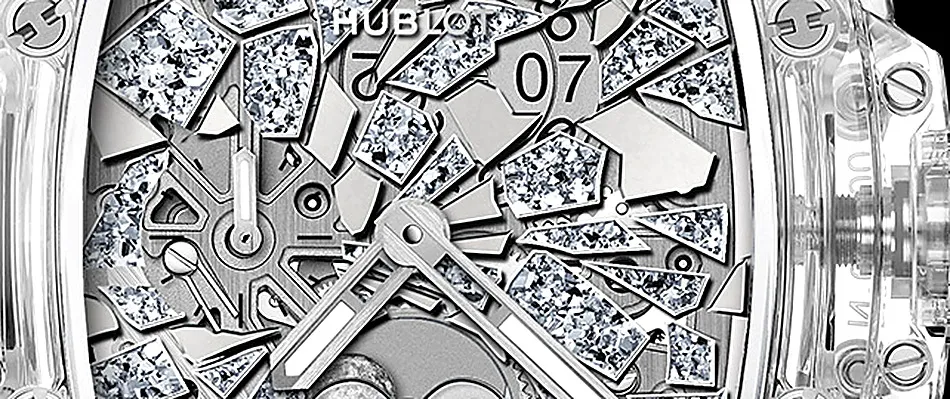
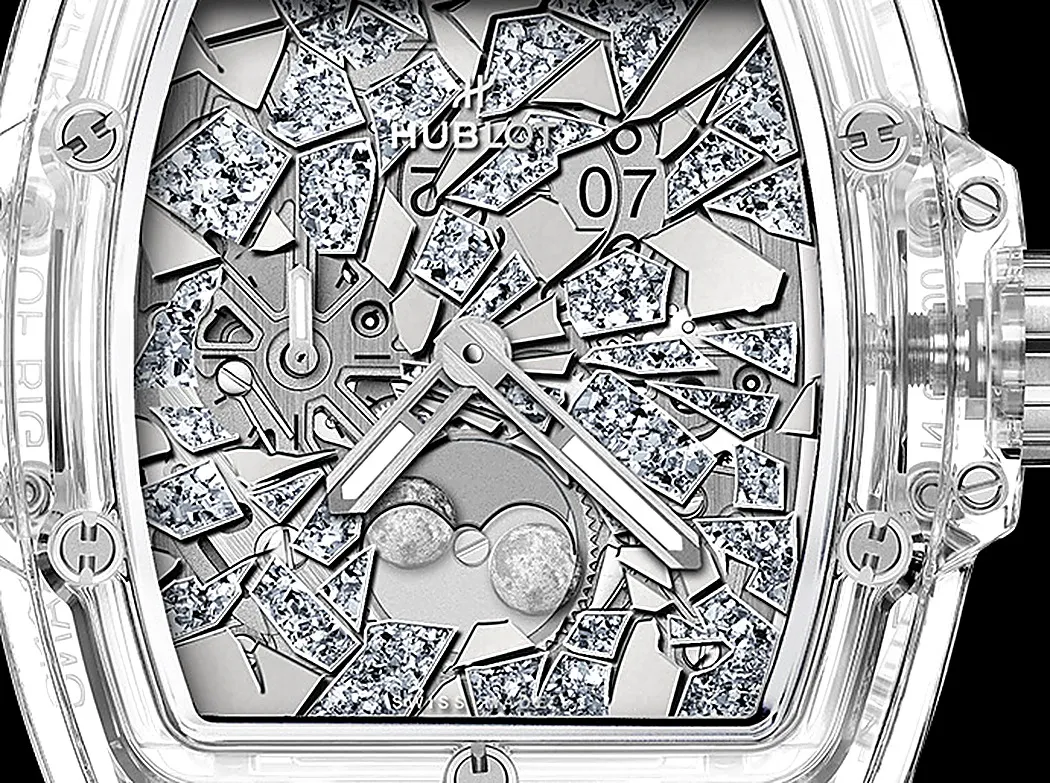
To protect what is left of the destruction of two stars, an opaque case in gold or steel would not have been enough. Hublot carved the forty-two millimetre tonneau case entirely out of synthetic sapphire crystal. This hard, transparent material, second only to diamond, exposes the frozen catastrophe on the dial from every angle like a sarcophagus made of glass. The case is fourteen point two five millimetres deep, water-resistant to fifty metres and closed with the H-shaped screws that are Hublot’s signature. To make a case transparent is to announce that there is nothing left to hide.
Behind the sapphire shield beats the skeletonised HUB1770. It is self-winding, built from 288 components, carries 27 jewels, runs at 28,800 vibrations an hour, which is 4 Hz, and gives fifty hours from a full wind. There are two indications on the dial: a twin-disc big date at one o’clock and a moon phase seen through a window at six. Nothing more; there is no room on this dial for a third complication, because the real spectacle is the material itself.
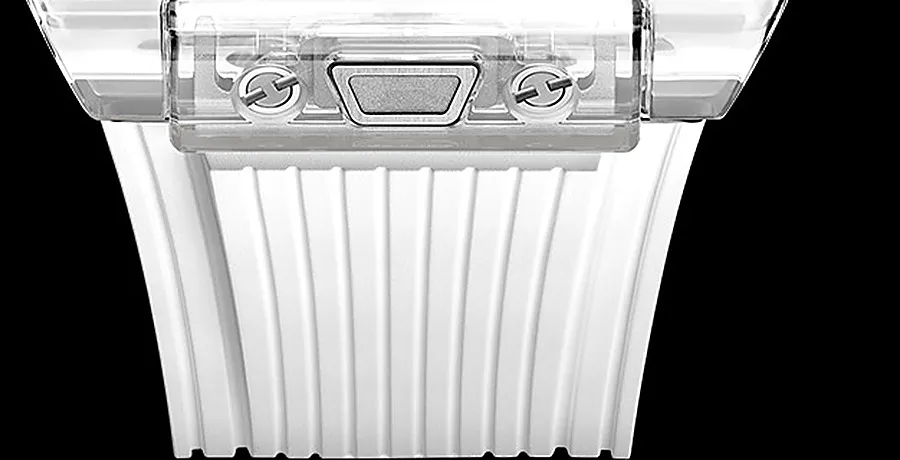
The strap is white-lined rubber with a titanium deployant clasp. The reference is 647.JX.0106.RW.IMP26 and the series runs to thirty pieces, at ninety-five thousand Swiss francs, which is around a hundred and twelve thousand two hundred euros.
format_quote"To make a case transparent is to announce that there is nothing left to hide."
Hasan Bekmezci
The Hublot Spirit of Big Bang Moonphase Impact is not merely an object that measures time. It is a seal of spacetime that brings to your wrist, in the transparency of sapphire crystal, the sorrowful cry of two dead stars that annihilated each other in the dark of space billions of years ago.
And it carries this irony: the most expensive material on your arm is not gold but a grain born in the same furnace as gold and found in far smaller quantity. What is rare is rare not because it is precious, but because the catastrophe that makes it happens so seldom.
format_quote"What is rare is rare not because it is precious, but because the catastrophe that makes it happens so seldom."
Hasan Bekmezci