Walking a desert at night is a different job from walking it by day. By day the heat wears a person down, but the direction is obvious. At night the cool arrives, and this time it is the direction that disappears.
Dunes resemble one another and they change shape as the wind passes over them. Where there was a crest last night there may be a hollow tonight. So nobody finds their way in a desert by looking at the ground. Whoever looks down gets lost.
Whoever looks up does not. Stars are indifferent to wind and they do not move. If a person can walk all night without losing north, the only reason is that they raised their head.
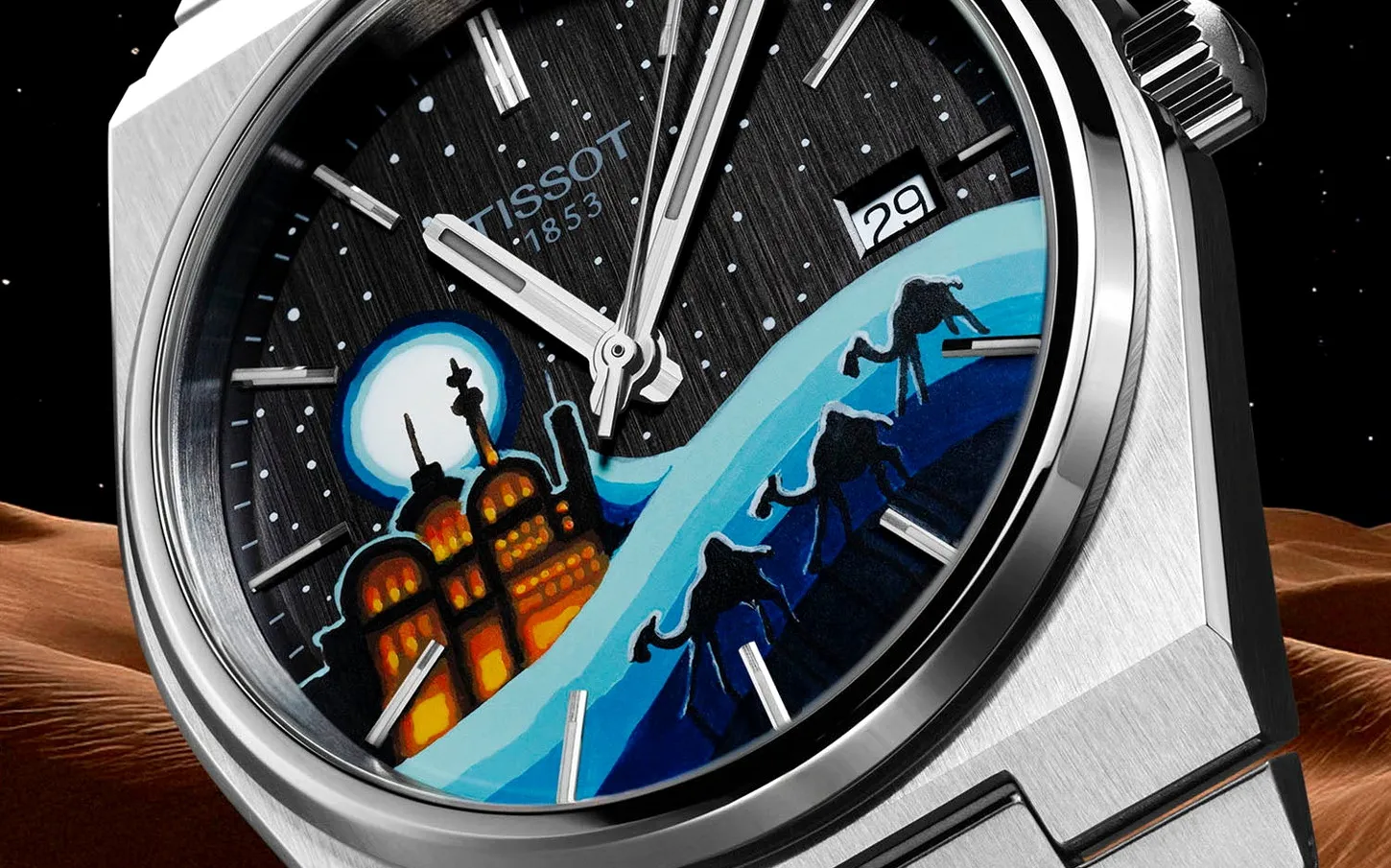
The dial of the watch in question carries exactly this view: a sky full of stars, a full moon, a distant settlement with its lamps burning, and the dunes in between. But before that dial can be understood, we should talk about what that sky has meant to human beings.
The pole star is not the brightest star in the sky. What makes it valuable is not its brightness but its stillness.
The rotation axis of our planet points almost exactly at it. So while the entire sky turns through the night, that one star stays where it is. The moment a person finds it they have found north, and every other direction follows on its own.
It has a second property, and that property was the shared knowledge of the desert and the sea for centuries. The height of the pole star above the horizon equals the latitude of wherever you are standing. Walk north and it rises; walk south and it sinks.
Arab navigators and desert guides needed no instrument to measure that height. They measured it by extending an arm and laying their fingers side by side. One finger width on an outstretched arm covers roughly a degree and a half of sky. An open hand spans about twenty degrees.
A person can therefore measure angles in the sky carrying nothing at all, using only their own hand. Small wooden plates and knotted cords came later, but the first instrument was always the same one: a human hand.
format_quote"One finger width on an outstretched arm covers roughly a degree and a half of sky. The first instrument humanity invented for measuring the heavens was its own hand."
Hasan Bekmezci
A considerable share of the bright stars visible to the naked eye today carry Arabic names. Aldebaran, Altair, Betelgeuse, Deneb, Rigel, Vega and Fomalhaut are only a few of them.
Their presence there is not an accident. After a long interval, the astronomy of antiquity reached Europe not directly from Greek but through Arabic translations and the fresh observations added to them. As a star catalogue passed from one language to the next it carried the trace of the language that had transported it.
Behind that trace lies a practical need. For a society living in a desert or on a sea, knowledge of the stars is not decoration. Knowing which star rises in which season means knowing when to set out, when to sow and when to go looking for water.
The sky was therefore first a calendar, then a compass, and only at the end a clock. The object on our wrist is the last link in that sequence, and most of the time we forget where the chain began.
Now consider two physical facts about a desert night, because the colours of this dial come directly out of them.
The first is the cold. Air that scorches by day turns bitter after dark, and people are usually surprised by the size of the swing. The reason is simple: water vapour in the air holds the heat rising from the ground and carries it into the night. Desert air contains almost no water vapour. Once the sun sets there is nothing to hold that heat and it radiates straight out into space. The same dryness makes the sky extraordinarily clear. The reason a desert night is so cold and the reason the stars are so sharp are one and the same.
The second is colour. The illumination a full moon delivers to the ground is about one four hundred thousandth of what the sun delivers. It is nevertheless enough to walk by. But the human eye cannot see colour in that little light.
There are two kinds of receptor at the back of the eye. One works by day and sees colour. The other works at night, is indifferent to colour, and responds most strongly to wavelengths between blue and green. As the light falls away, the second group takes over.
That is why a moonlit landscape is in truth colourless and yet looks blue to us. Somebody walking a desert at night does not see golden sand. They see a cold, blue, silvered surface. That is not the colour of the sand. It is the state of the eye at that hour.
format_quote"A moonlit desert is in truth colourless. What makes it look blue is not the sand but the eye that takes over in the dark."
Hasan Bekmezci
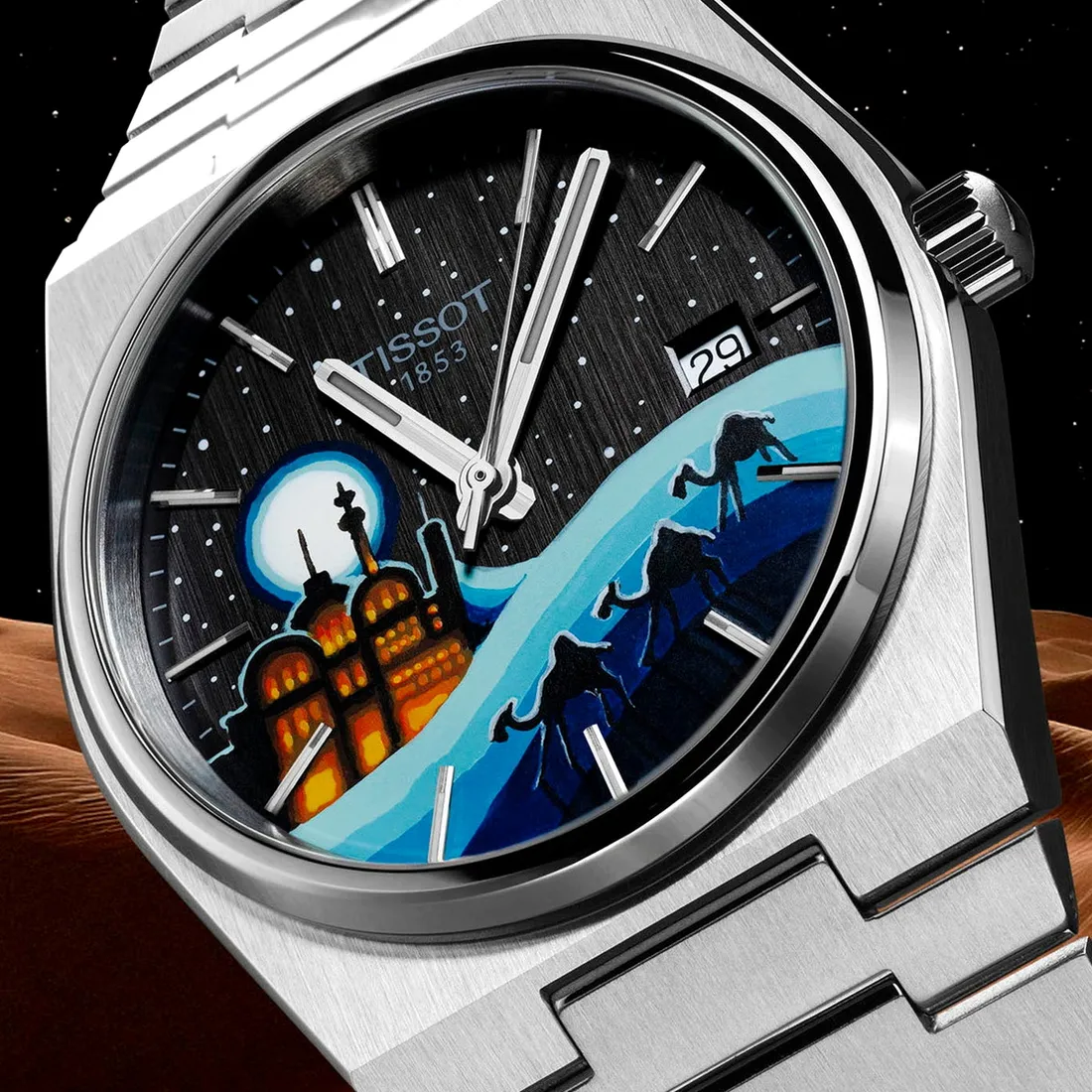
Keeping that in mind, look at the dial, because whoever painted it has depicted precisely this view.
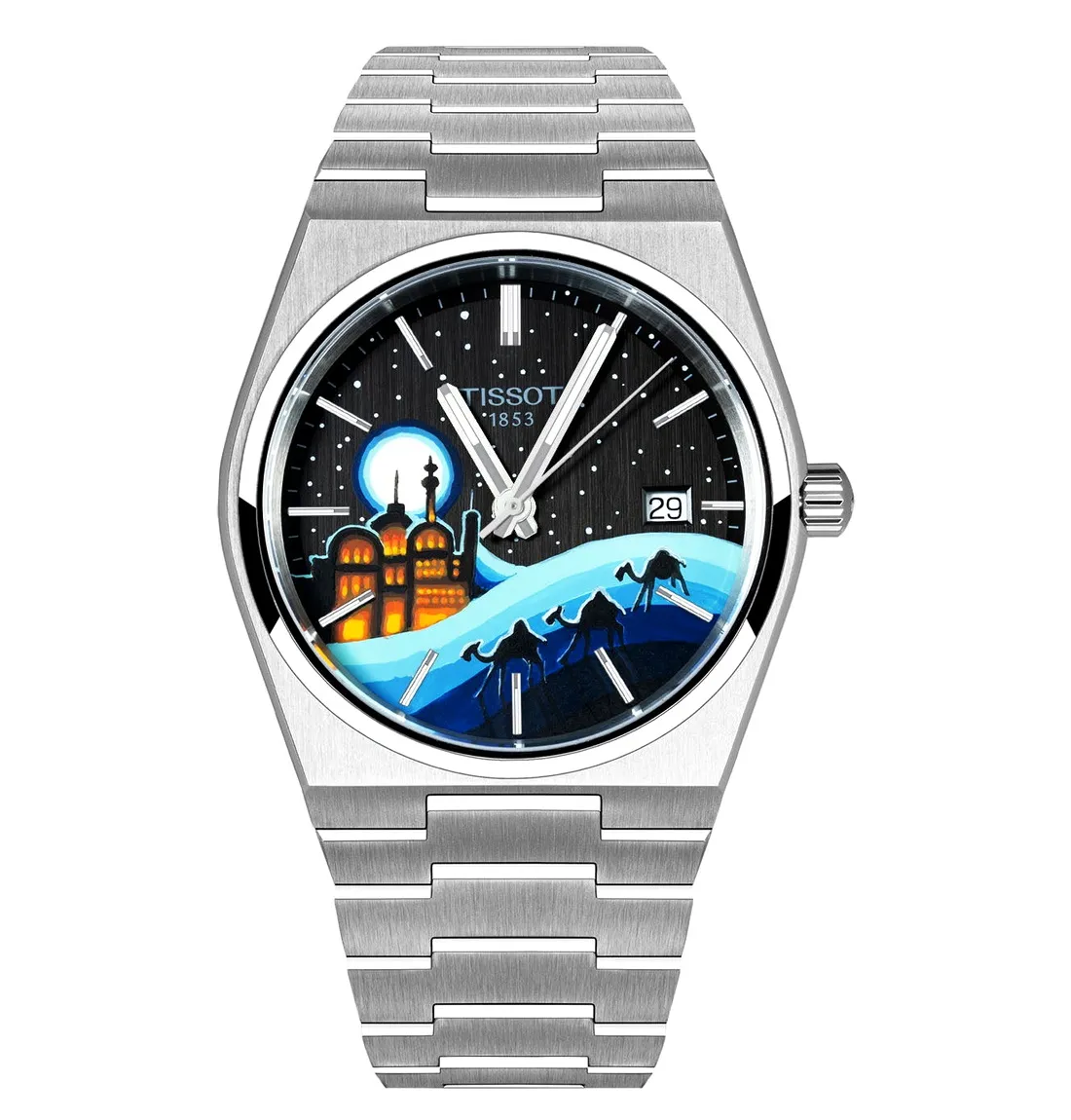
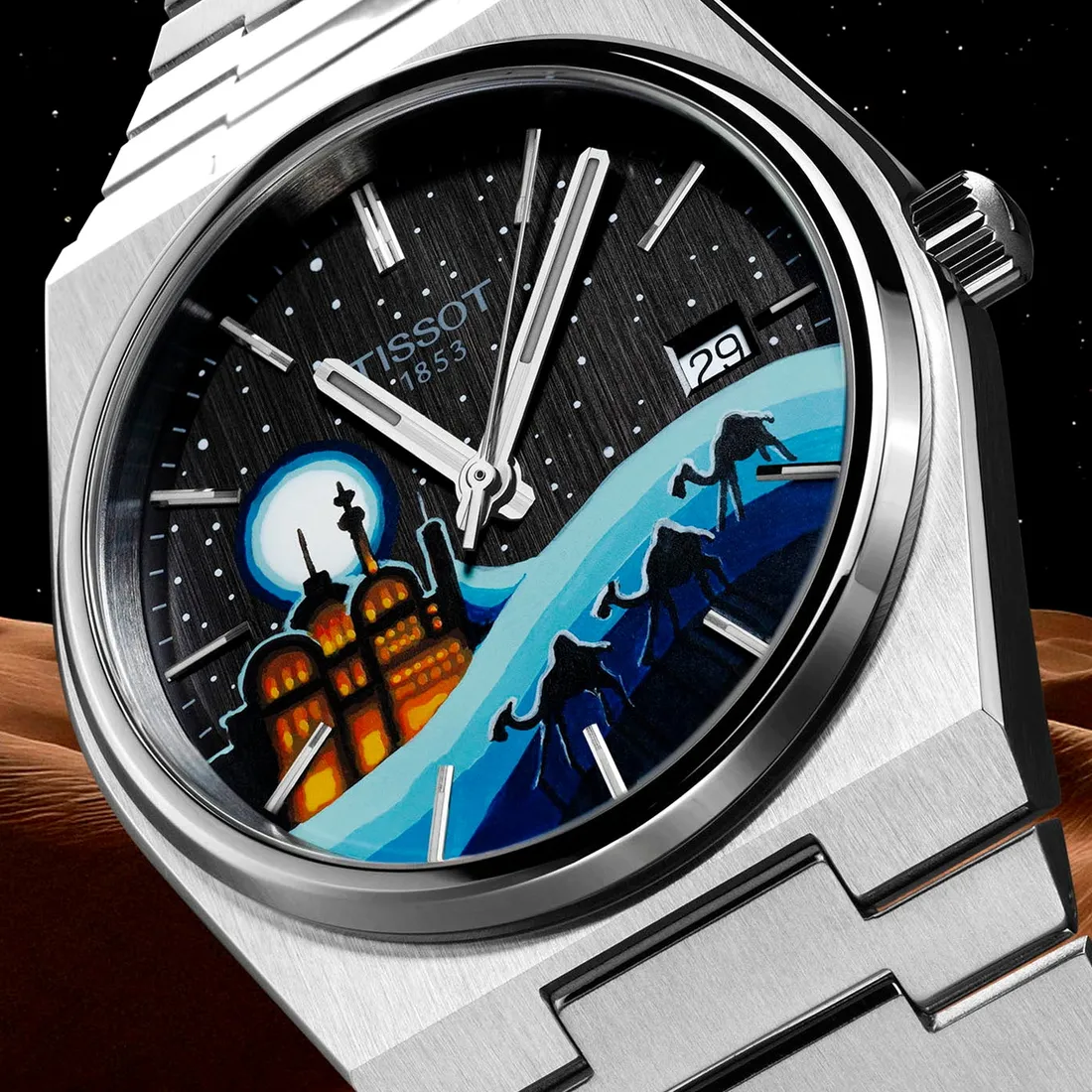
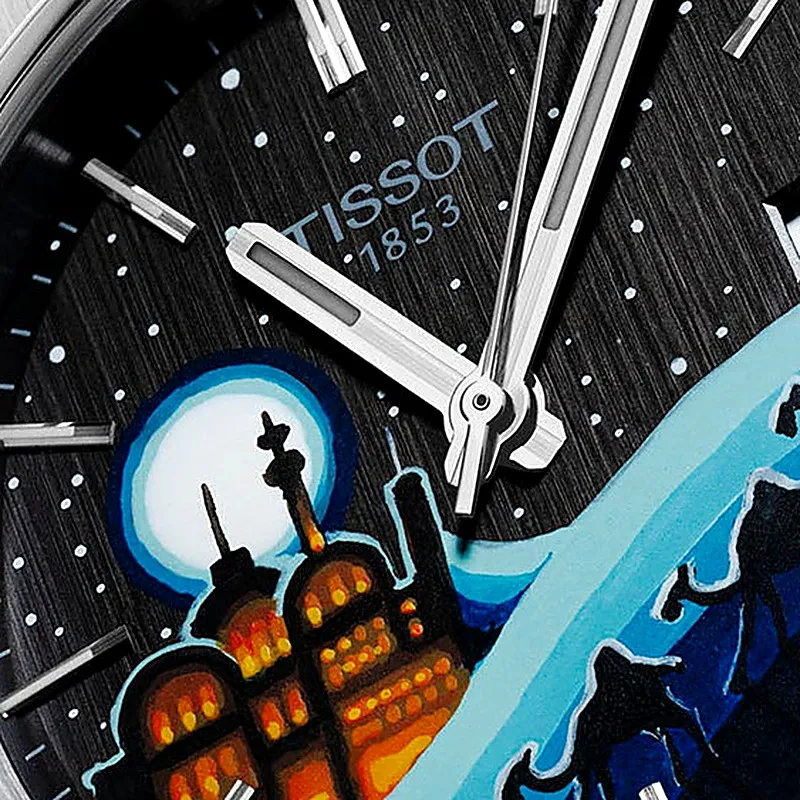
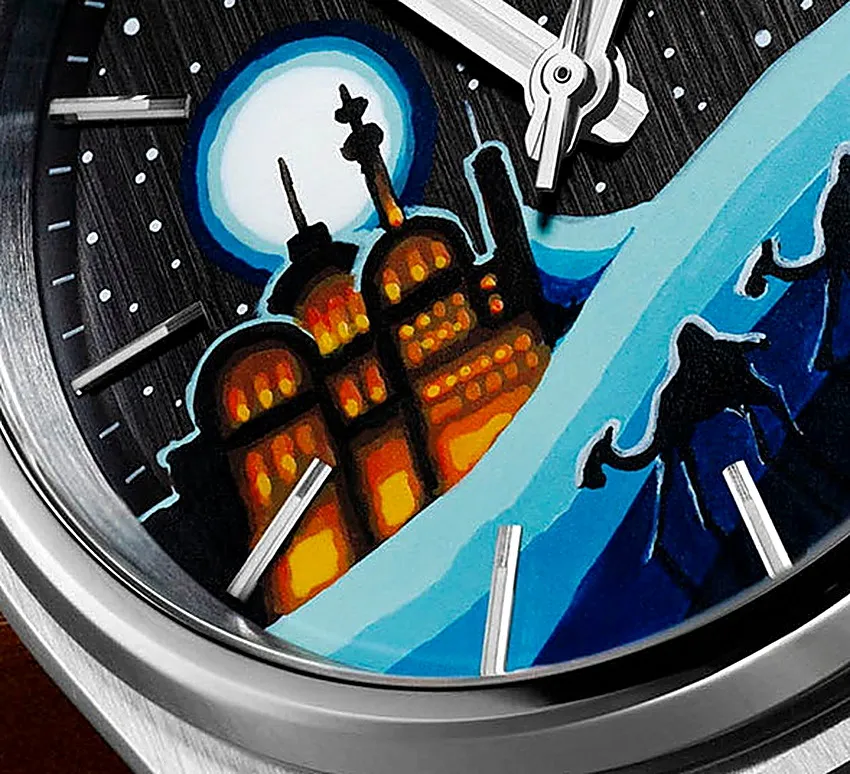
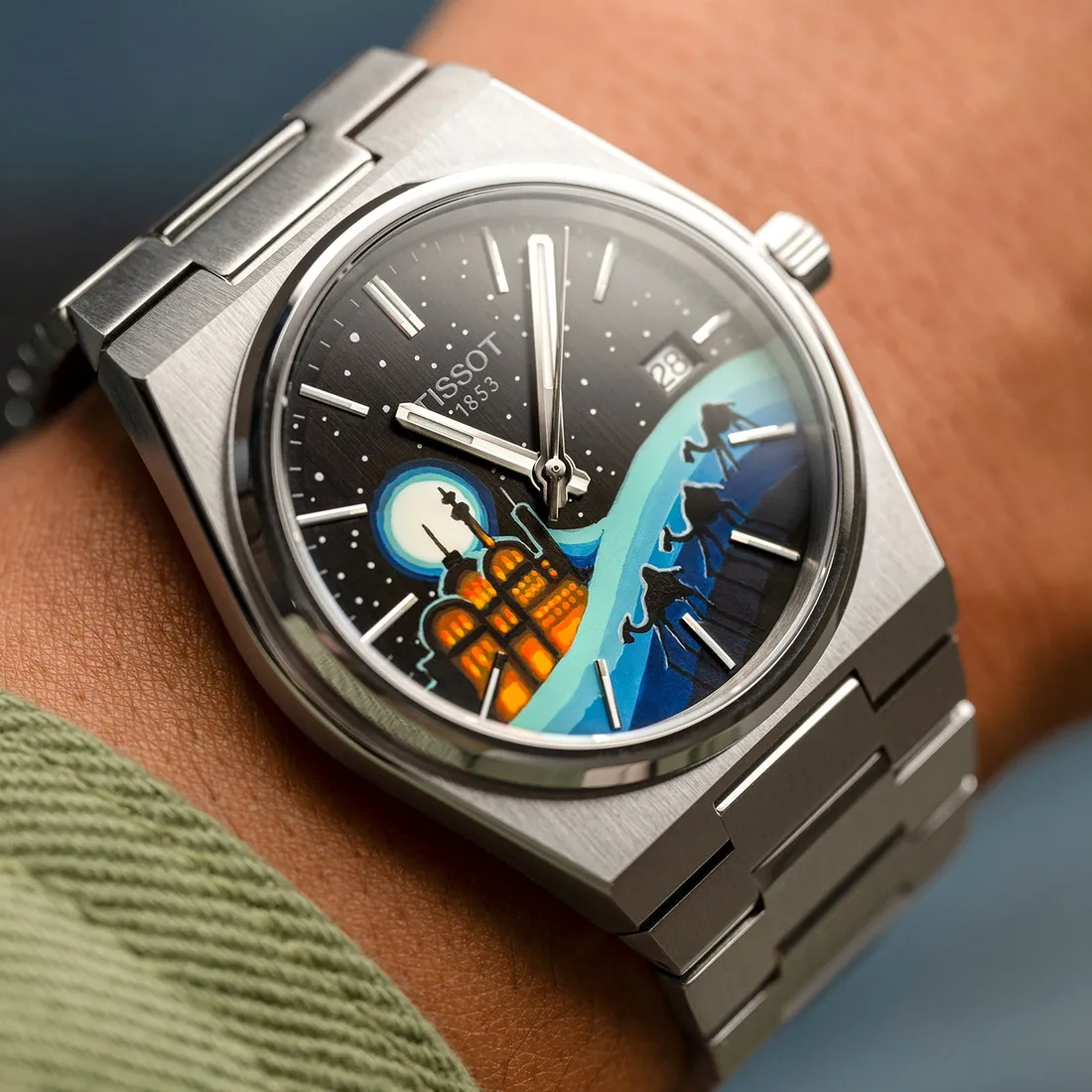
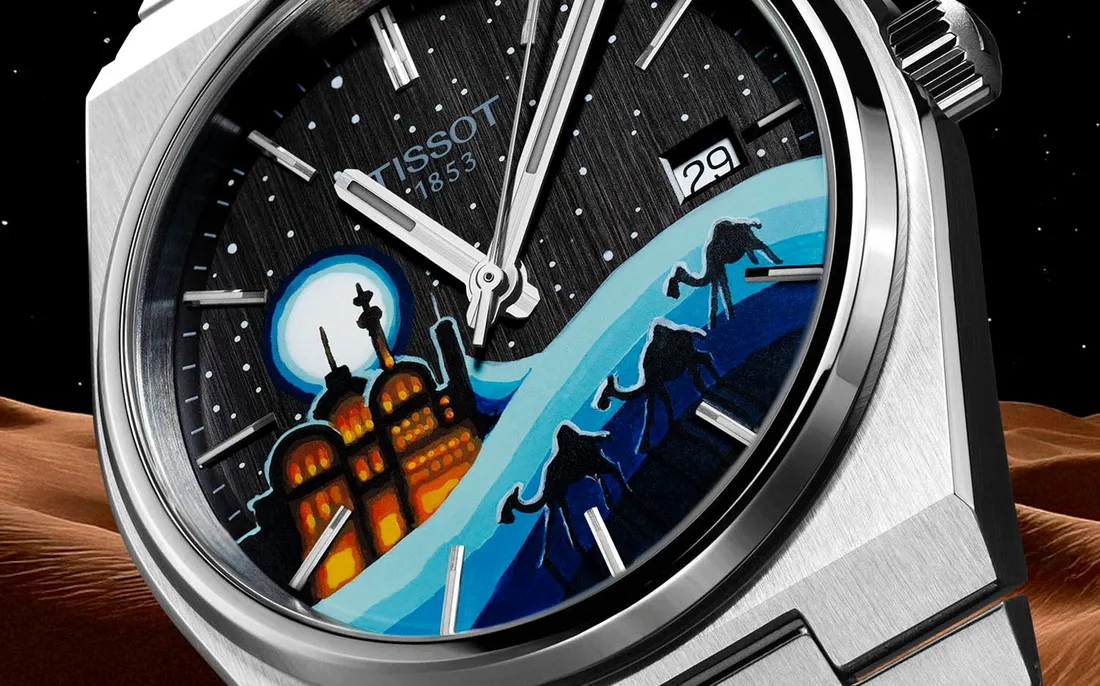
The upper half is black and white dots have been laid onto it one by one. They are not scattered at random; their sizes vary, and that variation gives the sky depth. Between nine and ten o’clock sits a bright white lunar disc with a pale blue halo around it.
A long narrow silhouette rises in front of that disc. It is a minaret, and it carries a crescent at its tip. On the left of the dial stand buildings painted in warm orange and amber, their arched windows lit from within. They are a settlement, and it is not asleep. The lamps are on.
The lower half is covered by dunes painted in layers of blue and turquoise. They curve upward from left to right and end in a deep navy ridge towards two o’clock.
Read the scene once more. The cold blue sand is the colour the eye sees at night. The warm orange buildings are the colour of fire made by human hands. The painter has set light from the sky in blue and light from people in orange, and placed the difference between them on the dial. For a traveller, the distance between those two colours is the rest of the road.
Leaving behind the city of one’s birth has carried the same weight in every period of history.
The best known journey this scene calls to mind is a prophet and his friend going out into the night. What was left behind in Mecca that night was not only a city. It was the house of one’s birth, familiar streets, known faces and the whole of the past. The words spoken at that parting make plain how strongly a person can be bound to their own homeland.
The journey was not a flight, however. It was a planned, calculated and carefully guarded departure. A young man lay down in the bed of the house, and when the searchers looked in they believed they had seen what they were looking for. That was a young man stretching out without hesitation in the shadow of drawn swords.
The guide hired for the road was a man who did not yet share the same faith. He was chosen not for his belief but because he knew his trade and kept his word. He had by heart not the main caravan routes but the rocky, waterless shortcuts nobody else would attempt. That competence decided the choice is one of the quietest lessons in the whole account.
Food was carried to the cave across three days by a young woman then in the last stage of a pregnancy. Nobody imagined such a person could climb a steep mountain, and that was the cleverest part of the plan. Finding no cord to tie the provision bag, she divided her own belt in two, and history recorded her under that name.
The tracks meanwhile were being erased by a shepherd, who drove a flock behind them and broke up the footprints. News from the city was carried up in darkness by a young man.
On the night walking portion of that journey the sky was not decoration. It was the thing that showed the way.
The guide took his bearing from the stars. The two travellers behind him knew that in the hardest hour the only thing a person can hold on to is the conviction that they are not alone. The short sentence spoken in the cave, repeated for centuries afterwards, says precisely that: do not grieve, we are not alone.
The city reached at the end of that road came out to meet the arrivals. The song sung that night, still known today, compares the one who came to a full moon. The comparison was not chosen at random. For a desert people, a full moon is the safest condition the night can be in. On a night of full moon the road is visible, danger is noticed and a person does not get lost.
To compare a human being to a full moon means, in the language of that society: when you arrived, we could see our way.
format_quote"For a desert people a full moon is the safest condition the night can be in. To compare a person to a full moon is to say: when you arrived, we could see our way."
Hasan Bekmezci
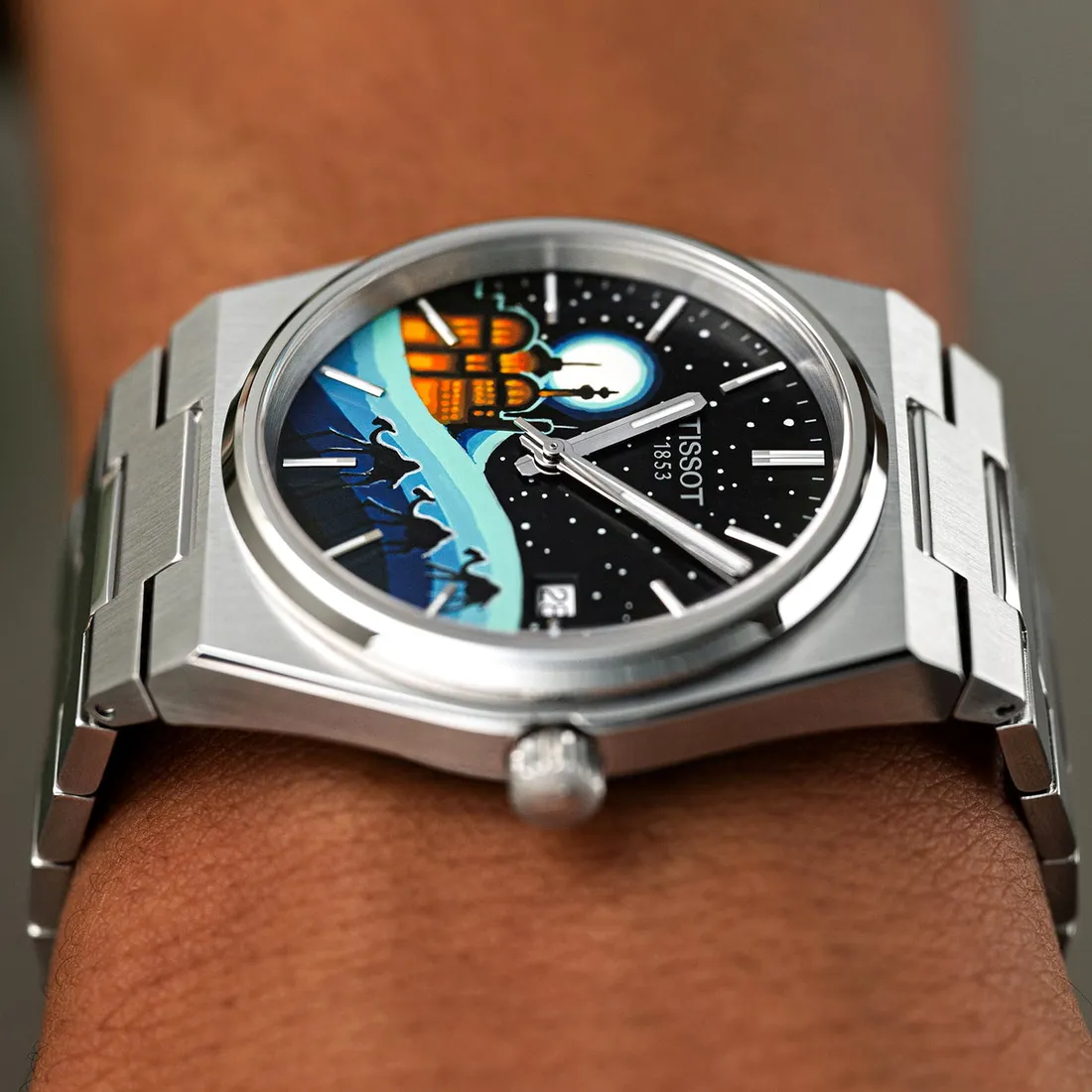
Now to the object itself.
The workshop behind this dial is called IFL Watches and it is based in Stockholm. Its working method is unusual. It does not build its own watches; it buys watches that exist, removes their dials and puts hand painted ones in their place.
The base chosen here is the black dial quartz version of the Tissot PRX. The case is forty millimetres across, forty four millimetres from lug tip to lug tip and ten point four millimetres deep. Water resistance is one hundred metres. The bracelet is integrated into the case and closes with a butterfly clasp.
Inside runs ETA’s F06.115 quartz calibre. It turns on three jewels, shows hours, minutes and seconds, and carries a date window at three. Two details are worth knowing about it. The first is a motor arrangement that delivers higher torque to the hands, so that heavier and larger hands can be driven. The second is that as the battery nears the end of its life the seconds hand stops advancing once a second and begins to jump in four second steps, warning the owner. Battery life is around two years.
Readers expecting a mechanical movement may find quartz a disappointment. But the work in this object is not in the movement. The work is in the dial, and that dial is one of the most labour intensive things that can go inside a watch.
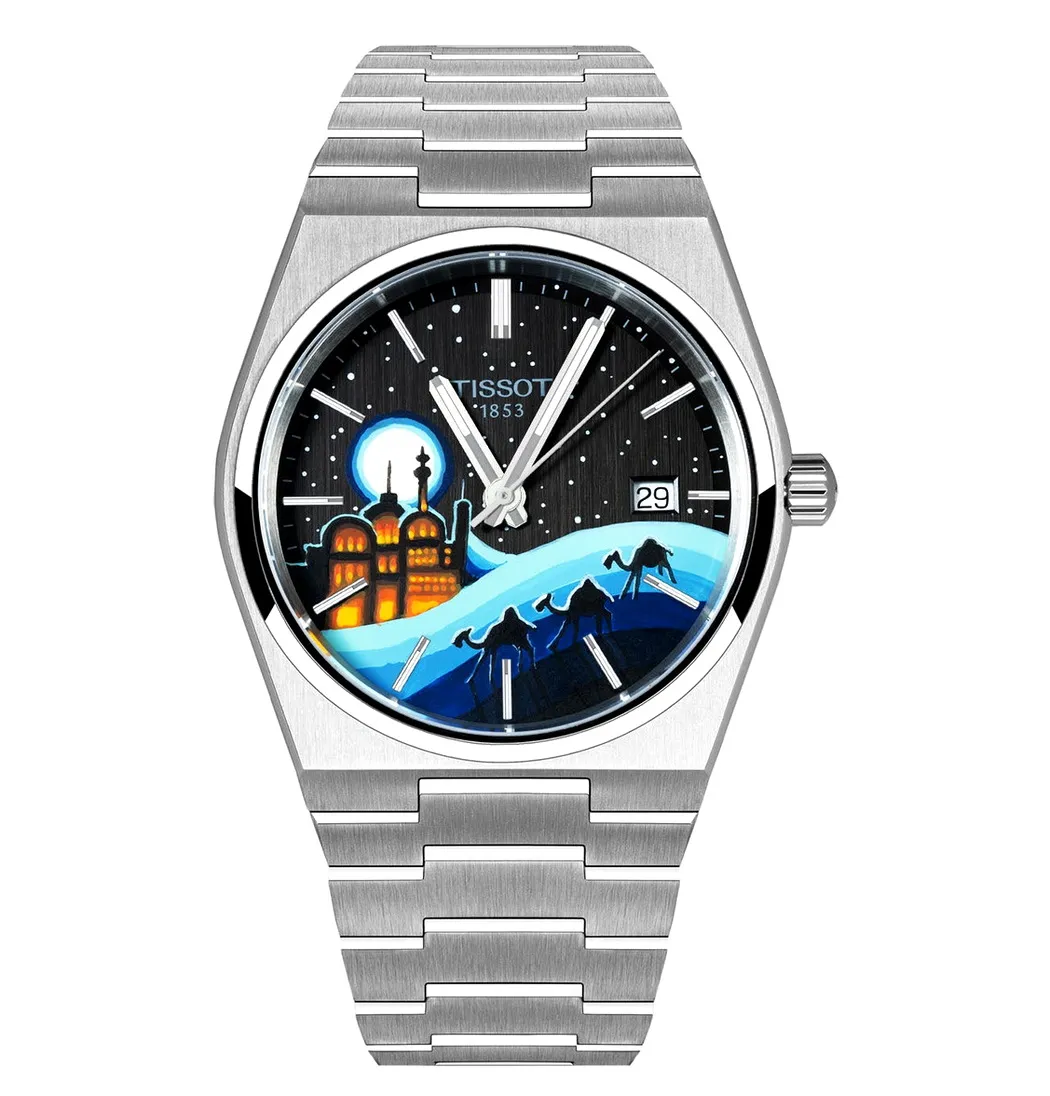
The dials are painted by hand in UV resistant enamel paints. The sun is the reason for that choice; an ordinary paint on a dial that spends years under a sapphire crystal in daylight will fade and yellow.
The painting proceeds in layers, and every layer has to dry completely before the next is applied. That wait cannot be shortened. Paint laid over a layer that has not fully set will blend with it and the edge line is lost. Completing a single dial can take up to ten hours.
One consequence of the process is unavoidable. No piece in the run of one hundred and fifty is exactly identical to another. The curve of a dune falls a few tenths of a millimetre elsewhere, the light in one window sits a little wider, one star comes out slightly larger than its neighbour.
On a mass produced object those differences count as faults. On a hand painted dial the opposite is true. They are the evidence that somebody sat in front of that dial for hours.
The watch is limited to one hundred and fifty pieces and costs one thousand and ninety euros. It went on sale on 4 November 2024.
If what this dial describes had to be reduced to a single sentence it would be this: a person walking in darkness, and somewhere ahead a place with its lights on.
The scene is not a picture of one particular night. It is not a picture of a caravan, a date or a city either. It is a picture of a threshold every person crosses at least once in their own life.
The known is left behind, the unknown is walked towards, and that walk is almost always made at night. Setting out by day is easy because everything is visible. The real question is whether a person can take a step while the way ahead cannot be seen.
Strapping a dial like this to your wrist does not hand you a calendar or a compass. It hands you a small reminder, and the reminder is this: every desert that has ever been crossed has one thing in common, which is that once the far side is reached the darkness left behind no longer looks frightening.
The sky is still the same sky. The stars are still standing where they stood. The only thing that has changed is that we are no longer obliged to look at them. And perhaps that is exactly what we have lost.