If you laid your ear against the deepest, most massless silence in the universe, what you would hear there is not the cold reticence of a stone but the endless performance of an enormous orchestra.
I mean the scale beyond the atoms, where the fabric of spacetime is woven: the Planck scale, an order of magnitude around ten to the minus thirty-fifth of a metre. String theory, the furthest edge modern physics has reached, tells us that the most fundamental building block of the universe is not a pointlike bead with mass. Everything is made of invisible, one-dimensional strings stretched across the folds of spacetime. And those strings vibrate without stopping.
What do these quantum vibrations tell us? First, they destroy at the root that illusion of solidity, of permanence, of unshakeability that matter offers us in a four-dimensional world. They whisper that the cold steel case we touch, the heavy stone we hold in our palm, our own body, are not heaps of mass at all but fields of energy rippling ceaselessly in the cloth of spacetime. At the Planck scale, stillness is a fantasy. The vibrations show us that the universe is not a warehouse in which motionless objects have been gathered but a dynamic process of existence, composed again from scratch at every instant, never pausing for a fraction of a second. What we call solidity is only a sweet deception created by our coarse senses, which cannot perceive that microscopic dance at the macro scale.
Second, they announce that mesmerising truth of oneness that lies behind the enormous variety of the universe. The photon, which is a particle of light, and the quark, which is a building block of matter, or that mystical graviton thought to carry gravitation: not one of them is made of a different raw material at bottom. All of them are notes that the same one-dimensional fundamental string produces at different frequencies. When a string swings at one pitch it gains mass and becomes matter; when it rises to another pitch it loses mass and becomes light. The colours on earth, the glitter in the stars and the mechanical tick on our wrist are not separate beings; they are the sounds of a single symphony played by the same cosmic orchestra in different registers.
Finally, these quantum vibrations say that time is not a coarse man-made calendar or the ticking of a clock on a wall, but existence itself. Every single vibration is the universe breathing in and out. Time does not flow because mechanical teeth force one another along; it is woven from those micro stitches made in the folded six dimensions of a ten-dimensional spacetime, inside Calabi-Yau geometries. The vibrations remind us that we are not strangers standing outside and watching a cold universe, but living lines vibrating at the same frequency inside that immense string matrix, joining that cosmic score with a consciousness of our own.

This truth of a vibrating universe, which string theory announced in mathematical equations at the end of the twentieth century, had already been put into words with a poetic and unsettling reach by the Ancient Master of the East, while modern quantum physics was still learning to crawl. In his formulation, the passage of the smallest particles from one state to another is nothing other than the trembling and the ceaseless turning that arise while the pen of an eternal Artist inscribes the signs of existence into the book of the universe.
Read that sentence in the language of modern physics and the map of the quantum universe unfolds in front of you: the passage of subatomic particles and of atoms from state to state is exactly those cosmic vibrations and that uninterrupted dance produced while the pen of an infinite Artificer inscribes the universal signs written into the book of being. The restless trembling of matter at the subatomic level is not an ownerless noise; it is the sound of the ink of the pen that brought existence into existence.
format_quote"What we call solidity is only a sweet deception created by senses too coarse to hear that microscopic dance at the macro scale."
Hasan Bekmezci

For three hundred years traditional watchmaking tried to measure mechanical time with the clumsy gearing of Newtonian physics: steel striking steel, brass rubbing on brass, balance springs lurching heavily along. The traditional Swiss lever regulating system that is the heart of classical watchmaking, meaning the balance wheel, the pallet fork, the balance spring, the jewels, the screws and the regulating arms, comes to exactly twenty-six separate components.
Bosonic string theory, the first to appear in the history of physics, also needed exactly twenty-six dimensions in order to hold its mathematical consistency together. But those twenty-six-part or twenty-six-dimensional structures meant friction, deviation, complexity and loss of energy. Physicists added symmetry, moved to superstring theory and united that complexity in one consistent matrix of ten dimensions. To simplify a system is to stop counting parts and start thinking of a single body.
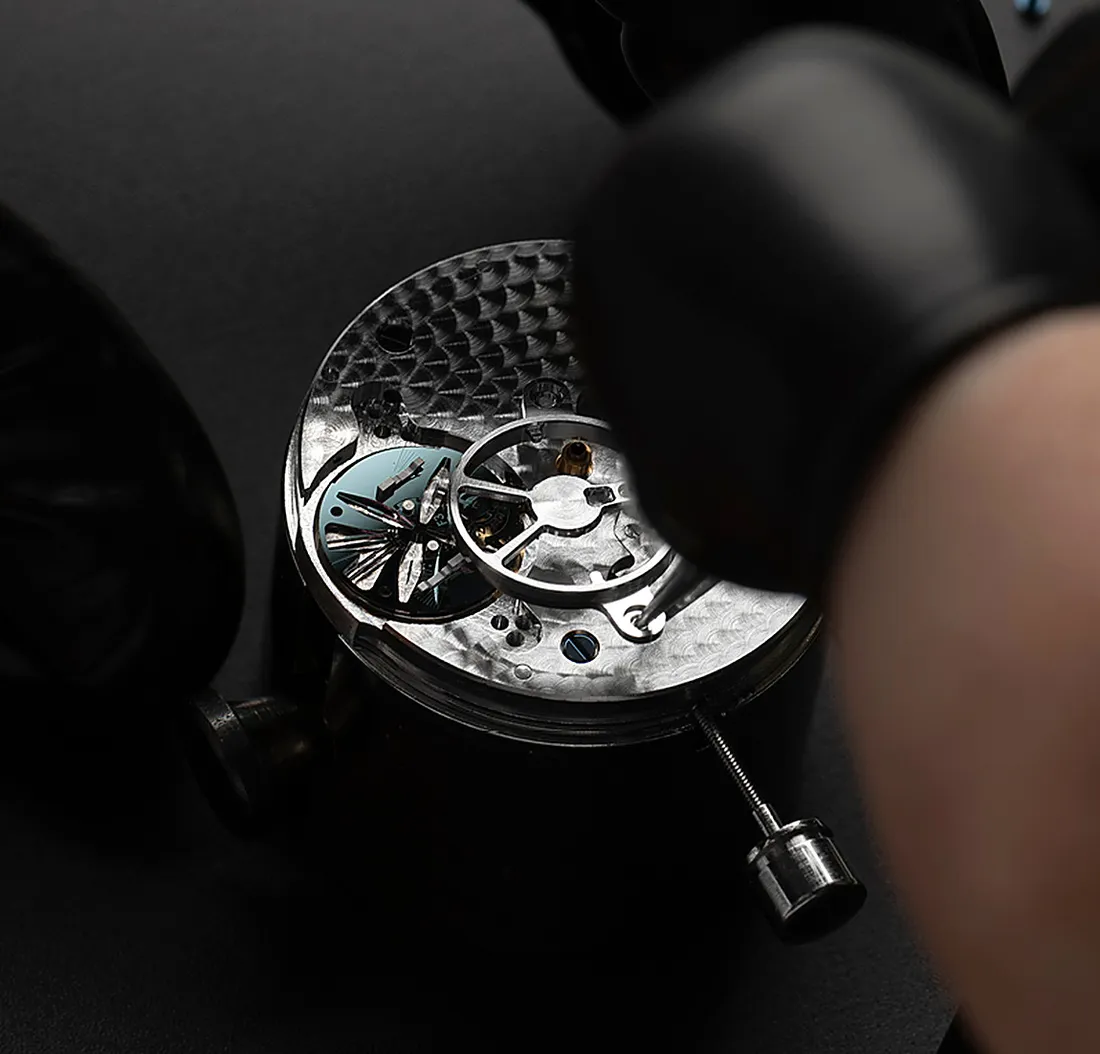
And here Frederique Constant carried out watchmaking’s superstring revolution with the Slimline Monolithic Manufacture, designed with the Dutch micromechanics pioneer Flexous. Flexures etched at the scale of microns into a single monocrystalline silicon plate three hundred microns thick gathered those twenty-six separate parts of the traditional escapement into one monolithic silicon matrix. There were no longer twenty-six components striking one another and asking for oil; there was a single structure flexing at molecular level. The three-year joint development with Dr. Nima Tolou, founder of Flexous in Delft, brought the idea of the compliant mechanism into watchmaking: instead of joining parts so they can pivot against each other, producing motion out of the elasticity of one material.

format_quote"A heart that asks for no oil has been freed not from servicing but from need."
Hasan Bekmezci
According to string theory the hidden six dimensions of the universe are folded at every point in space, at microscopic scale, into complex geometries called Calabi-Yau manifolds. We cannot see those dimensions, but the strings vibrating inside that geometry are what constitute the laws of physics.
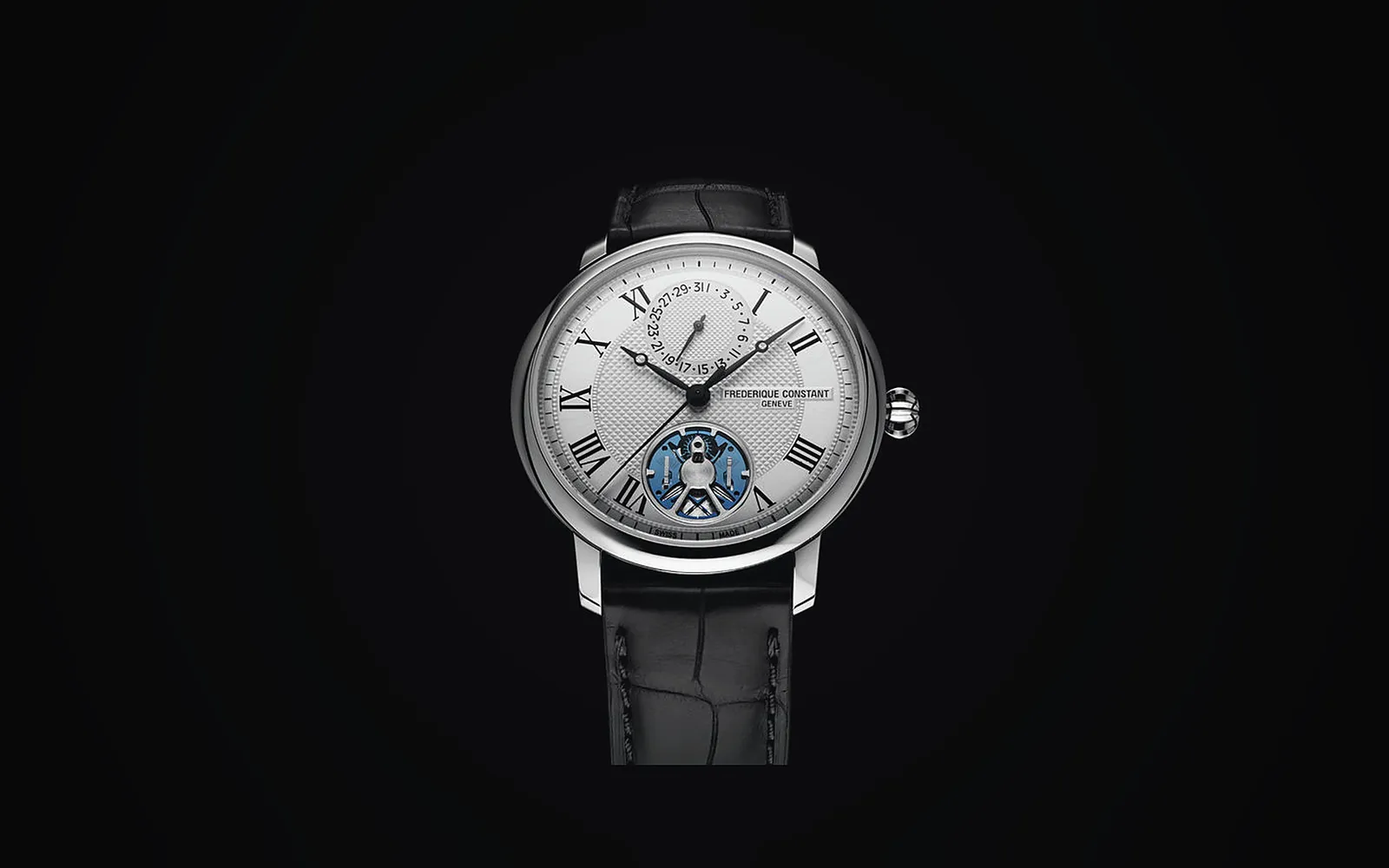
The circular, flexing anatomy of the blue silicon oscillator you see through the open aperture at six o’clock on the Monolithic is exactly the manifestation of that geometry in the mechanical world. The silicon arms swing without touching metal, on their own inner molecular elasticity; because there is no friction they require no lubrication, because the material is amagnetic they are immune to magnetic fields, and they show no fatigue. A heart that asks for no oil has been freed not from servicing but from need.
A standard mechanical watch divides time into coarse pieces at four full oscillations a second, meaning 28,800 vibrations an hour. The manufacture FC-810 beats eighty times a second, which is to say 40 Hz: exactly 288,000 vibrations an hour, ten times an ordinary mechanical watch. And here is the part that runs against expectation: even though a fourth wheel had to be added to the train to carry that frequency, the watch still runs eighty hours from a full wind. Not paying for high frequency out of the power reserve is the real accomplishment of this calibre.
The secret is in amplitude. Where a traditional balance wheel turns some three hundred degrees on every swing, the amplitude of the silicon oscillator is only six. To the naked eye its motion cannot be made out; it is not a lifeless part sitting on a dial but something like a living cell trembling at high frequency. Thanks to that immense frequency the seconds hand makes no micro jumps; it flows across the dial like a liquid wave. And on the plate there are adjustment weights, exactly as on a free-sprung balance: proof that a new technology is not obliged to reject the oldest tradition.
format_quote"To simplify a system is to stop counting parts and start thinking of a single body."
Hasan Bekmezci

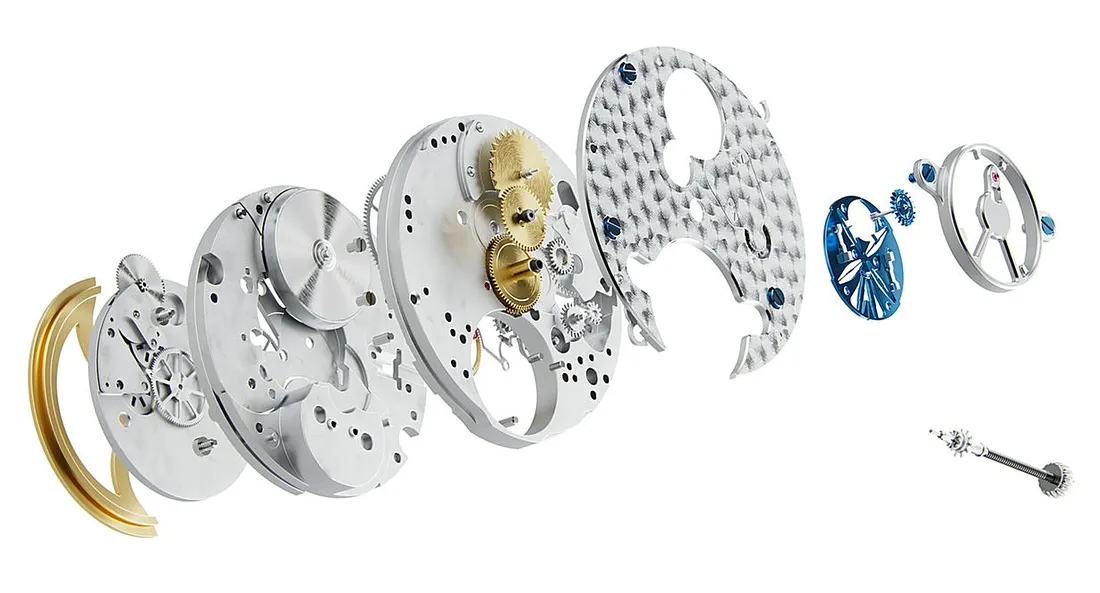
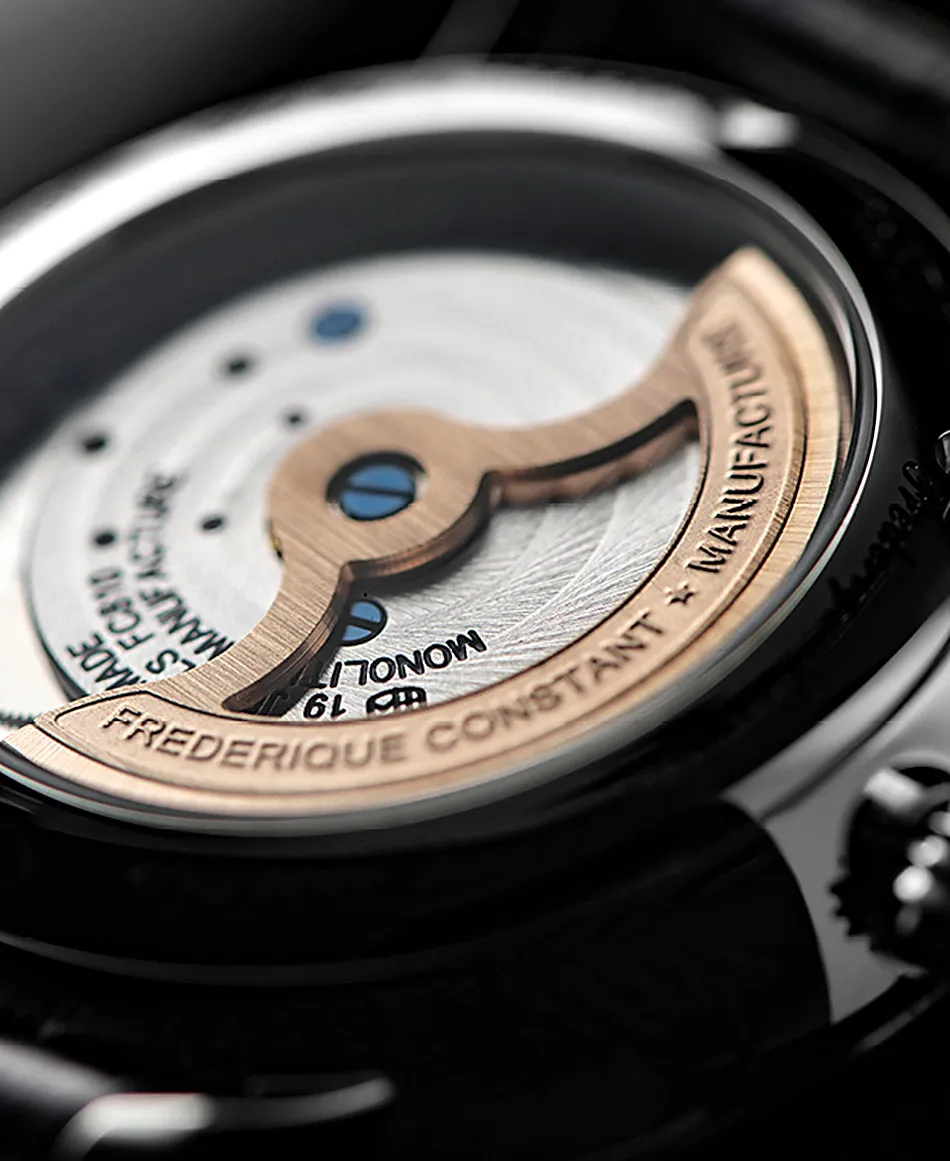
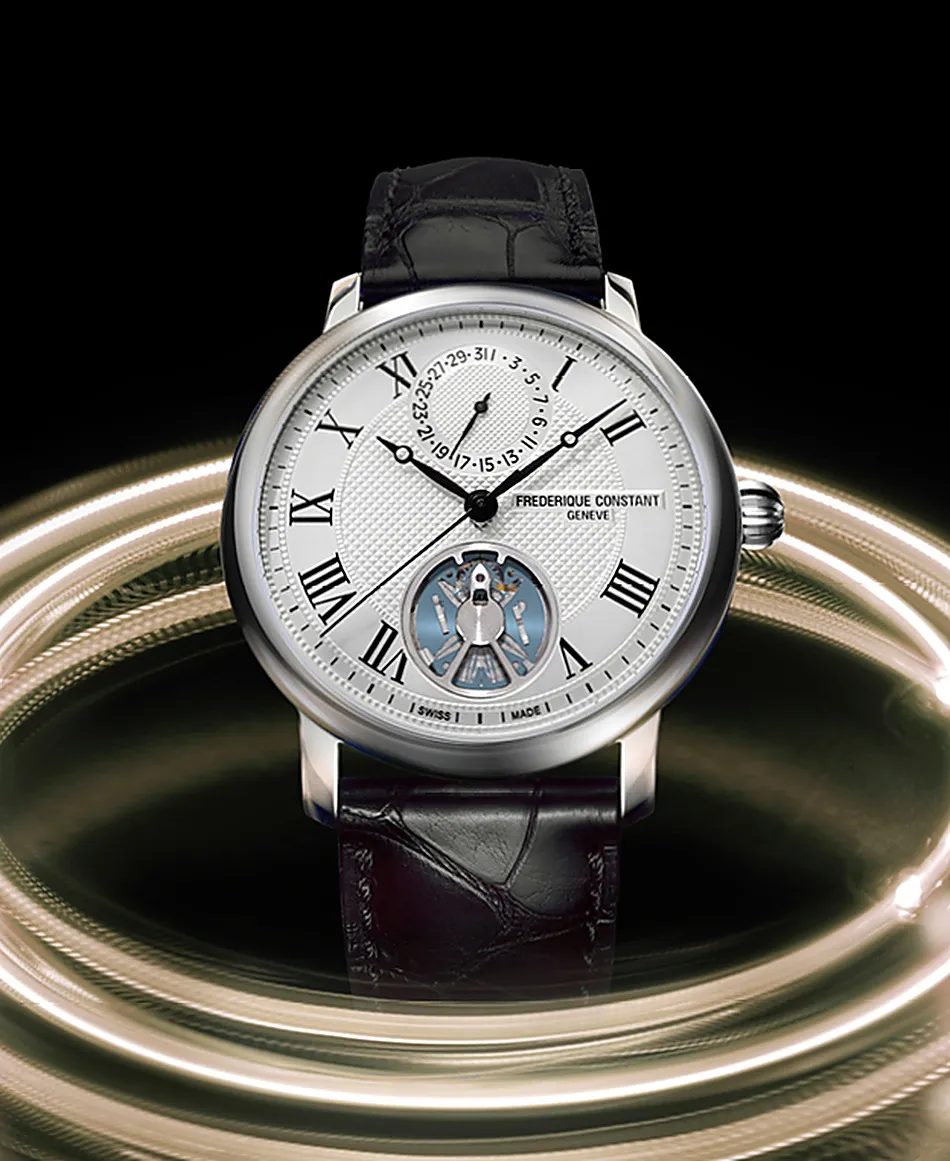
Seen from the outside, the Slimline Monolithic Manufacture holds the composed stance of a classical dress watch: a forty millimetre case, a dial brushed with a clous de Paris pattern, printed Roman numerals, Breguet-style hands and a pointer date at twelve. Thirty metres of water resistance, sapphire front and back. It was offered in steel and in eighteen-carat rose gold, in series of eight hundred and ten and of eighty-one pieces; the steel references stood around four and a half thousand euros, the gold reference around fourteen and a half thousand. For a house to hide its thirtieth calibre inside a case this quiet is the most silent form of self-confidence.
But that blue aperture at six o’clock opens straight onto the heart of the quantum universe. The last act of this architecture has now been played: this generation of the monolithic oscillator took its leave in a series of one hundred pieces, and the house announced that it would hand the turn to the next generation. The final series of a technology often says more than its first.
With its silicon heart trembling 288,000 times an hour, this watch whispers one truth to its owner: time is not the noise of rusted wheels striking one another. Time is that blessed vibration echoing in the hidden Calabi-Yau dimensions of the strings and in the molecular elasticity of silicon.