In most major team sports the clock counts down and everybody watches it. In basketball, in American football, in ice hockey, the time runs out, a horn sounds, and there is nothing to argue about.
Football does not do that. The clock counts up, never stops, and keeps running through injuries and every dead moment; at the end the referee adds back whatever he judges was lost. In the ninetieth minute a number goes up on the fourth official’s board, and even that number is a minimum. Only one person on the pitch knows when the match will really end, and nobody is certain until the whistle.
The most watched game in the world therefore leaves time deliberately uncertain. And that uncertainty is not a flaw but the texture of the game; the tension of the last minutes comes from exactly there.
format_quote"The most watched game in the world leaves time deliberately uncertain. That uncertainty is not a flaw but the texture of the game."
Eric Berger
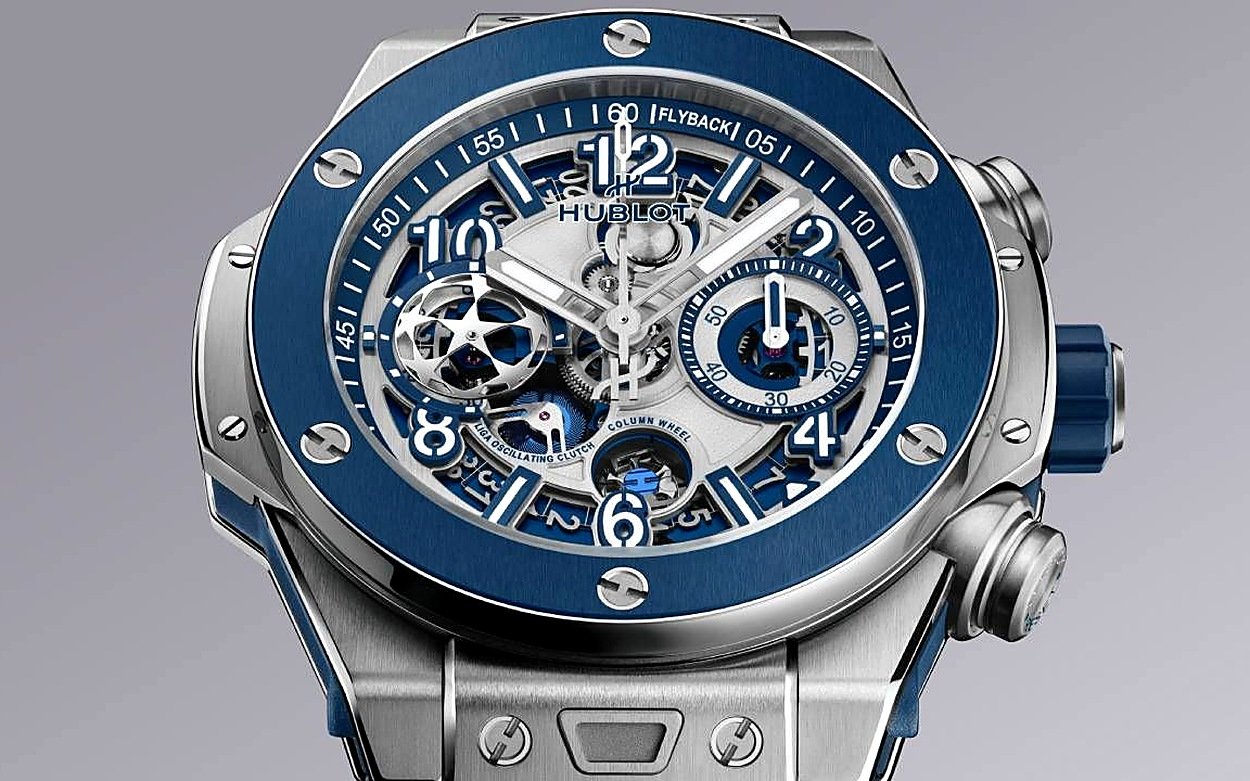
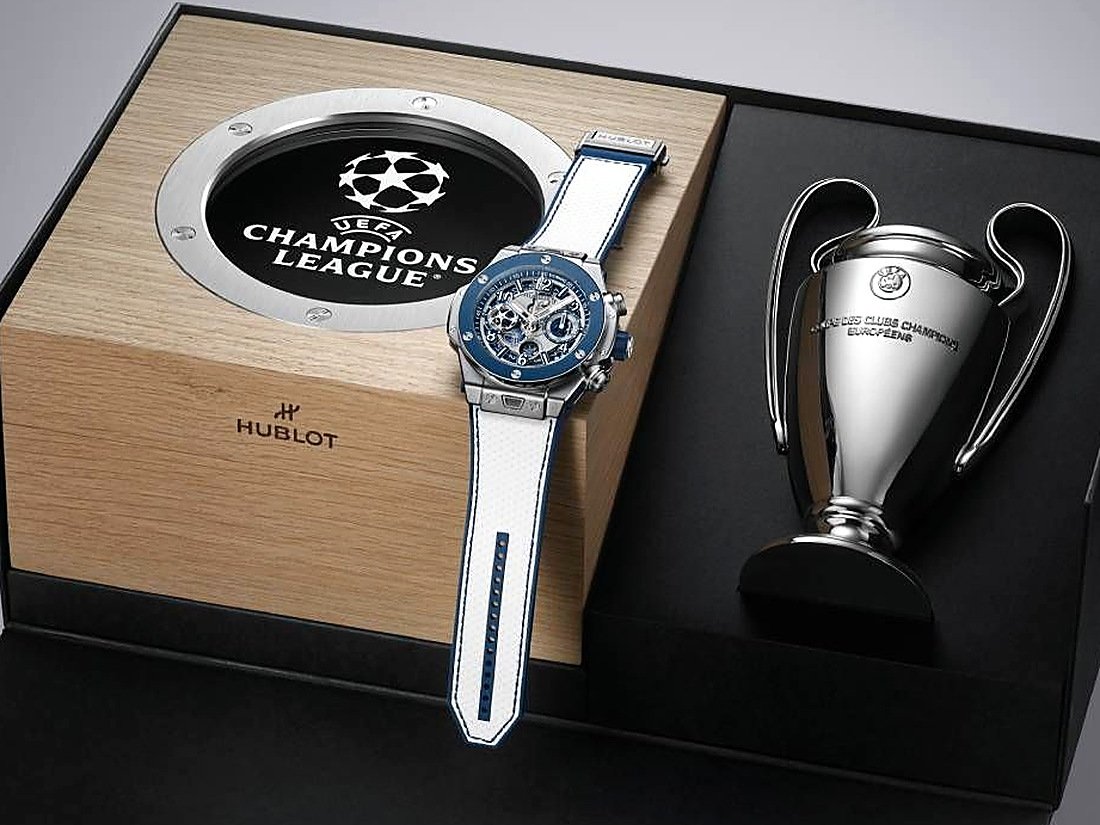
This watch is the eighth to come out of Hublot’s long partnership with Europe’s biggest club competition, launched alongside the opening of the new season. One hundred are being made.
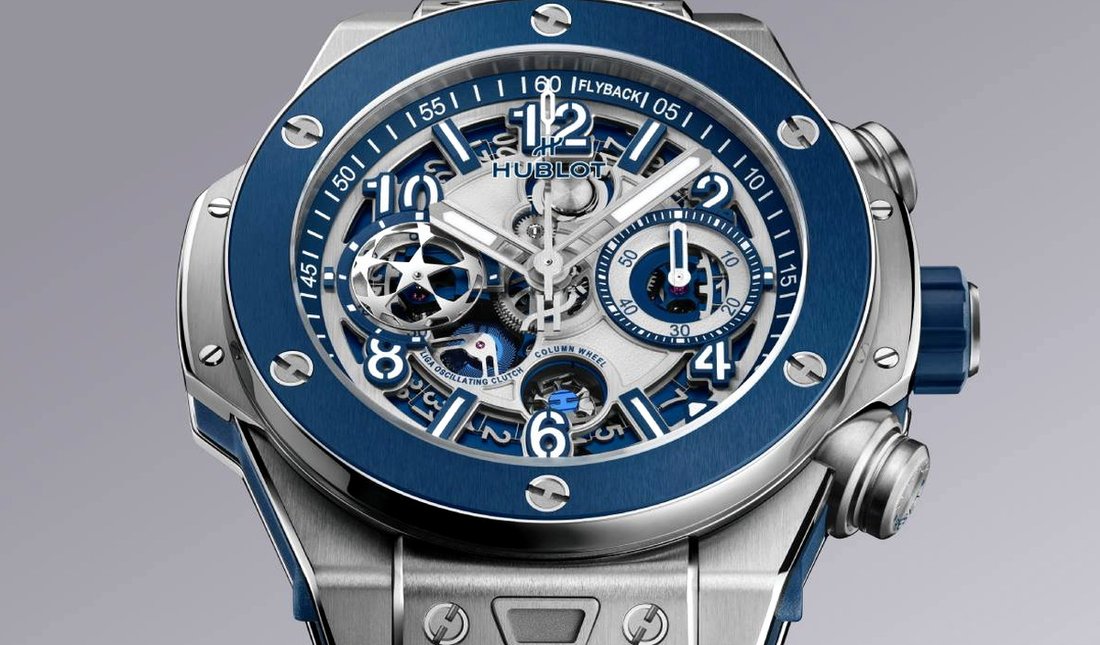
The case is forty-four millimetres and titanium, with satin and polished surfaces used together. The choice of titanium is a straightforward necessity at that size: the same case in steel would be noticeably heavy, and forty-four millimetres is already at the limit of a wrist. The bezel combines two materials, polished titanium and blue ceramic. The ceramic is not only there for colour; it resists scratching far better than metal, and the bezel is the part of a watch that takes the most knocks.
The dial is matte blue and skeletonised. The real difficulty of a skeleton dial on a chronograph is legibility: because the movement shows through, the ground is constantly moving and the hands risk disappearing into it. That has been countered here with a matte finish and thick edges on the hands. The brand’s mark sits on the tip of the seconds hand; putting a signature on the one part that turns is a simple trick for locking the eye onto it.
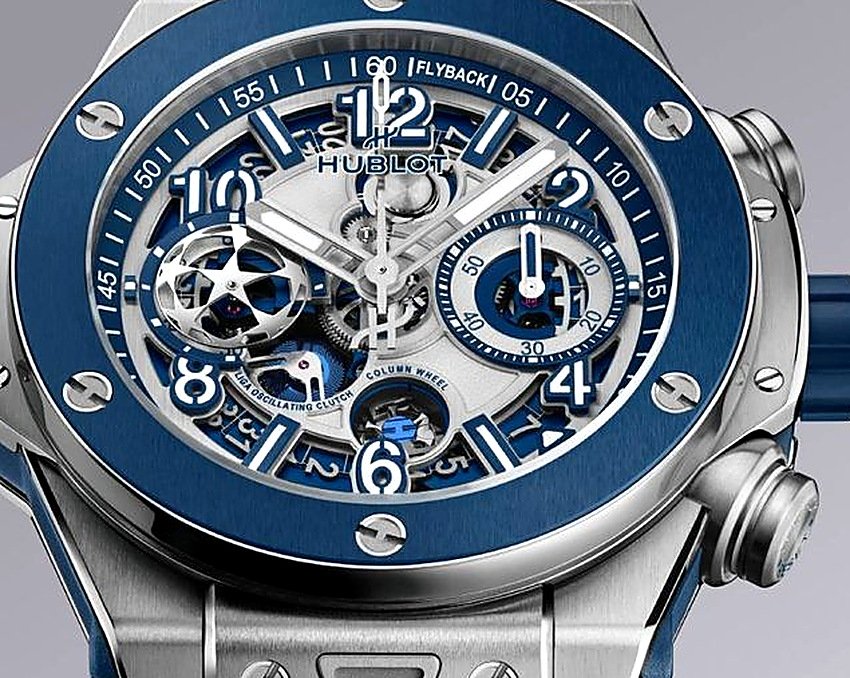
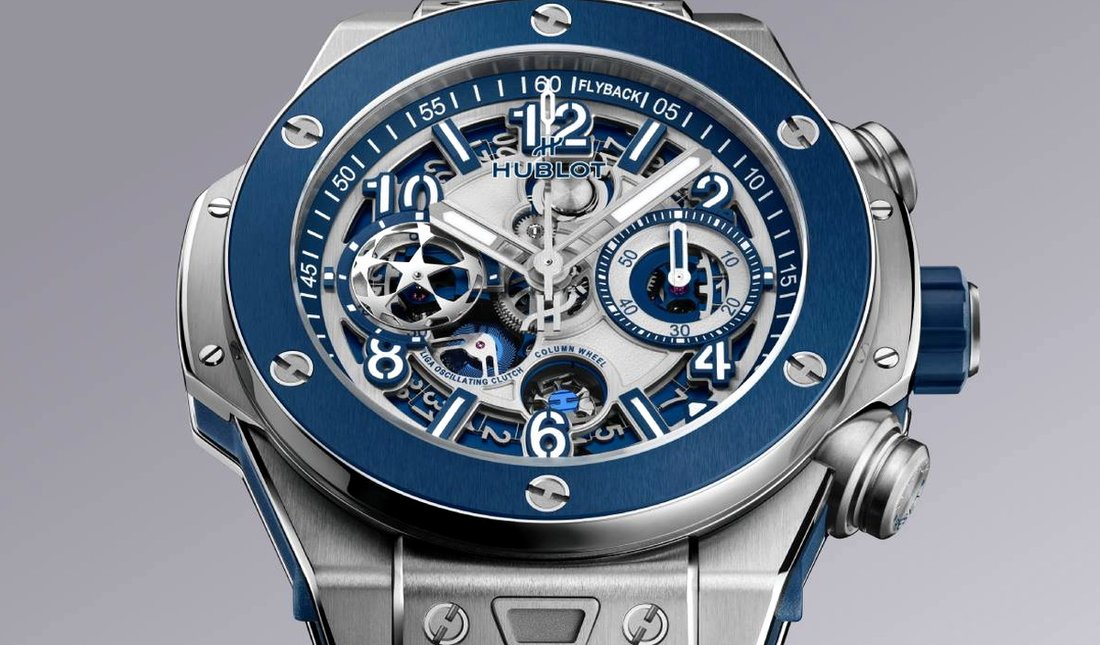
Inside runs the HUB1280 Unico, Hublot’s own chronograph calibre, built from three hundred and fifty-four components with around seventy-two hours of reserve. The best-known feature of this family is that the chronograph mechanism sits on the dial side; when you run the chronograph you watch the moving parts from the front rather than the back.
The control layout is column-wheel. A column wheel is the toothed part that routes the start, stop and reset commands of a chronograph; it costs more than the simpler cam-operated systems and gives a softer feel under the finger. That is also the part of a chronograph most felt in daily life: you do not remember the accuracy of the mechanism, you remember the character of the pusher.
The caseback is blue ceramic, with the competition’s mark carried on the sapphire at its centre.
format_quote"What is most felt about a chronograph in daily life is not the accuracy of the mechanism but the character of the pusher."
Eric Berger
format_quote"Measuring has never been the same as knowing."
Eric Berger
A partnership between a sports competition and a watch brand is usually no more than an exchange of logos. What makes this one a little more interesting is that time works in diametrically opposite ways in the two fields.
Watchmaking has spent centuries trying to reduce uncertainty: pushing deviation below a second, compensating for temperature, balancing out gravity. Football preserves uncertainty and feeds on it. Because nobody knows when the ninety minutes will end, forty thousand people in a stadium hold their breath at the same moment.
Waiting for the final whistle while carrying an instrument on your wrist that measures far below a second is a reminder that measuring has never been the same as knowing.