High in the untouched canopy of the Amazon rainforest, on the topmost branches of the great ceiba trees, lives a bird that folk tales have never treated as merely a bird. In the stories of Latin America it is the courier that brings the first light of the sun down to the forest floor, the go-between shuttling from sky to ground. When the sky goes black with storm, the tales say, the toucan tears the darkness open with that magnificent beak and gives the forest its colour back.
The story of a bird stays half told until you understand the bird’s anatomy.
The toucan is one of the most startling contradictions on earth. That enormous beak, so out of proportion to the body that it looks at first like heavy armour, has a thin shell of keratin on the outside and, inside, a lattice of bony struts like a honeycomb, the gaps filled with air and membrane. The result is a structure that is at once nearly weightless and strong enough not to crumple when it strikes a branch. Lightness and strength are usually bought at each other’s expense; here the two have been reconciled inside one organ.
More than that, the beak is not only a tool but a radiator. By opening and closing the flow of blood into the vessels of the beak, the bird manages its own body temperature: in tropical heat it dumps surplus heat out through the beak, and in the cool of night it throttles the flow, keeps the heat inside and sleeps with the beak laid back over its shoulder like a blanket. We are talking about a creature that has been given a way to cool down without sweating.
To say that such an arrangement arose on its own is to say a radiator happened to fit itself onto a bird’s face. The calculation that brings lightness, strength and thermal management together inside one organ cannot be the work of the creature that carries it. The toucan is the result of a design, and its beak is that design’s signature.
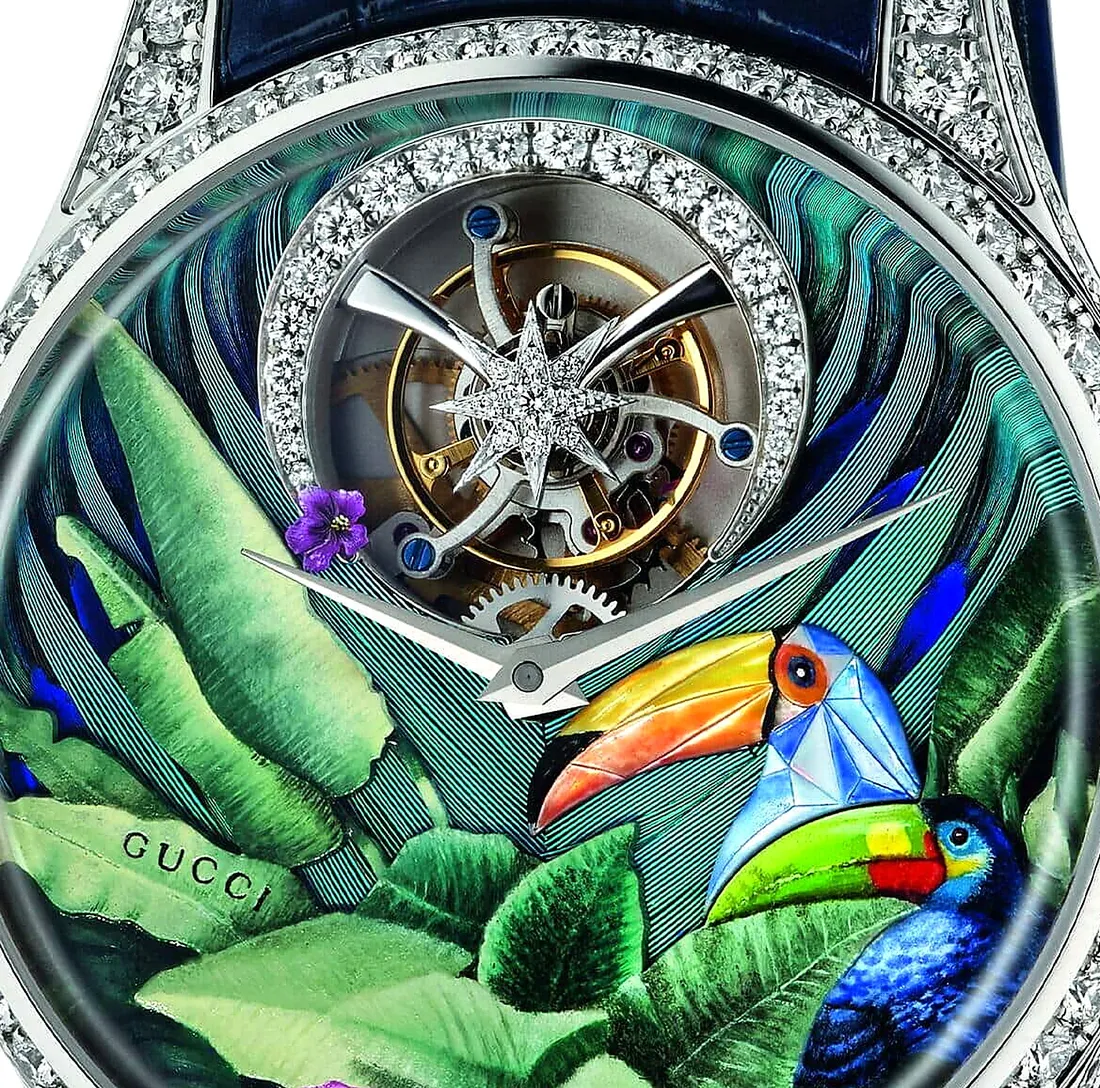
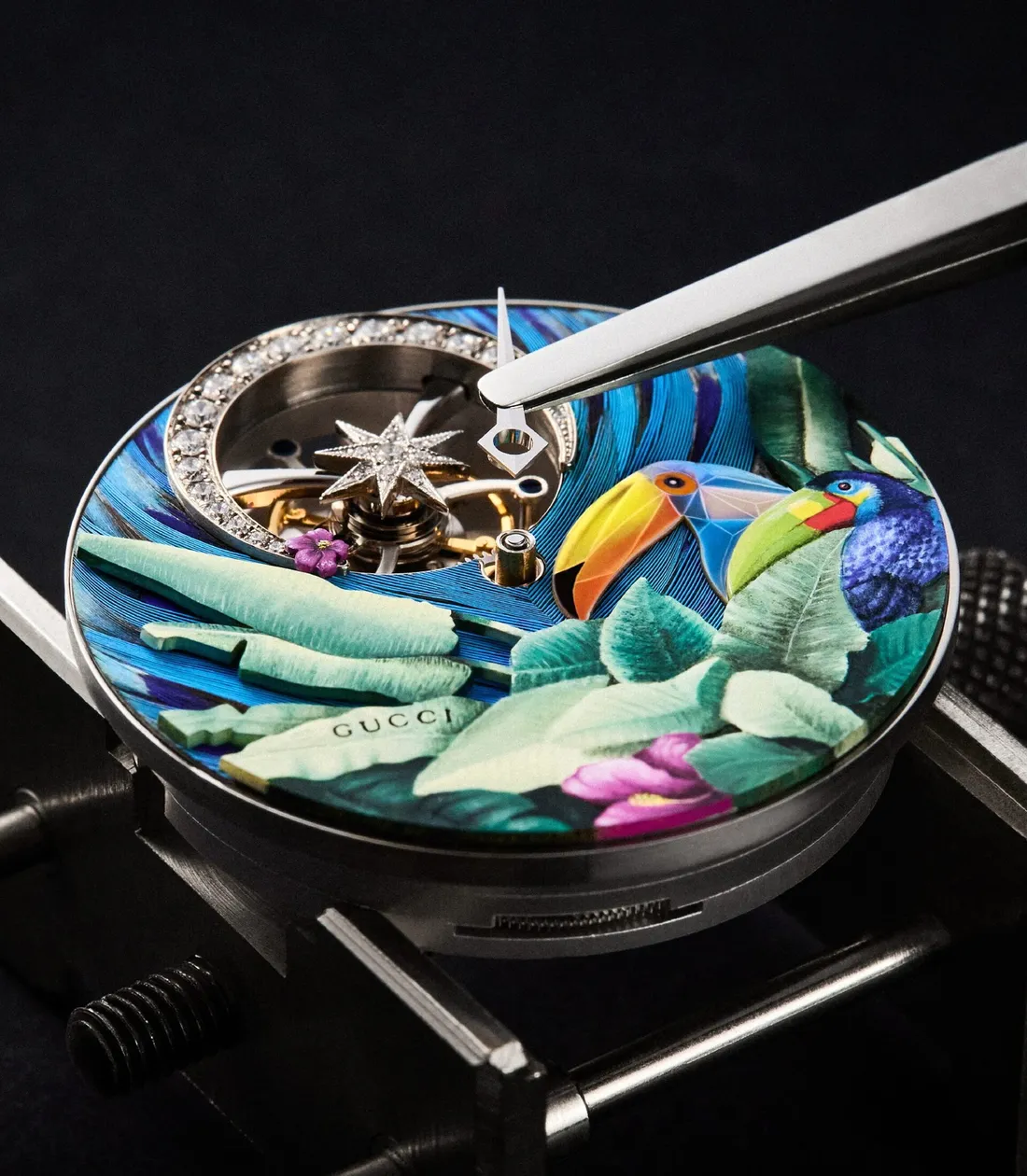
The Gucci G-Timeless Métiers d’Art sets this bird at the centre of watchmaking and turns time into something that beats in the heart of the forest.
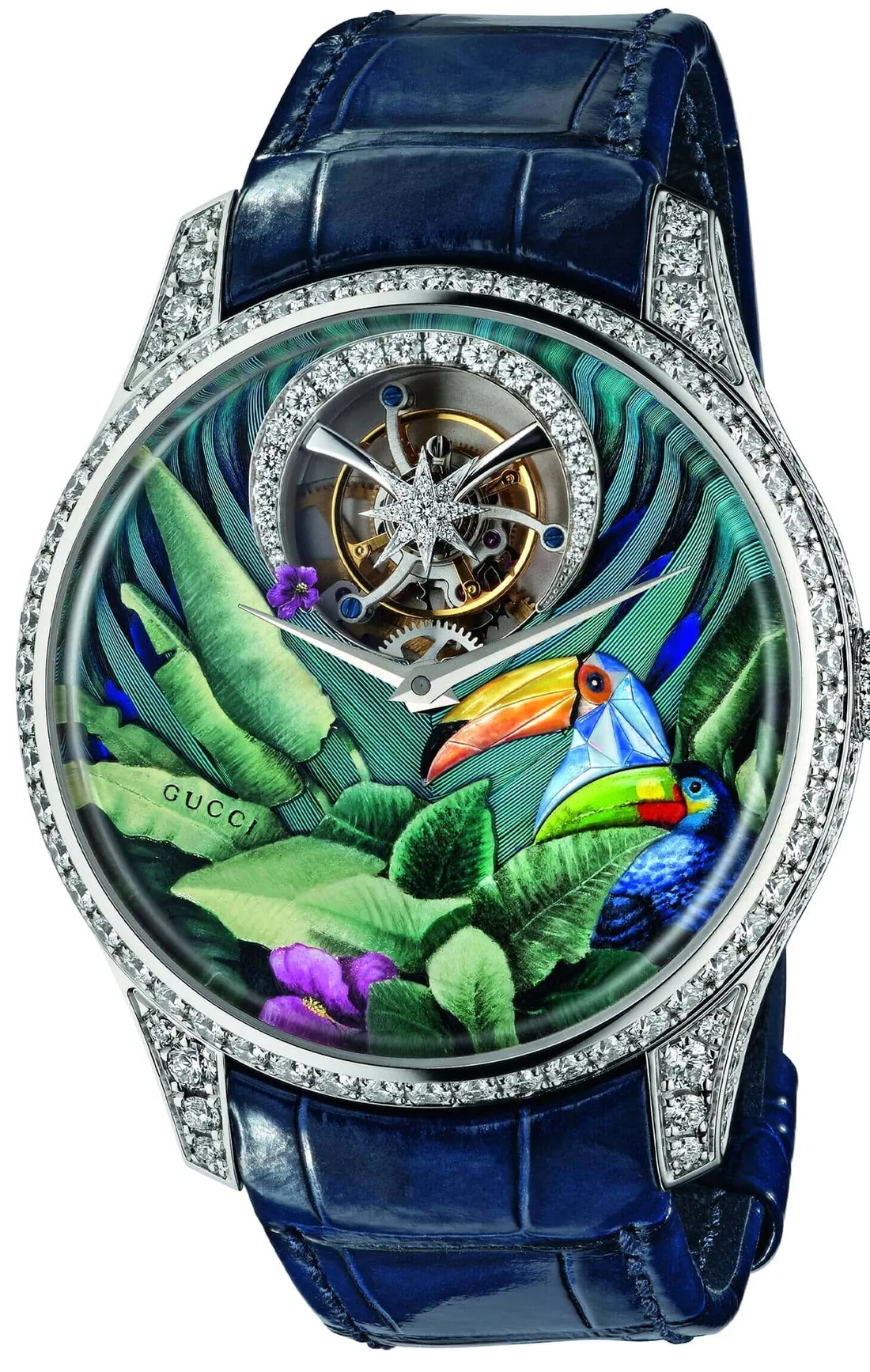
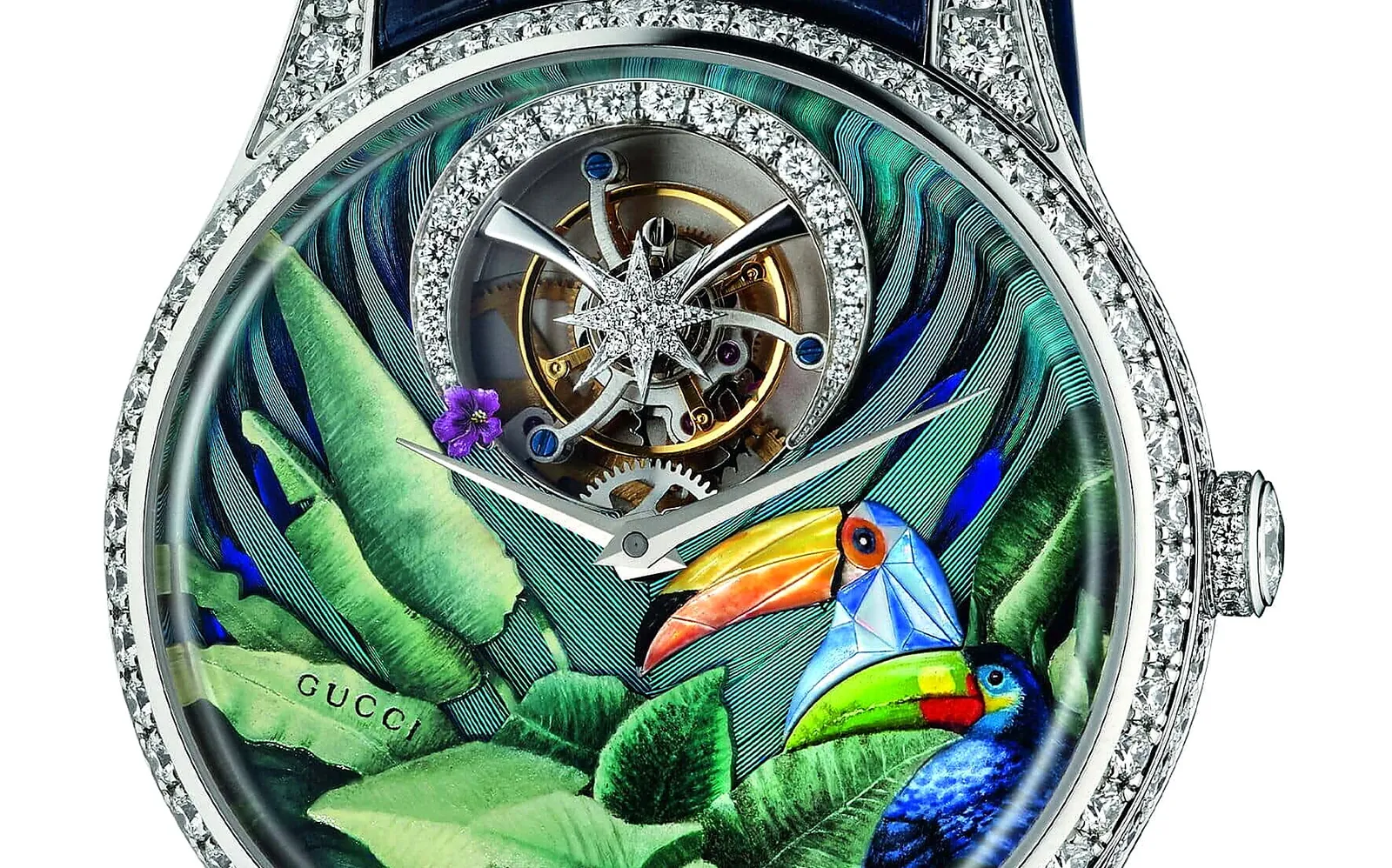
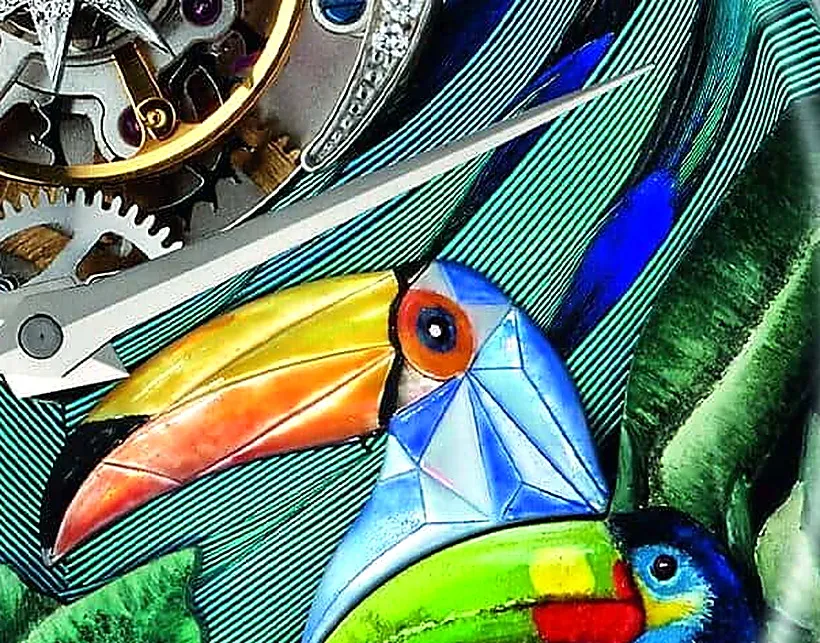
The toucan on this dial is neither a print nor an ordinary painting, and the real surprise of the craft is hidden not in the bird but in the ground behind it.
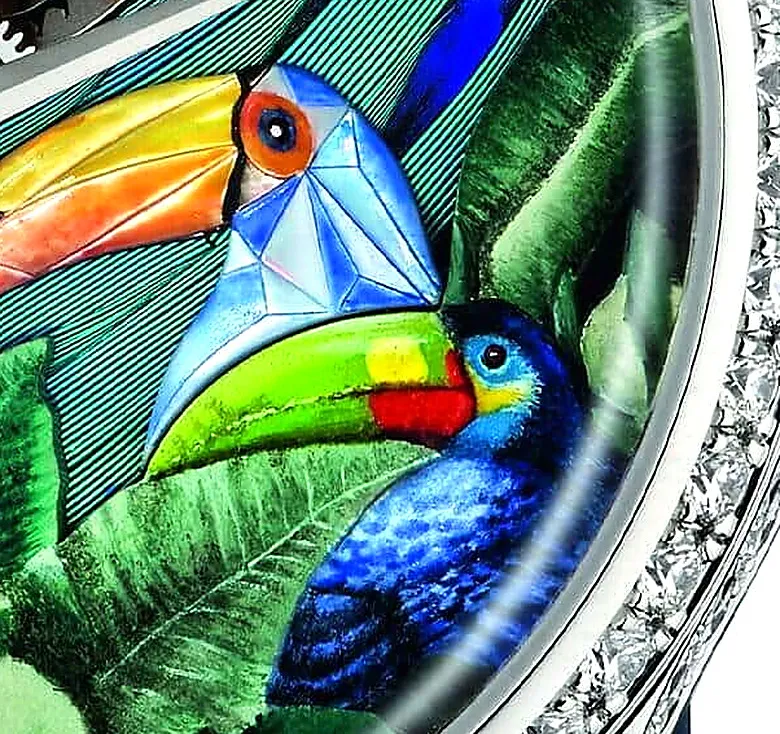
Those green and turquoise waves are not enamel but real feather. The ground was built by the French feather artist Nelly Saunier. Saunier works only with feathers a bird has moulted of its own accord; no bird is disturbed for this work. Every feather is chosen singly for its hue and texture, thinned with a blade, cut into pieces below the scale of a millimetre and laid in order onto the mother-of-pearl dial. Look closely and the barbs of the feathers are still visible; because the light strikes each one from a different angle, that green reads less like a leaf than like a living wing. The difference between painting a dial and clothing one is who gets to decide where the light comes from.
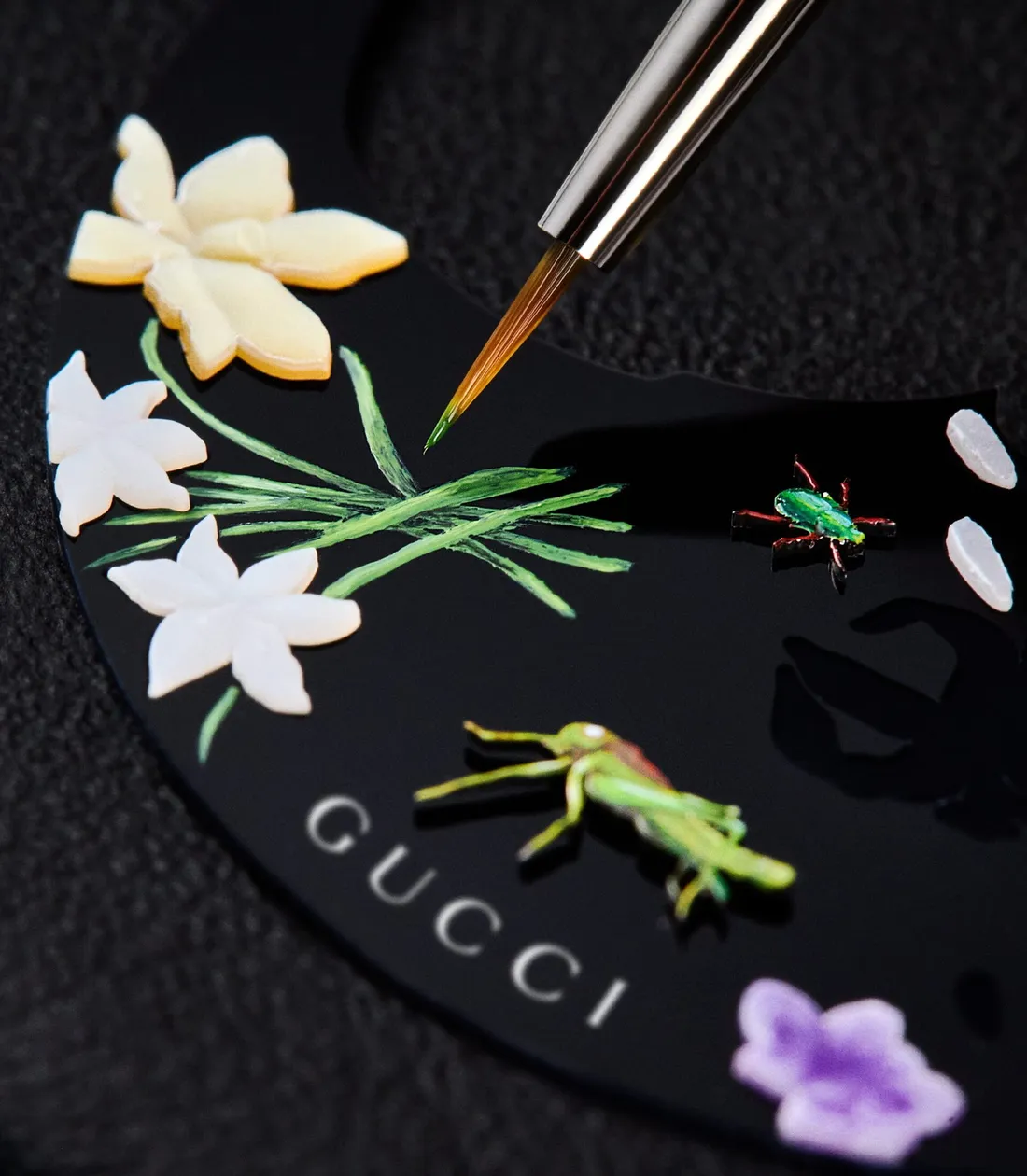
The toucans, and the tropical leaves in front of them, are carved mother-of-pearl painted over by hand. Since the layers of the shell throw light back from within, the transitions of orange, yellow and red along the beak do not stay on the surface of the paint; they rise out of the depth of the stone. Nor is there a single bird on this dial: just below the large toucan, a second and smaller one is looking out from between the leaves. At nine o’clock, fallen against the edge of the tourbillon, a single violet flower stands as the one warm point inside all that green.
format_quote"The difference between painting a dial and clothing one is who gets to decide where the light comes from."
Hasan Bekmezci
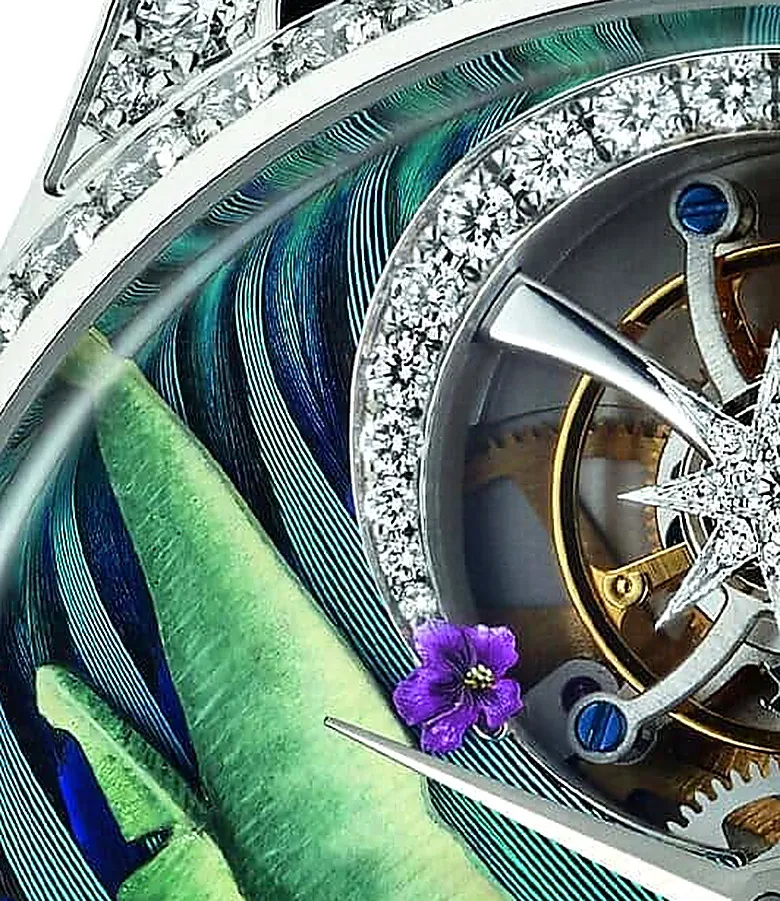
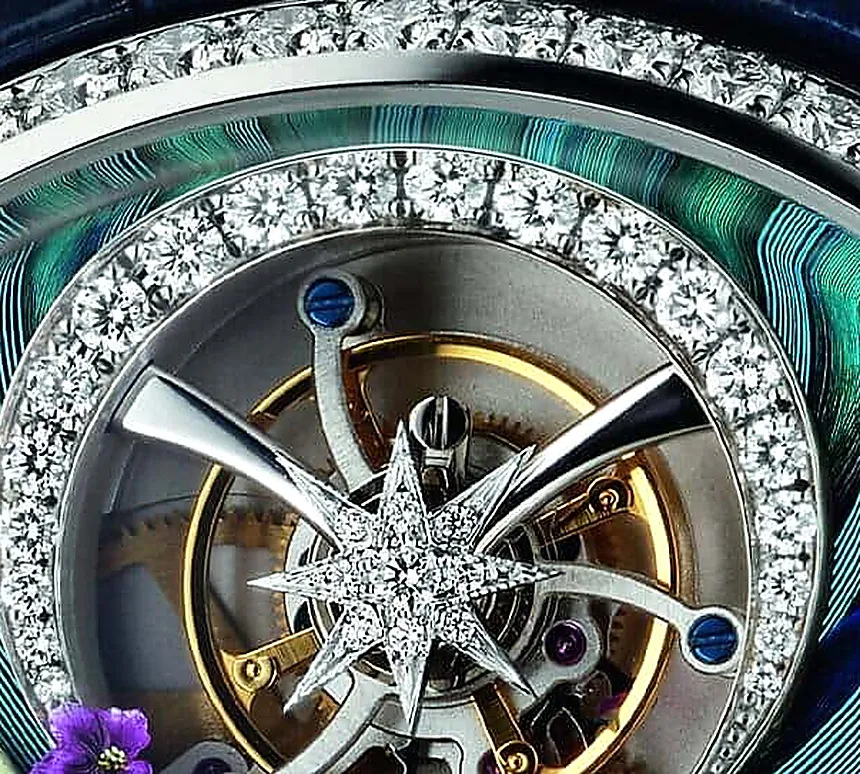
The miracle of a beak that looks massive and weighs almost nothing finds its counterpart in the mechanics. The tourbillon at twelve is not pressed down by a bridge from above; the cage hangs in the air exactly as the bird glides weightless through the canopy. And on that cage sits Gucci’s iconic star: diamond-set, turning one full revolution a minute along with the carriage. There is no seconds hand on the dial; the seconds are counted by the turning of the star itself. Making a complication visible is easy. Making it part of the scene is another matter.
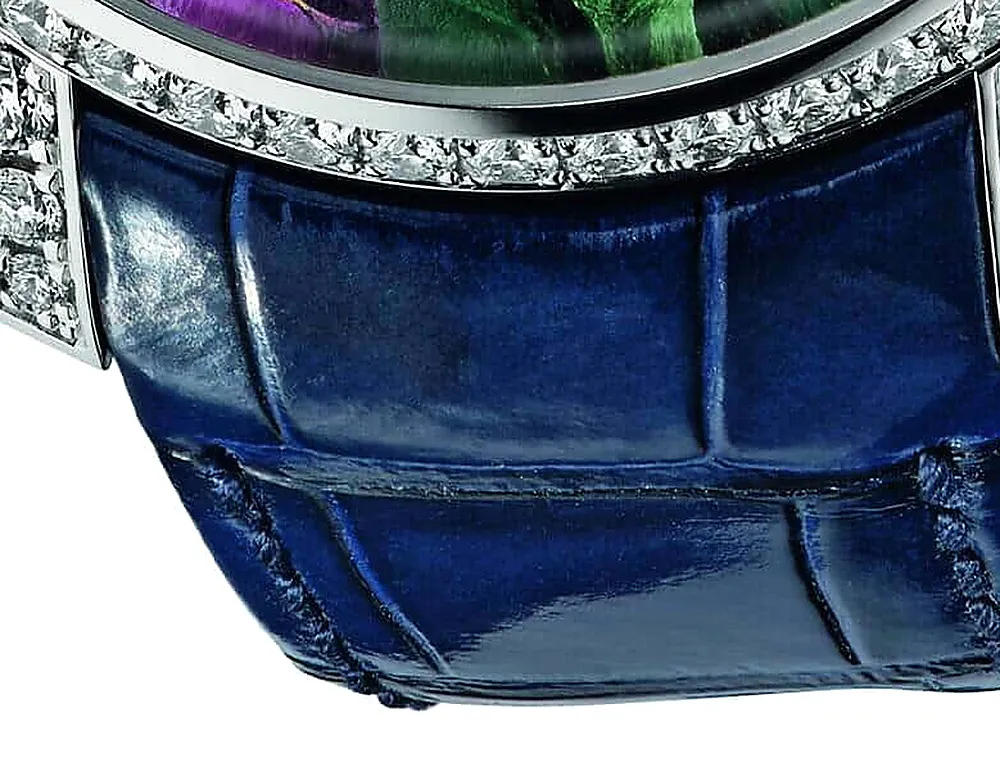
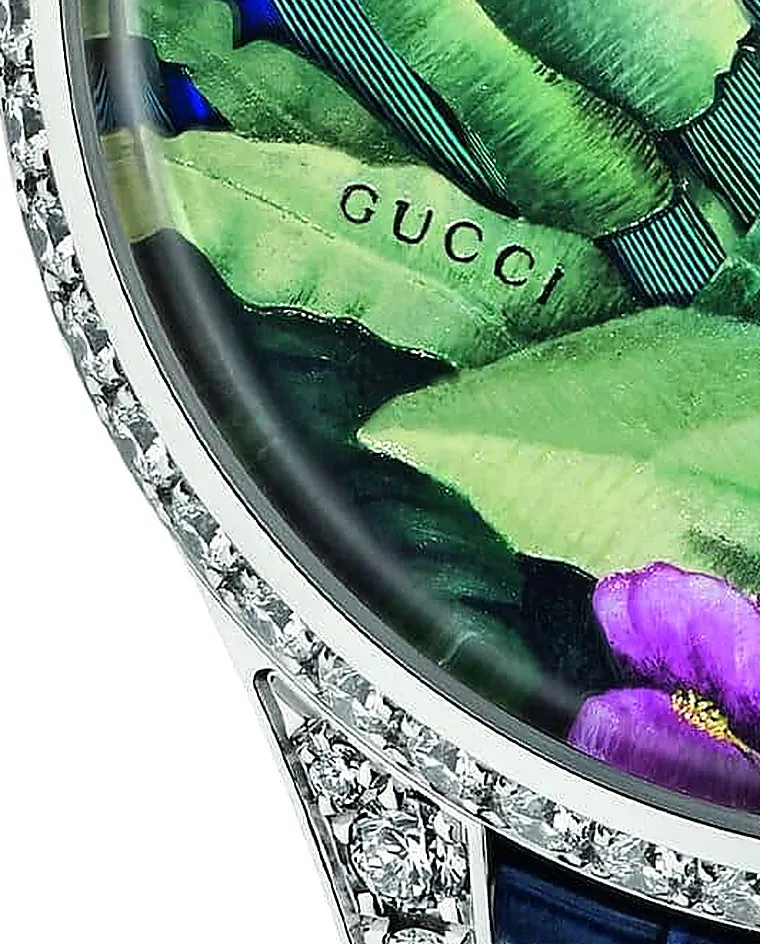
The case is forty millimetres across, in white gold. The clear diamonds set into the bezel and the lugs call to mind the morning dew filtering into the rainforest between the leaves, and the opening of the tourbillon is ringed with the same stones. The caseback is engraved, and the strap is navy alligator, carrying the tone of the blue feathers on the dial all the way down the wrist. In a jewelled watch the job of a stone is not to shine but to take the eye to the right place.
This dial is not an invention for Gucci but a reminder: with this collection the house is going back into its own archive, to the forest and animal prints it has been putting on silk scarves for decades. Three more dials stand in the same family, with cranes, with a tiger, and with a reinterpretation of the 1966 Flora print; all four are forty millimetres and all four carry a tourbillon at twelve. The archive of a fashion house is sometimes the soundest capital a manufacture has.
format_quote"Making a complication visible is easy. Making it part of the scene is another matter."
Hasan Bekmezci
The Gucci G-Timeless Métiers d’Art carries the toucan’s proud bearing onto a wrist and reminds us that time is not a perishable number but a living work of art, put together again with every breath.
And this too: the feathers used on this dial were not pulled from a bird. They were gathered from where the bird had already let them fall. The most elegant thing about a work is sometimes what it declined to do.
format_quote"The feathers on this dial were not pulled from a bird but gathered where the bird had let them fall. The most elegant thing about a work is sometimes what it declined to do."
Hasan Bekmezci