An art movement begins when it settles not on the wall of a gallery but in the language of the street. That is where Basquiat began.
New York in the 1980s. The sterile white of the SoHo gallery walls was being shaken by a raw scream rising out of the streets of the Lower East Side. Barely seventeen, spraying the tag SAMO with his schoolfriend Al Diaz onto the walls of Manhattan, onto subway carriages and old buildings, Jean-Michel Basquiat started a philosophical movement in the dark. The letters stood for Same Old Shit. Not a pseudonym, then, but an ironic street manifesto hurled at the hypocrisy of consumer society, at the counterfeit taste of the bourgeoisie and at the torpor of the system.
That tremor changed the dominant art of the day at the root. Neo-expressionism, born as a revolt against the cold, rational, feeling-stripped minimalism of the 1970s, brought raw emotion, predatory colour, primitive symbols and the inner scream of a human being back onto the canvas. The most sterile moment of an age produces its own loudest answer.
Why was Basquiat called the crownless king of that movement? Because without ever touching the sterile rules of the academies, he carried the violence of the New York streets, the trauma left by racism, the improvised rhythm of jazz and the chaotic soul of the pavement onto canvas with a massive energy. He refused the elitism of the galleries; instead of accepting the false crowns the system offered him, he put the yellow crowns he drew himself onto the heads of the most marginal heroes of his society. A crown changes meaning according to whose head it is placed on.
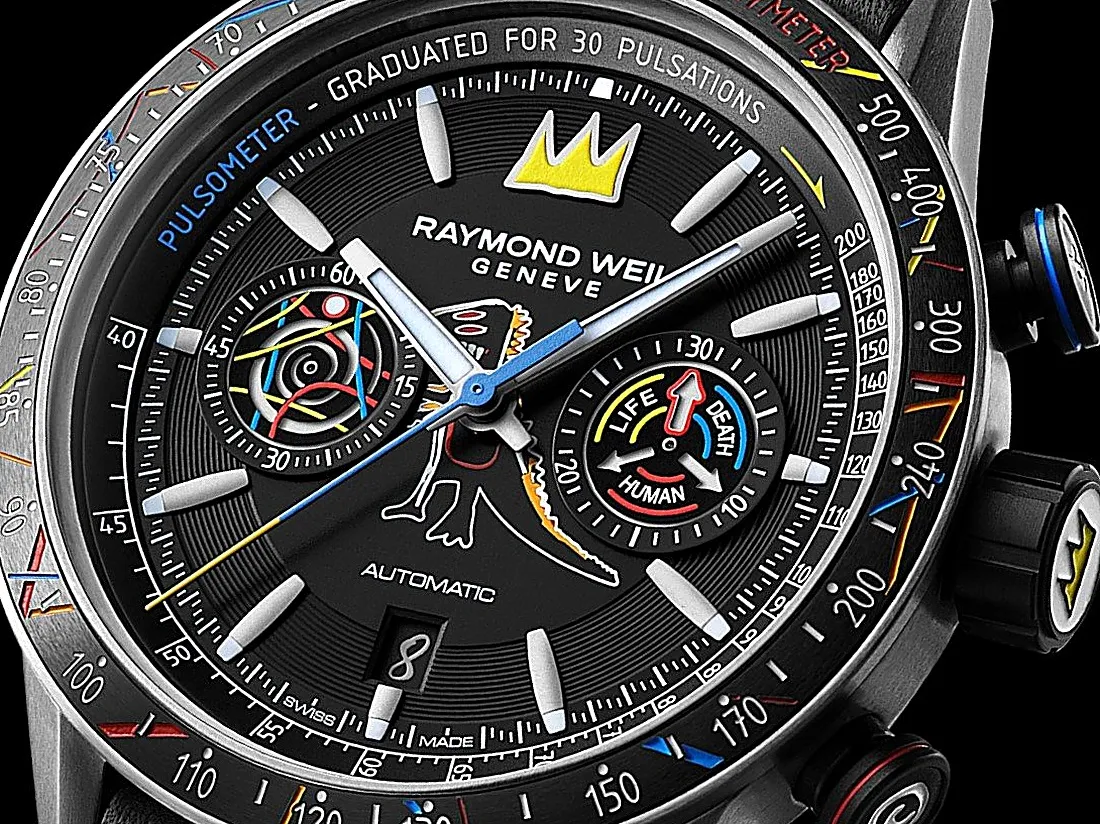
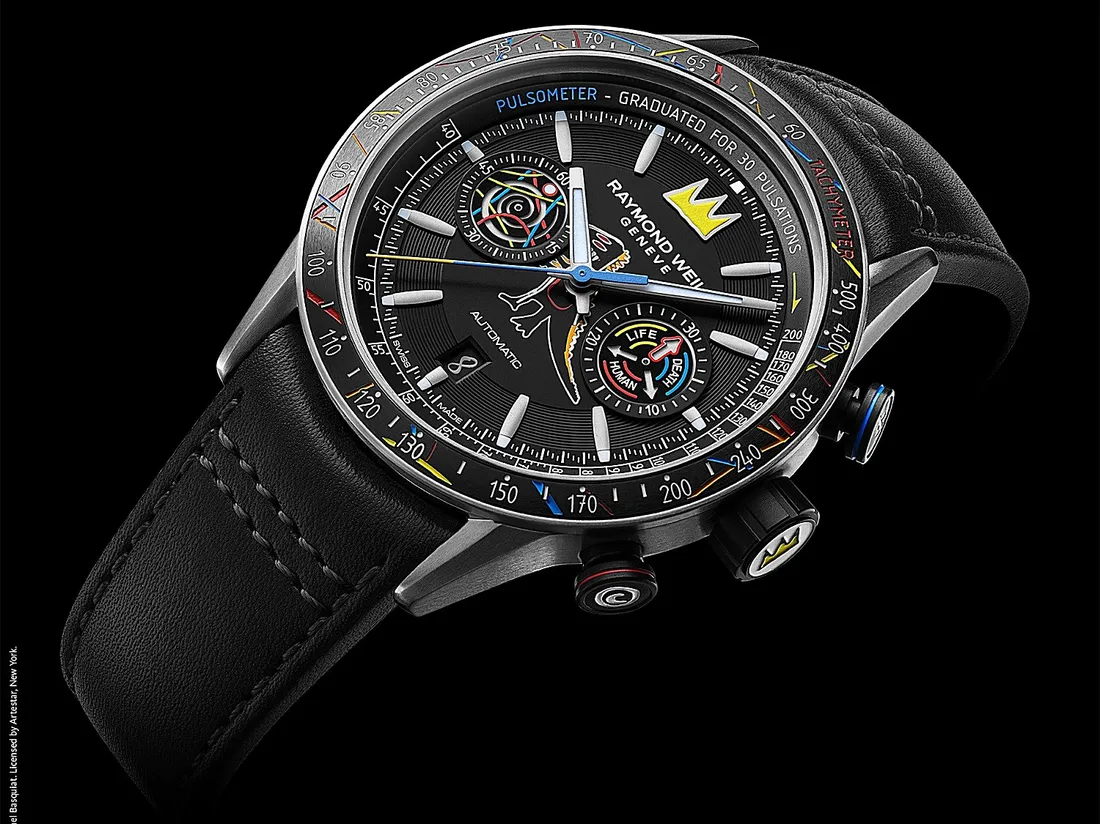
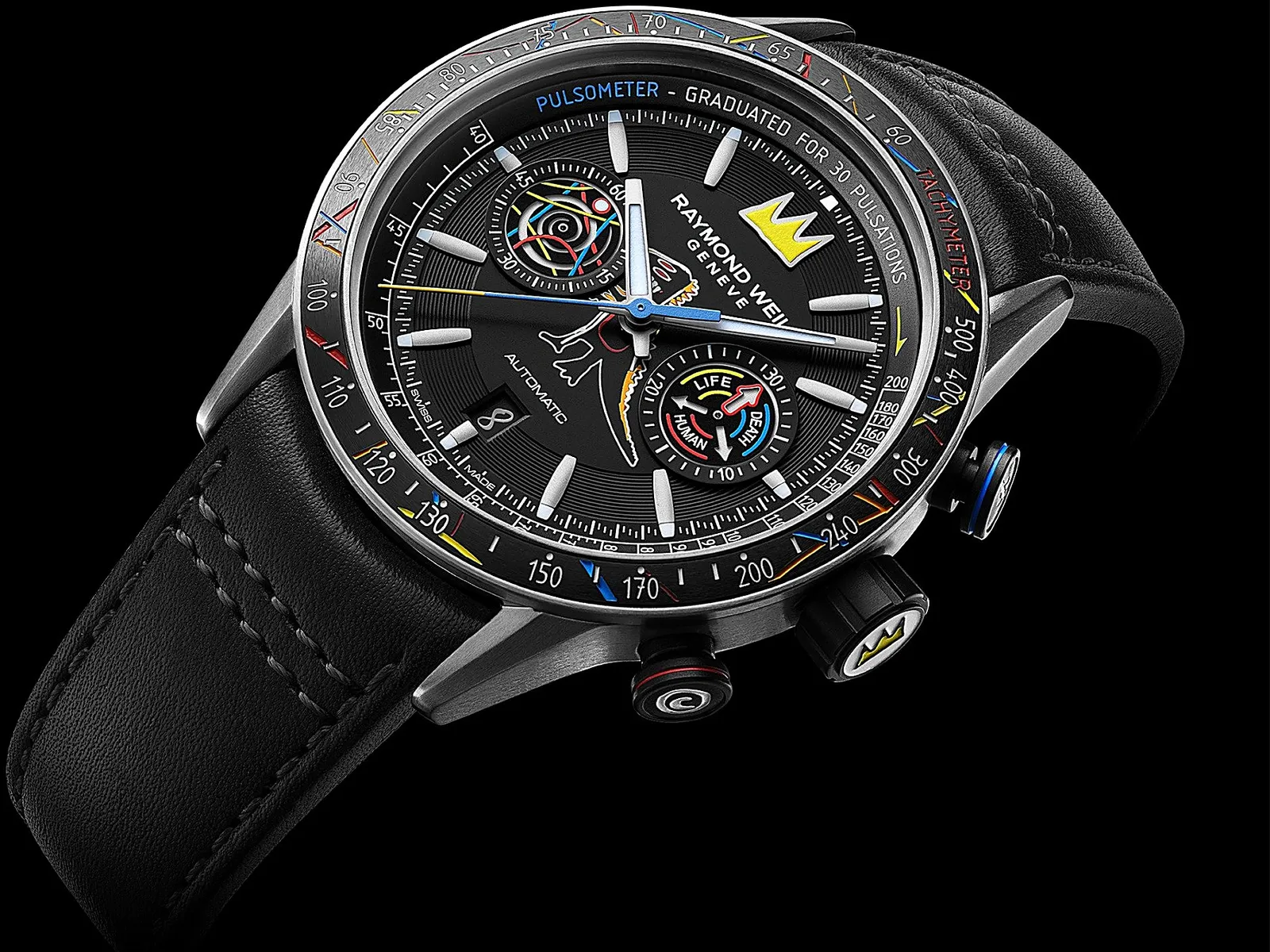
Traditional Swiss watchmaking, like those old academies, has consecrated symmetry, flawless polish and a sterile order for centuries. With the Freelancer Basquiat Special Edition, Raymond Weil tears up that canvas of Geneva high watchmaking and seals Basquiat’s chaotic, expressive, raw philosophy onto the wrist instead. A dial where red, yellow and blue, the primary colours, gather on a black ground, and yet every function stays legible. Chaos is style for exactly as long as it does not spoil legibility.
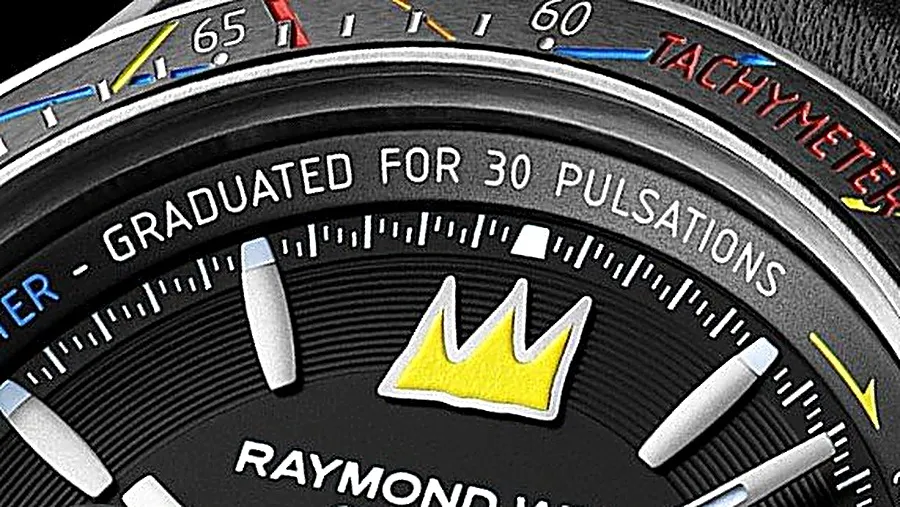
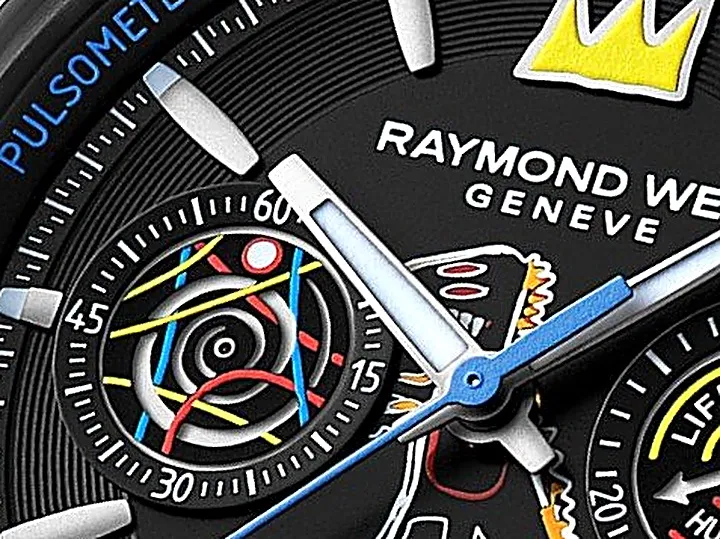
At twelve o’clock, in the place of a numeral, sits a yellow crown. Three-pointed, Basquiat’s most iconic signature. It is made in Super-LumiNova, so the thing that glows in the dark is not the name of the brand but that crown. A street symbol that stays visible at night is as good a decision as it is a good joke.
In the very centre of the dial is the crowned dinosaur that appears out of the brushstrokes. The figure comes from the 1984 painting Pez Dispenser, named after the popular children’s sweet dispensers of the period: those plastic toys that drop a sweet out of their mouths when you tip the head back. Why did Basquiat choose a dinosaur and put a crown on it? Because a dinosaur stands at once for humanity’s insatiable appetite for consumption, for the machinery that sucks art dry like a sweet, and for a primitive power condemned to be buried in the dusty pages of history. The crown on its head is the tragic kingdom of a creature turned into merchandise. A king who comes out of a sweet dispenser is the portrait of an age in which kings are consumed too.
And the steel hands beat straight across the chest of that raw creature. It is not a lifeless print sitting on a dial; it is a sign of primitive force in revolt against the sterile world of watchmaking.
format_quote"A king who comes out of a sweet dispenser is the portrait of an age in which kings are consumed too."
Hasan Bekmezci
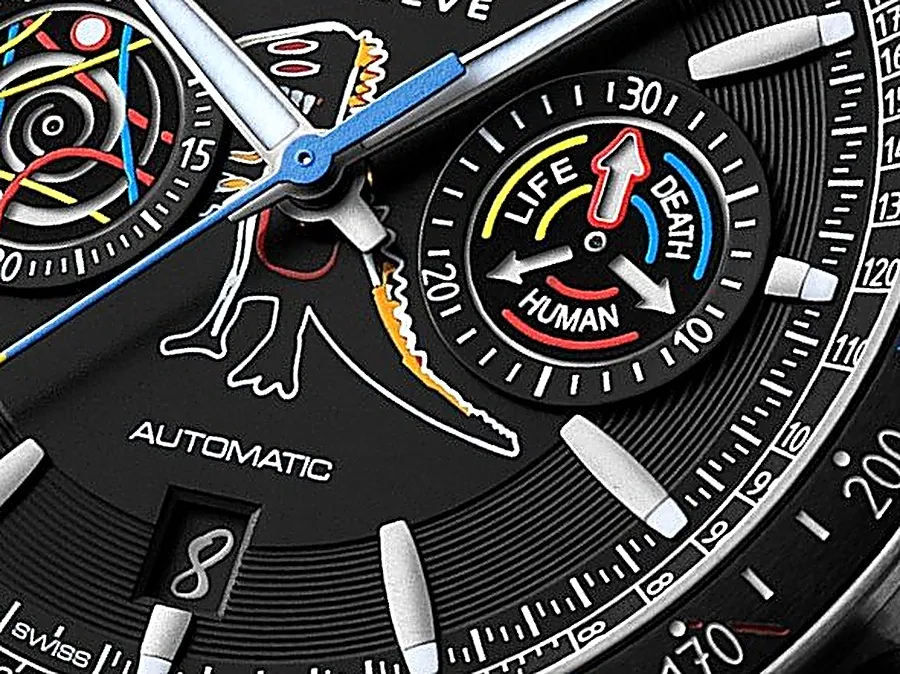
After a serious road accident in his childhood, Basquiat became obsessed with the human body, with bones and with the inevitability of death, thanks to the anatomy book his mother gave him. Raymond Weil has placed that obsession into the complications of the watch.
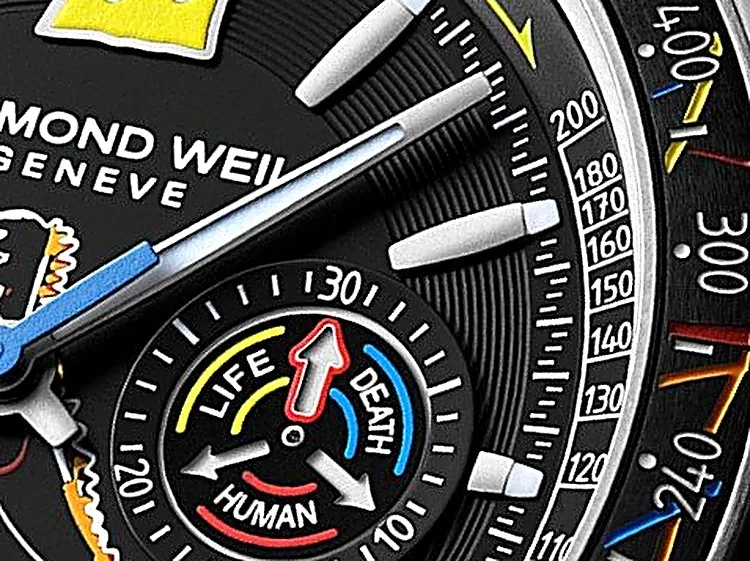
The thirty-minute counter at three o’clock is a disc in three parts. Three words are written on it: life, death, human. A red arrow turns around that triple circle, and the disc does not glide but jumps: start the chronograph and the minute leaps from one place to the next. A small mechanical confession that undoes our belief in time flowing without a break.
A human being is condemned to death from the moment of birth, a tragic acrobat walking a rope along the narrow path between life and nothingness. Crushed under the weight of existing, we are mortals who keep forgetting that the only thing separating life from death is that fragile breath beating in our chest. Life and death are not two separate islands; they are two waves striking the same shore. Man is a fragile search wedged into that duality, and the watch is the counter of the tragedy. Every tick takes us a step closer to death, and for exactly that reason every moment we live is an immense miracle.
format_quote"Life and death are not two separate islands; they are two waves striking the same shore."
Hasan Bekmezci
Opposite it, at nine o’clock, is the small seconds: a circular spiral in which yellow, red and blue run into one another. Why call this a quantum spiral? Because quantum means the world of probabilities, the smallest and indivisible, holding many possibilities at once. In quantum mechanics particles do not sit in a fixed position; they dance as an endless wave of possibility until an observer looks. Basquiat’s art is like those fields: chaotic, without rules, and yet a raw energy carrying an immense universe of possibilities inside itself. As the seconds disc turns, the three primary colours mix, and time stops being a linear plane advancing along one line and becomes a spiral that keeps collapsing into its own centre and being born again.
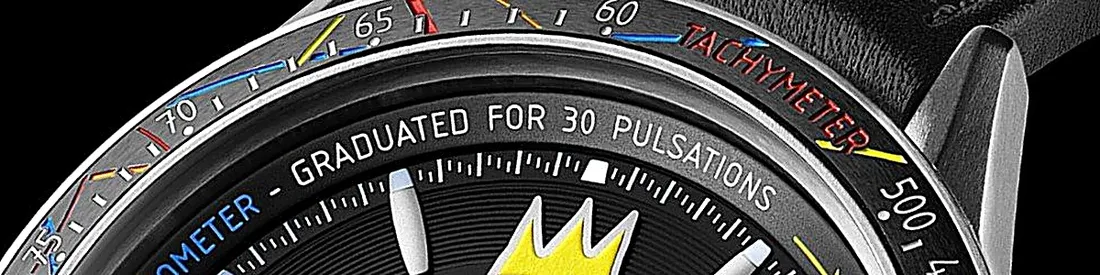
But the most radical decision on this dial stands on the flange: pulsometer, graduated for 30 pulsations. A pulse scale calibrated for thirty beats of a heart. Classic watches offer a cold, unfeeling, distant chronology set against atomic clocks. A pulsometer seals time directly to the heart of its owner. Start the chronograph and count thirty heartbeats, and what the dial shows you is not an astronomical calendar but the hot water of life boiling in your own veins.
The watch whispers this: time is measured not by the movement of the stars overhead or of toothed wheels, but directly by that rhythmic scream in your chest. Where the heart stops, time has no jurisdiction.
format_quote"Start the chronograph and count thirty heartbeats, and what the dial shows you is not an astronomical calendar but your own pulse. Where the heart stops, time has no jurisdiction."
Hasan Bekmezci
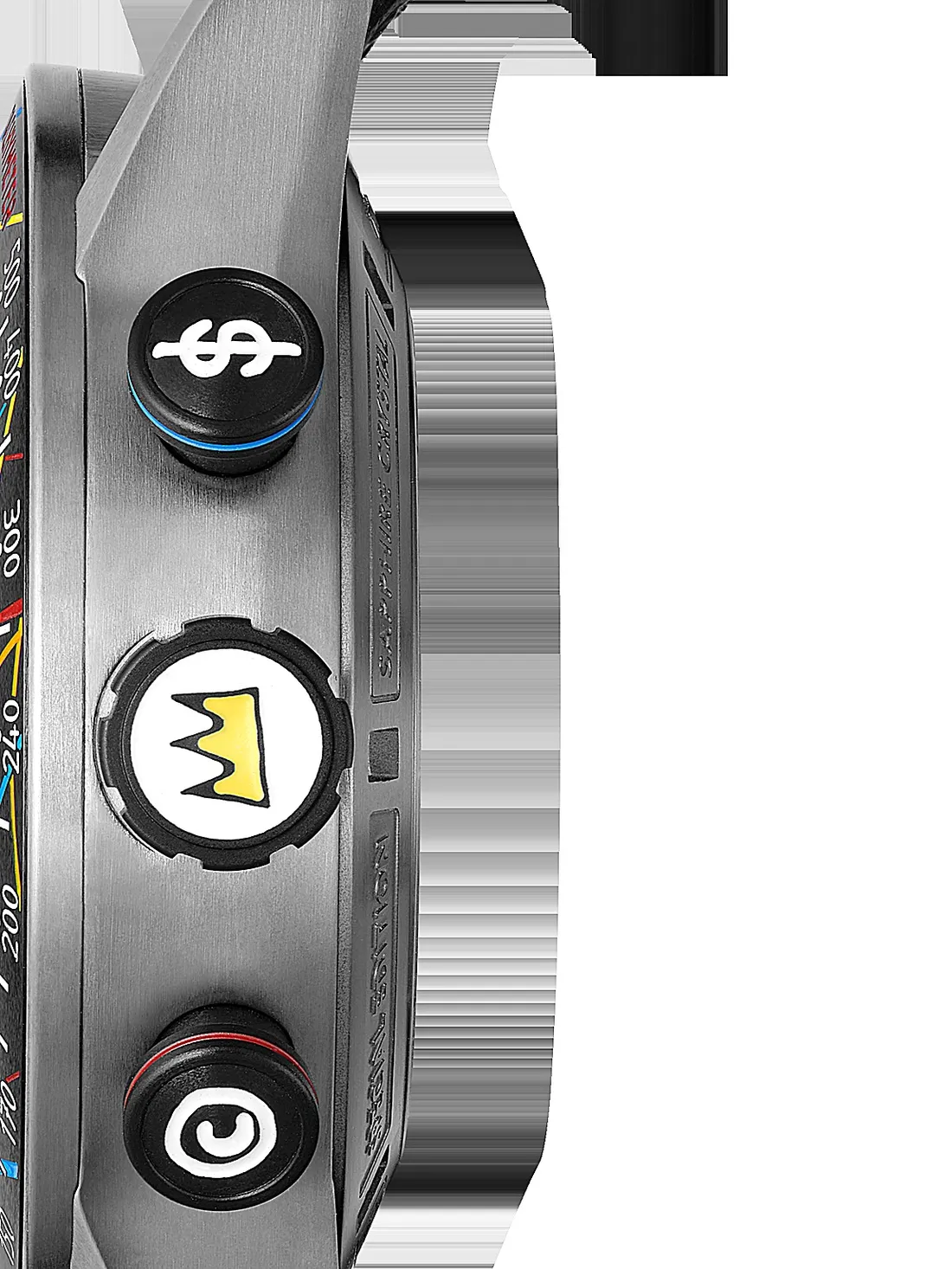
The artist’s signature reaches down the flank of the case too, and to the least expected place: the pushers. On the reset pusher there is a copyright sign. That circled C, which stood beside the SAMO tag for years, is now a mechanical part of a watch. On the start and stop pusher there is a dollar sign, the mark of what art costs the moment it reaches the market. And on the screw-down crown, that yellow crown. So to wind the watch you have to turn Basquiat’s crown, to start the chronograph you press the dollar, and to reset it you press the copyright. Fitting an artist’s entire argument into three pushers is less curating than poetry.
The case is 43.5 millimetres across and 13.7 deep in titanium: light, matte, undemonstrative. The tachymeter bezel on top of it is black ceramic and its colour scheme comes from the artist’s primary palette. The pushers and the crown are PVD coated for contrast. Water resistance is a hundred metres, so this is not a vitrine object but a daily instrument.
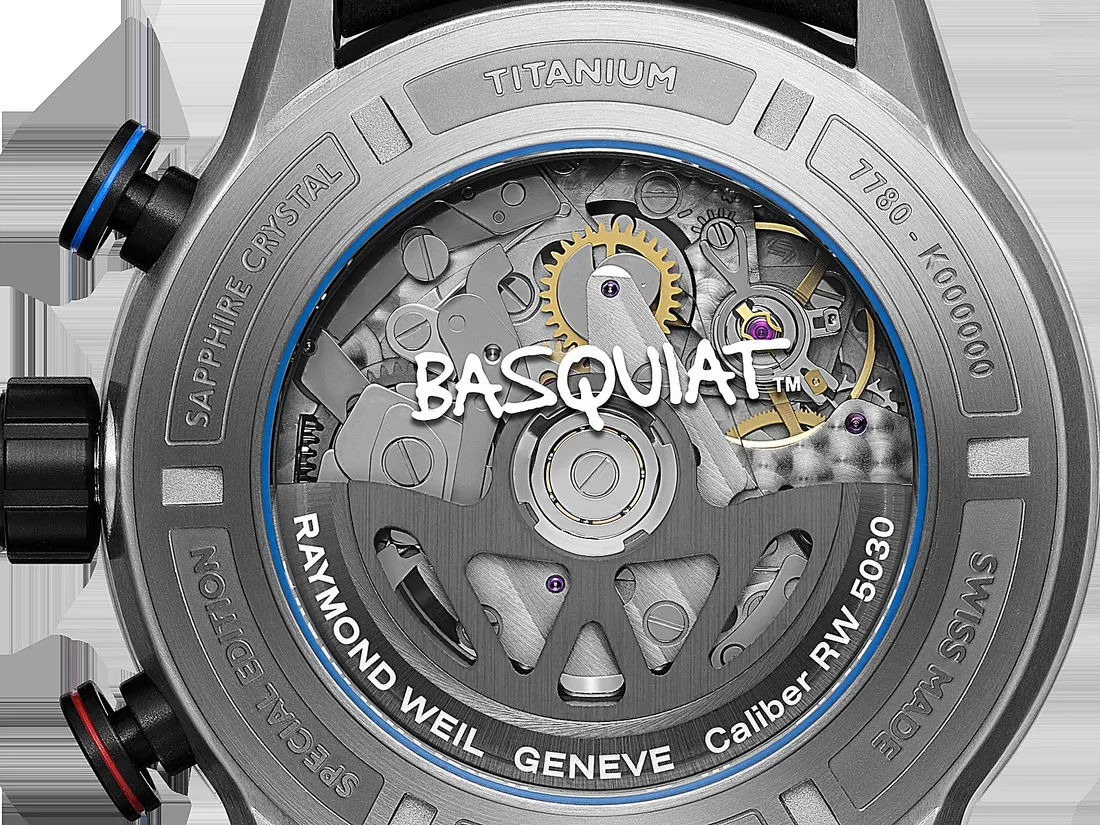
Turn it over and Basquiat’s name stands on the sapphire, with the identity of the movement beneath it: Calibre RW 5030. A self-winding bi-compax chronograph that governs its chronograph commands with a column wheel, runs at 28,800 vibrations an hour and gives fifty-six hours from a full wind. At six o’clock there is a plain date window. The strap is black calfskin with a folding clasp. The reference is 7780-TIC-JMB01 and the price is around four thousand seven hundred dollars.
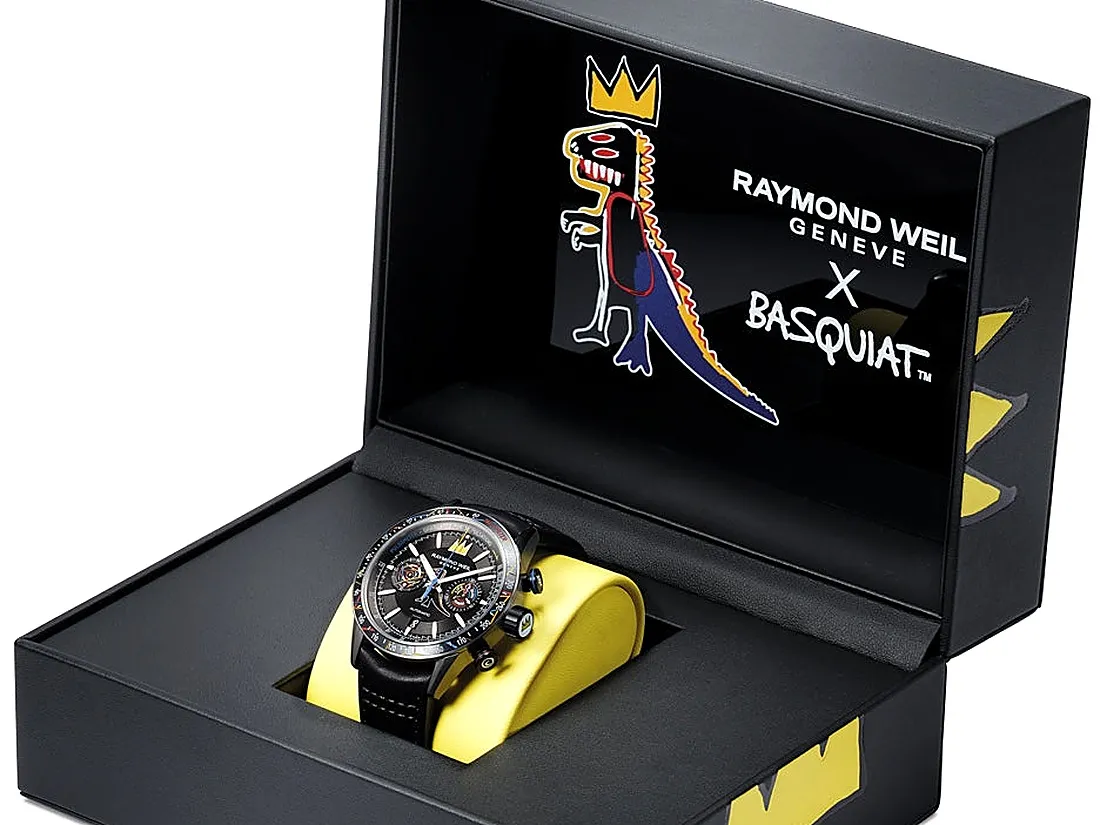
Even the box is a decision: inside the lid, that crowned dinosaur and two names standing side by side. An object carrying an artist’s legacy salutes that legacy in its own packaging.
This watch is far more than a painter’s memorial piece. It is a canvas of forty-three and a half millimetres carried on your wrist. The dinosaur on the dial whispers your own primitive force in the middle of capitalism, the crown at twelve your own nobility, the disc at three your transience in the world, the spiral at nine the possibilities of your mind, and the pulsometer the sanctity of your beating heart.
Basquiat was the man who came off the street and into the gallery. This watch is the object that goes back out of the gallery and onto the street. The most radical signature written against the sterilisation of time is not standing in a vitrine; it is standing on a wrist.