To find a watch is a far more dangerous discovery than to find a stone.
On a misty English morning in 1802, William Paley did not yet know what spark would catch in his mind when his foot struck a stone as he walked across a heath. A stone simply lying there could be taken for a random turn of the world. But what if Paley had found a mechanical pocket watch on the ground instead?
You have to get inside Paley’s mind. At the dawn of the Industrial Revolution, mechanical watchmaking was the highest level of intelligence and engineering humanity had reached. When Paley took up that watch and opened its case, he saw the tension of the mainspring, the millimetric teeth of the wheels and the flawlessly rhythmic beat of the lever and the balance. Lightning struck in his head: an order this complex and this harmonious, serving one determined purpose, that of showing the time, could never be the work of the wind, of the soil and of blind coincidence. If there is a watch, there must necessarily be a Watchmaker. In Natural Theology, published that same year, Paley explained the immense order of the universe with this mechanical seal and climbed to the summit of teleological thought.
The chain of reasoning Paley built in the West out of mechanics is deepened by the Ancient Master of the East, in his treatise on nature, with the plainest and most unsettling truth a modern mind could be handed. The old thinker’s logic is clear and gives no ground: matter itself is blind, deaf, without consciousness. A lifeless piece of steel, while it turns another wheel of brass, knows neither the time nor its own existence. To say that nature does this by itself is no different from refusing the master of a magnificent palace and awarding the title of architect to its bricks and its mortar. A cause is a veil; the wheels are only instruments obeying an order. Art cries out for its artist, but art itself can never be the Artificer.
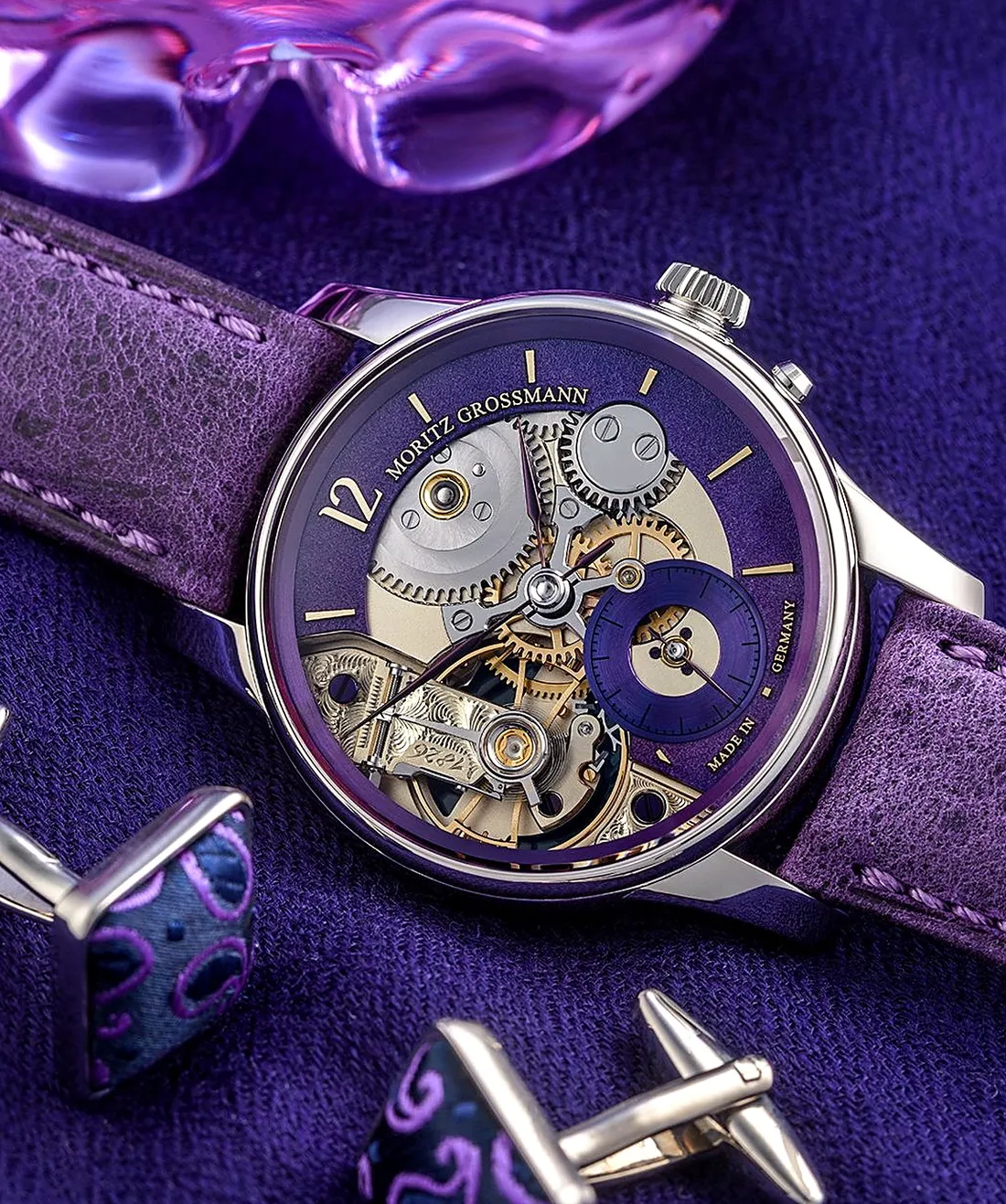
And here these two great philosophical minds turn into something concrete in the Moritz Grossmann Backpage Tremblage Violet, made in Glashütte.
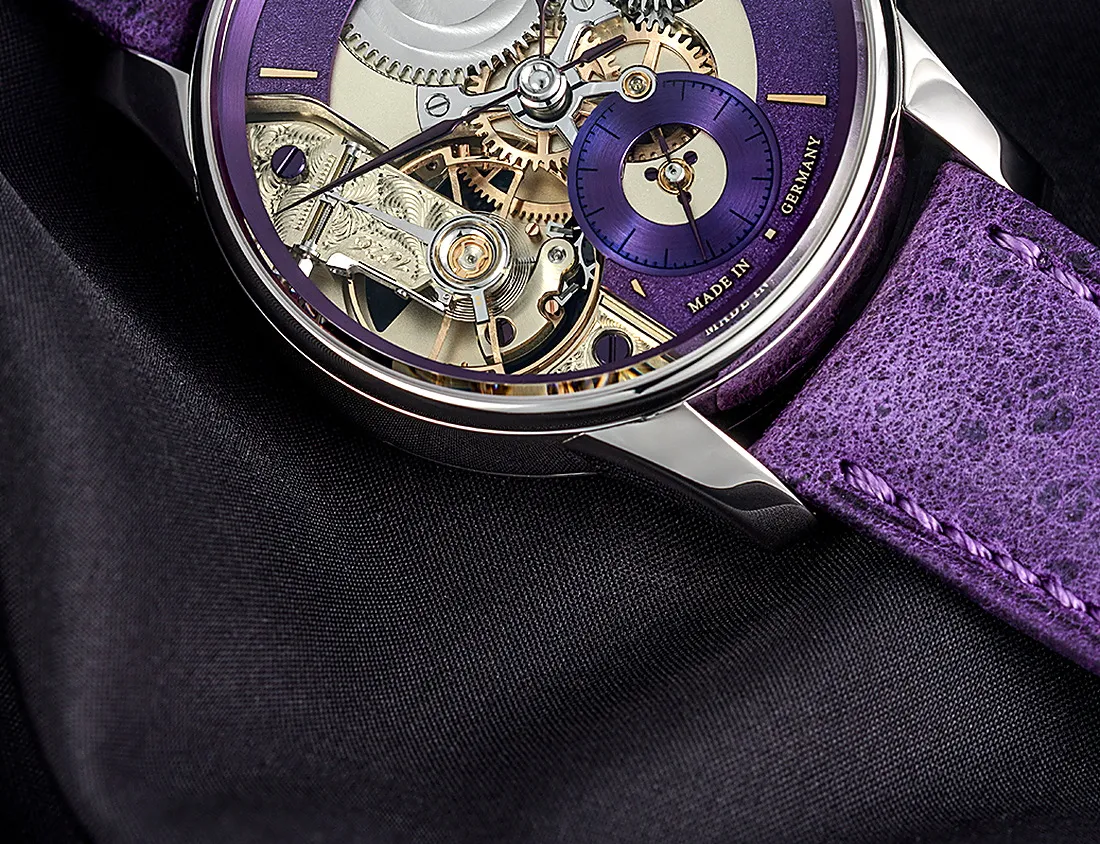
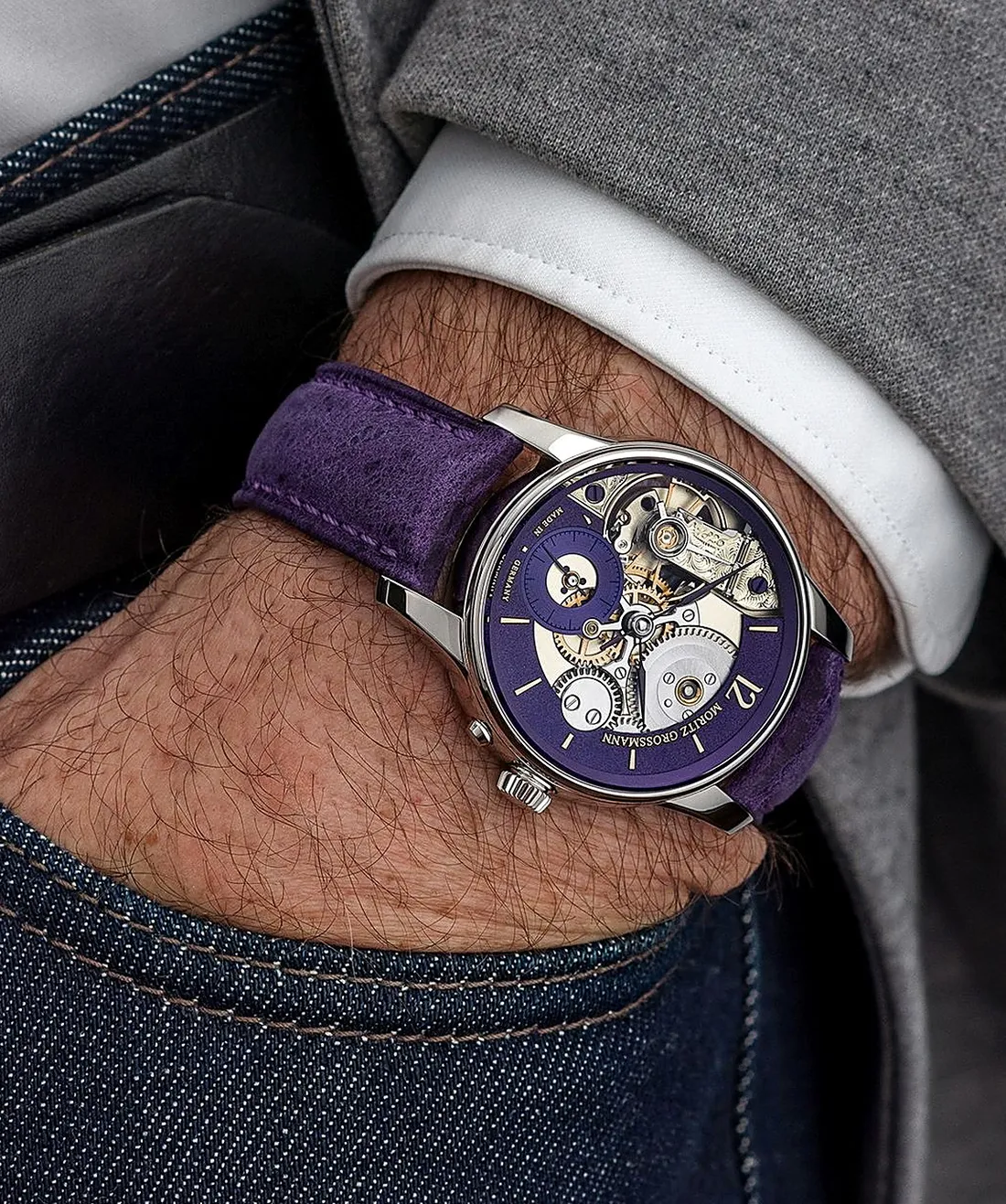
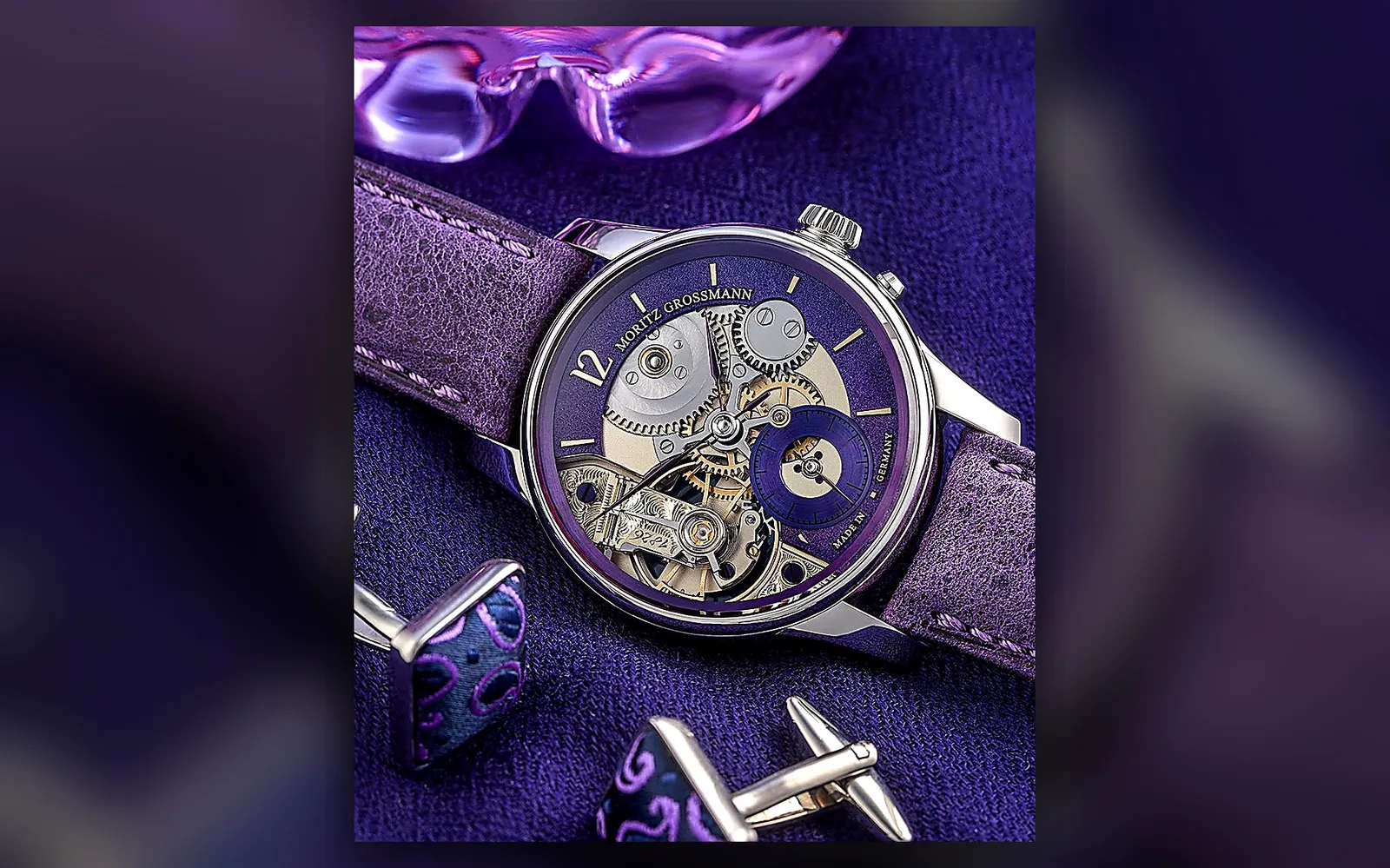
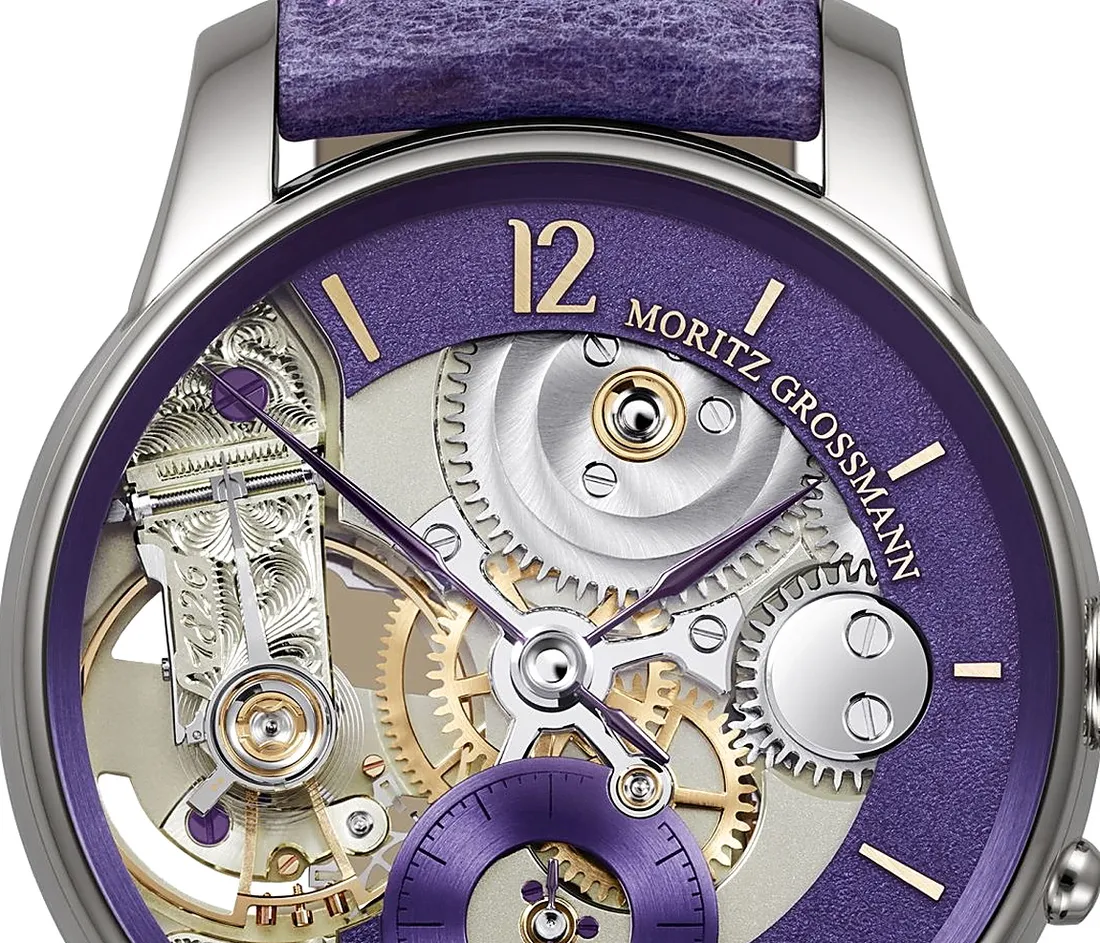
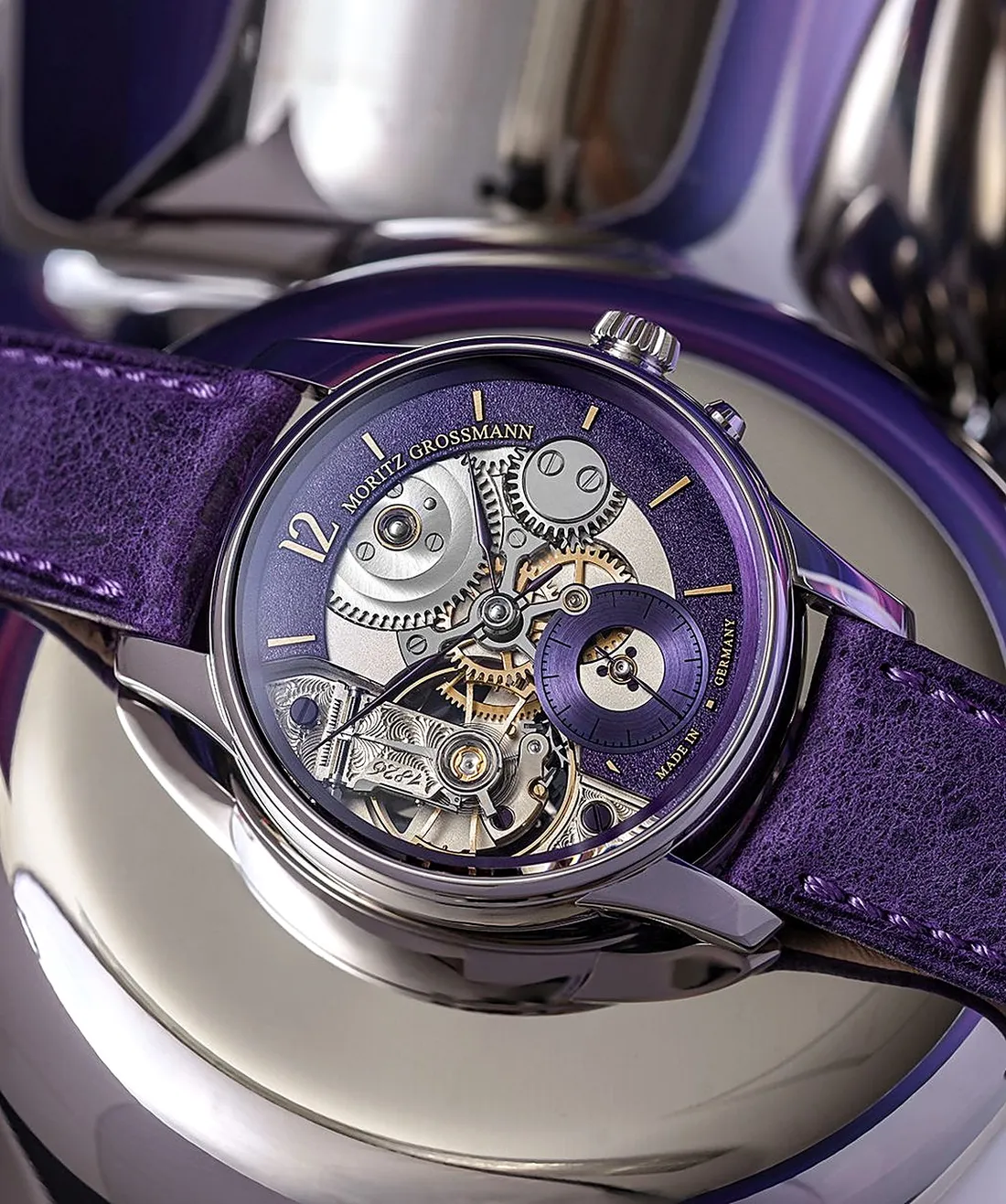
In the traditional understanding of watchmaking the movement hides behind the sapphire of the caseback like an intimate secret, while the dial is a bare stage across which only the hour and minute hands move. With this edition Moritz Grossmann tears up that habit at the root and rebuilds the manufacture calibre 107.0 as a mirror image of the house’s own calibre 100.1. So this is not a skeletonisation but a decision about symmetry: whatever normally stands at the back has come to the front.
The price of a decision like that is paid not on the dial but in the train. To mirror the movement, an extra wheel had to be added between the crown wheel and the ratchet wheel; that wheel reverses the entire drive with respect to the rotation of the mainspring barrel. The escapement and the oscillating system were mirrored too, and even the direction in which the balance spring coils was reversed. Showing a movement in a mirror is easy; making it run as its mirror image means thinking every part through again.
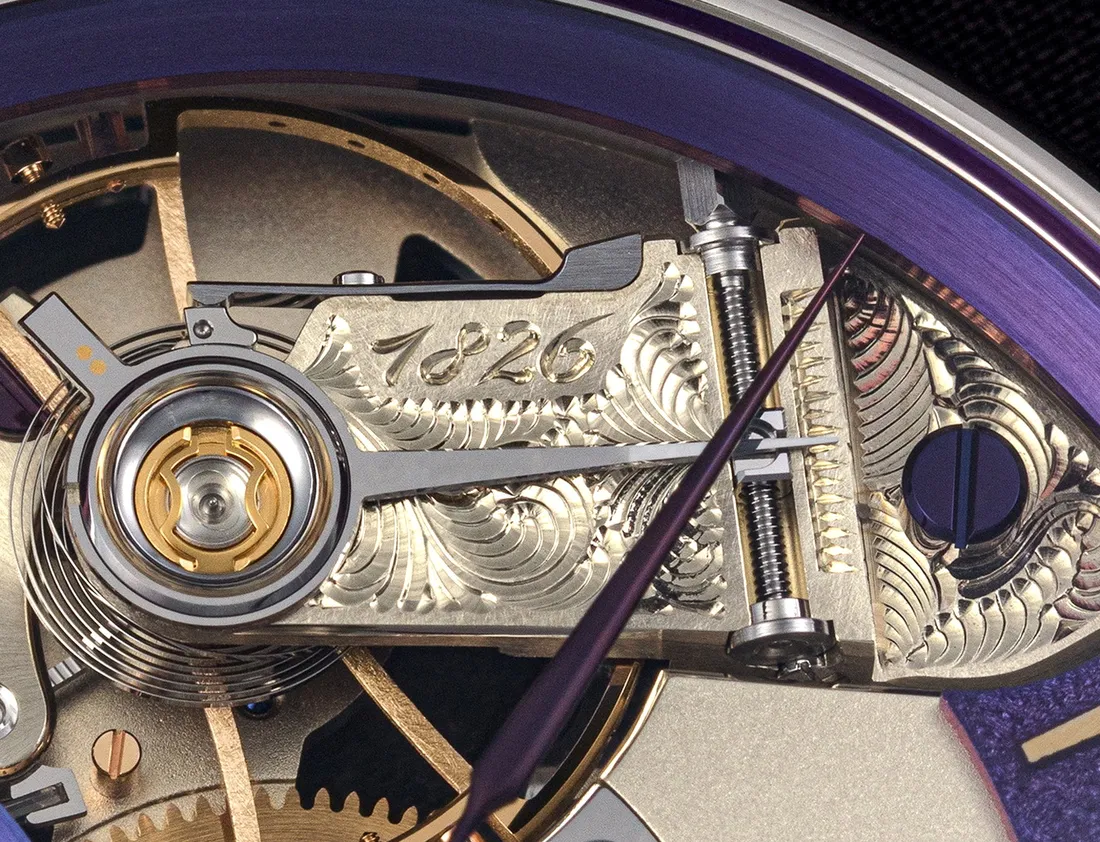
The result is a face on which the hand-engraved balance cock, the floral motifs cut into it, the gold chatons and the screw heads bevelled by hand are no longer concealed. The watch does not hide its intimate heart; it lays out every stage, from the winding of the spring to the swing of the balance.
format_quote"Showing a movement in a mirror is easy; making it run as its mirror image means thinking every part through again."
Hasan Bekmezci
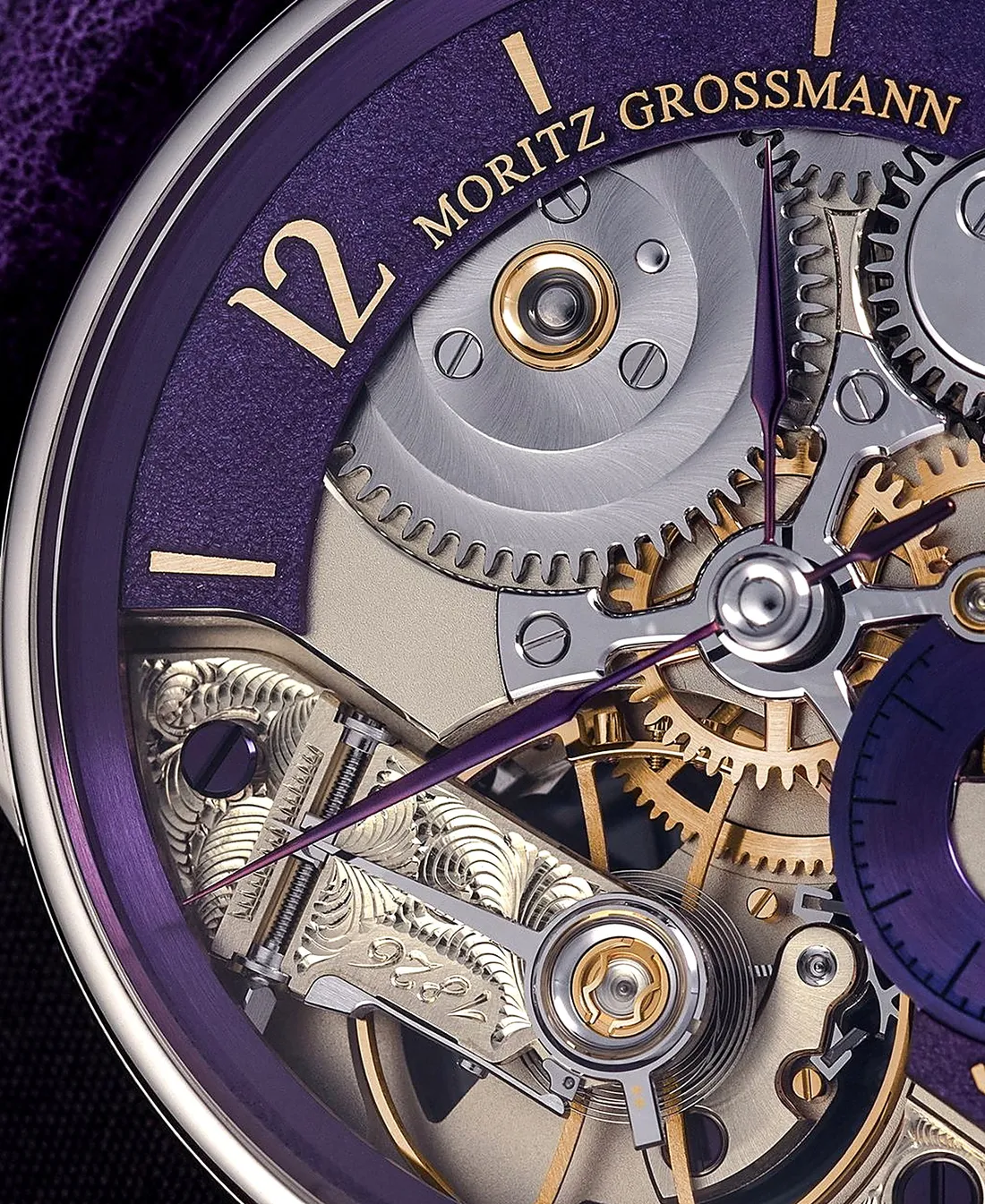
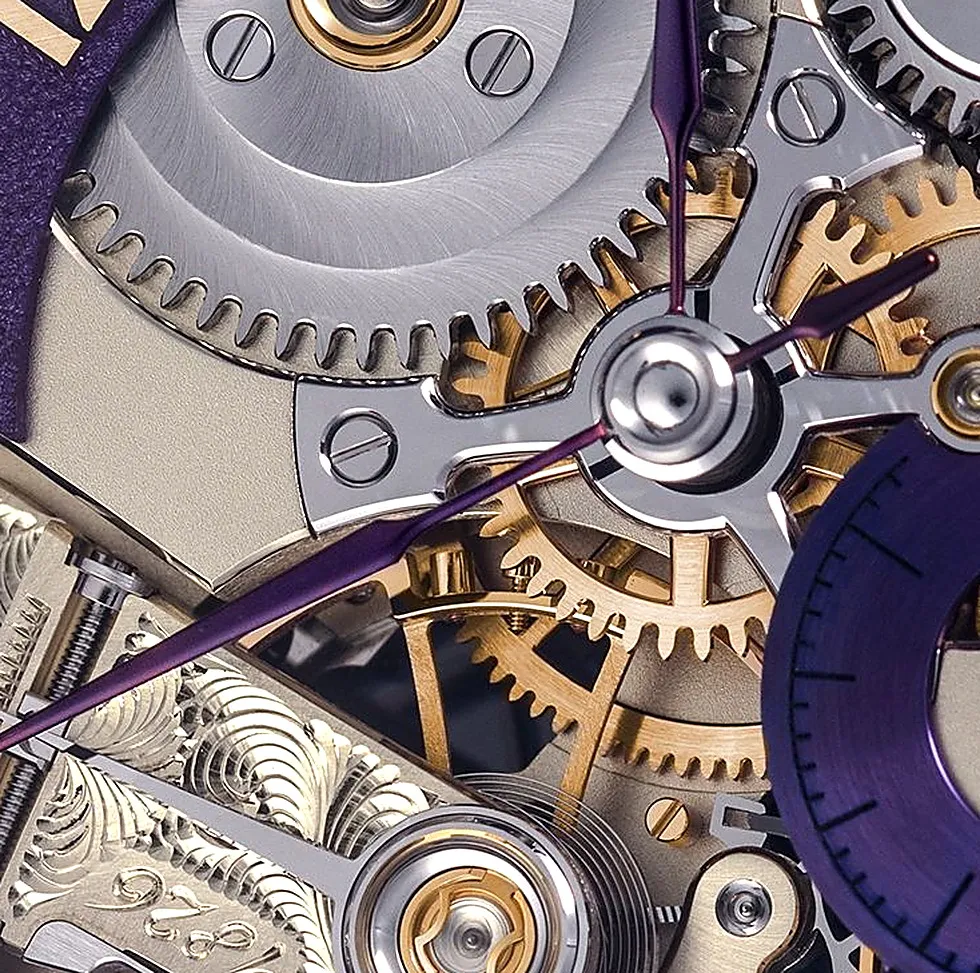
The ground that plays host to these wheels spread across the front is crowned with one of the most patience-demanding hand-engraving techniques in watchmaking: tremblage.
The dial plate is not solid silver but German silver, which is to say an alloy of copper, nickel and zinc containing no silver at all. It has been Glashütte’s material for a century and a half: soft enough to surrender to the graver, hard enough not to lose the mark the graver leaves. The engraver takes a specially sharpened burin to that plate and, trembling the wrist back and forth like a metronome, strikes thousands of micro incisions into the metal. A process in which one wrong stroke can send the whole dial to the bin, it takes days and demands years of training; and the hardest part is not the pattern but keeping the pressure identical from the first stroke to the last.
The texture that comes out is nothing like a machine-applied matting. Those microscopic incisions, apparently disordered, scatter the light softly from every angle and build an organic, velvety surface like suede. The dial spans from eleven o’clock to five; the tremblage chapter ring and the recessed small-seconds circle at six are coloured with a violet galvanisation. The applied gold markers and the gold numeral 12 are then the only bright points inside that matting. To make a surface matt is not to silence it but to let everything else be heard.
The hands belong to the same colour: shaped by hand from steel and annealed in a kiln to a violet-brown. Grossmann arrives at that tone with heat rather than paint, which means the colour of the hand is not on its surface but held in the temper of the steel itself.
To imagine this meeting you have to step out of the three dimensions of space and the single linear time that a human perceives; the Sussex of 1802 and twentieth-century Anatolia cannot come together at one physical point. So let us set the table on the physicists’ map instead. In string theory the universe has ten dimensions, six of them folded at every point in space, at microscopic scale, into Calabi-Yau geometries. We cannot see those folds; the strings vibrating inside them are what constitute the laws of physics. Picture the two thinkers inside one of those folded dimensions, with the Backpage Tremblage on the table in front of them. This is not a claim about physics but a thought experiment, and a good thought experiment often shows more than a laboratory.
Paley opens, looking at the balance beating on the face of the dial. We used to take time for a river that flows without stumbling, he says; yet at this scale what we call time is nothing but a tension vibrating at a certain frequency. Look at this watch: the movement is not hidden, it has been reversed and laid out at the front. Every wheel turning on this dial is a miniature imitation of the order bent into those folded geometries. With engineering this immense standing in plain sight, what mind could claim that these wheels came together by coincidence?
The old thinker smiles and runs a finger over the micro incisions on the violet tremblage surface. You speak the truth, Paley, he says; but do not forget that even those vibrating strings we call the foundation of matter cannot compose the score themselves. A trembling string cannot be its own composer. Look: the wheels and the balance of this watch, brought to the front though they are, are still lifeless steel and gold; they have no minds of their own with which to know their direction. Blinded inside this narrow dimension a man says that a wheel turns a wheel, that the universe creates itself. Yet the wheels visible in this watch, and the hidden strings that build the universe, are both no more than veils. The string vibrates, the wheel turns; but the melody is written by the master in Glashütte, and the universe is ordered by the absolute Artificer. The cause turns not to hide the master but to announce his knowledge on this violet dial.
format_quote"A trembling string cannot be its own composer. The string vibrates, the wheel turns; but the melody is written by someone else."
Hasan Bekmezci
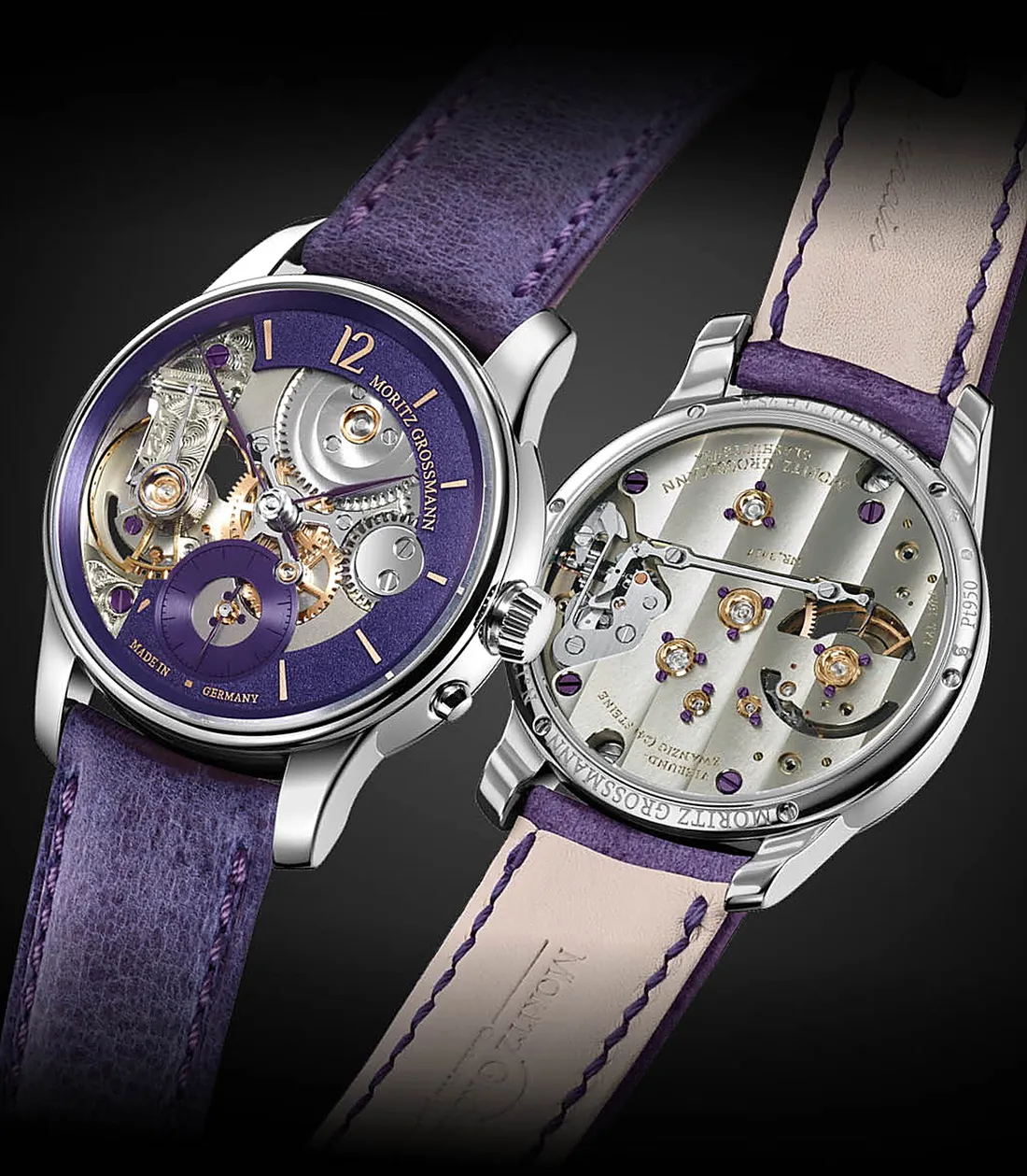
The numbers have something to say as well. Calibre 107.0 is hand-wound: 230 parts, 24 jewels, 11 gold chatons, a Grossmann balance with four inertia screws and two poising screws, a lever escapement, a stop-seconds. It runs at 18,000 vibrations an hour, two and a half a second, half the modern standard. That slowness is not a shortfall but a choice: a low frequency means a balance the eye can follow and forty-two hours from a full wind. The case is forty-one millimetres across and eleven point three five deep, in three parts of polished platinum, with anti-reflective sapphire front and back and thirty metres of water resistance. The strap is violet kudu leather with a platinum buckle. The reference is MG-003980 and the series runs to twelve pieces.
All of it also has a date. Moritz Grossmann was born on 27 March 1826, which makes this his two hundredth year. The way the house chose to mark its own founder’s bicentenary was not to hang a portrait of him but to turn the movement around and put it in everyone’s eye. The most honest way to commemorate a master is to make his work visible.
With its reversed architecture laid across the front, its violet texture worked by hand and that slow balance the eye can follow, the Backpage Tremblage is a monument on which Paley’s rational intuition and the old contemplation of the East meet on a wrist.
format_quote"The most honest way to commemorate a master is not to hang a portrait of him but to make his work visible."
Hasan Bekmezci