The Child of a Snowbound Valley
In one of Switzerland's coldest, most remote corners, hidden in a fold of the Jura Mountains, lies a long, snowbound valley: the Vallée de Joux. Winters here last for months; the lake freezes, the fields vanish under snow. Centuries ago, the farmers of this valley began to spend those long winter months, when they could not work the land, in the attics of their farmhouses, making the world's most complex watch movements. In time, this valley became the cradle of haute horlogerie, of the most demanding complications.
And so in 1948, in the very town at the heart of this valley, Le Sentier, Philippe Dufour was born. He began his apprenticeship at the watchmaking school of that same town; no one then knew that this boy would one day be called 'the greatest living watchmaker'.
Not a Supernova, but a Kilonova
Consider how matter is born in the universe. Stars cook the elements up to iron calmly in their cores. For the heavier ones, the death of a star is required, a supernova. But for certain materials, gold, platinum and the rarest earth elements, even a supernova is not enough; they are born only in that unimaginable event, seen but rarely in the universe, where two dead stars, two neutron stars, collide, the kilonova.
Watchmaking is the same. In every generation a few brilliant masters are born, each like a supernova. But Philippe Dufour is not a supernova, he is a kilonova: a cosmic collision, encountered only once in an age, that creates the rarest material of all, the purest craftsmanship. Why? Because Dufour took everything he had learned, working at Jaeger-LeCoultre, making complex striking mechanisms for Audemars Piguet, even restoring antique clocks in the Caribbean for a time, and in 1992 achieved what was thought impossible: for the first time in history, he fitted the most magnificent striking complication, once seen only in pocket watches, the Grande et Petite Sonnerie, into a wristwatch. He then created, in 1996, the twin-balance Duality, and in 2000 the Simplicity, a watch that shows only the time yet taught an entire industry a lesson with its finishing.
The Inward Angle No Machine Can Make
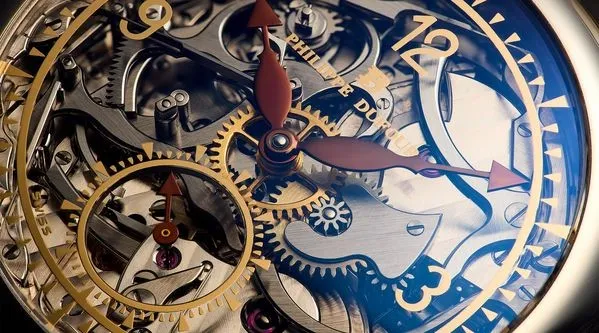
What makes Dufour a legend is less his complex complications than the obsessive finishing he lavishes where no one will ever see it. The edge of every steel part in the movement is bevelled at a 45-degree angle by a technique called anglage, and polished by hand until it shines like a mirror. But the true test is the inward angle: the sharp corner where a part curves inward. A machine, working with a rotating tool, can never cut this sharp inner corner; only a human hand, with hours of patience, can create it. That inward angle is the infallible proof that a part has truly been finished by hand, and it is Dufour's signature.
To this are added black polishing (polishing steel until, from a certain angle, it looks jet black), hand-drawn Geneva stripes and frosted grounds. Dufour works almost alone in his modest workshop in Le Sentier, and for years he has cried out to the entire industry: this hand-craft is dying, protect it. Today every great living master, from Journe to Voutilainen, secretly measures their own work against a single standard: Dufour's.
The Everest of Complications: the Grande et Petite Sonnerie
So why is the complication this unique watch carries considered the Everest of watchmaking? A minute repeater, when you push a lever, chimes the time with hammers on demand. A sonnerie does this of its own accord: the grande sonnerie, like a bell tower, automatically strikes both the hours and the quarters at every quarter; the petite sonnerie strikes only the hours. To combine all of this in a single watch requires a separate power source, governors to regulate the sound, safety locks to prevent misuse, and tiny gongs tuned by hand.
This is work that terrifies masters even in a pocket watch. To fit it into the minuscule volume of a wristwatch was thought impossible until 1992. When Dufour achieved it, one of the most important moments in the history of modern watchmaking took place. And of this complication he has made, to this day, only eight.
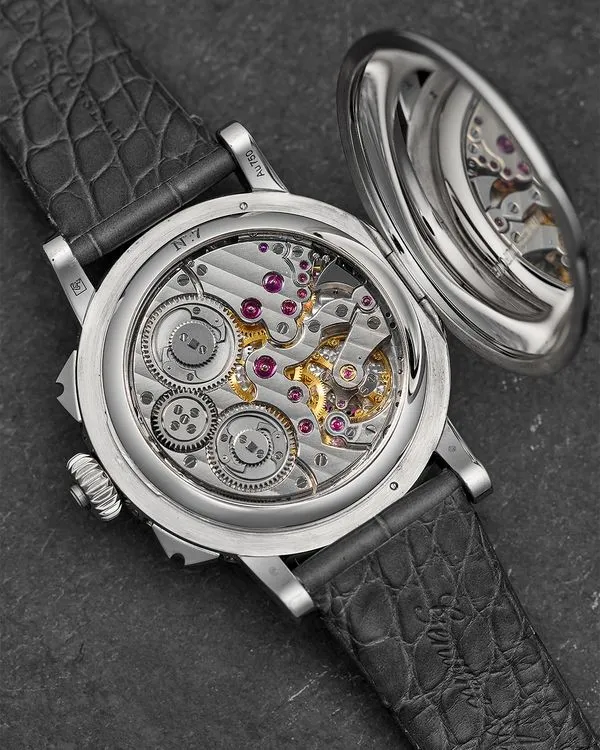
Eight Sonneries, a Single Skeleton: No. 7
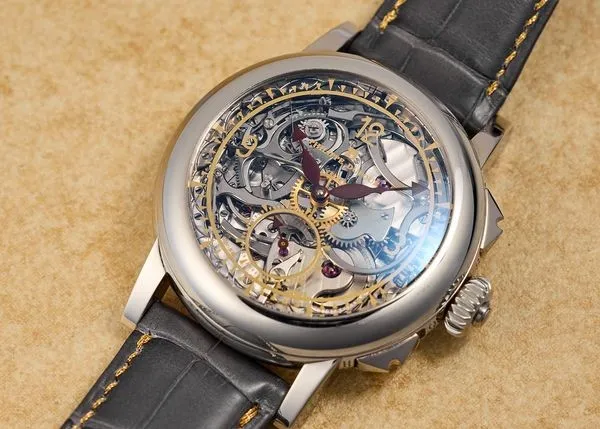
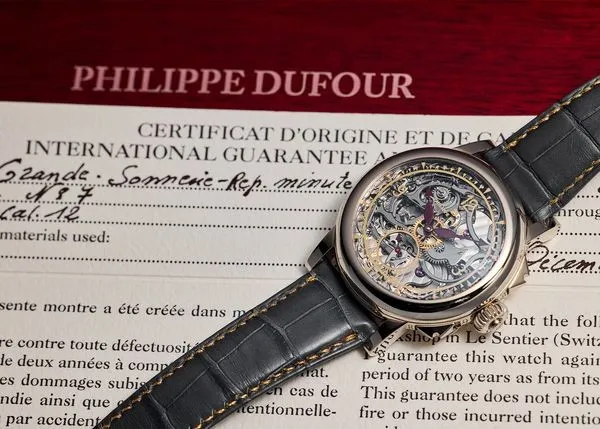
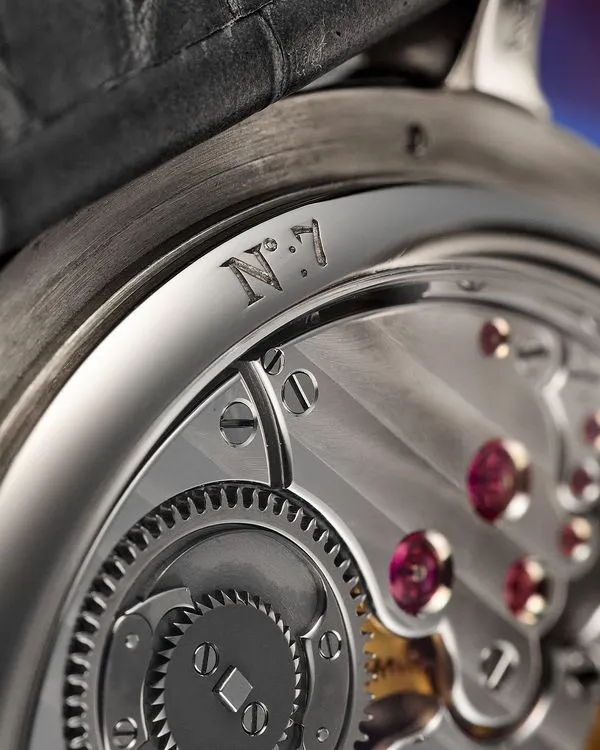
This watch, offered at Phillips New York's auction in December 2024, is one of those eight sonneries; but the one set apart from all the rest, entirely unique. Cased in white gold and signed 'No. 7', this piece is skeletonised; that is, Dufour removed the dial that hides his own flawless finishing and laid the whole intricate ballet of the striking mechanism, the dance of gongs, hammers and wheels, fully bare to the eye. The auction estimate was 'in excess of two million dollars', and the watch was expected to reclaim the title of the most expensive wristwatch made by an independent watchmaker. But for a Dufour, the price is the most ordinary part of the story.
The Sound of a Snowbound Silence
A kilonova shines perhaps once in an age, and leaves behind the rarest material that nothing else could produce. That is precisely what Philippe Dufour is to watchmaking. This unique No. 7 is the three-hundred-year winter patience of that cold valley, and the farthest point a human hand and eye can reach, distilled onto a single wrist. When you raise your arm and hear the clear voice of those chiming gongs, you are, in truth, listening to the snowbound silence of the Vallée de Joux.