Imagine a wristwatch that needs two faces just to hold everything it knows. Turn it over and one side tells you the ordinary things, the hour, the date, the phase of the moon. Turn it back and the other side shows you the sky itself, stars in their true positions, the exact moment a certain star will cross the meridian tonight, the moon's path traced across an oval window the size of a coin. This is the Patek Philippe Sky Moon Tourbillon, reference 6002R-001, and it carries twelve complications inside a single rose gold case forty four millimeters wide. Patek Philippe calls it the second most complicated watch in its current collection, and once you understand what those twelve complications actually do, the claim stops sounding like marketing and starts sounding like an understatement.
This article walks through every one of those twelve complications, what each one does, why it exists, and how the watchmakers actually built it, in language that assumes no prior knowledge of watchmaking or astronomy at all. By the end, a watch that looks impossibly complicated from the outside will make complete sense from the inside.
The Dial
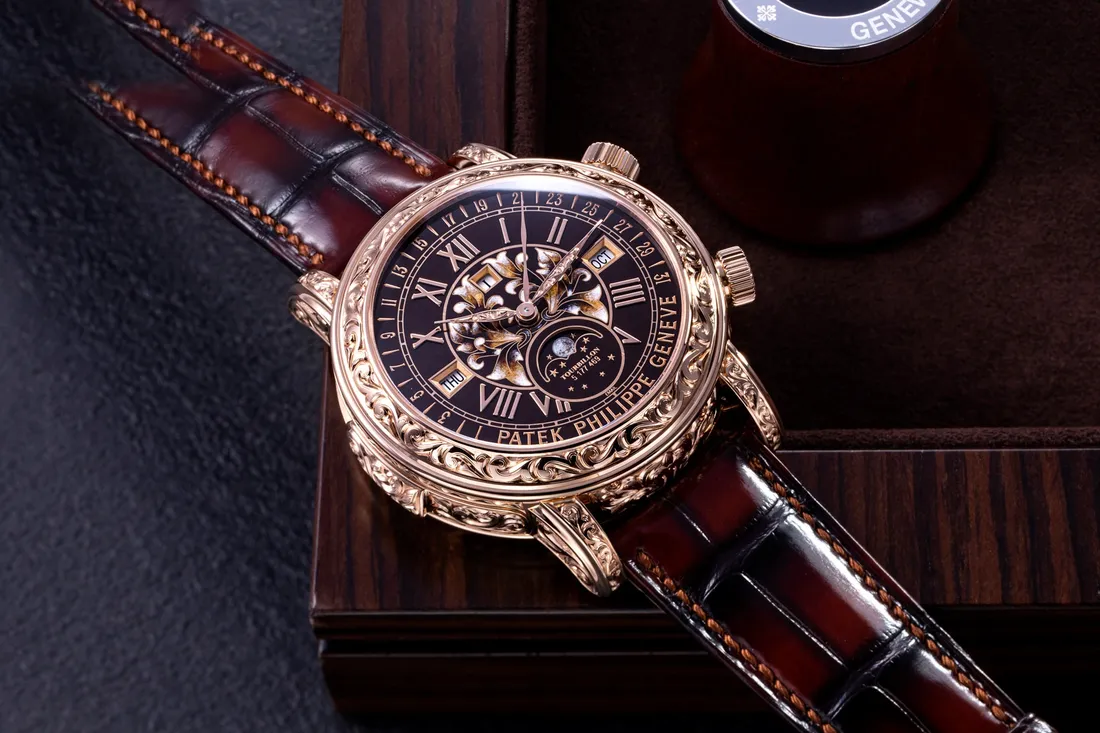
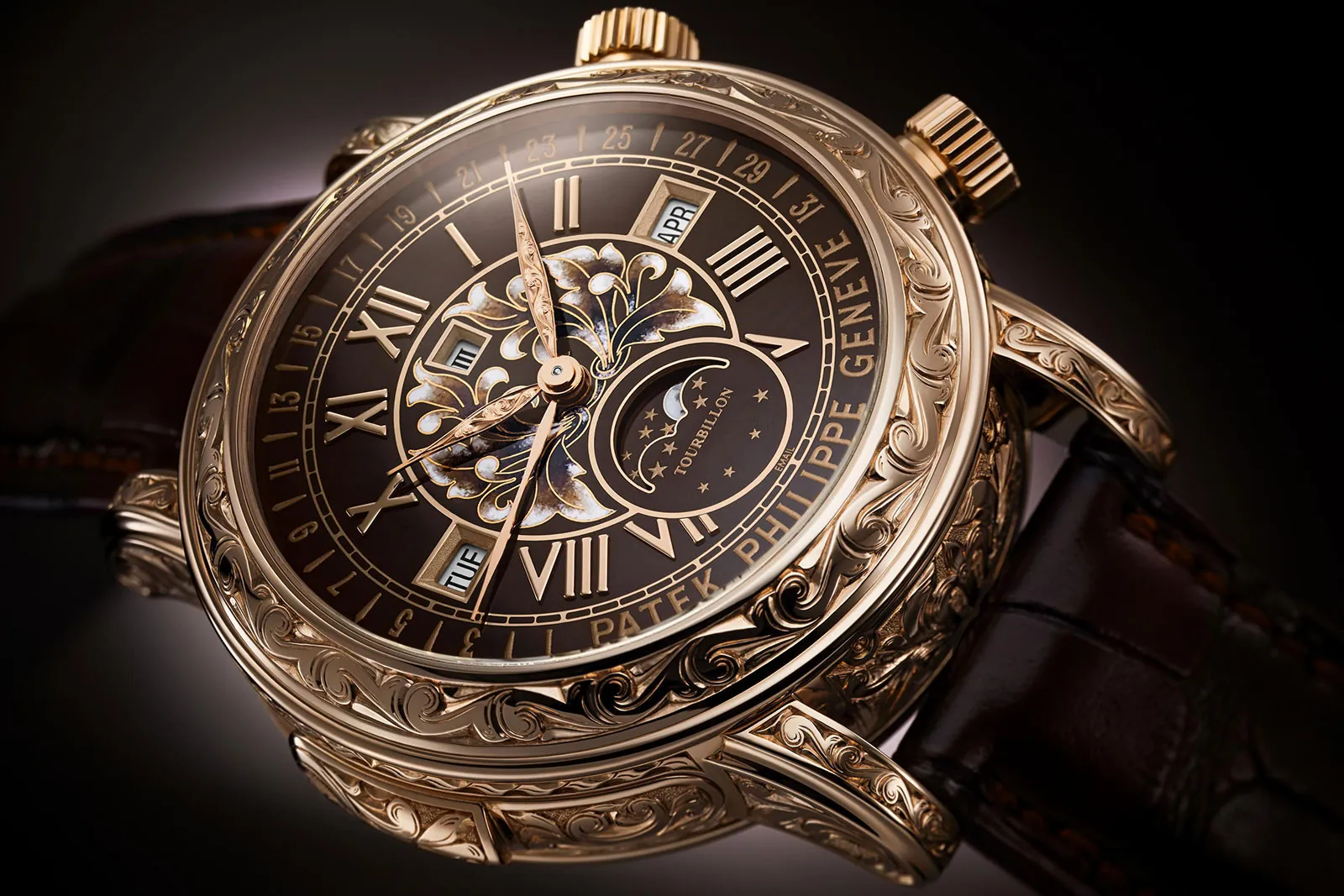
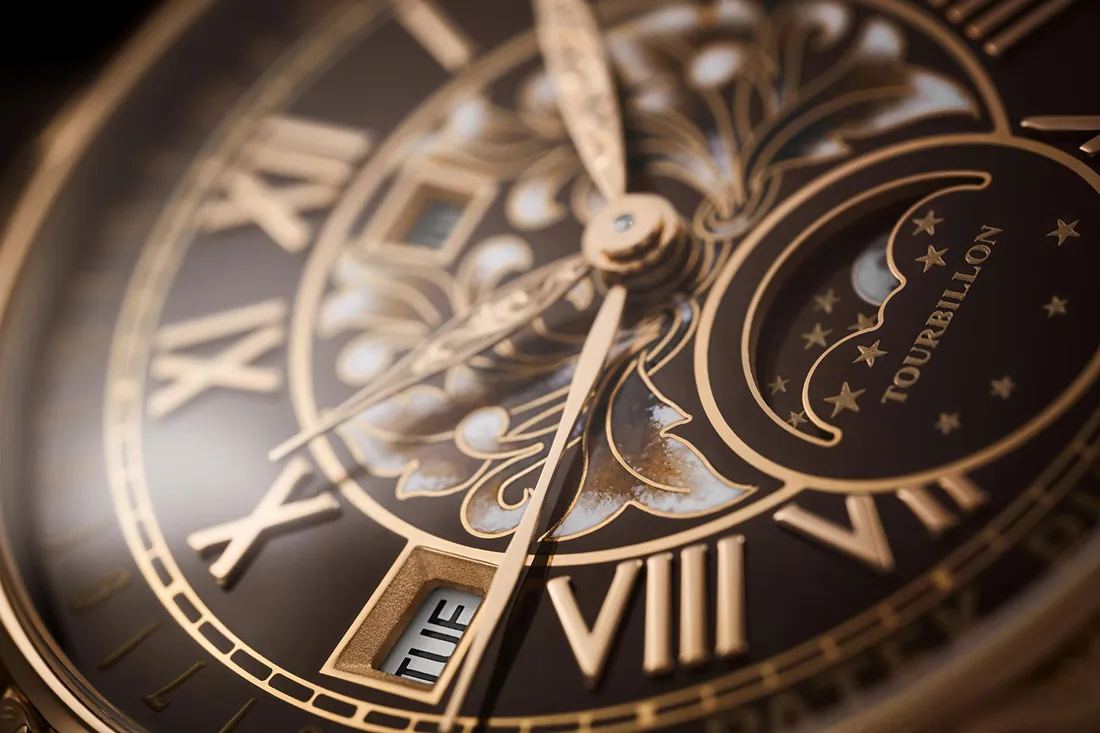
Start with what you see on the front dial, warm brown enamel that seems to glow from underneath rather than sit on top of the metal like paint. That glow is not an illusion. This is Grand Feu enamel, made by grinding colored glass into a fine powder, mixing it into a paste, and painting it onto a disc of solid eighteen karat gold. The disc then goes into a kiln heated past eight hundred degrees Celsius, hot enough to melt the glass powder into a liquid skin that fuses permanently to the gold underneath. The enamel artist cannot simply do this once. Each color, each layer of shading, requires its own application and its own trip through the fire, and a single crack or bubble at any stage means starting the entire dial over from a blank disc. The dial you see on this watch survived that gauntlet twice over, since the front and back dials are both enameled by hand. The numerals are then cut separately in solid rose gold and set into the enamel by hand, which is why the numbers on this dial have a sculpted, three dimensional presence rather than sitting flush against the surface.
Ordinary Time, Extraordinary Calendar
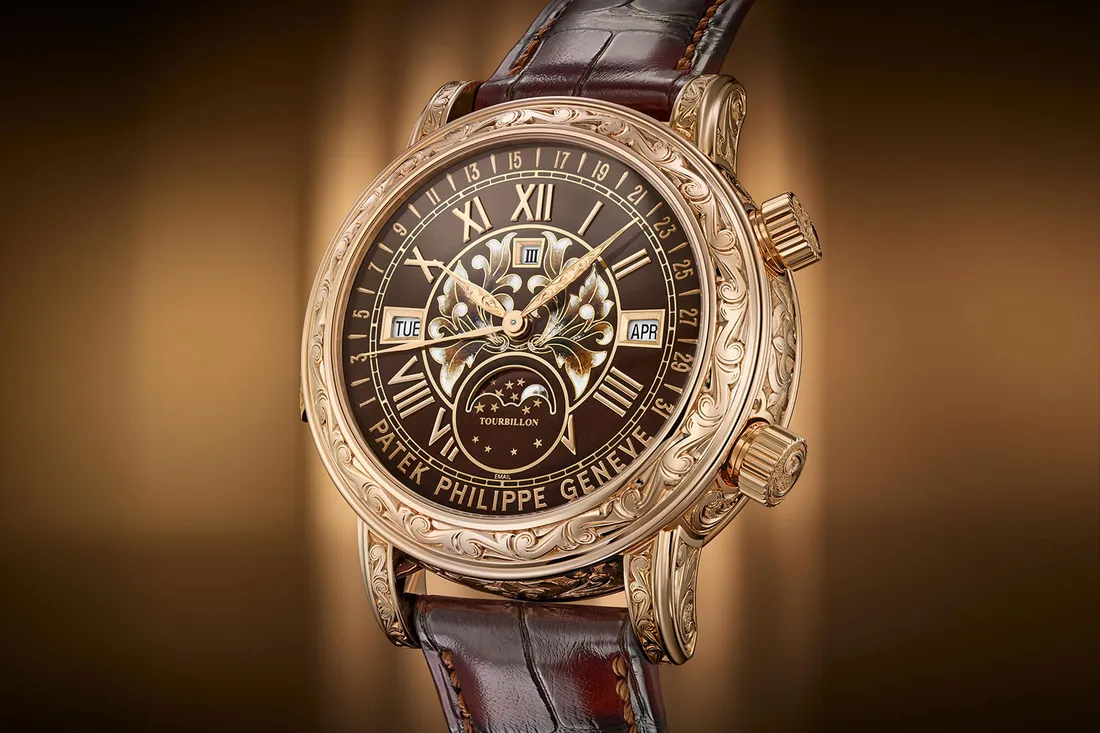
Now look at what that dial is actually telling you. Most of it reads like an ordinary watch at first glance, hours and minutes told by a pair of hand engraved rose gold hands shaped like leaves. But look closer and four more functions are quietly at work. A retrograde date hand sweeps across an arc at the edge of the dial and, instead of circling round and round like a normal date hand, it reaches the last day of the month, jumps back instantly to the first, and starts the sweep again. Three small windows nearby show the day of the week, the month, and something rarer, the leap year, a four year cycle spelled out directly on the dial so the watch itself keeps track of whether the coming February has twenty eight or twenty nine days. This is what watchmakers call a perpetual calendar, a mechanism built to understand the actual irregular length of months and the leap year rule without ever needing to be corrected by hand, in theory for as long as the watch is kept wound and serviced. Finally, a moon phase display, a slowly rotating disc painted with two moons, shows the moon's current phase and needs adjusting by only one day every hundred and twenty two years, which is about as close as mechanical watchmaking gets to matching the real astronomical cycle of the moon exactly.
The Tourbillon
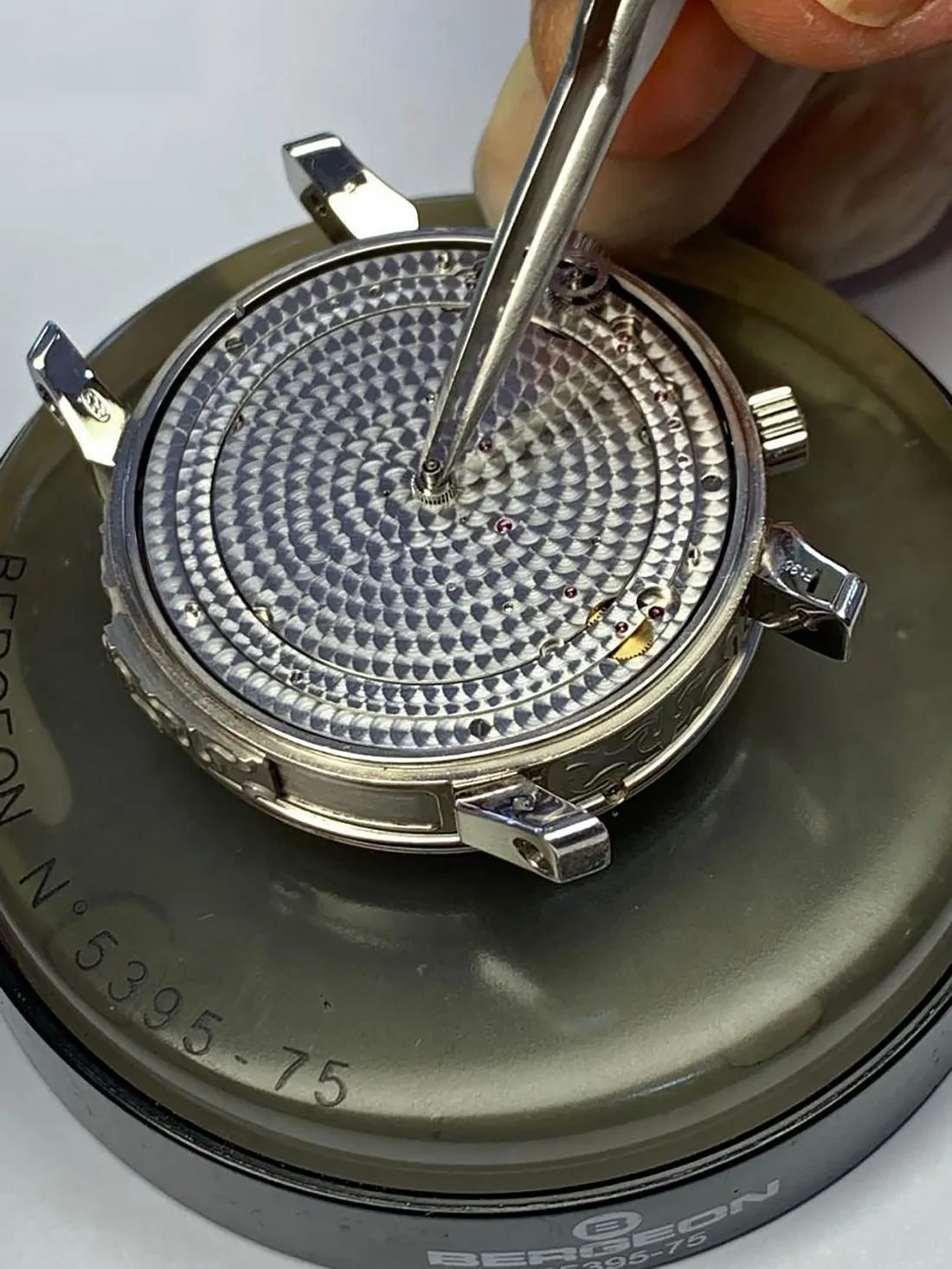
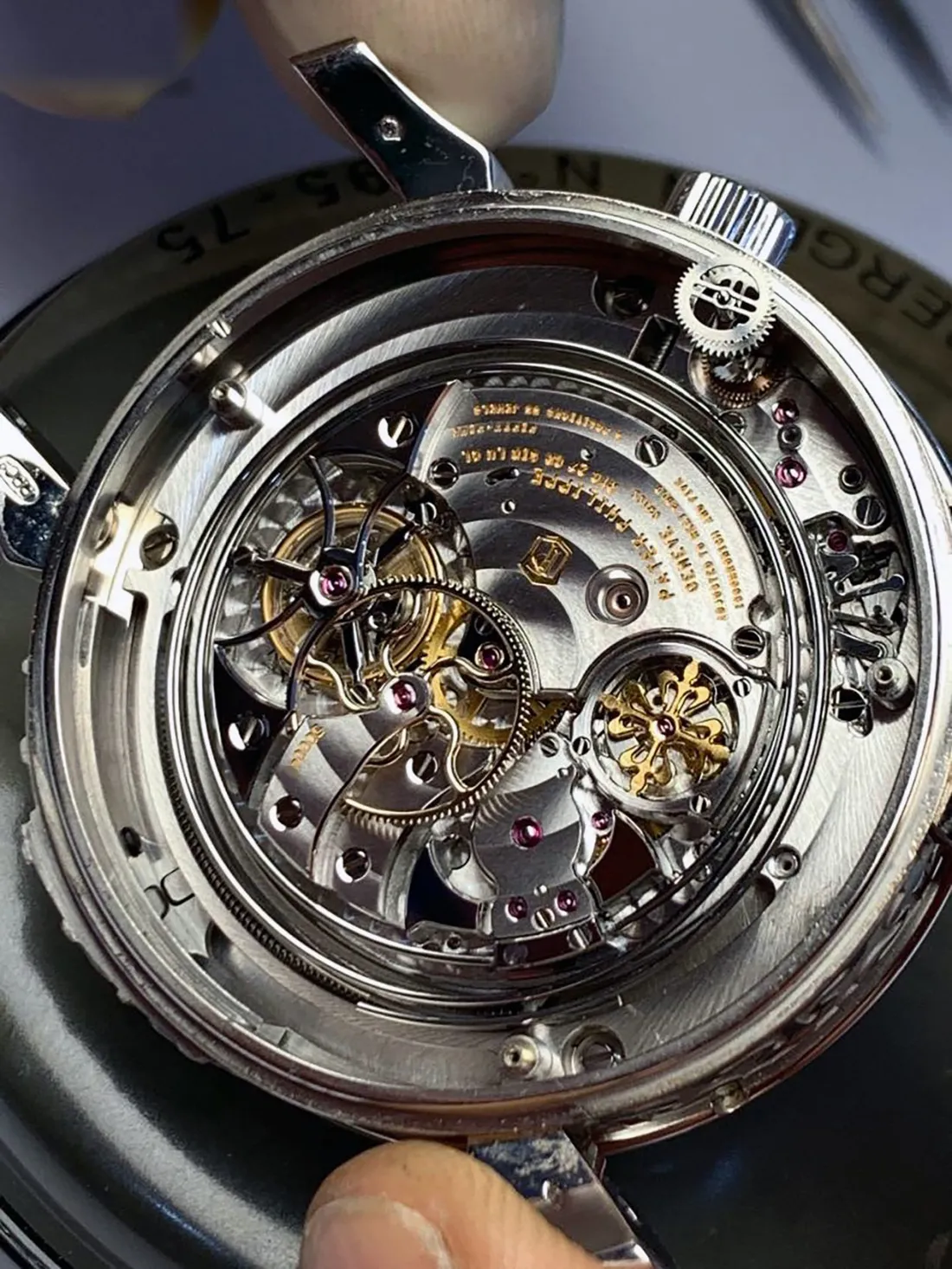
Below the calendar work sits the tourbillon, visible from the back of the watch as a small cage rotating once every sixty seconds. To understand why it exists, picture the watch's balance wheel, the tiny wheel that swings back and forth and acts as the watch's actual timekeeper, the way a pendulum keeps time in a grandfather clock. Gravity pulls on that balance wheel a little differently depending on which way the watch happens to be oriented at any given moment, lying flat on a desk, hanging face up on a wrist, tilted on its side in a pocket. Those small differences in gravity's pull create small differences in how fast or slow the balance wheel swings, which over a full day can add up to real, noticeable error. The tourbillon's solution is almost stubbornly simple once you see it: instead of fighting gravity, place the entire balance wheel and its escapement inside a lightweight rotating cage, and spin that cage continuously. As the cage turns, the balance wheel passes through every possible orientation in turn, so whatever error gravity introduces in one position gets cancelled out by an opposite error in the position exactly opposite it. The watch stops caring which way it is held, because averaged out over each rotation, every orientation gets equal time.
format_quote"The tourbillon does not fight gravity. It simply refuses to hold still long enough for gravity to win."
The Sound of the Hours
Press a slide on the case of this watch and it will chime the time out loud, the hours in one tone, the quarter hours in a second combined tone, the remaining minutes in a third, entirely from memory, entirely mechanical, with no battery or electronics involved anywhere. This is a minute repeater, and it works through a mechanism called a rack and snail: as you push the slide, tiny stepped cams called snails, one shaped to track the hour, one the quarter hour, one the minute, are read by a set of levers the way a finger reads braille, and that reading determines exactly how many times each hammer strikes its gong. What makes this particular repeater special is what it strikes. Most repeating watches use straight gongs, thin metal wires that circle the movement once. This watch uses cathedral gongs, wound almost twice around the full circumference of the movement instead of once, which lets each gong vibrate for a longer length before the sound dies out, producing a deeper, richer, more resonant chime, the mechanical equivalent of the difference between a small room and a cathedral. The engineering problem this creates is considerable: a gong is only ever anchored at one single point, so coiling nearly two full loops of wire around a crowded, moving mechanism, without that wire ever touching the case, the movement, or the other gong, and without dampening its own vibration by touching itself, demands that the case be cut with small precise recesses purely to give the gongs room to breathe.
The Sky on the Back
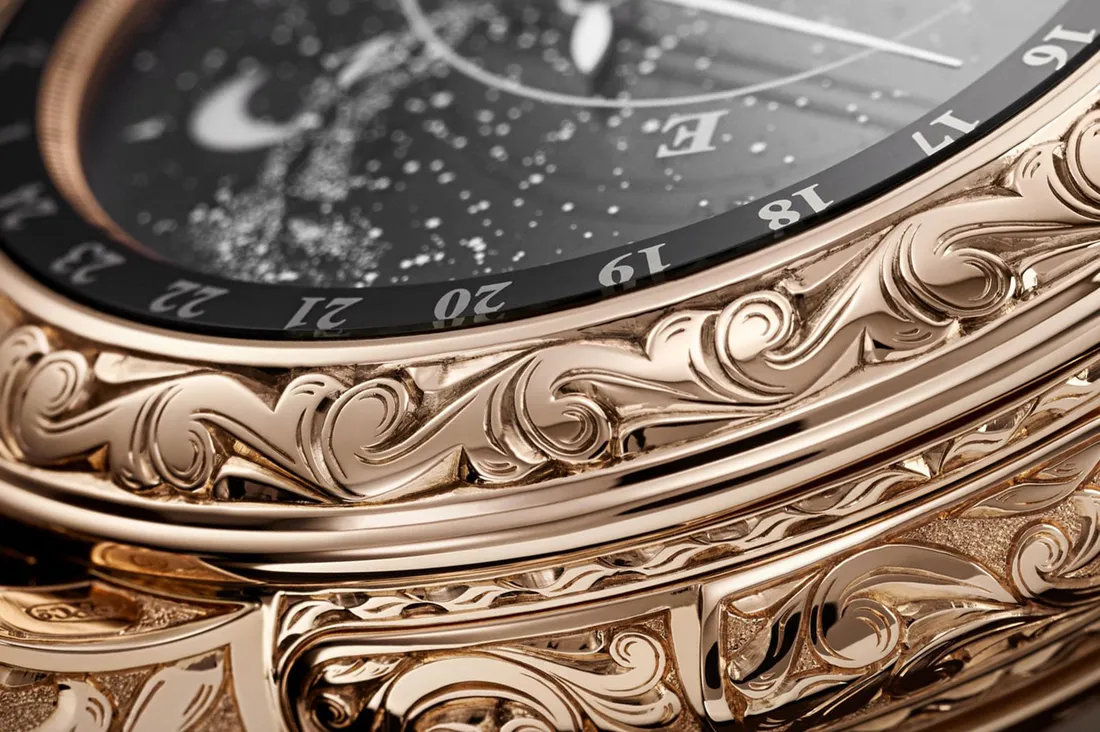
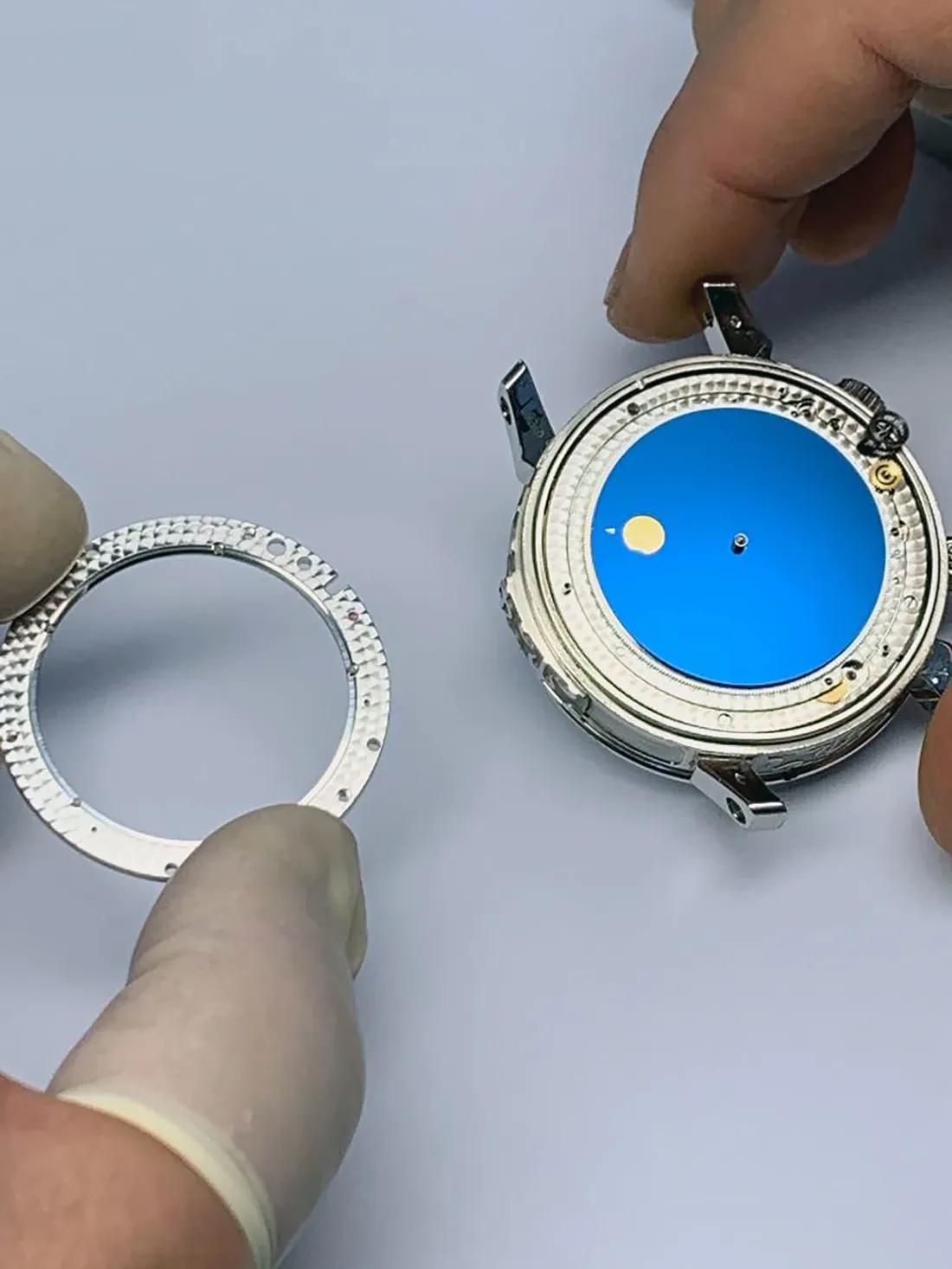
Turn the watch over and the character of the whole piece changes completely. Where the front dial spoke in the practical, everyday language of dates and hours, the back speaks in the language of astronomy, and it does so through three separate discs, layered one above another, each rotating at its own carefully calculated speed, working together to recreate the actual visible motion of the moon and stars as seen from Earth's Northern Hemisphere. An oval window cut into the display represents the portion of sky that is actually visible above the horizon at a given moment, for the latitude the watch was built for, with a line across it marking the meridian, the invisible north south line directly overhead that any given star crosses once a day. As the discs turn, real stars drift across that oval exactly as they do in the actual night sky, and two small hands elsewhere on the back read out something most people have never had reason to think about: sidereal time. Ordinary clock time is built around the sun, one full day being the time it takes the sun to return to the same position in the sky. But the Earth's yearly orbit around the sun means the stars actually complete their own circuit about four minutes faster than the sun does, so a clock that measured time by the stars instead of the sun would slowly drift away from ordinary clock time, gaining roughly one full day every year. Astronomers have always needed sidereal time because a telescope aimed at a star tonight needs to be aimed about four minutes earlier tomorrow to catch the same star in the same place, and this watch's second set of hands quietly keeps that separate, star based clock running in parallel with the ordinary one. The display also marks the precise time each night when Sirius, the brightest star in Earth's sky, and the moon itself, cross that meridian line, along with a separate indication tracking the moon's own angular motion, its actual, changing speed as it travels along its orbit.
format_quote"This watch keeps two clocks running at once, the sun's and the stars', and never lets them be confused for each other."
A Case Carved by Hand
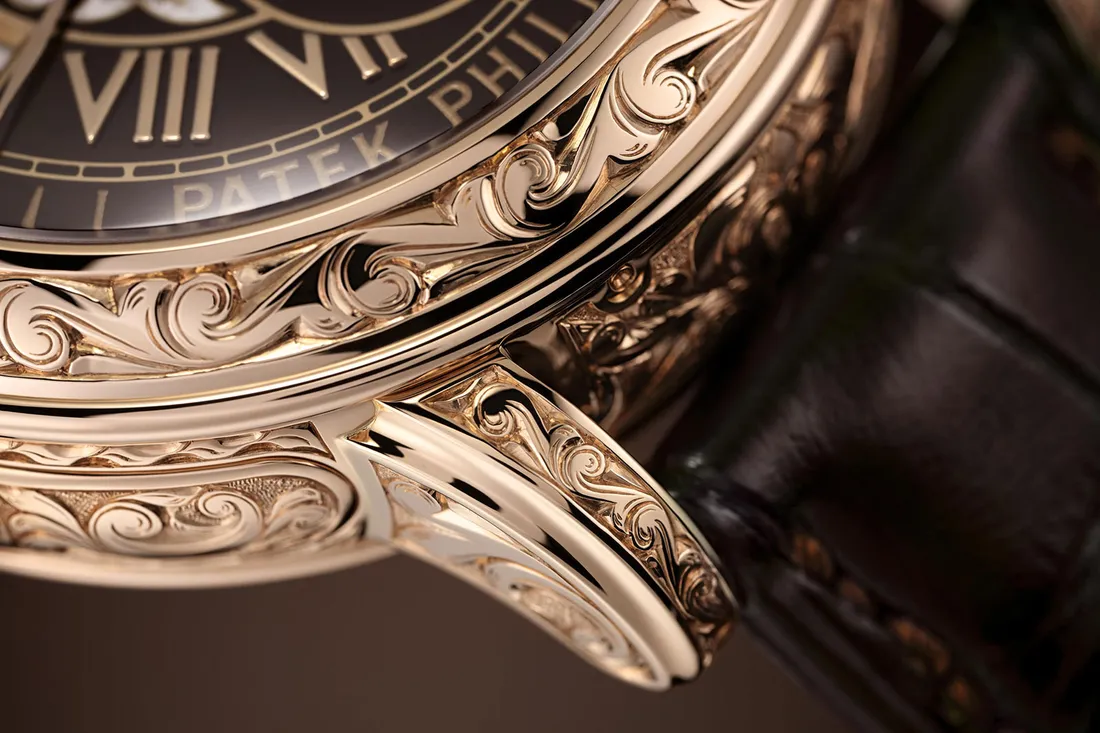
None of this would be visible at all if the case itself were left plain, so Patek Philippe's engravers were given the volutes, the lugs, the crowns, even the slide piece used to trigger the chime, and by the workshop's own account roughly one hundred hours of hand engraving went into decorating this single case before it was ever paired with a movement. Engraving at this level is done freehand with a burin, a small sharpened steel tool pushed by hand pressure and controlled entirely by the engraver's eye and years of muscle memory, not by any machine or template, which is why no two engraved Patek cases are ever perfectly identical. The strap continues the same handmade philosophy, a chestnut colored alligator leather strap with square scales, stitched by hand, closed by a fold over clasp that is itself hand engraved to match the case.
Three Movements Into One
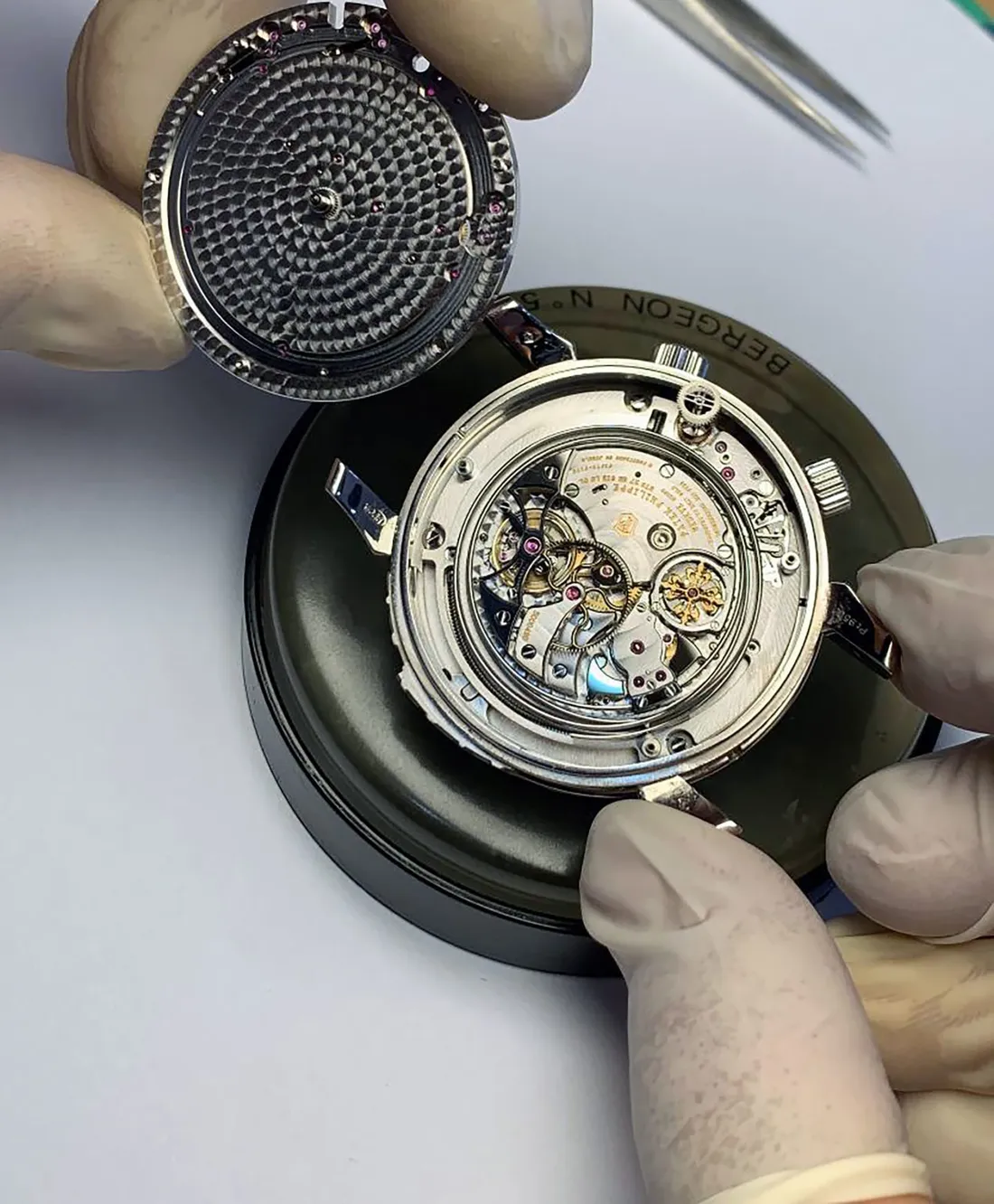
The movement inside, given the internal designation R TO 27 QR SID LU CL, did not appear all at once. Its foundation, a hand wound base combining a tourbillon with a minute repeater, was originally developed by Patek Philippe back in 1993, and the perpetual calendar and the entire astronomical back display were engineered afterward as additional modules layered onto that same foundation, an approach that let the manufacture build genuinely new complications on top of decades of proven, already reliable engineering rather than starting from zero. The finished movement runs to seven hundred and five individual parts and fifty five jewels, ticking at twenty one thousand six hundred semi oscillations per hour, roughly three beats every second, regulated by a Breguet balance spring whose final curved coil, elevated slightly above the rest of the spring, helps it breathe more evenly and keep more consistent time regardless of position, the same problem the tourbillon was built to solve, tackled here from the opposite direction with a slightly different tool. Fully wound, it runs for somewhere between thirty eight and forty eight hours before it needs winding again. Patek Philippe prices the Sky Moon Tourbillon at one million eight hundred forty five thousand three hundred euros and calls it the second most complicated watch in its current collection, and having taken it apart complication by complication, that ranking finally makes sense. What looks from across a room like an unusually handsome dress watch is, up close, an entire private observatory and a full concert hall of chiming bells, built small enough to wear on a wrist, and patient enough to keep both the sun's time and the stars' time correctly, forever, at the same moment.