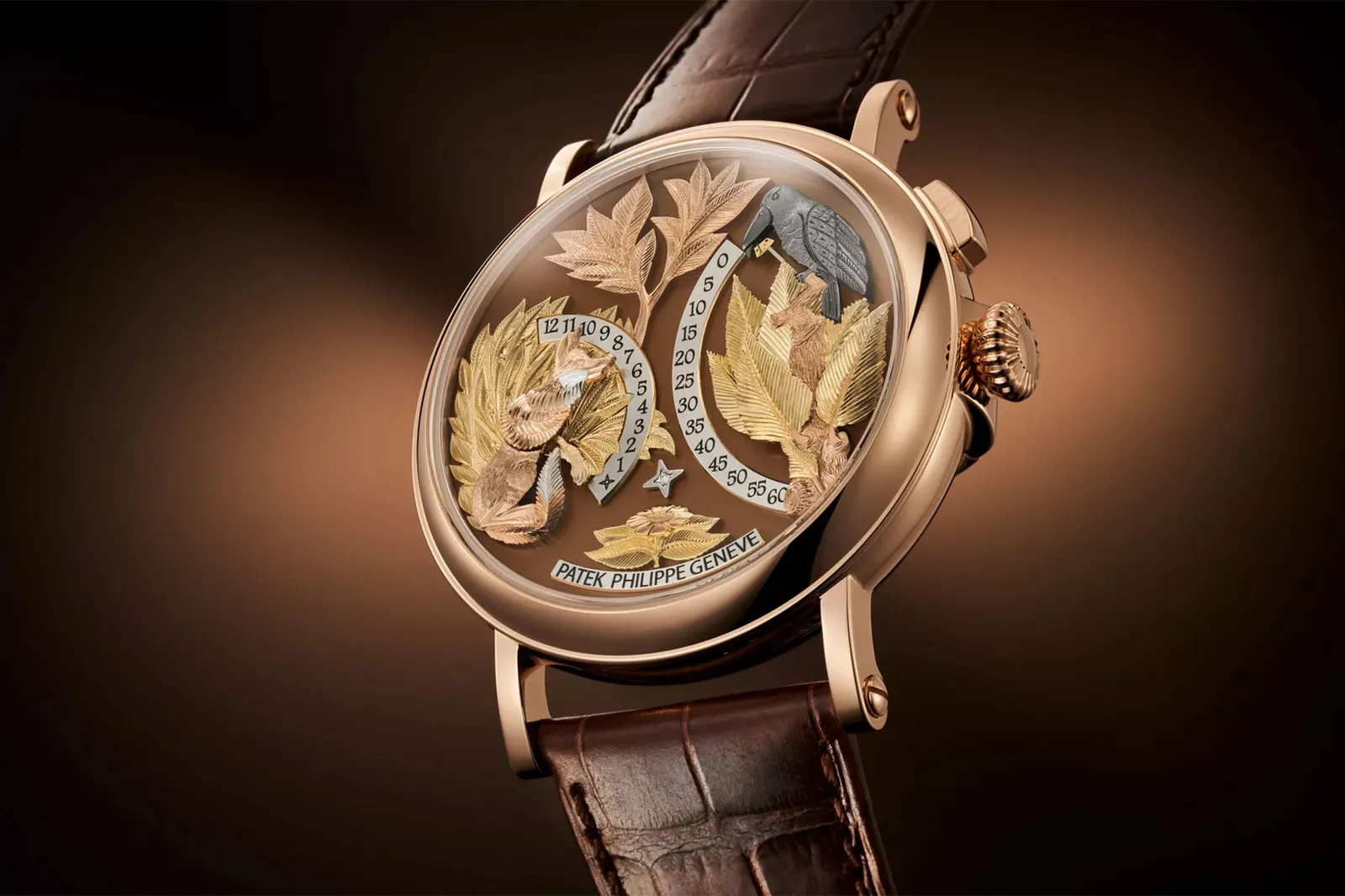
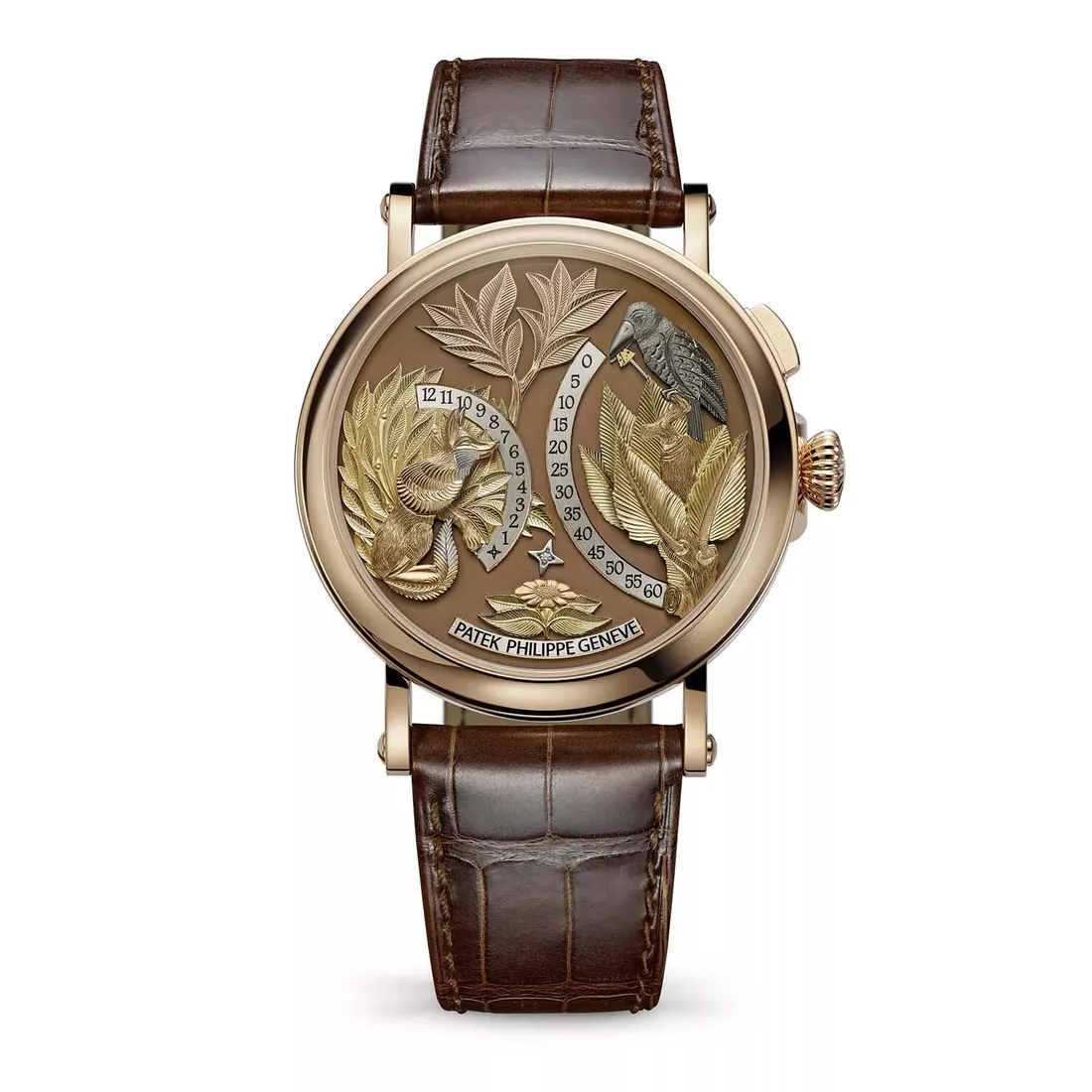
Press a small pusher at two o'clock on this watch and something almost theatrical happens. Two curved silver scales rise up out of the foliage engraved on the dial, a small gold fox lifts its paw or turns its snout to point at an hour, and a grey crow perched among gold leaves opens its beak and lets a tiny piece of cheese drop to mark the minutes. Then you let go of the pusher, the scales sink back into the leaves, the fox and the crow settle back into stillness, and the watch is once again just a very beautiful dress watch. This is the Patek Philippe Reference 5249R-001, and Patek Philippe calls it the first automaton wristwatch of its contemporary history, a title that undersells what is actually happening here. What sits on this dial is not a decoration. It is Jean de La Fontaine's three hundred and fifty year old fable of the fox and the crow, told mechanically, on demand, every single time you press that pusher.
A Fable in Gold
The fable itself is short and almost embarrassingly simple, which is exactly why it has survived since the seventeenth century. A crow is sitting in a tree with a piece of cheese held in its beak. A fox passes below, sees the cheese, and wants it, but has no way to reach it. So the fox begins to talk. It tells the crow how magnificent its feathers look, how noble its bearing is, and wonders aloud whether a bird so beautiful could possibly also have a beautiful singing voice. Flattered beyond reason, the crow opens its beak to prove the fox right and let out a triumphant caw. The moment it does, the cheese falls straight into the fox's waiting mouth, and the fox trots off satisfied, leaving the crow with nothing but the lesson that flattery is never free and the person offering it usually wants something in return. Jean de La Fontaine published this fable, Le Corbeau et le Renard, in 1668, and generations of French schoolchildren have memorized it ever since. What Patek Philippe has done is take that three century old moral lesson and give it a body made of gold, rubies, and two hundred and sixty seven tiny mechanical parts.
The Watch in the Museum
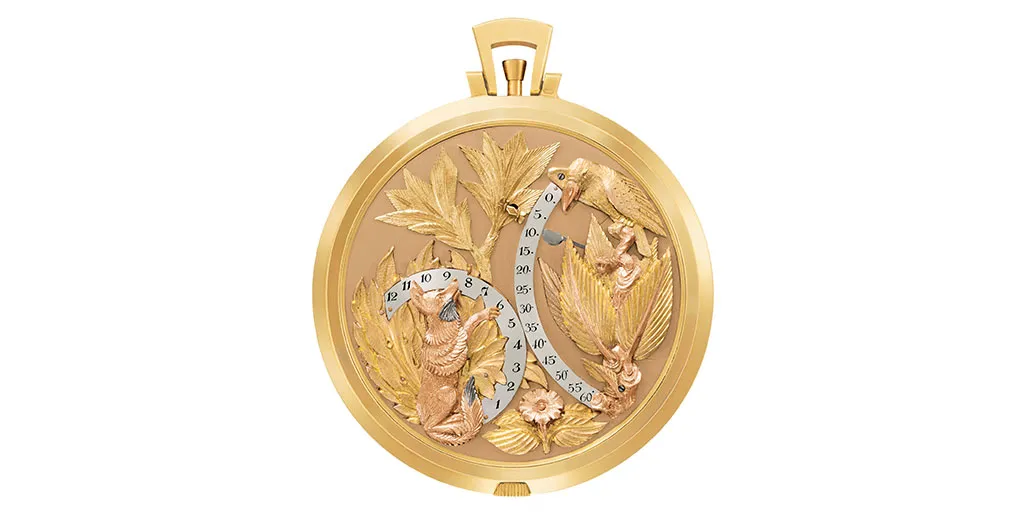
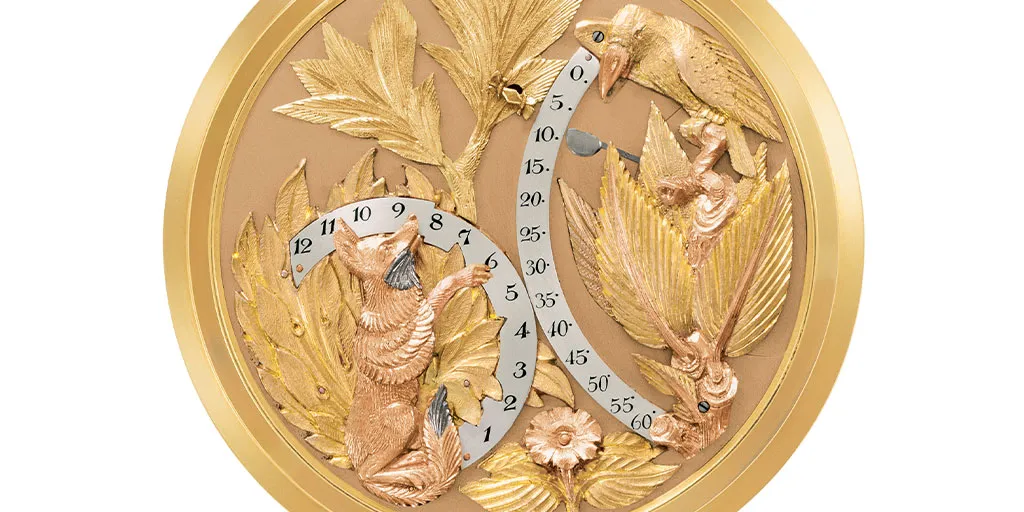
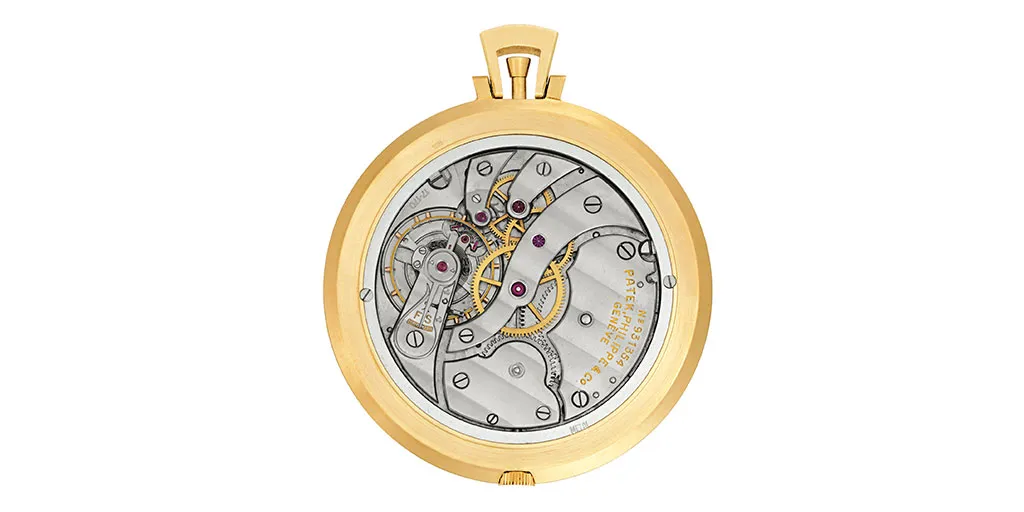
This is not the first time this particular fable has lived inside a Patek Philippe. Sitting today in a display case inside the Patek Philippe Museum in Geneva is a pocket watch, reference 784, made in 1958 and fitted with a movement customized by a watchmaker named Louis Cottier. Cottier is best remembered today for a completely different invention, the world time mechanism that both Patek Philippe and Vacheron Constantin still use, the ingenious system of rotating city rings that lets a single watch show the hour in twenty four places on earth at once. But Cottier had a second, quieter passion, for playful and unconventional ways of showing time that had nothing to do with practicality: jumping hours that leapt from one number to the next instead of sweeping around a dial, retrograde hands that swept across an arc and then snapped back to the start instead of circling forever. The 1958 pocket watch he built folded that same retrograde idea into a small piece of theater. On its yellow gold dial, a fox and a crow sit among engraved foliage, and at the press of a button, two scales rise up between them exactly as they do on the modern watch, the fox pointing to the hour and the crow dropping its cheese to mark the minute. For sixty eight years, this watch existed only as a single, precious object in a museum vitrine, admired by visitors but worn by no one.
Sixty Eight Years Later
In 2026, Patek Philippe decided to give that idea a life on the wrist. The result, reference 5249R-001, is described by the manufacture itself as the first automaton wristwatch of its contemporary history, meaning the first time in living memory that Patek Philippe has built a wristwatch whose entire purpose is to perform a small mechanical scene rather than simply tell the time. Everything about the 1958 pocket watch's idea survives the transition: the same fable, the same fox and crow, the same push button drama. What changes is the scale. A pocket watch movement has room to spare compared to what needs to fit inside a 43 millimeter wristwatch case only 11.55 millimeters thick, and translating a piece of theater built for a pocket watch into something worn on the wrist meant re-engineering nearly everything about how the automaton is driven, while keeping the story exactly as charming as it always was.
How the Story Plays Out
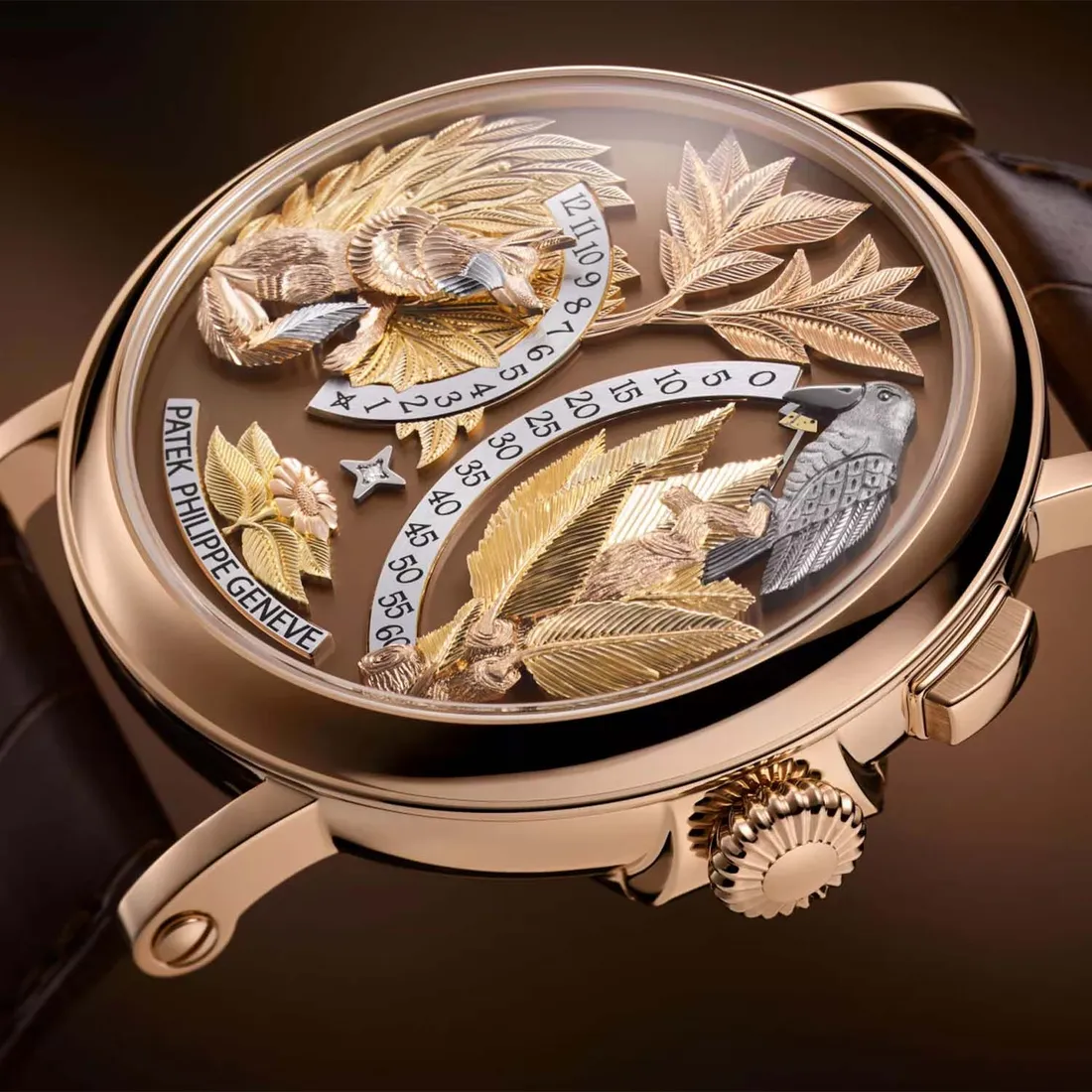
Here is what actually happens mechanically when you press that pusher at two o'clock. A lever inside the movement is released, and it does two things in careful sequence rather than at once. First, it reads the current hour and drives the fox's arm, an ingenious detail here is that the fox does not always point the same way: from midnight to six fifty nine, it lifts its paw to indicate the hour, and from seven o'clock to eleven fifty nine, it instead turns its snout toward the hour scale, so the animal itself changes gesture depending on the time of day, which is as small and delightful a piece of mechanical wit as anything in modern watchmaking. Only after the hour has been shown does the same lever move on to the second half of the sequence, releasing the crow to tip forward and drop its piece of cheese along a separate curved scale that reads out the minute. Release the pusher, and both scales retract back into the engraved leaves, the fox and crow returning to their resting positions, ready to perform the same two-act scene again the next time you want to know the time. None of this can be allowed to interfere with the watch's ordinary timekeeping, so Patek Philippe's engineers developed a patented disengaging clutch system whose entire job is to protect the time-setting mechanism from the automaton mechanism and vice versa, so that pressing the pusher to watch the fable never risks throwing off the accuracy of the hands underneath. One more detail rewards close attention: a small diamond set at the center of the dial rotates continuously, driven directly off the seconds wheel, and it is the only part of the display that is always moving, a quiet, constant reassurance that the watch is alive even while the fox and the crow are waiting their turn.
format_quote"Press the pusher, and for a few seconds this watch stops telling the time and starts telling a story instead."
A Dial Carved by Hand
None of this would carry any warmth if the dial itself were left cold and mechanical, so Patek Philippe turned to its rare handcrafts workshop to give the fox, the crow, and the leaves around them real texture and life. The dial begins as a gold plate given an opaline finish in a warm color the manufacture calls matara brown, and onto this plate twelve separate gold appliques are applied, nine of which are entirely hand engraved rather than stamped or cast. Some of these appliques exist purely for decoration, the leaves and foliage that frame the scene, but others are functional parts of the display itself, meaning they have to move correctly as well as look beautiful, and at their thinnest these engraved gold pieces measure only two tenths of a millimeter. An engraver working at that thickness cannot simply carve with full force the way they might on a thicker piece of gold, because too much pressure risks bending or deforming a part that the automaton mechanism depends on to function correctly, so every stroke of the burin has to be judged not only for how it looks but for how much force it is safe to apply. Patek Philippe states that engraving the appliques for a single dial requires one hundred and fifty hours of manual work, nearly a month of a craftsperson's working life spent shaping a fox, a crow, and a scattering of leaves small enough to fit under a fingertip.
The Case and the Clasp
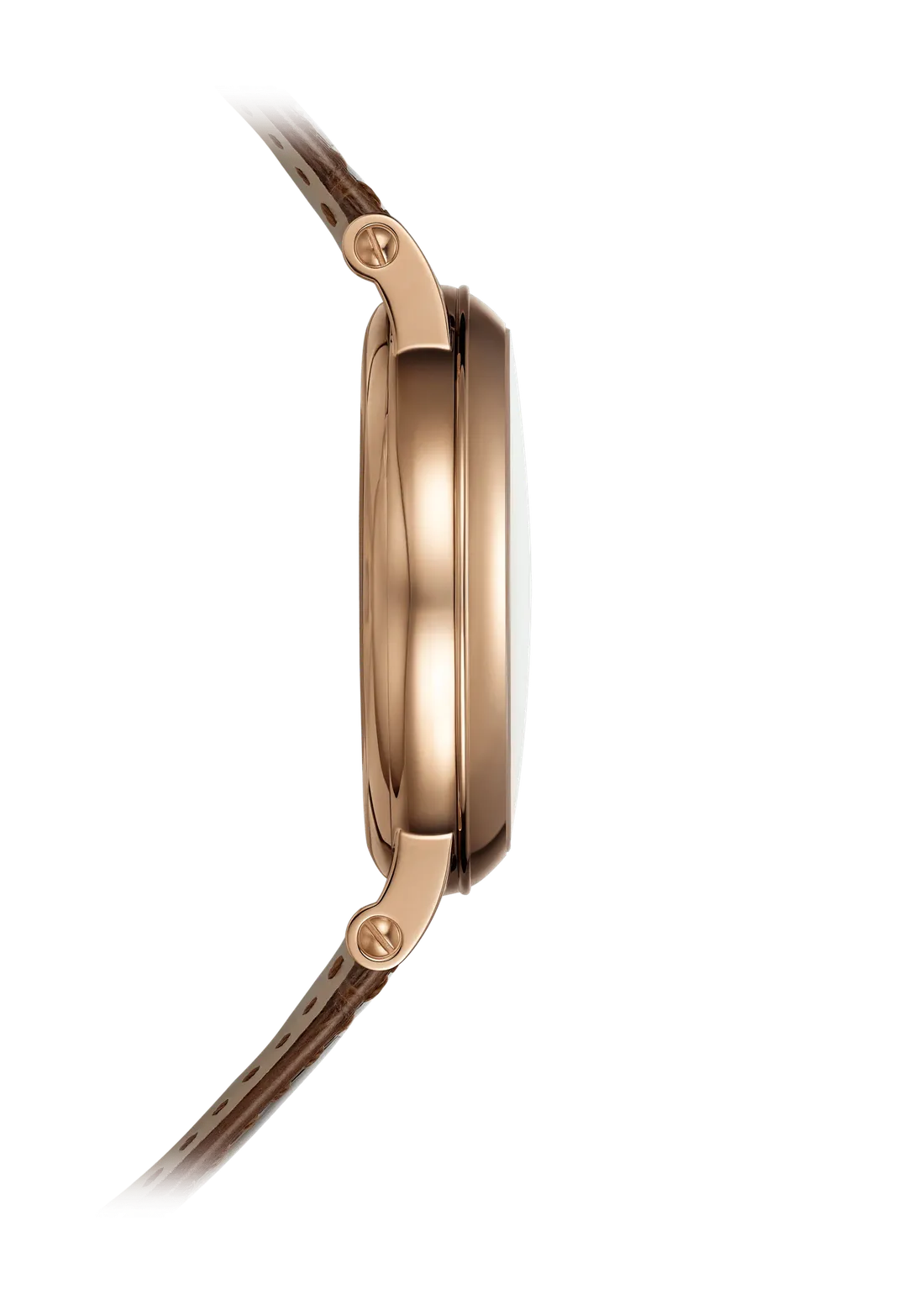
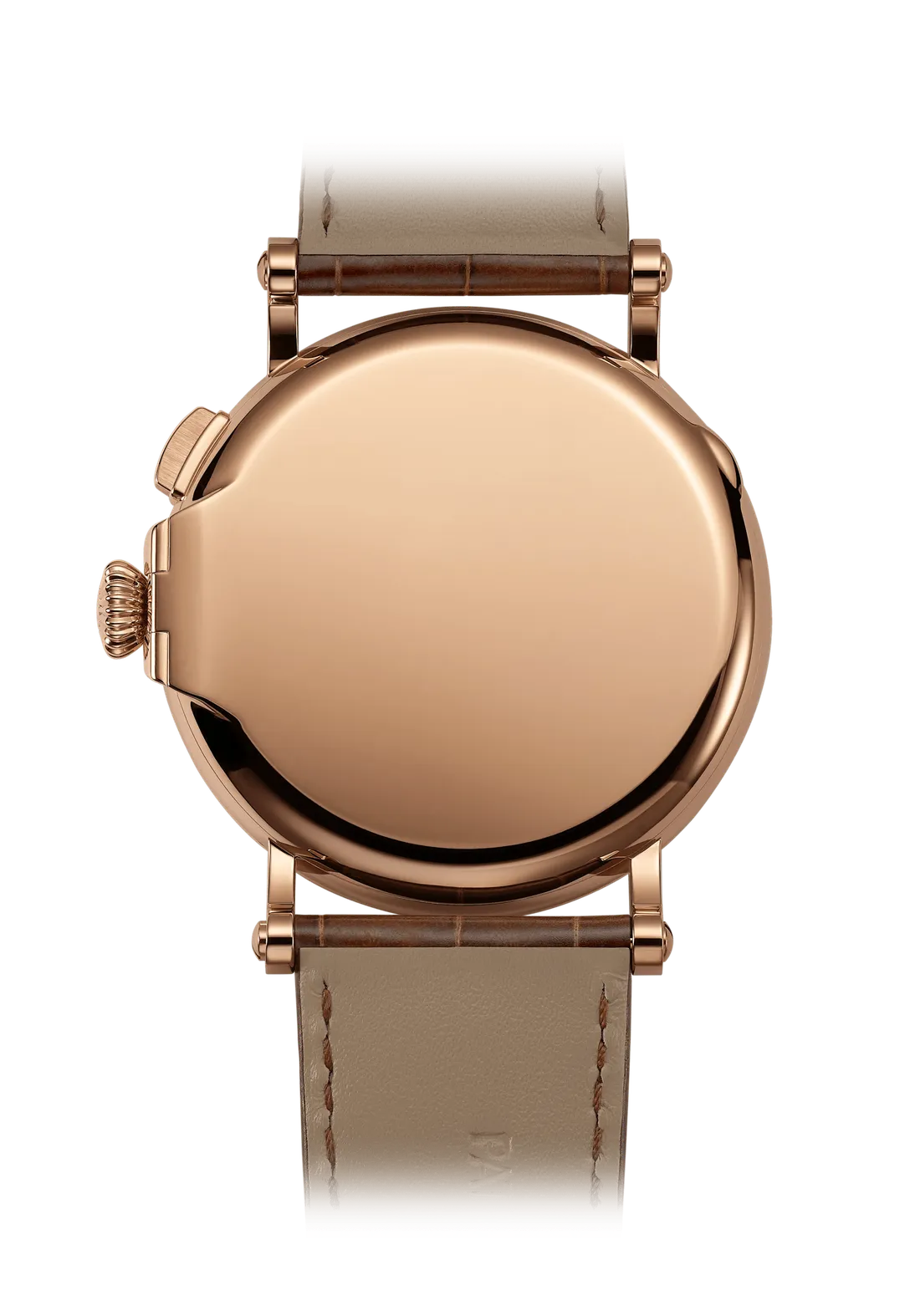
The case built to hold this scene is a fully polished rose gold Officer's style case, a design language borrowed from military pocket watches of the early twentieth century, recognizable by its short straight lugs and, on this watch, a turban shaped crown reminiscent of the Louis XV style crowns Patek Philippe has used on its dress watches for generations. The sapphire crystal caseback that lets you see the movement is protected by a hinged dust cover in solid gold, a small shutter that swings open on an invisible hinge, a detail that exists purely because pocket watches traditionally protected their movements this way and Patek Philippe chose to preserve that habit even though this piece is worn on the wrist rather than carried in a pocket. The watch is finished on a shiny chocolate brown alligator leather strap with square scales, closed by a rose gold triple blade fold over clasp that is itself a patented Patek Philippe design, its three overlapping blades distributing the strap's tension more evenly across the wrist than a simple two piece clasp would.
format_quote"An engraver spent one hundred and fifty hours on a fox smaller than a fingertip, because the story deserved nothing less."
The Engine Behind the Story
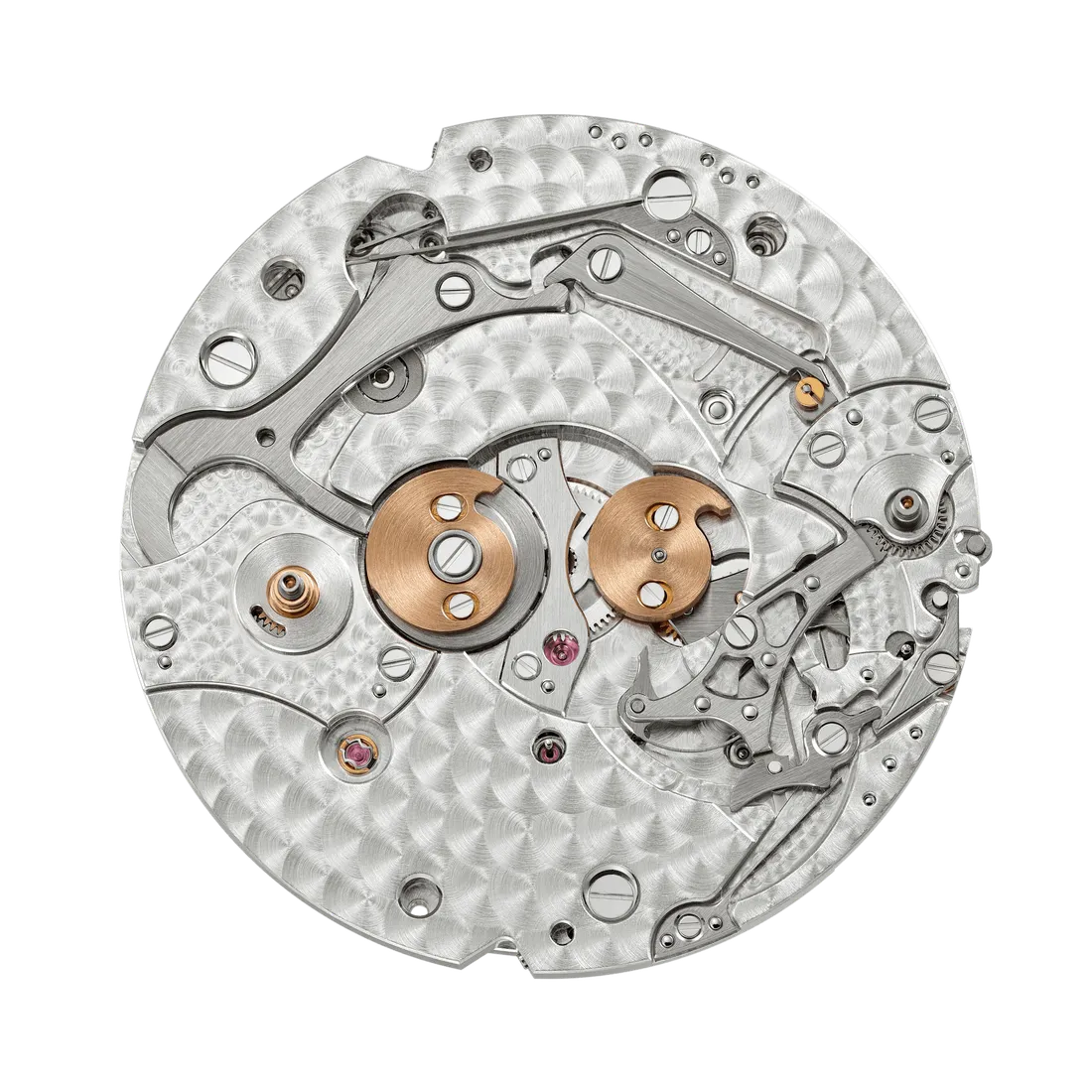
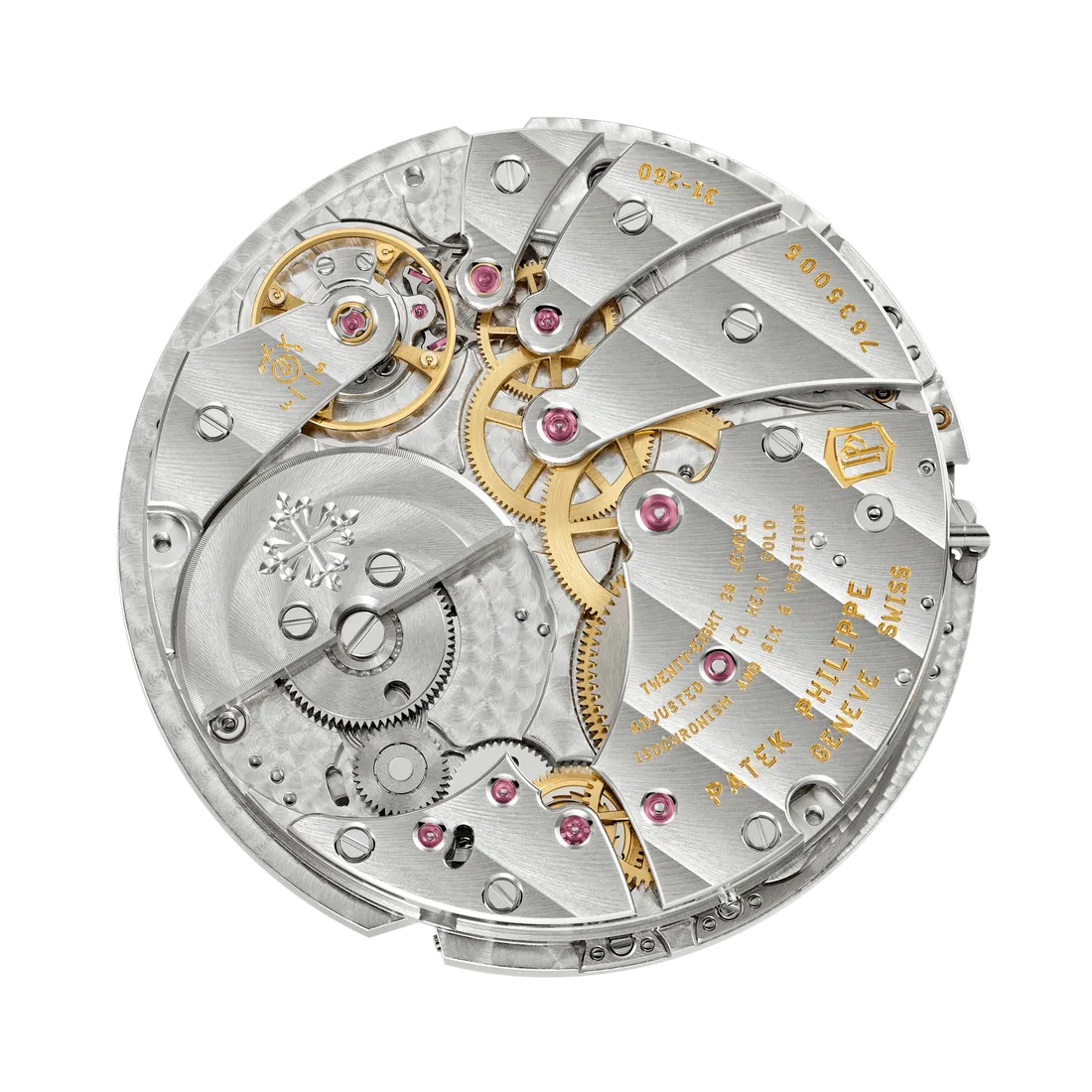
Powering all of this is the caliber 31-260 PS HMD AU, a movement built on the foundation of Patek Philippe's 260 family, an ultra thin self winding architecture that uses an off center mini rotor in platinum rather than a full sized rotor sweeping over the entire movement, which is what allows the base caliber to stay only four millimeters thick even before the automaton and retrograde modules are added on top. The finished movement, automaton mechanism included, comes to two hundred and sixty seven individual components and twenty eight jewels, regulated by a Gyromax balance paired with a Spiromax balance spring, Patek Philippe's own patented flat balance spring whose curved terminal curve helps it breathe more evenly regardless of the watch's position, beating at twenty eight thousand eight hundred half swings per hour, or four full beats every second. Fully wound, it runs for somewhere between thirty eight and forty eight hours, and the entire movement carries the Patek Philippe Seal, the manufacture's own in house quality mark applied only to movements that meet its internal standards for finishing, precision, and reliability.
Patek Philippe prices the reference 5249R-001 at three hundred sixty four thousand six hundred euros, a number that on its own tells you nothing about why this watch matters. What matters is that somewhere in a workshop in Geneva, a craftsperson spent a hundred and fifty hours engraving a fox no bigger than a fingertip, working at a thickness of two tenths of a millimeter, because sixty eight years ago a watchmaker named Louis Cottier decided a fable about vanity and flattery deserved to be told in gold, and because in 2026 Patek Philippe decided that story was worth learning to tell all over again, small enough this time to fit on a wrist, and just as charming as it always was.