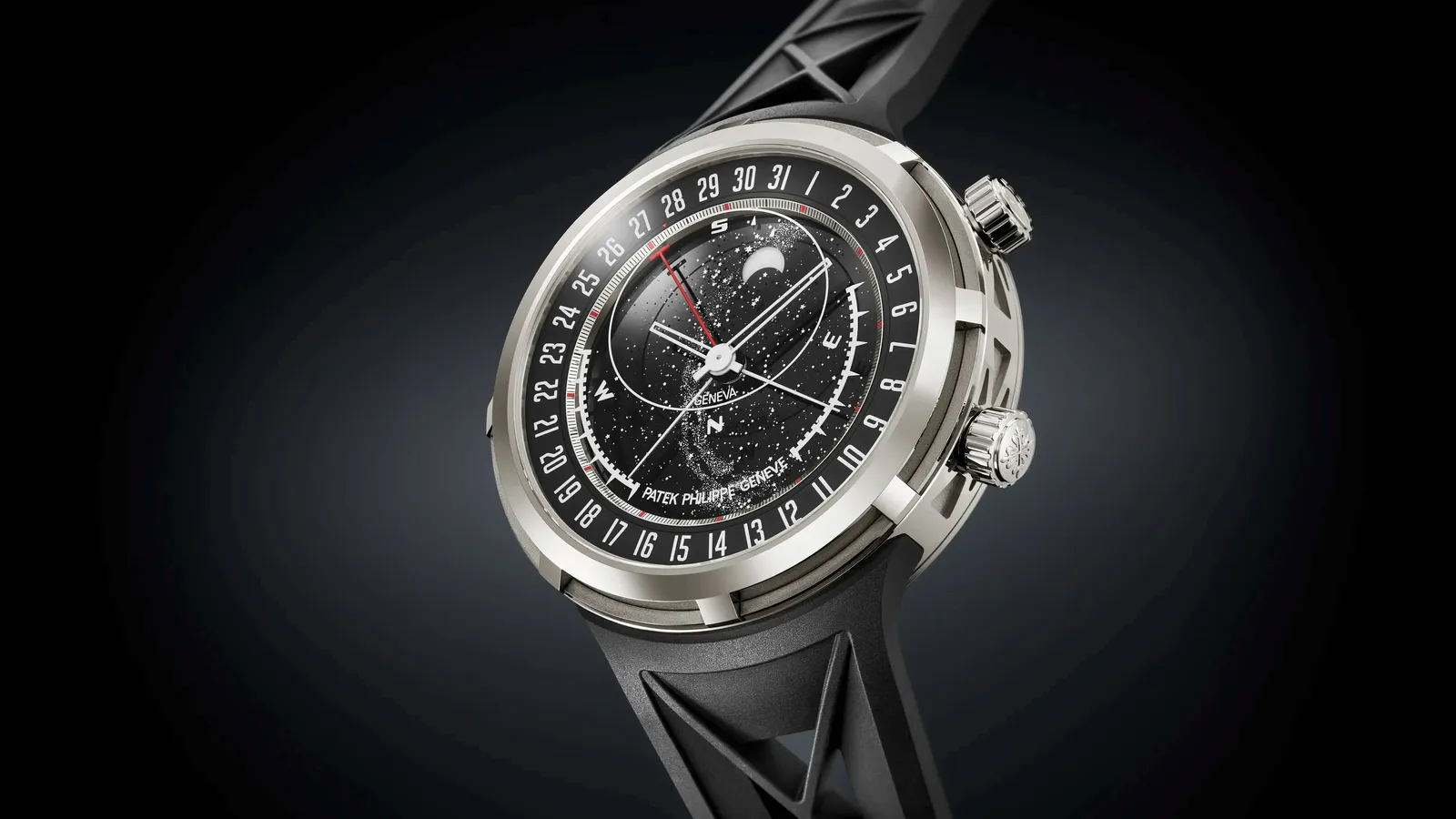
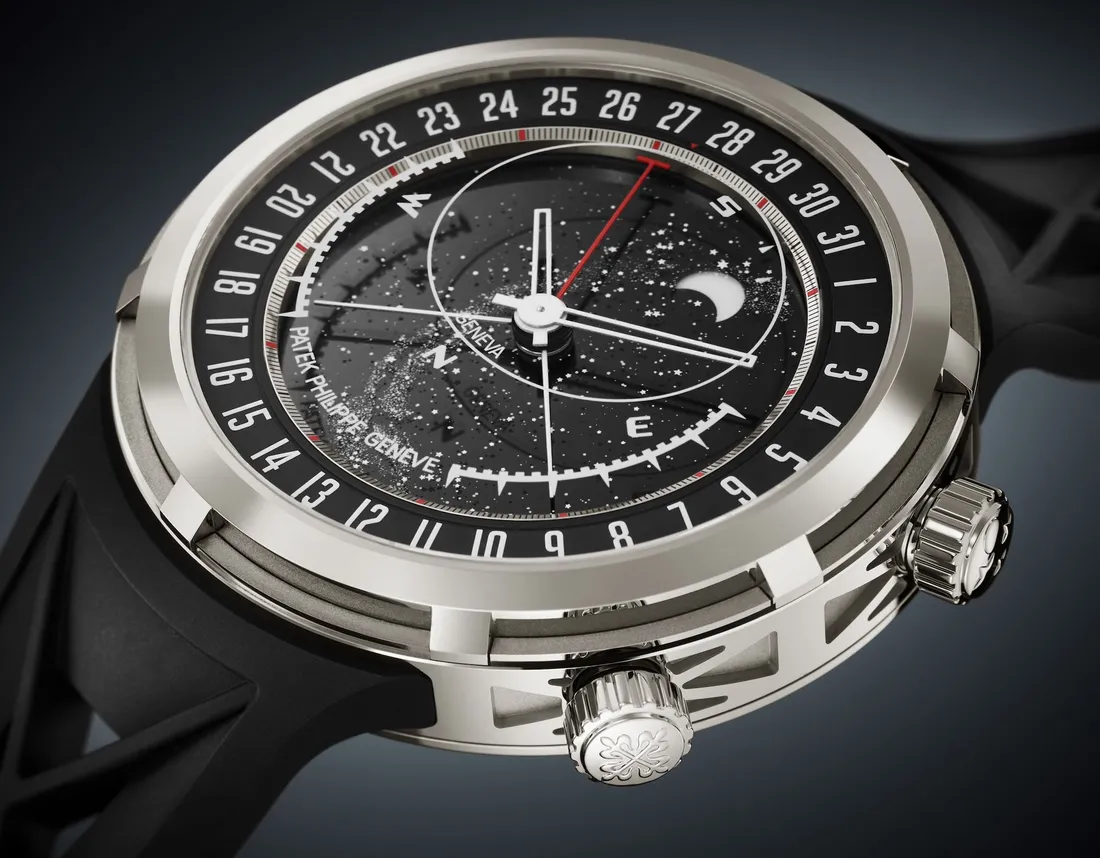
Look closely at the dial of this watch and the first thing you notice is that it is not really a dial at all. It is a window. Through a curved sapphire crystal shaped like an eye, an entire slice of the night sky drifts past: a scatter of white stars over black, a pale smear of the Milky Way curling from one edge to the other, and a small moon that waxes and wanes on its own separate, slower schedule. Above it all, a needle thin red hand and two white ones quietly keep track of the date, the sunrise, and the sunset, as if time itself were just one more small detail floating in that sky. This is the Patek Philippe Celestial Sunrise and Sunset, reference 6105G-001, and it asks a very old question in a very new way: what would it look like to wear the sky as it actually appears above one specific city on earth, updating in real time, on your wrist.
A Sky Frozen in Sapphire
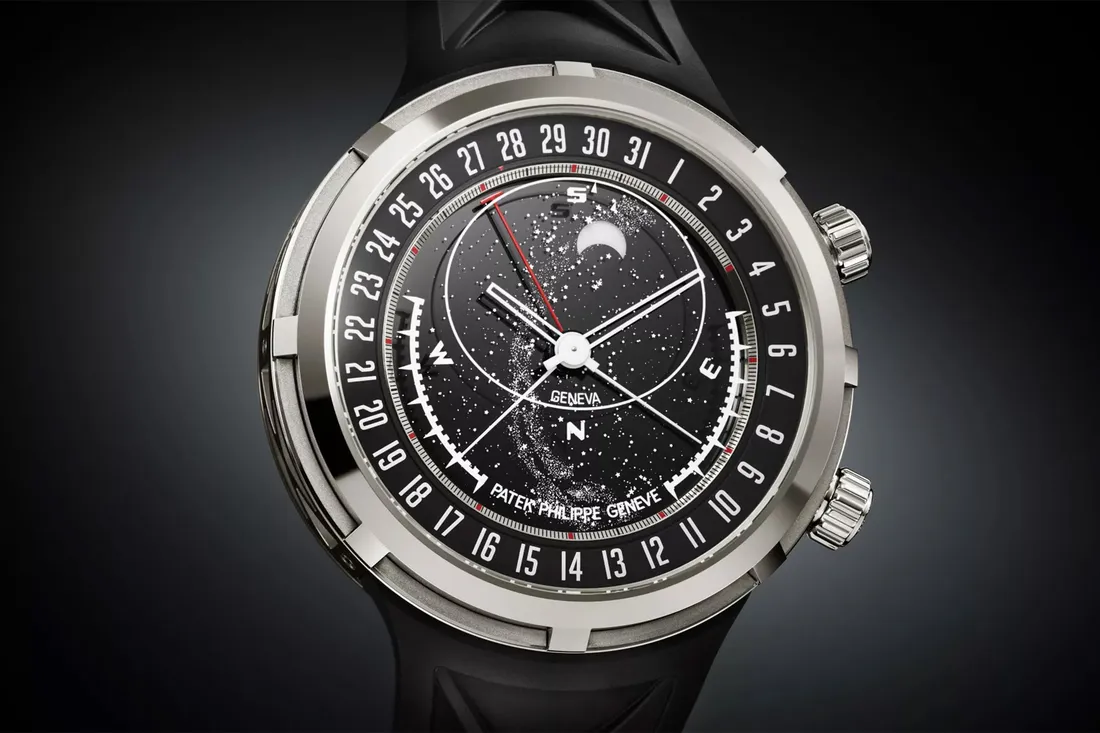
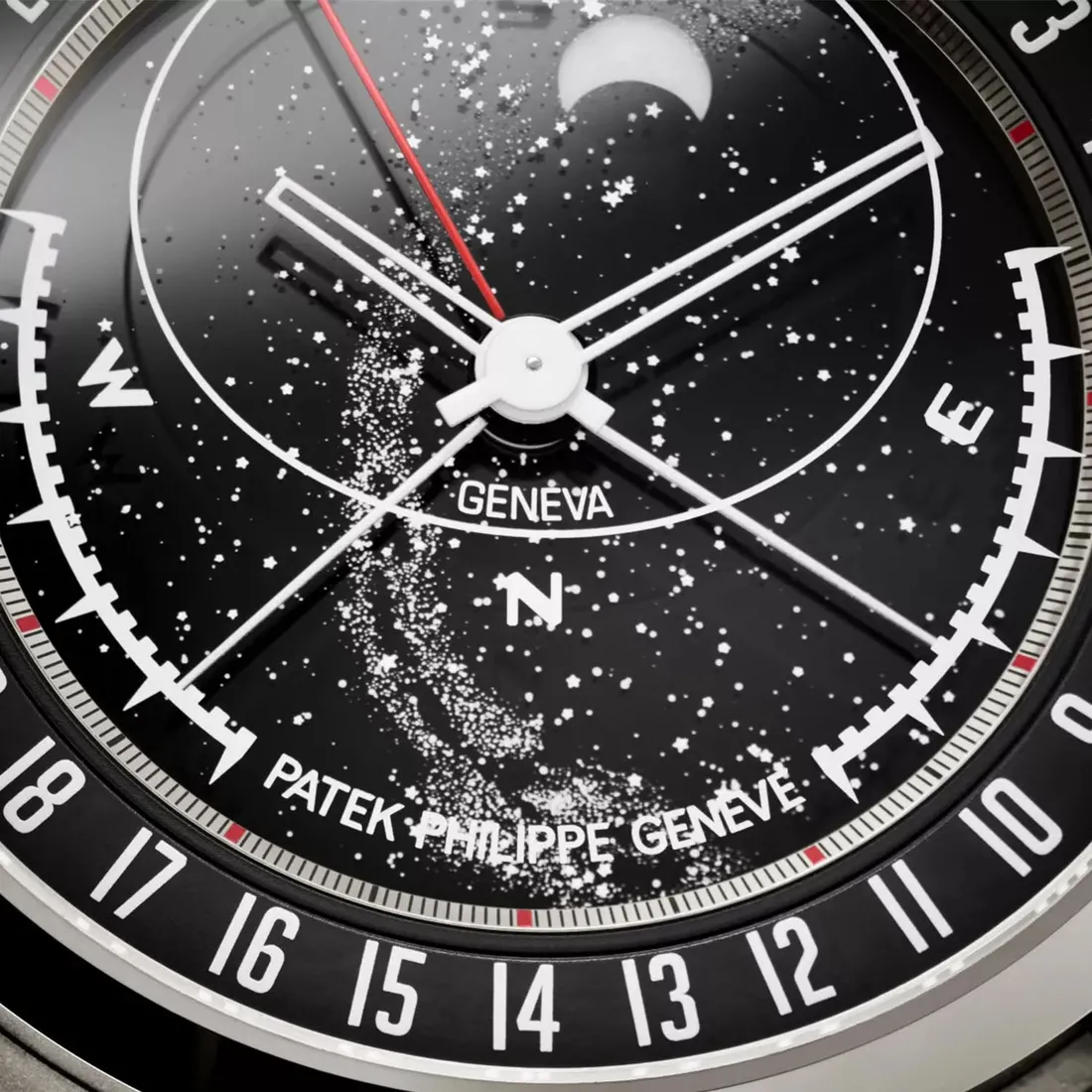
The dial is not printed, painted, or even engraved in the way most watch dials are made. It is built from stacked, independently rotating discs, each one doing a different job, layered so precisely that from the front they read as a single continuous scene. The main star chart sits on a disc of sapphire crystal, metallized so that the stars appear as tiny points of light against black, and this disc does something quietly clever: it carries the star chart on its front face and an image of the Milky Way on its back, so that looking through the front of the watch, the two images overlap and create real depth, the faint galactic band appearing to hang genuinely behind the individual stars rather than sitting flat on the same plane. This disc completes one full rotation every twenty three hours and fifty six minutes, not twenty four, because that is a sidereal day, the actual time it takes the earth to complete one rotation relative to the distant stars rather than relative to the sun, and it is calibrated specifically for the sky as seen from Geneva, the city where the watch is made. An oval aperture cut into the dial's upper half acts as a window onto this rotating scene, framing only the portion of sky that would actually be visible above the horizon at any given moment, exactly as it would look if you stepped outside and looked up.
The Moon That Waits Three Thousand Years to Be Wrong
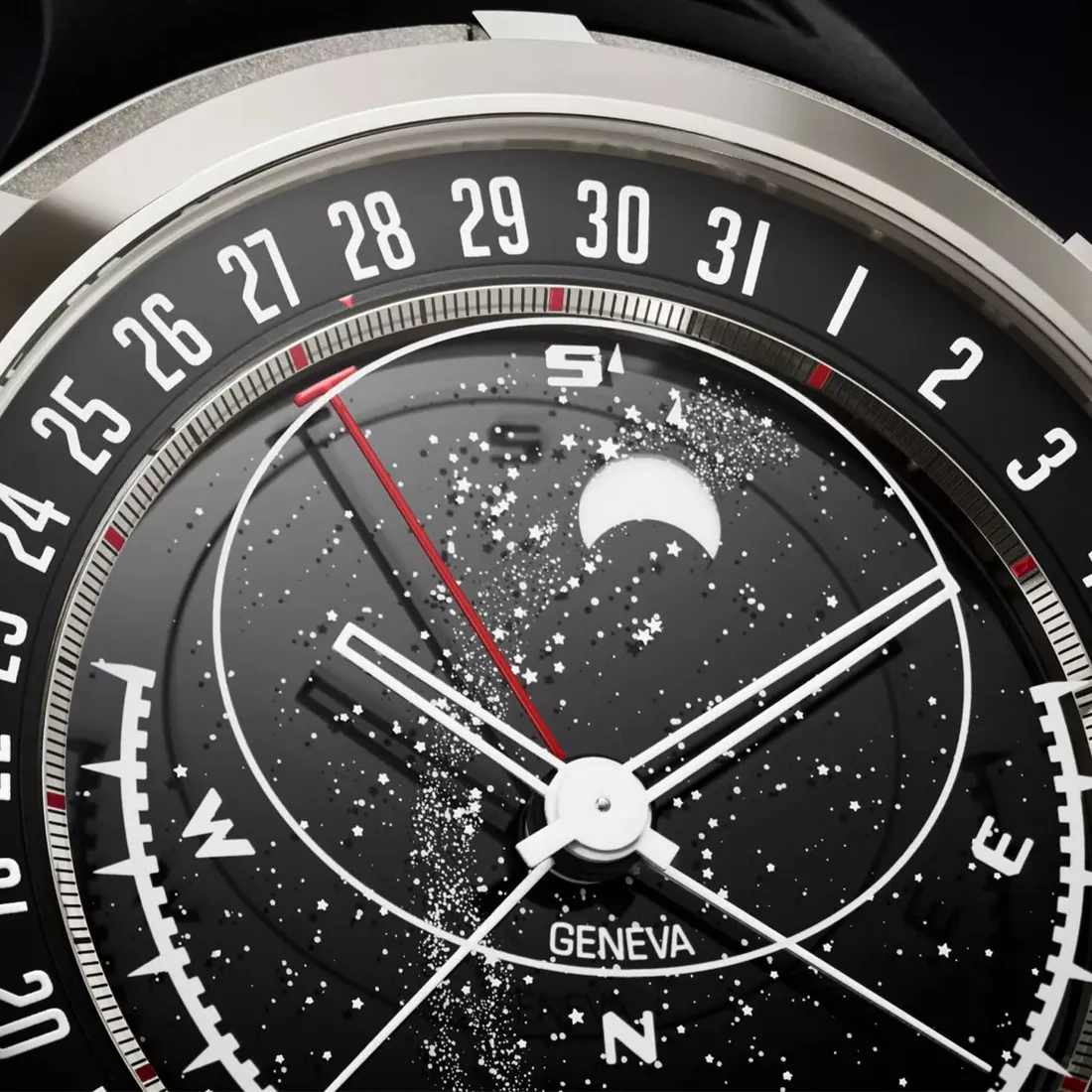
A second disc, also sapphire but coated in black on its underside, carries the moon across this sky, completing its own rotation in twenty four hours and fifty minutes, the real length of a lunar day. Cut into this disc is a round opening that reveals a third disc underneath, made of mineral crystal, painted with the classic waxing and waning moon phases, so that as the two discs turn against each other, the correct sliver or crescent or full circle of moon appears in that little window at exactly the right size and angle. The whole arrangement is precise almost beyond what the eye can appreciate: left alone, wound and running, this moon phase mechanism will drift by only a single day of error after three thousand years, a claim that turns a small rotating disc under sapphire into one of the most quietly accurate calendars ever built into a wristwatch.
Sunrise, Sunset, and the Twist in the Date Ring
Around the outer edge of the dial runs a ring of numbers that looks, at first glance, like an ordinary date scale, and it is, but it is doing three jobs at once. Look carefully and you will notice the ring is tilted so that the number one does not sit at twelve o'clock the way a conventional date display would place it, a small deliberate asymmetry that exists purely to keep the whole dial visually balanced once the sunrise and sunset indications are added. A red hand points to today's date on this ring, while two additional white hands share the exact same numbers to indicate the time of sunrise, read against the five to eleven portion of the scale, and the time of sunset, read against the seventeen to twenty three portion, an elegant piece of design thinking that lets one printed scale serve three separate purposes instead of needing three separate scales crowding the dial. Underneath, driving the white sunrise and sunset hands, sit a pair of egg shaped cams, one for sunrise and one for sunset, each completing exactly one rotation per year as the length of Geneva's days grows and shrinks with the seasons. A patented double feeler reads the changing edge of each cam and translates it into the position of the hand above, and the way that feeler moves is the real engineering novelty here: instead of a conventional pivoting lever, Patek Philippe built what is called a compliant mechanism, a single monolithic component, precise enough that it was very likely produced using LIGA, a lithography based micro fabrication technique, that replaces several separately hinged parts with two linear racks guided by flexible springs only forty eight hundredths of a millimeter wide. Because there are no separate pivots or joints to wear, bind, or need lubrication, the whole assembly moves with less play and more repeatable precision than a traditional linkage ever could, and Patek Philippe believes it may be the first mechanism of its kind used anywhere in watchmaking.
format_quote"No pivots, no joints, nothing to wear out: Patek Philippe may have just built watchmaking's first flexible mechanism."
Solving Daylight Saving Time
Every watch that shows sunrise and sunset times has historically shared the same small, permanent flaw: those times shift by an hour every spring and autumn as clocks move for daylight saving time, and no amount of mechanical cleverness in the sunrise and sunset display itself can fix that, because the cams underneath keep tracking solar time regardless of what the clocks on the wall are doing. The reference 6105G-001 solves this with two correctors set into the side of the case. Press one at the change to summer time and three things happen simultaneously: the hour hand jumps forward by one hour, the date ring rotates by one thirty first of a full turn, and the red date hand rotates by exactly the same amount to keep pointing at the correct day. Because the sunrise and sunset hands are read against that same date ring rather than being directly linked to the time display, they do not move at all during this correction, they simply end up pointing at the correct new hour because the ring beneath them has shifted instead. Press the second corrector at the change back to winter time and the entire sequence runs in reverse. A small locking system prevents either corrector from being pressed twice by mistake, protecting the display from being thrown out of sync by an accidental double press.
A Case Built Like a Space Module
Everything described so far sits inside a case that looks like almost nothing else Patek Philippe has ever made. It is white gold, forty seven millimeters across, and has no lugs at all, the black composite strap running directly into the case middle in a single continuous line. The case band, the strap, and the solid caseback are all decorated with a repeating X shaped relief pattern that Patek Philippe describes as inspired by the trusses and structural framework of spacecraft and satellites, an aesthetic decision reportedly championed personally by the manufacture's president, and one that gives this piece a distinctly futuristic character next to the rest of the Patek Philippe catalogue. Two crowns manage the watch: the lower one at four o'clock winds the movement and sets ordinary time, while the upper one at two o'clock, protected by a bayonet style lock that must be pressed down and twisted before it can be pulled out, adjusts the star chart in one direction of rotation and the moon phase in the other. Because there is no exhibition window on this particular watch, the caseback is left solid, engraved instead with the same X pattern radiating outward from a Calatrava cross at its center, Patek Philippe's own heraldic emblem, continuing the case's visual language onto a surface most owners will rarely see but the maker clearly still wanted to make beautiful.
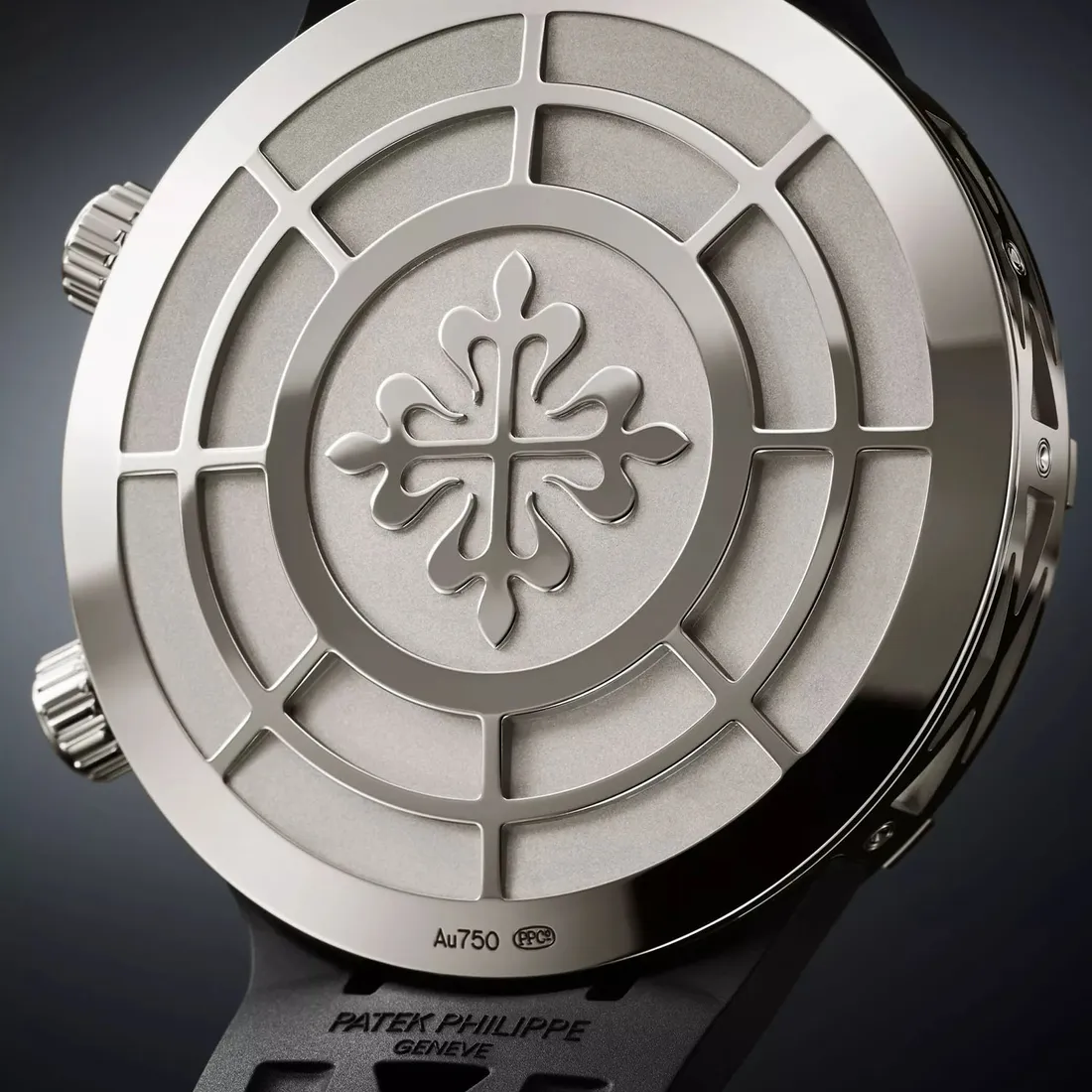
format_quote"Take away the dial and this could pass for a piece of a satellite: Patek Philippe built a spacecraft you can wind."
Fifty Years of Miniaturization
The astronomical display sitting on top of all this is driven by caliber 240 C LU CL LCSO, built on a movement architecture, the caliber 240, that Patek Philippe first introduced decades ago and has continued refining ever since, recognizable by its off center micro rotor in twenty two karat gold, a design that lets the movement wind itself without needing a full sized rotor sweeping over the entire mechanism. On its own, that base movement is only three and a half millimeters thick, a genuinely tiny foundation, and the entire celestial and sunrise and sunset module bolted on top of it, despite its four hundred and twenty six individual parts and fifty one jewels, brings the complete assembly to only seven point nine three millimeters, remarkable given everything it has to track at once. The whole mechanism carries the Patek Philippe Seal and beats at twenty one thousand six hundred vibrations per hour, or three beats every second, and Patek Philippe states that developing this particular combination of complications took more than five years and resulted in six separate patent filings. This watch is also not a first attempt at any of this. Its lineage traces back to the Star Caliber 2000, a vast and extraordinarily expensive astronomical pocket watch, which lent its miniaturized planisphere mechanism to the back of the Sky Moon Tourbillon wristwatch in 2001. A year later, Patek Philippe extracted that same star chart display and moved it to the front of a new, more accessible model, the original Celestial, reference 5102, of 2002, updated in 2012 as the reference 6102 with the addition of a simple date display. The reference 6105G-001 is the third generation of that idea, and the first to add sunrise, sunset, and a real answer to daylight saving time, wrapped in a case unlike anything the manufacture has built before.
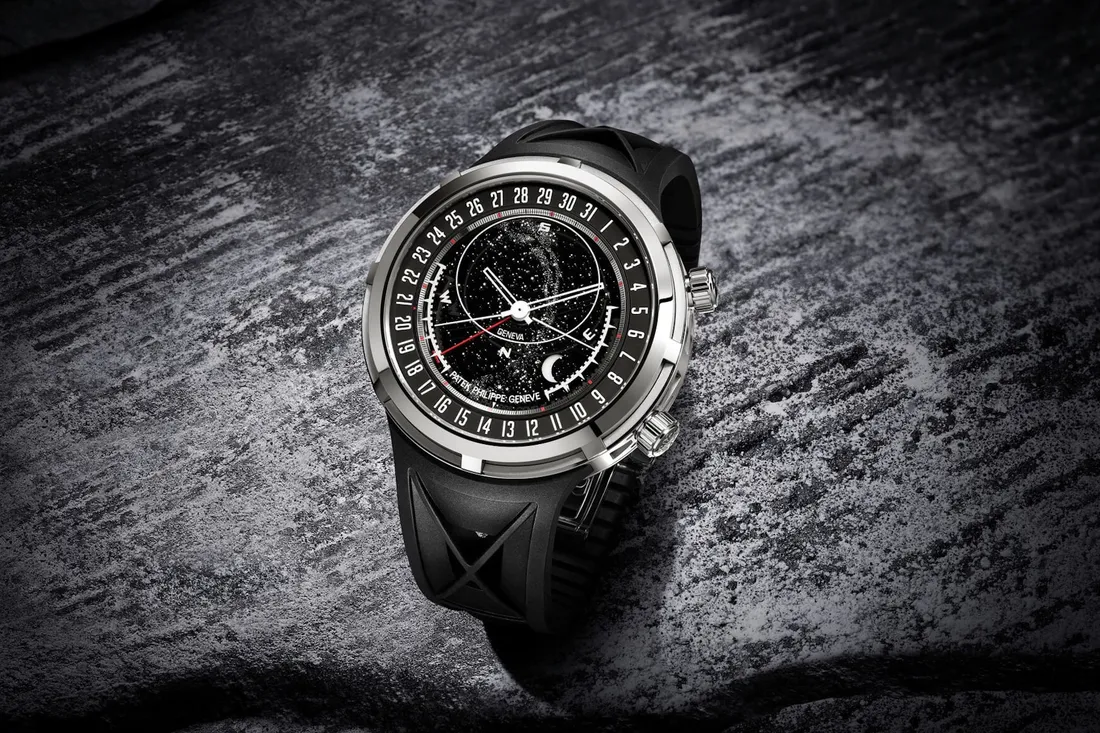
Patek Philippe prices the reference 6105G-001 at three hundred ninety eight thousand eight hundred euros, and whatever one makes of that number, it buys something genuinely rare: a watch that does not simply tell you what time it is, but shows you, continuously and mechanically, what the sky above one particular city looks like at this exact moment, where the sun will rise and set today, how old the moon is, and how many days remain until the current month runs out, all of it correct to within a day after three thousand years, all of it compressed into a case less than eight millimeters thick. Look at the dial long enough and the line between telling time and looking at the heavens starts to disappear entirely, which, for a complication with roots running back to pocket watches built for astronomers and industrialists a century ago, feels like exactly the point.