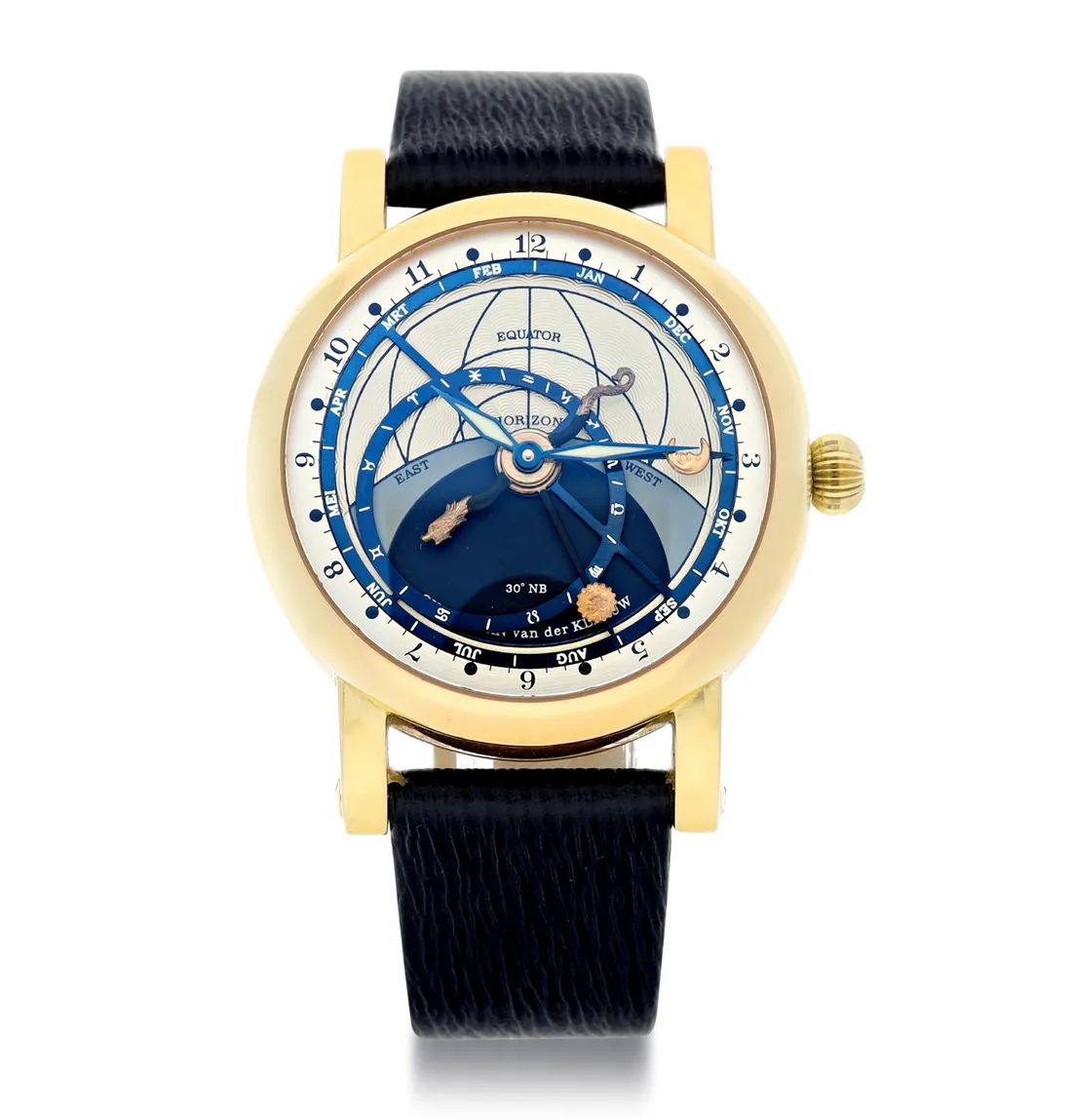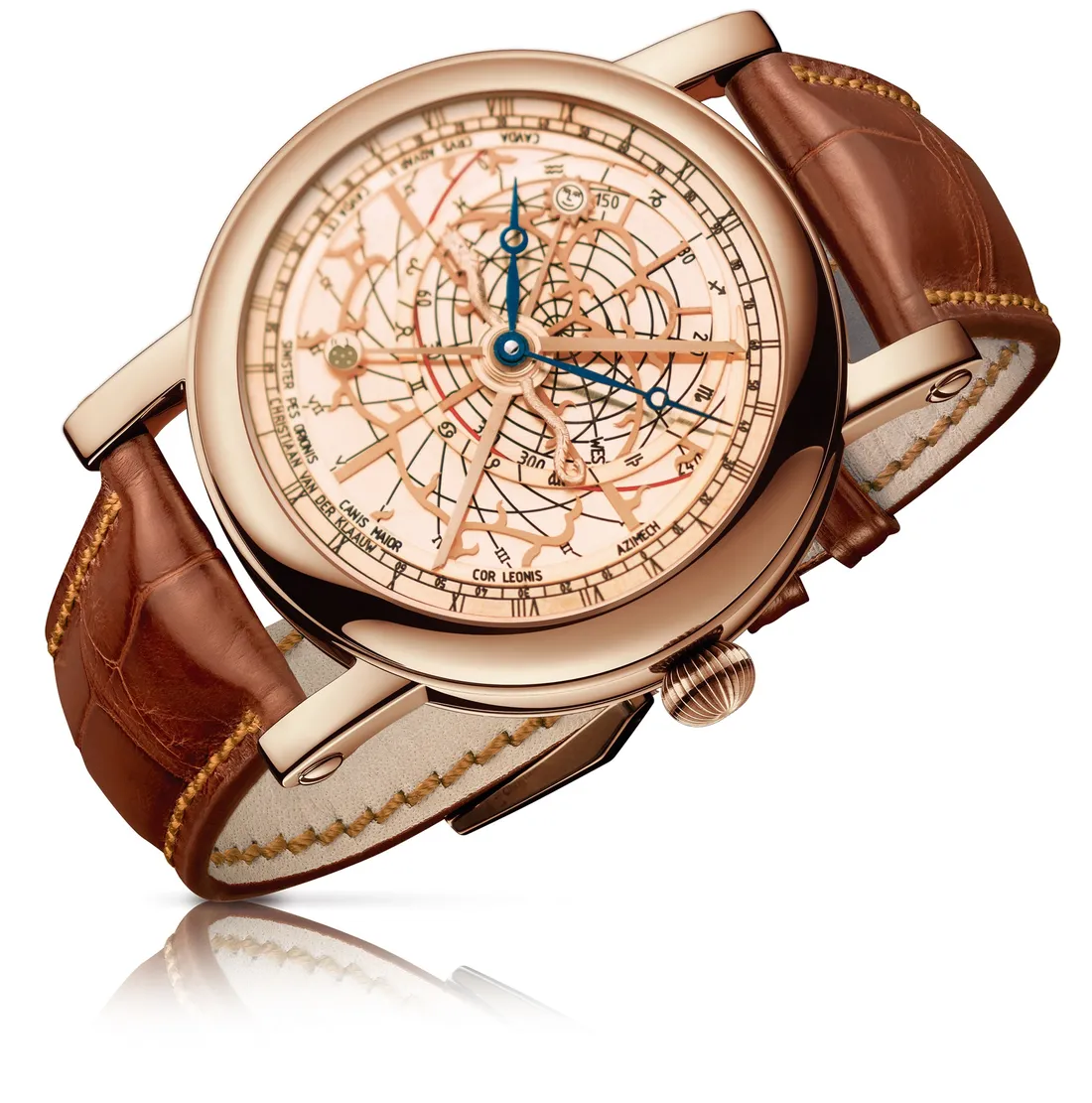
To look at the dial of a watch and see there not only the hour and the minute but the whole geometry of the sky. That passion is the short version of the adventure to which Christiaan van der Klaauw, born in Leiden, a city kneaded out of the history of science, devoted his life.
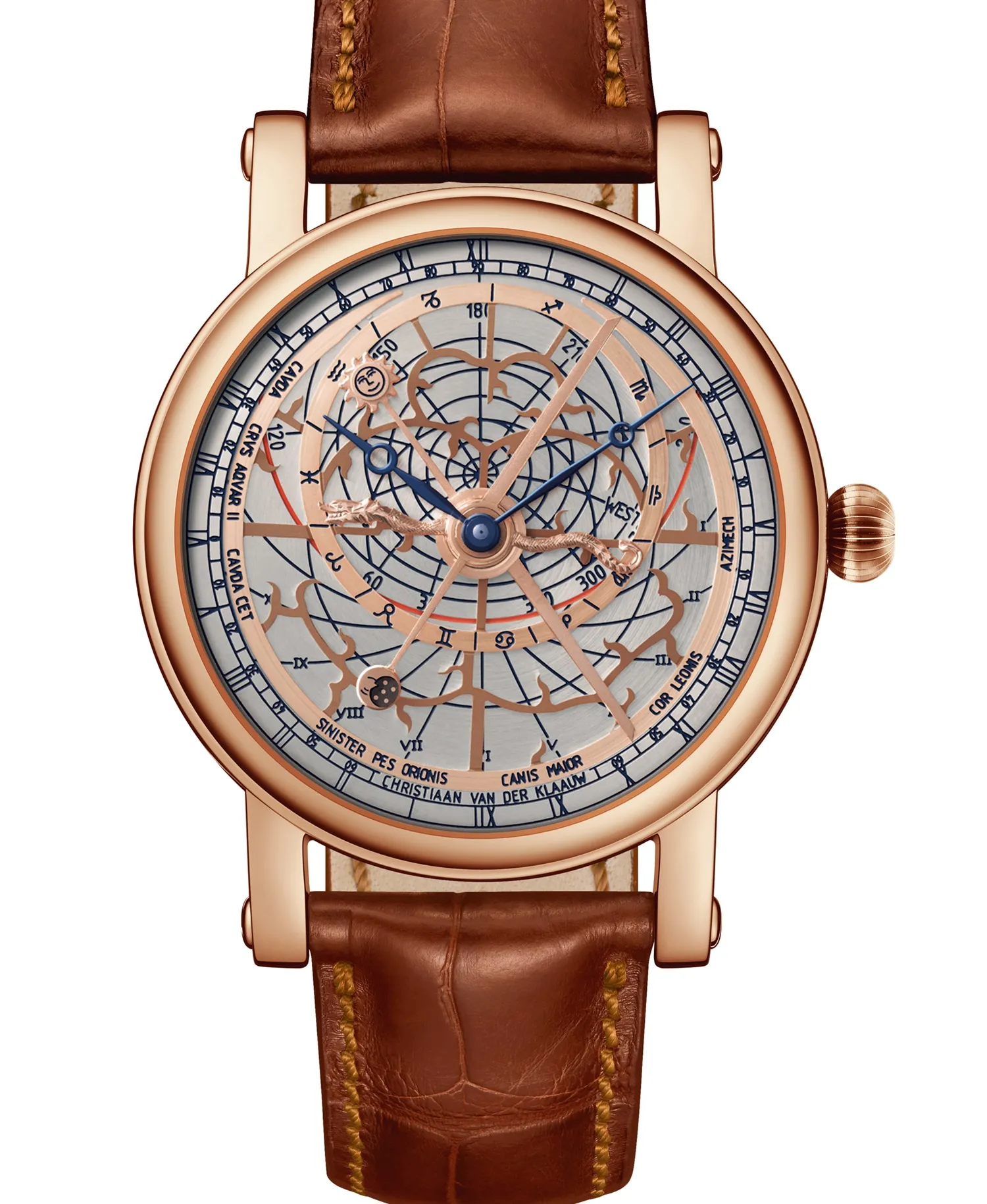
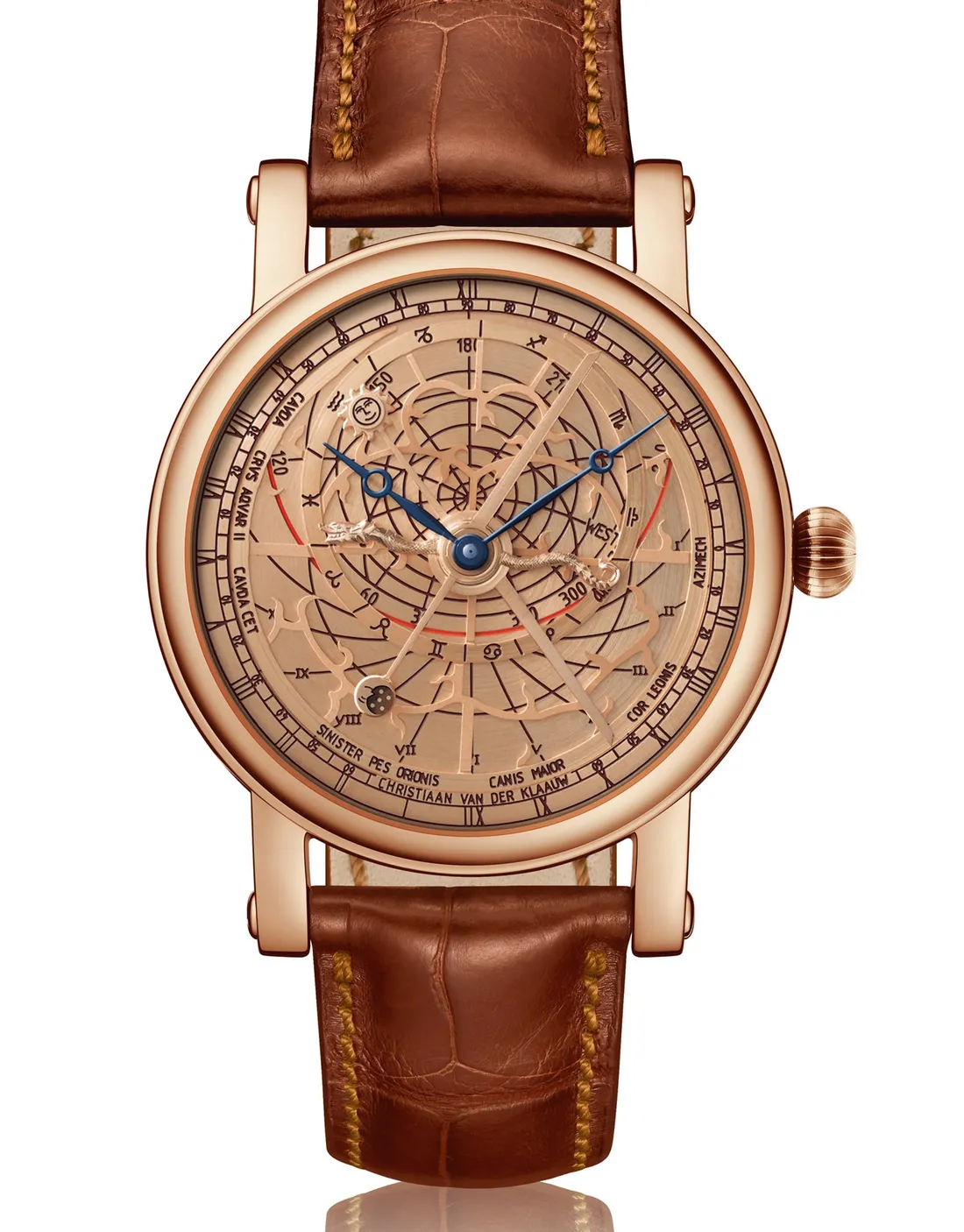
The piece in front of us is the top model of the brand's Collection of Astronomical Masterpieces: a forty millimetre rose gold case, sapphire crystal front and back, blued steel hands, the self-winding calibre CVDK1198 and, seated on top of it, an astrolabe module developed entirely in the atelier's own workshop. There are two dial versions: a rose gold dial in the CKAL1115, a silver coloured dial in the CKAL1125, both with black indexes.
And a single line separates this watch from every other astronomical complication: the piece was made separately for eighteen different degrees of latitude. Which is to say the dial of this watch knows where on earth you are standing.
A Craftsman Under a Blue Light: Who Is Christiaan van der Klaauw?
Many people assume he is an astrophysicist. In fact Christiaan van der Klaauw is not a schooled theoretical physicist; he is a brilliant maker of astronomical instruments and clocks, a graduate of the legendary Leiden School for Instrument Makers (Leidse Instrumentmakersschool, founded 1901).
It is not hard to see why Leiden was the right city for this. Christiaan Huygens, who put the pendulum into the service of time, studied here; Heike Kamerlingh Onnes, who liquefied helium and took matter to the threshold of absolute zero, was a professor here. And in the middle of the city stands the Leidse Sterrewacht, founded in 1633, the oldest university observatory still standing.
That is exactly where the young van der Klaauw earned his practice. Alongside his training as an instrument maker he worked at that observatory; inside a workshop busy with telescope cradles, mount mechanics and fine adjustment devices, he learned what it means to measure the sky from the bench rather than from paper.
In 1974 he moved to the Frisian village of Joure and founded his own atelier; that same year he showed his first clock with astronomical complications. In 1989 he was made an honorary member of the Swiss academy of independent creators, the AHCI, joining a list that holds names like George Daniels and François-Paul Journe. Between 1994 and 1996 he built his first wristwatch, the Satellite du Monde, which showed the place on earth where it was exactly noon at the moment you looked. In 2009 he stepped back, handing the atelier to the designer couple Daniël and Maria Reintjes. The workshop moved from Joure to Heerenveen and from there to its present home, Het Arsenaal in Naarden.
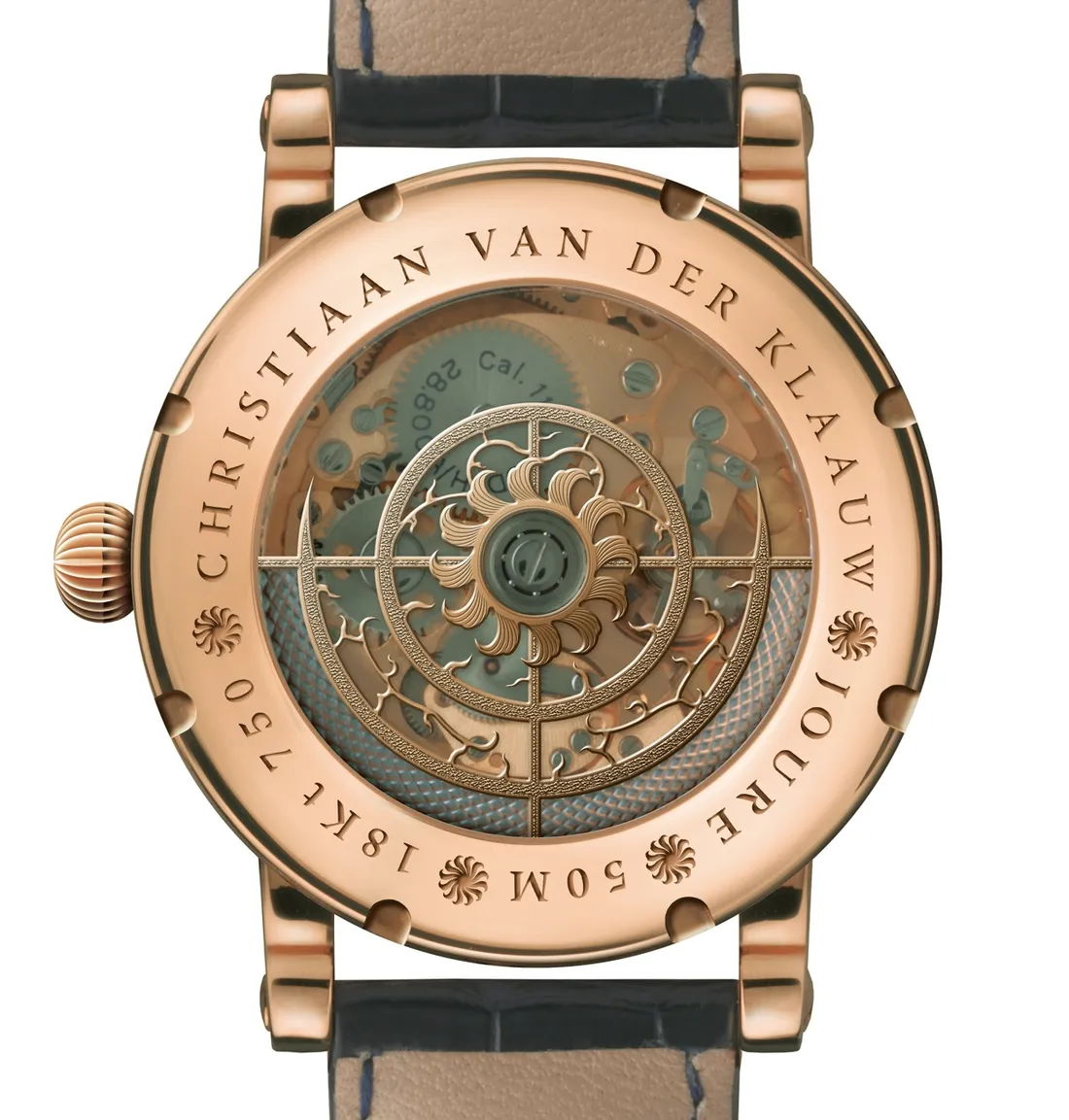
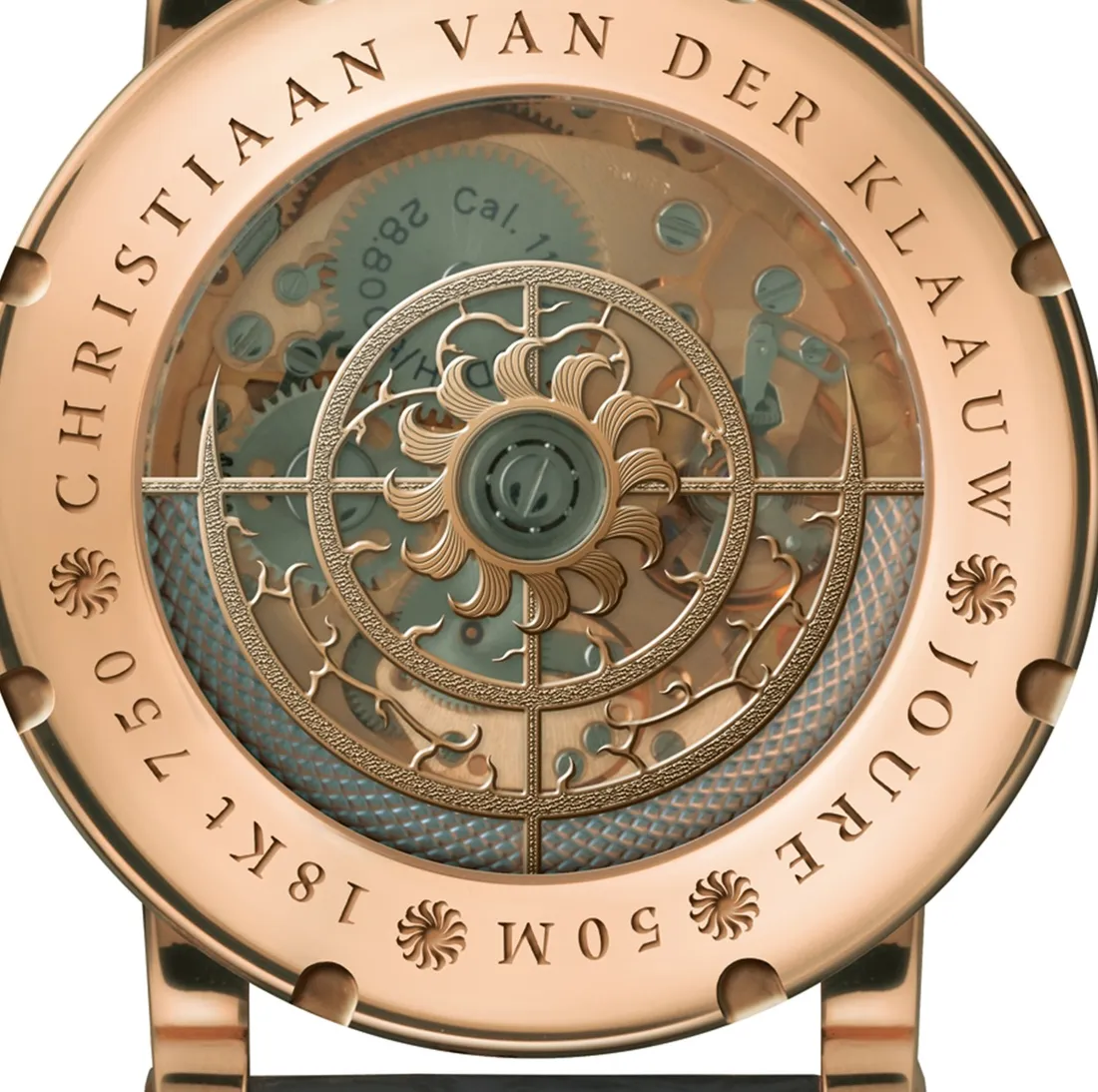
Turn this watch over and one word is still legible on the flank of the case: JOURE. Beside it, 18Kt 750 and 50M. The piece carries the name of the village where it was born.
format_quote"One word is still legible on the flank of this caseback: JOURE. The piece carries the name of the village where it was born."
A Sky Built Into a Ceiling: Eise Eisinga
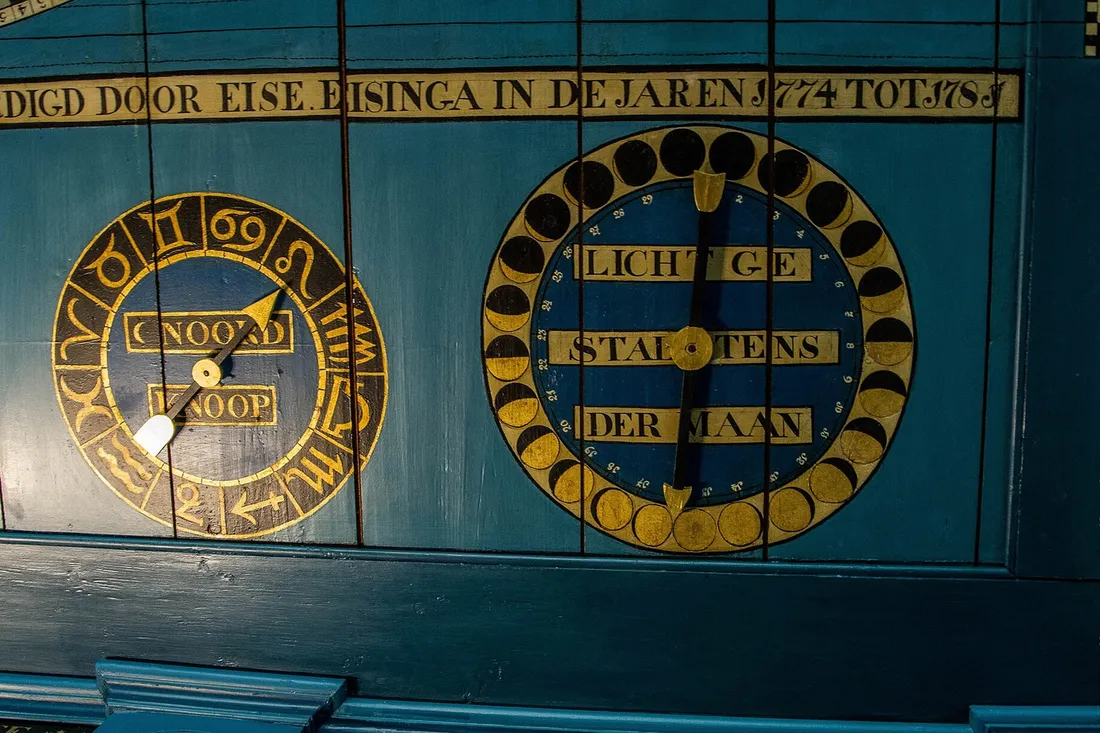
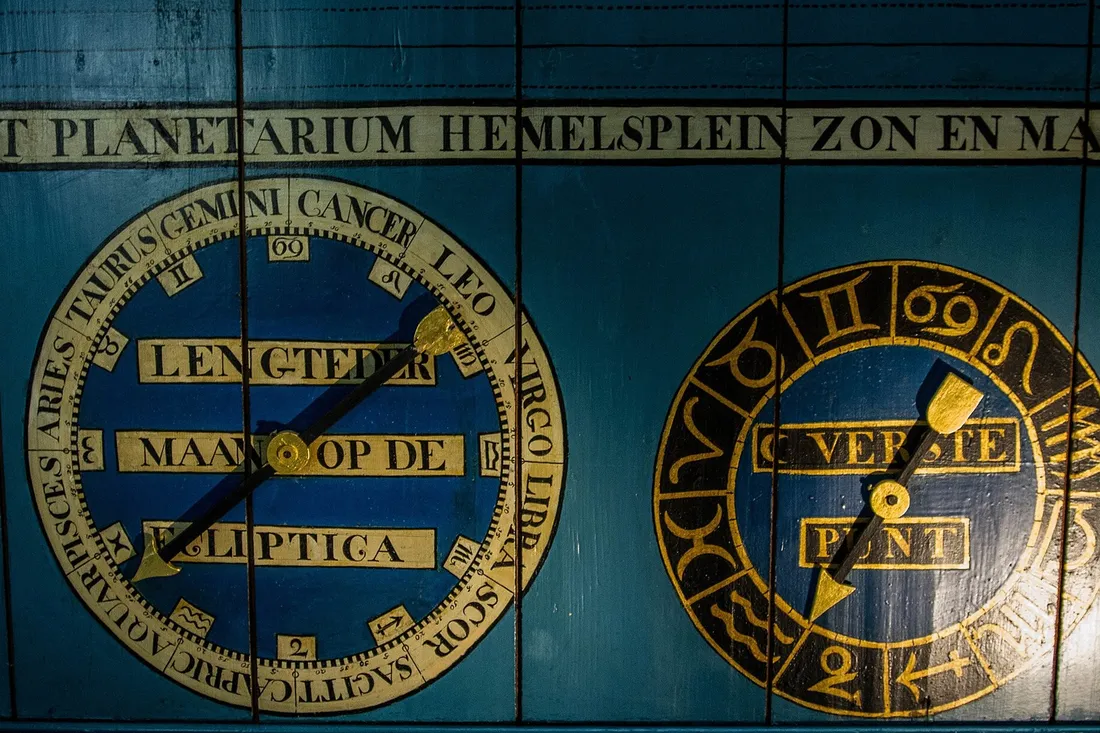
Van der Klaauw's source of inspiration is Eise Eisinga, who lived in the eighteenth century in the Frisian town of Franeker. Eisinga was not an astronomer; his trade was wool combing. He taught himself mathematics and, between 1774 and 1781, over seven years, built a working planetarium into the ceiling of his own living room.
On that ceiling the Sun, Mercury, Venus, Earth, Mars, Jupiter and Saturn move at their real orbital speeds. A pendulum-driven mechanism hidden in the dark space between the boards, nine thousand hand-driven nails and wooden gears carry that motion. The thing has not stopped for two and a half centuries; it stands in the same room today as the oldest working planetarium in the world.
Why Eisinga built it is part of the story too. In May 1774, when four planets and the Moon gathered in the sky, a preacher wrote that the earth would be knocked out of place, and fear spread through the town. Eisinga's answer was not an argument but a machine: the sky is not random, it holds a calculable order; here, I am building it into your ceiling, look for yourself.
The young clockmaker who saw that room set himself a single goal: to take this celestial order, which for centuries had only ever fitted onto walls, ceilings and tables, into a case that would fit on a human wrist. When he founded his atelier in 1974, exactly two hundred years had passed since Eisinga began.

So Where Did the Craftsman Get This Astronomy?
A legend needs correcting here. Van der Klaauw did not sit down alone and invent this mathematics from nothing; but, contrary to the usual assumption, none of these calculations was secret either. The geometry of the astrolabe and the periods of the Moon and the Sun have been written down in printed literature for at least five hundred years. The craftsman's job was not to find that knowledge but to convert it into a count of teeth.
It resembles a division of labour we know from cinema. When Christopher Nolan shot Interstellar, he worked with the equations of the Nobel laureate astrophysicist Kip Thorne in order to produce the image of a black hole correctly; Thorne gave the physics, the team turned it into a picture. Astronomical watchmaking has a similar handover: astronomy supplies the orbital periods, and the craftsman converts those periods into tooth counts, shaft ratios and discs worked to the micron.
Van der Klaauw's real equipment, though, was the instrument making that came from the school and the observatory. A maker of astronomical instruments already has to work with latitude, the obliquity of the ecliptic and celestial coordinates while building the mount of a telescope. Which is to say this watch did not appear because a watchmaker grew curious about astronomy; it appeared because a maker of astronomical instruments started making watches. The order is reversed, and that is the difference.
format_quote"This watch did not appear because a watchmaker grew curious about astronomy; it appeared because a maker of astronomical instruments started making watches."
The Computer of the Middle Ages: How Was an Astrolabe Used?
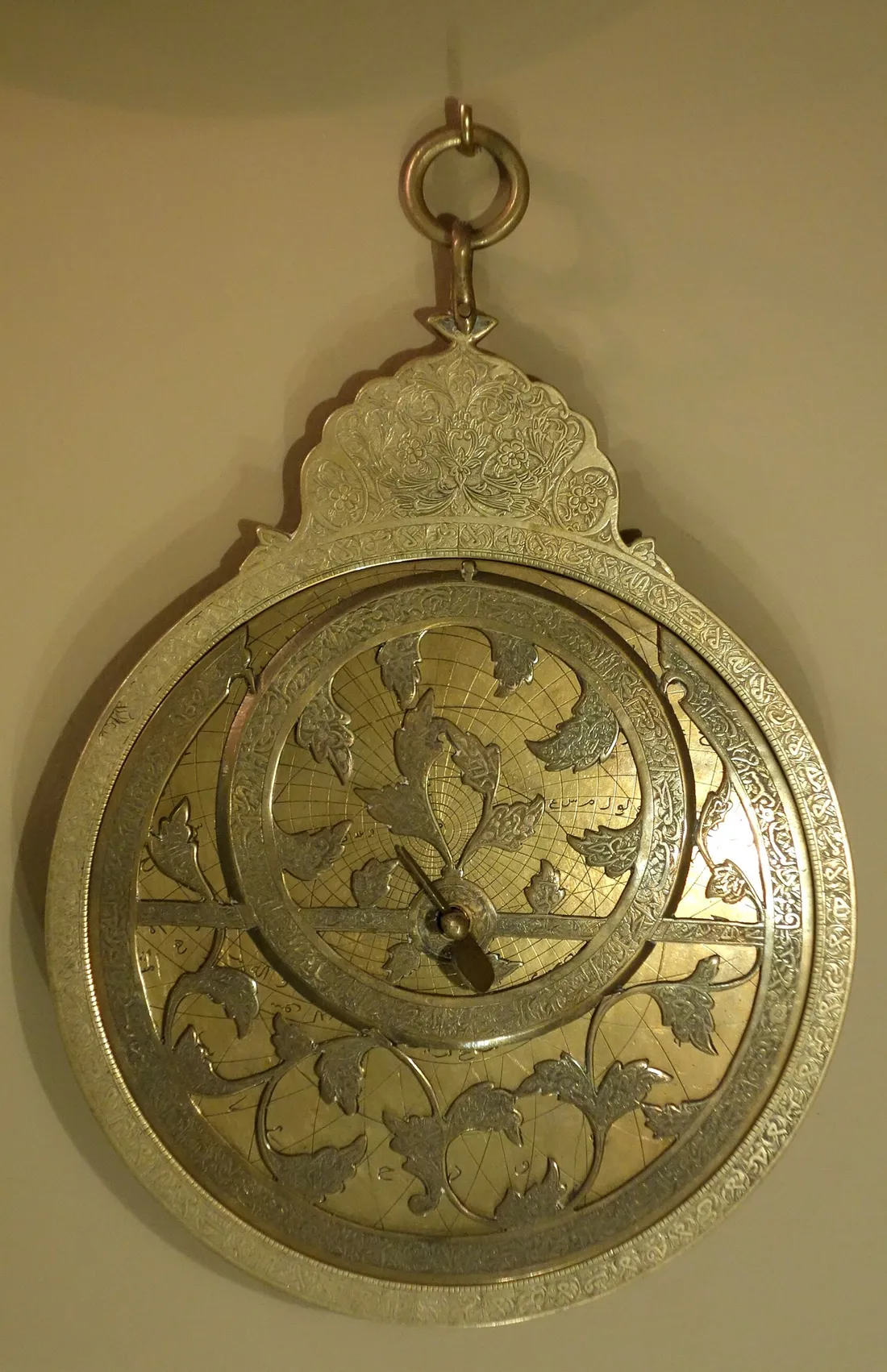
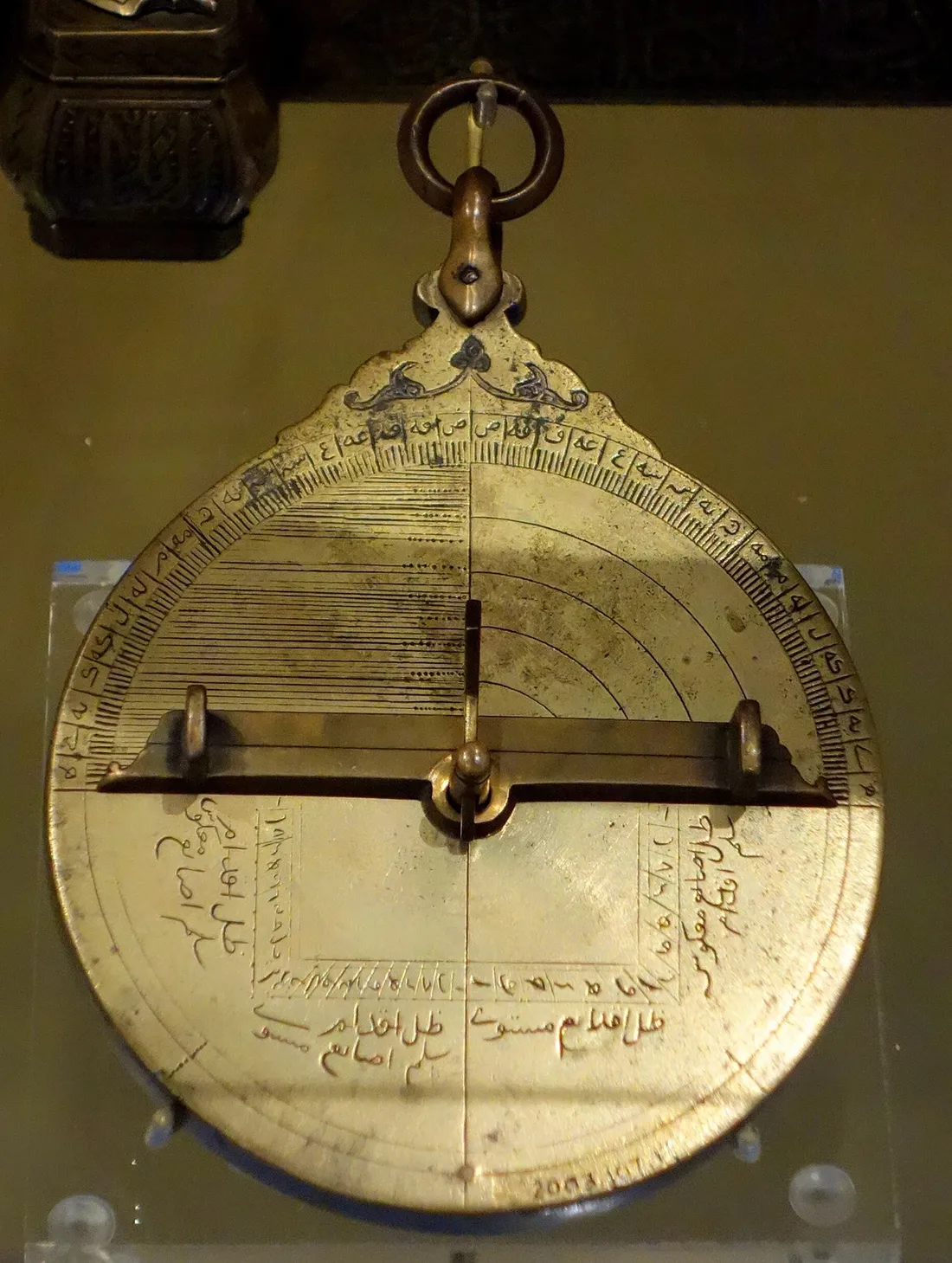
The instrument Christiaan van der Klaauw carried onto a wristwatch is the planispheric astrolabe. Its history, as the brand's own archive also underlines, runs longer than two thousand years: the man who set down its principles in writing was Ptolemy. The instrument reached its real maturity in the Islamic world; there it was developed, its measuring precision raised, and new functions such as the qibla and the prayer times added to it. It entered Europe through Spain in the twelfth century and remained the most important instrument of astronomy until the middle of the seventeenth century, which is to say for more than five hundred years.
An astrolabe has three main parts. At the bottom sits a fixed plate drawn for your latitude: on it are the horizon, the circles of altitude (the almucantars) and the azimuth lines. Above it turns a pierced net that carries the bright stars on its points along with the ring of the ecliptic: this is called the rete, the spider's web. On the back are a scale of degrees and a pierced rotating rule for sighting a star, the alidade.
Now let us see with two concrete examples how vital, and how difficult, this work was.
Example 1: Finding the Hour at Midnight
Suppose you are in the year 1350. It is a pitch black night and you are in the middle of the desert. You have no wristwatch and no other indicator. How do you find out what time it is?
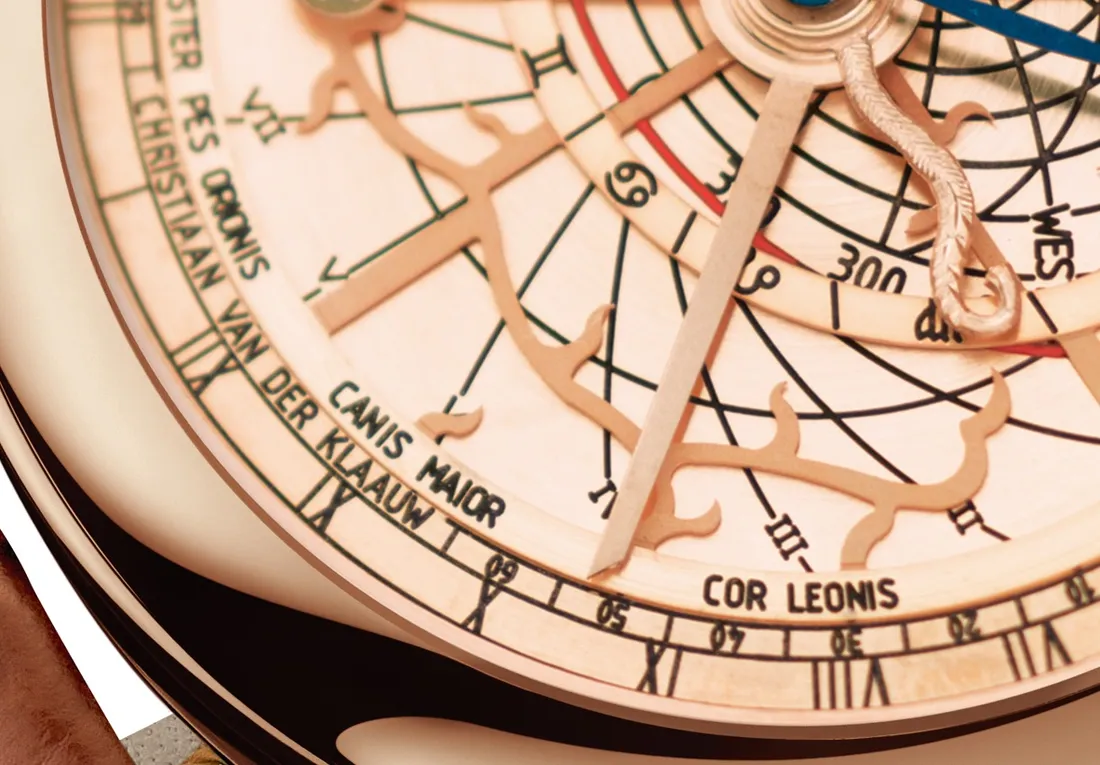
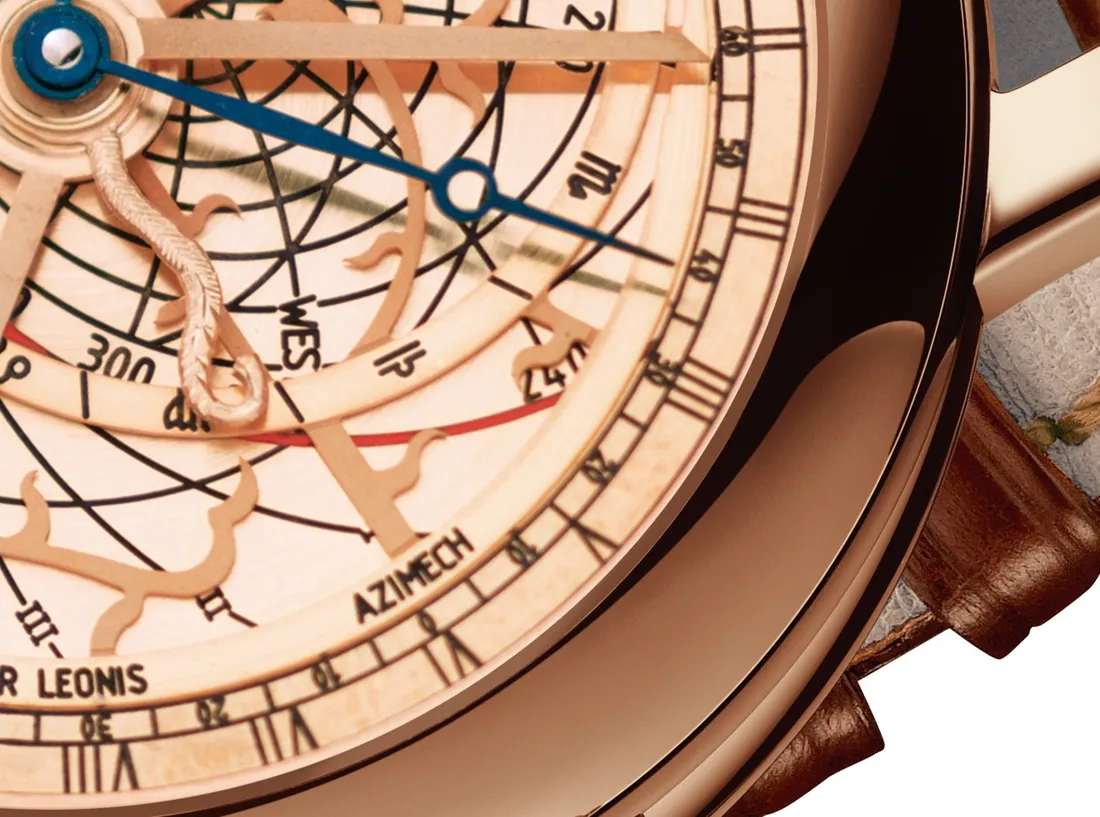
First you choose a star. There is a point to watch here: the star you choose has to rise during the night. Polaris is precisely the star that cannot be used for this, because it stands right beside the axis on which the sky turns and its altitude barely changes all night. Polaris tells you your place, not your hour. So the person with the astrolabe picks one of the stars whose names are written on the rete: Azimech in Virgo, say, or Cor Leonis, the heart of the lion.
Then you hang the instrument from its ring on your finger; gravity holds it vertical by itself. You aim the alidade on the back at the star you chose. The moment you see the star lined up through the holes at both ends of the rule, you read the star's altitude above the horizon from the scale at the edge. Thirty five degrees, say.
Now you turn the instrument over and rotate the net until that star on the rete sits on the thirty five degree altitude circle of the plate. With that single movement you have set the whole sky into its true position at that moment. You look at the Sun's point for that day on the ecliptic ring of the rete and read the hour scale at the edge from there. Say the Sun's marker stands below the horizon line and about sixty degrees below the west; that means roughly four hours have passed since sunset. If the Sun set at six that season, the hour is ten at night.
Notice this: nowhere did you calculate anything. You measured an angle, turned a disc and read a line. All the trigonometry was already there, engraved onto the plate as lines. That is why an astrolabe is not a table but genuinely a calculating machine.
format_quote"All the trigonometry was already there, engraved onto the plate as lines. That is why an astrolabe is not a table but genuinely a calculating machine."
Example 2: Finding Your Latitude in Mid Ocean
You are a ship's captain in the fourteen hundreds. You have been fighting the swell for days and you have lost the land. How will you know where you are?
Here too a correction is needed. The instrument used on ships was not the astrolabe with rete and plates described above; that was the astronomer's instrument and it was far too delicate to be of any use on the deck of a rolling boat. Sailors used its simplified brother: the mariner's astrolabe. A heavy brass ring cut open in the middle and a single alidade, and that is all. There is little surface for the wind to catch, and it reacts less to the pitching of the boat.
What the captain knows is simple: Polaris stands on the extension of the earth's axis of rotation. At the equator it is right on the horizon line, which is zero degrees. At the north pole it is directly overhead, ninety degrees. And everywhere in between, the star's altitude above the horizon is directly equal to your latitude.
The captain hangs the ring, sights the alidade on Polaris and reads: thirty six degrees. The ship is on the thirty sixth northern parallel. Without going ashore, without receiving any position information at all, he has found his place on earth with a brass ring.
There is one more detail, and the sailors of the period knew it very well: Polaris is not exactly over the true pole. Today it is about two thirds of a degree away from it; in the fourteen hundreds it was about three and a half degrees away. So the raw measurement swung by as much as seven degrees. Sailors solved this with a table of corrections applied according to the position at that moment of the two stars of the Great Bear closest to the pole, the guards. Which is to say the first number read off the sky was never the final number; it also had to be corrected.
Without Formulas: What Is Stereographic Projection?
When we think about the sky we live inside a vast three dimensional sphere. The dial of a wristwatch, however, is a flat two dimensional surface. How do you fit a three dimensional celestial sphere onto a two dimensional dial without spoiling its angles and its shapes?
Let us tell it with the glass sphere and lamp analogy we can picture in our own heads.
Imagine a vast sphere of transparent glass. Suppose we have drawn on its surface every bright star in the sky, the ecliptic and the constellations. Now let us put a tiny, very bright lamp at the very lowest point of the sphere, at the south pole. And at the top of the sphere, at the north pole, let us lay a flat white sheet of paper so that it touches tangentially. When the lamp below is lit, the shadow of every three dimensional star and line on the glass falls onto that flat paper at the top.
This method has two miracles. The first: every circle on the celestial sphere stays a circle on the paper as well. It does not deform into an ellipse or an egg. That is why the horizon, the altitude circles and the azimuth lines can be drawn on the dial with a compass; it is what makes an astrolabe plate something that can be engraved by hand. The second: the method preserves angles. The angle two lines make in the sky stays the same on the paper. Distances stretch and shrink, but the angles do not lie, and every reading on an astrolabe is a reading of angles anyway.
The price is this: area is not preserved. Everything grows as you move away from the centre, and the southern side of the sky swells rapidly. That is why on classical astrolabes the drawing is usually cut off at the tropic of Capricorn; anything further south will not fit on the paper. Christiaan van der Klaauw placed exactly this projection, the one that falls onto the paper, inside a forty millimetre dial as layers worked to the micron.
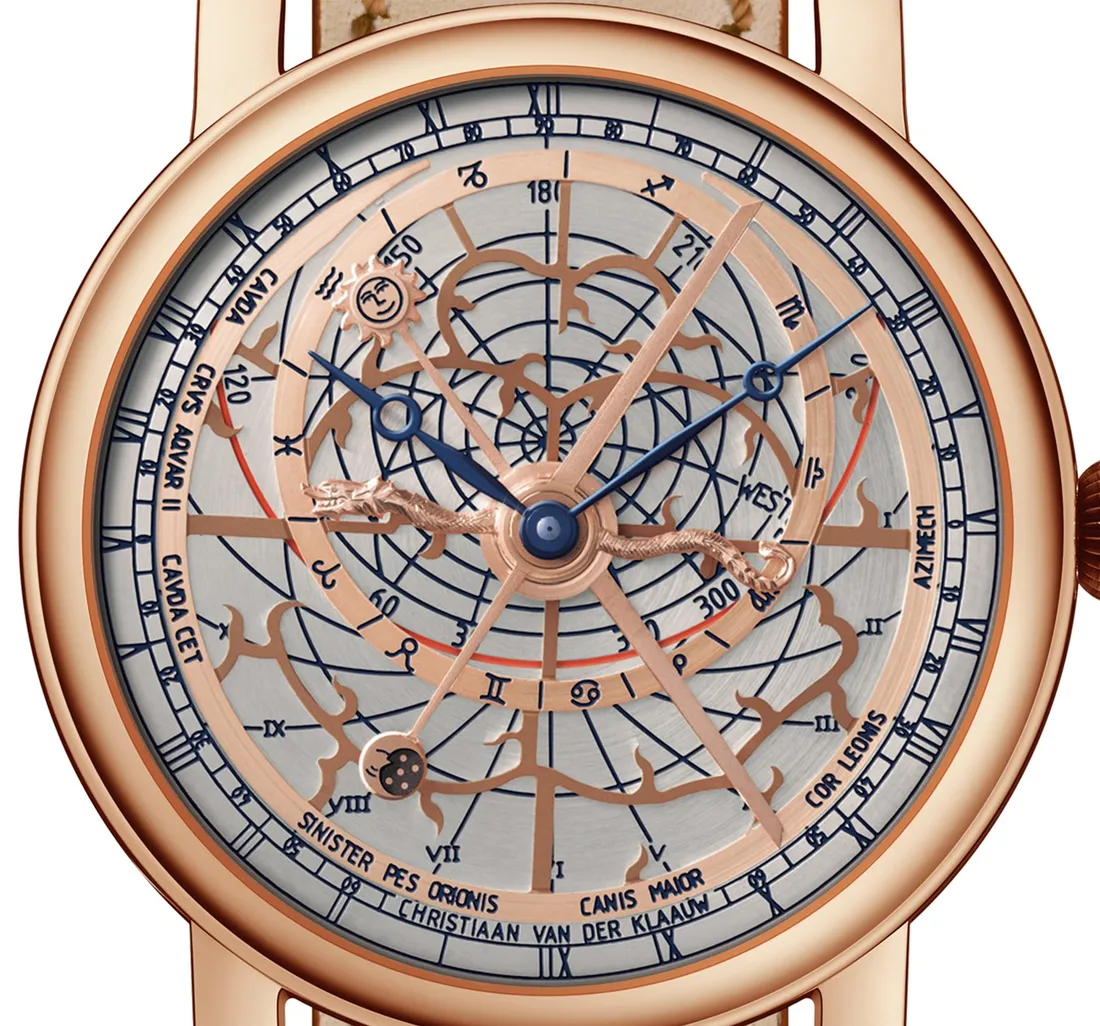
The Secret Language of the Dial: Horizon, Ecliptic and Dragon
When you look at the dial of the Astrolabium, every line that appears complicated has a very concrete counterpart in nature. Let us take them in order.
A. The Curved Line: Horizon and Latitude
That curved line in the middle of the dial is the horizon line. That is, the endless line where the sky meets the earth when you set your eye at sea level.
This line is not straight but curved, and the measure of its curve depends on the geographic latitude for which the watch was set. Istanbul stands on the forty first northern parallel, Amsterdam on the fifty second; the two see the sky from different angles, so their horizon curves differ as well. At the equator the horizon is an almost symmetrical circle; the closer you get to the pole, the further it slides to one side.
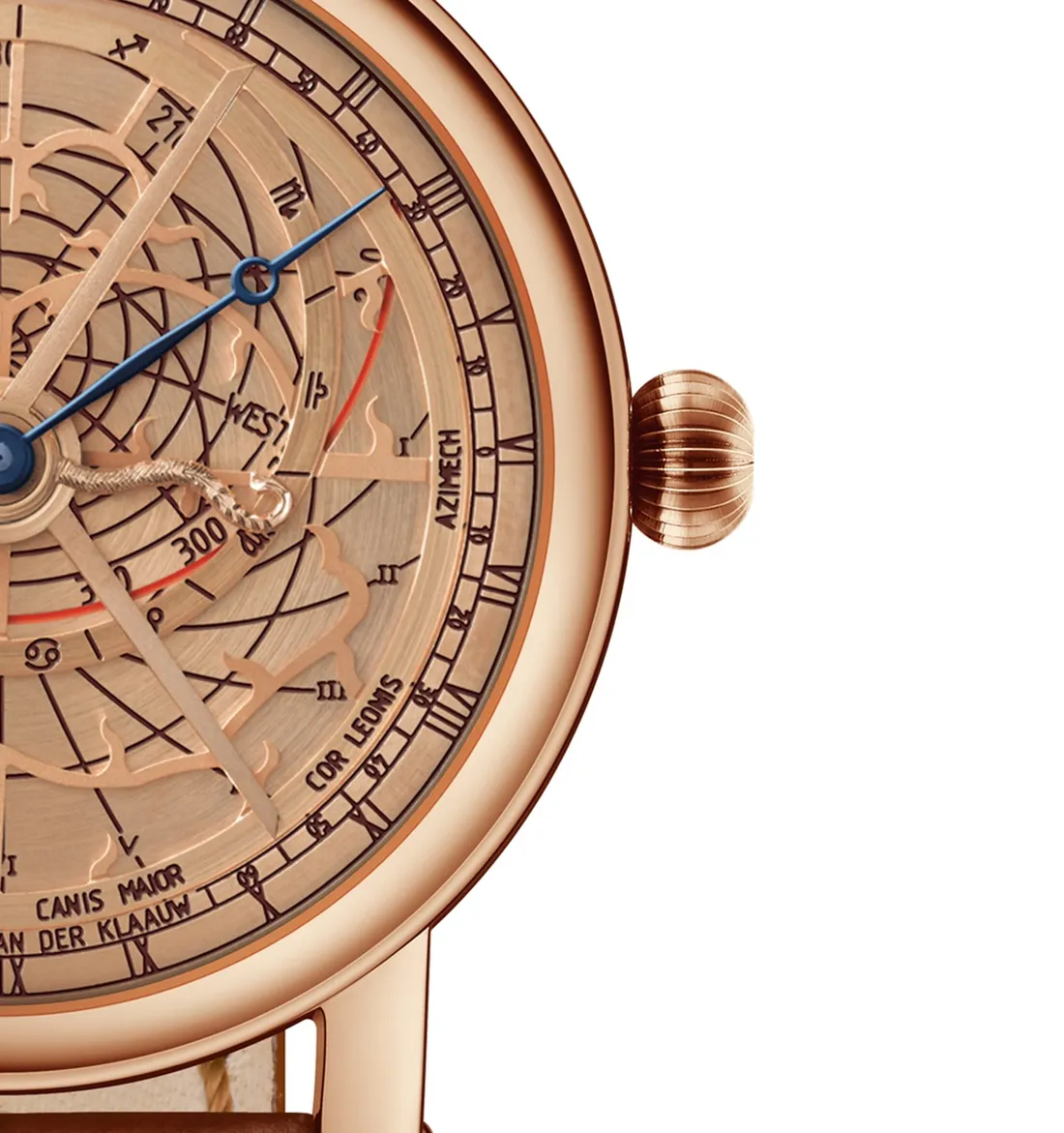
The symbols that remain above this line are the bodies you could see in the sky if you raised your head right now. Those that remain below it are under your feet, on the other side of the Earth. There is also the word WEST on the dial: when a body reaches that point it is setting.
And this leads to the most radical decision in the watch. Because the horizon curve depends on latitude and is engraved into the lower layer of the dial, this watch is not universal. It is exactly for this reason that the Christiaan van der Klaauw Astrolabium was made separately for eighteen different degrees of latitude. The person ordering the piece was not only choosing the metal of the case and the colour of the dial; he was also saying which parallel of the world he lived on. The watch was engraved for that place. Carry it to another latitude and the dial is still beautiful, but it no longer reads true.
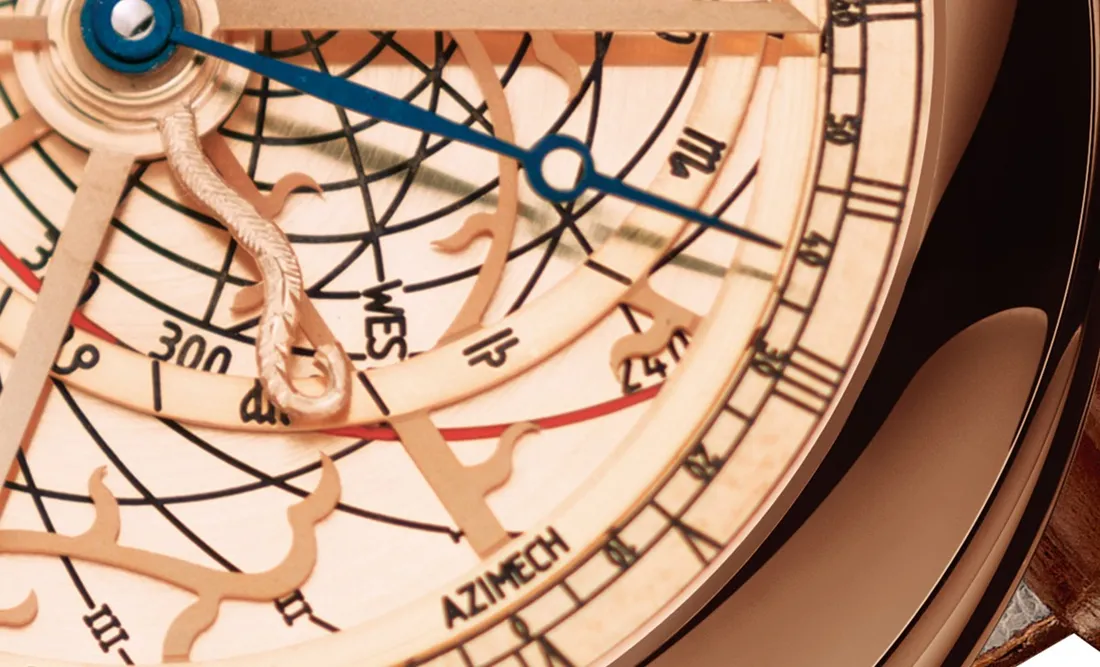
format_quote"The person ordering the piece was not only choosing the metal of the case; he was also saying which parallel of the world he lived on. The watch was engraved for that place."
B. The Ecliptic and the Belt of the Zodiac
The Earth turns around the Sun. But when we look from the Earth, the Sun appears to move all year along one and the same imaginary strip in the sky. This annual path of the Sun across the sky is called the ecliptic. Its name comes from exactly that: an eclipse can only happen on this line.
The ecliptic is inclined to the celestial equator by twenty three and a half degrees, because the Earth's axis is not perpendicular to the plane of its orbit but leans by that much. The existence of the seasons is due precisely to that tilt.
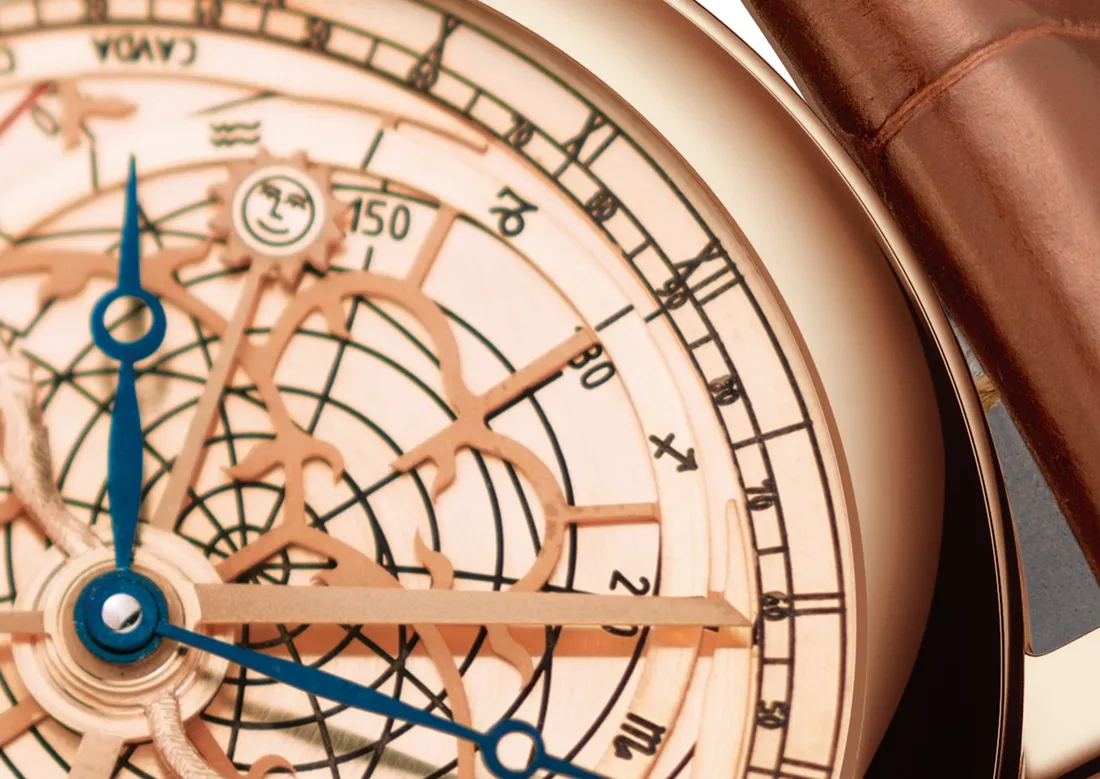
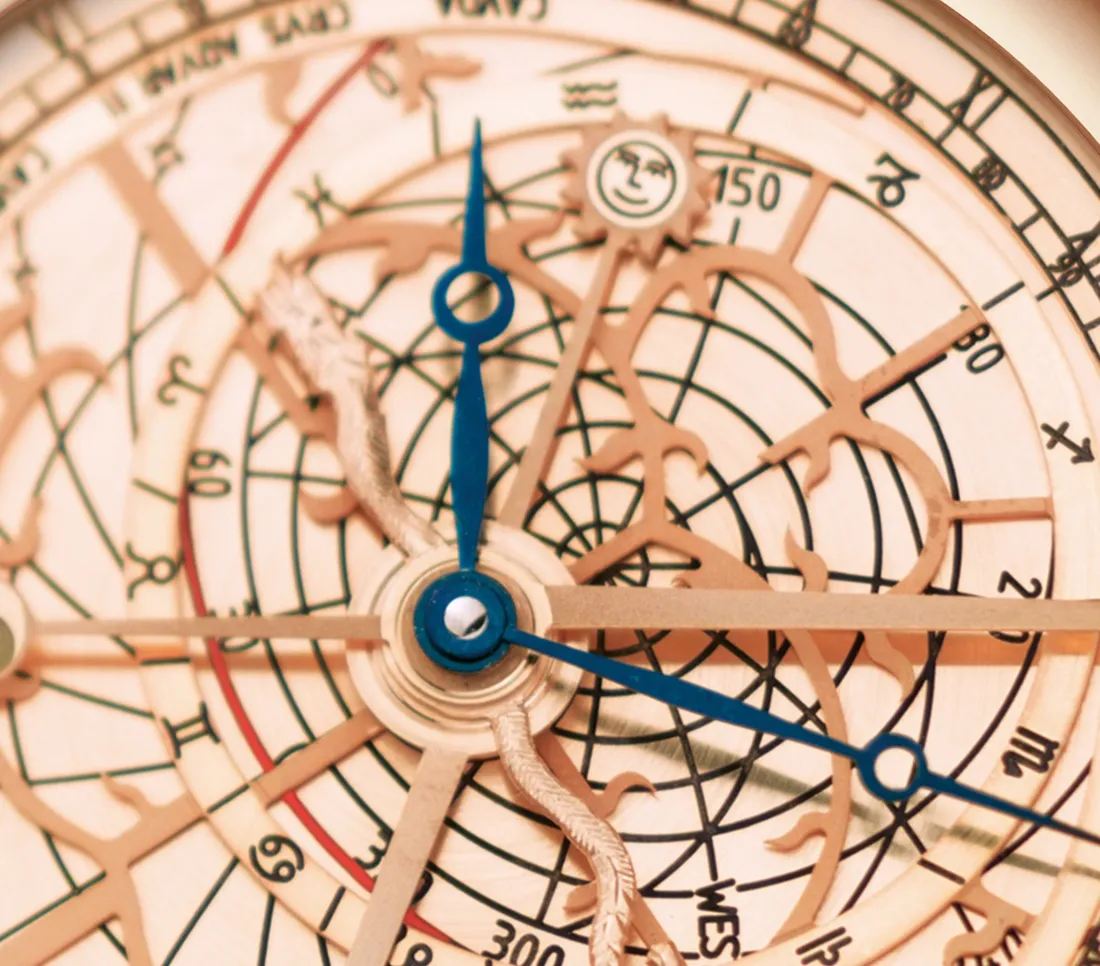
The twelve constellations lined up along the edge of that path form the belt of the zodiac. The turning ecliptic ring on the dial carries those twelve divisions and shows which one the Sun's marker stands in front of on a given day. The same ring also does the work of a calendar: the sun hand gives the date.
The Moon, just like the Sun, travels near this path. On the dial, the point where the moon hand cuts the outer circumference of the ecliptic ring gives the Moon's place in its orbit. When that intersection comes over the western horizon, the Moon is setting at that moment.
And this detail is the most elegant thing about the watch: the angle between the sun hand and the moon hand tells you the phase of the Moon directly. When the two fully overlap it is a new Moon; when they stand directly opposite each other it is a full Moon. There is no separate moon phase aperture on this dial. The phase is the distance between two hands.
C. The Stars on the Rete
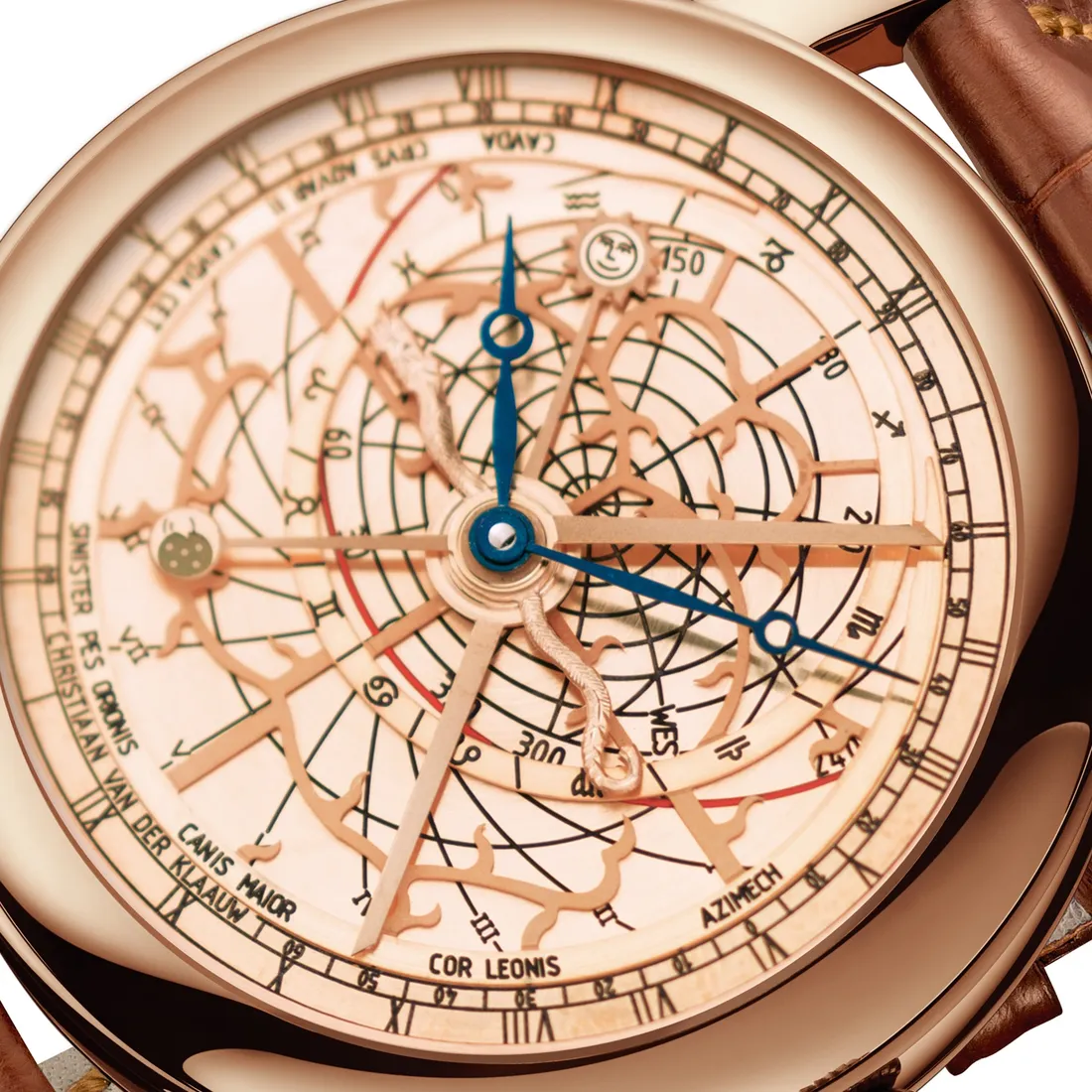
The most overlooked thing about this dial is that real stars are seated on the points of the rete. And their names are written on the dial too, all of them the Latin and Arabic derived names of the classical literature.
Cor Leonis, the heart of the lion: the star we call Regulus today. Azimech, by its Arabic derived name, the brightest star of Virgo, today's Spica. Sinister Pes Orionis, the left foot of Orion: Rigel. Canis Maior, that very bright star of the Great Dog constellation, Sirius. Cauda Cygni, the tail of the swan: Deneb. Cauda Ceti, the tail of the whale: today's Diphda. And Crus Aquarii, the leg of Aquarius.
These are not ornament. They are exactly what makes an astrolabe work: the star you measured is where that point on the rete is brought to coincide with the altitude circle on the plate. Seven stars means seven separate possibilities of measurement; you use whichever of them happens to be well placed in the sky that night.
There are also two scales around the dial: one gives the hours in Roman numerals, the other gives degrees. The hands are of blued steel; that colour contrast is the only reason you can tell them apart on top of a gold coloured rete.
D. The Dragon Hand and Knowing an Eclipse in Advance
The most mysterious hand travelling across the dial is the one with a dragon figure at its tip. The name comes from the classical literature of astronomy: Caput Draconis and Cauda Draconis, the head and the tail of the dragon.
The heart of the matter is this: the Moon's orbit around the Earth and the Sun's path across the sky, the ecliptic, do not exactly coincide. There is an angle of five degrees between them. Imagine putting two gymnastic hoops inside one another at a slight angle; the hoops touch at only two points. Those two points are called nodes, and the head and the tail of the dragon indicate exactly those.
The secret of an eclipse is hidden there. For an eclipse it is not enough for the Sun and the Moon to meet at random in the sky; the meeting has to happen at one of these two nodes. The brand sums it up in its own archive like this: if the Moon is at a node while it is full, there is an eclipse of the Moon; when the Sun and the Moon fully overlap at a node, there is an eclipse of the Sun. Which is to say that when the three hands come into line on the dial, the watch is whispering something to you.
One technical detail needs correcting here, because it is often confused. The Moon returns to the same node in twenty seven point two one two two two days; this is called the draconic month. But the nodes themselves do not stay put; the Sun's pull slowly turns the plane of the Moon's orbit and the nodes move backwards along the ecliptic. They complete a full revolution in about eighteen and a half years, six thousand seven hundred and ninety eight days to be exact. What the dragon hand follows on the dial is that second, far slower rotation. That a watch contains a hand which makes one turn every eighteen and a half years is the shortest answer to why this piece counts as a masterpiece.
format_quote"That a watch contains a hand which makes one turn every eighteen and a half years is the shortest answer to why this piece counts as a masterpiece."
How Hard Is This Work? The Limit of Micro Mechanics
For a craftsman to put these systems into a vast wall clock, or into a globe on a table, is relatively easy. You make the wheels large, the tolerances are generous, the torque is plentiful. The planetarium on Eisinga's ceiling runs on nine thousand nails and wooden gears; space is not the problem.
Fitting the same thing inside a forty millimetre wristwatch, into the size of a coin, is another matter.
First, the gear ratios. In an ordinary watch the relations are simple: the seconds wheel turns once a minute, the minutes wheel once an hour; the ratios sit on whole numbers. Here, on the power of the same single spring, four separate rhythms have to turn at once: the Earth's twenty four hour day, the Moon's phase cycle of twenty nine point five three zero five eight eight eight days, the Sun's annual round of three hundred and sixty five point two four two one nine days, and the roughly eighteen and a half year backward walk of the nodes. None of those numbers is a whole number. The craftsman has to convert them into gear ratios he can only approximate; and the gap of one part in a million he leaves in one ratio turns, a few years later, into a deviation visible to the eye on the dial.
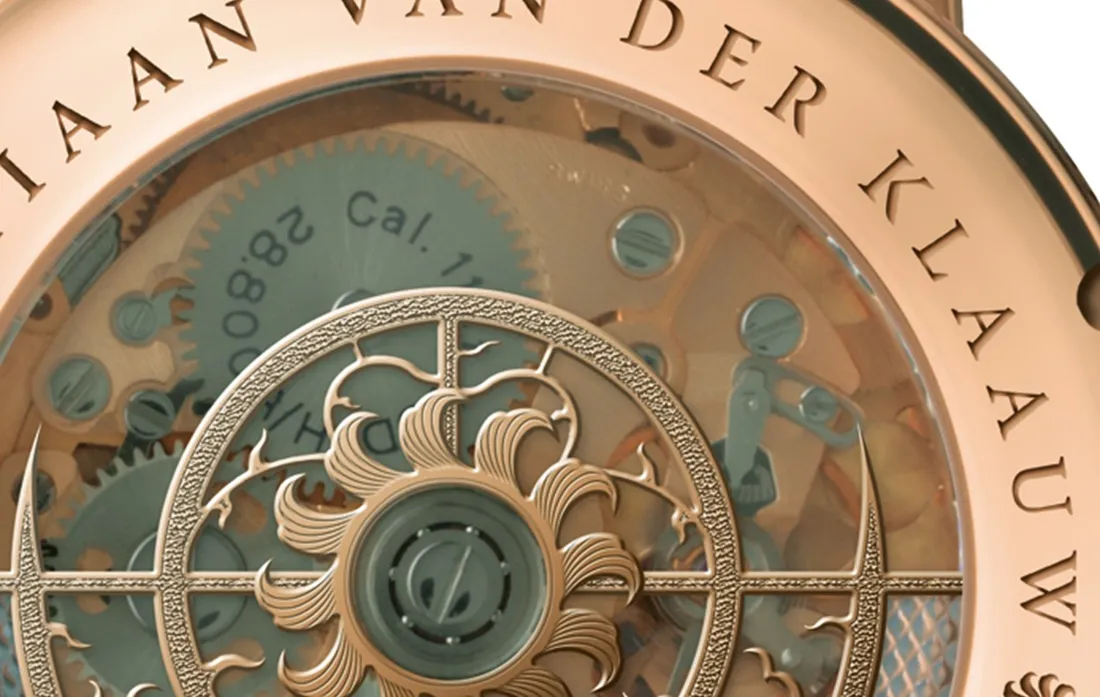
The source of those four rhythms, meanwhile, is a single vibration. The number read off the caseback makes that plain: twenty eight thousand eight hundred oscillations an hour, which is four full cycles a second. The dragon hand's eighteen and a half year turn is geared down, wheel by wheel, from that same balance swinging back and forth eight times a second.
Second, the budget of torque and weight. The turning rete, the ecliptic ring and three separate hands stacked on the dial bring a load an ordinary dial does not carry. A small spring has to turn this whole celestial chart. If you cannot produce enough torque the watch stops or runs slow; if you fit a stronger spring, those very fine wheels wear and their teeth break. The entire engineering of the calibre CVDK1198 is about standing on the narrow strip between those two cliffs.
Third, friction and flatness. The layers have to sit on top of one another without touching one another. The gap between the surface of the plate beneath the rete and the rete itself is of the order of the thickness of a human hair. Let the case be dropped once, or a single layer bend slightly, and the two discs rub and the watch stops.
The caseback itself is part of this story. The gold rotor under the sapphire crystal is skeletonised and the azimuth lines of the astrolabe are worked onto it; at its centre a hand engraved sunburst, around it a grained border. Which is to say that what winds the watch when you swing your arm is, seen from behind, an astrolabe again.
A Signed Work Beyond Time
The Christiaan van der Klaauw Astrolabium carries onto the wrist the philosophy of an age without battery sensors, digital screens and satellites. The catalogue does not print a price; beside it stands a single phrase: on request.
Working brass, steel and sapphire in his Frisian atelier, the craftsman gave us something far deeper than a watch: the human passion to understand our own position in the universe. Eisinga built it into the ceiling of a room, van der Klaauw fitted the same order inside forty millimetres; neither of them invented the thing they made, they only made a working order legible.
When you look at the dial of this watch you do not see how many minutes remain until your meeting. You read which stars are shining above your horizon, in which phase the Moon is and where in its orbit, when an eclipse is possible, and how that silent, faultless order goes on working for you.
And on the caseback that one word still stands: Joure.