About a thousand years ago, in a workshop in Constantinople, an old enamel master bent over a charcoal fire. Before him lay powders of coloured glass; dry, lifeless, like ordinary grains of sand. One by one, the master filled with this powder the tiny cells he had carved into gold, and gave them all to the fire. And there the miracle took place: the glass that a moment before had been a dead powder melted and blazed in the fire, and turned into a deep, immortal colour. It was as if matter had died and been reborn in a more beautiful form.
The master knew that he himself would one day die; but this fire, this knowledge in his hands, would live on after him. And so it did. The art of fusing glass onto gold passed from hand to hand and land to land across the centuries: from the golden enamelled icons of Byzantium to the workshops of medieval Europe, and from there to the watchmaking benches of Switzerland. Like a fire that never went out for a thousand years.
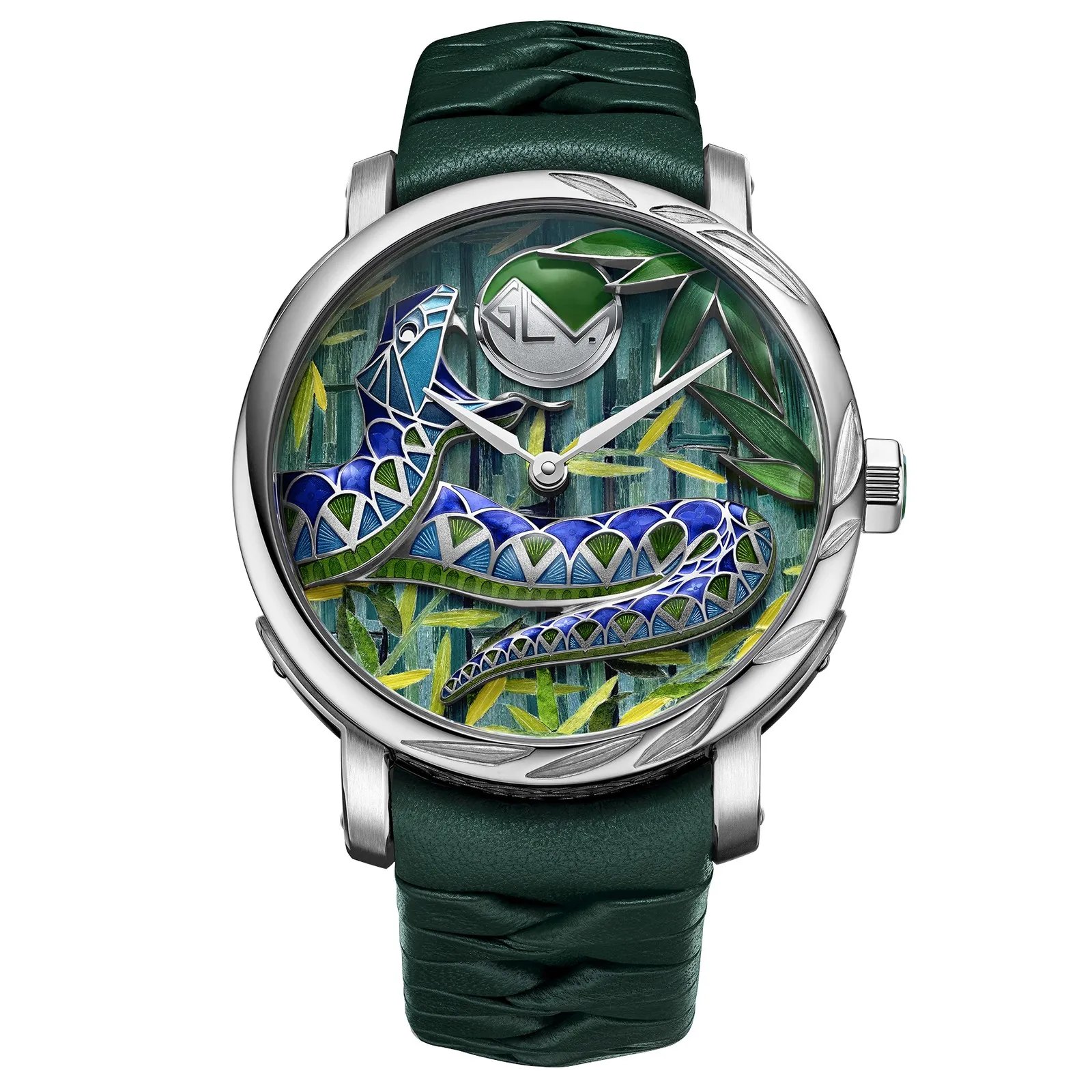
And today the same fire has been kindled again upon a dial in Geneva, to colour the scales of a serpent coiling in a bamboo forest. Could there be a better guardian than the serpent, which is endlessly reborn by shedding its skin, for this fire that has been reborn without pause for a thousand years? This is the true secret of the Louis Vuitton Escale Cabinet of Wonders Snake's Jungle: no beauty comes from nothing; all of it passes through a fire, dies, and is reborn. And we are merely those who carry that ancient fire, entrusted to us, on to the next hand.
A Cabinet of Wonders and a Passion for Japan
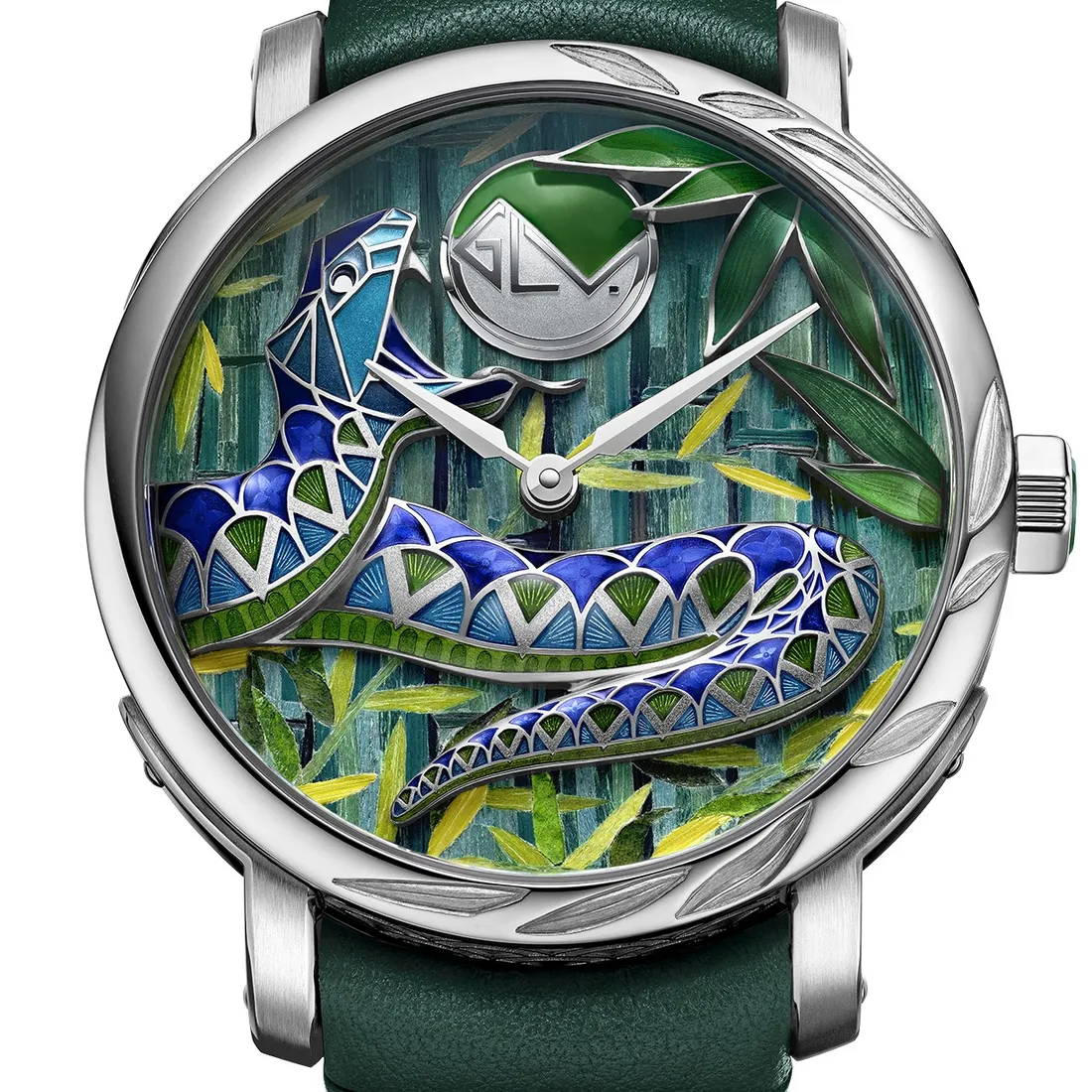
This piece is part of Louis Vuitton's Escale Cabinet of Wonders trilogy. It draws inspiration from the collection of antique Japanese tsuba, the guards of swords, amassed by Gaston-Louis Vuitton, grandson of the founder, and from his passion for Japan. Snake's Jungle is one of these three watches, and only twenty examples have been made; its forty-millimetre case is of white gold. And the dial you will see below is no ordinary dial but a display case in itself: a forest, a serpent, and three separate arts.
The Hands that Weave a Forest: Rose Saneuil and Marquetry
The verdant bamboo forest on the dial was not drawn with paint; it was woven with marquetry, the art of inlay. Think of it as a jigsaw or a mosaic, except that each piece is a slice of wood, straw or parchment cut to the thinness of paper. In other words, the master paints not with pigment, but with the fine slices of nature.
The French artist Rose Saneuil, who created this forest, set three hundred and sixty-seven distinct pieces into a single dial: four different woods, three colours of straw and two kinds of parchment, all selected, cut and fitted by hand. And why straw? Because the straw fibre catches the light like fine golden threads; as you move your wrist the forest comes alive and the leaves shimmer.
The Stirring Serpent: Eddy Jaquet's Engraving
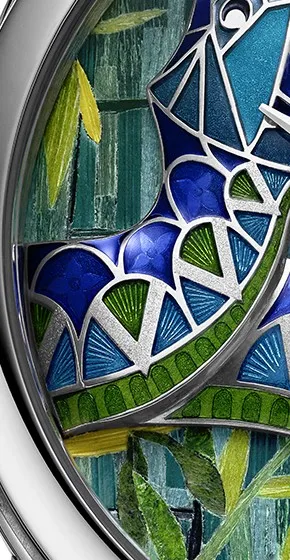
The forest's inhabitant, the serpent, came from the hand of the engraver Eddy Jaquet. What he does you might liken to a sculptor drawing a figure out of marble; except that here the scale is as small as a fingernail and the material is white gold. What gives the serpent its coiling, living volume is a clever trick: overlapping white gold rings, each one slightly different in size from the last. It is like stacking bangles of different sizes one over another; the eye reads them as a real, rounded body.
Jaquet carved each of the serpent's scales one by one and adorned them with Louis Vuitton's Monogram V letters and flowers. The bamboo leaves rising from the upper right of the dial then draw the eye to the Gaston-Louis Vuitton crest of gold and nephrite jade that seems to float in the air. The jade is here; that is, not in the serpent's eye, but in that seal suspended above the forest.

A Thousand-Year-Old Fire: Champlevé Enamel
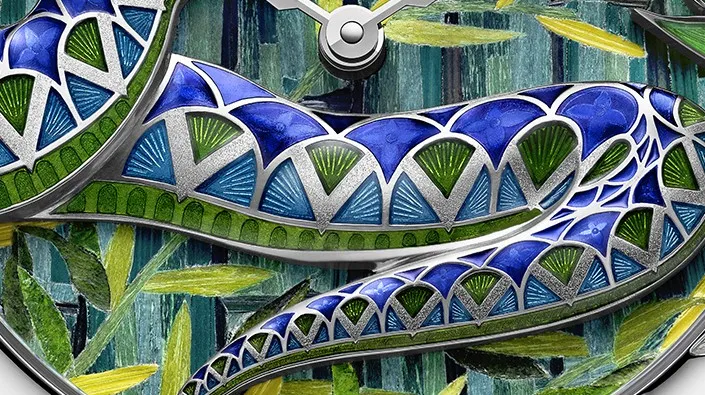
The third art, which gives the dial its colour and its life, was the champlevé enamel from the hand of Vanessa Lecci. In its simplest form, picture it thus: the engraver carves tiny pools into the metal; the enameller fills these pools with a coloured glass sand and fires them in a kiln at around eight hundred degrees. That dry powder melts in the fire and turns into a glossy, jewel-like glass. It is just like a stained-glass window; but the lead lines that separate the panes are here replaced by engraved walls of gold, which keep every colour perfectly pure.
This is a very old art of fire. The idea of fusing glass onto gold has lived for more than a thousand years: the golden enamelled icons of Byzantium raised this art to the heavens, and in medieval Europe the champlevé technique reached its summit in centres such as Limoges. Back then the fire came from charcoal, and the glass was ground to powder by hand in a mortar; today the kilns are electric and the enamel refined. But the essence of the work has not changed in a thousand years: open the cell, fill it with powder, give it to the fire; when it shrinks, fill it again, and fire it again. The fire that colours this serpent's scales is, in truth, the very same fire that once lit the haloes of Byzantine saints.
Waves, and the Serpent that Sheds its Skin
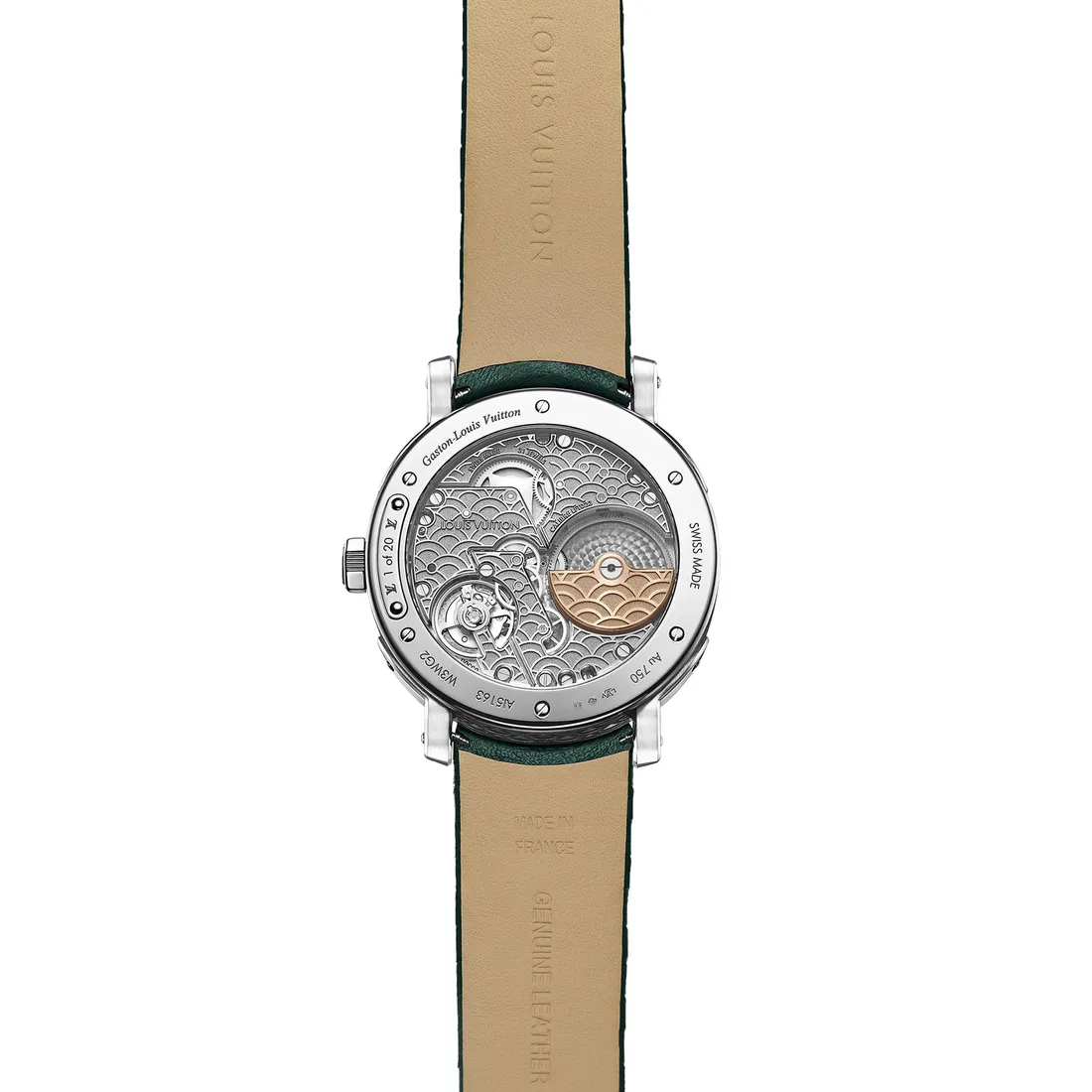
This greenery crosses the borders of the dial and wraps the white gold case as well. Louis Vuitton's spirit of travel lives on in the Seigaiha waves engraved on the caseband and lugs; this motif, which represents the ocean and is a symbol of good fortune and prosperity, adorns even the bridges of the movement. And the serpent at the centre of the whole scene is no animal chosen at random: shedding its skin to be reborn, it is the emblem of the very idea that runs through this entire work. Dead wood, cold metal and a lifeless glass powder: all of them die in the hands and fire of the masters, and are reborn as a living, glowing forest.
Those Who Carry the Fire
That old master in Constantinople long ago returned to the earth, but the fire he lit never went out. Today it still burns in Rose Saneuil's trees, in Eddy Jaquet's burin and in Vanessa Lecci's kiln. Whoever fastens Snake's Jungle to the wrist carries, in truth, not merely a watch but a single link in a thousand-year-old chain of fire.
Only twenty people in the world will walk this forest on their wrist. And it is to be hoped that each time they look, they will remember that no beauty is born from nothing; that every colour comes from a fire, and every master from a hand that came before. The serpent sheds its skin, the master dies, but the fire goes on its way.