In the dim room of a mountain monastery, an old ink master lay on his deathbed. His young student longed to see the one painting his master had pursued all his life: the dragon. But when he opened the chest, he was stunned. There were dozens of scrolls; on all of them, only clouds. Coiling, swirling, dissolving clouds. But not a single dragon.
“Why, master?” he asked in a trembling voice. “A whole life spent drawing dragons, and there is no dragon.” The old man smiled. “No one has ever seen the dragon, my child. For it exists not to be seen, but to be sensed. You paint the cloud; paint its curl, its speed, its shadow. The dragon will appear behind that cloud, in the heart of the beholder. The most powerful way to tell of a thing is to paint not the thing, but the trace it leaves.”
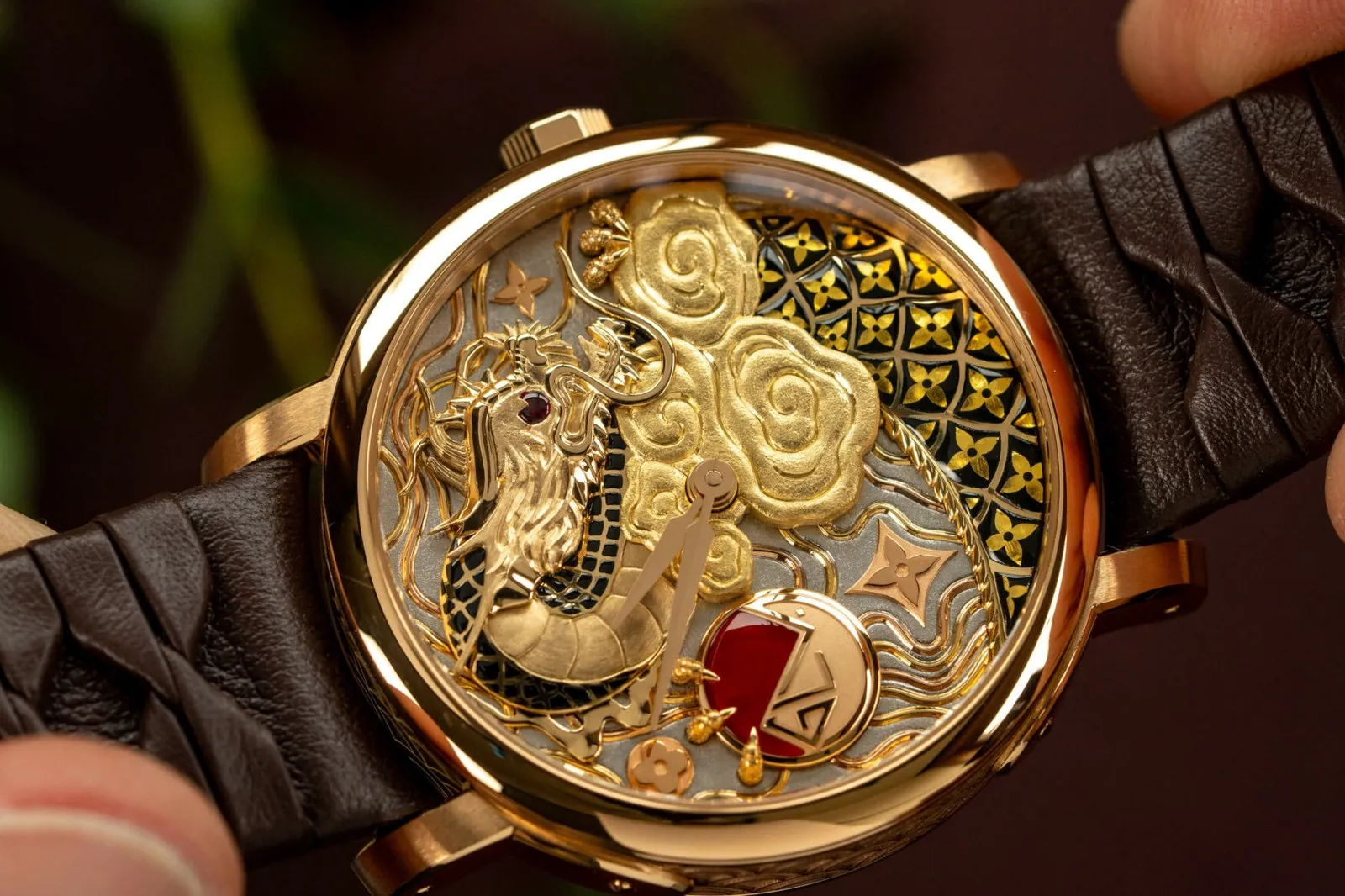
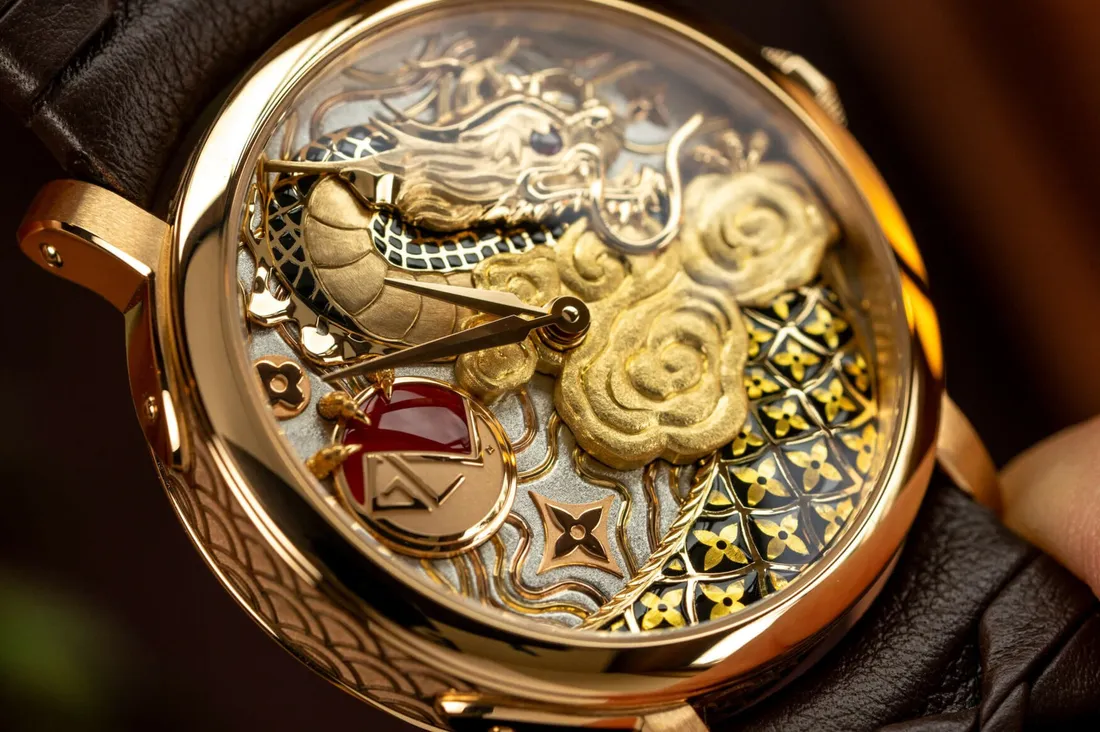
Centuries later, the same wisdom was reborn upon a dial in Geneva. The Louis Vuitton Escale Cabinet of Wonders Dragon's Cloud. The masters did not, in truth, make a dragon; they made a cloud. And the dragon rose of its own accord from the golden curls of that cloud.
Reading the Unseen
The dragon of Japanese legend is not the winged, fire-breathing monster of the West. It is the unseen spirit of water and cloud; you can never see it directly, only its traces: the gathering cloud, the coming rain, the ring of a drop falling on a pond, the mist leaning against the mountainside. The dragon is there, but always behind a veil.
And here is what is worthy of contemplation. In truth, we spend our whole lives in pursuit of that dragon; of the great cause behind everything, of the hidden meaning. But what we catch is always the cloud: the traces, the signs, the tokens. The wise one does not exhaust himself trying to seize the dragon by force; he learns to read the cloud. For the unseen is known only by the trace it leaves.
Consider: we have never seen time either. We could neither grasp its flow nor touch its colour; we know only its cloud: the yellowing of leaves, the greying of hair, the silent march of the hour hand. This watch, too, offers you not the dragon but its cloud. And perhaps the true skill is to know not how to look, but how to see.
The Dragon of a Cabinet of Wonders
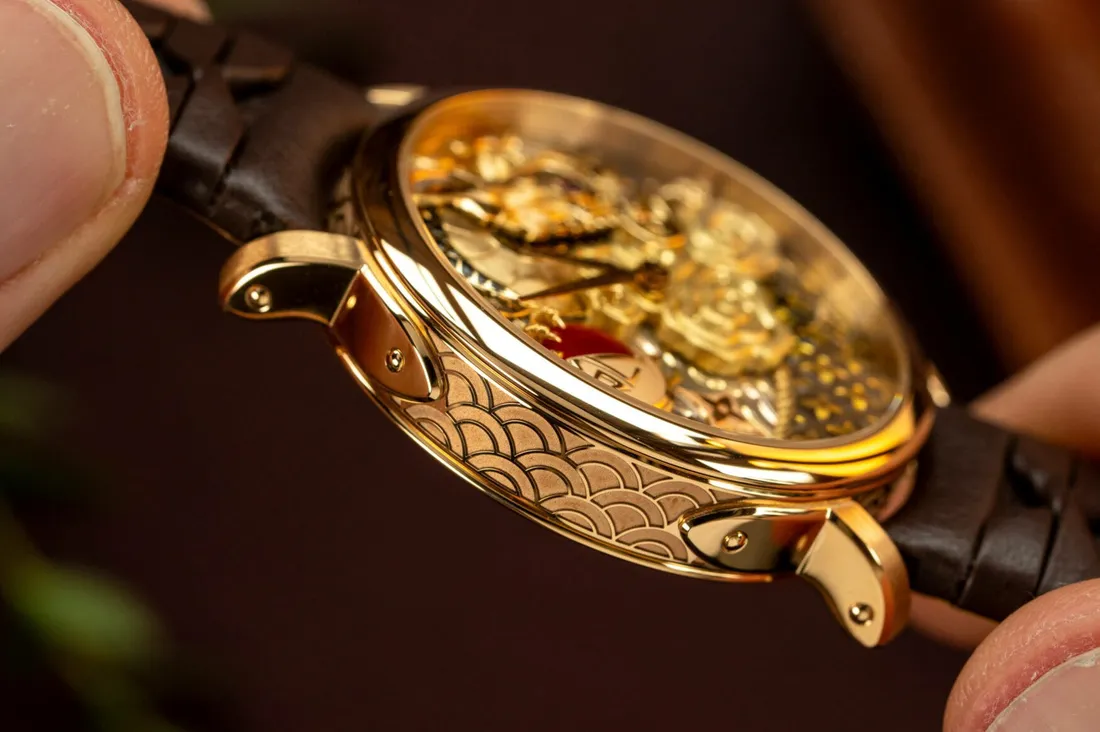
This piece is part of Louis Vuitton's Escale Cabinet of Wonders trilogy; it draws inspiration from the collection of antique Japanese tsuba, the guards of swords, amassed by Gaston-Louis Vuitton, grandson of the founder, and from his passion for Japan. Dragon's Cloud is one of these three watches, and only twenty examples have been made. Its forty-millimetre case is of 18-carat rose gold; around it wrap the famous Seigaiha waves of Japanese iconography.
The Hand that Sews Gold into Metal: Fanny Queloz and Damascening
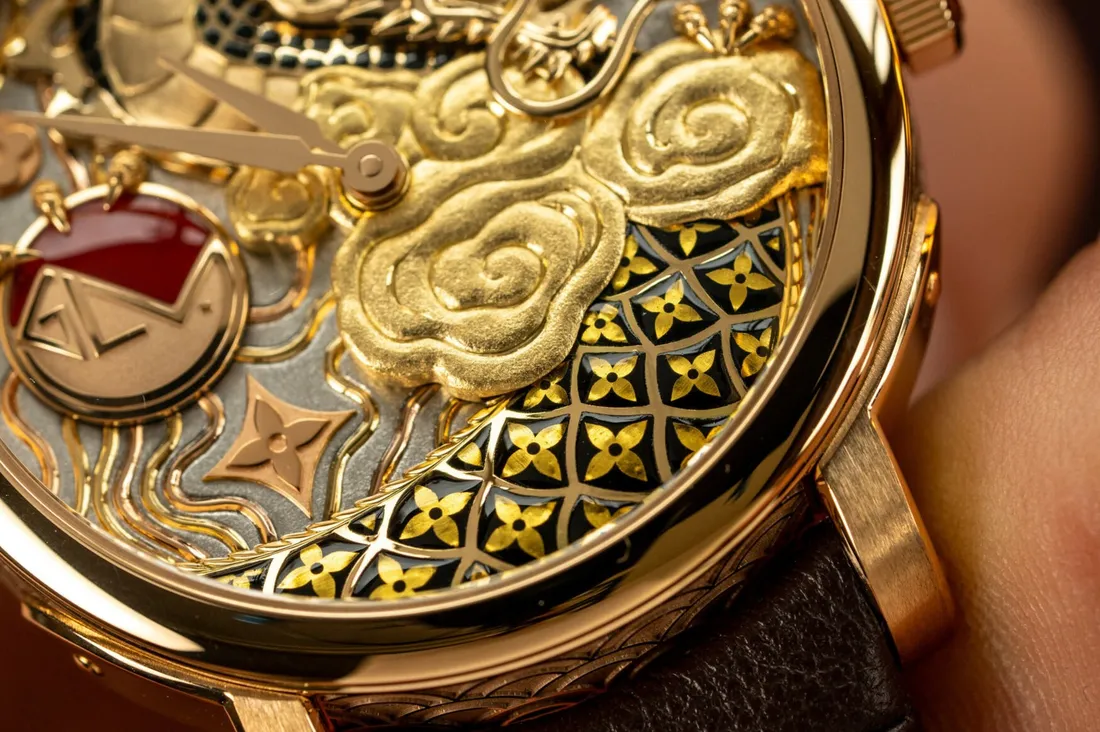
The one who brought to life that sea of golden clouds on the dial is Fanny Queloz, one of the last masters of this rare craft. The technique she uses is called damascening: the inlaying of yellow and rose gold wires into a hand-hammered metal base.
An analogy tells it best: damascening is like tattooing gold into the skin of metal. First the master hammers the base thousands of times and raises a field of tiny thorns invisible to the eye, a rough, unseen thicket. Then she lays a soft thread of gold over this field and presses. The gold catches on those invisible thorns and stays there, with no glue and no solder, held by nothing but its grip. So the golden cloud you admire rests entirely upon an invisible, patient labour. Just as the dragon rests upon its cloud; just as every visible glory is built upon an unseen effort. Two different golds, yellow and rose, give the cloud two separate lights and a real depth.
The Pearl That Is Chased
The dragon coils among these golden clouds; hand-engraving and enamel give it life, and the Monogram Flowers worked into the golden ground turn the background into a garden. Its eye is a tiny ruby cabochon. And at the heart of the whole scene glows an orb of red carnelian: that legendary ball of flame the dragon chases, the pearl of wisdom.
For according to legend the dragon pursues that pearl for all eternity, yet can never quite grasp it. Just as we pursue meaning, and truth. That red orb is not merely a stone; it is the very truth we long to reach, but that always stands a step beyond. The dragon turns around it; we turn around time.
The Heart Beneath the Cloud
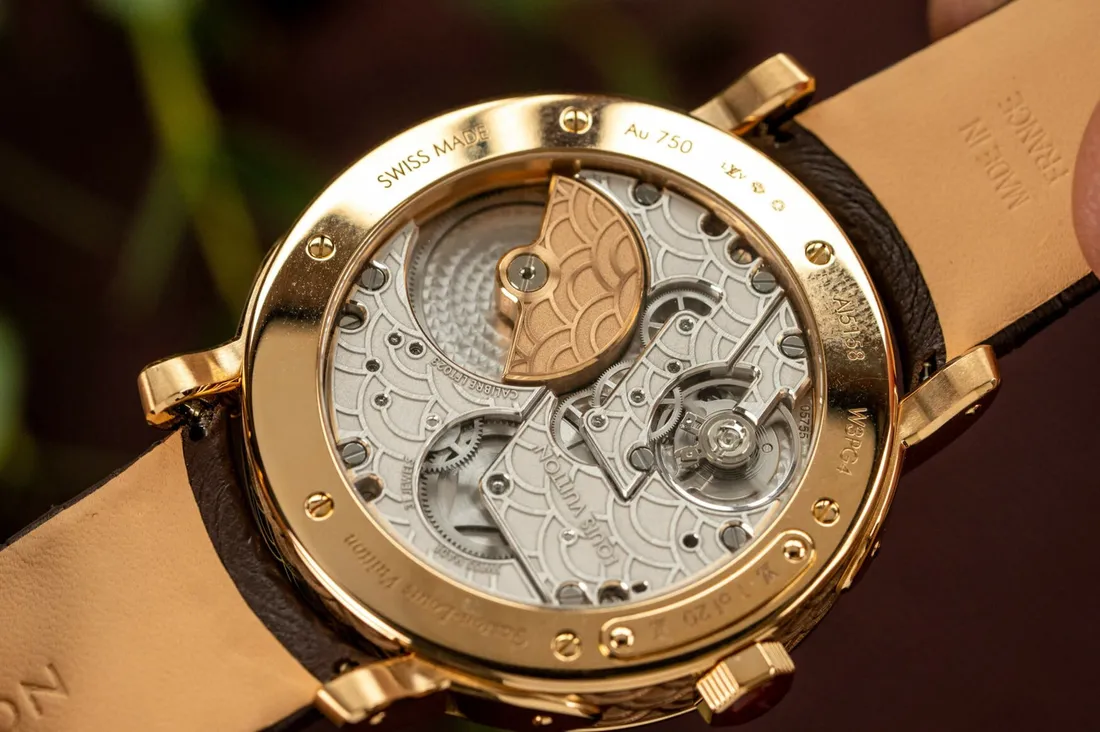
What holds all of this art together is the Geneva-based high watchmaking atelier La Fabrique du Temps Louis Vuitton. The logic here is a dual approach: to bring the Maison's own engineering strength and the genius of independent artists such as Fanny Queloz to the same table. Beneath all this visible splendour, the automatic LFT023 caliber beats with a silent micro-rotor, at four hertz and with a fifty-hour power reserve. The dial is so full that the heart modestly shows only the hours and the minutes; for what is told here is less time itself than its cloud.
To Look and to See
As that old ink master said, perhaps we shall never see the dragon. But Fanny Queloz's hammer wove the cloud of gold so finely that anyone who looks closely at that cloud will sense, in their own heart, the dragon behind it. Dragon's Cloud is less a watch worn on the wrist than a portable object of contemplation.
Only twenty people in the world will carry this cloud on their wrist. And it is to be hoped that each time they look, they will remember not only the time, but that behind everything seen there is something unseen.