Three in the morning. The light of the yellow lamp on the desk falls on the cold surface of a stainless steel case under the loupe. In front of me there is no ornate automaton and no instrument playing court music.
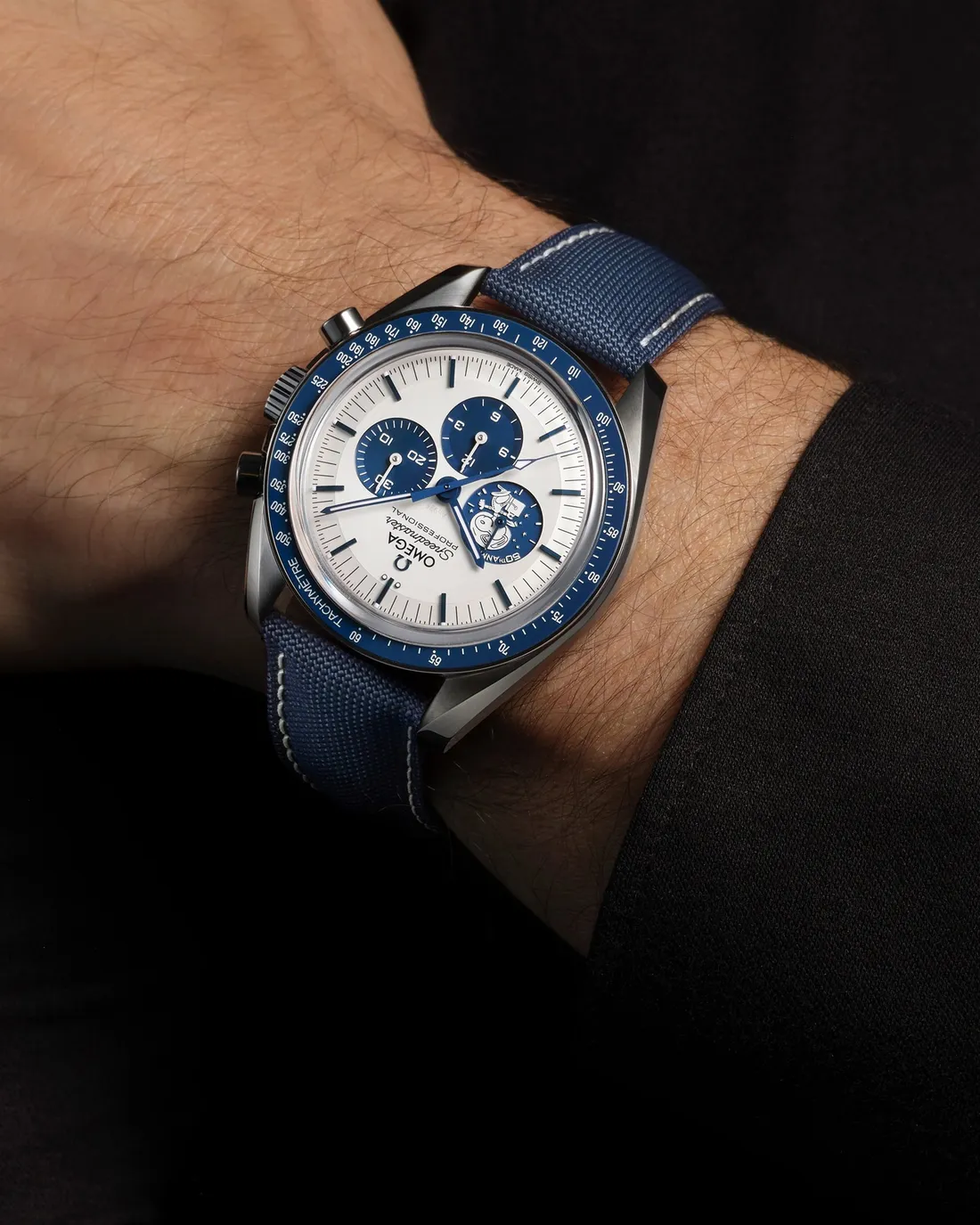
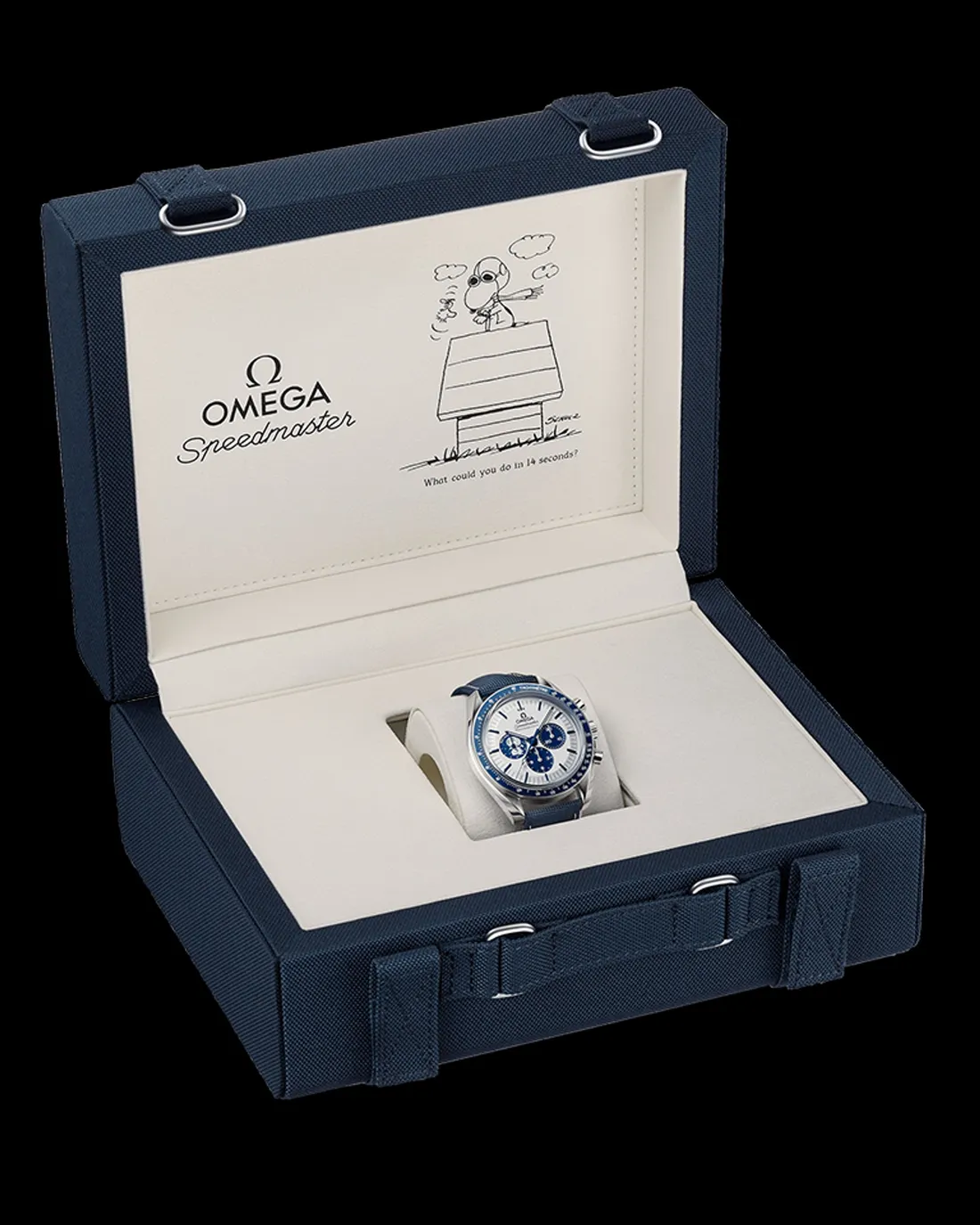
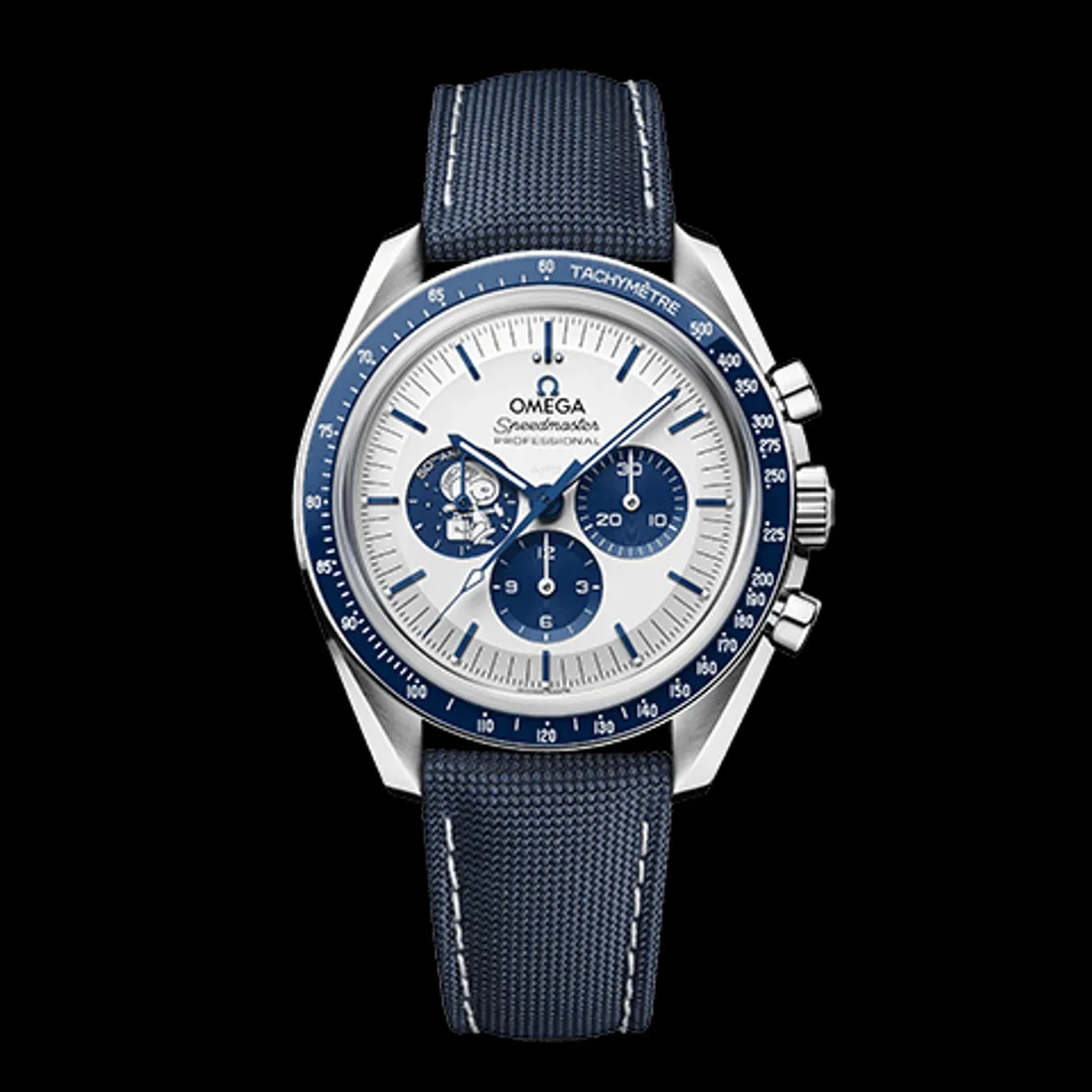
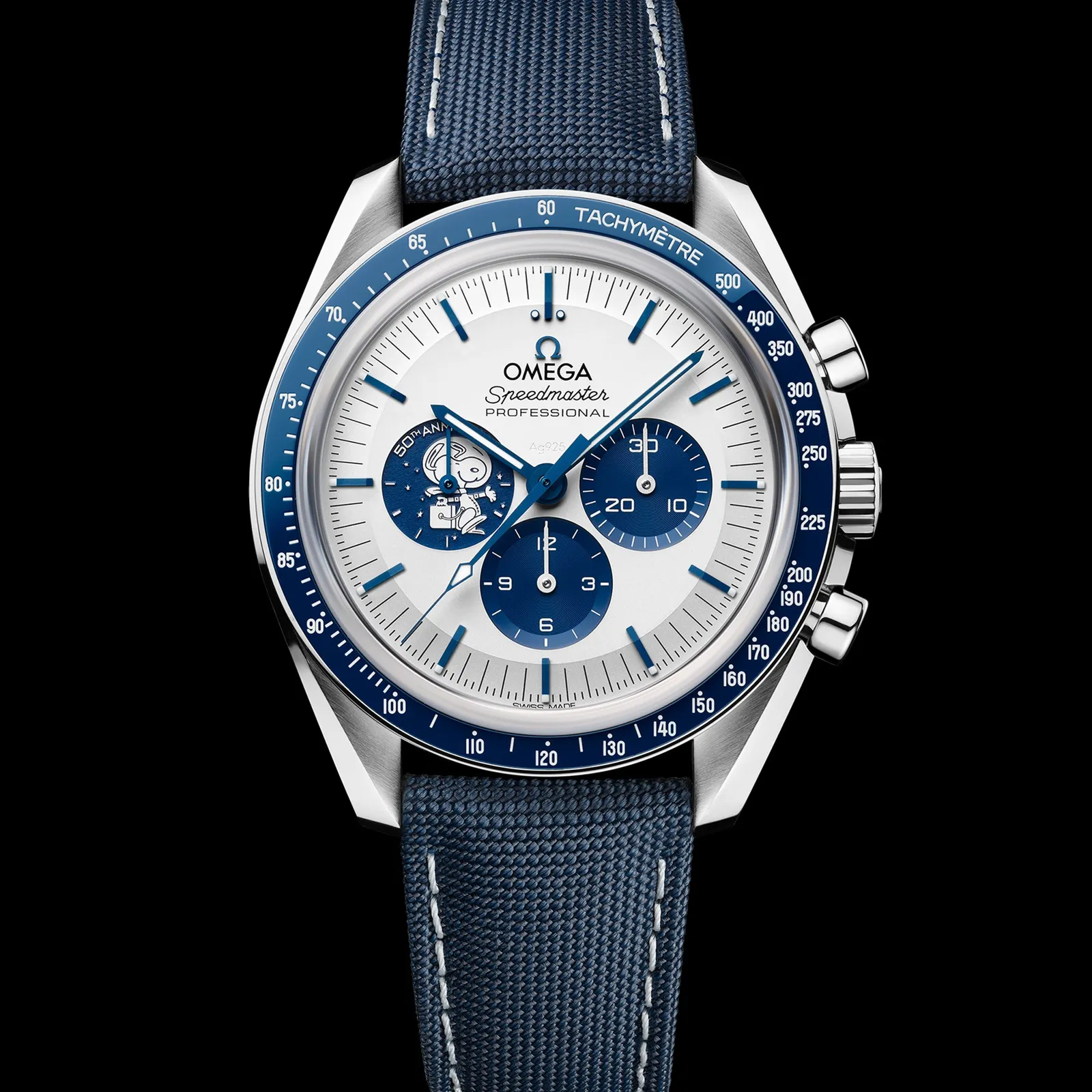
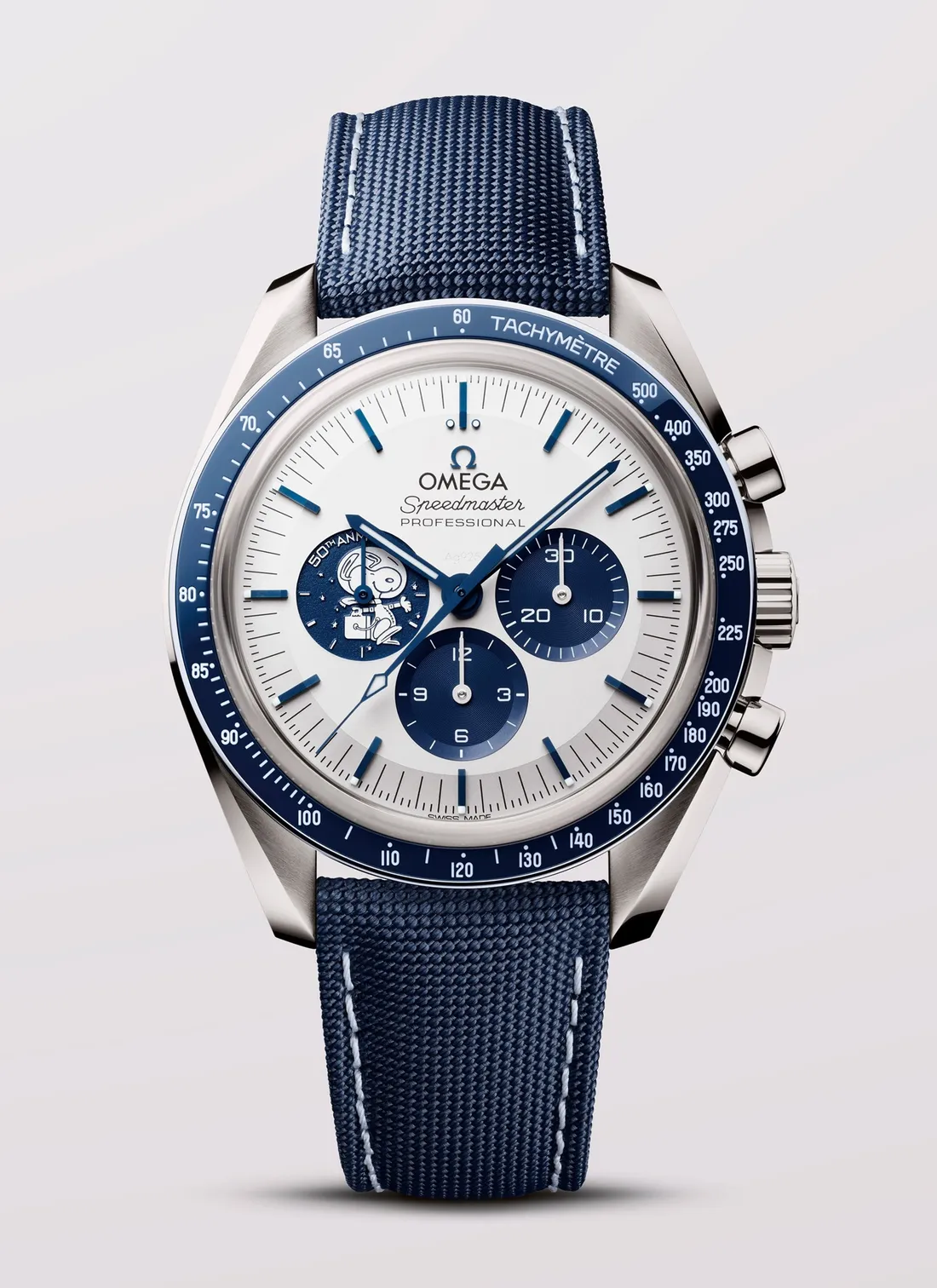
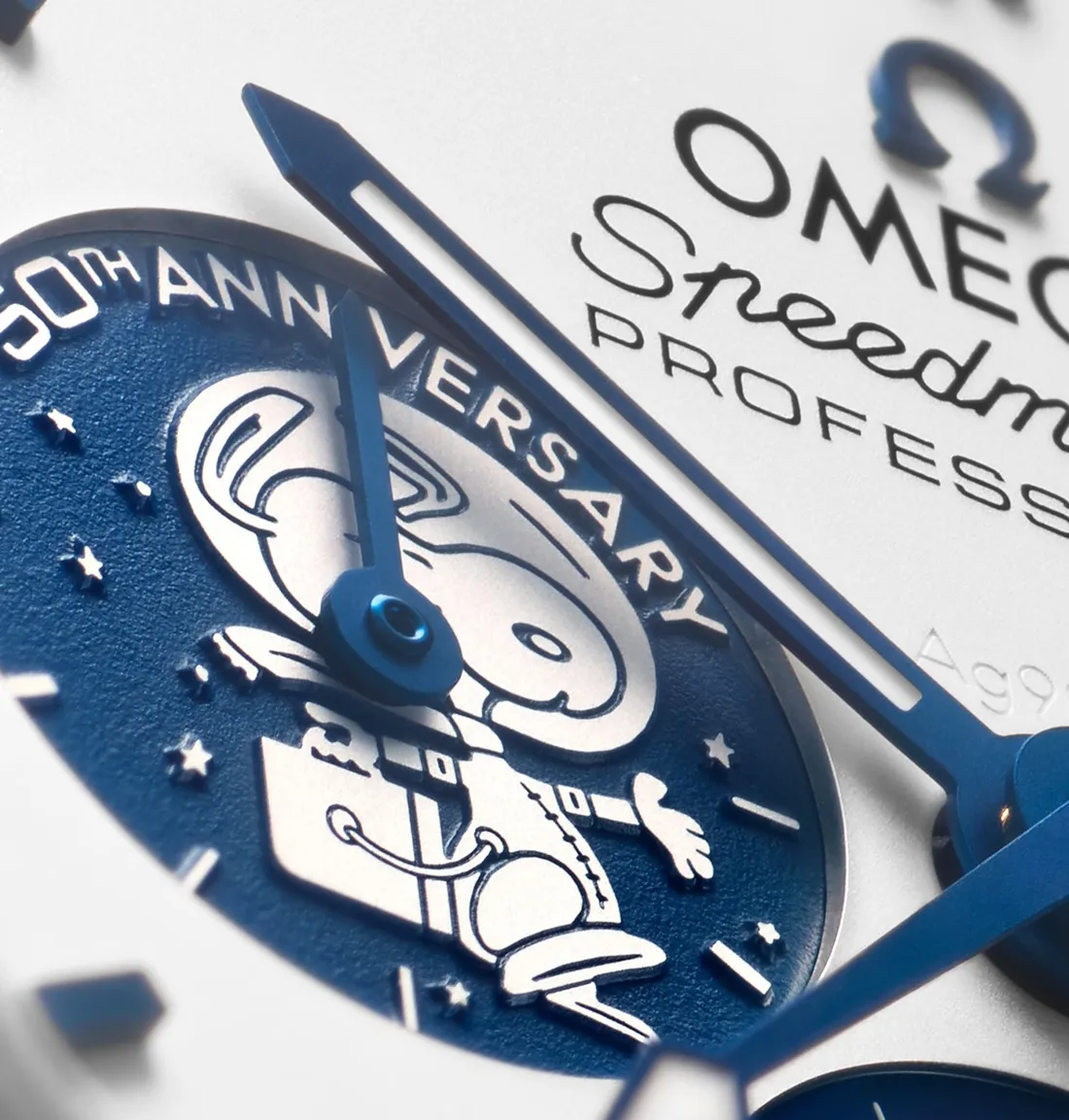
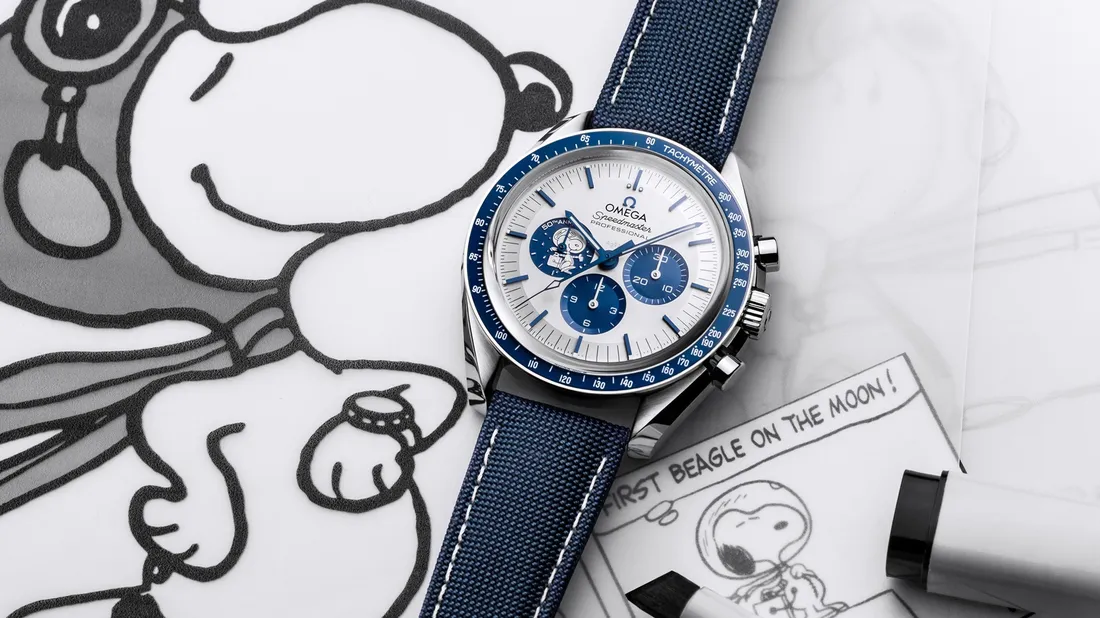
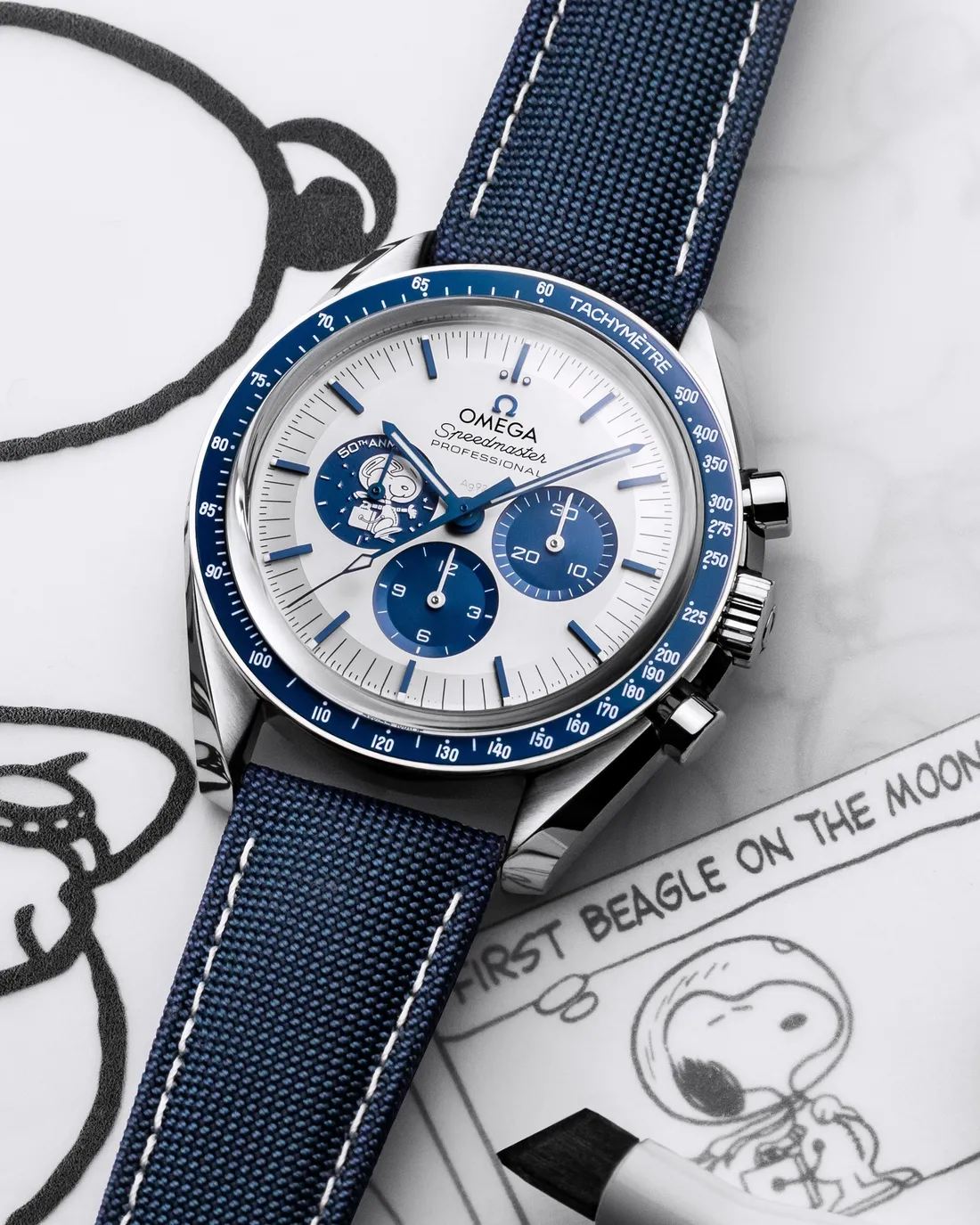
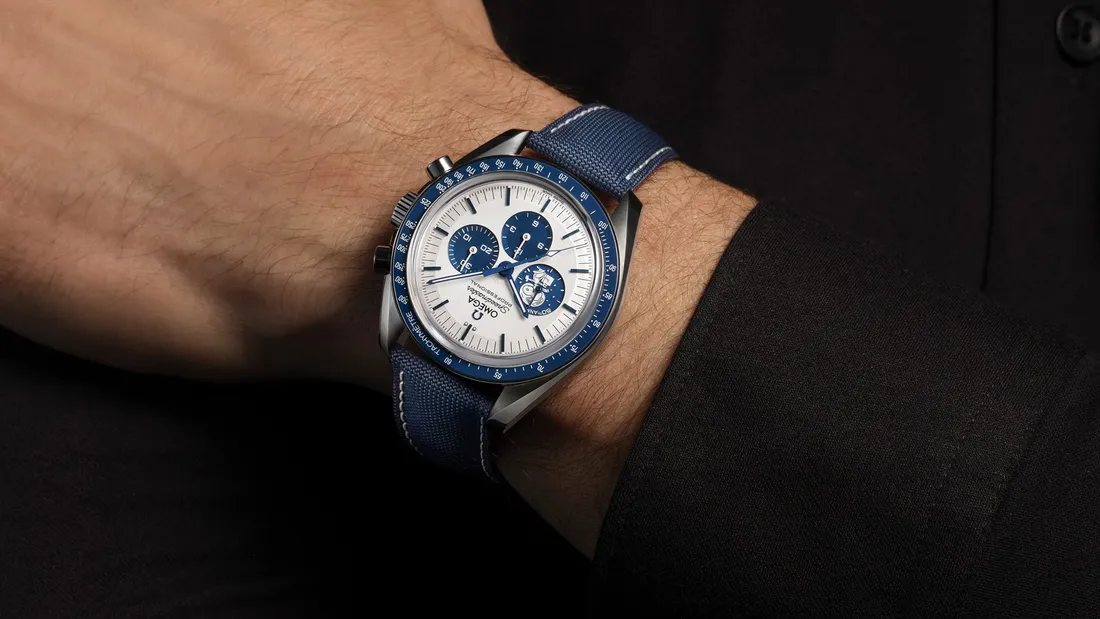
What stands in front of me is a solid silver dial, a blue ceramic bezel and a cartoon dog in a spacesuit looking back at me from the subdial at nine o'clock. The Omega Speedmaster Professional Silver Snoopy Award 50th Anniversary, reference 310.32.42.50.02.001.
At first glance it looks like a cheerful joke aimed at the excessive seriousness of the world of high watchmaking. But the Snoopy on this dial is not an ornament or an advertisement for a comic strip. That small figure is the evidence of a fourteen second struggle that saved the lives of three astronauts in the freezing dark of space in 1970. And the date of that struggle is engraved on the caseback: 5 October 1970.
I. Dead Screens and Those Fourteen Seconds
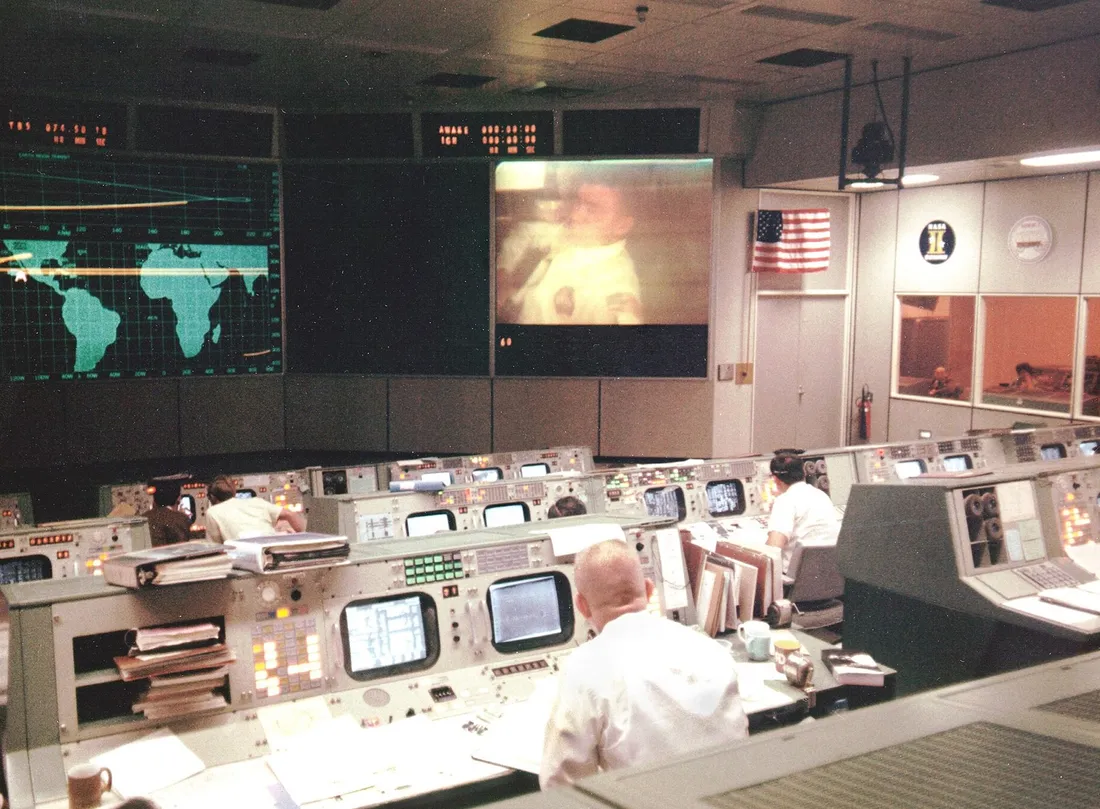
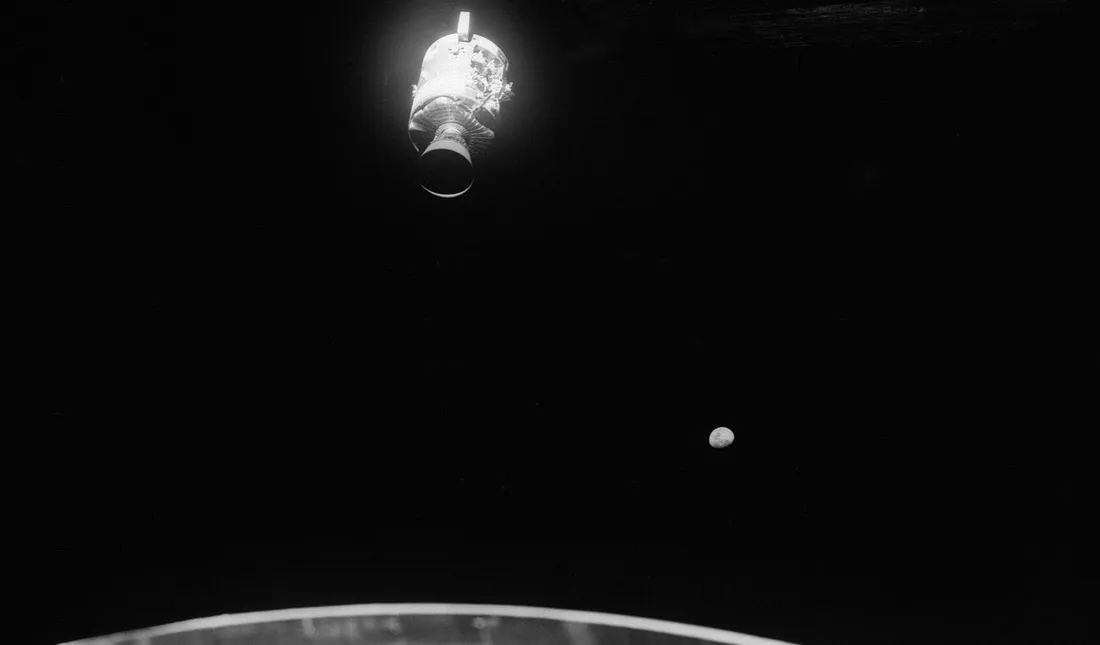
13 April 1970. About three hundred and twenty thousand kilometres from Earth, oxygen tank number two in the service module of Apollo 13 exploded. The blast also damaged tank number one, which then drained. With both tanks gone the fuel cells of the command module were gone too, which is to say the electricity was gone.
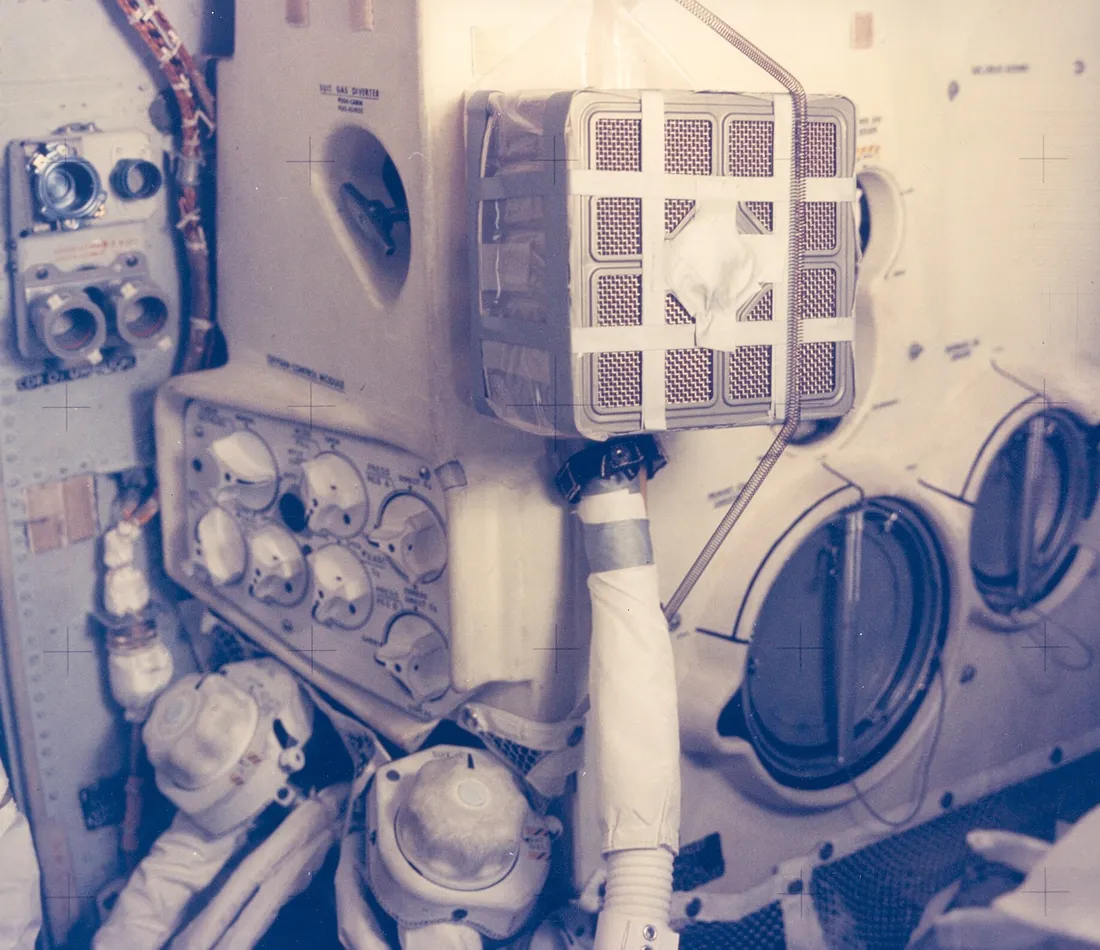
A common misunderstanding needs correcting here. The main computers did not crash. The crew shut them down deliberately. All that remained were the command module's batteries reserved for atmospheric entry, and those batteries had to be kept untouched until the last moment in order to bring the capsule down onto the water. So the guidance computer, the digital timers and the instrument displays were switched off one by one. The crew took refuge in the lunar module Aquarius and used it as a lifeboat. The cabin temperature fell to about three degrees, the windows fogged over and the air inside began to fail.
And there was one more problem. After the explosion the spacecraft had drifted some sixty to eighty nautical miles off its path. If that drift were not corrected, the capsule would enter the Earth's atmosphere at the wrong angle.
The precision at stake here needs stating properly, because this part is often exaggerated. The band of safe entry angles for an Apollo capsule, the entry corridor, was only about two degrees wide in flight path angle. Stay above that corridor and the capsule skips off the atmosphere and back into space; fall below it and the deceleration and the heat load rise above what the capsule can carry. A single second of error was not by itself fatal. What was fatal was this: with the guidance computer off, there was no second attempt, no computed correction and no measured confirmation. Whatever was done had to be right the first time.
For the final course correction the descent engine of the lunar module was to be fired for exactly fourteen seconds. And there was no working digital timer in that cabin to count how long the engine burned.
format_quote"A single second of error was not by itself fatal. What was fatal was that with the guidance computer off there was no second attempt."
Who Counted the Fourteen Seconds: Three Men, Three Jobs
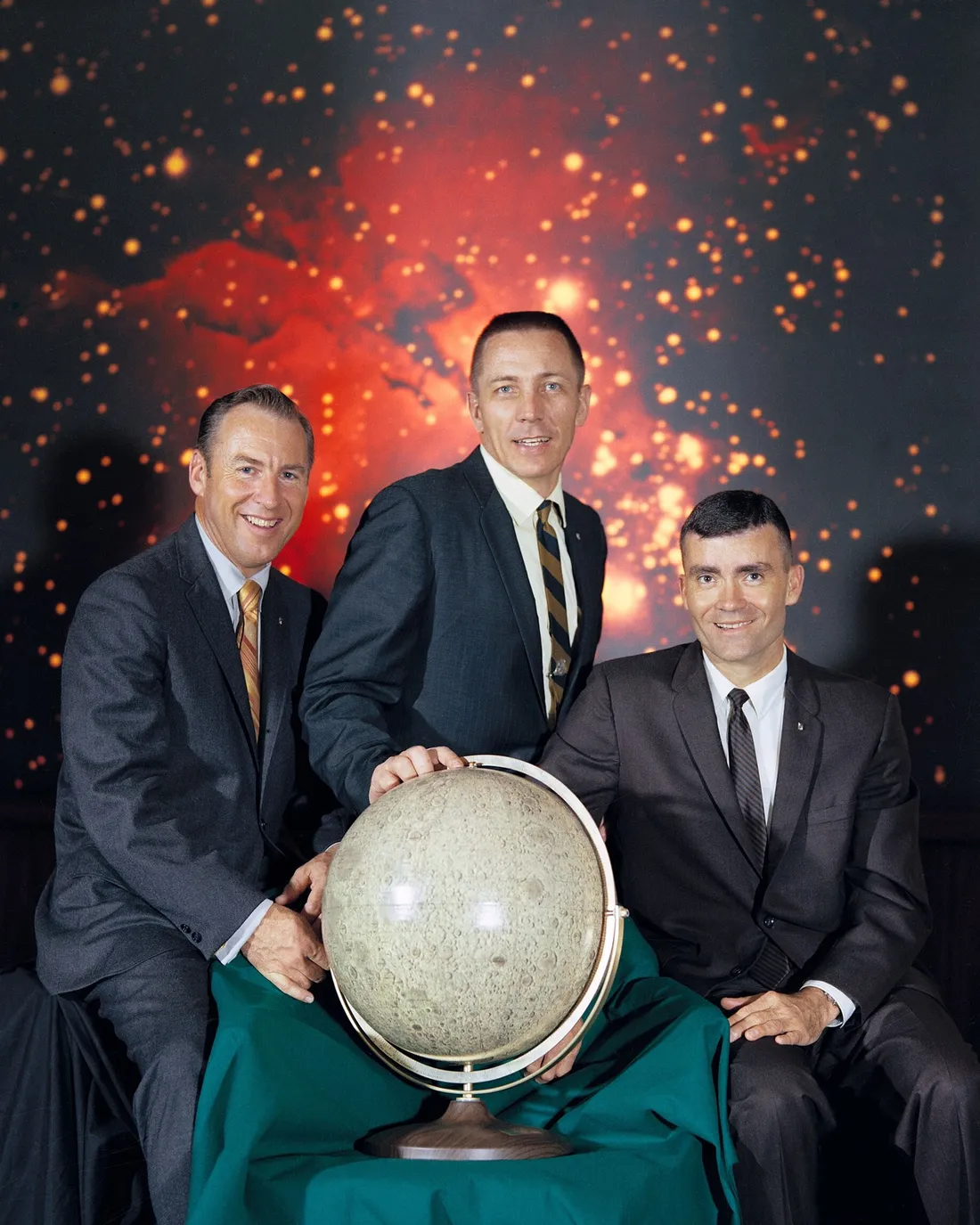
The most striking thing about this manoeuvre is that it was not one hero but a division of labour. With the computer off, three separate men held three separate references in order to point the spacecraft the right way.
The mission commander, Jim Lovell, held the craft steady using the line where day meets night on the Earth, the terminator, as a sight in his window. The lunar module pilot Fred Haise tracked the Sun through a second sighting device and held the second axis. The command module pilot Jack Swigert counted the time and called out the moment to shut the engine down.
Swigert had neither a working stopwatch nor a screen. According to the account that has come down to us, what he had on his wrist was an Omega Speedmaster, and that watch was not his own but Lovell's; they chose it because it was known to be the most recently serviced chronograph on board.
The most tense fourteen seconds in human history were counted out by the mechanical ticking of wheels and a spring. The engine was shut down exactly on time. On 17 April the three men came down safely into the Pacific. This manoeuvre was afterwards judged so important that it was added as mandatory training to the programme of every Apollo crew that followed.
One more detail: Apollo 13 also remains the mission on which human beings travelled furthest from Earth. Swinging around the far side of the Moon, they were four hundred thousand one hundred and seventy one kilometres from home. That record still stands today.
What the Silver Snoopy Award Actually Is
A second common error here is worth correcting. The Silver Snoopy Award is not NASA's highest official institutional honour. It is something more interesting: it is the astronauts' own award.
The award was created in 1968 and serves one purpose: to let the people who would pay for a failure with their own lives, that is the astronauts, personally recognise those who contribute to flight safety and mission success. The medal is handed over in person by an astronaut and reaches fewer than one per cent of the space programme workforce each year. The figure on it is Snoopy, chosen by NASA at the end of the 1960s as the emblem of its safety culture, struck as a silver pin in his spacesuit.
Omega received this award on 5 October 1970, about six months after Apollo 13 came down. And that date is engraved letter by letter around the edge of the caseback of the watch in front of us.
Omega has turned the award into a watch three times: the first Snoopy Speedmaster in 2003, the forty fifth anniversary model in 2015 and the fiftieth anniversary model we have here, from 2020. Of the three, this last one is the only one that builds a mechanical scene of its own.
II. Mechanical Cinema: The Scene on the Caseback
What makes this watch unique is that it has turned its legend into a moving mechanical scene on the caseback. But how that scene is built is misreported in most accounts. Here is what is actually happening.
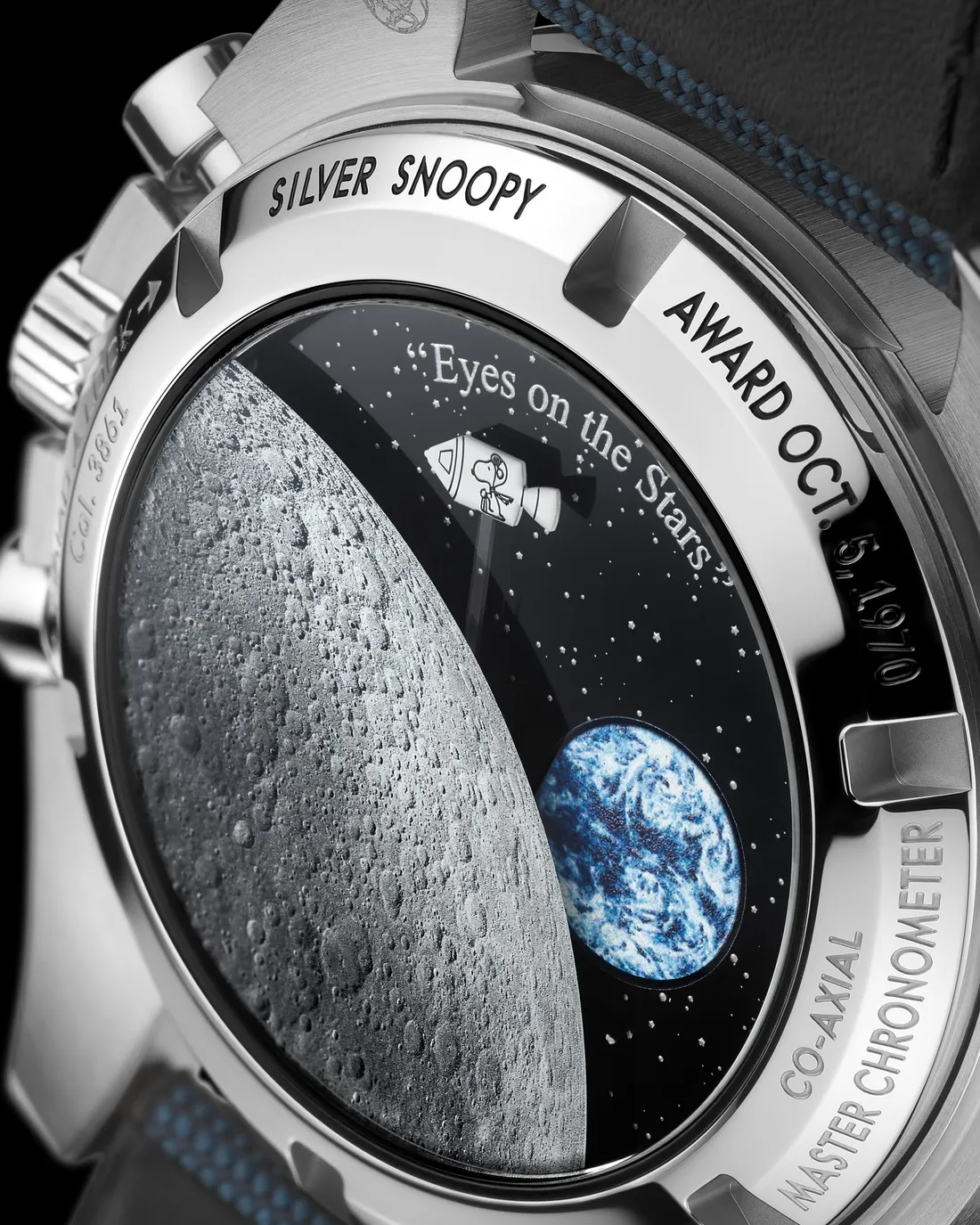
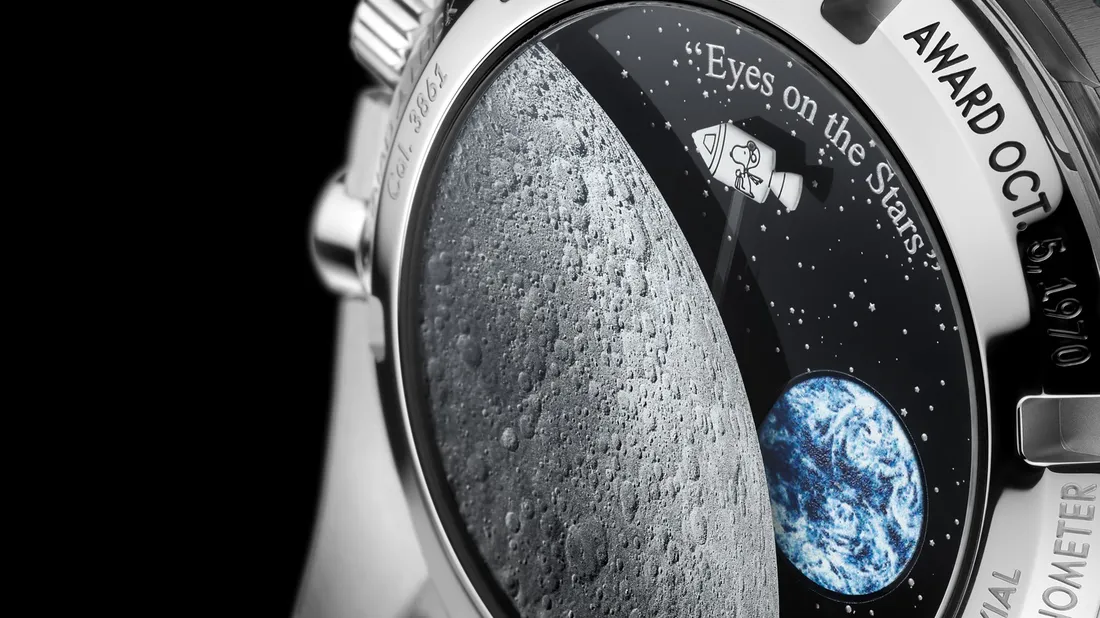
The Moon does not move. The far side of the Moon has been worked onto the sapphire crystal of the caseback using a technique called micro-structured metallisation. The word matters here: not the dark side, the far side. The face the Moon never shows the Earth is not in fact dark, it is merely invisible from where we stand. And that landscape stays still; it is the crystal itself.
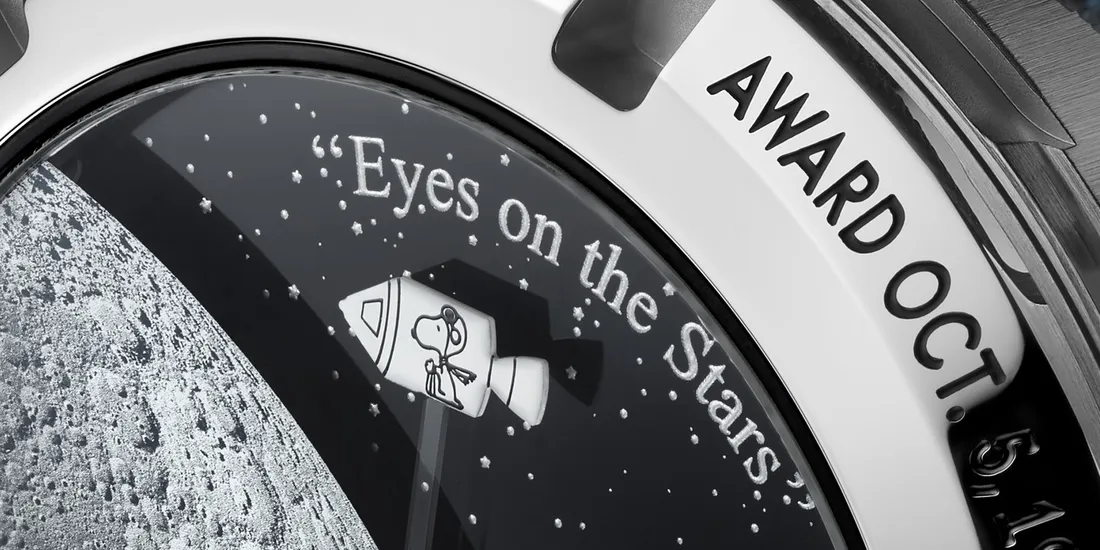
What moves is Snoopy. The moment you press the chronograph pusher on the flank of the case, a mechanical hand beneath the sapphire begins to turn. At the tip of that hand is the command and service module, with Snoopy on board. As the chronograph seconds advance, the module travels across the far side of the Moon. When Snoopy disappears behind that grey surface, what is being represented is the minutes when Apollo 13 lost radio contact swinging behind the Moon, the minutes when everyone on Earth held their breath.
The second motion never stops. Lower down there is a blue Earth disc, and it makes one full turn every minute. What it is coupled to is the small seconds hand at nine o'clock on the front of the dial. Which is to say the hand sweeping over the Snoopy medallion and the Earth on the caseback are fed from the same wheel. When our planet turns, the watch is running; when the watch runs, our planet turns.
Three lines are engraved around the back as well: SILVER SNOOPY AWARD OCT. 5. 1970, CO-AXIAL MASTER CHRONOMETER and, among the stars, one sentence in quotation marks: Eyes on the Stars. On the flank of the case the name of the movement can be read in small letters: Cal. 3861.
This back is secured by a system called NAIAD LOCK, a mechanical solution that keeps the engraving perfectly upright when the back is screwed down tight. If you are staging a scene, that scene cannot be allowed to sit crooked.
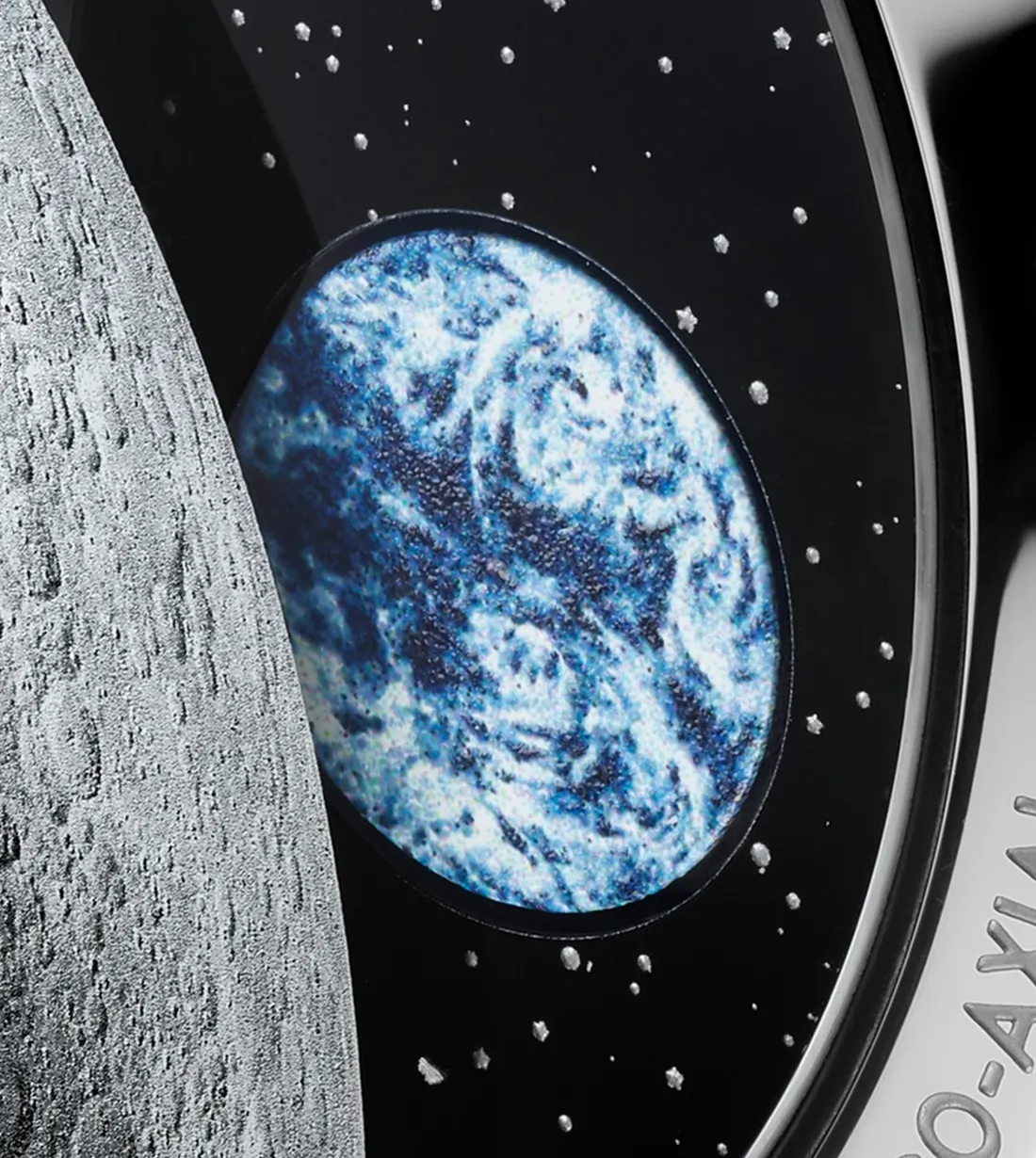
format_quote"When Snoopy disappears behind the far side of the Moon, what is being represented is the minutes when Apollo 13 lost radio contact."
III. Texture and Architecture: Solid Silver and Zirconium
The visual language of the watch rests on a deeper material decision than that of a classic Speedmaster.
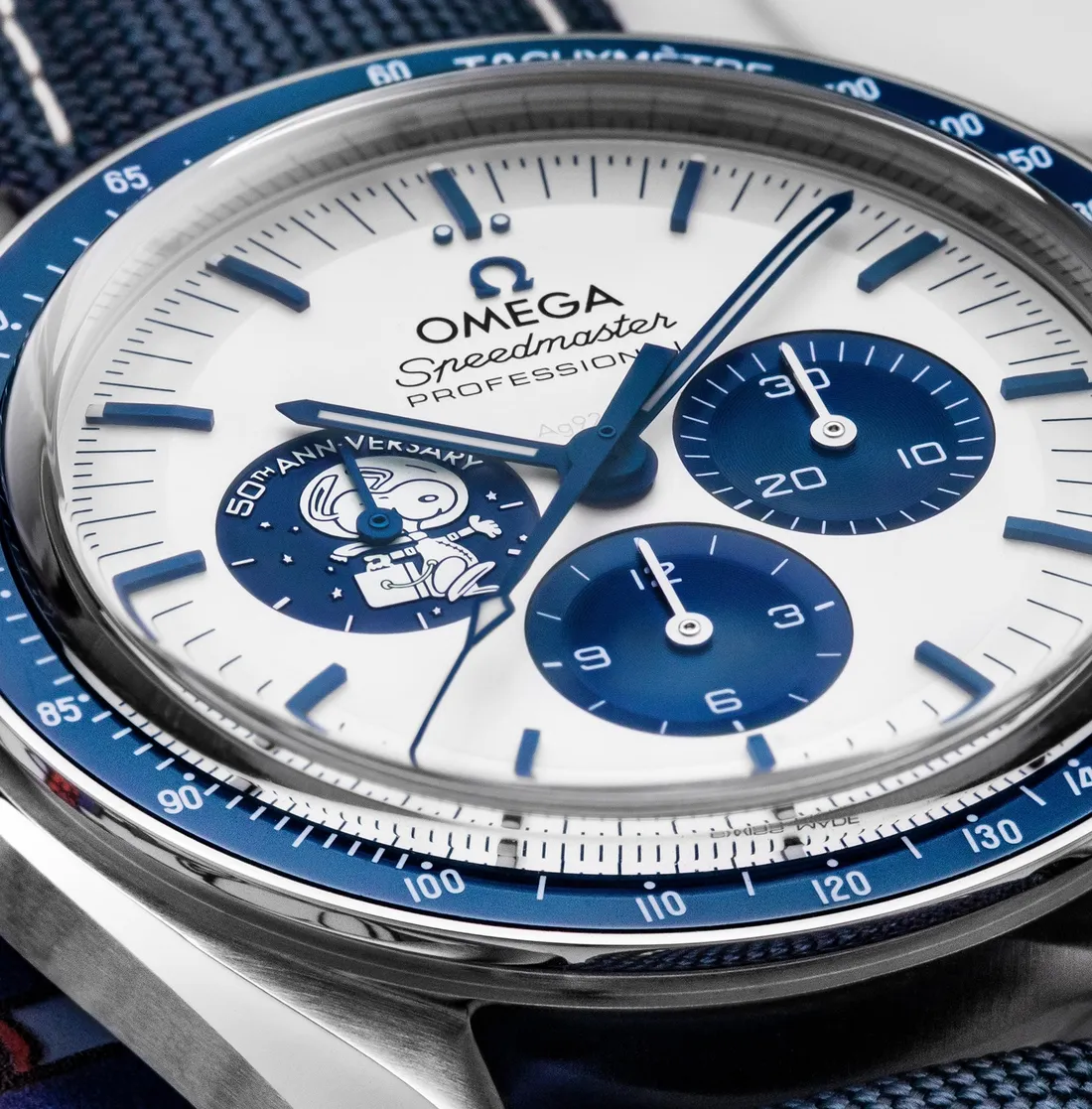
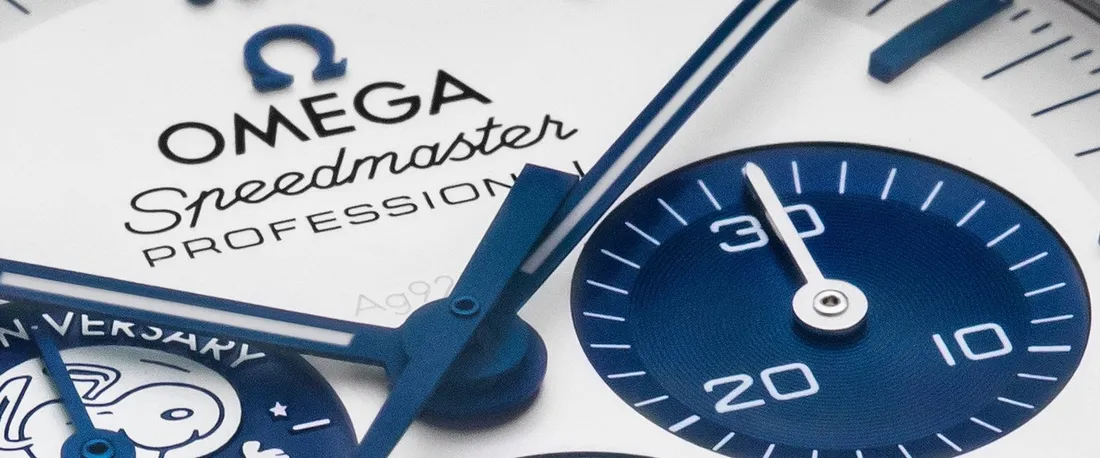
The dial is not painted. It is worked from solid silver, the Ag925 alloy, and that information is laser engraved onto the dial itself: just below the word Speedmaster, in tiny letters, Ag925 can be read. Making a dial out of silver has a visual price, because silver does not shine as evenly as paint; it returns light from beneath the surface and produces a matte but cold nobility. That it takes on a slight patina over time is also in the nature of the material.
The indexes and hands are blue PVD coated. At three o'clock sits the thirty minute chronograph counter, at six the twelve hour counter, and at nine the small seconds. The Snoopy medallion sits on exactly that last subdial; it is in embossed silver and is worked in the same pose as the figure on NASA's real silver pin. Around it runs a line of text: fifty years.
The bezel is blue zirconium ceramic, ZrO2 by its chemical name. The function of ceramic here is not aesthetic but durability: an aluminium bezel scratches and fades over the years, ceramic does not scratch and its colour does not go in the sun. The tachymeter scale on it is filled with white enamel.
And one more detail: the dot belonging to the number ninety on the bezel sits not beside the figure but directly above it. This arrangement, which collectors call Dot Over Ninety, or DON, is the mark of the Speedmaster bezels of the 1960s. The case salutes the same period; it is made to the line of the fourth generation Speedmaster, the first Moonwatch of 1969. Which is to say this watch wears the case and the bezel of the very years its story takes place in.
The strap is blue nylon fabric and it hides a secret: the trajectory of the Apollo 13 mission is embossed on the lining. So when you put the strap on, that trajectory faces your skin. Nobody sees it.
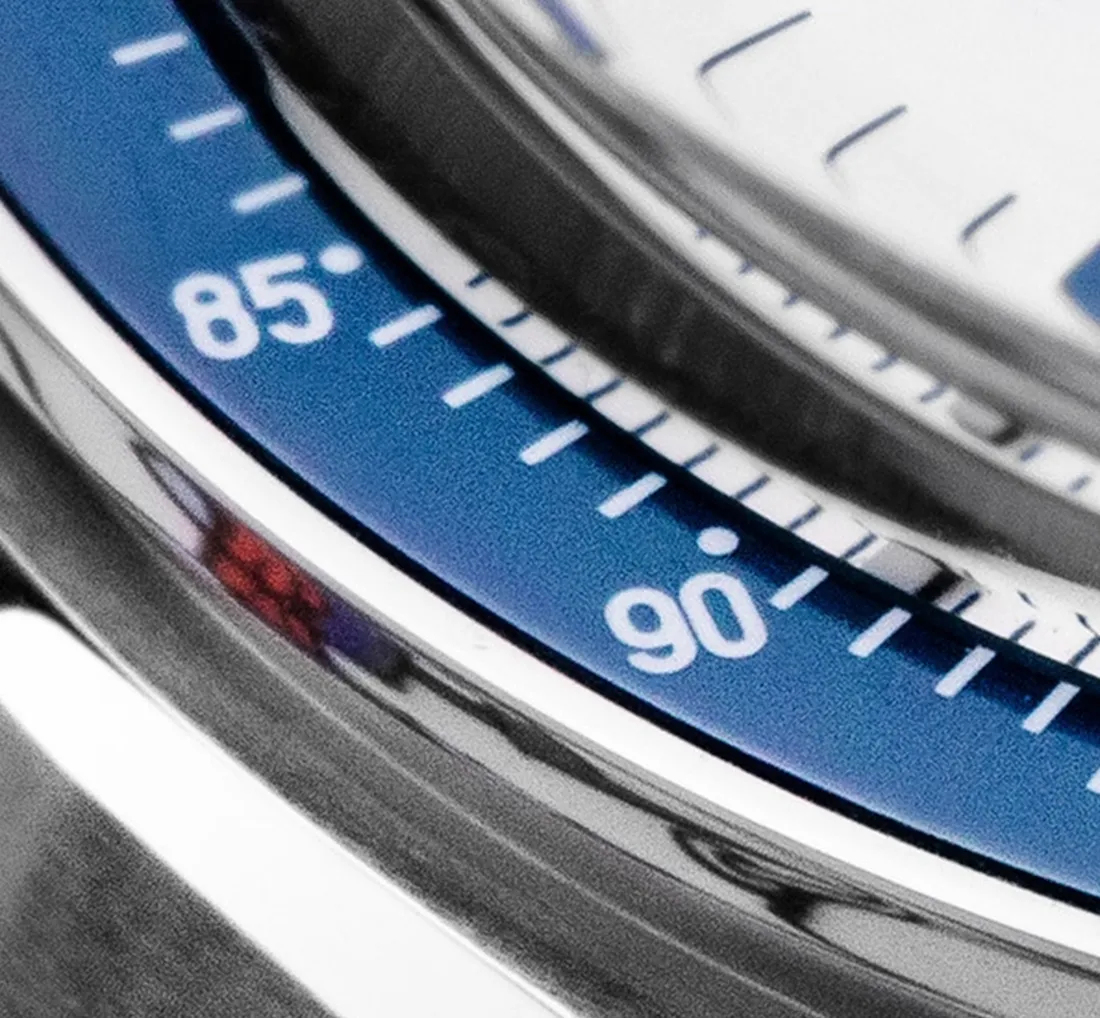
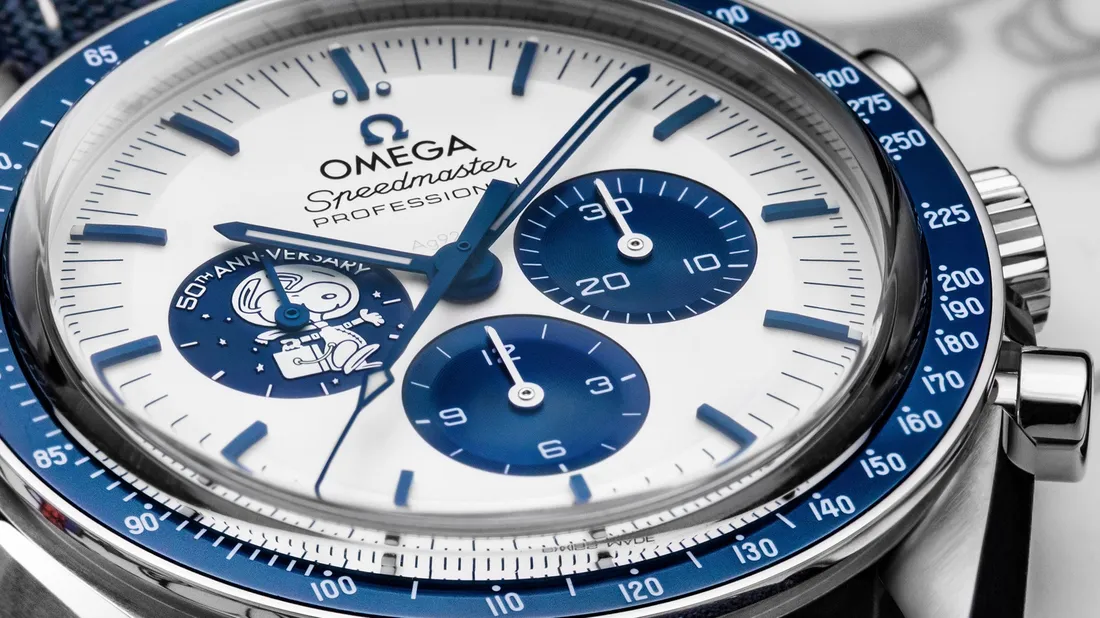
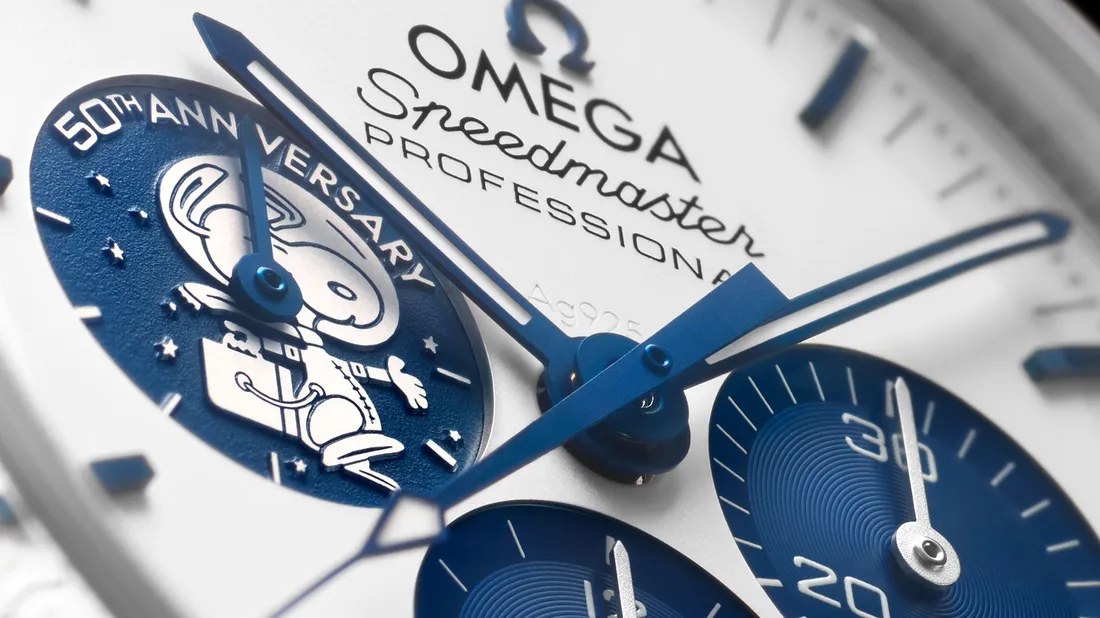
format_quote"The trajectory of Apollo 13 is embossed on the lining of the strap. When you put it on, that trajectory faces your skin. Nobody sees it."
IV. A Shield: Calibre 3861
At the heart of the watch beats the hand wound Co-Axial Master Chronometer Calibre 3861, which carries the manually wound spirit of the first watches that went to the Moon but is armoured with modern laboratory technology.
The Co-Axial escapement is the essence of the matter here. In the classic Swiss lever escapement the pallets transmit force by sliding against the escape wheel; that sliding needs oil, and oil degrades over time, so the watch slowly drifts off rate towards the end of its service interval. The Co-Axial arrangement transmits force not by sliding but as a radial push. The result: less oil, less degradation, the same precision for longer between services.
The balance spring is silicon; Omega calls it Si14. Silicon has two great advantages. First: it is not magnetic and cannot be magnetised. Second: it reacts less than a steel spring to shock and to changes in temperature. Put those two together and the calibre withstands magnetic fields of up to 15,000 gauss. That number is not abstract: the phone cases in our pockets, laptop speakers, bag closures and tablet covers are today the greatest enemies of mechanical watches, and a classic steel spring begins to suffer at around one thousand gauss.
On the certification side Omega uses the Master Chronometer standard, established together with the Swiss Federal Institute of Metrology, METAS. That certificate puts not only the movement but the entire cased watch through eight separate tests and limits the daily deviation to between zero and plus five seconds. Which is to say the watch does not lose time; it only gains a very little.
The power reserve is fifty hours. Water resistance is five bar, that is fifty metres. And the watch is not a limited edition; Omega kept this piece as a permanent member of the collection.
What You Cannot See Is Also a Decision
This needs writing plainly: in this watch you cannot see the movement.
A sapphire caseback is normally there to show the bridges, the wheels and the turning rotor. Here the back is sapphire but a sky has been worked onto the crystal, and the calibre 3861 beneath it is hidden from view. In this piece Omega chose to exhibit not the movement but what the movement is saying.
It is possible to see that as a loss. But the opposite can also be argued: seeing a rotor turn at the back every time you swing your arm is something you have seen on tens of thousands of watches. Seeing a seconds hand turn the story of a photograph taken from three hundred and twenty thousand kilometres away into a rotating planet is not.
And the mechanics of this watch are already at work on the side you cannot see. The transmission running from the small seconds wheel to the Earth disc on the back, the second transmission running from the chronograph seconds to Snoopy's hand; these sit just under the back, where you cannot look. You do not see backstage while you watch a scene. That is rather the point.
A Signature Beyond Time
I put the loupe down on the desk and look at the watch from a distance.
The Omega Speedmaster Silver Snoopy Award is not simply an accessory that measures time. It is the record of the fact that in that cold void three hundred and twenty thousand kilometres away, where digital technology was out of action and the screens had been deliberately switched off, human intelligence, human composure and brass wheels could save a life.
There is a balance in this story that nobody should forget. The watch saved nobody. What saved them was a commander using the terminator as a gunsight, a pilot holding the second axis, a third man calling the count out loud, and hundreds of people doing arithmetic in Houston. What the watch did was humbler: it did not switch off. It asked for no electricity and no screen, it did not overheat and it did not freeze. It simply went on counting.
What you carry on your wrist is not a simple chronograph; it is the proof that the greatest praise for an instrument is to be still working at the moment it is needed.