Murten is a small town and one of the few places in Switzerland where you can still walk along the top of the walls. A covered rampart runs the whole way round; below lies the lake, behind it the vineyards.
The town also stands on a border. Murten speaks German, its French name is Morat, and the language changes in the villages on the far shore. The two great language regions of Switzerland touch here, and neither gives up its own.
Those two facts, the wall and the border, explain the whole story of the place.
On the twenty-second of June 1476, one of the strongest armies in Europe came apart at the foot of these walls.
Charles the Bold of Burgundy had laid siege to the town. The Confederate forces arrived to relieve it and attacked after a morning of rain. Within a few hours the Burgundian army had dissolved, and a large part of those who fled were driven into the lake. This was the second of three defeats, beginning at Grandson and ending at Nancy, and those three battles ended Burgundy’s claim to be a great power.
The Confederates’ weapon was not a special armour or a new gun. It was a dense square of long pikes. The strength of that formation came not from the men individually but from their moving together. A square is an organism: everyone steps at the same moment, the pikes hold a single line, the ranks do not break. The moment they do, the square becomes a crowd, and a crowd does not hold against cavalry.
format_quote"A pike square is an organism. The moment the ranks break it becomes a crowd, and a crowd does not hold against cavalry."
Hasan Bekmezci
The best known story about this battle almost certainly never happened.
A young man is said to have run from Murten to Fribourg with the news of victory, to have entered the square holding a branch of linden, cried out that they had won, and fallen dead. The branch was planted and the tree is said to have lived for centuries.
Historians place the shaping of that story much later, in the nineteenth century. It is still told, and there is a reason it survives: it sums up a world in which the speed of news was limited by the body carrying it. In that age, the speed of a message was the speed at which a person could run.
The battle itself became an enormous painting in 1893. Louis Braun made the Murten Panorama: a canvas about ten metres high and a hundred metres long, curved all the way round. The viewer stands at the centre and cannot find the edge of the landscape surrounding him.
format_quote"The speed of a message was the speed of a running man. News could not travel faster than the body carrying it."
Hasan Bekmezci
What keeps a pike square standing has a name in physics too: synchronisation.
The first person to study it carefully was Christiaan Huygens. In February 1665 he was ill, and in his room hung two of his pendulum clocks from a single wooden beam. Whenever he started them at random, within half an hour the two settled into opposite swings and stayed there. He separated them, started them again, and the same thing happened. Huygens called it an odd kind of sympathy.
The connection ran through the beam. Each pendulum, as it swung, applied a very small force to the beam; the beam carried that force to the other pendulum; and the pair settled into the arrangement that cost them least energy. Neither was commanding the other. Two independent oscillations came to an agreement because they could feel each other.
format_quote"Neither one commands the other. Two independent oscillations come to an agreement because they can feel each other."
Hasan Bekmezci
The same effect has a darker side, and armies paid to learn it.
In 1831 the Broughton suspension bridge near Manchester collapsed under a detachment of soldiers marching across it in step. As the rhythm of the steps approached the bridge’s own swing, each step amplified the one before. After that, the order to break step on a bridge became standard.
The same thing happened in reverse in London in 2000. On its opening day the Millennium Bridge began to sway sideways, and the people crossing it, trying to keep their balance, unconsciously matched their steps to the sway. The people did not synchronise the bridge; the bridge synchronised the people, and the sway grew. The bridge was closed and fitted with dampers.
Coupling, in other words, is not always a benefit. Whether it helps depends on the phase relationship the two oscillations settle into.
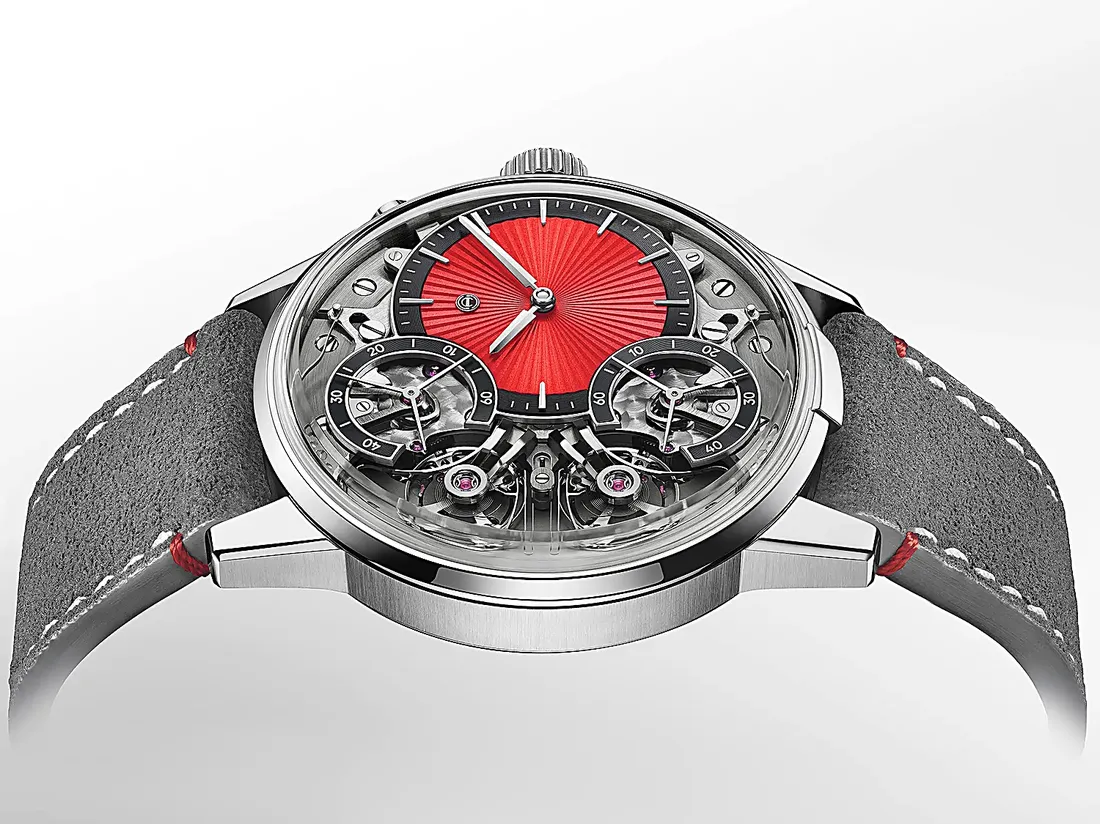
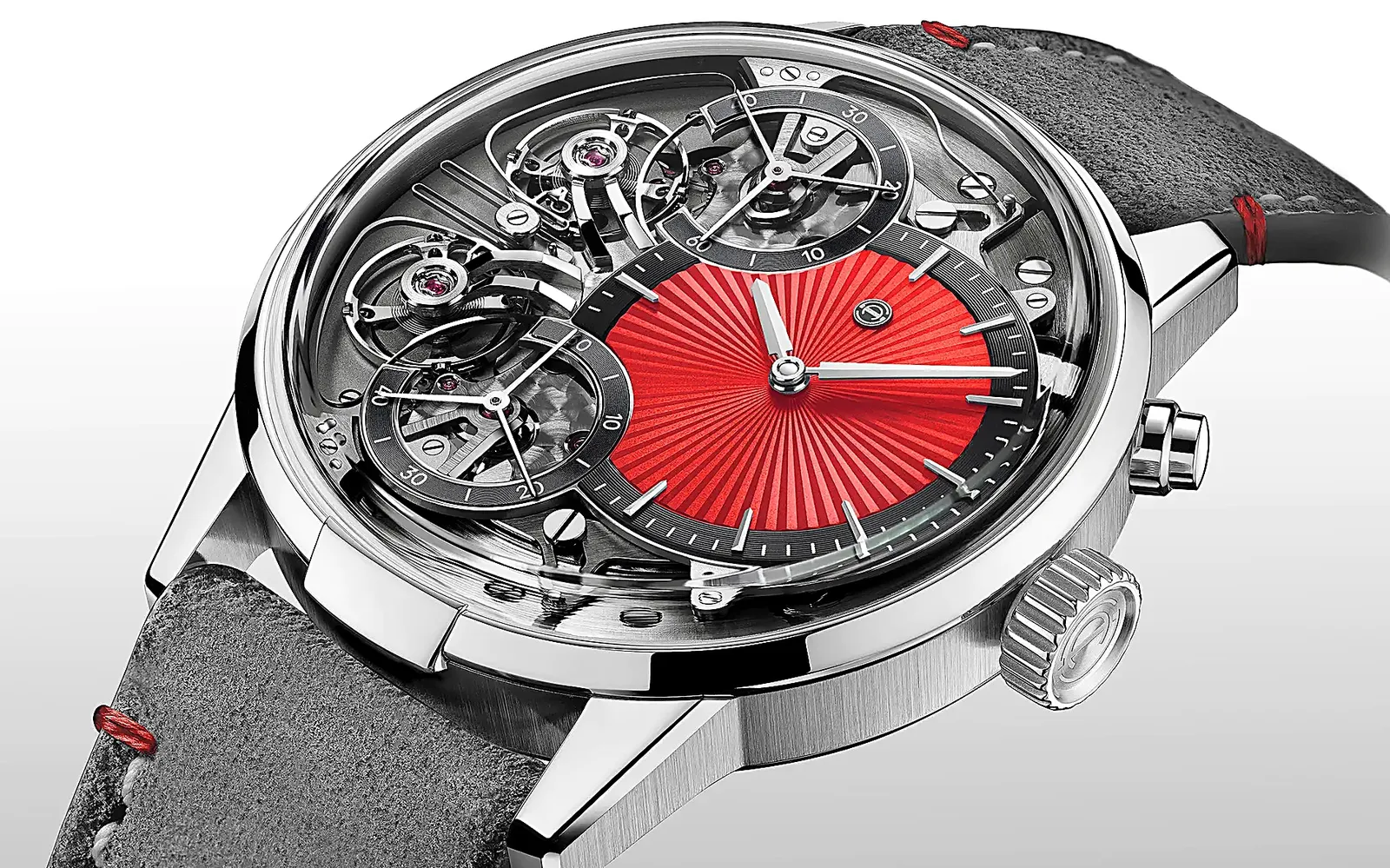
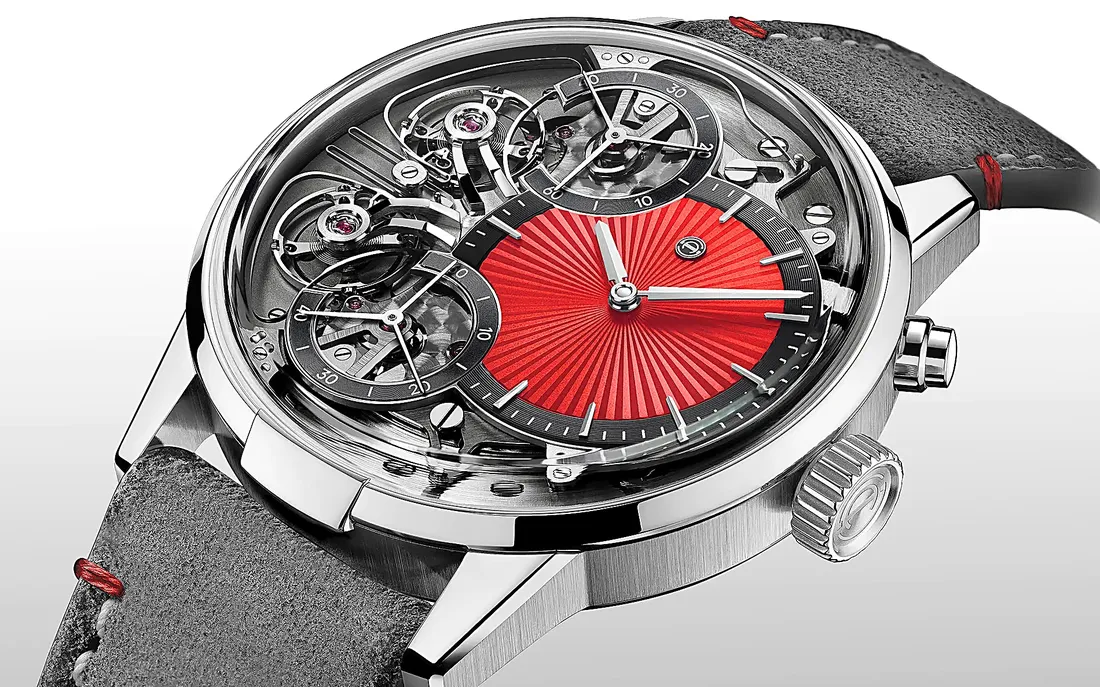
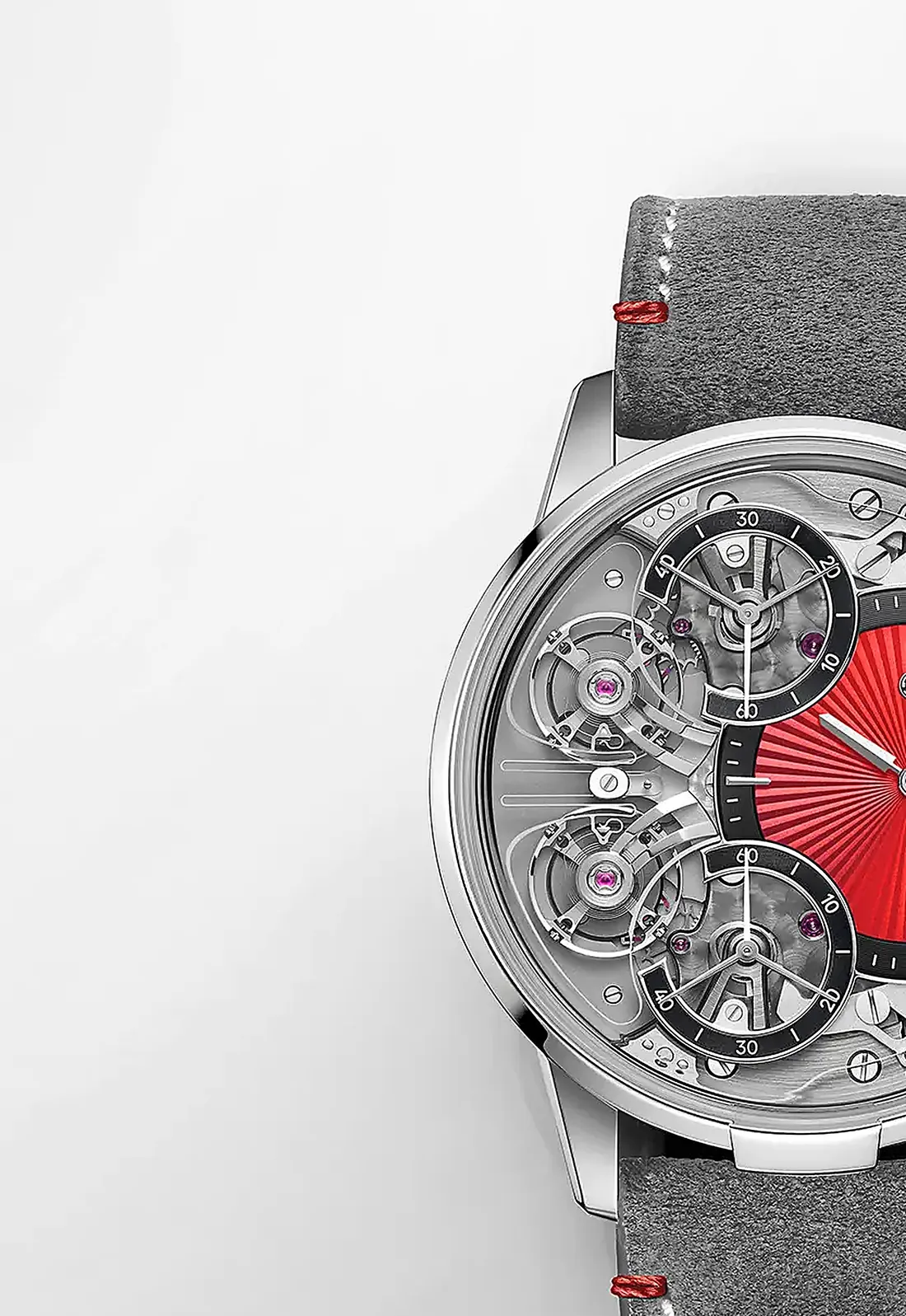
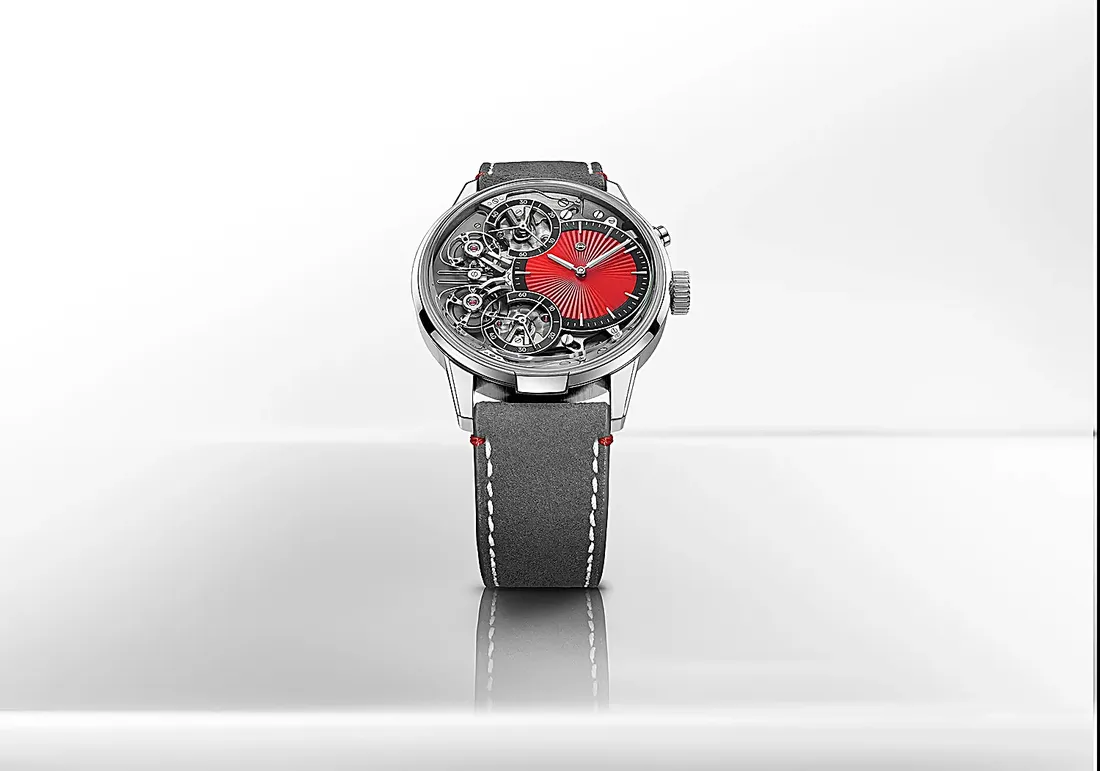
The Mirrored Force Resonance Red, introduced by Armin Strom in July 2026, is one of the few watches that carries this effect on the wrist.
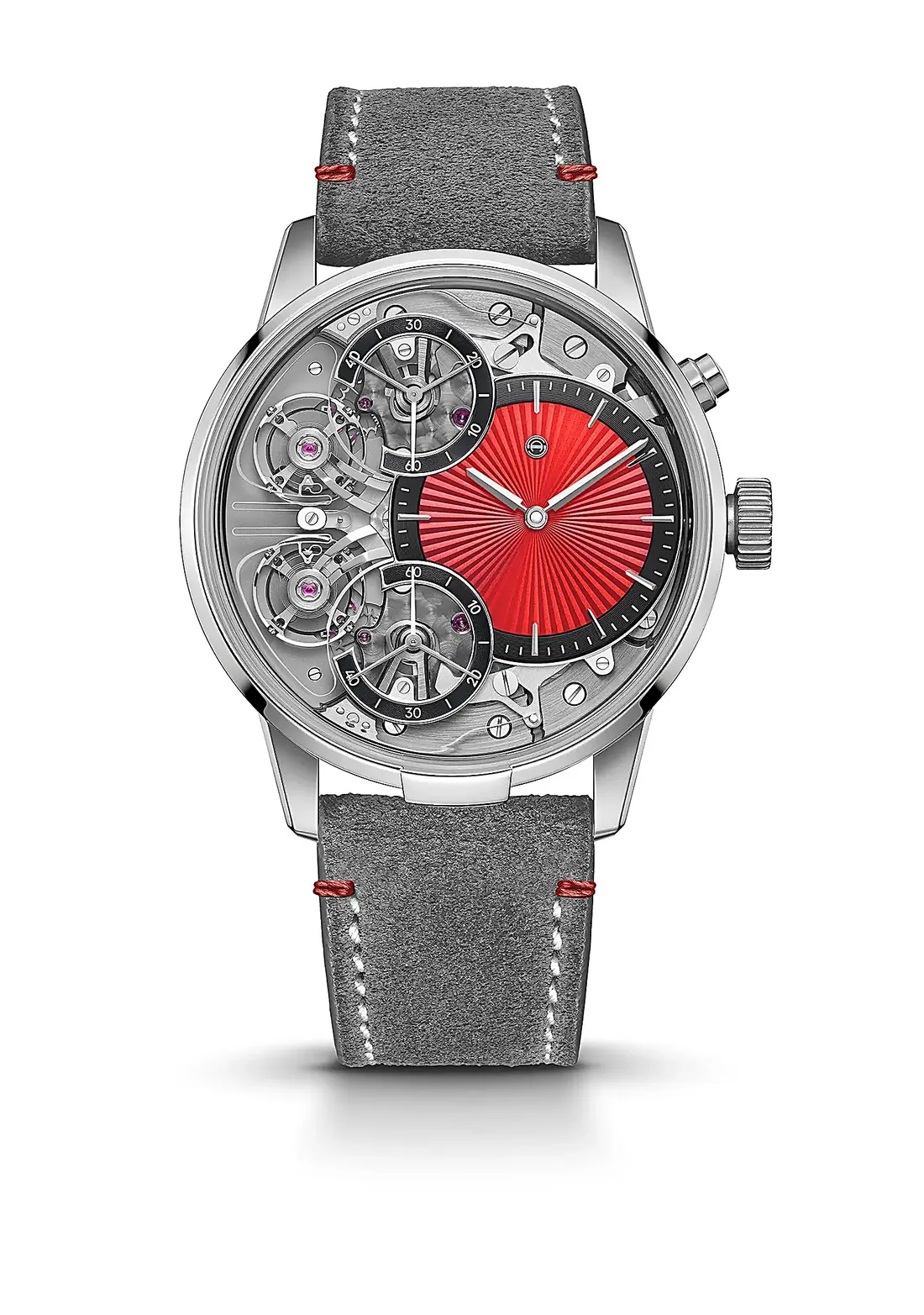
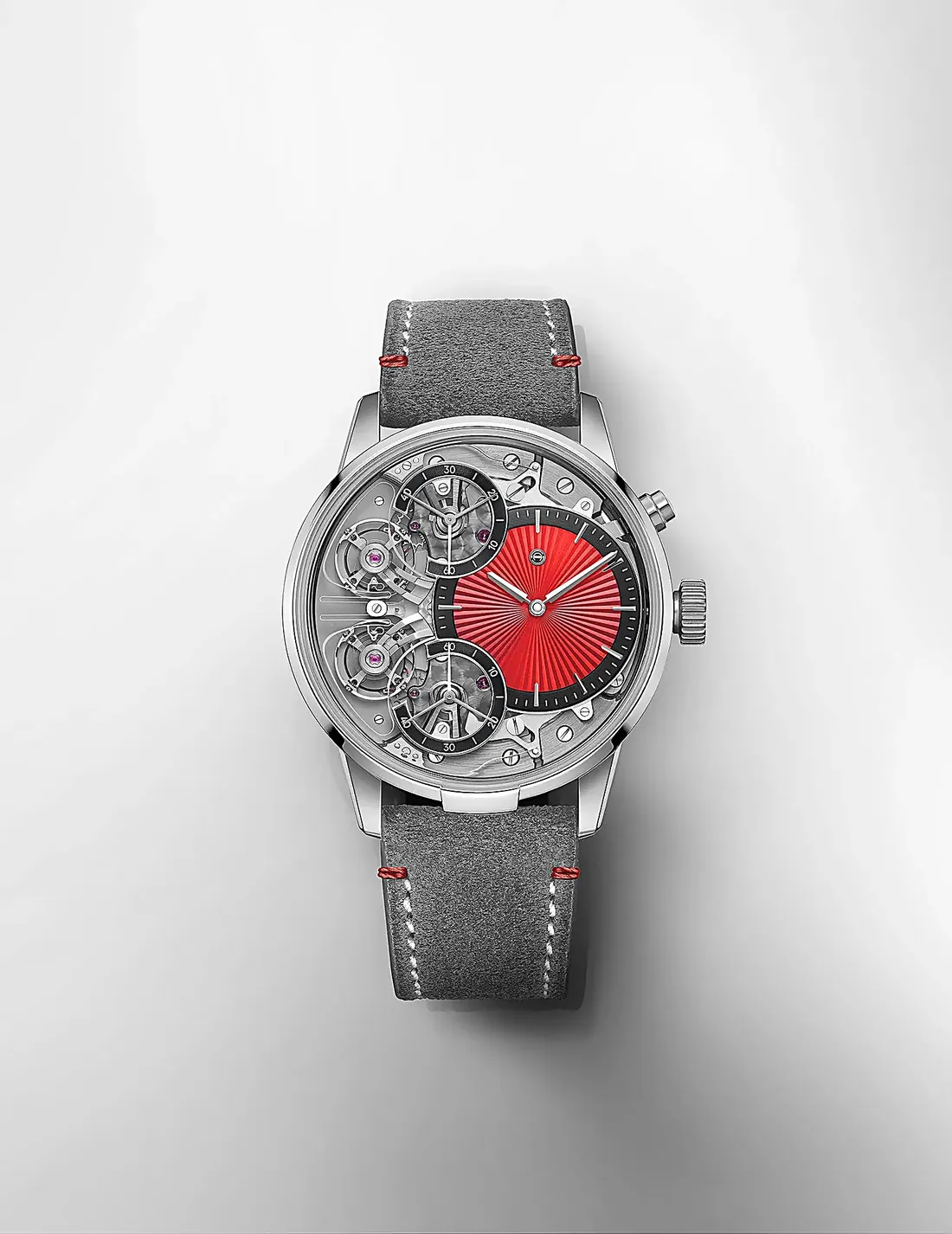
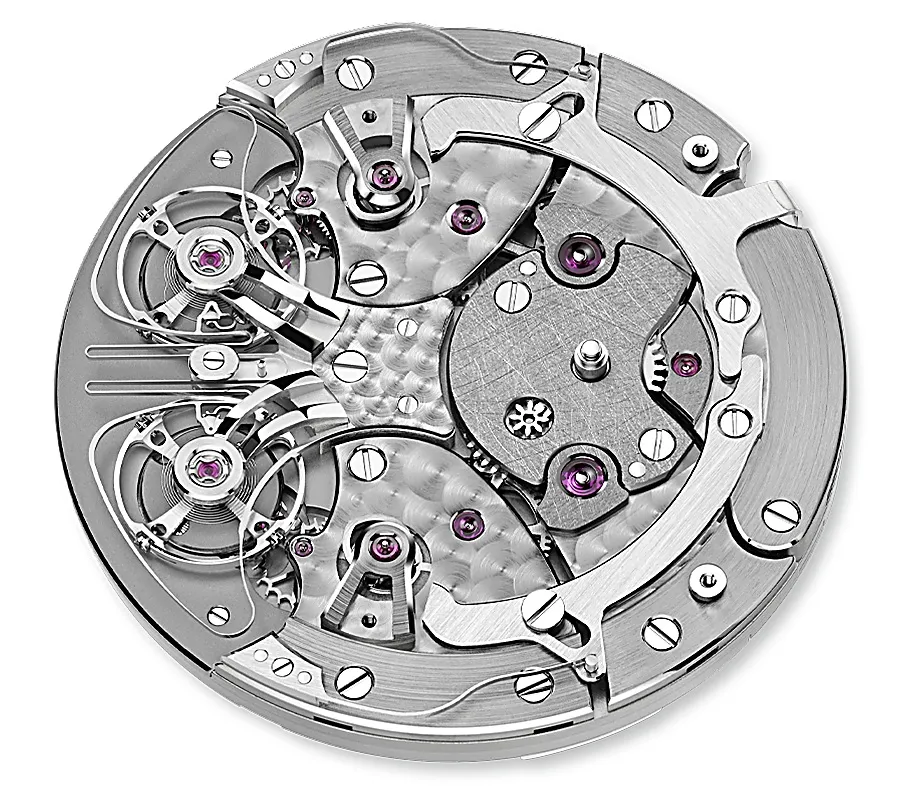
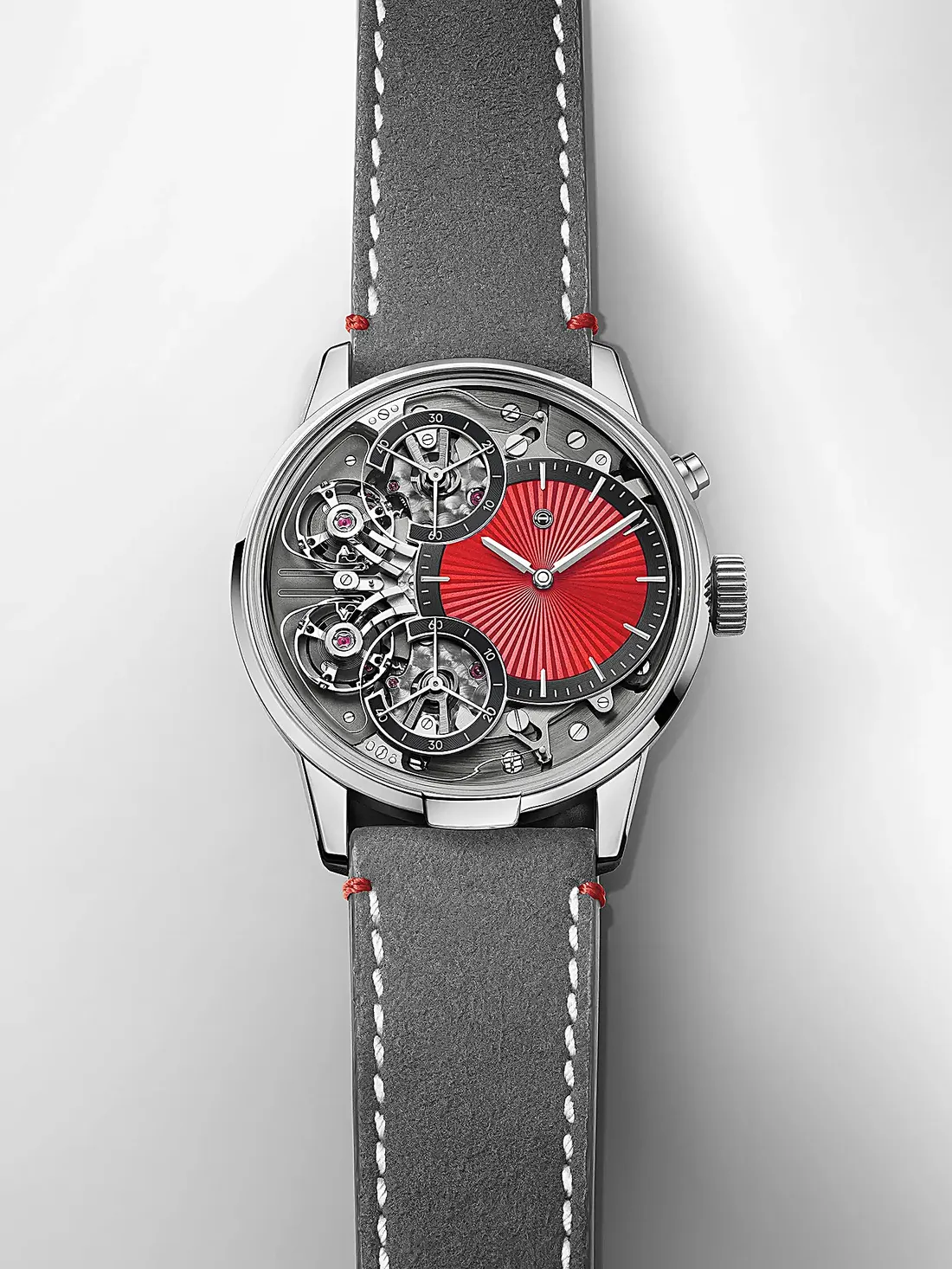
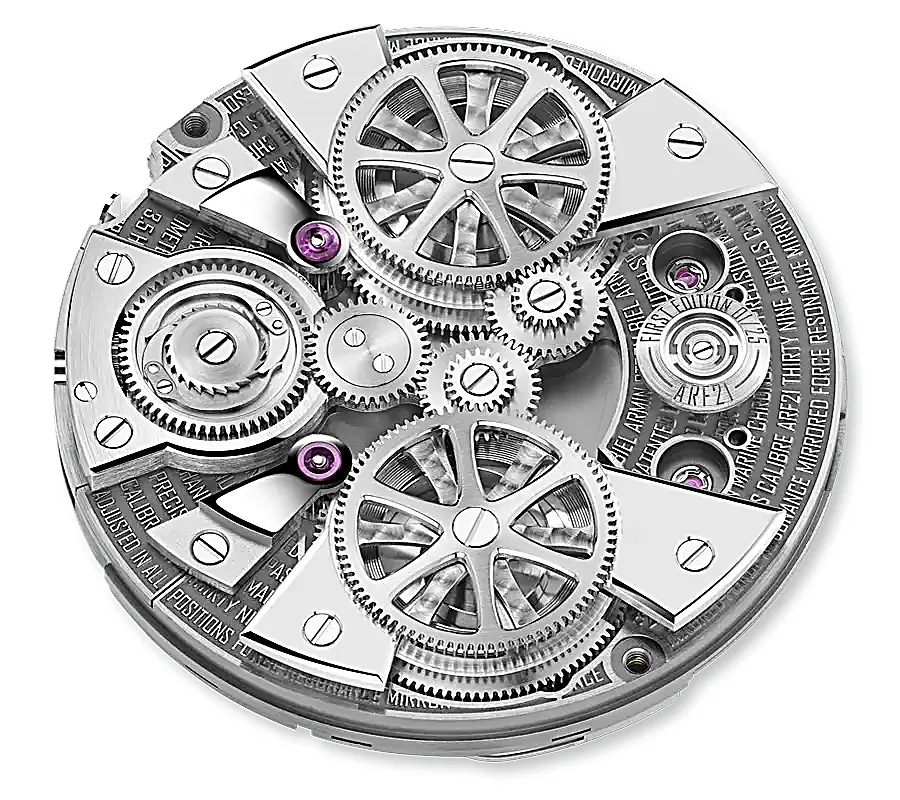
The ARF21 calibre inside holds two complete movements in a single body. Each has its own barrel, its own gear train, its own escapement and its own regulating organ, so there are technically two watches running in one case. The two balance wheels swing in opposite directions, and between them sits the house’s patented resonance clutch. That spring continuously exchanges the vibrations of the two wheels, and after a while they enter a shared arrangement and hold it.
The gain lies here. When one balance takes a knock from outside, its rate changes for an instant. If the two are coupled, that change is shared between them and averaged out, so the daily error becomes smaller and steadier. It is also why the dial carries two separate seconds displays. A pusher at two o’clock resets both seconds hands at the same moment, so you can watch with your own eyes as the two independent movements fall back into step.
Put a historian standing in front of the Murten panorama next to the watchmaker who adjusts these two balances, and the conversation would be short.
The historian would say: the side that won here was not braver, it was better coordinated. Five thousand men walking as a square are a different thing entirely from five thousand men running loose. The difference is not in the number but in the bond between them.
The watchmaker would say: my two balances are the same. Each can run alone, and left alone they will drift apart over time. Put that spring between them and they begin to hear one another, and within a few minutes they settle into a shared arrangement. I am not telling them what to do. I am only opening a path along which they can hear each other.
The figures run as follows. The case is steel, forty-three millimetres across and eleven point five five millimetres tall, with anti-reflective sapphire on both faces and a water resistance of three atmospheres. The calibre beats three and a half times a second, twenty-five thousand two hundred vibrations an hour, and gives eighty hours of reserve. The red off-centre section of the dial is guilloché, cut on a hand-operated rose engine; the rings around it are finished in black azuré, and the faceted hour markers are mounted on those rings so that they hover just above the guilloché. The bridges are coated in anthracite. Bevels are polished by hand, surfaces frosted, screws black-polished, and the technical inscriptions on the reverse of the main plate are raised in relief rather than engraved into it. Each watch is assembled twice. The edition runs to fifteen pieces.
The thought that follows fits the town and the watch equally well.
For two independent things to find a common rhythm, neither has to govern the other. What is needed is a path of contact between them. In the pendulums that path was a beam, in the watch a steel spring, in the town a shared wall and a shared danger. Agreement is not imposed from above; it establishes itself once the two sides can hear each other.
This tendency is not a human invention. It is a disposition placed in matter, and all we did was notice it and set it inside a case. Huygens found it from a sickbed, engineers paid for it on bridges, watchmakers turned it into an advantage. In all three the human act is the same: reading an order that was already there.
Walking the walls of Murten, perhaps that is what comes to mind. Five hundred and fifty years ago there were two languages here, cantons unlike one another and one shared fear, and although they stood apart they found the same step. The same town lives with two languages today and nobody has given up either. The Creator arranged a world in which separate things can stand together without spoiling one another. The two balance wheels on a wrist are a small proof of it.
The watch on its maker’s own site: Armin Strom, Mirrored Force Resonance Red