A stonemason working on a thirteenth-century cathedral began knowing he would never see the finished building. If he was forty when the foundations went down, his great-great-grandchildren would be alive when the tower was closed. All he could do in a lifetime was cut his own stone correctly.
Most of these people left no name either. They scratched a mark under an arch, carved a small face into a capital, and went. What moved them was not the hope of seeing the building finished, because they had no such hope. What moved them was that it would be finished.
Making an object to a scale longer than your own life is one of the strangest and most serious things a person can do. And there is a watch doing it today.
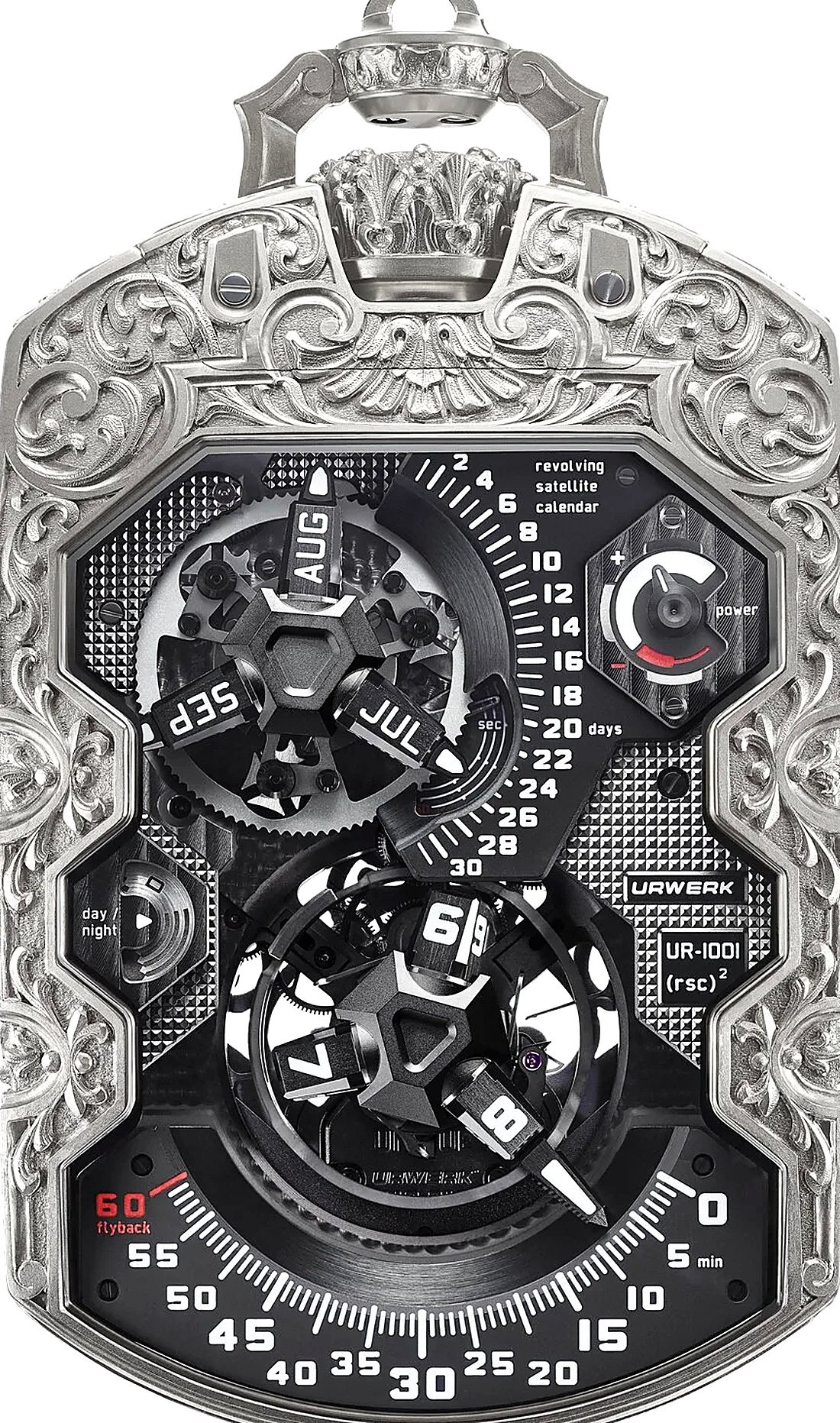
Urwerk’s UR-1001 is not a wristwatch but a pocket watch, or more accurately an instrument panel that settles into a palm. At over ten centimetres it belongs to an older world, one in which a man carried a tool in his coat. The idea inside it, however, is new.
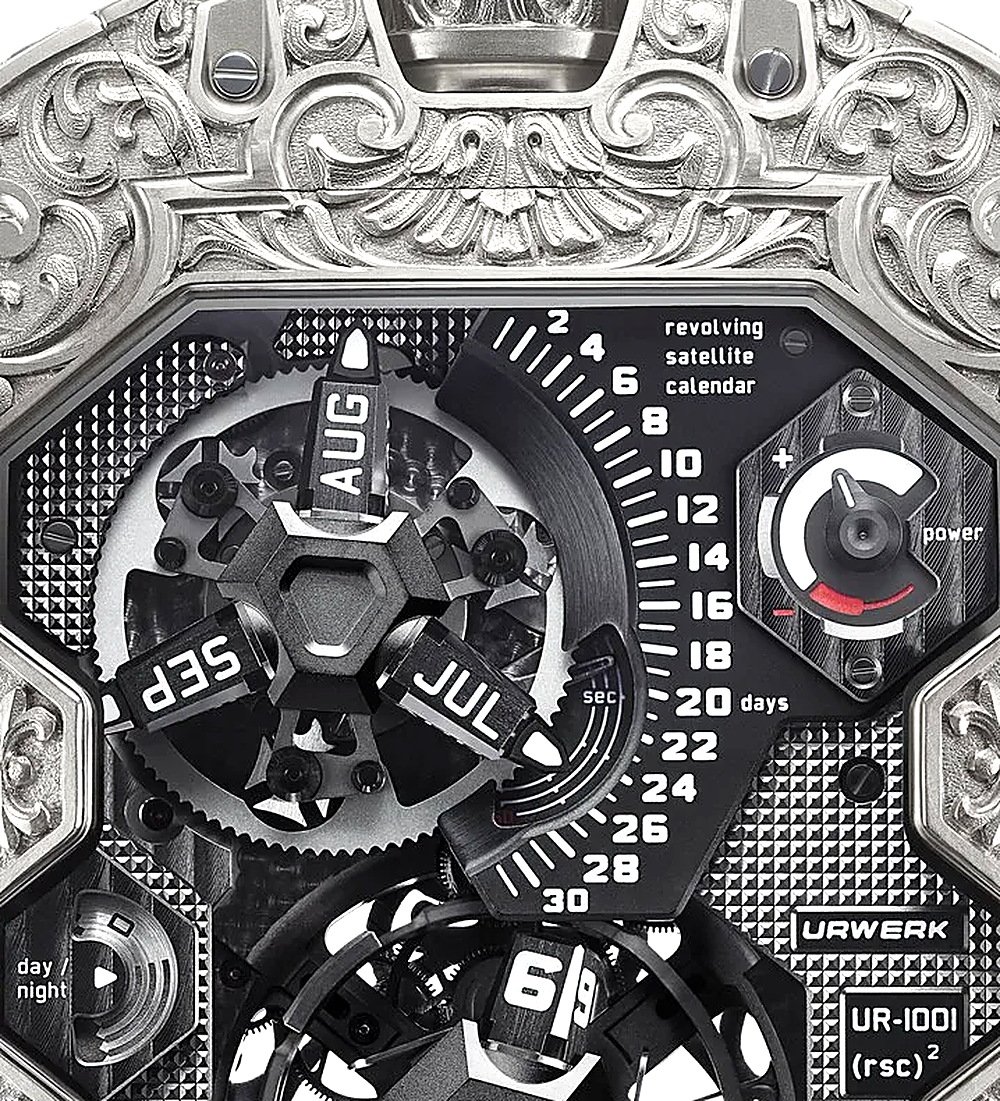
The upper half of the dial carries the satellite hour display that has become Urwerk’s signature. There is no conventional hour hand. Small cubes ride on a rotating carrier, each of them bearing an hour, and each travels along an arc so that it shows the minutes as well. When the arc runs out the cube withdraws and the next one comes forward. The hour does not advance. It changes guard.
Below it, the seconds run inside a sector, but not under a single hand: they are laid out in three separate twenty-second spans across a hundred and twenty degree field. That division does not make the reading easier, and it feels designed instead to slow the eye down. Then comes a day and night indicator, and after that a thirty-nine hour power reserve.
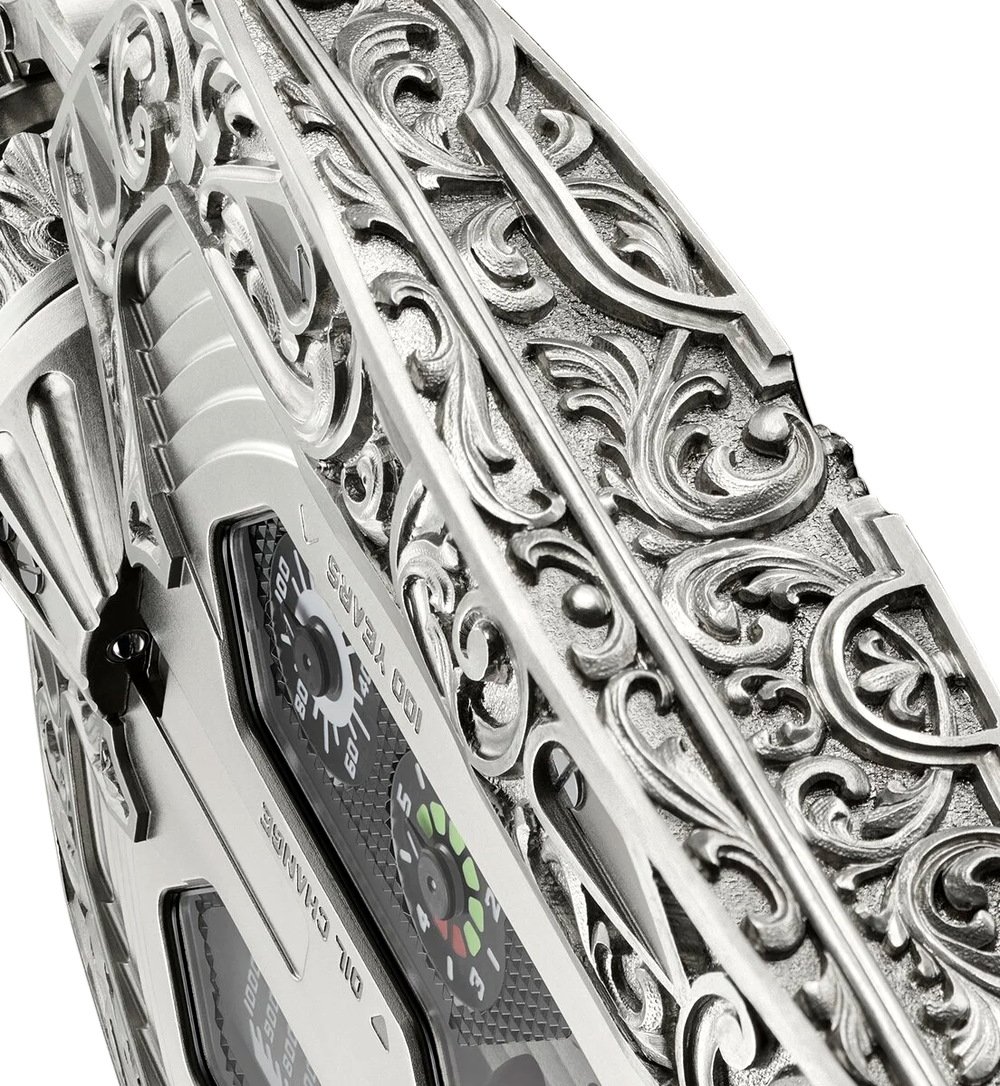
And then the scale changes. The same dial carries a service indicator that fills over five years, a counter telling you how old the oil in the movement has grown. Beside it, an indication that counts a hundred years. At the bottom, a linear scale advances, and that scale runs end to end once in a thousand years.
Its owner will use none of these three. You might see the five-year one turn over twice. You will never see the hundred-year one turn over at all. Nobody will see the thousand-year one; over an entire human life that pointer travels about a tenth of its own width.
Spending components to count a number you cannot live to read looks at first like showmanship. It is not. Because those indications are there, the watch becomes something else: no longer an instrument serving you, but a witness walking alongside you and intending to keep walking afterwards.
format_quote"The smallest indication moves every twenty seconds and the largest once in a thousand years. The distance between them is where a person sees his own scale."
Hasan Bekmezci
All of it is driven by a movement called UR 10.01, running on fifty-one jewels at 28,800 vibrations an hour with a thirty-nine hour power reserve. Thirty-nine hours is an almost sardonic figure for an object that counts a millennium: an instrument thinking on the scale of the sky stops after less than two days and waits for somebody to wind it. For the thousand-year pointer to advance at all, someone has to pick this watch up every other day.
That is the most honest detail in it. Continuity does not happen by itself. Every generation winds its own share.
format_quote"For the thousand-year pointer to advance, somebody has to pick the watch up every other day. Continuity does not happen by itself."
Hasan Bekmezci
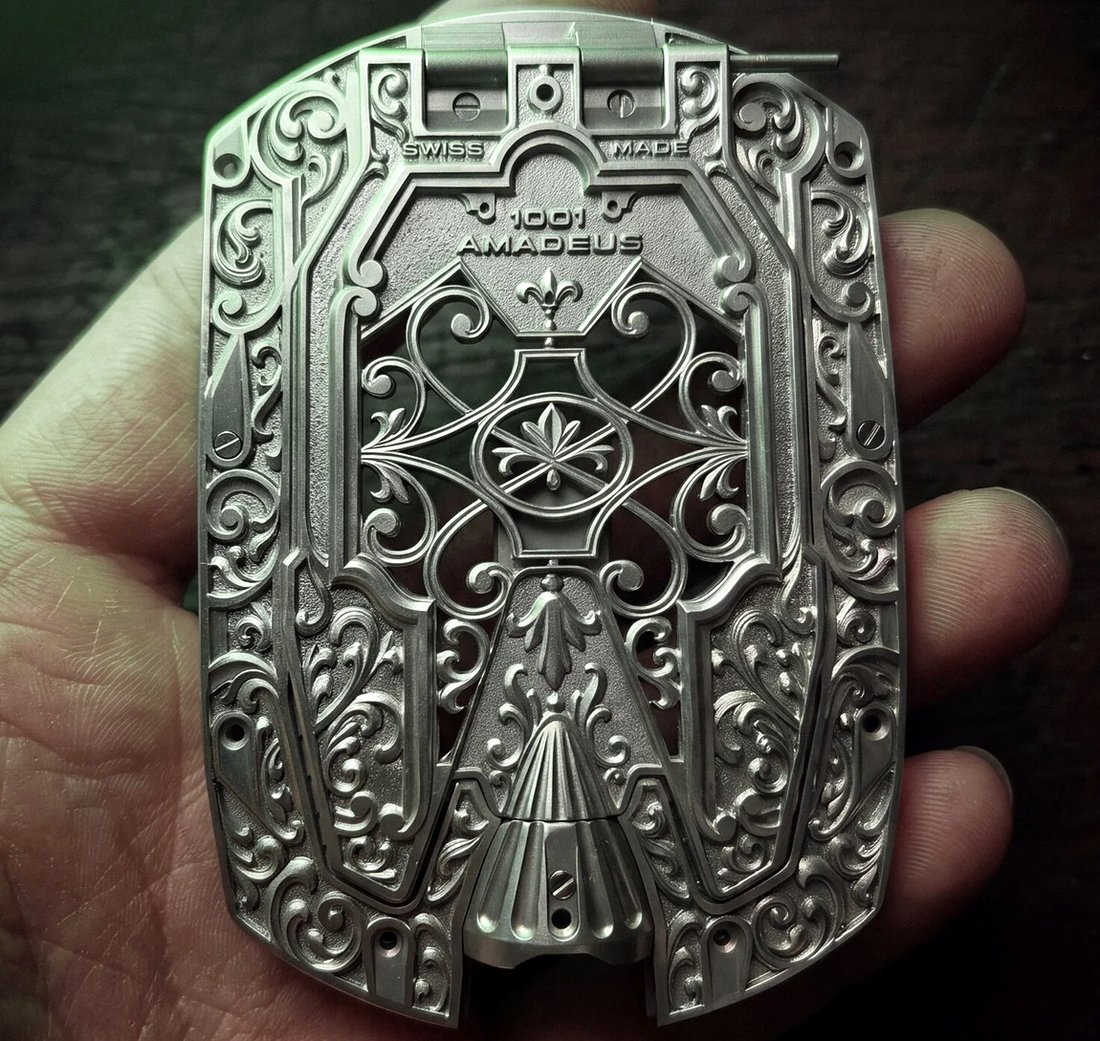
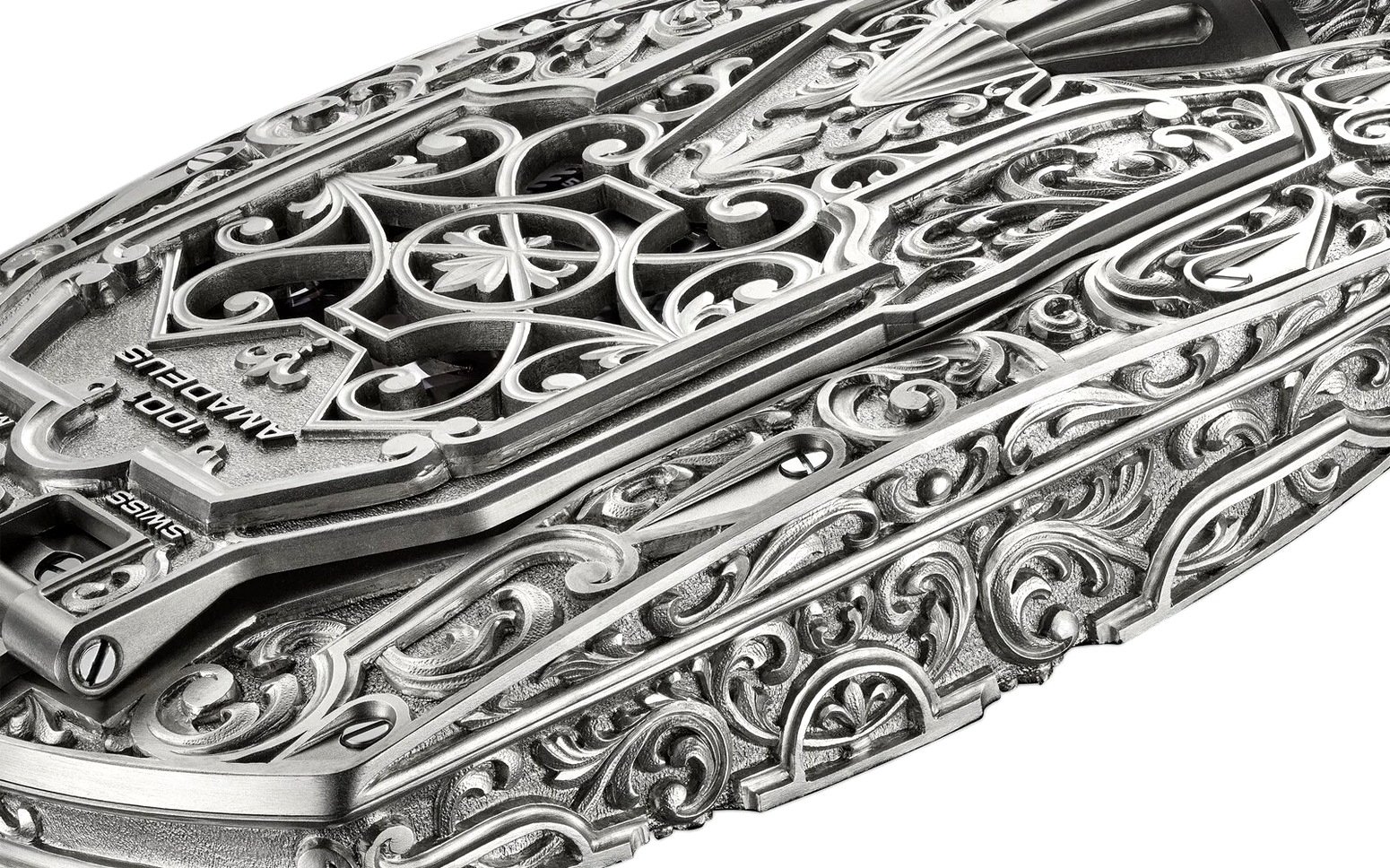
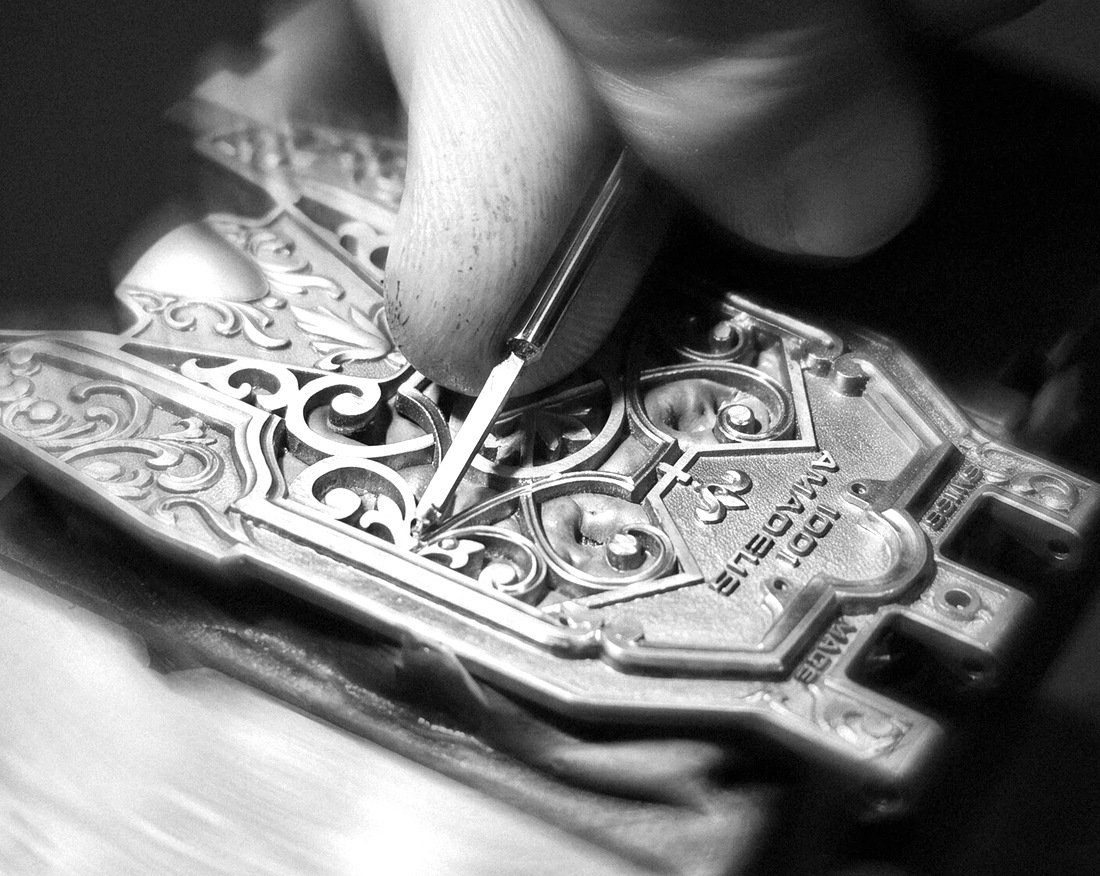
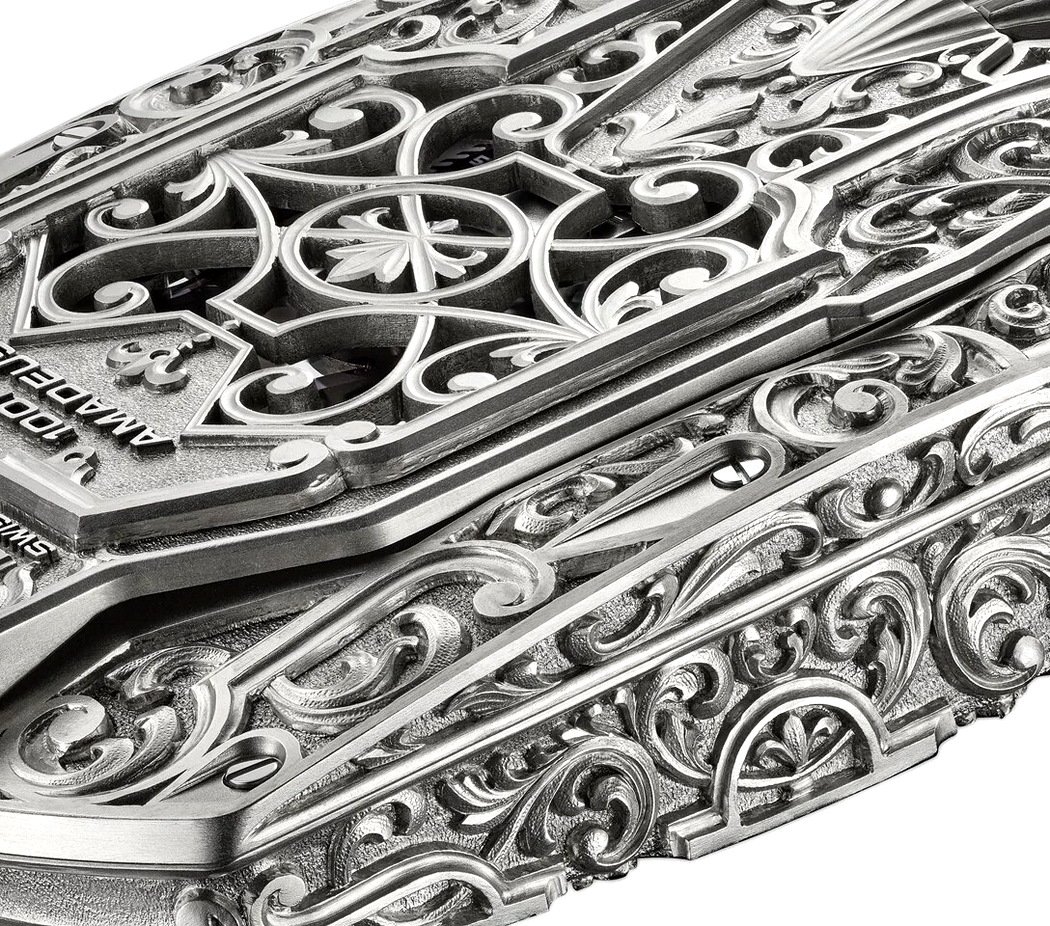
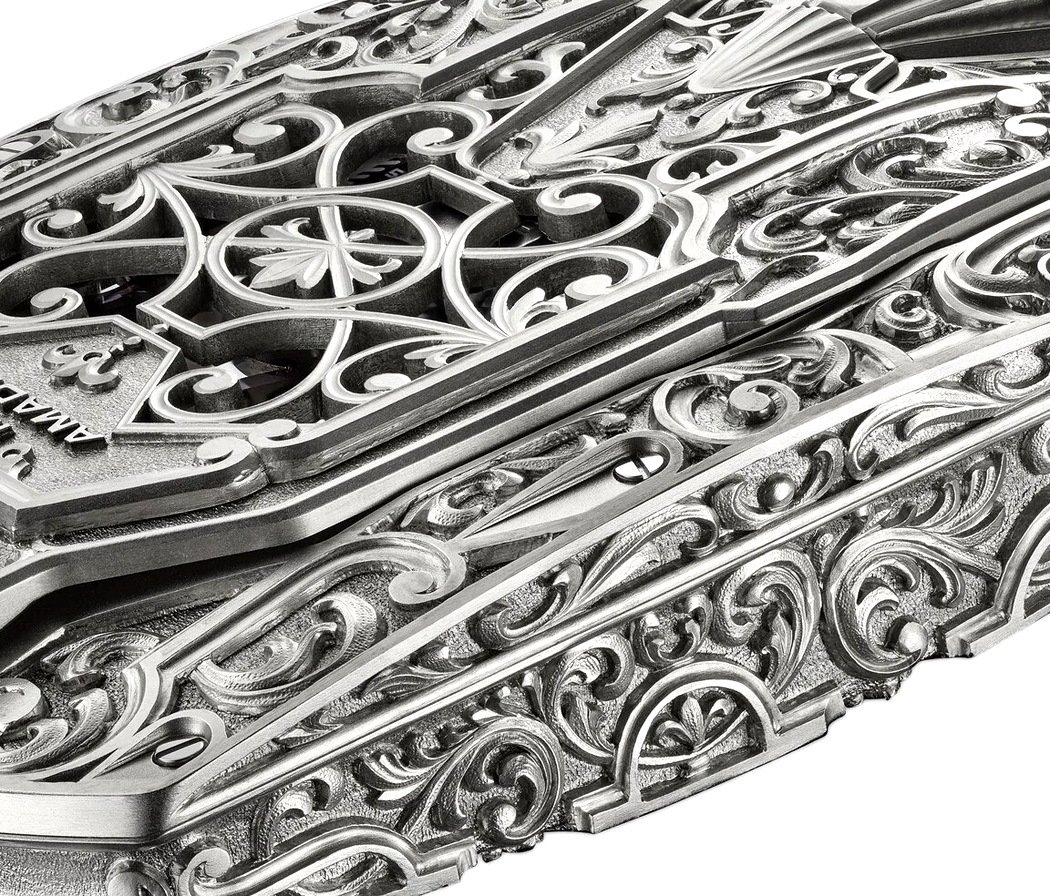
What makes Amadeus a single piece is not the movement but the shell. Every surface of the case has been cut by hand in a baroque idiom: curling leaves, bent stems, hatched grounds. The work was done by the German engraver Florian Güllert and took roughly five hundred hours, which is close to three months.
There is a technical difficulty here that tends to go unmentioned. Engravers traditionally work in gold, silver or soft steel. Those metals give the graver a clean chip, leave a tidy cut edge and forgive a mistake up to a point. Titanium is none of that. It is hard, it blunts a tool quickly, it tears rather than cuts, and it seizes when it heats. Hatching a baroque ground into titanium is like working granite instead of marble: the same pattern, several times the resistance.
Güllert therefore took a mixed route. The rough outlines were prepared by laser, the actual cutting was done with a pneumatic graver, and the finishing was carried out with files and by hand. What results is a surface with two textures: raised lines left bright, and behind them a hatched matte ground. Without that contrast the engraving would catch no light and would read from any distance as a flat grey smear.
The name Amadeus does not look accidental either. Baroque ornament is the decoration hung around a musical phrase: less important than the melody, and yet without it the piece dries out. The curls on a watch case work the same way. They contribute nothing to the accuracy of the movement, and that is exactly why they are there.
Set the figures side by side. An assembly measured in hundreds of hours, an engraving of five hundred, and an indication that spans a thousand years. What emerges from that arithmetic is not a luxury object but a position on time.
format_quote"The mason cut his stone properly and left. Nobody knows which stone was his, but the building is standing."
Hasan Bekmezci
The cathedral mason cut his stone properly and left. Nobody today knows which stone was his, but the building is standing. This single Urwerk does something similar: it sets up a scale longer than any one life and hands the keeping of that scale not to an owner but to a succession of them.
The thousand-year pointer is not moving today. It will not move tomorrow either. But each time the watch is wound, whoever winds it puts a small signature on a very distant date without noticing.