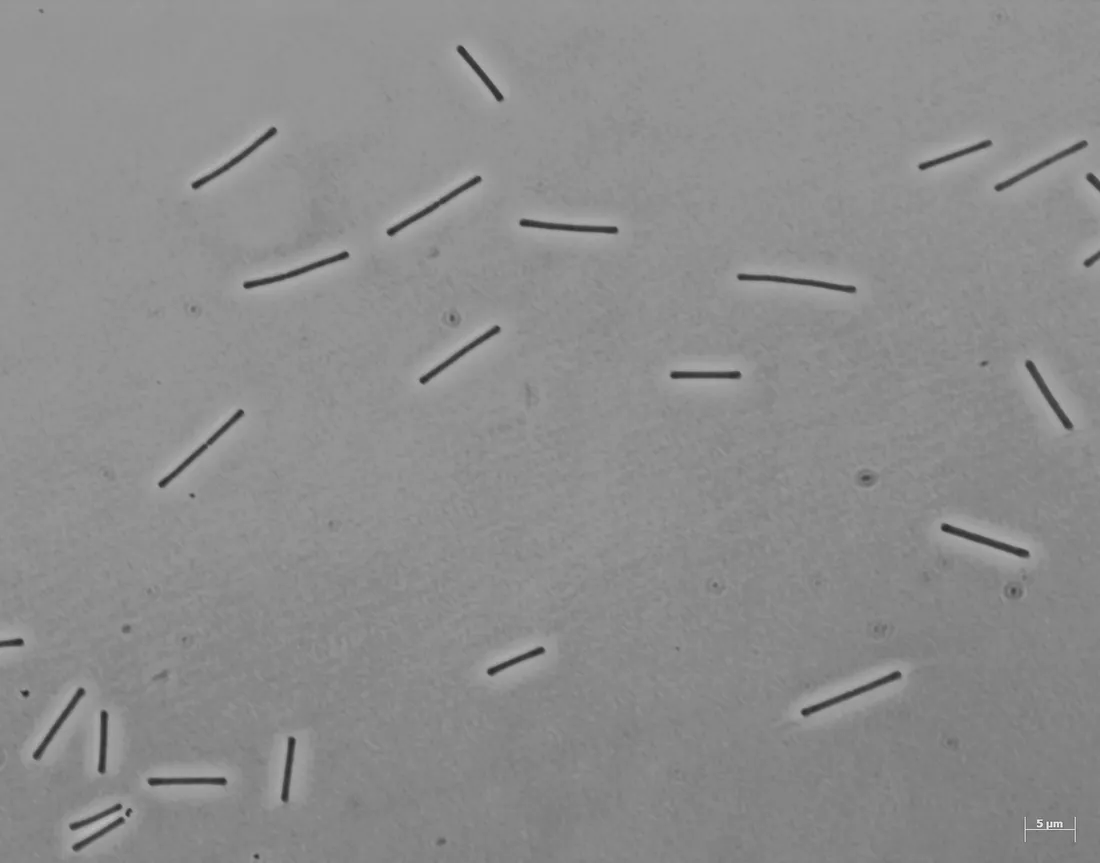
In the middle of September, at three in the afternoon, the pressure laboratory in the basement of a marine microbiology institute was quiet. Inside a steel culture vessel the water stood at a hundred and twenty two degrees, and it stayed liquid only because two hundred atmospheres were pressing down on it. Two people stood at the vessel: the microbiologist Dr Harun Soylu and the thermophilic enzyme specialist Dr Nevin Derin.
On the screen the cell count was climbing. At a temperature that would curdle the proteins, the DNA bonds and the enzymes of an ordinary organism in seconds, like the white of an egg, Methanopyrus kandleri was not merely surviving. It was dividing.
Remember the hard thermodynamics we were taught at school, said Dr Soylu. A hundred degrees is where water boils, above it every organic tissue breaks, proteins collapse, life ends. Heat is biology’s final enemy.
We took heat for a purely destructive energy, said Dr Derin. But this creature is not even a bacterium; it belongs to the archaea. And an archaeal membrane is assembled differently from ours. In our membranes the fatty tails hold onto glycerol through an ester bond, and an ester bond comes apart in water at this temperature. In archaea the same joint is made with an ether bond, and an ether bond does not break in boiling water. The whole difference is one bridging oxygen, and that bridge carries the limit of life forty degrees higher.
Three comparisons are enough. The first is a material that does not melt: throw ordinary plastic into a kiln and it runs, while certain ceramic composites do not soften at all but crystallise and grow harder. The second is an engine running backwards; this organism does not die at room temperature but neither does it multiply, and its pistons only begin to turn above about eighty four degrees. The third is the joint itself: if the membranes of other living things are sewn with cotton thread, this one is welded with steel cable.
The strain was raised in 2008 from a sample taken at the Kairei hydrothermal vent field in the Indian Ocean and pushed in the laboratory to a hundred and twenty two degrees. That is still the highest temperature at which any organism is known to reproduce. One point is worth holding onto: the temperature is only possible under pressure, because without it the water turns to steam and there is no liquid left to live in. What makes the life possible is not heat alone but the narrow band that heat and pressure hold open together.
format_quote"What carries the limit of life forty degrees higher is a single bridging oxygen."
Hasan Bekmezci
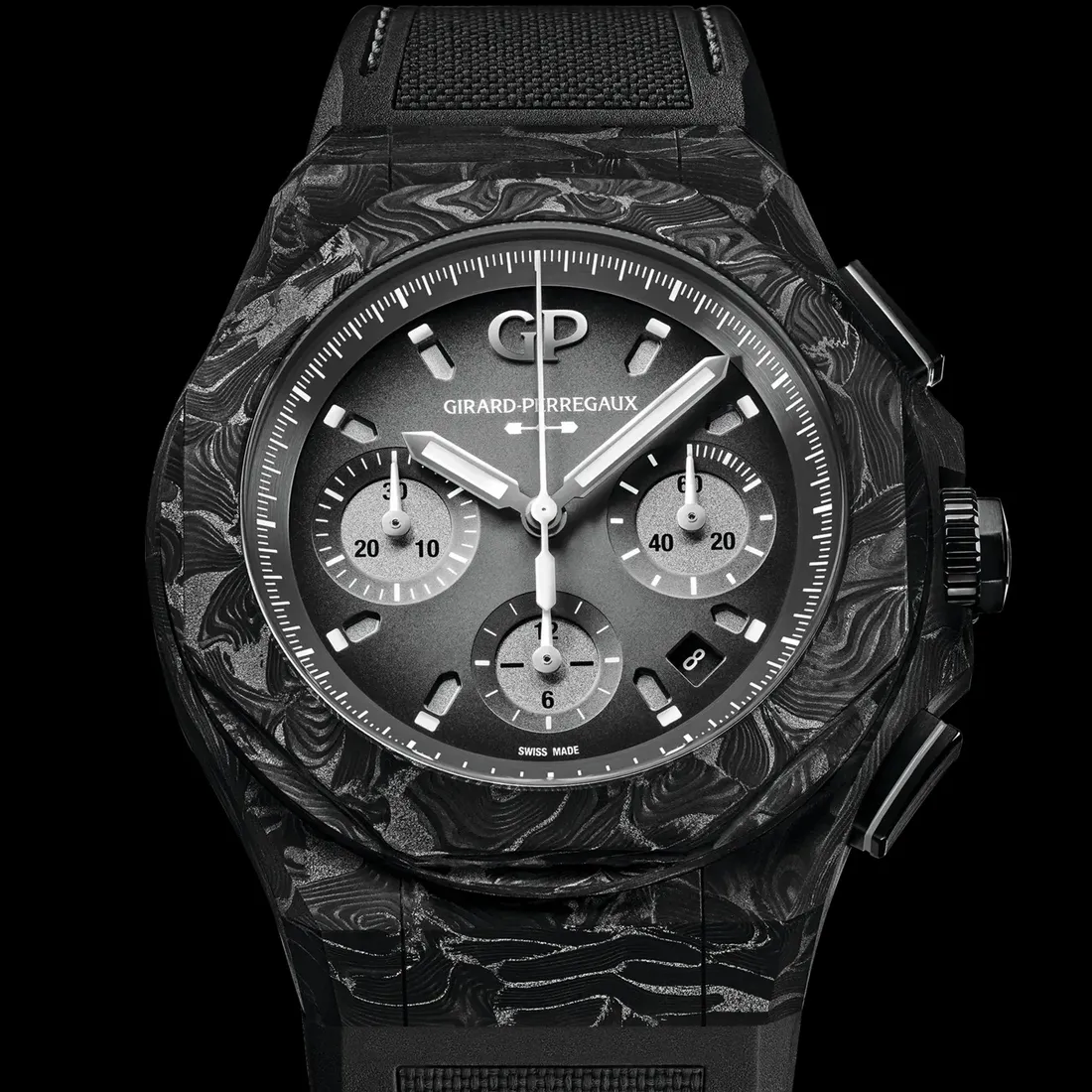
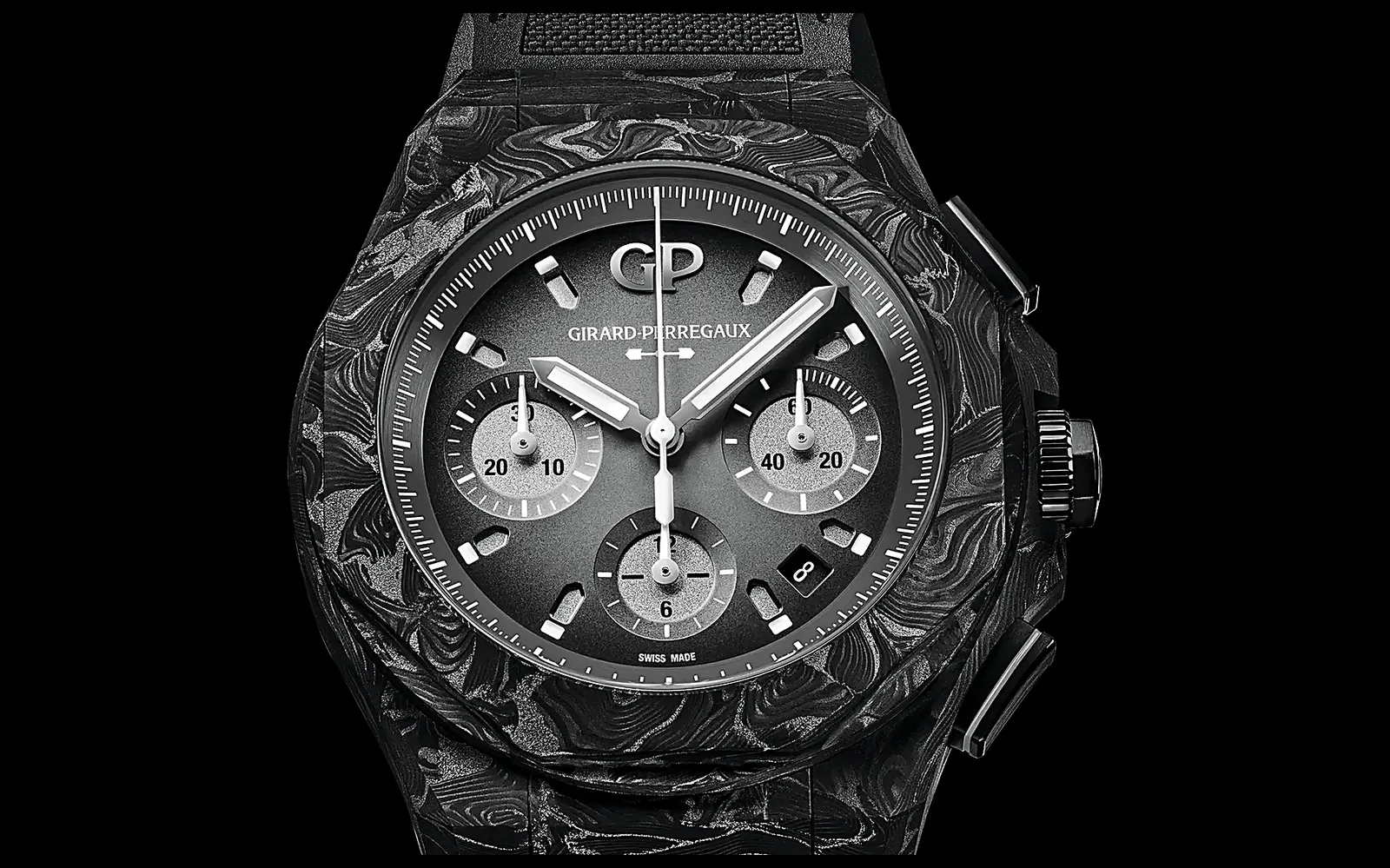
Heat and pressure work together in a watch case too. Since presenting the Laureato Absolute family in 2019, Girard-Perregaux has kept experimenting on the material side, and the method it calls 8Tech is where those experiments stand today.
The case is not milled from a single block of metal. Carbon parts cut into octagons are poured into a mould, resin is added, and the whole mass is turned into one body under heat and pressure. Because the parts fall into the mould at random, the resulting figure never repeats. When the case is machined, the cut faces of those octagons surface and leave a wavy texture that Girard-Perregaux itself likens to Damascus steel. The octagon is no accident: the Laureato’s signature since 1975 has been its octagonal bezel.
The result is a carbon and titanium composite five times lighter than steel, with strength and rigidity that stand comparison with it. The forty four millimetre case is water resistant to a hundred metres, and sapphire closes it front and back.
format_quote"The parts fall into the mould at random, so the same figure never comes back. Every case is one of one."
Hasan Bekmezci
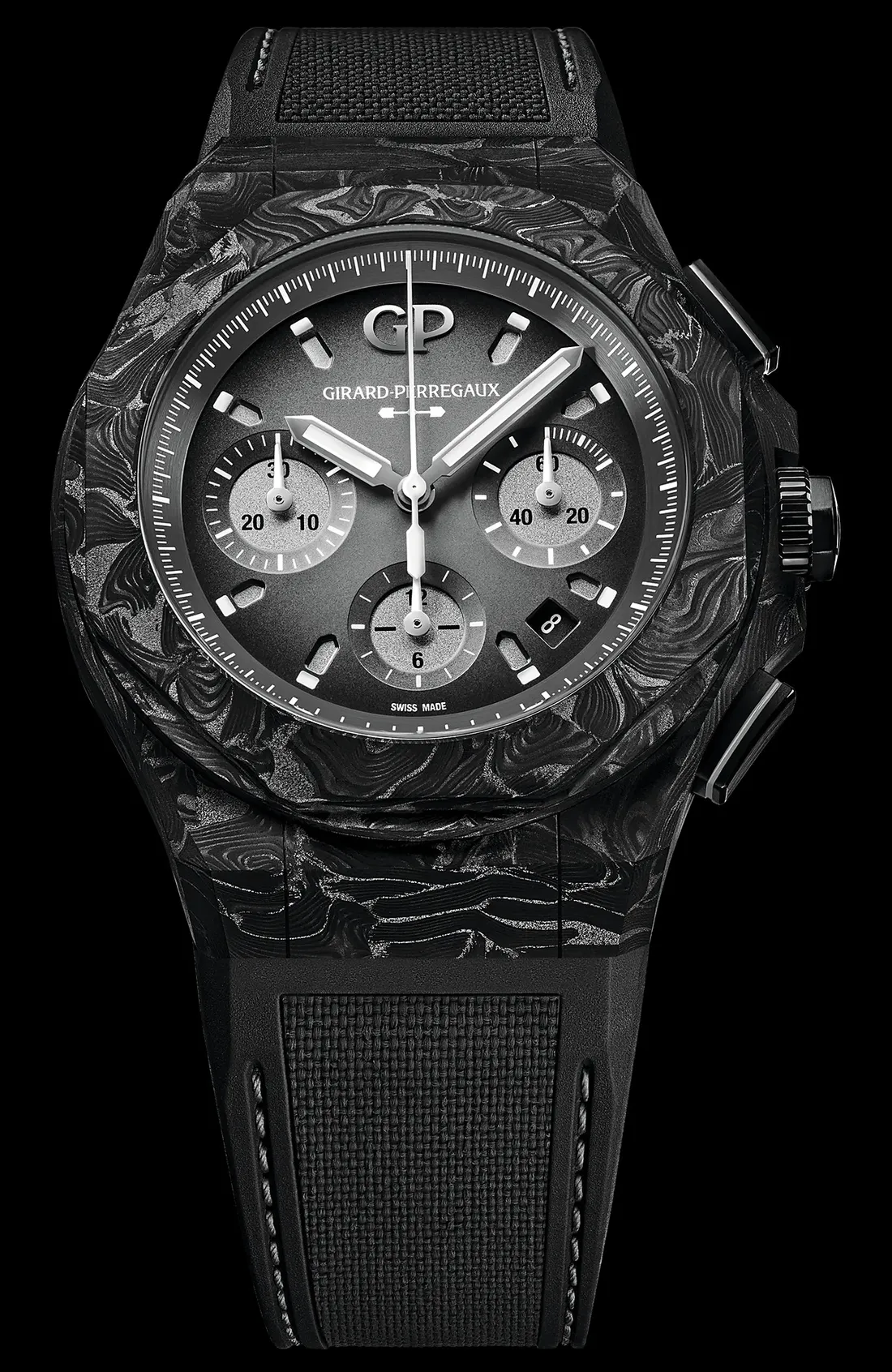
Inside works the calibre GP03300, a self winding chronograph movement carrying two counters, a small seconds and a date. It has four hundred and nineteen components, fills the case comfortably at nearly twenty six millimetres across, and beats four times a second. There are Geneva stripes on the bridges, chamfering along the edges, straight graining across the surfaces. From the front the watch reads as a tool; turn it over and you find the workshop.
Honesty is owed here. Girard-Perregaux makes no claim of heat resistance for this case; what it claims is lightness, rigidity, and the fact that no two are alike. Nobody ever meant to take the watch to a hydrothermal vent.
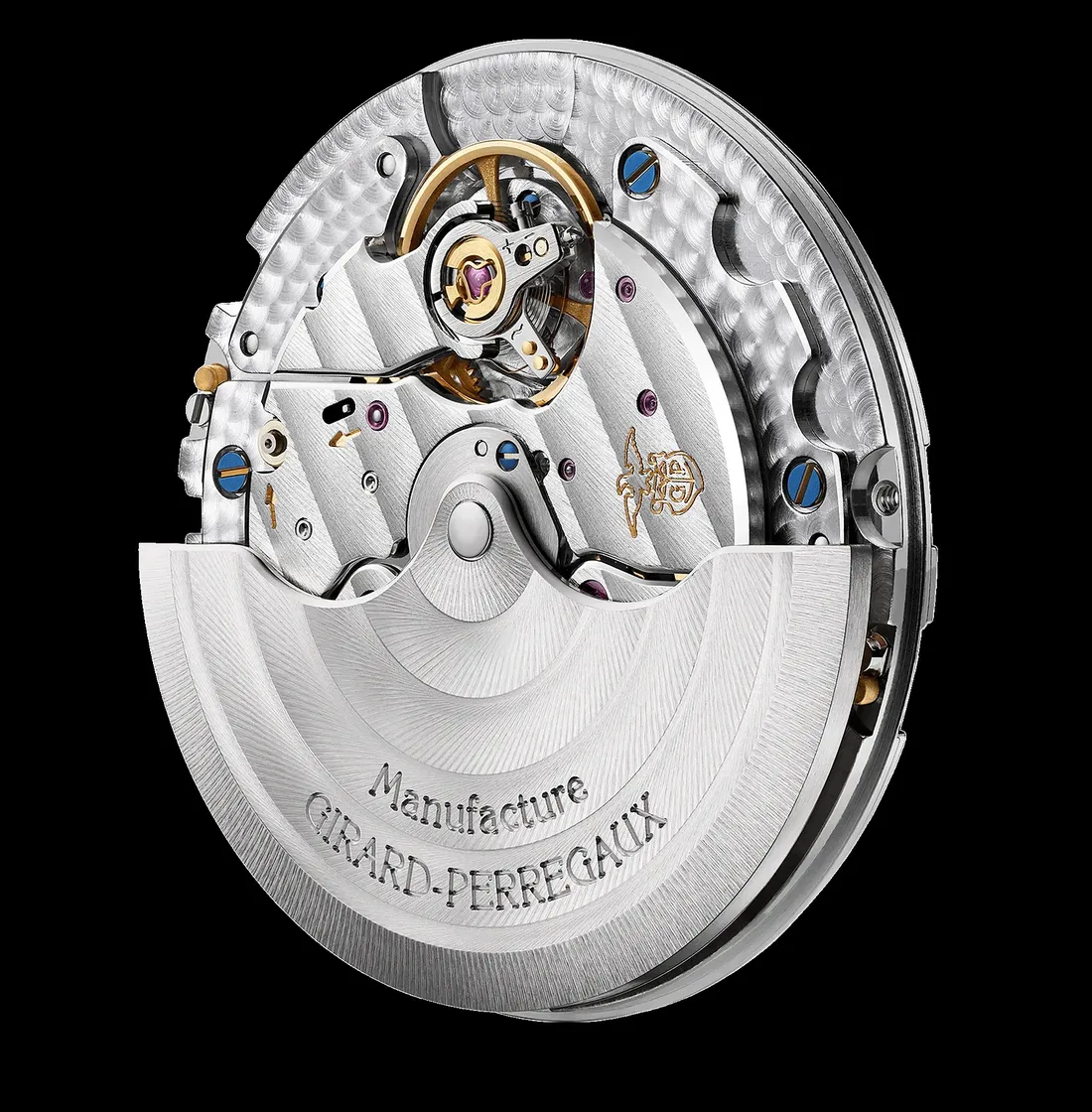
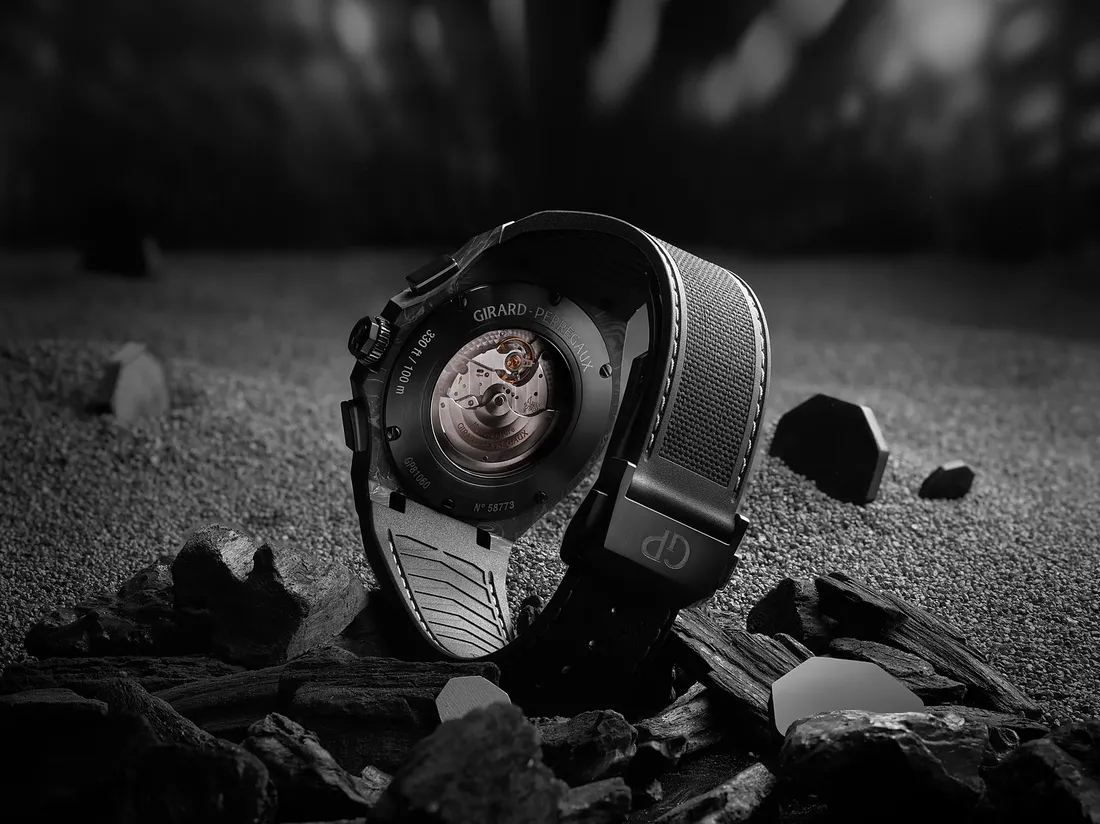
The same principle is nonetheless at work in both places. Neither that case nor that cell came into being in spite of heat. Both came into being because of it. Resin does not cure without pressure and temperature, and the carbon parts do not take hold of one another. Nor is the archaeon’s membrane any use in the cold; that molecular arrangement was built precisely to work in boiling water. The resemblance is the viewer’s reading, not a claim made by the manufacturer.
The real question is this: who put into the membrane of a cell the bond that will not come apart in boiling water? That bond was not selected by itself. The price of the wrong choice is death on the first attempt, and a dead cell makes no second one. A person can spend years looking for the recipe of a composite, throwing out what fails and starting again. No such allowance was made for the living thing; it had to be right from the first day.
format_quote"A person throws out what fails and starts again. The living thing was given no such allowance."
Hasan Bekmezci
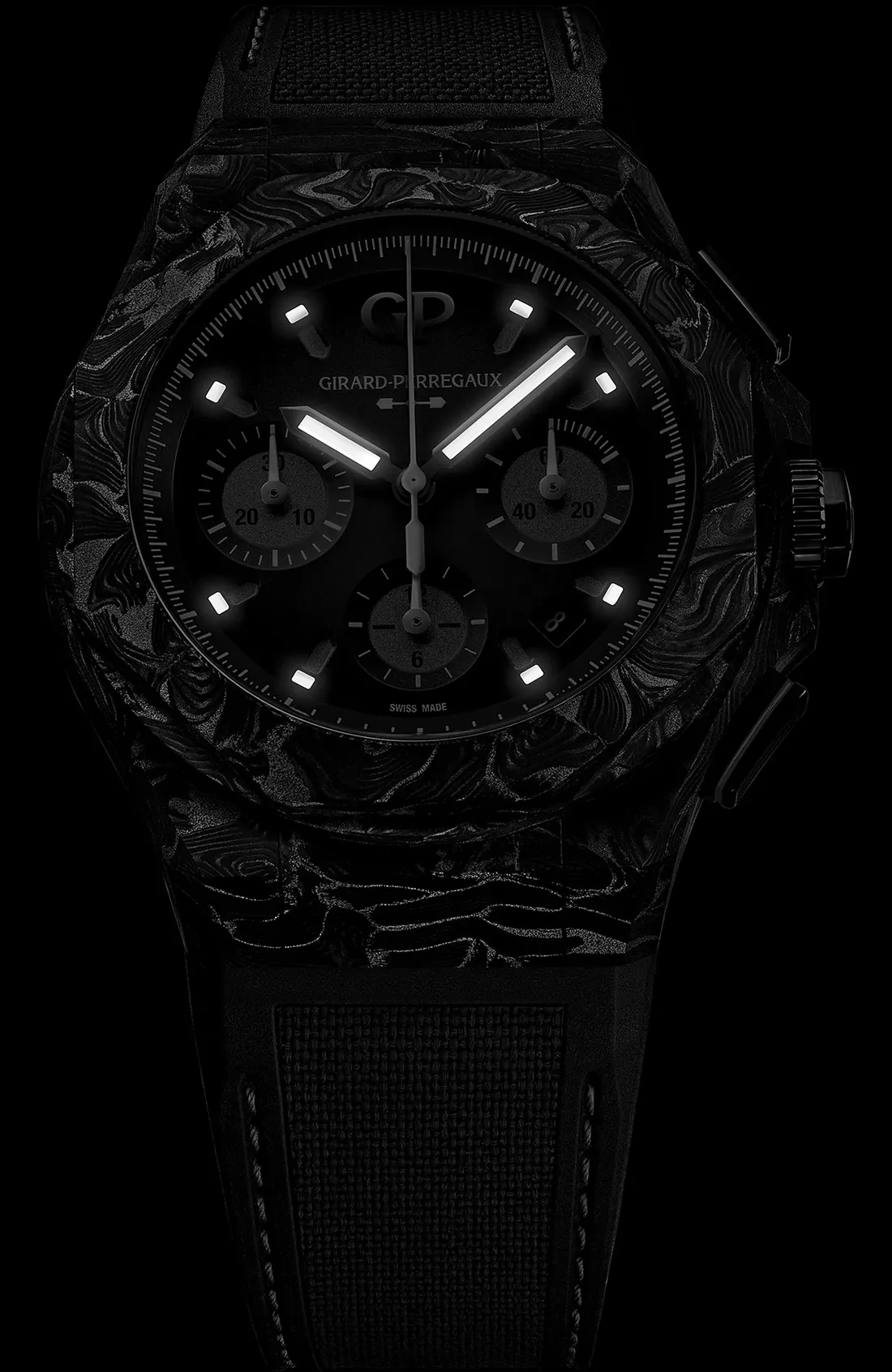
The Laureato Absolute 8Tech is a reminder that heat is not only a cause of ruin. What you see in that wavy texture is not decoration but the signature heat and pressure left behind together. The same signature can be read in a cell that goes on dividing inside water no hand could ever enter.
The watch on its maker’s own site: Girard-Perregaux, Laureato Absolute 8Tech