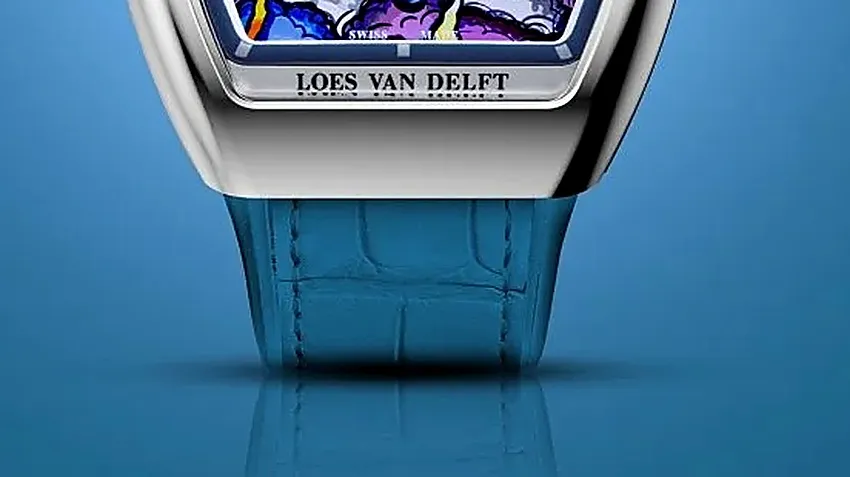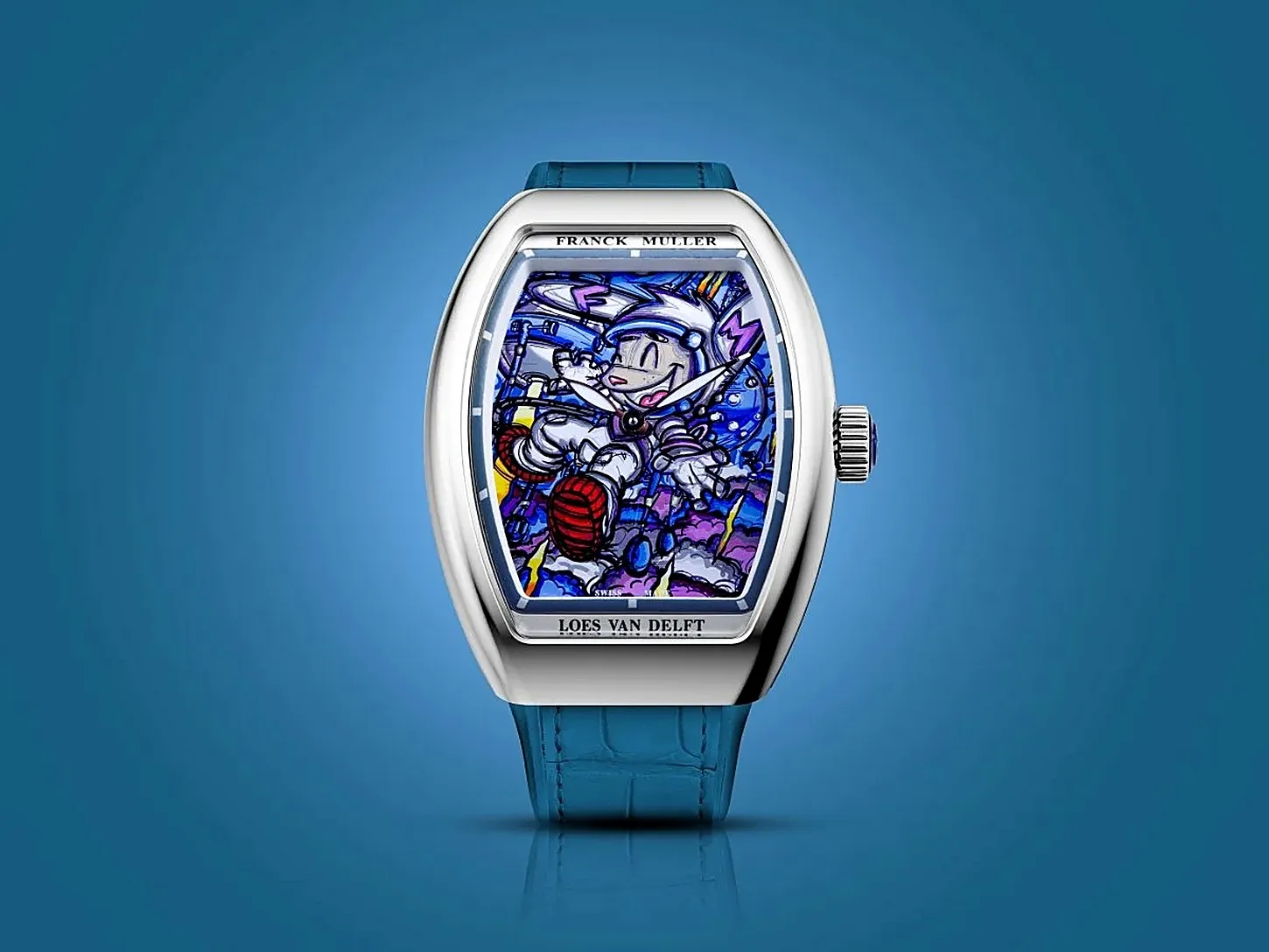
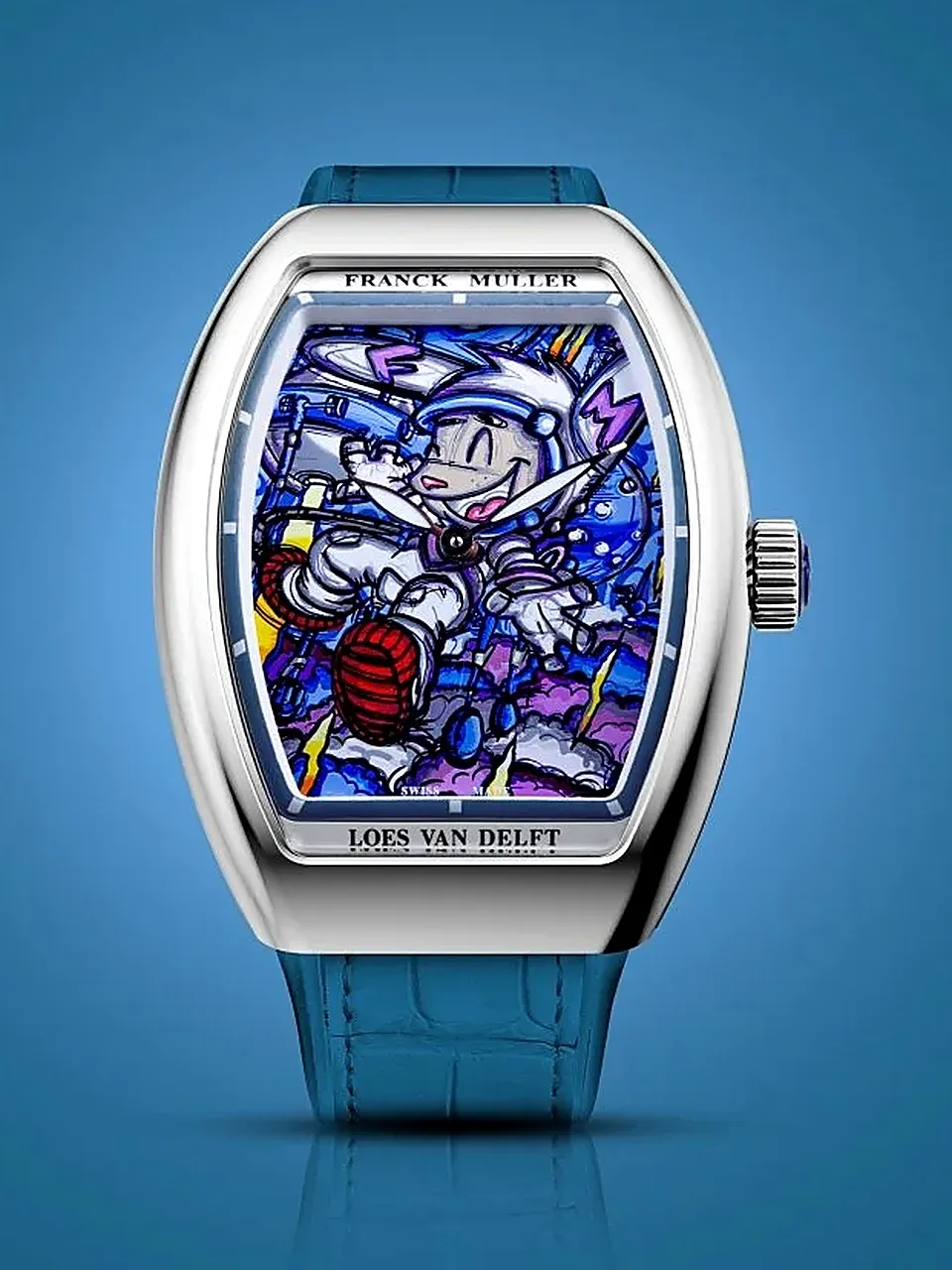
When the curved sapphire crystal dome of the Franck Muller x Loes Van Delft parted, Pjipje, in his spacesuit, slipped out of the chains of gravity. He was no ordinary figure imprisoned on a watch dial; he was a cosmic traveller drifting between the layers of dimensions, a seeker of truth. With letters drawn by Loes Van Delft in his pocket, he set off towards the five pop art geniuses who hold sway in the depths of space. His purpose was to discover that in unknown places there are beings far more beautiful, more colourful and more conscious than on Earth, and to bring them news from home.
The first stop was Mercury, the planet closest to the Sun. In that orbit, casting a silvery aura under the scorching light of the Sun, Andy Warhol appeared, seated on a column of light. Beside him stood the famous image of the Campbell’s soup can. As Pjipje held out the letter, Warhol pointed to his own work:
When I was on Earth and I painted those mass-produced soup cans, I was showing people how tightly they had been squeezed into worldly moulds, Pjipje. People thought of themselves as factory-made contents inside a metal can. Yet the moment the lid of that can opens, the soul goes free. Look: the conscious beings in these dimensions are infinite souls that have escaped their metal cans and shine with an unmixed joy.
format_quote"People thought of themselves as factory-made contents inside a metal can. Yet the moment the lid of that can opens, the soul goes free."
Hasan Bekmezci
Pjipje puffed away from Mercury and fired his rockets. An enormous distance lay ahead of him. He crossed the roughly 770 million kilometres of cosmic emptiness between Mercury and Jupiter in a space-time leap of about 43 minutes at the speed of light. The mass of time melted away and he entered the gravitational field of the giant gas planet.
In the stormy red atmosphere of Jupiter, Roy Lichtenstein was redrawing the speech bubbles from his famous Drowning Girl with stardust. He read the note Pjipje had brought and looked at his own character:
That girl of mine in the painting, the one who would rather sink than call for help, was mankind believing it was drowning in worldly anxieties and false troubles. But those stormy waves stayed on Earth, Pjipje. Look: in this dimension there is no drowning and no fear. What greets us is not a nightmare but the most colourful and luminous painting drawn by the Owner of Infinite Mercy.
format_quote"What greets us is not a nightmare but the most colourful and luminous painting drawn by the Owner of Infinite Mercy."
Hasan Bekmezci
Taking his leave of Lichtenstein, Pjipje puffed away from Jupiter, covered the roughly 650 million kilometres between Jupiter and Saturn in 36 minutes at the speed of light, and entered the orbit of Saturn’s beguiling rings.
In the golden rings of Saturn, Keith Haring was gliding along with the Radiant Baby figure, which looked as though it had leapt off his canvases. Haring touched Pjipje’s spacesuit:
That crawling baby I drew, the one giving off light, Pjipje. That is the first state of the pure soul, freed from the burden of the body. A human being does not vanish when they die; they throw off the coarse garment they were wearing and become weightless, like that luminous baby. The conscious beings in this dimension know neither hatred nor gravity. They only dance in the light of Infinite Mercy.
format_quote"A human being does not vanish when they die; they throw off the coarse garment they were wearing and become weightless, like that luminous baby."
Hasan Bekmezci

Pjipje puffed out of Saturn’s golden rings and set off towards deep space. He crossed the freezing 2.7 billion kilometres or so between Saturn and Neptune in about 2.5 light hours through a bending of gravity, and reached the deep blue.
In the calm, deep blues of Neptune, Jean-Michel Basquiat stood with that iconic three-pointed crown floating above his head. He smiled at Pjipje:
On Earth I used to put that crown on boxers and on lonely people in the street, because I sensed that every soul carries a kingdom. But the real crown is placed on us, when we change dimensions, by the Most Merciful, who does not punish us but gathers us up with compassion. Does anyone fear moving from their own house into a finer palace?
format_quote"Does anyone fear moving from their own house into a finer palace?"
Hasan Bekmezci
Drifting down out of Neptune’s atmosphere, Pjipje crossed the roughly 1.4 billion kilometres of emptiness between Neptune and Pluto in 1.3 hours at the speed of light and arrived at the outermost boundary of the solar system.
In the endlessly speckled star sea of Pluto and the Kuiper Belt, Yayoi Kusama was waiting inside a fabric of space covered in Infinity Dots. Kusama placed one of her dots on Pjipje’s helmet:
Those millions of dots I paint onto my canvases. Every one of them is the reflection of a different consciousness in the universe, of a soul that is aware. We take the Earth for our only home, and yet each dot is a luminous life joining the endless feast of the Most Merciful, the Most Compassionate.
When Pjipje had delivered the letters and listened to these cosmic analogies, he felt a deep peace inside his spacesuit. Even if the distances ran to hundreds of millions of kilometres and time to light hours, there was no room for fear in the infinity behind that crystal. The unknown was far more beautiful than the Earth, because behind that unknown stood the Owner of Infinite Mercy, who encircles everything with colour, with consciousness and with compassion.
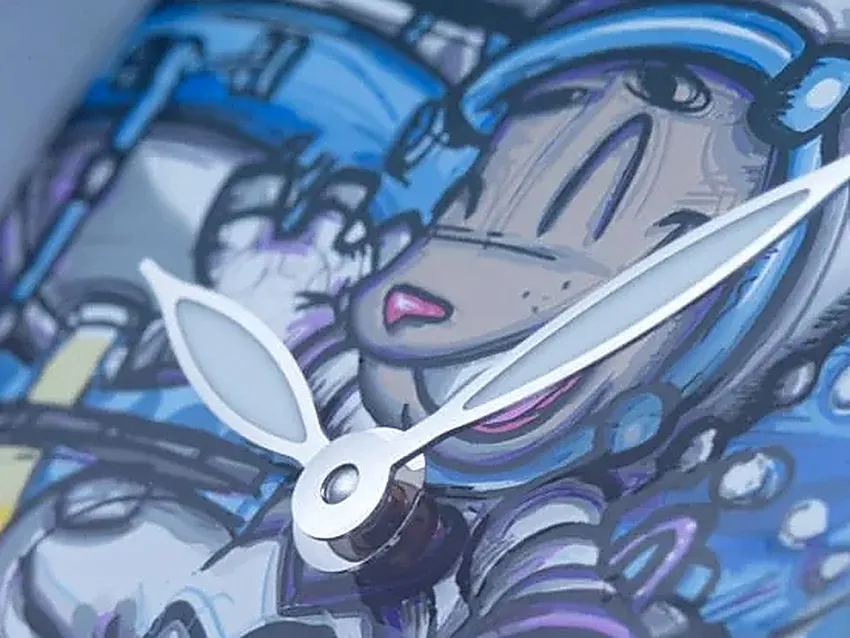
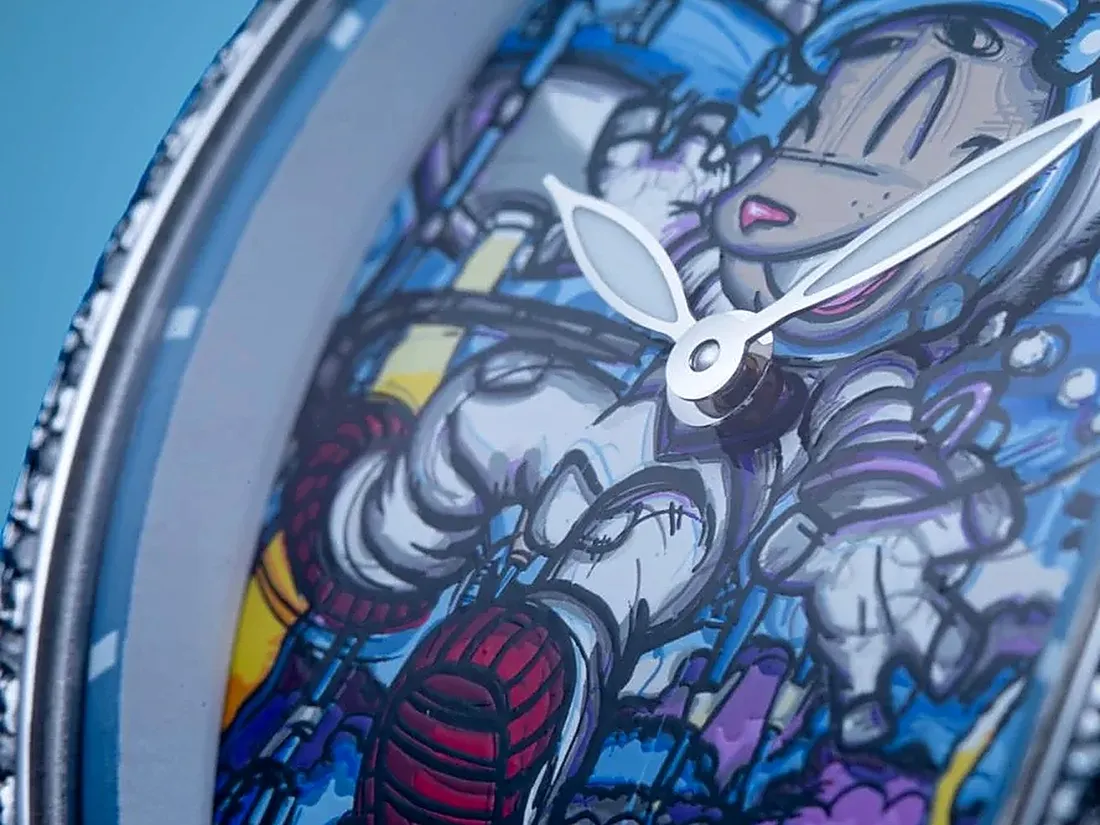
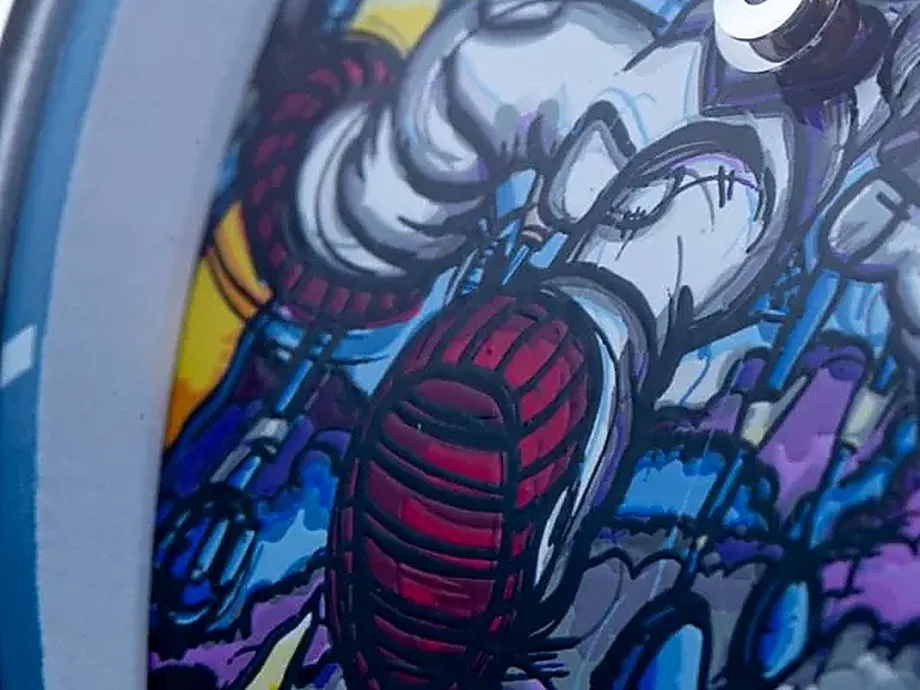
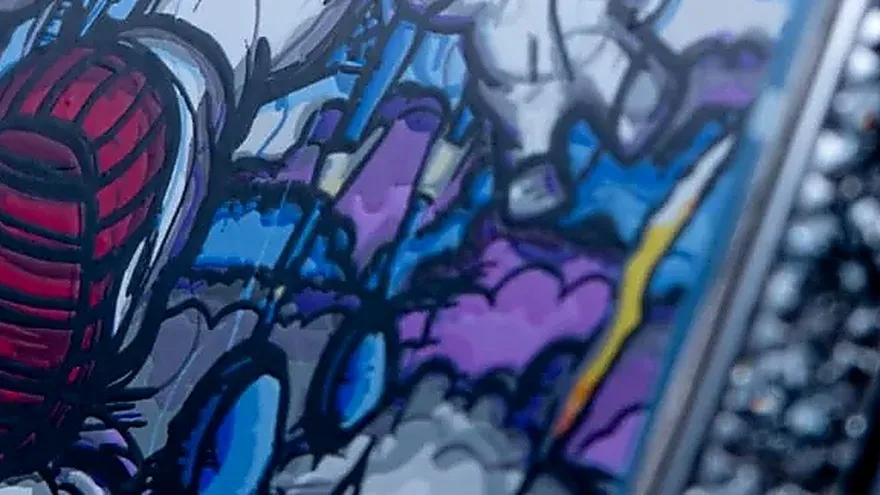
The watch that carries this journey is itself a work of translation. The scene was painted first onto a canvas; then that work was brought down to dial scale without spoiling its spirit, its proportions or its precise colour palette. To do that, no fewer than thirty layers of lacquer were applied to the dial, with roughly one hour of drying time between each layer. The depth you see on the wrist is not a print but the work of dozens of transparent layers laid over one another.
The case is, in the brand’s own words, a sculptural steel tonneau body, and the sapphire that follows the curve of the dial sits on top of it. The strap is blue alligator with light blue stitching, tuned to the blue of the dial. The collection comes in two colourways, pink and blue, and each colour is offered in a diamond-set and a diamond-free reading; the case of this blue version carries no stones, and the plainness of the polished steel balances the crowdedness of the dial. A special giclée print accompanies the watches: the diamond-free reading is €12,650 and the diamond-set case €19,850.
This is the first ladies’ watch Franck Muller has signed together with Loes Van Delft.