Chapter I: The Island Where the Crust Splits
On the Reykjanes Peninsula in Iceland the wind whistled across the black basalt. Sulphurous steam rising from the geothermal cracks below had settled over two geological engineers like a white curtain.
Erik and Elena had spent the morning here, at the edge of the fissure system that has erupted again and again since 2021. In the afternoon they had driven north east, to Þingvellir. The distinction matters: the steam and the lava fields are at Reykjanes, while the place where the rift visibly opens is Þingvellir. Two ends of the same line.
And now they stood at the edge of Silfra. The water beneath their feet melted off the Langjökull glacier and reached this fissure after decades of filtering through porous lava underground. It is so clean that visibility approaches a hundred metres; its temperature holds between two and four degrees all year.
A legend needs correcting here too. People say that at Silfra you can put one foot on the North American plate and the other on the Eurasian. The truth is broader: a plate boundary is not a single crack but a rift zone kilometres wide, and Silfra is one fissure inside that zone. The two plates move apart by about two centimetres a year, and Iceland sits directly on that parting, where the Mid-Atlantic Ridge comes ashore.
Erik set his flask down and pushed back the cuff of his jacket. He meant to adjust his glove, but when the light struck the mirrored flank of the rose gold case on his wrist, Elena's eyes locked onto it.
Chapter II: The Name on His Wrist
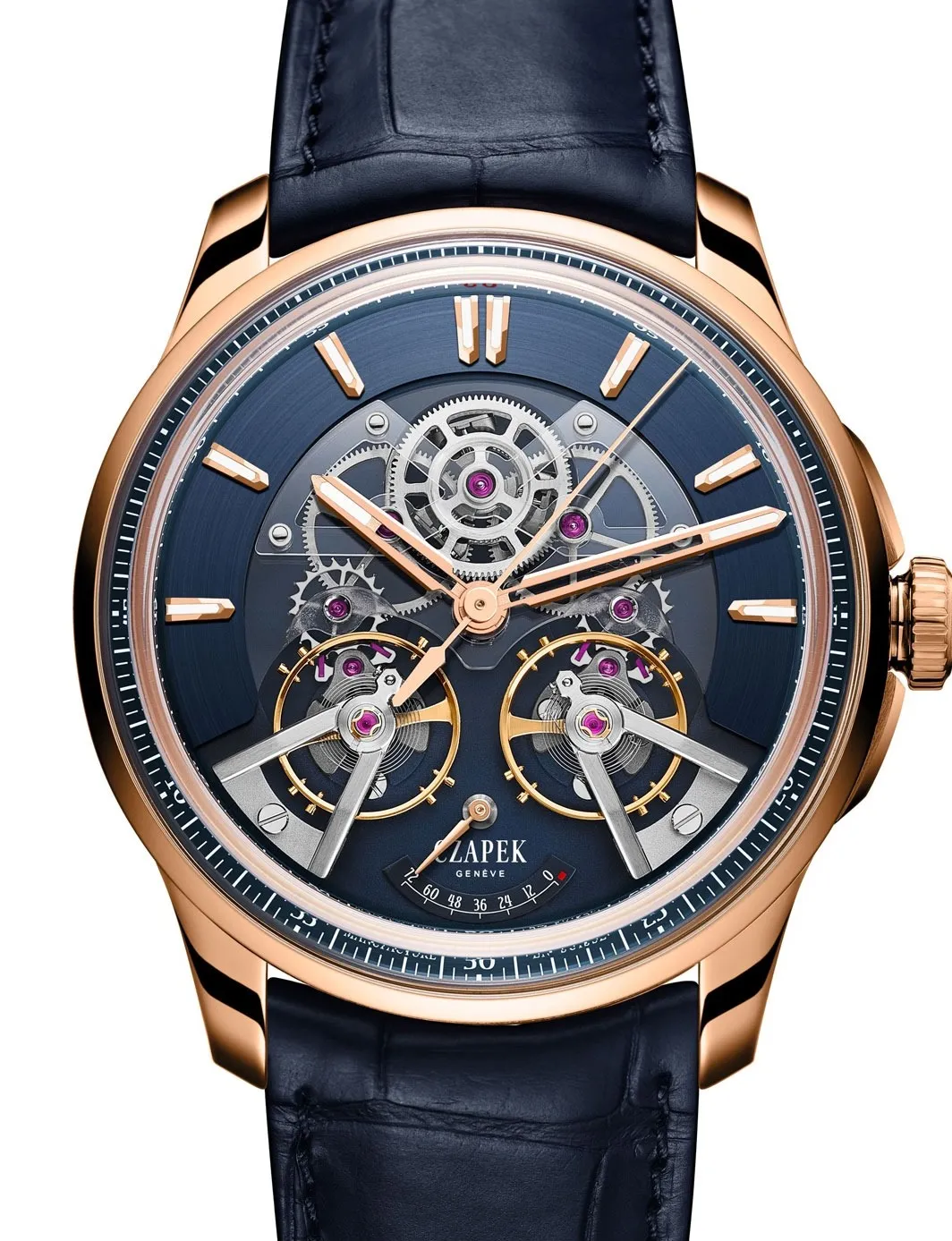
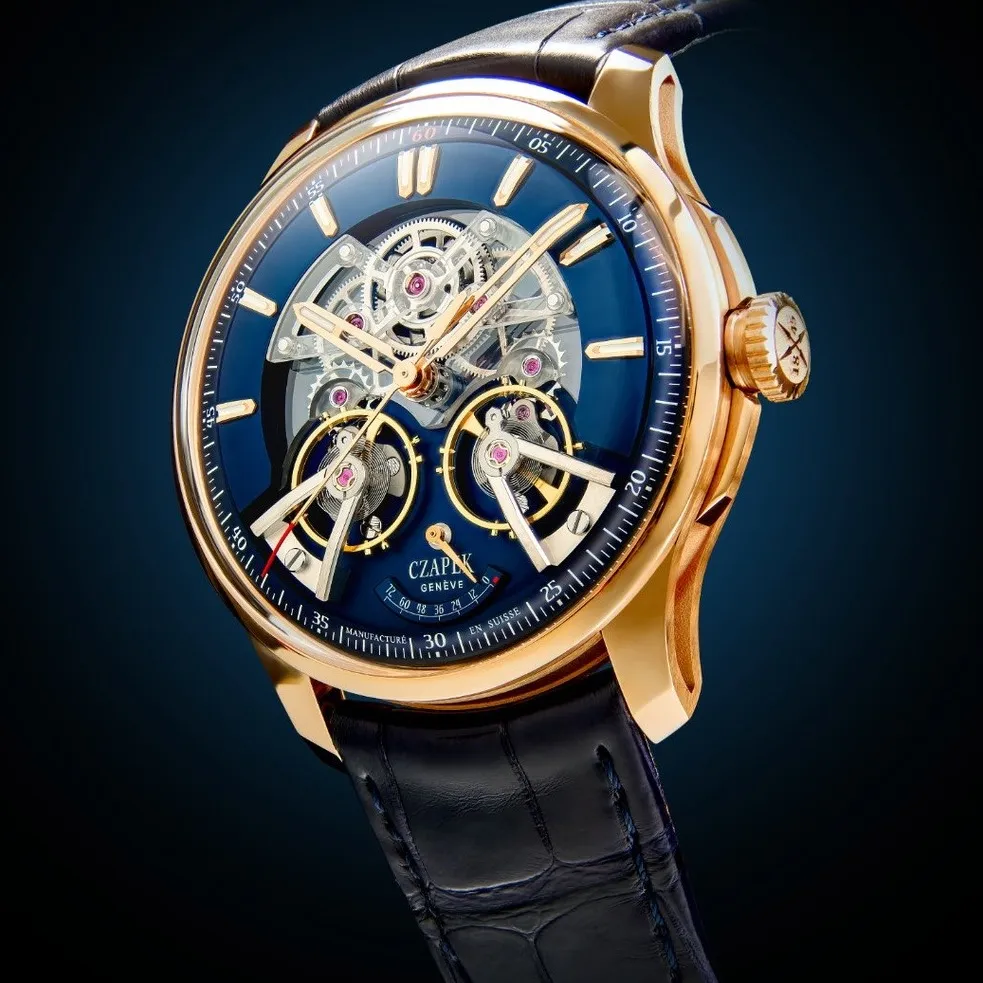
"Erik, we are out here measuring magma movement and continental friction," said Elena. "And there is a piece of miniature architecture on your wrist. That symmetry in the open dial, those two wheels below. What is this watch called?"
Erik turned his wrist to shelter it from the wind. "Czapek Place Vendôme Complicité. Both halves of the name have their own story."
"Place Vendôme is the square in Paris. But there is a mistake that gets repeated here, and I had it wrong for years myself. François Czapek did not open his boutique on that square in 1845. 1845 is the name of something else: that April his six year partnership with Antoine Norbert de Patek dissolved, and on 1 May 1845 Czapek founded his own company, Czapek & Cie. The Place Vendôme boutique opened in 1850, and by the brand's own account it was the first fine watchmaking boutique ever opened on that square."
"And who was the man?"
"Franciszek Czapek was born in 1811 at Semonice in Bohemia. He emigrated to Poland with his family. In 1832, after the collapse of the Polish uprising, he fled to Switzerland; he had taken part in that uprising himself. There he founded his first company and Gallicised his name to François. In 1836 he met Patek, a fellow refugee, and it was Czapek who invited him into watchmaking. In 1839 they founded Patek, Czapek & Cie."
"Then?"
"Then they separated and both went on making watches. Czapek opened a third boutique in Warsaw in 1854 and in 1855 received the title of Watchmaker to Prince Napoleon. And in 1871 he disappeared. Nobody knows where he died or where he went. The name was re-established in 2012 and launched in Geneva in 2015, and in doing so it did something unusual: it got to its feet on an equity crowdfunding campaign, on the money of watch enthusiasts. It became the first fine watchmaking house revived by its own aficionados."
"And Complicité?"
"It means complicity in French, but here it carries two meanings at once. The first is how this watch came to exist. The second is the partnership between the two escapements inside it, working in unison."
format_quote"1845 is not the year of Place Vendôme. 1845 is the year the Patek partnership dissolved and Czapek founded his own company. The boutique opened in 1850."
Chapter III: The Watch a School Class Brought
"Did Czapek design this architecture alone?" asked Elena.
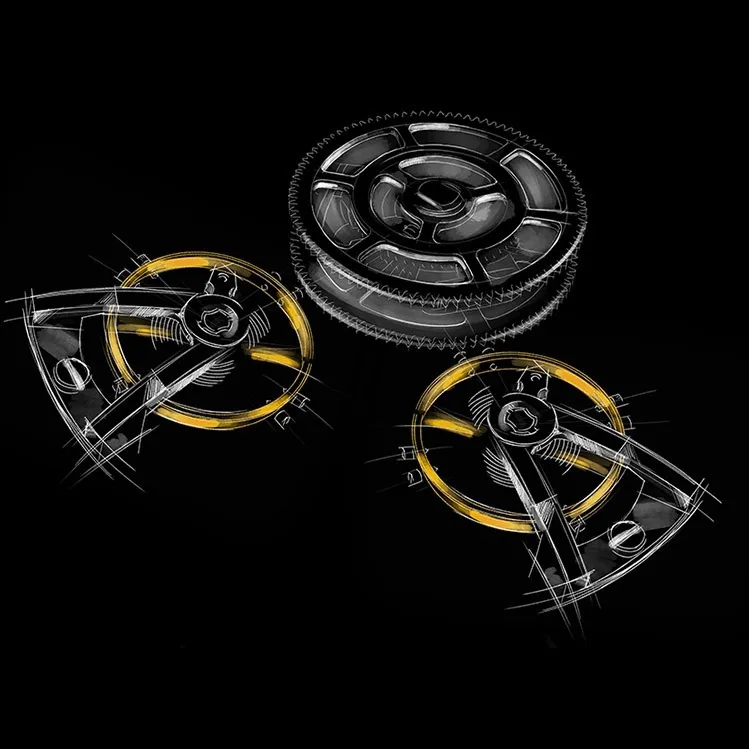
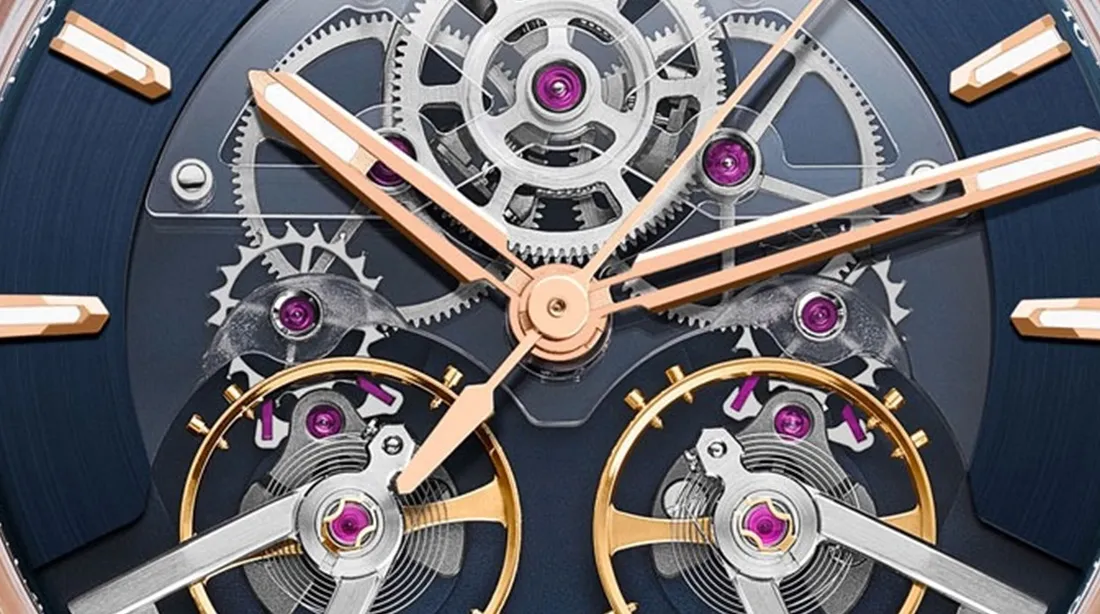
"No, and that is the best part of the story," said Erik. "The idea was born in 2018. On the brand's first models, the Quai des Bergues and the Place Vendôme, the lower part of the dial carried two sub-dials at half past four and half past seven; those two formed the base of a pyramid and a third at the top formed its apex. The house wanted to keep that layout and put two escapements inside it: the two balances at the base of the pyramid, and the differential that joins them at twelve o'clock."
"That sounds simple."
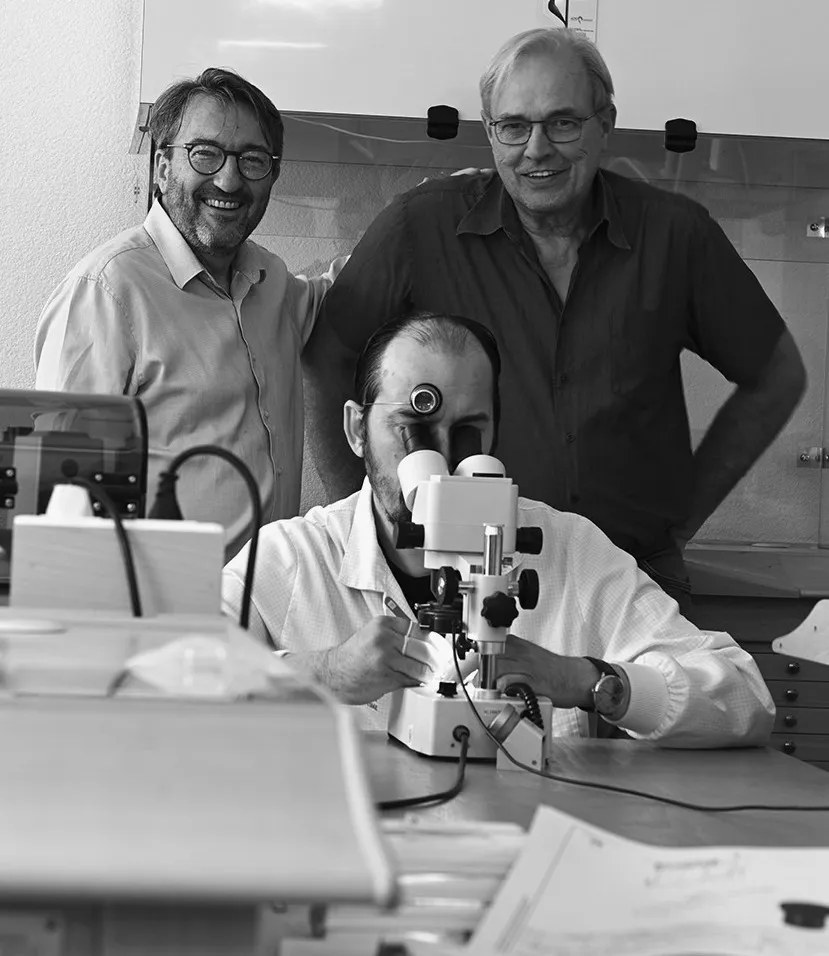
"It was not. They looked for a partner who could do it and did not find one. The project was shelved. Then this happened: Paul, a son of Czapek's chief executive Xavier de Roquemaurel, was in the same school class in Neuchâtel as the daughter of the watchmaker Bernhard Lederer. A mutual friend introduced the two fathers. The introduction became a friendship, the friendship became an exchange of ideas, and that became this watch. Which is to say that without a school class this watch might not exist."
"Who is Lederer?"
"One of the living legends. He has been a member of the AHCI, the academy of independent creators, since its foundation in 1985, which is to say he is one of the founding members. On escapement physics and the flow of mechanical power he is among the most respected names in the world."
"So he made the movement?"
"This needs care, because it is often misreported too. The movement is called Calibre 8 and it is Czapek's own; in the brand's own words it was created in collaboration with Bernhard Lederer. Lederer's contribution is not unsigned but it is hidden: the crown wheel arrangement in the movement is his own signature, placed there as a quiet thank you for his part in it. Which is the first meaning of the word Complicité: the partnership of a house's aesthetic vision with a craftsman's mechanical intelligence."
"One more thing," Erik added. "Czapek's working philosophy has a name, établissage. The whole watch industry once ran this way: the specialist workshop that does each craft best works separately, and someone brings them together like a conductor with an orchestra. Czapek treats a supplier as a partner, not a supplier. Without that philosophy this watch would not have appeared."
Chapter IV: What a Differential Actually Does
"There are two separate balance wheels swinging at half past four and half past seven," said Elena. "How does the gearing at twelve turn them into a single time? Explain it simply enough for a geologist."
"Let me use a car's differential," said Erik. "In a corner the outer wheel has further to travel, so it has to turn faster, while the inner one turns slower. If the two were joined by a rigid bar, one would slip or the axle would break. The differential gear absorbs that difference in speed and distributes the engine's power to both wheels. The job in the watch is from the same family: two separate inputs, one output, and the output is the average of the inputs."
"So how does that raise precision?"
"Here I have to be honest, because this part is usually oversold. A differential does not remove the error. It averages it."
"What is the difference?"
"This: if the left balance runs two seconds fast a day and the right one two seconds slow, the output really is zero. But if both run two seconds fast in the same direction, the output is two seconds fast as well; the differential performs no miracle. What it does is shrink the scatter. In a single balance watch, that balance's positional error at that moment goes straight to the hands. With two balances, because their errors are partly independent of each other, the deviation of the average is smaller and steadier. Taking the average of two independent measurements does exactly the same thing in metrology."
"And where is the real trick?"
"The real trick sits as a single line in Czapek's technical list and most accounts skip it: these two balances oscillate in opposite directions. The consequence is this: the deviation one balance takes from gravity in a given position appears with the opposite sign in the second one, which turns the other way. Averaging them cancels much of it. And because their angular momentum is opposed as well, the reaction they hand back to the case is largely damped out."
"One more distinction is needed," he went on. "This is not a resonance watch. In resonance the two balances mechanically catch one another and physically synchronise. Here they run entirely independently; what is joined is not the balances but their output. Two approaches, two philosophies."
"And the frequency," said Elena. "Two different frequencies?"
"No, both run at the same nominal frequency: twenty one thousand six hundred vibrations an hour, three cycles a second. What differs is not the frequency but the rate at that moment. That is what the differential balances out."
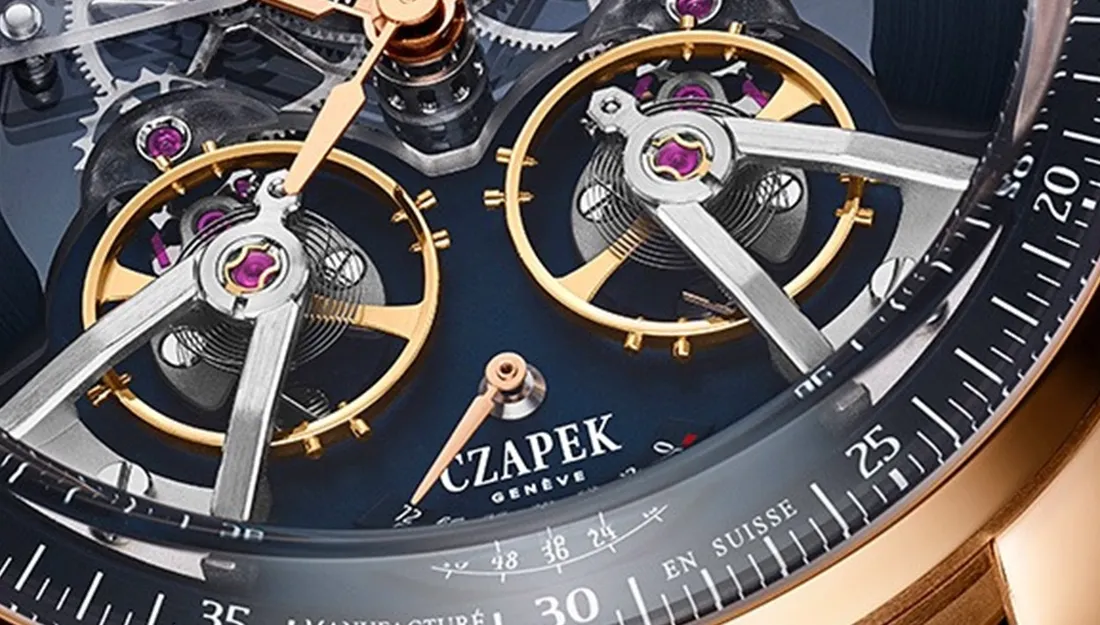
format_quote"A differential does not remove the error, it averages it. The real trick is elsewhere: these two balances oscillate in opposite directions."
Chapter V: The Specification of Calibre 8
"Give me numbers," said Elena.
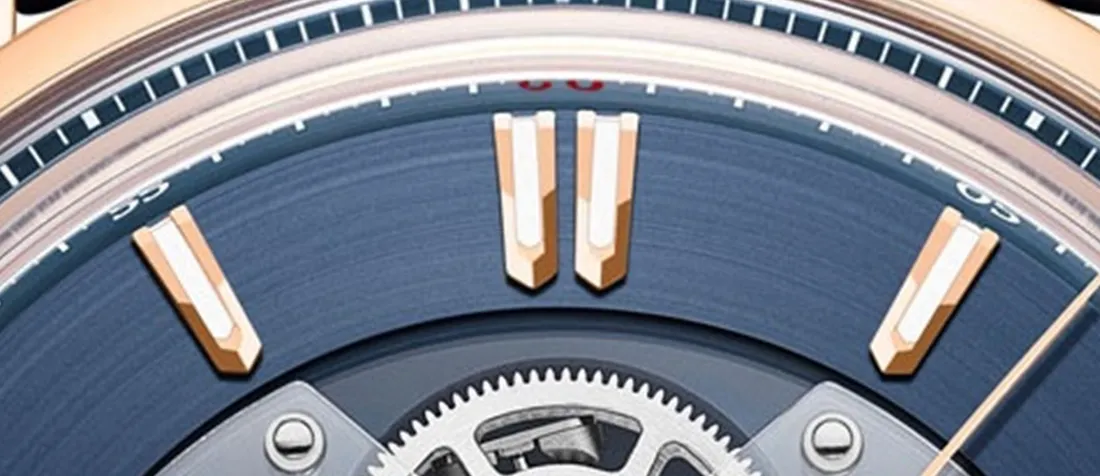
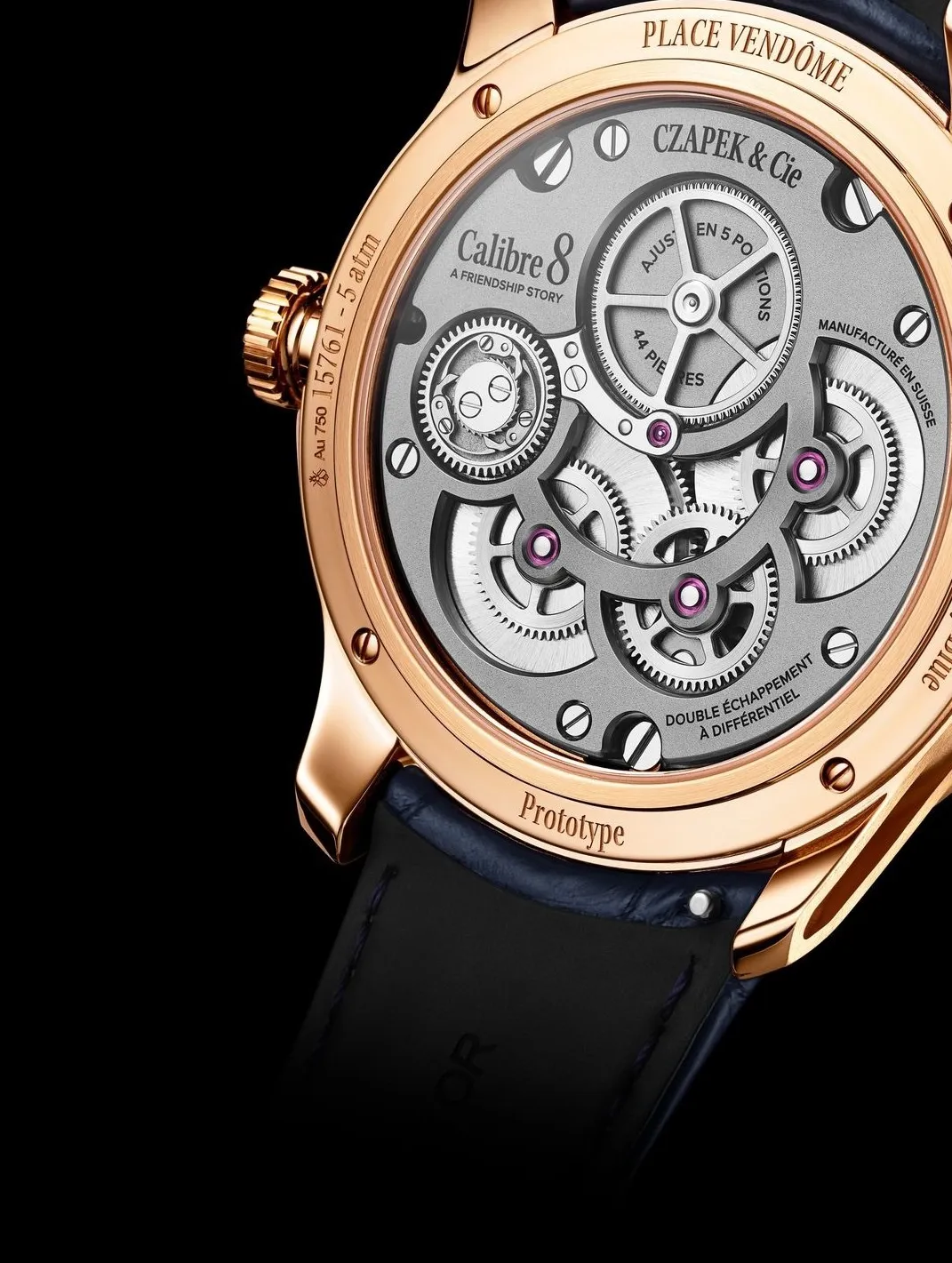
"Calibre 8, hand wound. Two hundred and ninety three components. Twenty one thousand six hundred vibrations an hour. Power reserve seventy two hours, and its indicator sits on the dial at six o'clock, exactly between the two balances."
"How many barrels?"
"One. And that is the least known detail in the watch. There are two escapements but there are not two barrels; the power leaves a single barrel and is distributed to the two trains through the differential. Which is to say the system shares the power, it does not multiply it. Feeding two escapements from one barrel for seventy two hours is this calibre's quiet achievement."
"The balances?"
"Variable inertia. Which is to say the regulating is done not by sliding an index but by moving weights on the wheel itself. Each balance has four adjustment screws and four weights. The balance springs also carry Breguet terminal curves: the outermost coil is lifted on a bridge and bent inwards, so the spring behaves more concentrically as it breathes. A two hundred and thirty year old answer, still in the best watches."
"And those transparent bridges?"
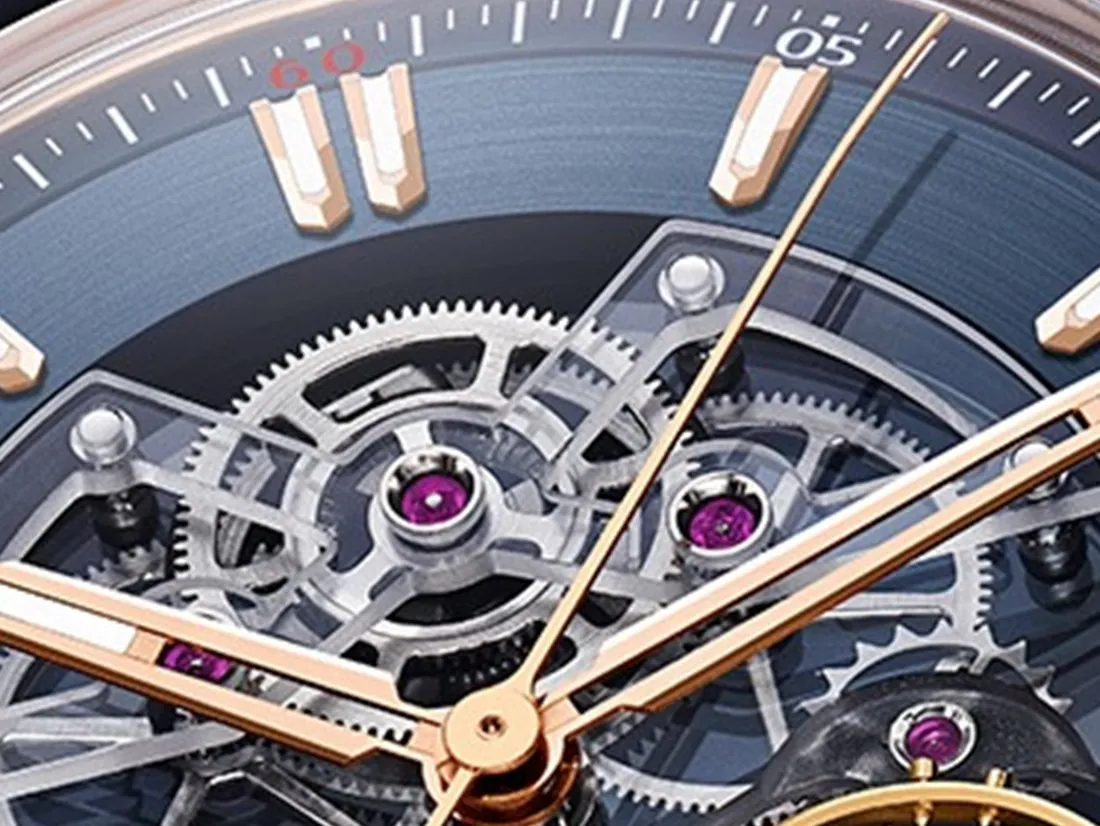
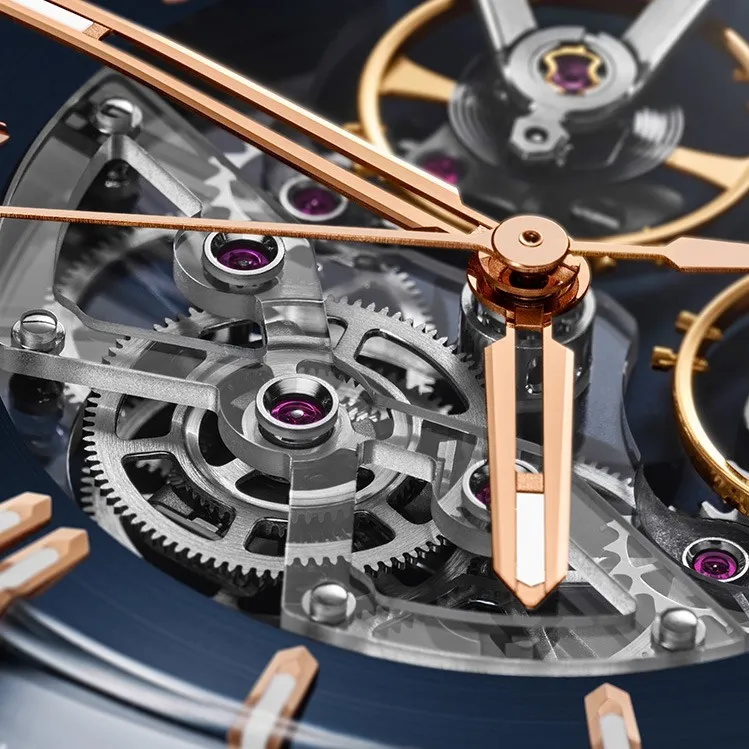
"Here is another thing that is often told wrongly. Those bridges are not openworked steel; they are two bridges made of sapphire, and six rubies set in gold chatons are mounted on them. That is why the whole gear train is visible. Above it sits a box style sapphire crystal. Which is to say that what we call the dial is really a movement seen from above."
Chapter VI: Openworking and the Mark a Hand Leaves
"The open dial looks wonderful, but this cannot just be drilling holes in a plate," said Elena.
"It is not," said Erik. "But a correction is needed here too. People explaining openworking usually say the craftsman calculates the part of the metal that carries no load and cuts it away. That is true, but in the Complicité the real decision is more radical: some of the bridges are not metal at all. They are made of sapphire. Instead of cutting the metal away, they made the load bearing member out of a transparent material. Sapphire's hardness is close to that of steel, and it is invisible."
"And the parts that are metal?"
"Those are finished by hand, and there are two jobs. The first is bevelling. An openworked bridge leaves a square, sharp edge; under a microscope the craftsman turns that edge into an inclined surface and polishes it like a mirror. The tools used for it are still old ones: sticks of gentian wood, leather and felt. Nothing electric, because an electric tip rounds the edge."
"The second?"
"Inward angles. If the edge of a bridge makes a sharp corner pointing inwards, no rotating tool can reach the bottom of that corner; a machine tip always leaves a rounded trace. The only way to leave that corner sharp is a hand held file. That is why the number of inward angles is the one countable indicator of hand labour in watchmaking. And Czapek states the figure openly: on the back of the movement, eighteen inward angles have been bevelled by hand."
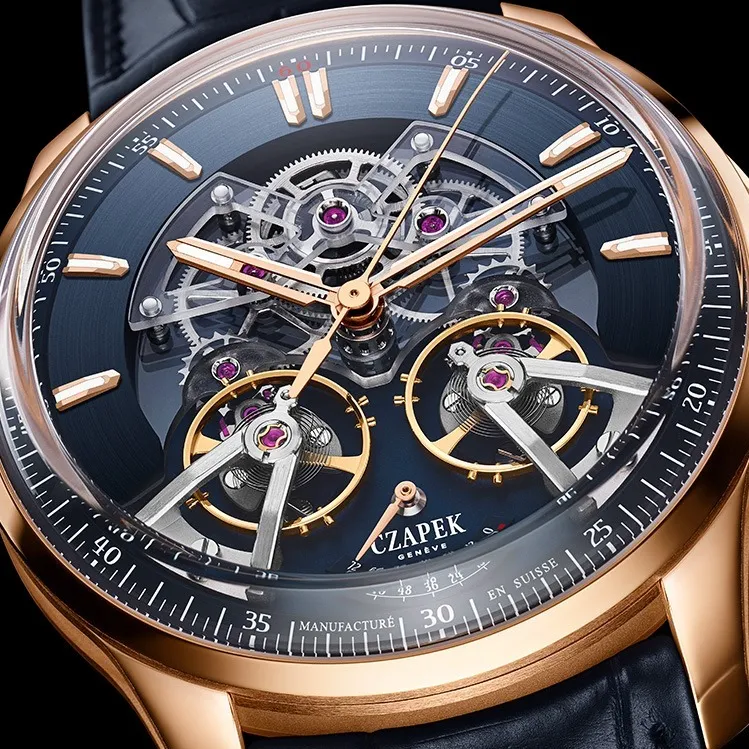
"And there is this," Erik said with a smile. "The house has also put in a detail that is almost impossible to see. The central post on which the hands are mounted is openworked too, with a small row of arches cut into it; they call it the arcade des heures, the arcade of the hours. It is there whether anyone looks or not."
"The hands?"
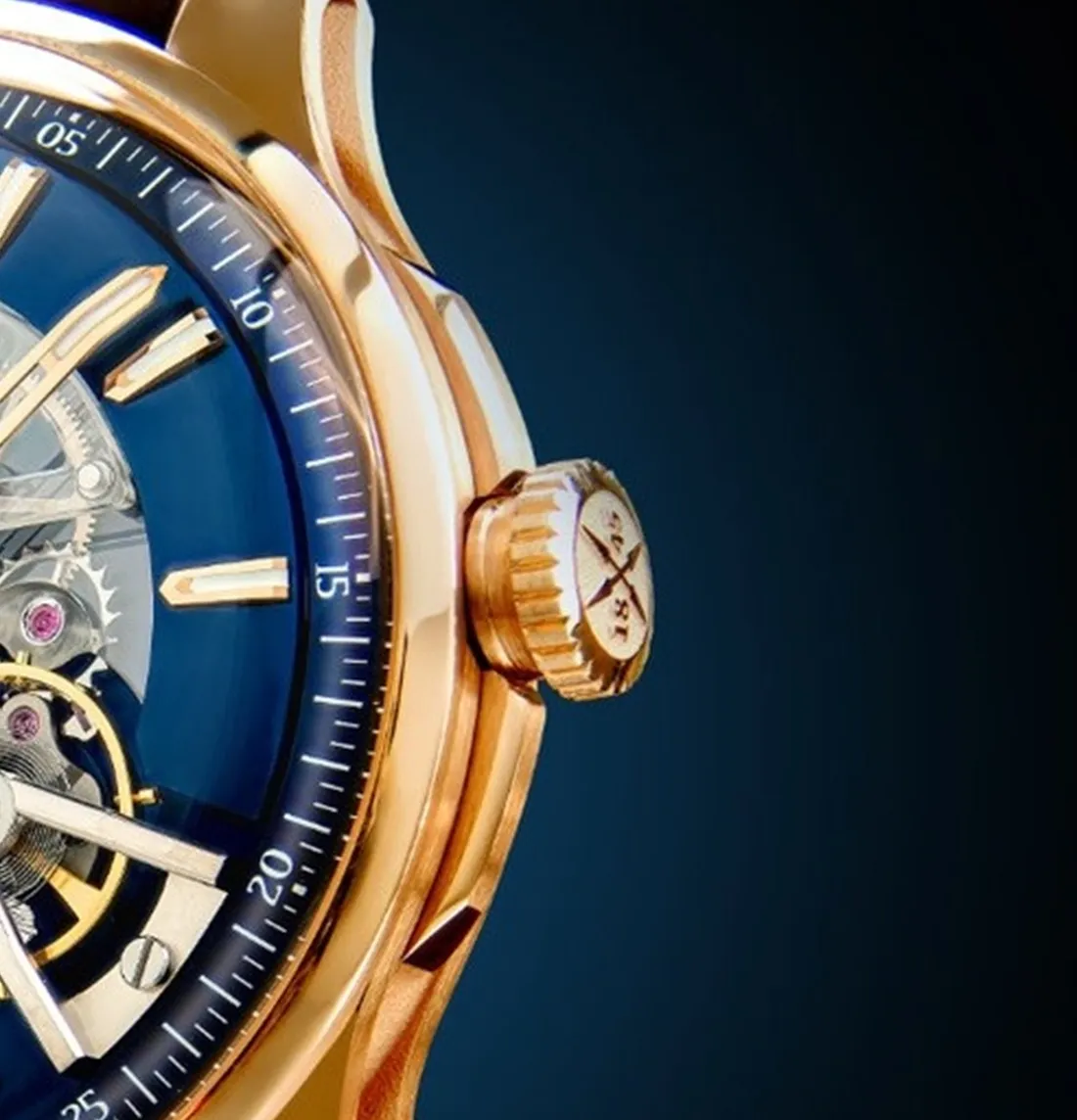
"Sword shaped and openworked themselves, because they must not cover the mechanism beneath. The hour markers repeat the same shape. Both are gold plated to match the case, and their tips carry a light storing material."
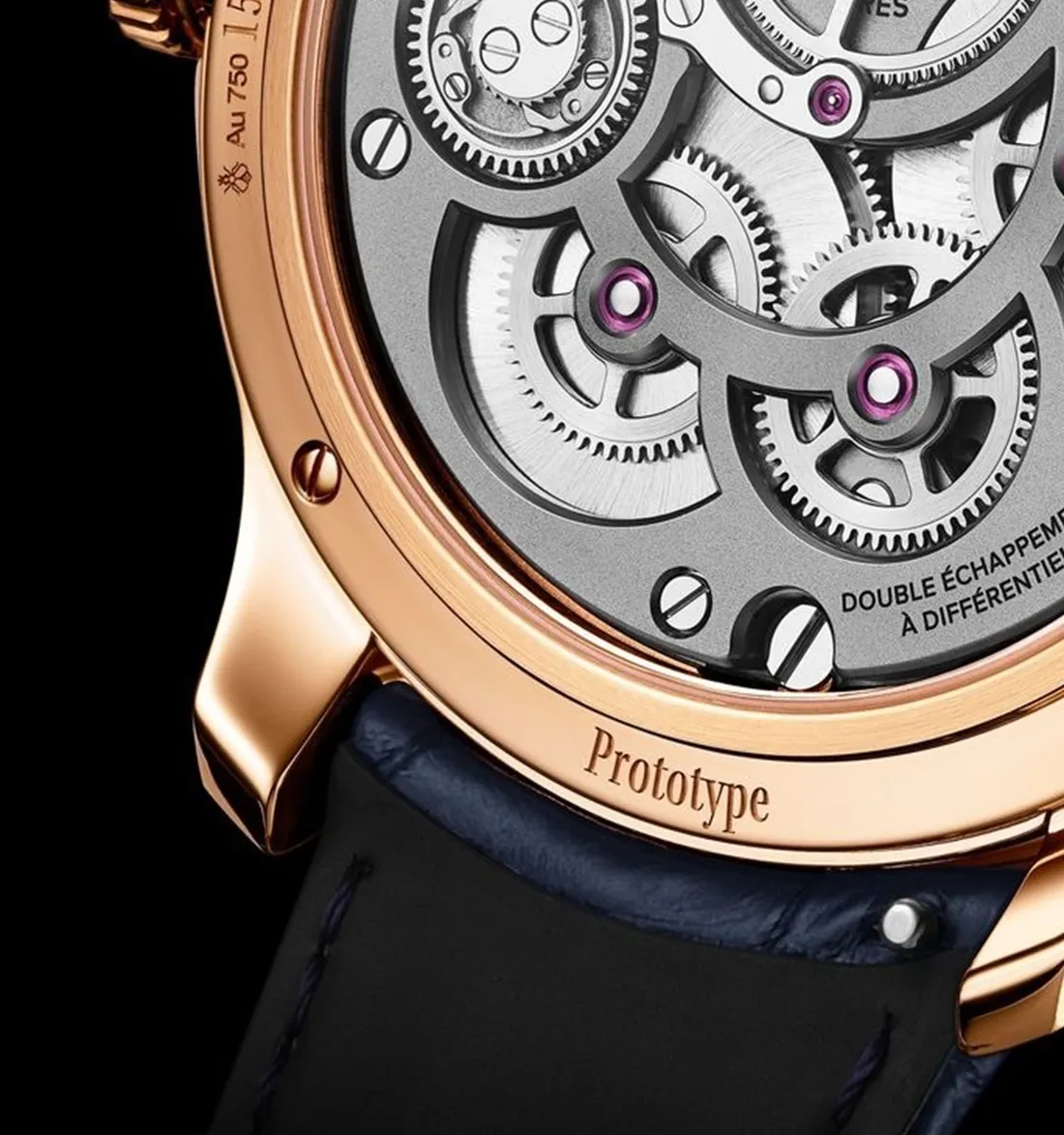
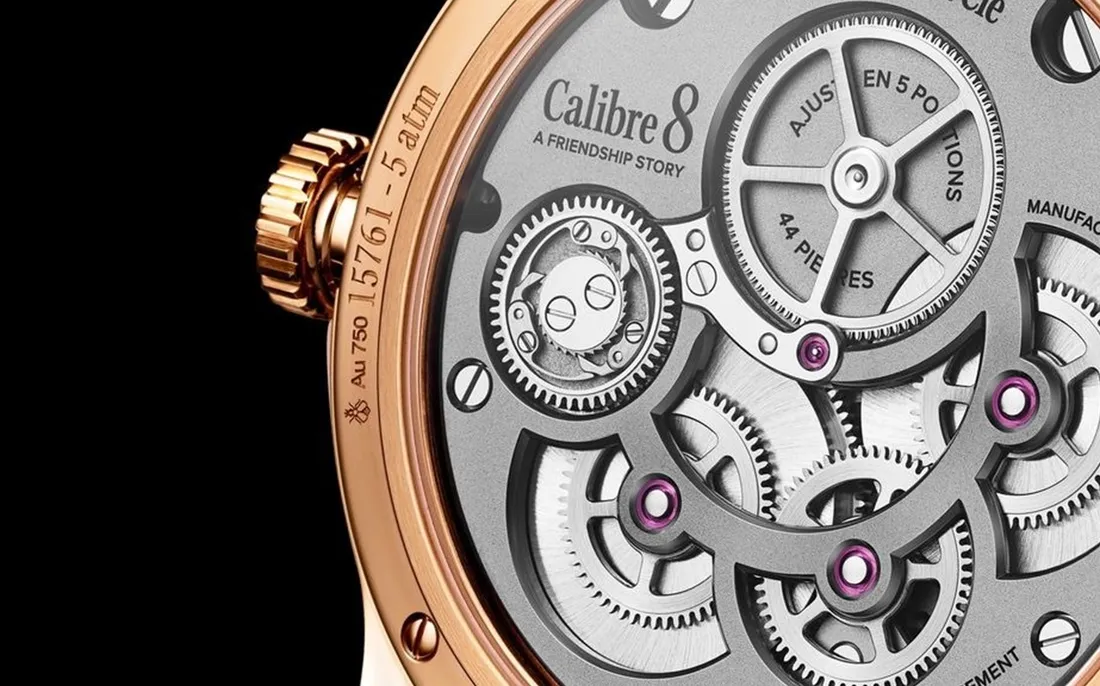
format_quote"The number of inward angles is the one countable indicator of hand labour in watchmaking. Czapek states the figure openly: eighteen."
Chapter VII: Material and Measure
"An 18 carat 5N rose gold case, a deep blue ground, gold bridges," said Elena. "There is a geological balance to it."
"Let me give you the measurements too," said Erik. "The case is forty one point eight millimetres across, thirteen point three millimetres tall, forty eight point two millimetres from lug to lug. Water resistance fifty metres. The crystal is box style sapphire."
"What does 5N mean?"
"An alloy code describing the copper content of rose gold. In 5N the copper is high, which is why the colour is warmer than yellow gold and closer to red. And about gold itself, this is worth remembering: not even acid can alter its natural properties. Pure gold is very soft, around two and a half on the hardness scale, so it is alloyed with silver and copper for durability. And it is exactly that alloy ratio which decides the colour."
"And the blue?"
"This version is called Harmony Blue. The ground shifts its tone with the angle of the light, the way the glacial water under our feet darkens as you go down into it."
"How many were made?"
"Fifty of this version. And all the variations of the Complicité together are limited to a hundred pieces; once that number is reached it cannot be ordered again. The price is ninety three thousand Swiss francs excluding tax. The house makes every watch to order; the queue for this model runs about twelve months."
The Balance of the Ground and of Time
As Elena put the loupe to her eye and watched the micro movements of the differential at twelve, the ground under her foot trembled faintly. In Iceland that is ordinary; the movement under the island never stops.
Elena took her eye from the loupe. "You know, Erik, out here two plates move two centimetres apart a year and nobody is trying to align them. On your wrist two balances swing in opposite directions and at twelve o'clock one carries away the other's deviation."
"That is the difference," said Erik. "The order under our feet runs by itself; the order on our wrist had to be calculated by somebody. And to make that calculation possible, two men's children had to be in the same classroom."
Elena laughed. "So when you wear this watch you are not carrying a mechanism, you are carrying a coincidence."
"The house says the same," said Erik, closing his cuff. "There is a line on the back of the case: A Friendship Story."