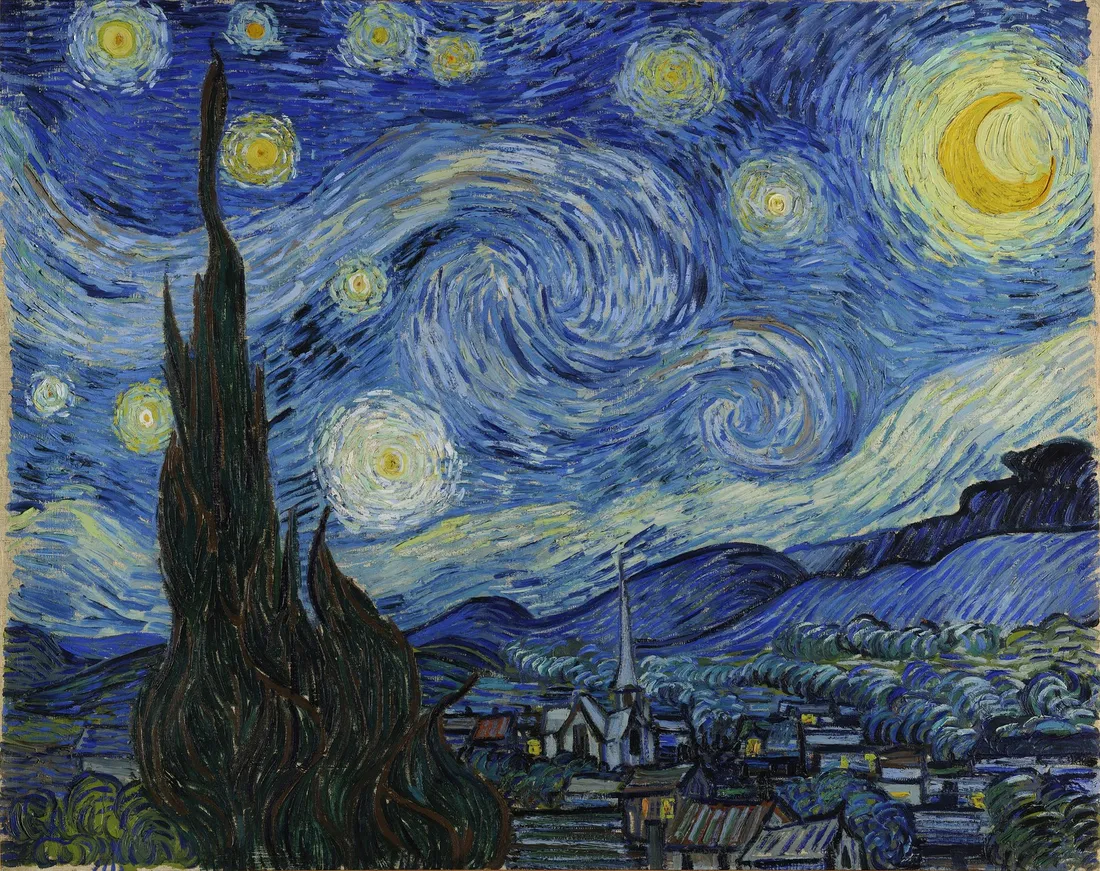
On that stifling June night of 1889, Vincent van Gogh sat before the window of his asylum at Saint-Rémy. In the trembling shadow of the candlelight, the heavy smell of paint choking his breath, he wrestled with that familiar, roaring darkness within him. With a deep despair, with the ache of a man estranged from his own soul, he dipped his brush into the paint and surrendered his hand to a merciless rhythm his mind could not govern.
In that moment he felt neither like a genius nor thought of immortality; he wished only to cry out the unbearable pang of existence that gripped his chest, his loneliness, and a soul too vast for the world. And at last, with a final stroke, The Starry Night froze upon the canvas: that mad, swirling sky, the provocative yellow stars, and the cypress rising into the heavens like a dark lament were all there now. Believing he had eased his inner storm a little, he laid down his brush and threw his weary body onto the bed.
But the moment he closed his eyes, in the deep darkness of that heavy sleep, the true miracle began. His soul slipped free of flesh and bone, of all the weight of matter, and crystallised. This was no ordinary dream; it was a spiritual experience, at once terrifying and dazzling, lived in a vertical dimension of time.
At the instant his soul was flung into the cosmic void, at the very centre of the sky he had just painted, a vast supernova, a stellar explosion, took place. The swirls on the canvas came alive; the stars detonated one by one, scattering glittering light into space. Four rare lights, torn from this magnificent conflagration of the cosmos, were flung to the four corners of the universe.
These four lights were none other than four rare geniuses who, centuries later, would take human form in different corners of the earth and bend time. The first light fell upon the ancient islands of the far East, upon Japan, and took root as Tatsuo Kitamura. The second fell into the heart of Europe, that land where colours are baptised in fire, and took the name Anita Porchet. The third was breathed into the soul of Eddy Jaquet, gifted with the power to write poetry upon the hard body of metal. And the greatest fragment fell into the palms of the orchestra's conductor, Kari Voutilainen, the one who would gather all this celestial scattering and turn time into a temple, beneath the northern lights of Finland.
The Mathematics Van Gogh Saw in His Sleep
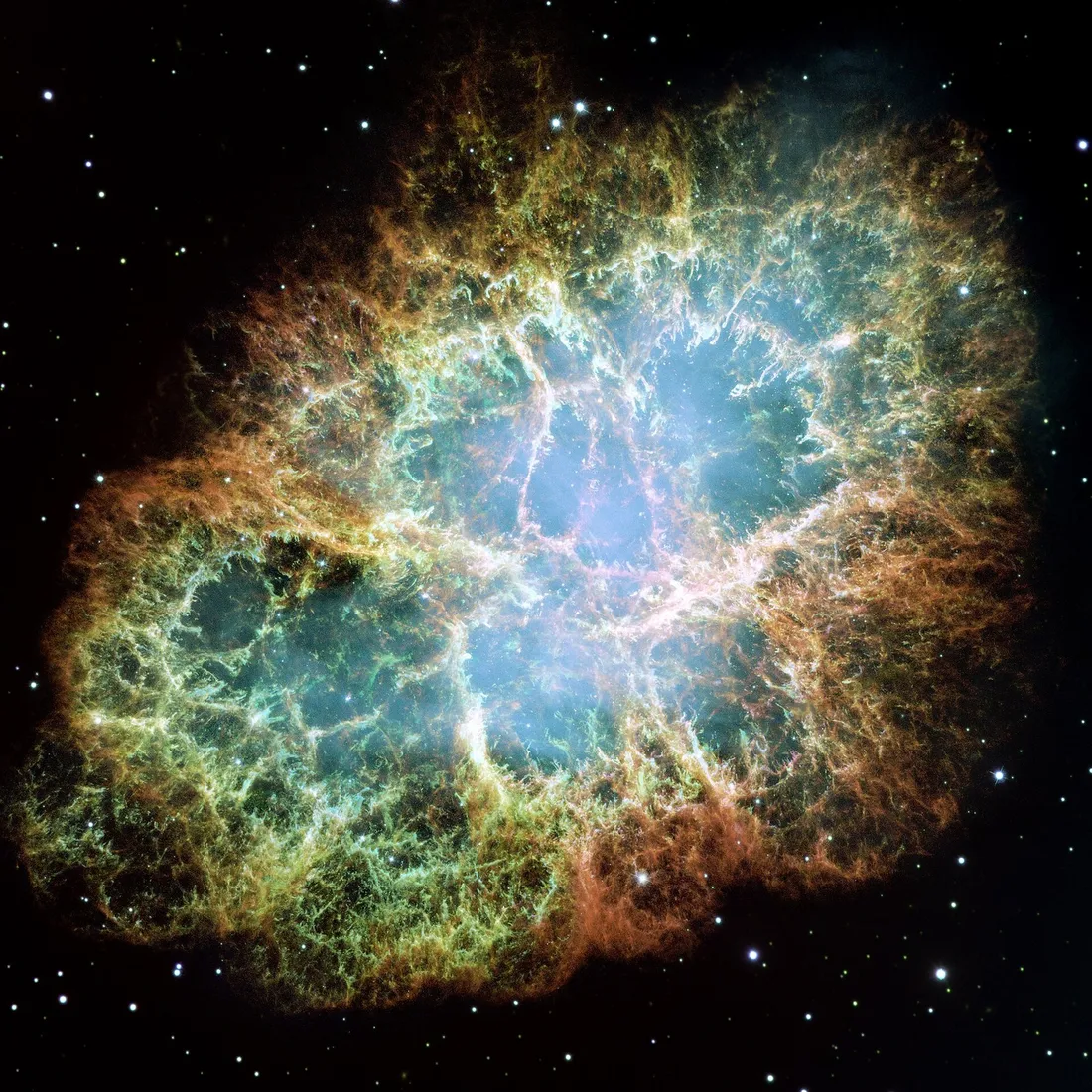
But is all this merely a poetic fancy? No. In recent years, modern science has confirmed a startling truth: Van Gogh's swirling sky carries the very same mathematics as one of the deepest secrets of fluid physics, turbulence.
In 1941, the Russian mathematician Andrey Kolmogorov bound the hidden order of turbulence into a law: in a fluid, energy passes from large eddies to ever smaller ones in a precise proportion, the famous minus-five-thirds law. In 2006, the physicist José Luis Aragón and his team showed that the paintings of Van Gogh's most turbulent period, The Starry Night among them, have a distribution of luminance that follows exactly Kolmogorov's statistics of turbulence.
In 2024, a study published in the journal Physics of Fluids went further still: researchers measured the sizes, the spacing and the brightness distribution of the fourteen principal whirls in The Starry Night, and found that they matched almost perfectly the energy cascade of atmospheric turbulence, and, at the smaller scales, Batchelor's scaling. In other words, Van Gogh had already seen, in the mirror of a soul freed from matter in his sleep, the universal mathematics that physics could only write in equations decades later.
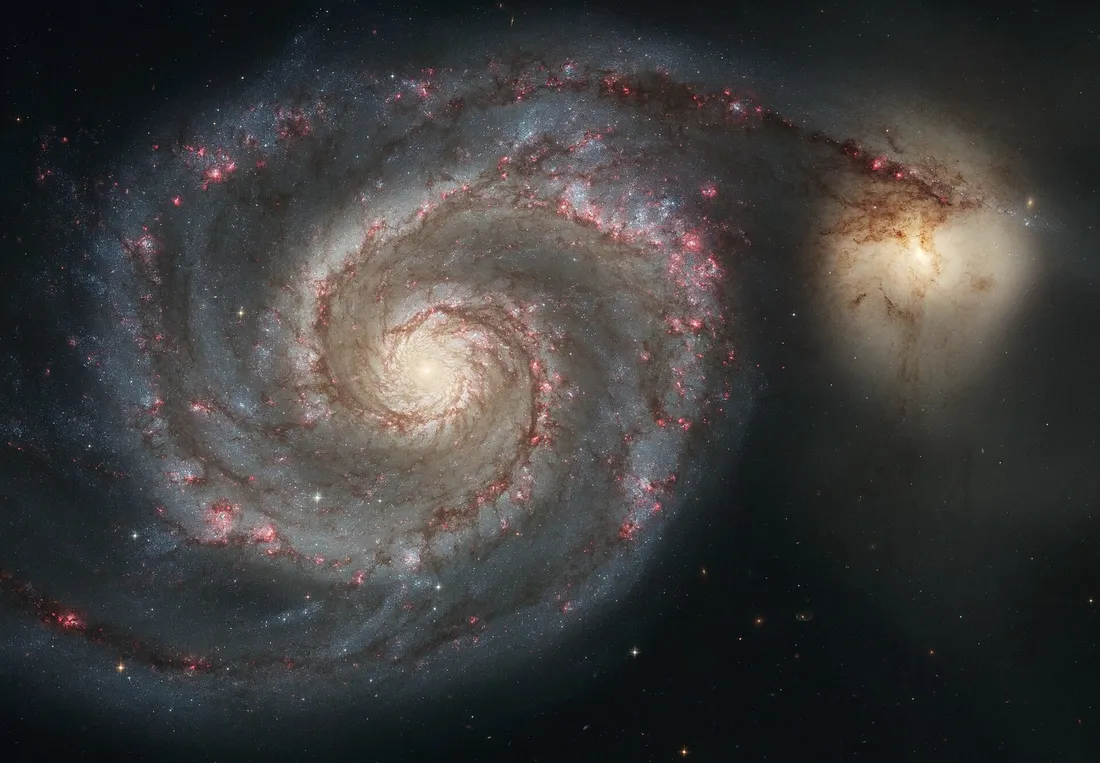
And this law of turbulence is the law not only of the wind or of a cup of coffee, but of the gas of star-forming nebulae and of the arms of spiral galaxies. This is why the resemblance between Van Gogh's sky and the real cosmos is no coincidence, but physics itself.
Why a Grapevine? The Secret Marriage of Earth and Sky
So why was a grapevine placed at the heart of Van Gogh's shimmering sky? This was no ordinary motif of nature. The grapevine, whose roots cling to the darkest point of the soil while its branches, leaves and fruit turn their face to the sky, was the one being that married earth to heaven, matter to meaning; just like the human being, whose body is of the soil yet whose soul wanders the celestial realms. The artists resolved to wrap Van Gogh's sky in this wisest of the earth's plants.
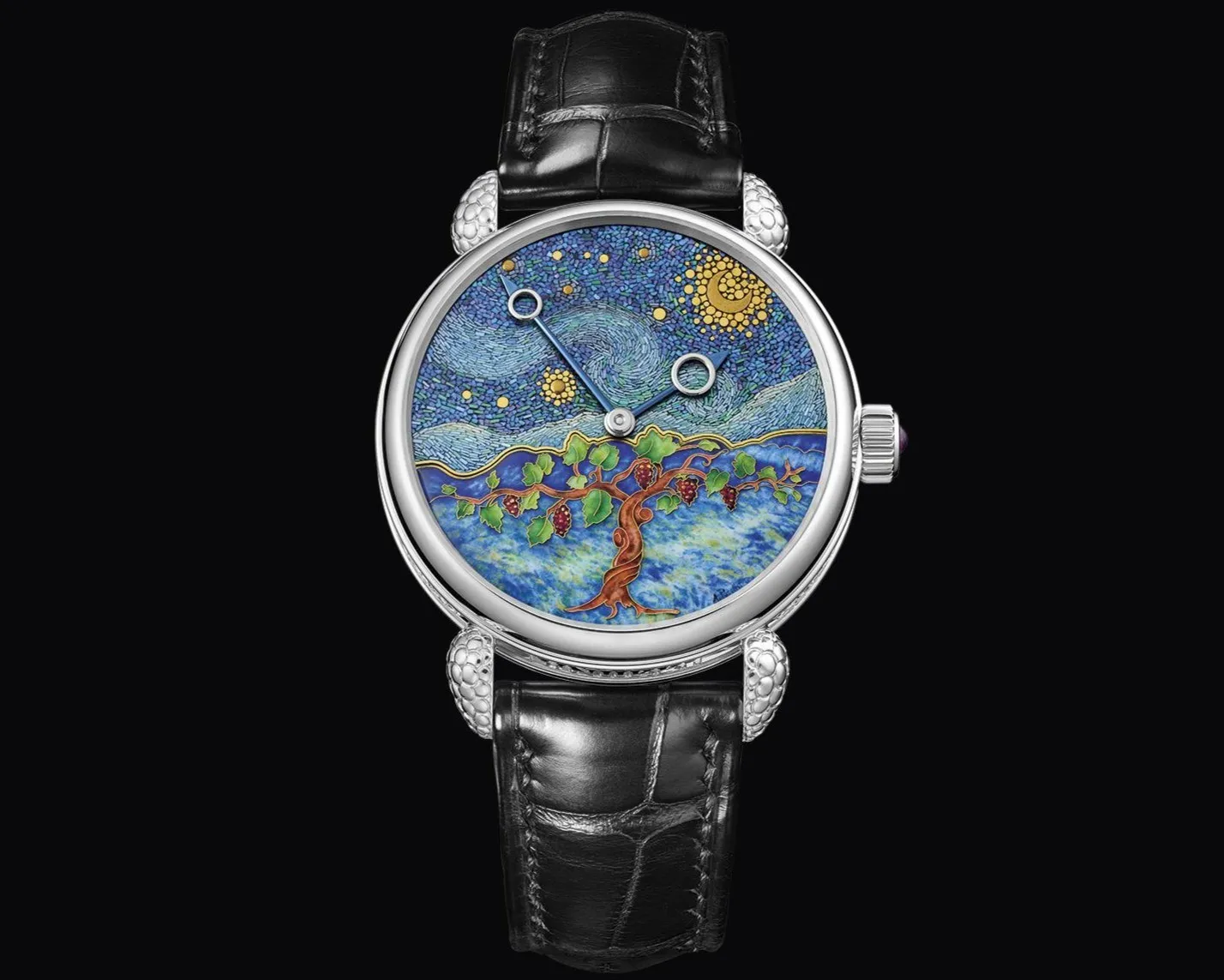
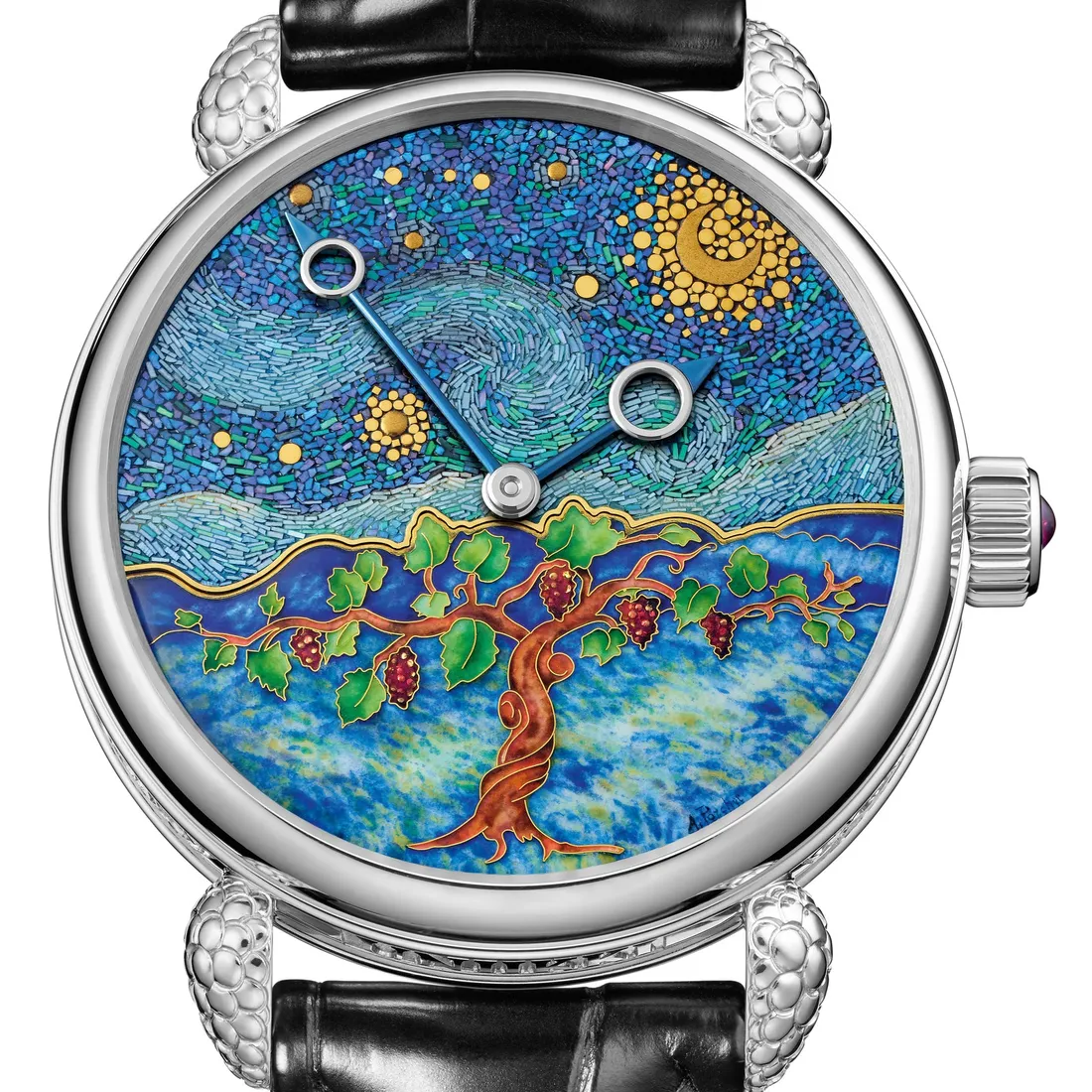
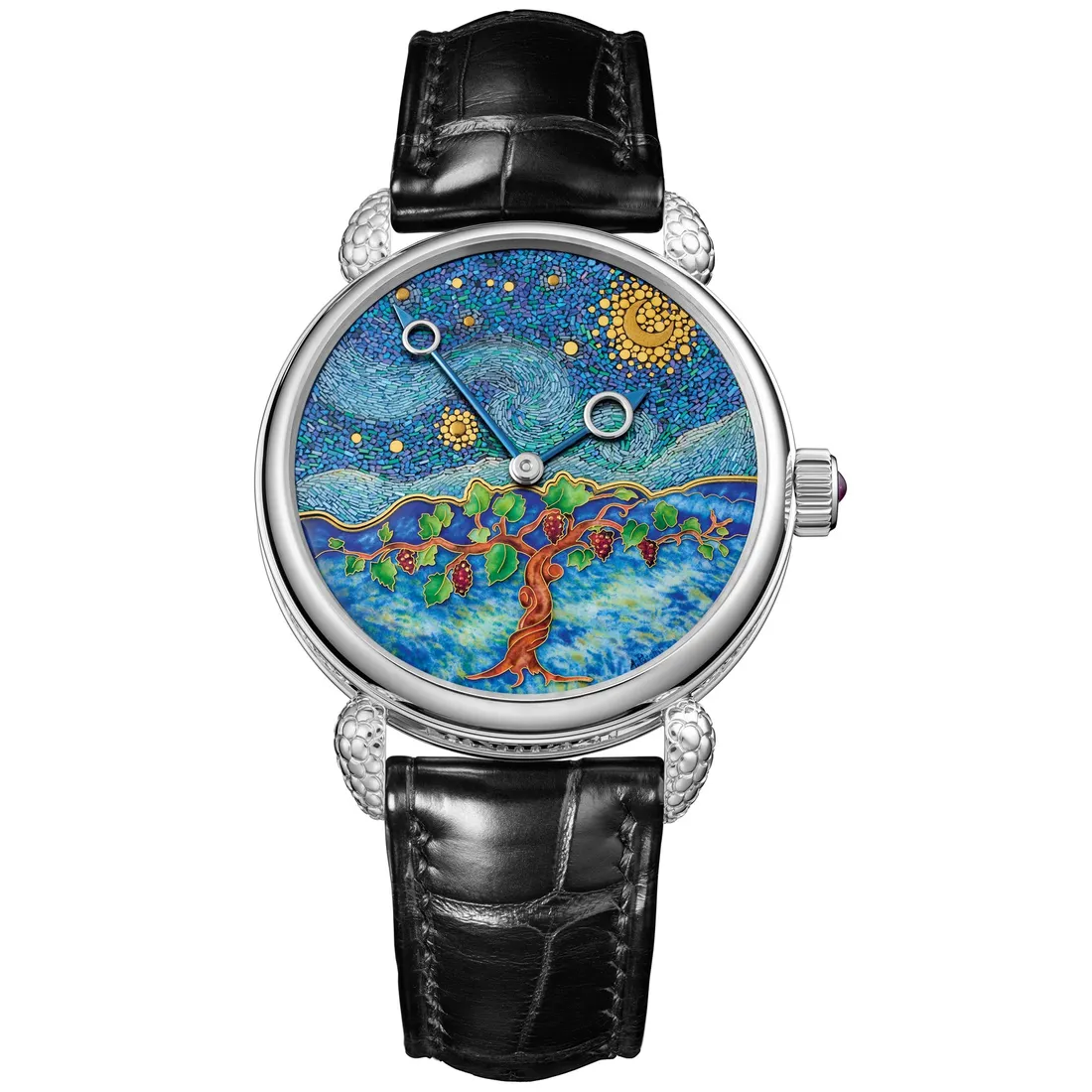
And centuries later, in the twenty-first century, these four rare stars were drawn together by an invisible gravity in that celebrated atelier in Switzerland. The work that emerged was named Starry Night Vine: a Pièce Unique, made in a single example, reference 218RSV, without equal in the world. It was unveiled in 2019, appeared in the Artistic Crafts category of the 2019 Grand Prix d'Horlogerie de Genève (GPHG), and was priced at two hundred and forty-eight thousand Swiss francs. Within this small dome of thirty-nine millimetres, Van Gogh's dream now beat.
The Conductor: Kari Voutilainen and the Invisible Heart
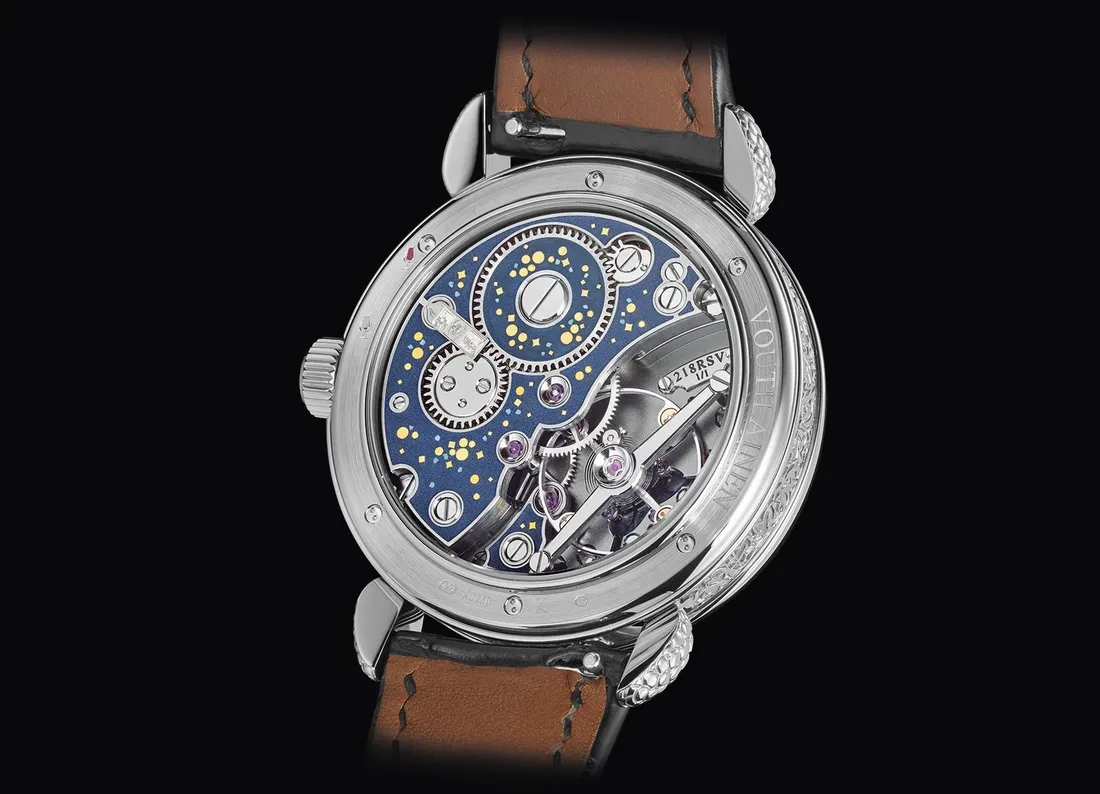
The mechanical genius Kari Voutilainen set to work, honouring the element that had fallen into his own soul. At the heart of the watch he placed a movement made entirely by hand in his own atelier. The greatest secret of this heart lay in the very invention that made Voutilainen a legend: the direct-impulse double escapement.
In an ordinary Swiss lever escapement, energy reaches the balance indirectly, through a lever that rubs and demands oil. Voutilainen instead uses two separate escape wheels, which deliver their impulses to the balance alternately and directly. Friction is thus reduced to a minimum, the impulse surfaces need almost no lubrication, and the watch keeps its stability for years. Its hand-cut balance wheel and hand-formed overcoil hairspring oscillate eighteen thousand times an hour, at a calm 2.5 hertz; it runs on thirty jewels and a sixty-five-hour power reserve, and a small indicator on the dial counts this breath.
The case is no less special than the movement. Rather than ordinary white gold, Voutilainen chose the 18-carat high-palladium white gold that has become his signature; this alloy, needing no rhodium plating and possessing a purer, warmer whiteness, clothes the thirty-nine millimetre case. The base of the dial is solid gold, for only solid gold could withstand the kiln-fire of the enamel and lacquer to be laid upon it. Having set this celestial rhythm, Voutilainen entrusted the dial and the case to the other three bright stars.
Kitamura and the Mosaic of Stars: Maki-e
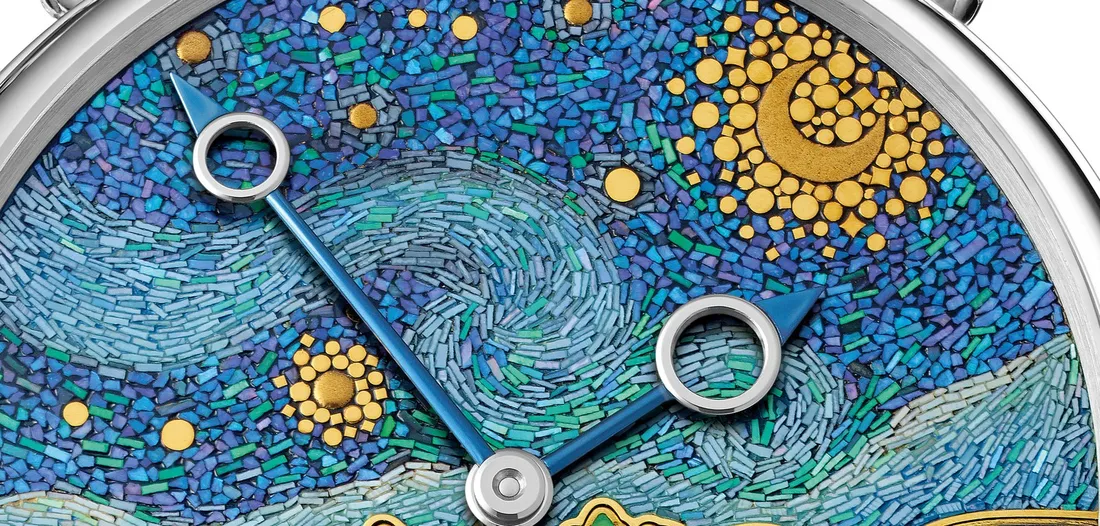
The upper half of the dial rose under the hands of Tatsuo Kitamura, from the legendary Unryuan atelier in the Japanese city of Wajima. Kitamura recreated Van Gogh's swirling sky with the maki-e technique handed down from the Edo period. Maki-e, meaning sprinkled picture, is the art of sowing precious powders onto layer upon layer of urushi lacquer while it is still wet. For this dial and the movement bridges alone, more than a thousand hours of work were required.
The raw materials used are like a treasure chest: Kinpun, gold powder, formed the stars and the luminous fields of the sky; Jyunkin-itakane, solid gold leaf, formed the solid body of the moon and the sun. But the true magic was hidden in two seashells: Yakou-gai, the night-glowing green turban shell, and Awabi-gai, the New Zealand abalone, known commonly as paua.
So why these two shells in particular? Because the nacre of these shells is not a flat colour but a structural iridescence that shifts, with the angle of the light, from green to violet, from blue to gold. The green turban shell gives the sky its deep sea-green sheen, while the New Zealand paua, whose nacre holds the most vivid blue and violet in the world, gives the stars their electric flash. Kitamura split these shells into microscopic fragments and set each one into the dial like a tessera; so that every time you move your wrist, the sky truly shimmers and the stars flicker as if alive. Just as in the Japanese tradition a memory lives on eternally without a single grain being lost, so Kitamura engraved the memory of that celestial night into the very soul of the mechanism.
Porchet and the Garden of Fire: Cloisonné Enamel
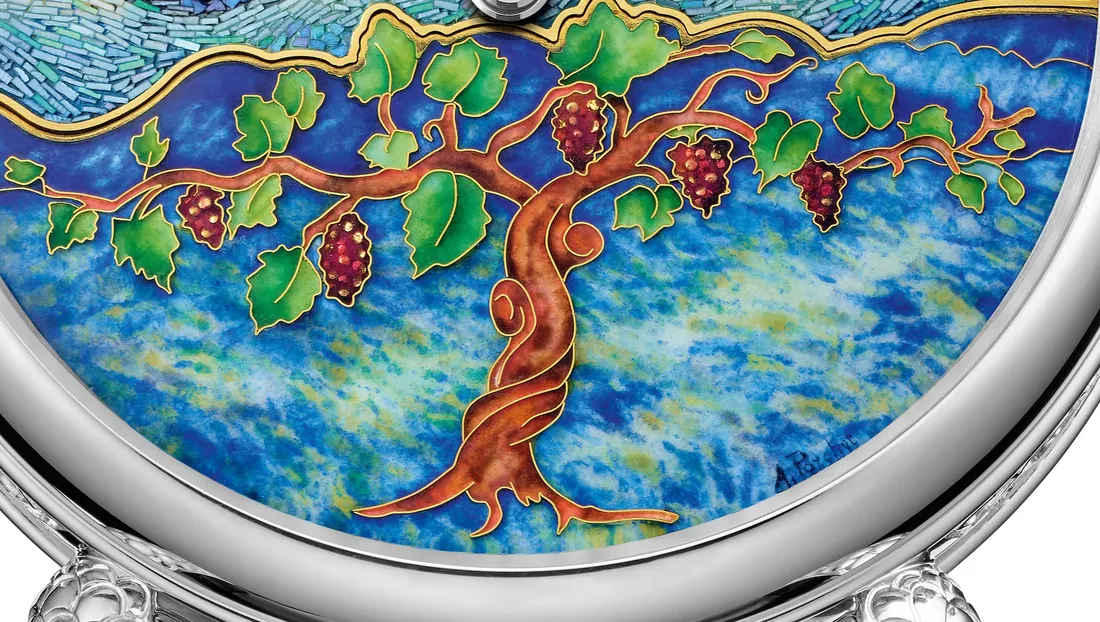
On the half-dial just below, the queen of enamel of the West, Anita Porchet, stepped onto the stage and brought that wise vine to life. The technique she used was cloisonné enamel, one of the most difficult arts in all of watchmaking.
In cloisonné, the master first bends thin, flat gold wires by hand to trace the outlines of the vine, of every leaf and every grape. When these wires are fixed to the gold base, a honeycomb of tiny cells appears. Each cell is then filled with powdered coloured glass, the enamel, and fired in a kiln at around eight hundred degrees. Because the enamel shrinks as it fires, the cells are refilled and refired many times over; and each firing revives the risk of cracking the entire work.
So why cloisonné? Because those golden wire walls do two things at once: they draw the design with a glinting golden line, and they act as dams that keep the molten colours from bleeding into one another. Thus the green of the leaves, the purple of the grapes and the copper of the trunk stay pure and crisp as jewels. What is more, those golden cell-walls echo the veined structure of the vine itself; the technique imitates the form of its subject. This is precisely why cloisonné is both the opposite and the complement of maki-e: one sprinkles light softly, the other imprisons colour within sharp walls.
Jaquet's Signature and the Perfect Symbiosis of East and West
The third star, completing the body and the case, was the master engraver Eddy Jaquet. Jaquet turned the 18-carat gold case into a living vine stock: onto the thickness of the case he engraved the silhouettes of fine vine-leaf tracery, and on the lugs that fasten the watch to the wrist he brought forth fresh clusters of grapes. Reading the language of the metal, the master whispered onto the lugs the two words that proclaim this work's singularity in the world: Voutilainen and Unikki. And upon the tip of the winding crown he set a cabochon-cut ruby, crowned with a grape motif in relief, bringing to mind the ember of that first cosmic explosion, placing the final full stop upon the work.
And it is precisely here that a miracle takes place, far beyond a mere display of handcraft. The Starry Night Vine is the peaceful breathing, upon a single dial, of two utterly foreign civilisations and two philosophies. On one side, the patience of Japan: the East, organic and asymmetric, with its lacquer, its nacre and its sprinkled light. On the other, the precision of the West: the Occident, disciplining enamel, engraving and micromechanics with fire and geometry.
The reason this is not a collage but a true symbiosis is this: Porchet's vine, sharp and richly coloured, meets Kitamura's sprinkled, shimmering sky-light upon the earth, just as Van Gogh's painting itself unites sky and soil. Each technique does what the other cannot. And Voutilainen's invisible heart, together with the frame Jaquet engraved, binds these two halves into a single body. So East and West do not compete; they complete one another. With this unique work, Kari Voutilainen has forged so harmonious a symbiosis between Japanese tradition and Swiss haute horlogerie that it becomes impossible to say where one ends and the other begins.
Beholding the Universe with an Eye Rooted in the Earth
Kari Voutilainen, Tatsuo Kitamura, Anita Porchet and Eddy Jaquet. These four rare stars, scattered from the sleep into which Van Gogh fell after finishing his canvas on that June night, were reunited centuries later in this watch.
The Starry Night Vine is far more than a watch worn on the wrist. It is the experience of beholding forever, with the eye of the earth-rooted vine, the most living, the most secret and the most luminous poem of the universe. One night, Van Gogh slipped free of matter and saw that poem; and four masters imprisoned it forever within gold, enamel and light.