You step off a plane, take out your phone and find that the time has already changed by itself. On a mechanical watch you have to do that job with your hand; and on most watches the price of doing it is losing the seconds.
Pull the crown and turn the hand, and the movement stops. Even if you set the new city correctly, your seconds have drifted, and now you do not even know by how much.
The Sport Traveller, which Laurent Ferrier introduced in 2026, was designed to solve that small and irritating problem. Two pushers, two time zones, and a movement that never stops.
Thirty Seven Years at Patek Philippe, a Podium at Le Mans
Knowing the founder of this brand also explains why the watch looks the way it does.
After watchmaking school Laurent Ferrier joined Patek Philippe and stayed there thirty seven years. During that time he also worked on the prototype of the Nautilus designed by Gérald Genta. Which is to say that at the birth of the whole category we now call the integrated bracelet sports watch, he was at the bench.
His second life was spent on racetracks. At the 24 Hours of Le Mans in 1979 he raced the Porsche Kremer Racing 935/77A alongside François Servanin and François Trisconi. Starting twentieth on the grid, they finished third overall.
He founded his own brand around 2010 together with François Servanin, the man beside whom he had raced. Their first watch was a tourbillon with a double hairspring, and the brand has held the same line ever since: quiet dials, spear shaped hands, and a movement whose appeal comes from architecture rather than display.
The Sport Traveller stands exactly at the crossing of those two lives: the integrated bracelet discipline learned at Patek, and the thing a racing driver expects from an instrument panel, which is instant legibility.
format_quote"At the birth of the whole category we now call the integrated bracelet sports watch, Laurent Ferrier was at the bench."
Two Pushers: Jumping the Hour Without Stopping the Watch
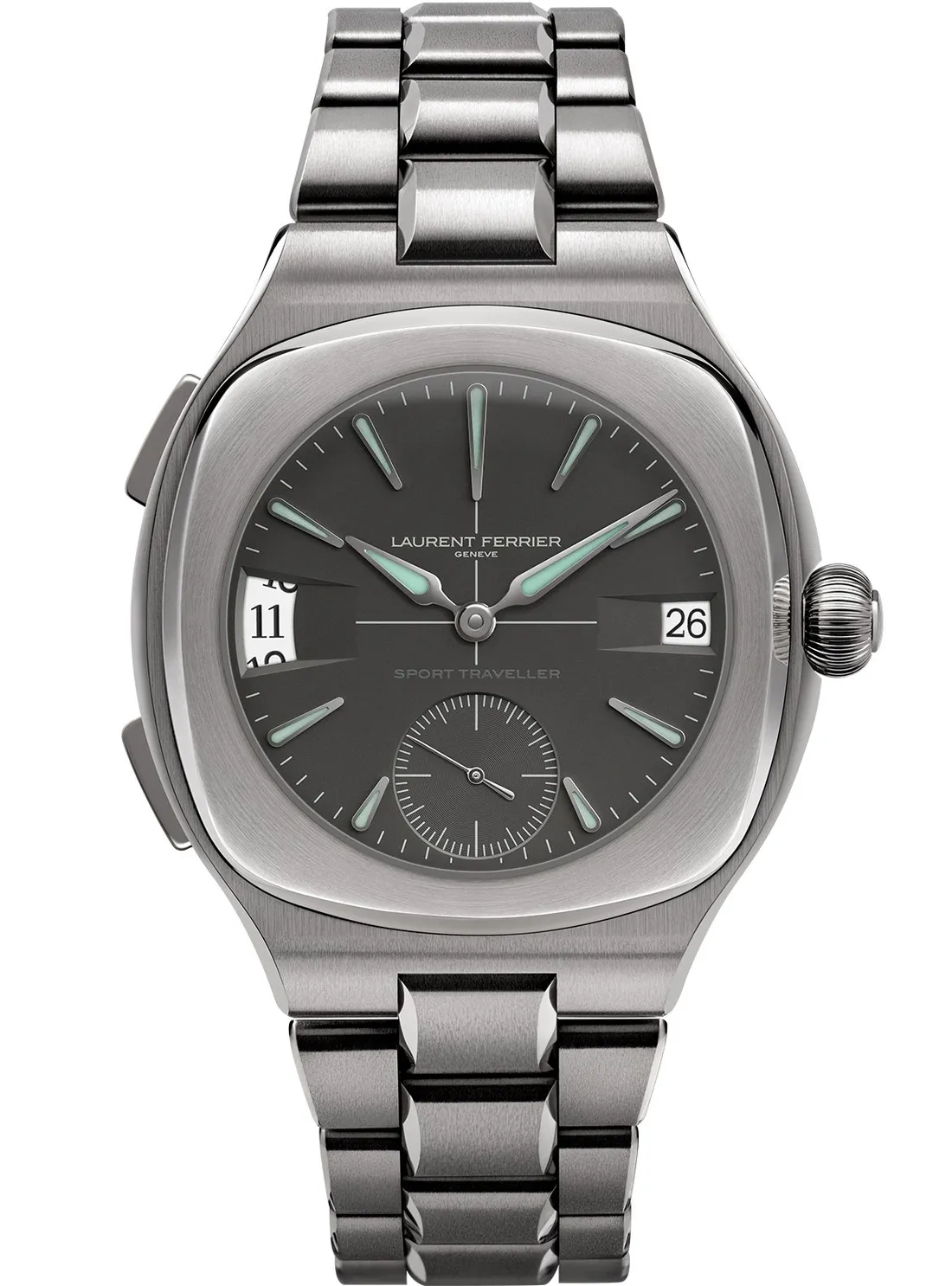
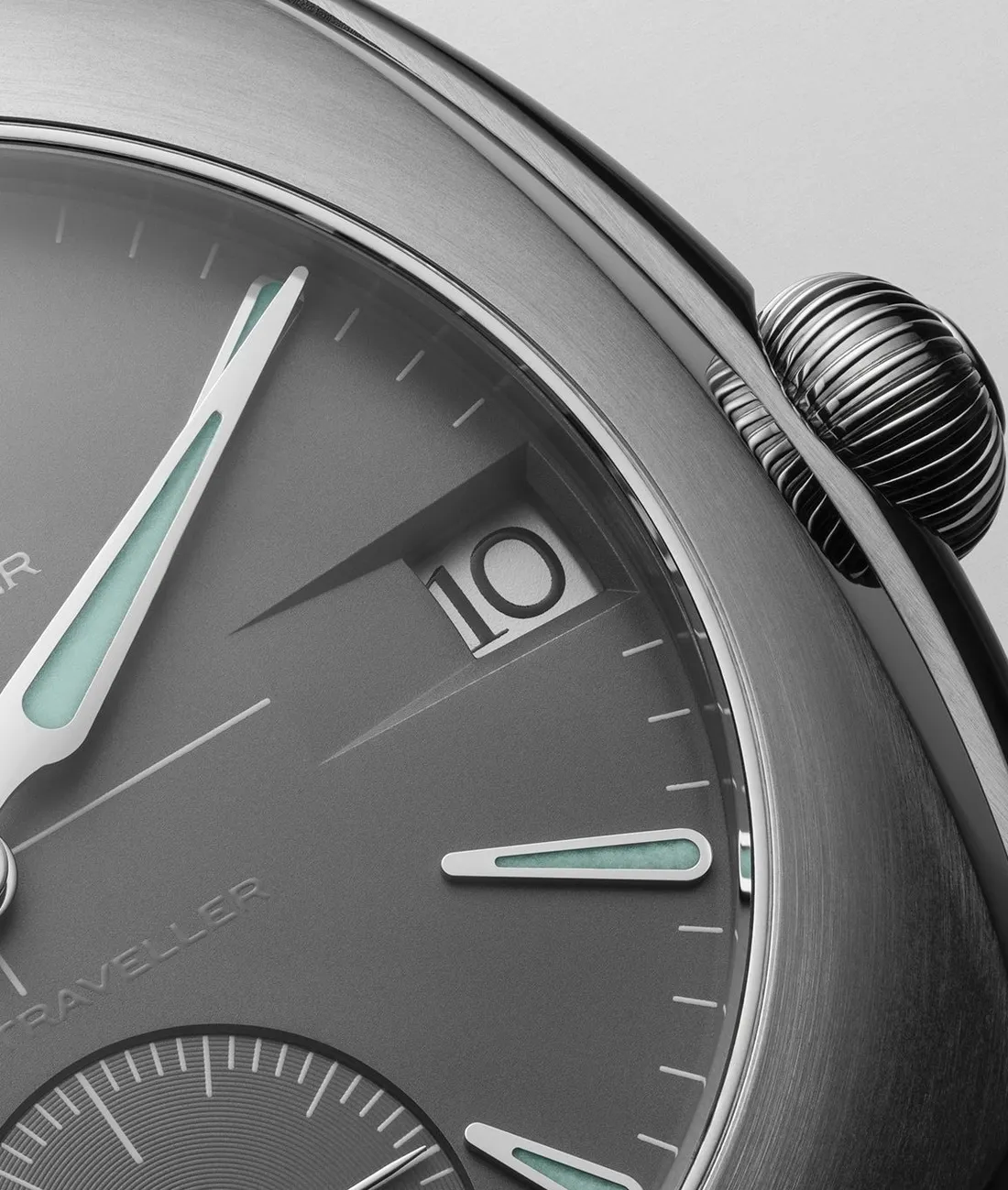
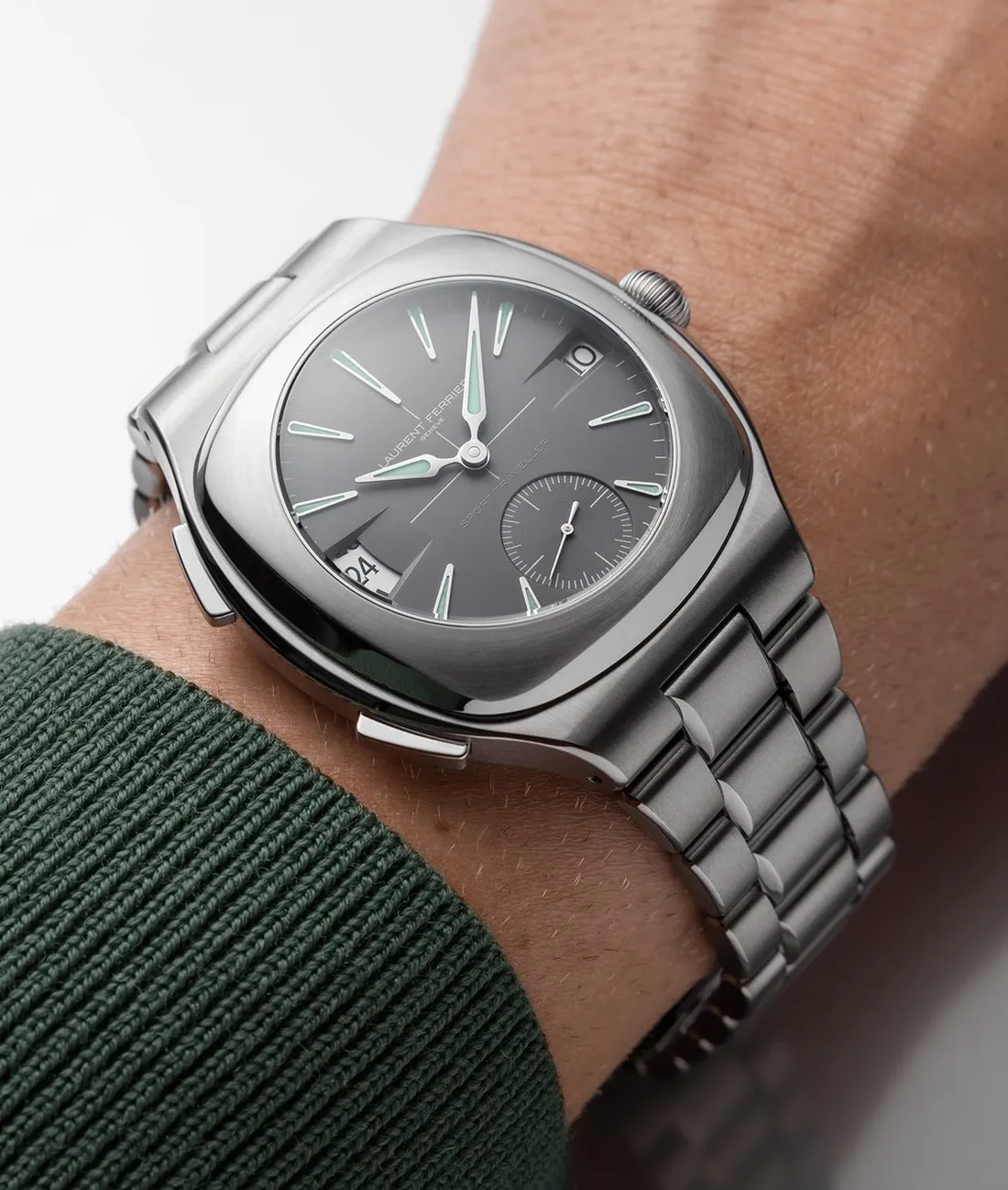
The logic of the watch runs like this. The central hands show the time where you are. In the window at nine o'clock stands the hour at home, the reference time that does not move. In the window at three o'clock is the date.
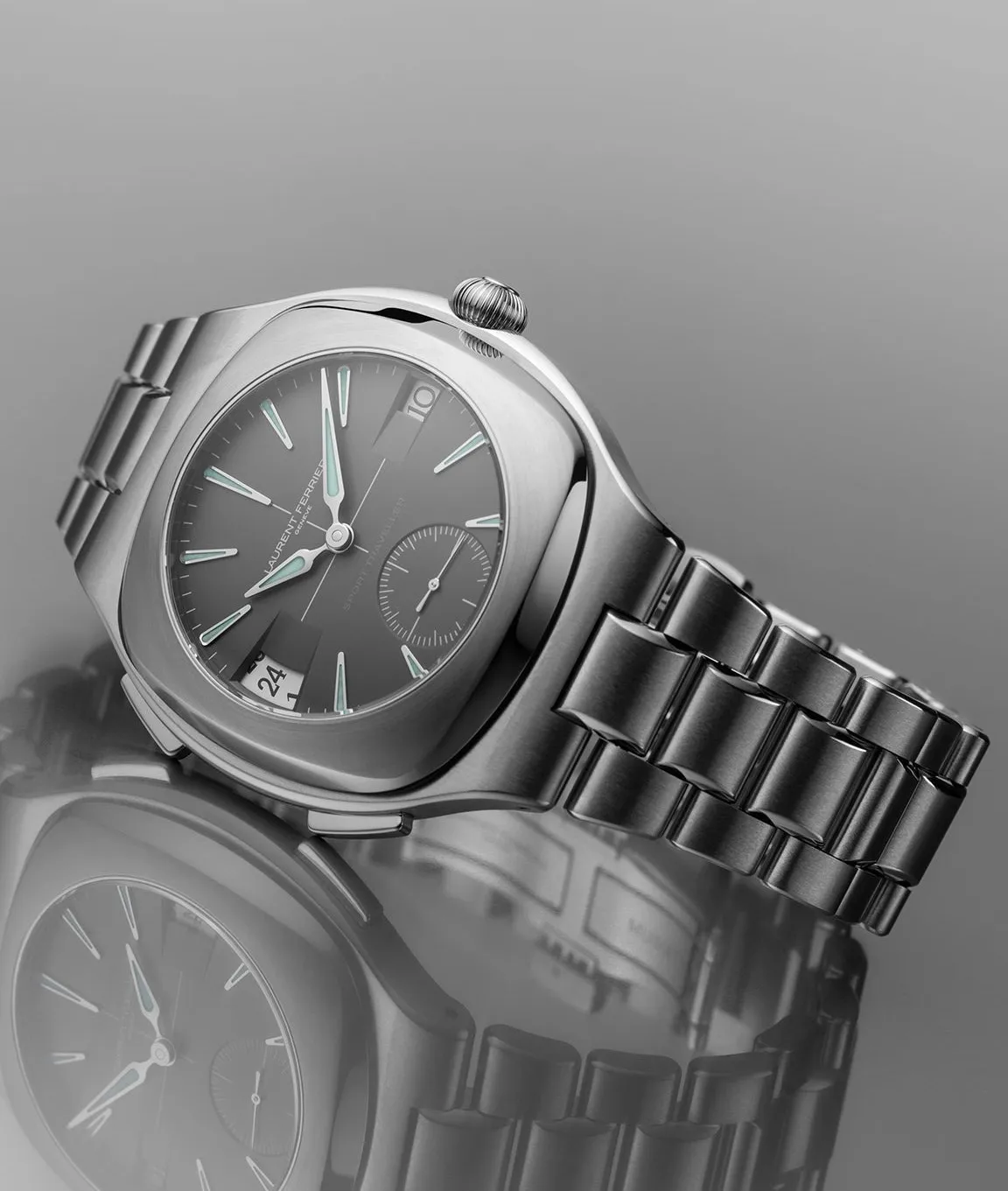
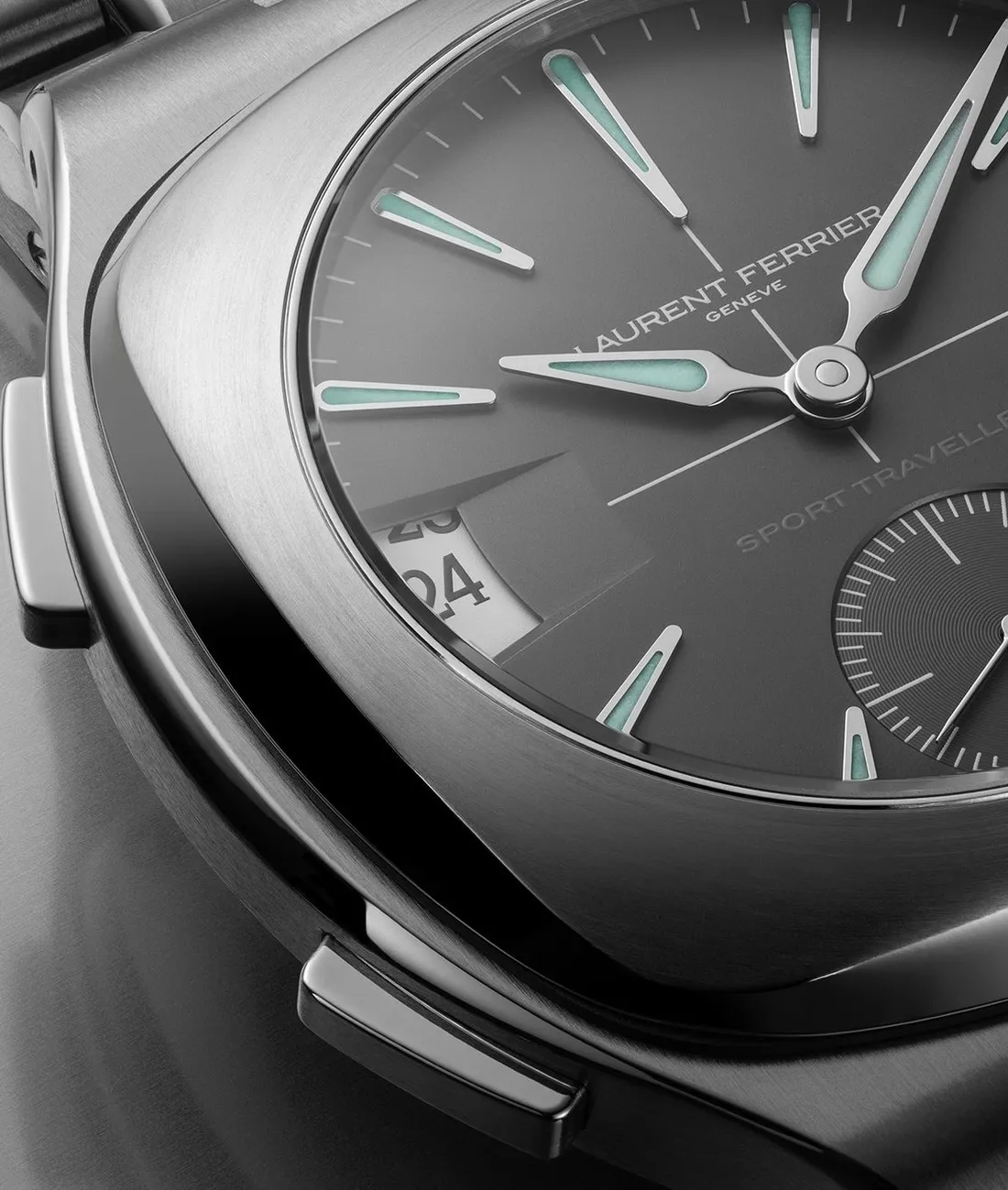
On the left flank of the case, level with eight and ten o'clock, there are two pushers. Each press of the plus pusher jumps the local hour hand forward one hour; each press of the minus pusher takes it back one hour. The minute and seconds hands are never touched.
That detail, the movement carrying on running, sounds small and is decisive in practice. Almost all the time zones in the world are separated by whole hours; your minute is the same everywhere. Which is to say that touching the minute in order to change the local hour is unnecessary and harmful. Because you never pull the crown, the movement does not stop, the seconds do not drift, your rate is not disturbed. You fly from Geneva to Tokyo, press the plus eight times, and the watch still runs at the precision it had on the day you took off.
And on the way home it is enough to look at your home hour; that window has not moved at all.
Calibre LF275.01: Why a Micro-Rotor
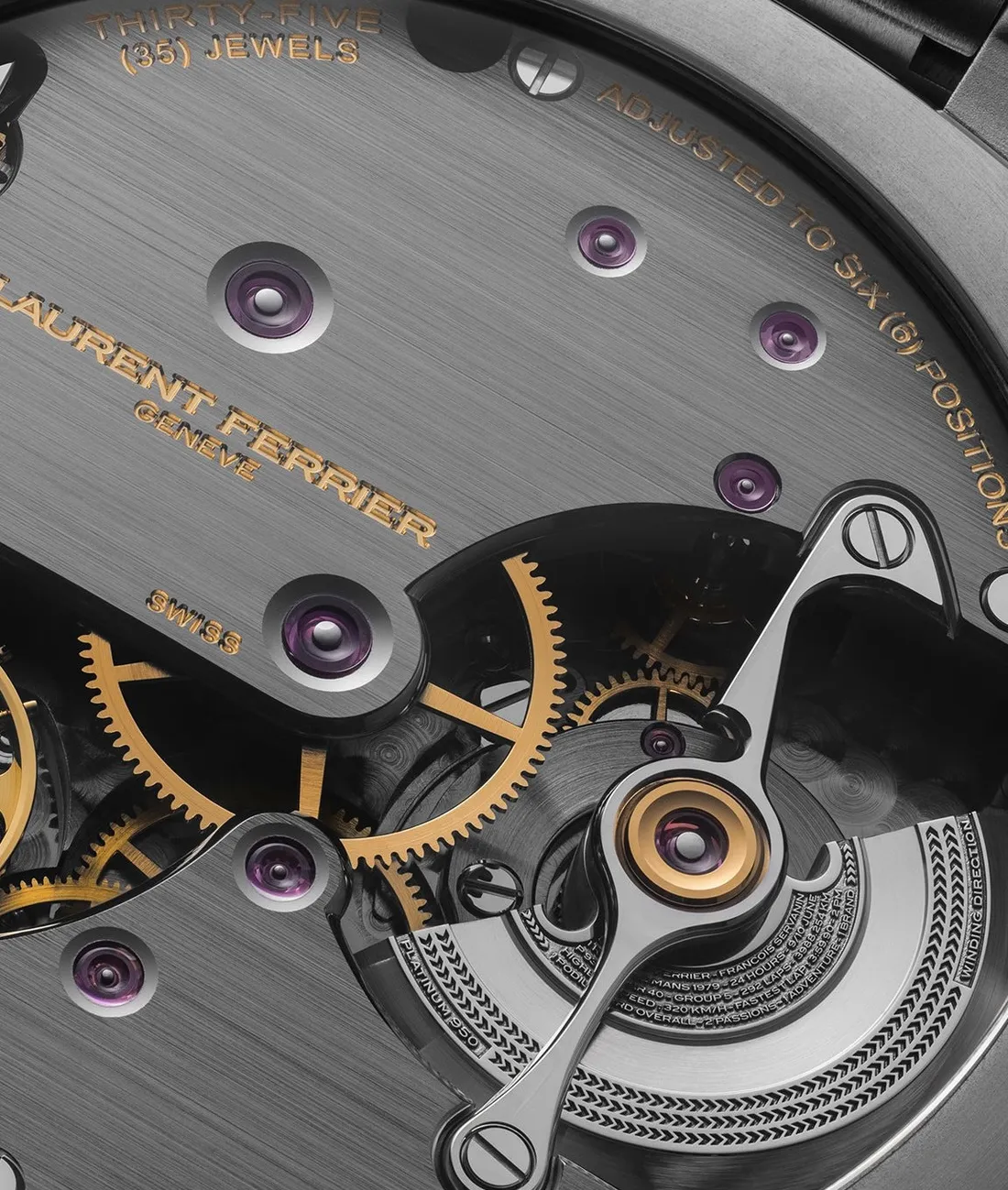
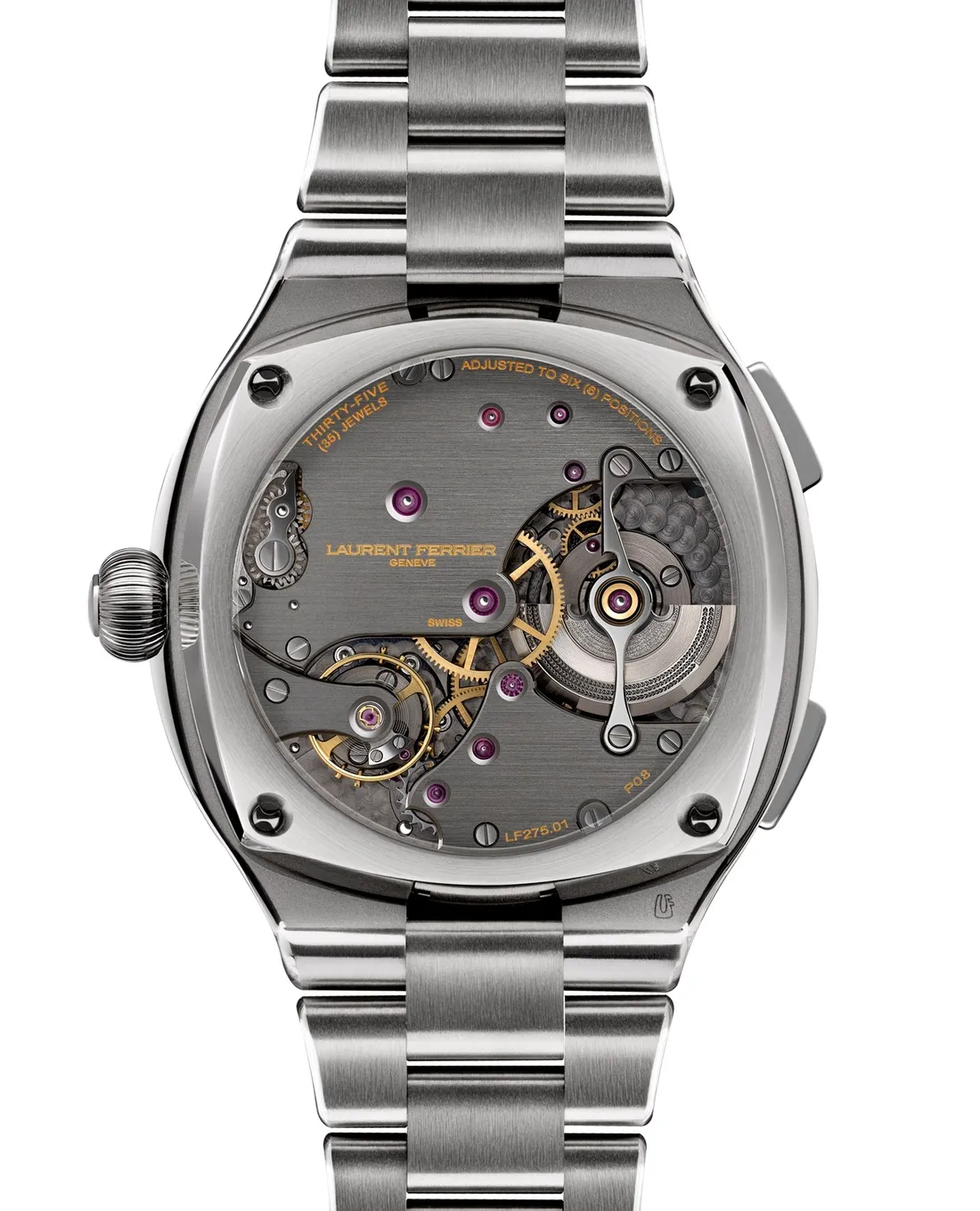
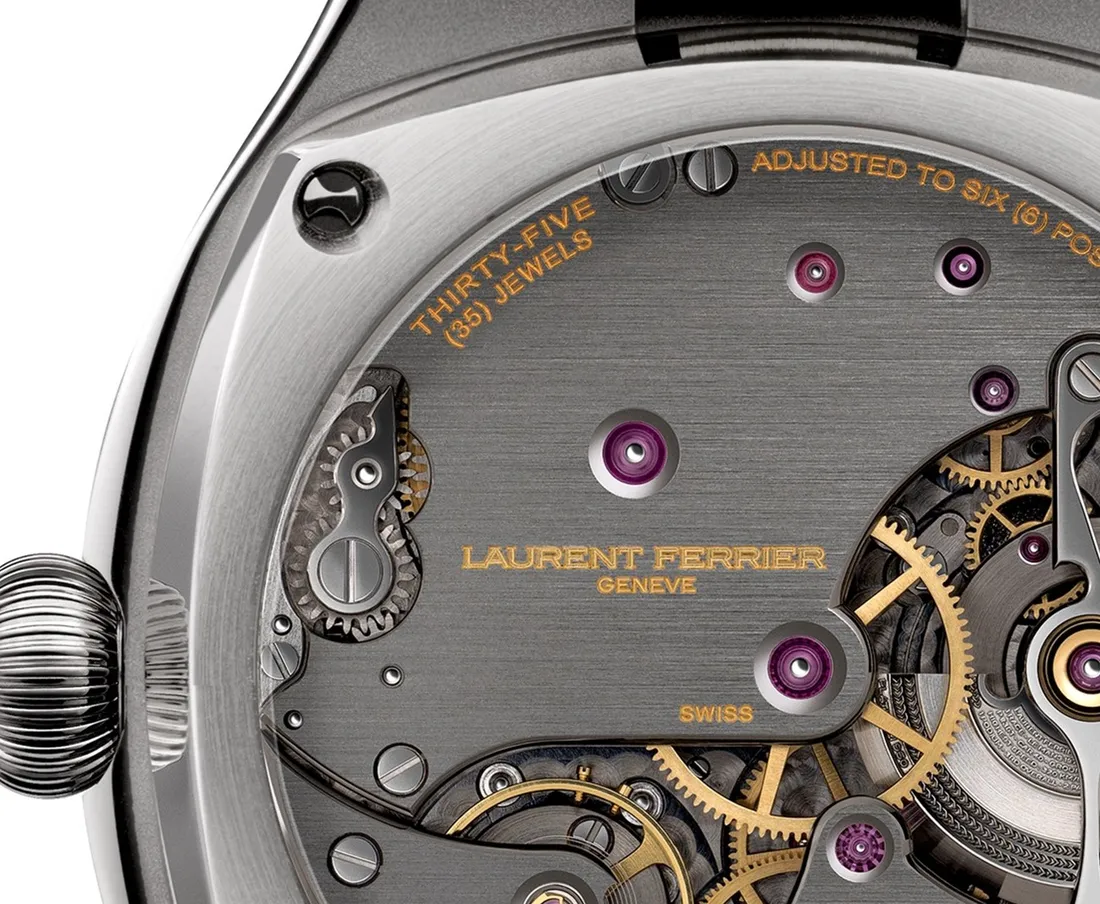
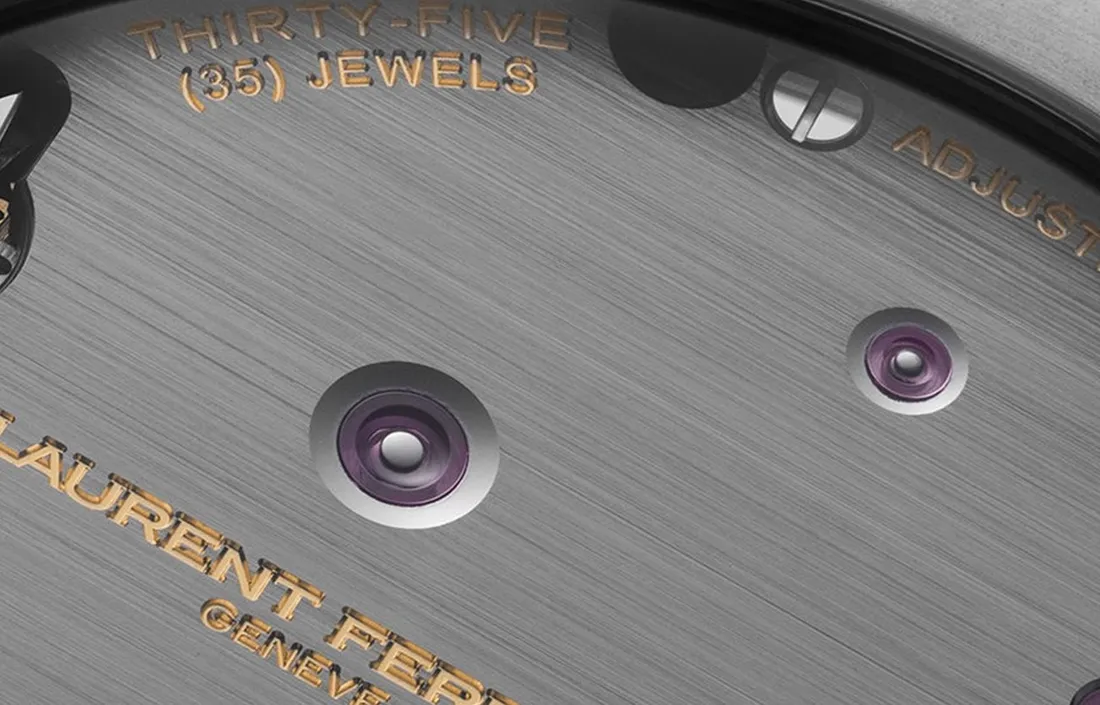
The movement inside is a new calibre developed for this model: the LF275.01. Automatic, thirty one point six millimetres across, five point eight millimetres tall. Two hundred and forty components, thirty five jewels, twenty eight thousand eight hundred vibrations an hour. Power reserve seventy two hours.
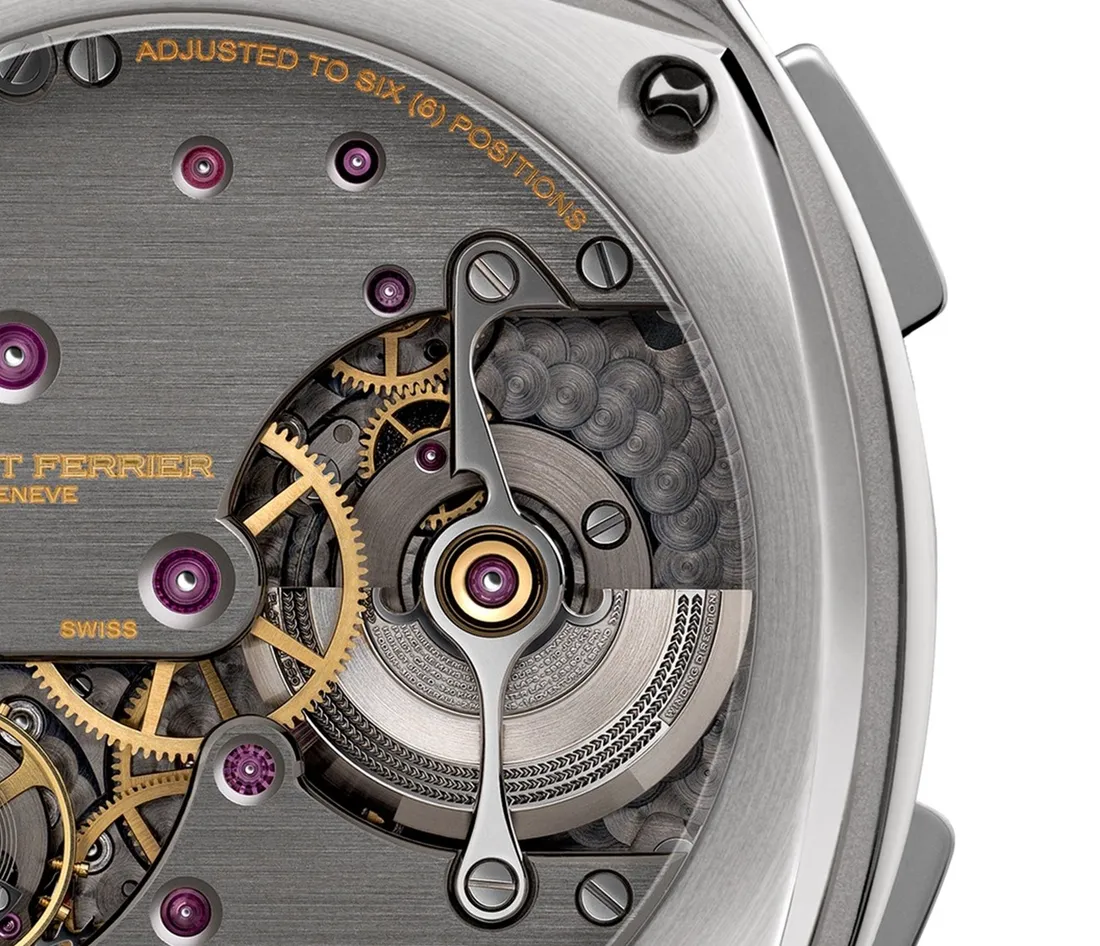
The winding system runs on a micro-rotor. In a classical automatic watch the rotor sits on top of the movement and covers everything beneath it as it turns; what you see through the caseback is largely that metal half circle. A micro-rotor instead sinks into the movement, down to the level of the plate, and is far smaller.
Its price comes from physics: a small, light rotor gathers less energy. That is why reaching a seventy two hour power reserve in a micro-rotor calibre is harder than reaching the same number with a full size rotor. The gain runs two ways. First thickness: the movement becomes thinner. Second the view: you see the whole movement through the caseback, because no wing covers it.
Here the rotor is off-centred and made of platinum. Platinum was not chosen for looks: its specific gravity is higher even than gold, which means more mass in the same volume. You compensate for a small rotor's poor energy harvest by making the material heavier. The rotor winds in one direction and turns on a ball bearing.
On the escapement a note of honesty is needed. Among collectors the name Laurent Ferrier is identified with the natural escapement, that rare double direct-impulse arrangement. It is not in this calibre; there is a classical Swiss lever escapement. That is not a shortfall but a positioning: the natural escapement stays in the brand's higher series calibres, while the Sport collection moves forward with a robust, serviceable solution meant for daily use.
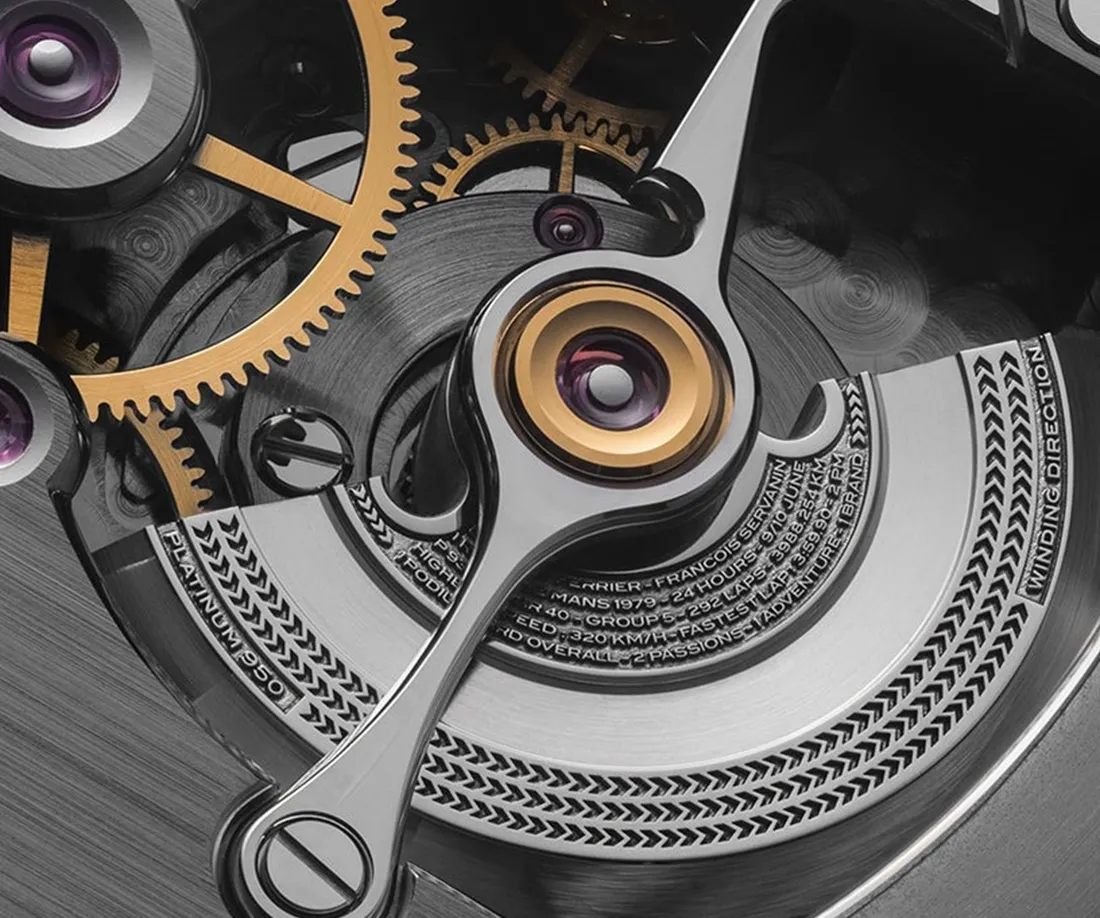
format_quote"A micro-rotor's price comes from physics: a small, light rotor gathers less energy. The answer is not to enlarge the rotor but to make it heavier."
The Dial and Legibility
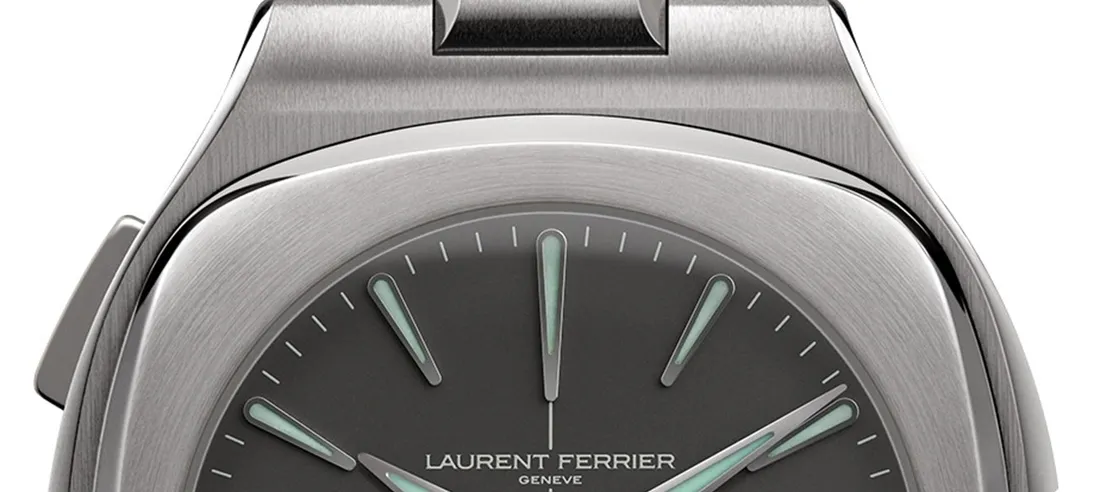
The dial is anthracite opaline. Opaline is a treatment that gives a surface a fine, even matte texture; it breaks the glare and lets the grey tone shift with the light.
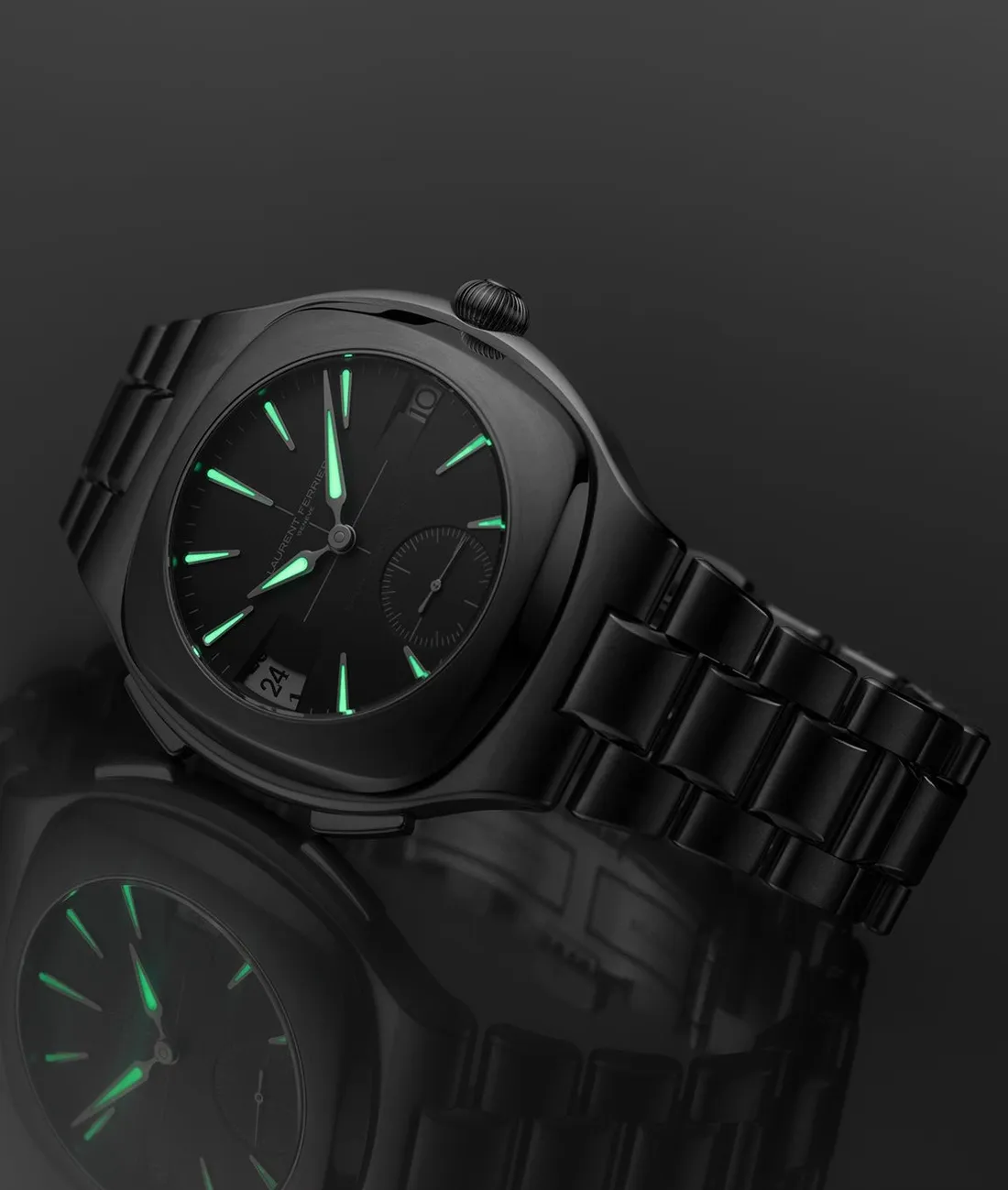
The indices are drop shaped and in eighteen carat white gold, filled with green Super-LumiNova. The hands are in the brand's signature Assegai shape, again in white gold. The assegai is the traditional throwing spear of southern Africa, and the shape of the hand comes directly from the head of that spear: a broad body narrowing abruptly to a point. That shape is not decoration but a legibility decision; the broad body gathers light, so in the dark you see a mass rather than a line, while the sharp tip tells you exactly where it is pointing on the scale.
The choice of green lume is part of the same logic. The dark adapted human eye is most sensitive to green, at around five hundred nanometres; a blue lume of the same brightness looks weaker to you. So green is a choice drawn from the retina, not from display.
Case and Bracelet
The case is in grade 5 titanium. That alloy is around forty five per cent lighter than steel by volume and is neutral against the skin; in a forty two millimetre watch with an integrated bracelet, that difference is felt on the wrist immediately.
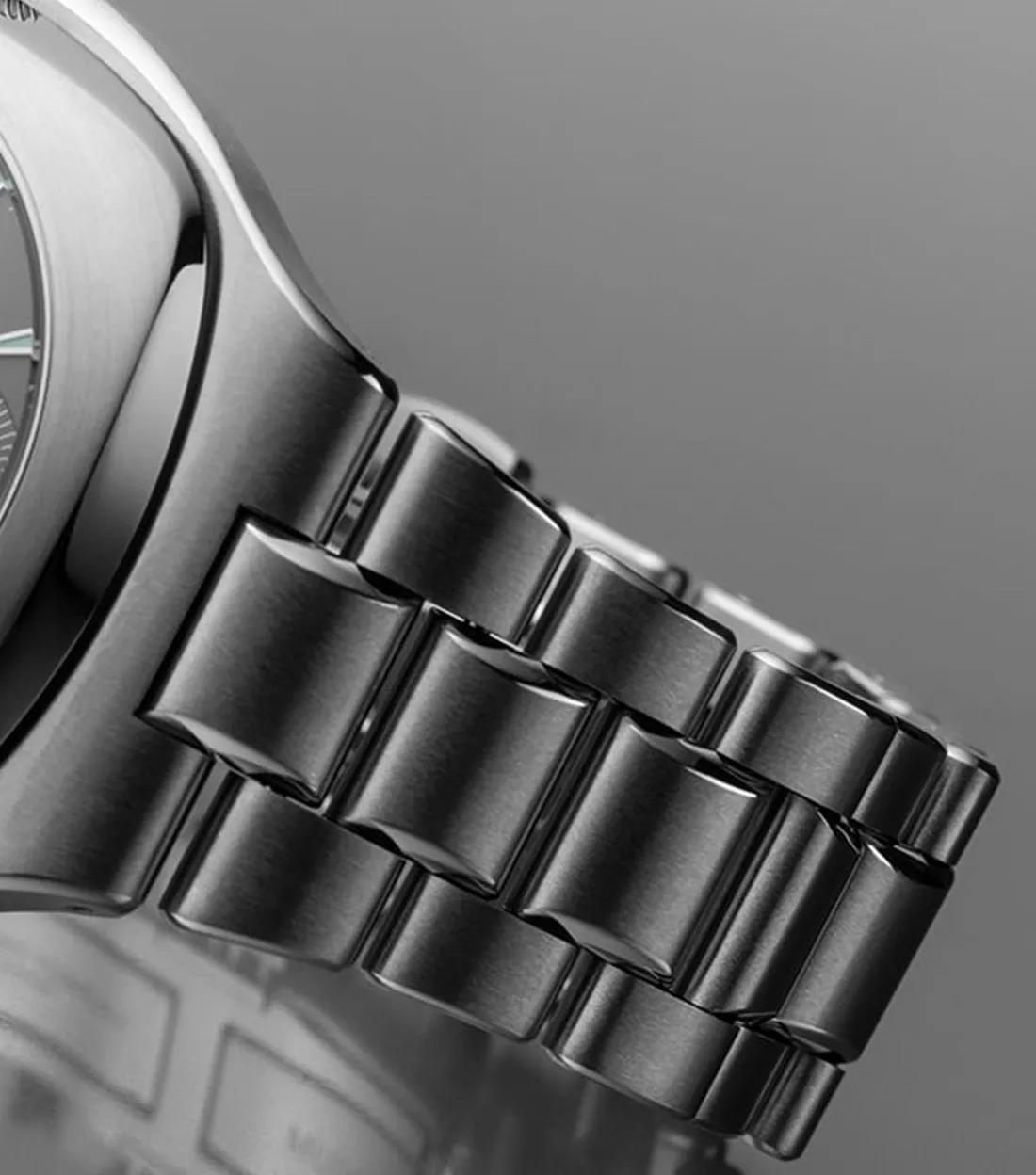
The surface work sets two textures against each other: the flanks of the case are polished, the case middle is vertically satin brushed, and the bezel is circular satin. Which is to say light behaves in three separate ways across the case. The bezel and the caseback middle screw on; the caseback carries special screws. The crystal is domed sapphire. The crown is ball shaped and screws down.
Water resistance is one hundred metres. The case is thirteen point three millimetres tall; that figure comes from the domed crystal and the integrated bracelet rather than from the movement, which is thin. Bracelet and clasp are titanium too.
The price is sixty one thousand Swiss francs. And the watch is not a limited edition; the brand describes it as a permanent addition to the Sport collection.
Waiting for September
What sums this watch up is not a record in complications but the solving of a problem. The less someone who uses two time zones actually needs, the less the watch does: one pusher forward, one pusher back, and a movement that never stops in the background.
In September the 2026 nominees for the GPHG will be announced. The Sport Traveller is a piece that could sit in either the jury's travel watch or its sports watch category; that the brand developed its own calibre from nothing for this model adds weight to the story. We will not make predictions, but we are waiting for the list with interest.
And there is this. A man who spent thirty seven years making watches under somebody else's name dwells, on the watches carrying his own, mostly on the shape of the tip of a hand. That detail tells us what patience actually looks like.