A World on the Edge of Chaos: The Instability of Time (1884-1931)
In the late 19th century, global trade was transforming at a speed humanity had never seen. Vast telegraph cables laid across the ocean floor had bound the London Stock Exchange to Wall Street; steam-powered transatlantic liners had cut intercontinental journeys from weeks to days. But hidden in the middle of all this speed was a problem that was extremely dangerous to solve: the instability of time.
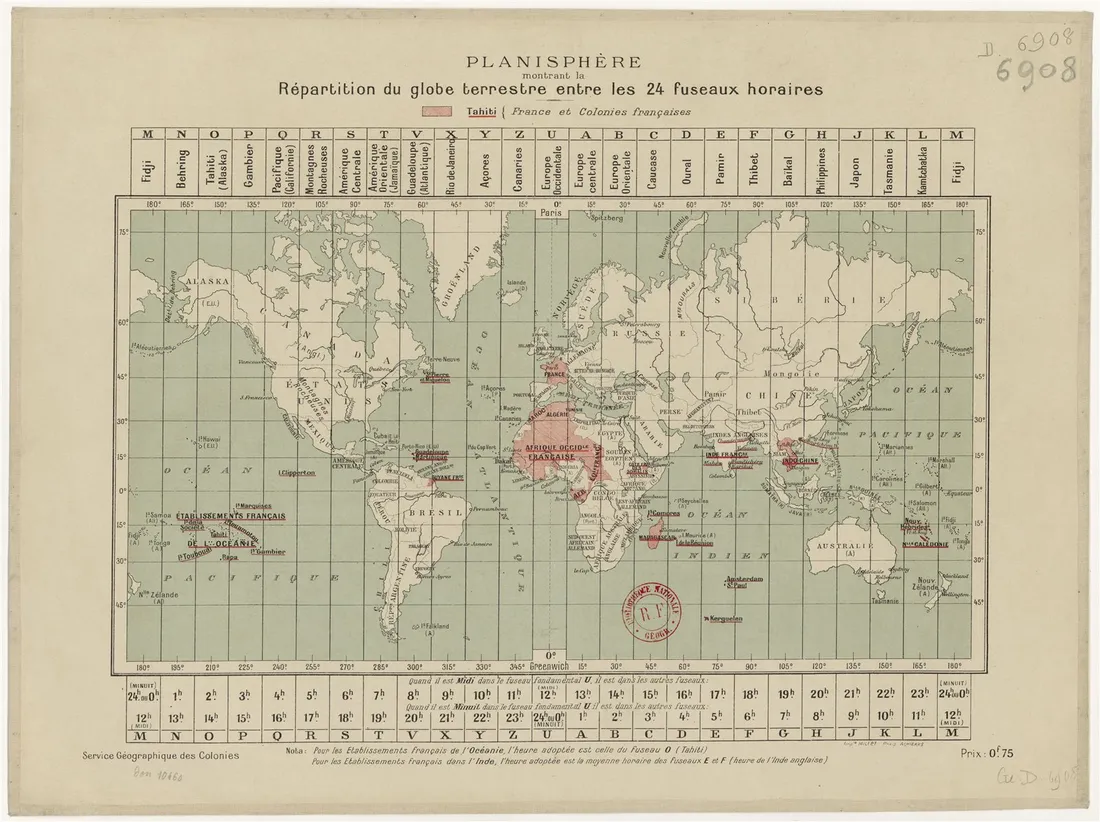
The International Meridian Conference held in Washington in 1884 took Greenwich (GMT) as the zero point and divided the planet into 24 theoretical time zones. Yet this system on paper was not enough to resolve the practical chaos on the ground; every city went on using its own local solar time or its regional railway time.
This confusion had devastating consequences in daily life. Arbitrage collapses: traders working the cotton and gold arbitrage between the Liverpool Cotton Exchange and the New York Chamber of Commerce frequently miscalculated the time differences in telegraph messages; a trader who believed Liverpool was still open when New York had closed could be ruined overnight by a single hour’s error.
Railway collisions: engine drivers working in adjacent time zones, converting their pocket-watch settings wrongly, collided head-on on the same line, and dozens of lives were lost. The failure of multi-dial pocket watches: watchmakers sought the solution by placing three or four separate small sub-dials and separate hand-sets in the case; but these watches were both fragile and could not stop a trader from confusing whether it was three in the morning or three in the afternoon in London.
The world needed a radical mechanical revolution that would show the entire planet on a single dial, with no complicated calculation.
A Bench in Carouge: Louis Cottier’s Mechanical Agony and Revolution (1931)
Unlike the opulent watch houses in the centre of Geneva, Louis Cottier, who lived on a modest street in the neighbouring town of Carouge, was no wealthy factory owner. His father, Emmanuel Cottier, was also a gifted watchmaker who had devoted much of his life to designing a system that would show world time on a single dial, but who died without ever managing to miniaturise the mechanism enough to fit a reliable wristwatch or pocket watch.
Louis was left alone with this mad idea inherited from his father. In the late 1920s and the first years of the Great Depression, he stayed up through the night in his cold Carouge workshop under a single gas lamp. The mechanical wall before him was extremely hard.
In a traditional watch, the central hour wheel turns clockwise and makes one full turn every 12 hours. But when you want to show world time, two enormous obstacles rise before you. The first is the ratio problem: the Earth turns on its axis not in 12 but in 24 hours, so a 1:2 reduction must be obtained from the mechanism. The second, and the most fascinating, is the direction problem: the Earth turns from west to east. If you place a clockwise-turning 24-hour disc beneath a fixed city ring, the eastern cities that ought to run ahead (Cairo or Tokyo relative to London) begin to run backwards. So the 24-hour disc must turn counter-clockwise (anti-horaire), the exact opposite of the traditional hands.
The master names of the era tried to solve this by stuffing dozens of extra wheels into the mechanism, which pushed the watch’s thickness to unbearable levels and, through friction, caused torque loss that stopped the watch.
After months of sleeplessness and dozens of wasted brass discs, Louis Cottier made a radical decision: he would not touch the main architecture at all. He solved the problem with an ultra-thin module placed between the dial and the mechanism. Taking the motion of the hour wheel, he inserted a single small transfer wheel (pignon d’inversion) in between. This special gear did two things at once: it halved the watch’s 12-hour rotation speed to equal a 24-hour period, and it reversed the direction of rotation so the disc would turn counter-clockwise.
Around this turning 24-hour disc Cottier placed a fixed city ring representing the 24 main time zones. When the user set their own local time, thanks to the reverse-turning inner disc, the local time aligned with every city on the dial fell into place on its own, continuously. No extra pusher, no complicated crown calculation. When he patented this invention in 1931, giants such as Patek Philippe and Vacheron Constantin came knocking at this modest master’s door at once. But the craft was so delicate and its production so difficult that for many years it remained a privilege only very special collectors could reach.

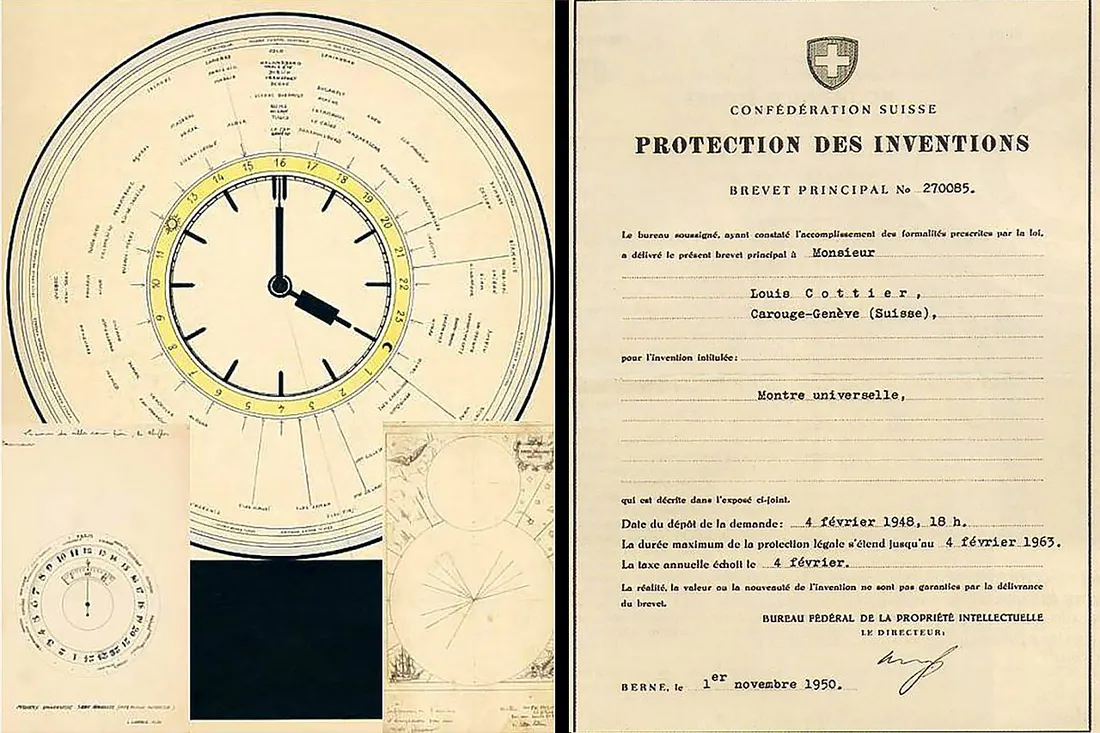
A Modern Reading: The Tiger Eye Dial
In 2026, Baltic took this historic architecture of Louis Cottier’s from 1931 and turned it into a durable dress-tool watch fit for everyday use.
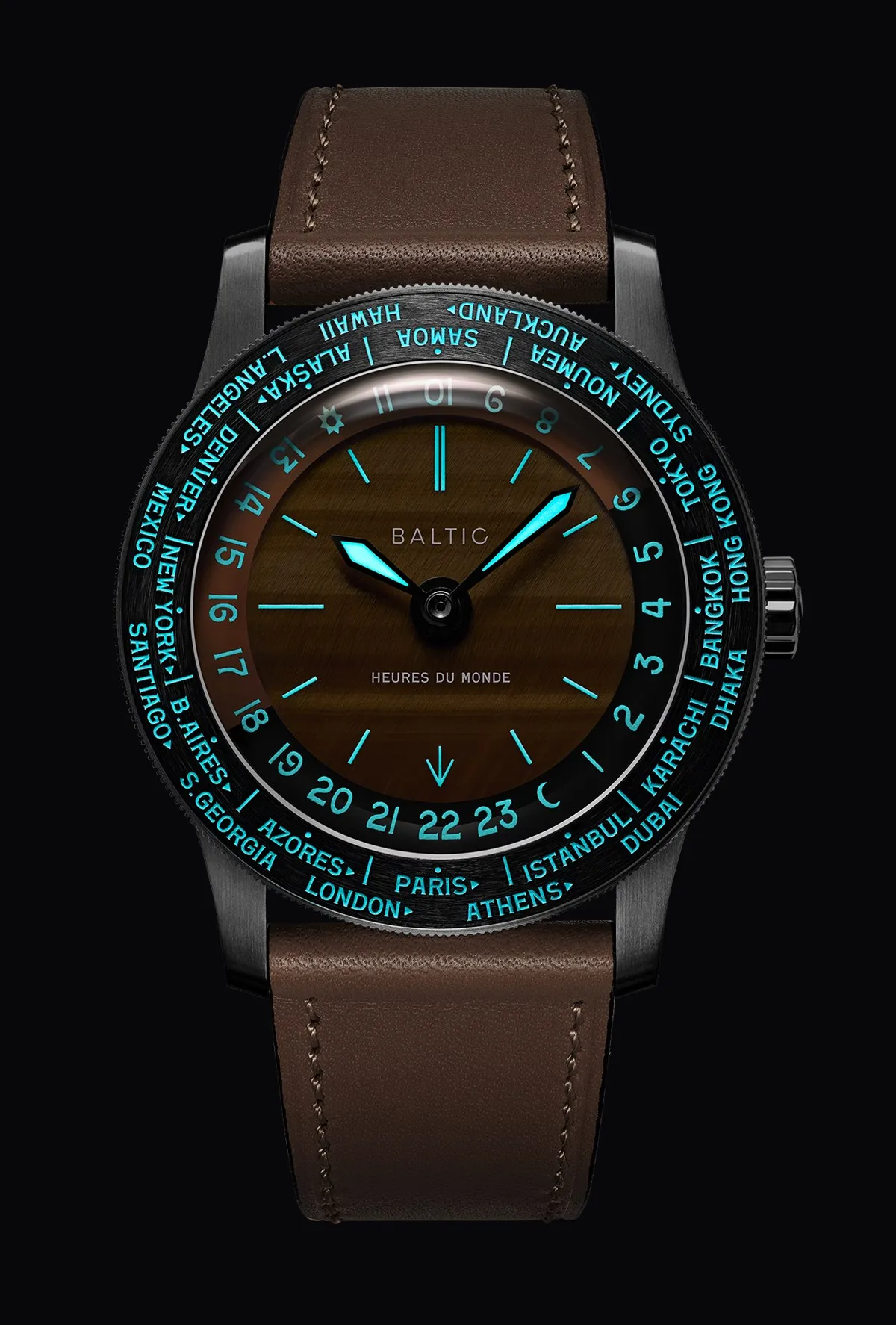
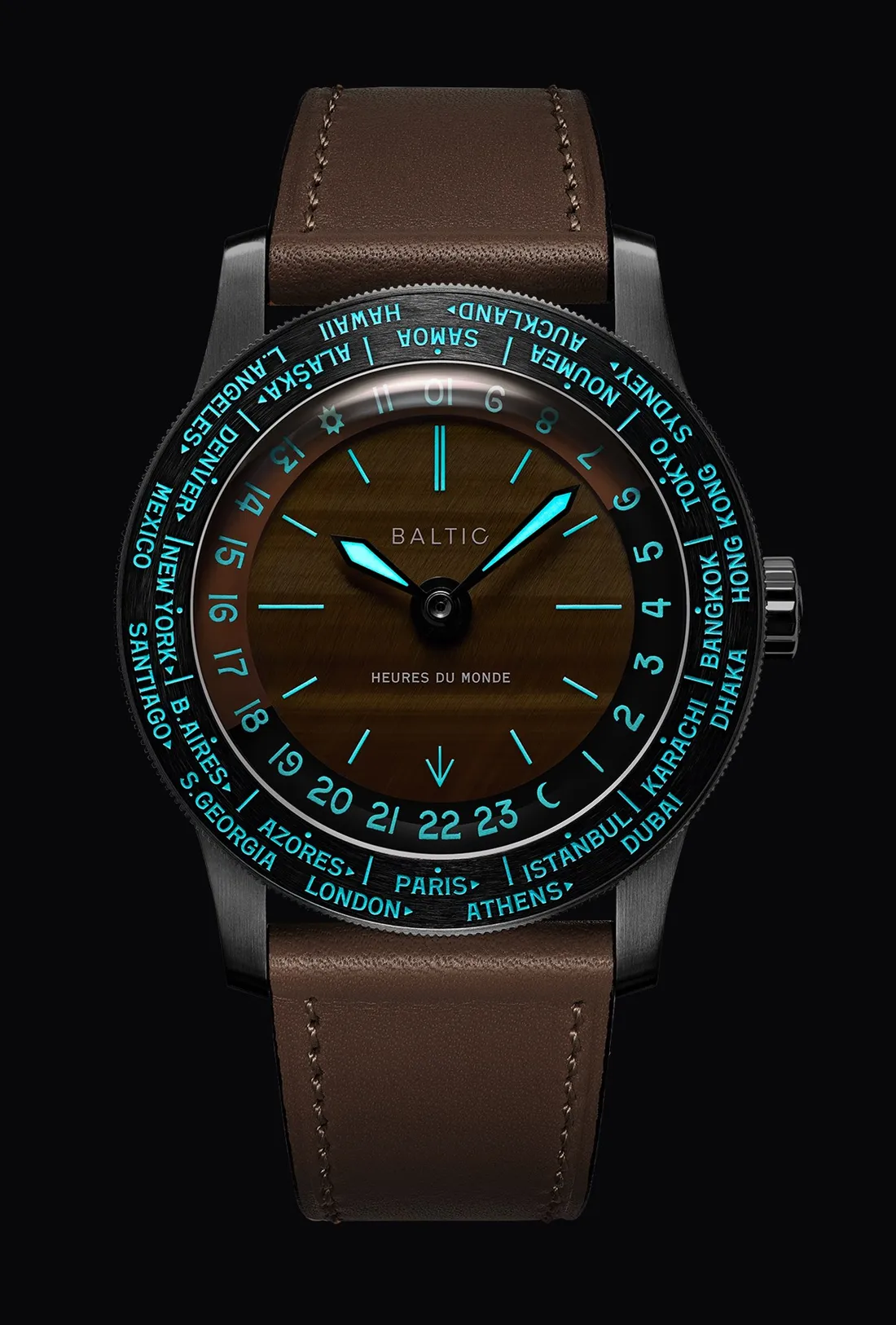
The natural Tiger Eye dial at the centre of the watch is sliced at the scale of microns into a plate just 0.4 mm thick. The natural golden and brown fibrous texture in the stone (chatoyancy) changes as the light strikes the dial from every angle. Limited to 200 pieces, the dial of each watch is, by nature, different and unique.
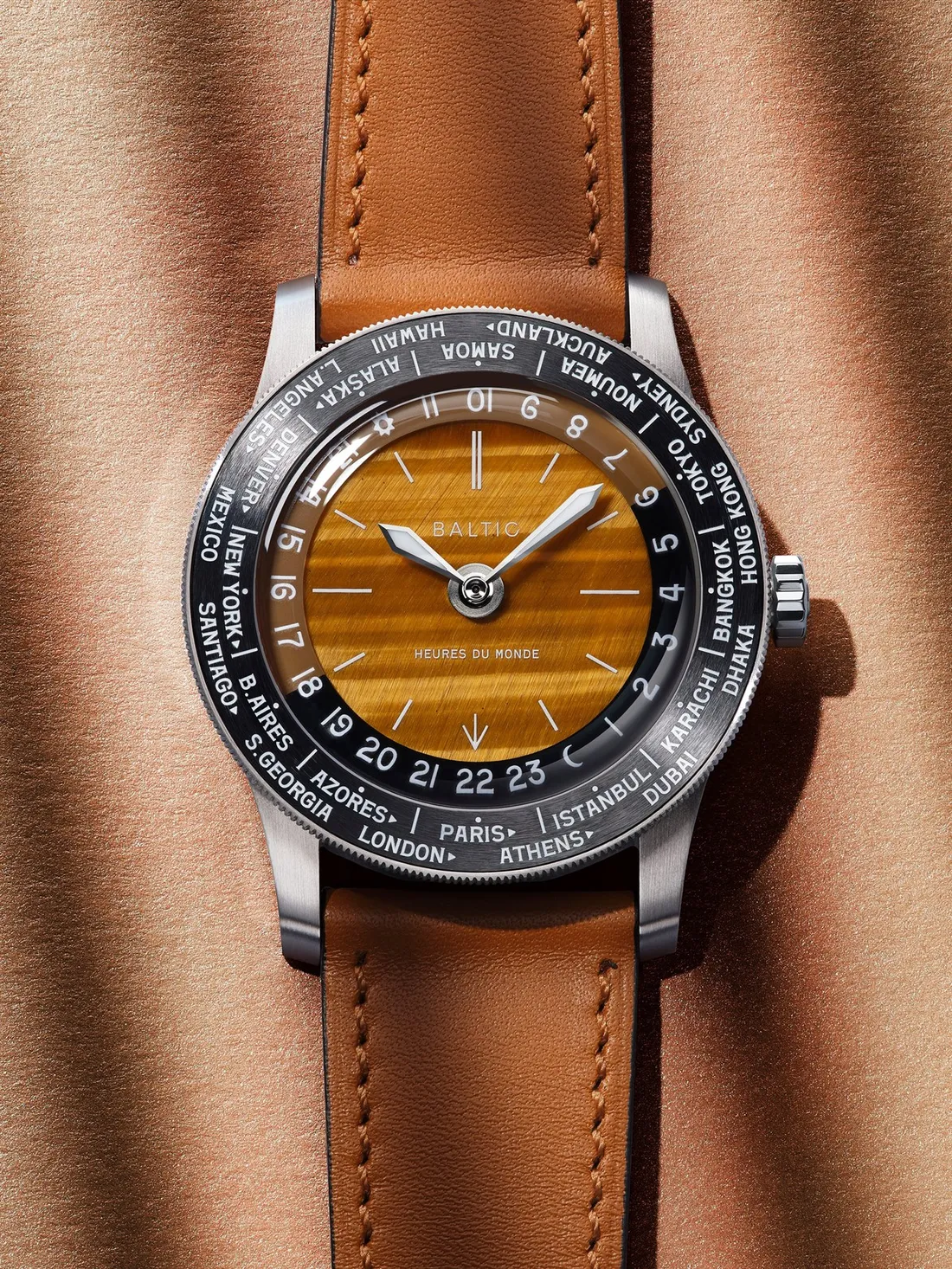
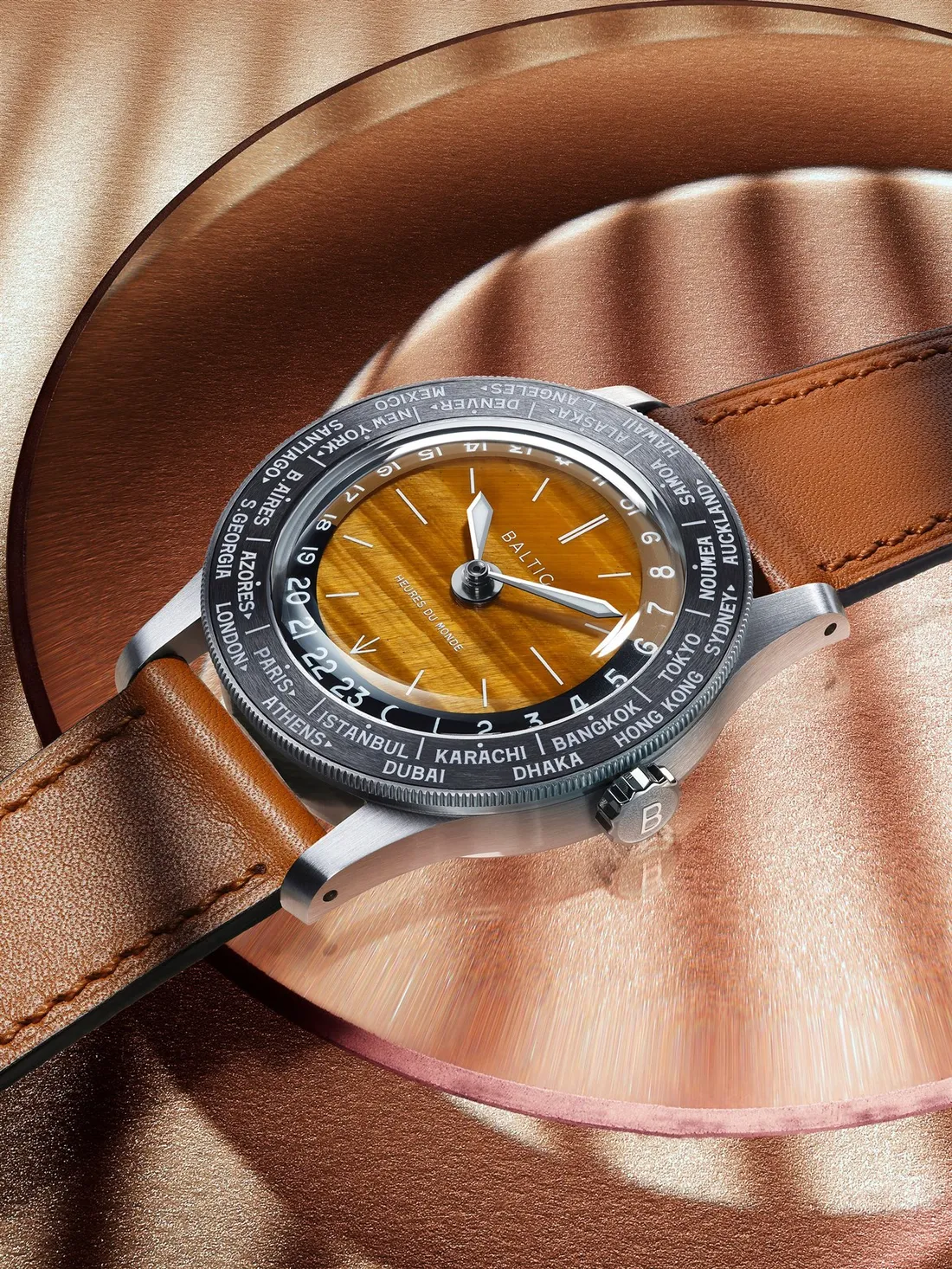
Case and City Ergonomics
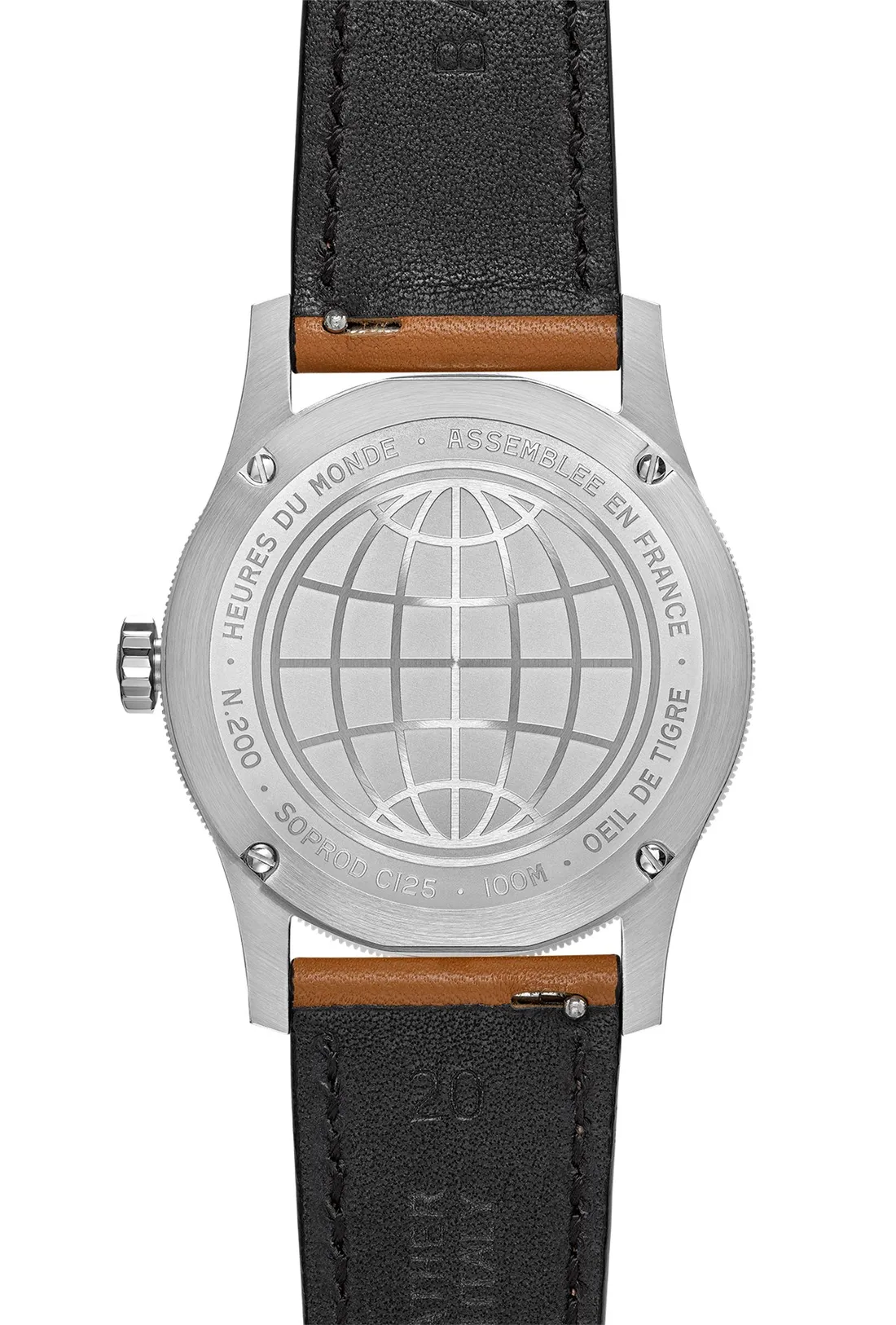
The case observes the same balance. At 37 mm in diameter, it offers an ideal wrist balance faithful to the neo-classical, elegant proportions of the 1930s. Its thinness is just 9.3 mm without the crystal (11.3 mm in total with the double-domed sapphire). The 24 city names engraved on the rotating brushed ceramic bezel are filled with Super-LumiNova BGW9 for night legibility, and the watch is water-resistant to 100 metres (10 ATM).
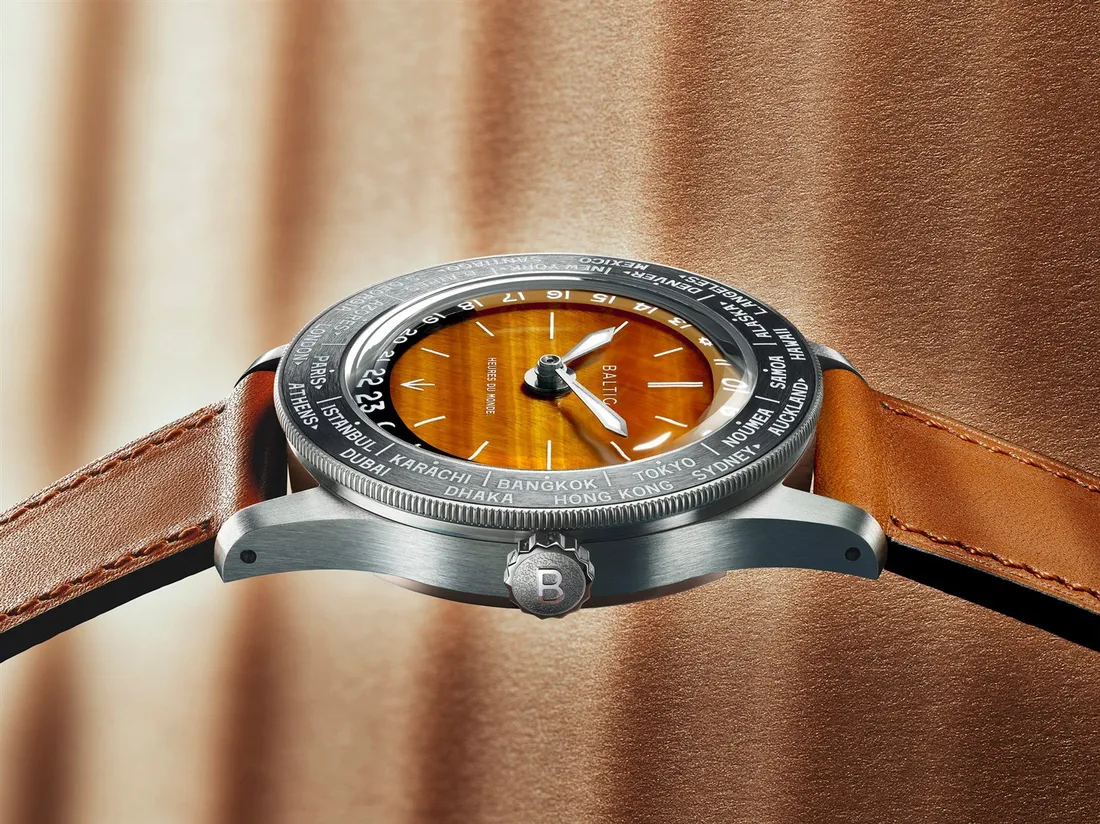
The Chemistry of Night: The Rare Earths That Trap the Light
So how do those city names light up on their own at night? The answer lies in a tiny rare-earth dance inside the Super-LumiNova BGW9 packed into the grooves of the ceramic bezel. This material is made, at its base, from a crystal of strontium aluminate; scattered one by one through the crystal lattice are two rare-earth atoms, europium and dysprosium.
By day, as light washes over the dial, europium takes the stage first. With the energy it absorbs, one of this atom’s electrons leaps from its low-energy orbit up to a high-energy level, as if jumping to the top step of a staircase. And it is right here that dysprosium steps in. Like a treasurer, it catches the energy europium has seized and stores it in tiny traps within the crystal.
When darkness falls, the dance reverses. Dysprosium releases the energy it has stored drop by drop, patiently; europium takes each drop and lowers its electron back to its old step, and with every descent a photon is born, a single particle of blue light. Europium, then, is a lamp, and dysprosium the battery that feeds it through the night. No cell is fitted and no radiation is involved; the ceramic bezel drinks in the daylight and, at night, gives it back gently, like a breath.
And so, while half the world sinks into darkness, the cities on your wrist go on glowing with the daylight they gathered themselves. Cottier’s city ring, read by day, stays with you through the night.
Two Sister Stones: Labradorite and Sodalite
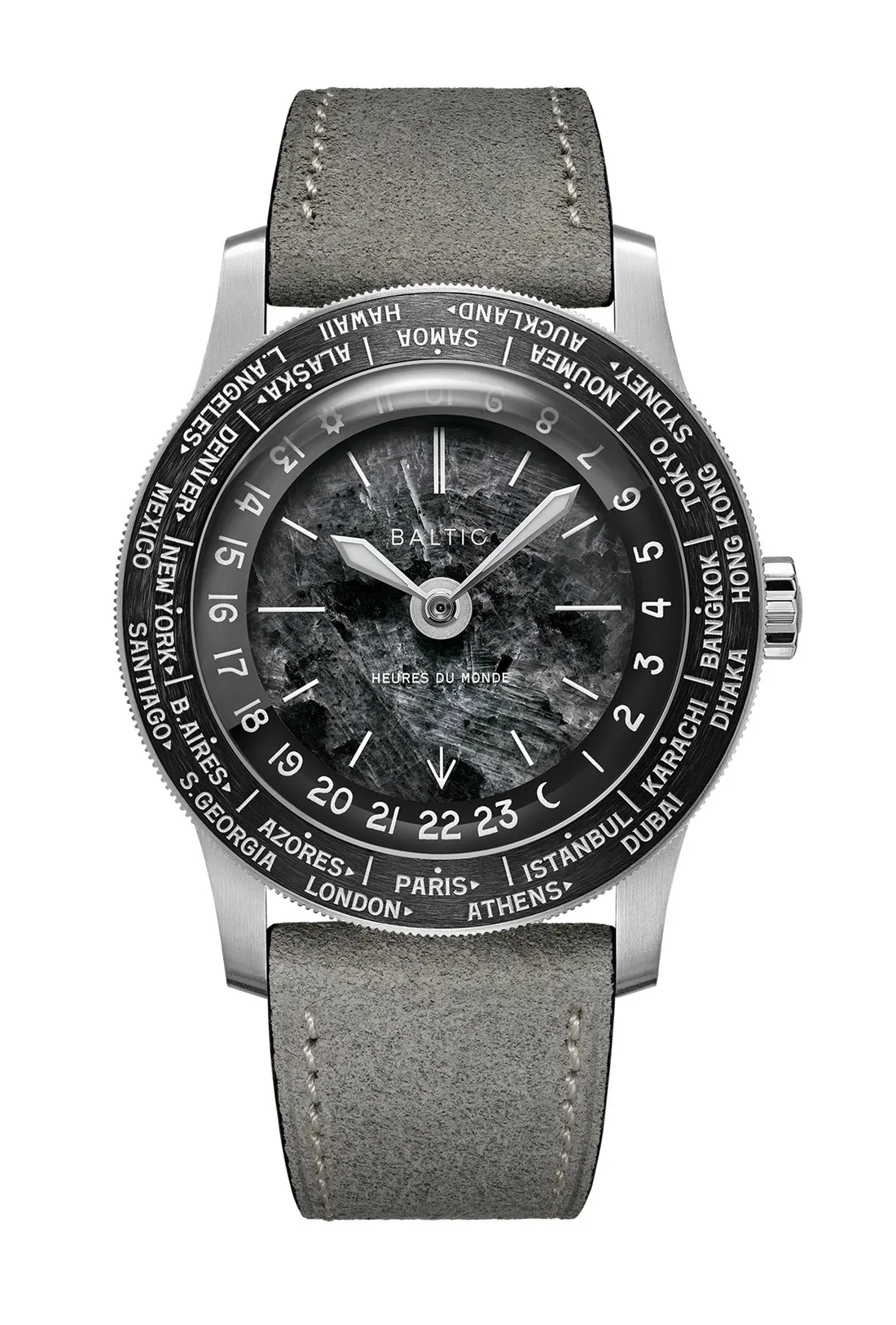
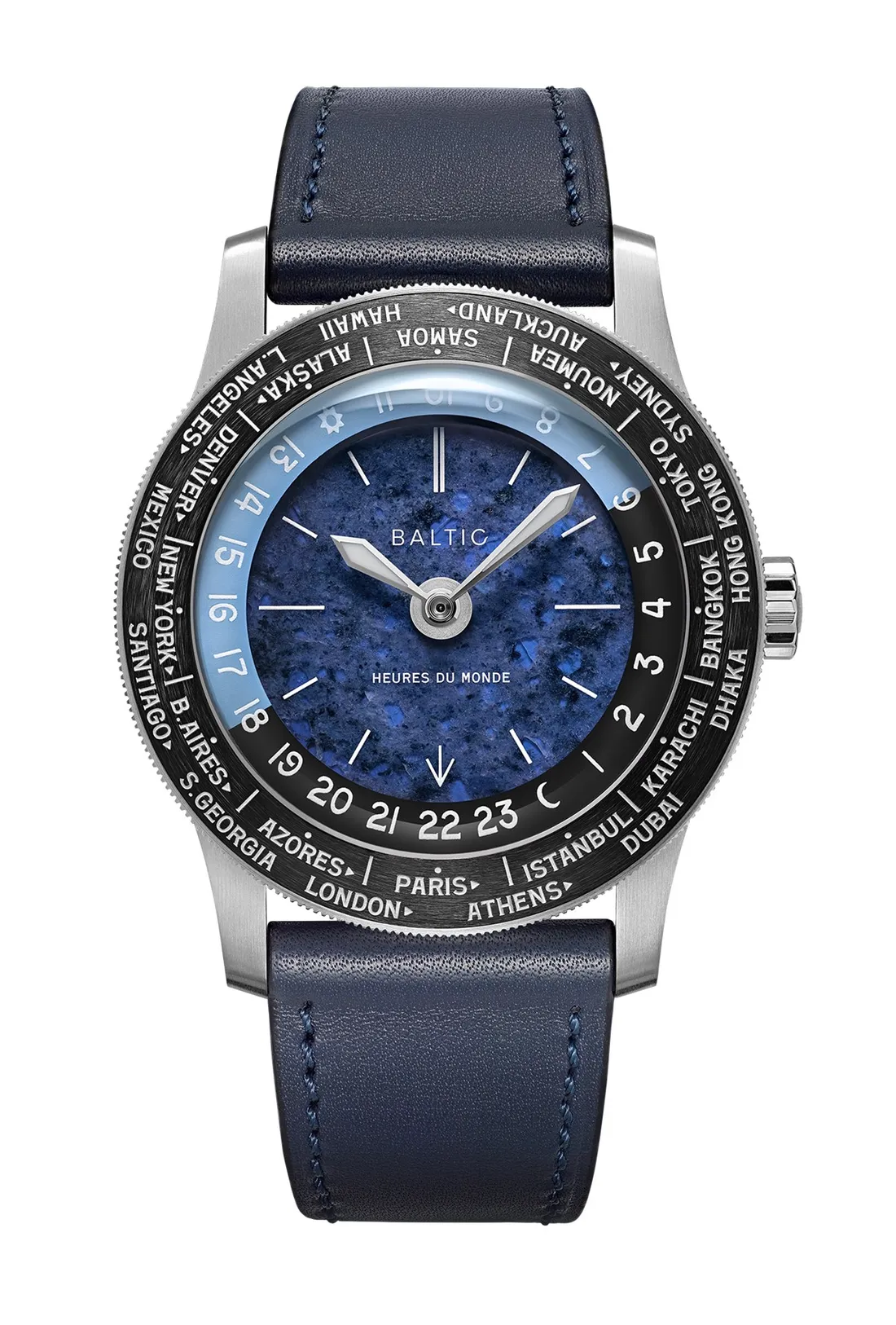
The Tiger Eye is not alone. Baltic offers the same architecture in two more sister stones: Labradorite, which shifts colour with the light like the northern lights, and Sodalite, deep and blue-veined like the night sky. Because each stone carries its own geological story, no dial can ever be exactly like another; beneath the world map on your wrist turns a unique landscape formed over millions of years.
Anatomy of the Mechanism and a Biological Analogy
At the heart of the Baltic Heures du Monde beats the Swiss-made automatic Soprod C125 GMT calibre. To preserve the natural stone symmetry of the dial, Baltic’s engineers removed the date wheel and directed all the mechanical torque to the Cottier-style 24-hour world-time module.
The working principle of this calibre bears a striking resemblance to the biological clock of the human brain, the suprachiasmatic nucleus (SCN), and to the circadian rhythm mechanism in our cells.
The SCN, located in the hypothalamus of the brain, processes light signals from the eyes to govern the body’s 24-hour biological rhythm. The 24-hour wheel in the Soprod C125 likewise transmits the energy it takes from the mainspring to the gears so as to turn 360 degrees exactly once every 24 hours; it is, in effect, the watch’s biological clock.
In our cells, the Period (PER) and Timeless (TIM) proteins accumulate through the day, fall in the darkness of night, and this cycle repeats itself every 24 hours. The two-colour 24-hour disc around the dial, just like this protein oscillation, visually separates the hours of day from those of night.
As the Earth turns eastward on its axis, the 24-hour disc on the dial moves counter-clockwise. The number aligned with the city name on the outer ceramic bezel shows that city’s local time instantly and without error. The mechanical knot that Cottier untied under a gas lamp goes on turning quietly today, beneath a tiger’s eye, on your wrist.