Creation is not a heap of accidental parts. It is an enormous fabric in which every stitch was set with a separate attention, and inside that fabric no living thing is an independent island. From the tremor of a microorganism on the sea floor to a roar in the depth of a forest, every breath belongs to a network through which energy and sustenance change hands. A food chain is not merely a feeding diagram. It is an order in which creatures are bound to one another by service and by need.
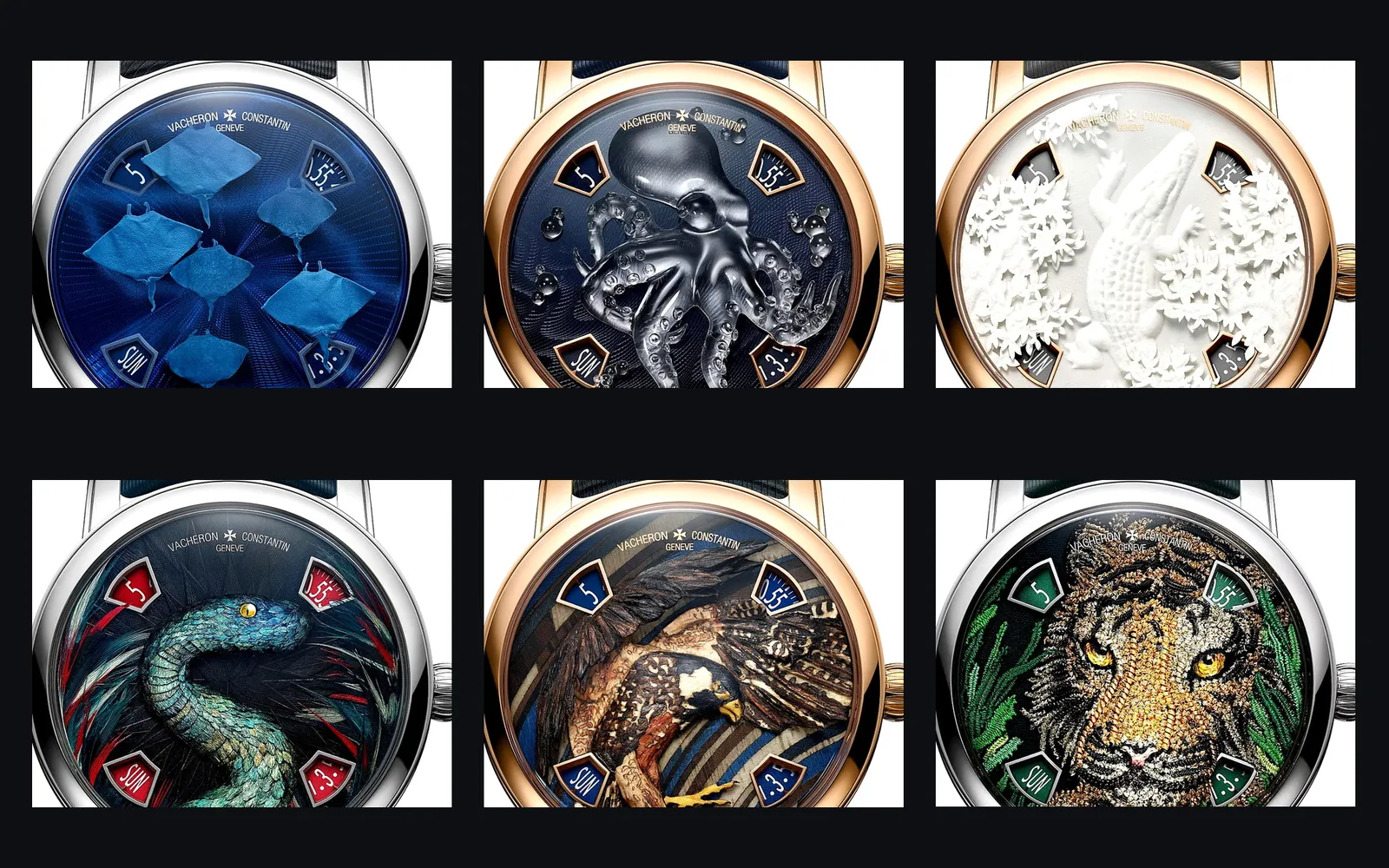
In the summer of 2026 Vacheron Constantin brought that order down to the scale of a watch dial with a set of six Métiers d’Art pieces. The collection is called Tribute to the Animal Kingdom, and all six come out of the house’s One of Not Many Crafts Programme, which pairs a craftsperson from outside watchmaking with the watchmakers of Geneva and requires that their own technique fit inside forty-two millimetres for the first time.
Not one of the six dials has hands. That is not incidental. The moment time is taken out of the centre and pushed to the rim, the middle of the dial stops being an indicating surface and becomes a stage. And what stands on that stage is not decoration. It is a hierarchy.
format_quote"What I see in the natural world is not a war but a table, where every link feeds the one after it. A watch works the same way: one wheel stops, hands its energy to the next, and time keeps running."
Hasan Bekmezci
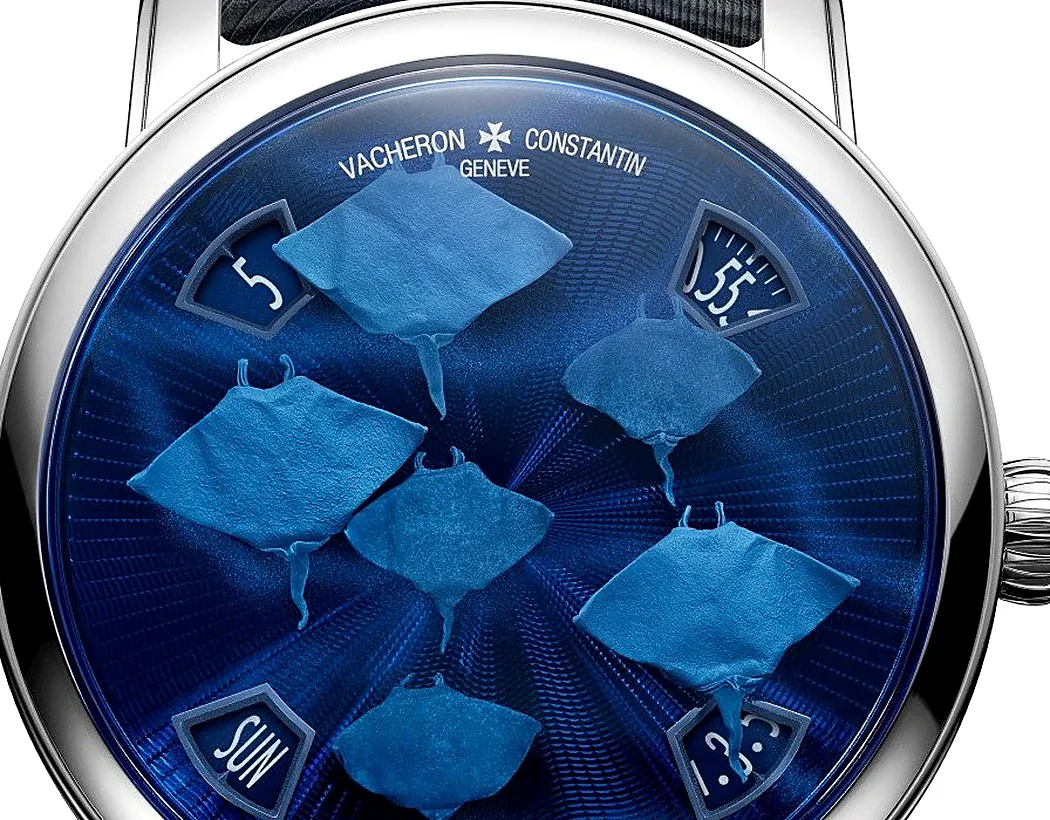
At the bottom of the chain is a body that lets the current carry it. The manta ray is not a hunter but a filter, opening the cephalic fins on either side of its head like two scoops and steering microscopic plankton into its mouth. At night it descends to between two hundred and a thousand metres, loads up on nitrogen, phosphorus and iron, then returns to the surface to warm itself and releases that rich waste into sunlit water. Surface water is poor in iron and nitrogen; it is a kind of oceanic desert. What the ray leaves behind is fertiliser falling on that desert. The phytoplankton that feeds on it blooms, produces more than half the oxygen on Earth, and on dying carries the carbon it absorbed to the bottom. The lowest link in the chain is the one that manufactures the fuel for all the rest.
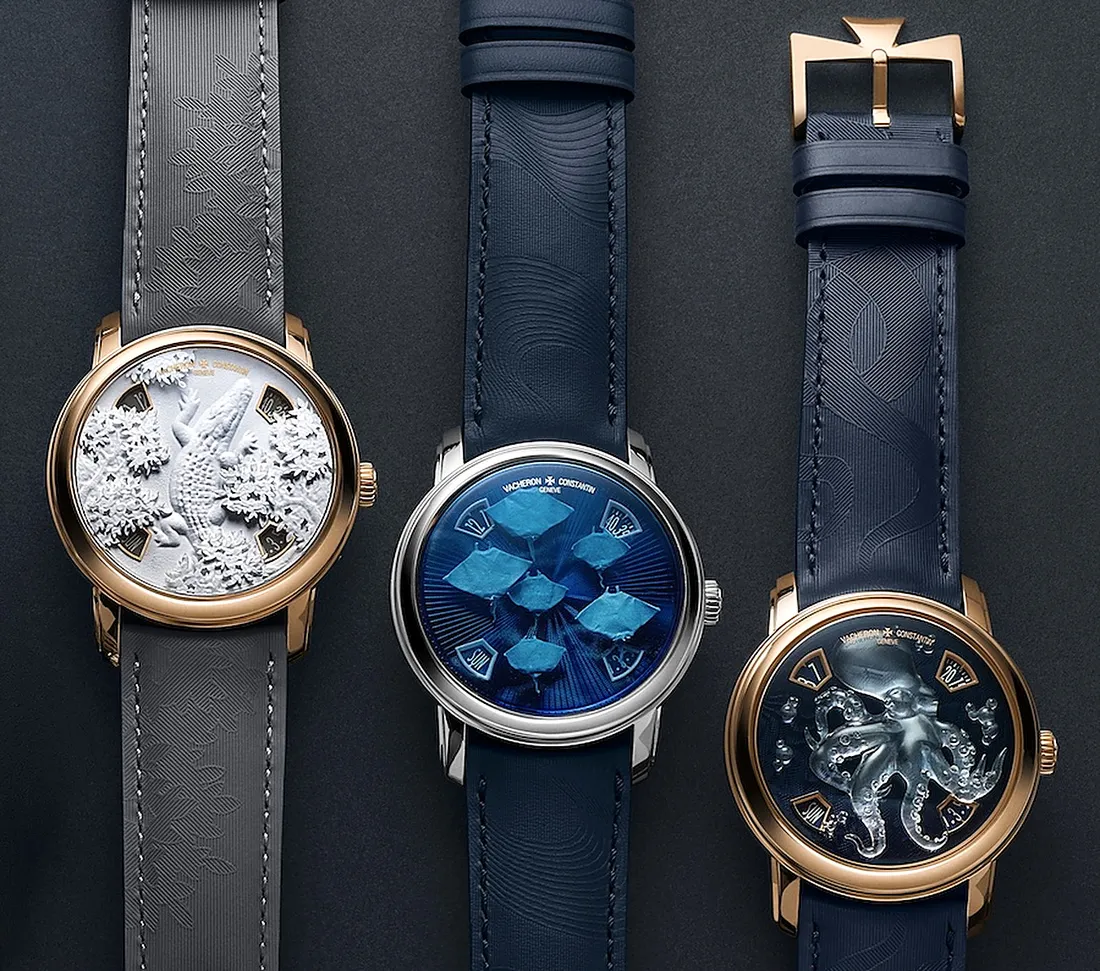
On the dial this animal becomes Oraygami. Six rays glide there and not one of them is metal; every one is paper. The artisan Anja Midori works in micro-origami, turning a single square into an animal with folds under a millimetre, with nothing cut and nothing glued. Beneath them lies hand-guilloché 18K gold. The most fragile material available has been set on the most permanent one.
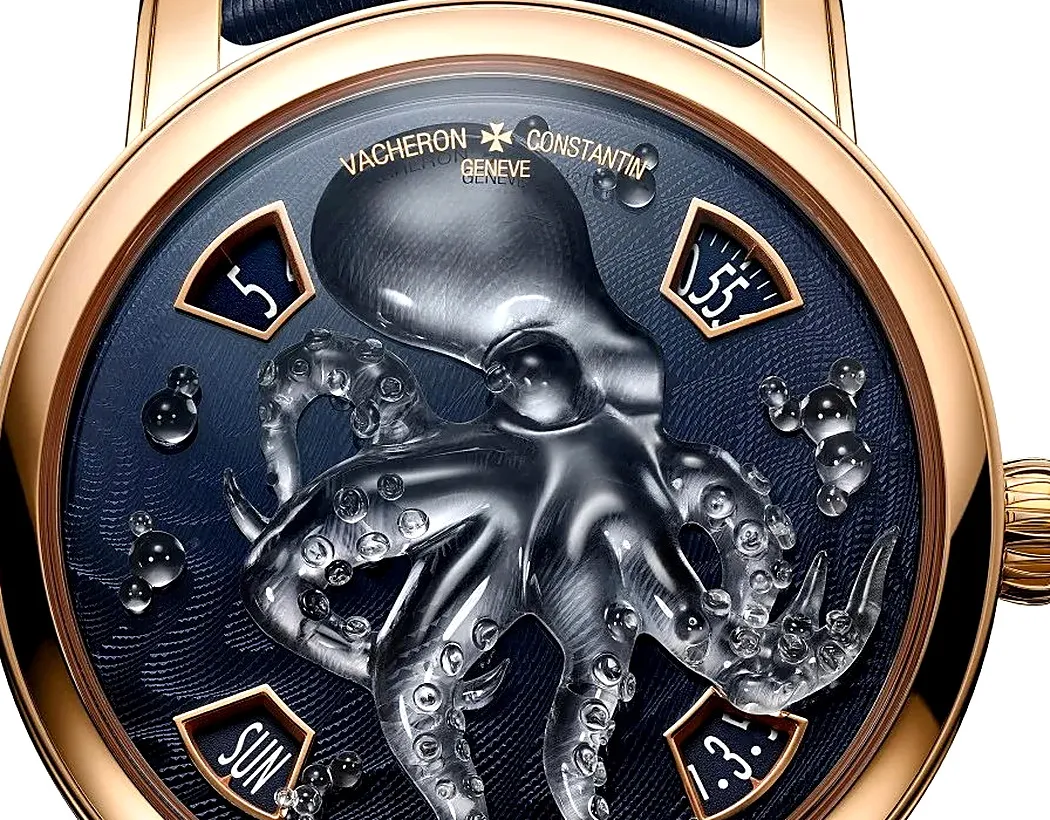
One step up stands the keystone of the benthic system. By holding crab and crustacean numbers in check the octopus keeps rocky habitats from collapsing, and it is in turn the richest protein available to moray eels, sharks and larger hunters. Three hearts beat in its body and its blood is copper-based: a chemistry that turns blue when it takes on oxygen and stays fluid even in freezing water. Two-thirds of its neurons are not in the brain but in the arms, which means each of the eight decides for itself.
The heaviest part of the story comes at the end. After laying, the female stops eating for months; at the cost of consuming her own body she blows clean water over the eggs, cleans the silt from them and puts herself between them and any predator. On the day the young hatch, that spent body takes its last breath and feeds the scavengers of the sea floor, returning its energy to the chain. A cycle that balances while it lives and feeds the bottom even as it ends.
In Glassoctopus the animal is made of glass. The Italian artist Simone Crestani softens borosilicate rod in a torch and shapes the material while it is still moving; the interval in which glass is workable is measured in seconds, and no mould is used anywhere. The ground beneath is hand-guilloché gold again, this time in 3N. Being transparent, the glass does not conceal the gold. It passes the gold through its own thickness and bends it.
format_quote"Each of the eight arms decides for itself. A mind distributed through a body is more supple than a mind gathered in one place."
Hasan Bekmezci
On the step between water and land stands the crocodile. Taking its heat from outside, it chooses the moment it will spend energy: it can drop its heart rate to a few beats a minute, wait for hours, and at the end of that wait produce the strongest bite ever measured in a living animal. The skin over its jaw carries thousands of pressure organs more sensitive than a human fingertip, and in darkness it reads the ring made by a single drop hitting the water.
Its role in the ecosystem is unexpectedly protective. In the dry season crocodiles work into the mud and open pockets of water, keeping those hollows clear by using them; when the river withdraws, the only water the fish, birds and grazers of a region can find is often a hole a crocodile dug. The most feared animal in the basin is the one holding the basin together through drought. And the same jaw takes newly hatched young up like a spoon and carries them to the water. Within a single day it is both a weapon and a cradle.
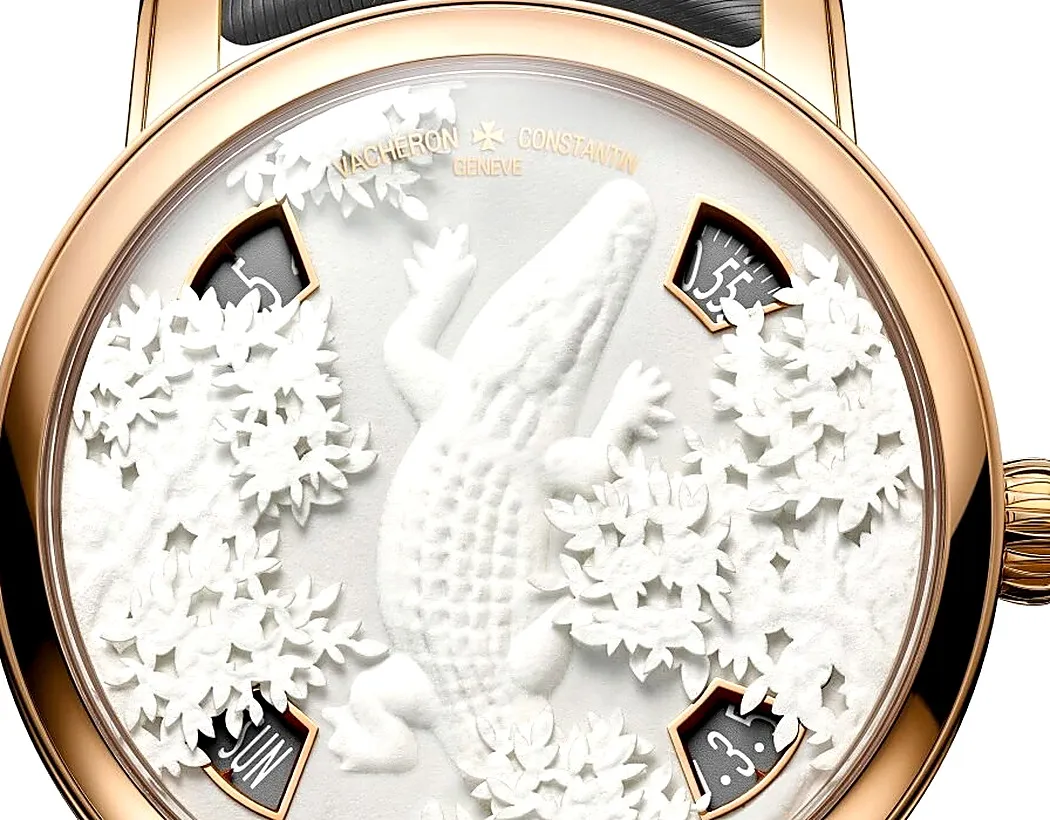
Papercroc tells that doubling on a surface with no colour at all. On the dial by the Parisian paper artist Marianne Guély you see nothing but white cotton paper. The plates along the back, the claws, the fold of the eyelid and the vegetation around the animal are drawn by height alone, which is to say by shadow. Embossing paper is not reversible: a surface pressed wrongly cannot be corrected, so the sheet is discarded and the work begins again.
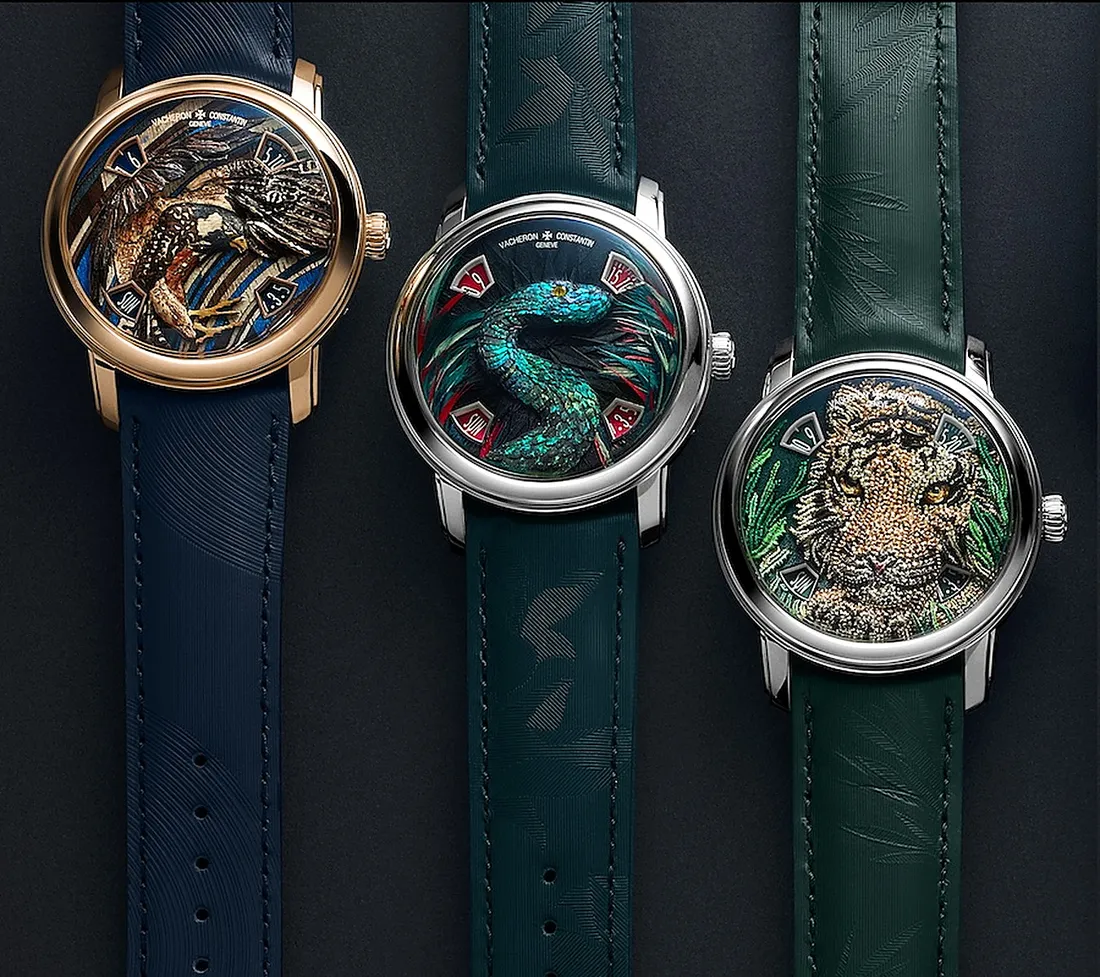
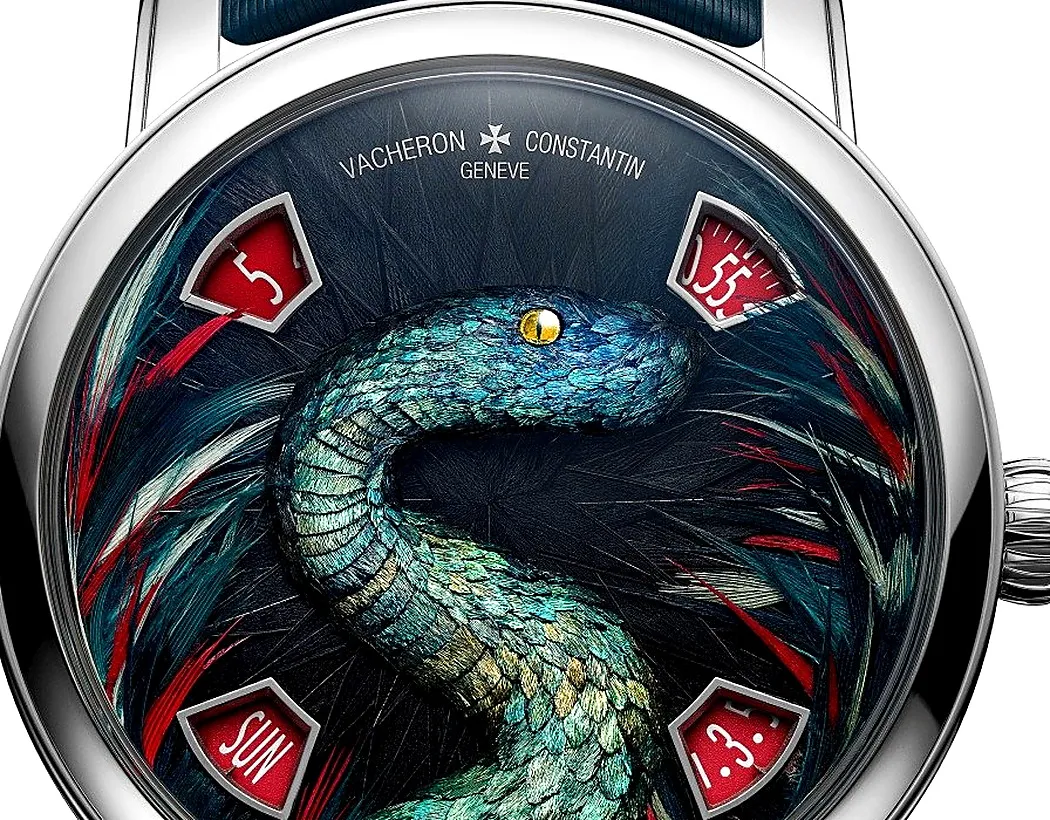
On land, the middle of the chain belongs to the snake. It has no eyelids; over the eye sits a transparent scale renewed with every shed. The forked tongue is not a weapon but a nose, collecting molecules from the air and carrying them to an organ in the roof of the mouth, then reading the direction of a scent from the difference between the two tips. In some species, pits between the eye and the nostril register temperature differences of less than a degree, so the animal sees light with one organ and heat with another and assembles both into one image. By suppressing rodent numbers it protects farmland, and it is in turn the most regular meal a bird of prey gets.
On the Feathersnake dial the animal has no scales; in the place of every scale sits a feather. The French plumassier Julien Vermeulen cut small pieces from lophophore and goose feathers and laid them in overlapping rows exactly as they would sit on a real reptile. The idea here is not virtuosity but kinship: the scale of a snake and the feather of a bird are made of the same substance, both of them keratin. Vermeulen did not make feathers out of feathers. He made scales out of them.
format_quote"The scale of a snake and the feather of a bird are the same substance. So much form written into one material cannot be explained away as accident."
Hasan Bekmezci
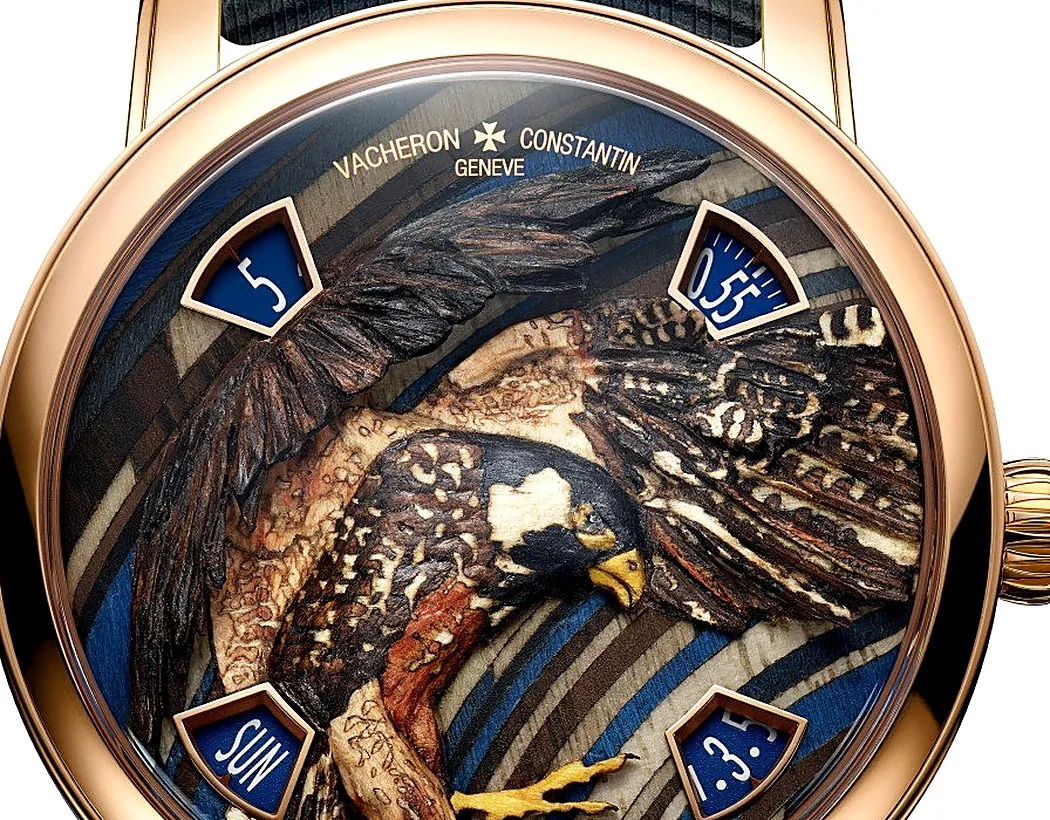
A step higher is the sky, and the falcon holds it. Relative to the size of its head it carries one of the largest visual organs in the animal world. It sees into the ultraviolet, and a double fovea in each retina lets it magnify a detail a thousand metres below like a telescope while scanning a wide panorama at the same time. A human eye processes roughly sixty frames a second; the falcon resolves more than twice that. In the stoop, past three hundred kilometres an hour, cone-shaped structures in its nostrils break the pressure of the air forced into its lungs, and that detail inspired the cone in the air intake of the modern jet engine.
Apex hunters do not take prey at random. They go for the sick, the weak and the old, and that preference keeps the gene pool strong. When a bird of prey withdraws from a region, rodent numbers explode, the floor of the forest is stripped, and years later nobody remembers why. A raptor is a health report on a region.
In Woodenwings the bird is neither painted nor carved. The marquetry artisan Anna Le Corno laid hundreds of microscopic veneer pieces cut from twelve different woods side by side like a mosaic. The dark band across the wing is ebony, the pale flecks on the breast are maple, the transitional tones on the head are walnut. The artist is not mixing colour; she is choosing timber, and the palette is not in a paint box but in a forest.
And at the very top of the chain stands the tiger. Every animal’s stripe pattern is unique, and the left and right flanks of the same tiger do not even match one another; that pattern sits in the skin rather than the coat. It is carried not for display but for disappearance, since a body broken into vertical cuts among tall grass stops reading as a body at all. The claws retract, the pads spread the load, and not a dry leaf breaks under four hundred kilograms. Part of its roar sits below the lower limit of human hearing, so you do not hear it; you feel it in your chest.
An ecosystem with a tiger in it is a healthy ecosystem. A tiger needs a large forest, enough herbivores, healthy vegetation and a steady water regime, so putting one animal’s range under protection protects thousands of species whose names you do not know. Hold the top link of the chain and the whole chain stays off the ground.
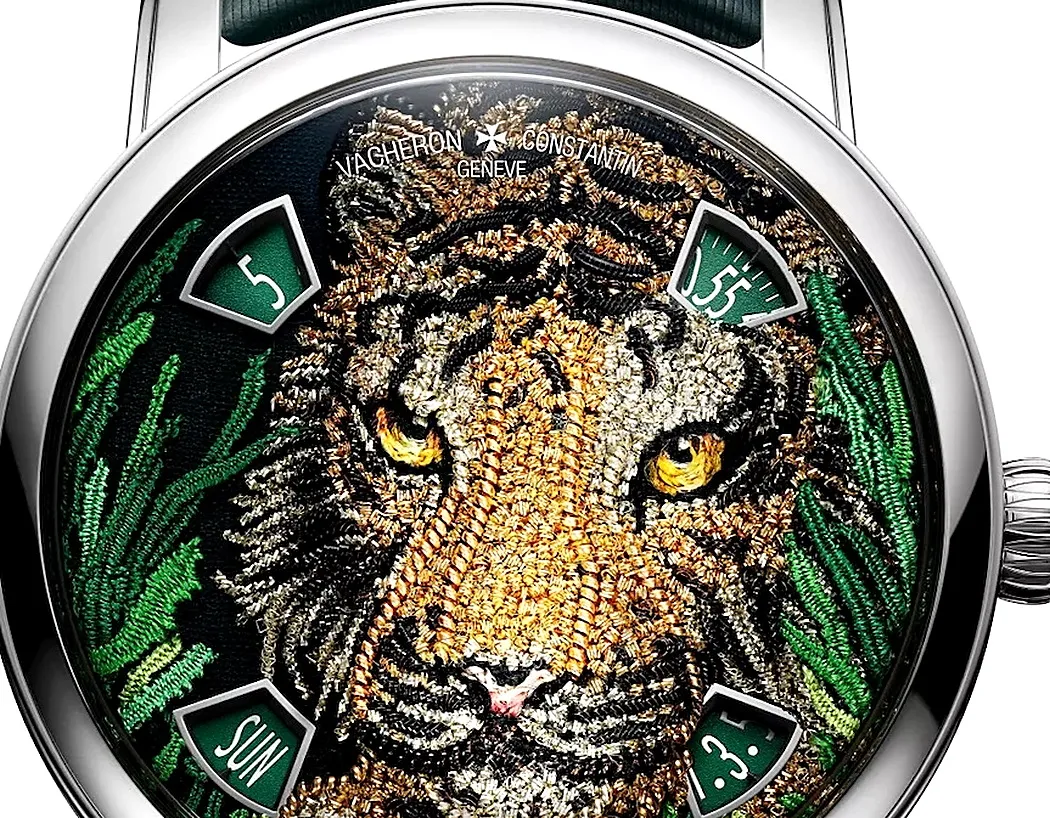
Tigerbroidery turns this animal into thread. The embroiderer Laura Baverstock worked in nine-carat gold and silk on a base of green silk and cotton. Goldwork has a rule of its own: gold thread cannot be passed repeatedly through cloth, so it is laid on the surface and held down by a much finer silk stitch crossing over it. Every gold line you see is built from two threads. And this is the only dial in the set where the material does not sit on the surface but passes through it.
format_quote"Hold the top link of the chain and the whole chain stays off the ground. Protecting one tiger’s range protects thousands of species you cannot name."
Hasan Bekmezci
What holds the six animals together is not only a story but a shared mechanical decision. All six run Vacheron Constantin’s calibre 2460 G4: two hundred and thirty-seven parts, self-winding, 28,800 vibrations an hour, forty hours of reserve. The G4 stands for four indications, and all four have been pushed to the rim rather than left at the centre. Jumping hour at upper left, dragging minute at upper right, jumping day at lower left, dragging date at lower right. A jumping indication waits and then falls into place in one movement; a dragging one slides without ever being caught at it. Two temperaments of time run on the same dial at once.
The reason is not technical display. A steel hand crossing these dials would cut through paper rays, glass arms, feather scales and gold stitching once a minute; it would also flatten the feather and confuse its own shadow with the shadow of the paper. The 12.9 millimetre height of the forty-two millimetre cases exists for the same reason: roughly four millimetres of air sit between each dial surface and the sapphire. Nothing touches the glass, because anything that did would lie flat.
The cases are 18K white gold or 18K 5N pink gold, and that too is deliberate. Warm metal sits behind the cold figures and cold metal behind the warm ones. Pink gold is what makes the glass octopus visible at all, white gold cools the paper rays, and the pink gold around the entirely white crocodile is what makes the white read whiter.
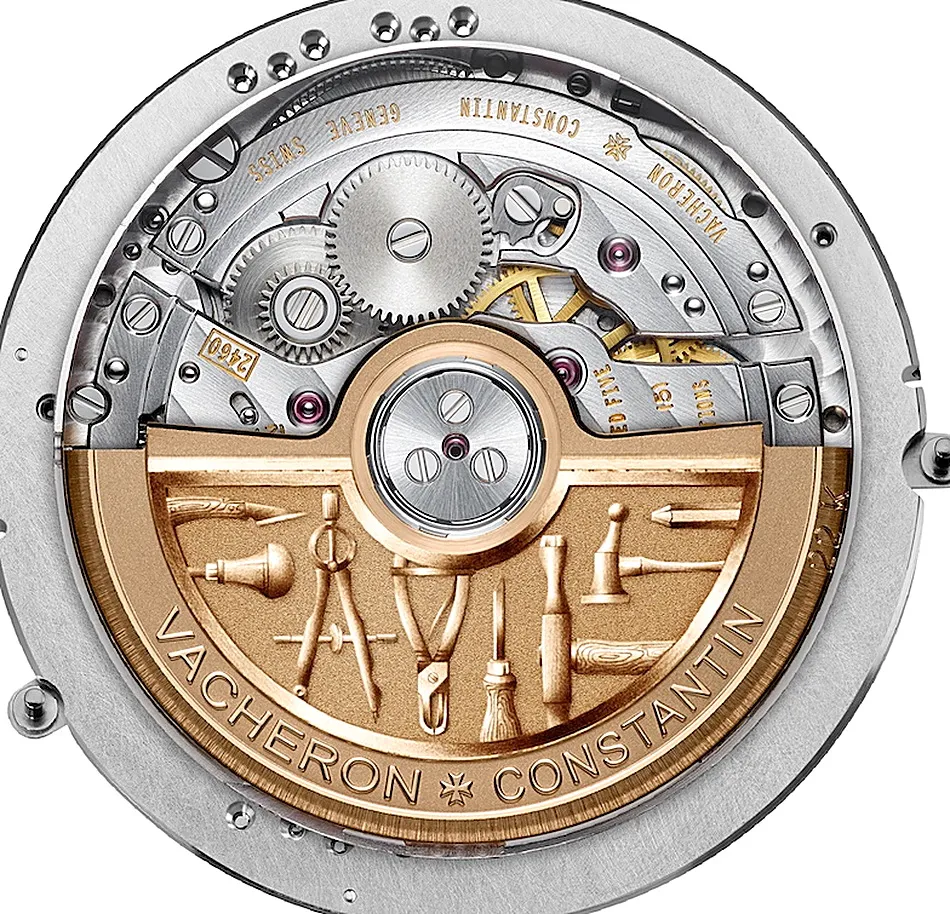
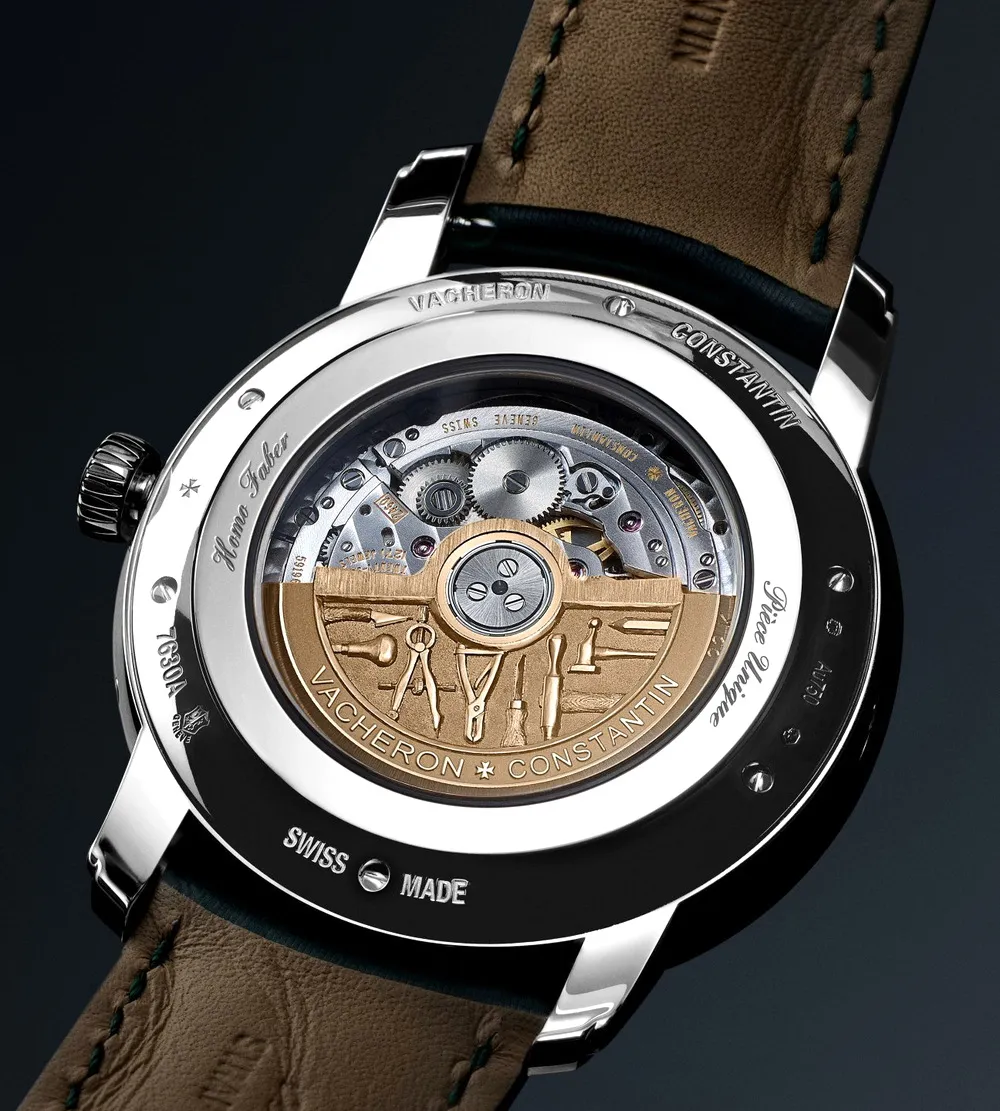
Look through the back of any of the six and the same thing appears: a relief of craftsmen’s tools engraved on the rotor. Vacheron placed the instruments of the hand behind the movement rather than its own crest. The whole argument of the collection is compressed into that small engraving, because the real subject of these six pieces is not the animals but the six separate hands that carry them.
The order of the materials says something too. Paper, glass, embossed paper, feather, wood and gold thread. There is not a single enamel on that list, and enamel is the standard solution watchmaking has used for centuries when it wants to fill a dial with an animal. Vacheron deliberately declined the standard solution and went looking, for each animal, for a material that belonged to it. The armoured one is told in the most fragile substance, the fastest one in the slowest, and the one already made of lines in line itself.
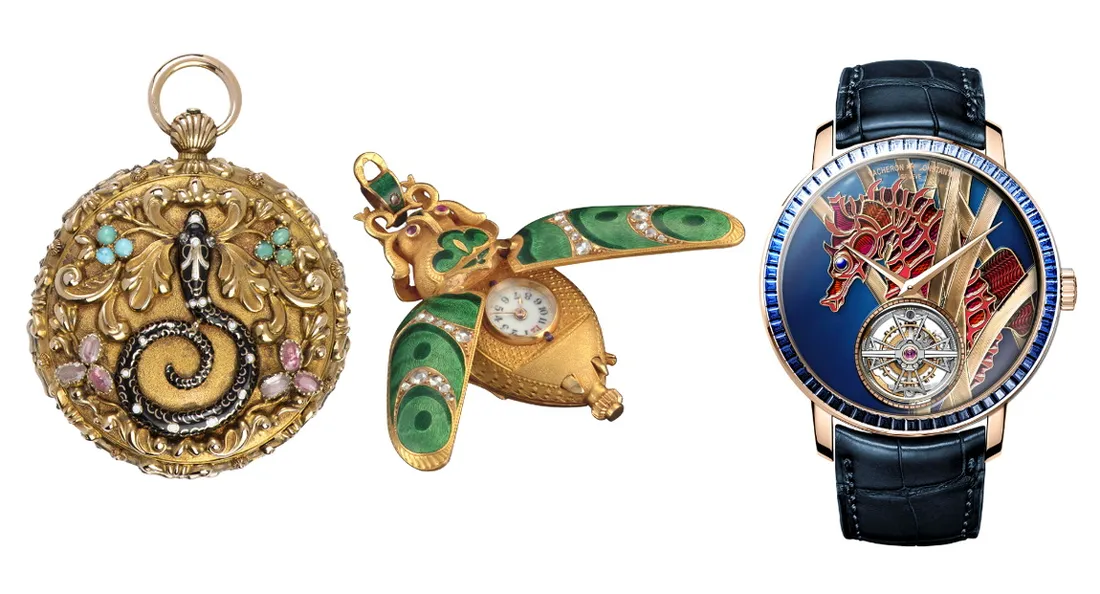
The animal figure is not new in this house. It has moved through engraved pocket watches, enamelled covers and jewelled watches for centuries. What separates these six from that tradition is not the figure but the way the material was chosen. Carving an animal in gold is a preference. Building one out of paper, glass or feather is an argument.
Time runs quietly through four small windows while the figures at the centre stay where they are. The ray does not swim, the octopus does not stir, the falcon does not beat a wing. All of them hold still and remind you of one thing: nothing hunted in the natural world is hunted without reason, and no hunter in it is surplus. Every creature is somebody’s sustenance, and every portion of sustenance is somebody’s lifetime. Six dials say this in six different hands.