6 June 1944, half past six in the morning. Off the Normandy coast of France, steel landing craft push toward a strip of sand code-named Omaha. Inside them are thousands of young soldiers; some pray, some fall silent, some tremble. That morning the fate of these thousands hung neither on a general’s order nor on the range of a gun; it hung on the invisible pull of two celestial bodies, the Moon and the Sun, that is, on how many centimetres the ocean would rise and fall on that beach.
For Operation Overlord was not only the largest landing history has seen, but perhaps also its greatest tidal calculation.

Overlord: The Greatest Tidal Equation in History
When General Eisenhower and his staff chose the day of the landing, they had to gather three conditions of nature that seemed at war with one another into a single morning.
First they needed a full moon: so that the paratroopers dropping behind enemy lines at midnight could find their way in the dark, the Moon had to be at its fullest. Then they needed the lowest tide: the German field marshal Erwin Rommel had armed the approaches to the beach with thousands of steel obstacles hidden beneath the water, mined stakes, and explosive traps called "Czech hedgehogs." A craft coming in at high water would be torn apart on these invisible traps; so the boats had to touch the shore in that brief moment when the sea had drawn back the furthest and the obstacles stood bare to the eye. And immediately afterwards they needed a rising tide: the moment the troops set foot on the sand, the sea had to swell and carry in the ammunition and support ships behind them.
These three conditions came together on only a few days of the month, and only a few hours of those days. Those who landed in the first wave at Omaha found themselves in the midst of a stormy sea and a tide rising faster than expected. As the Moon’s pull pushed the ocean toward the beach like an invisible wall, minutes were the difference between life and death. The history written at Omaha that morning was a deadly dance between the mechanism in the sky and the level of the water below.
Nearly seventy years later, the Dutch master Christiaan van der Klaauw turned this very ocean physics into a mechanical masterpiece that can be worn on the wrist.
Holland’s Trial by Water, and Astronomical Genes
It is no accident that this watch came from the hand of a Dutchman. For centuries Holland has been a nation that wrested a great part of its land from the sea, from the tides and the ocean, with dikes and dams. For a Dutchman the tide is not a luxurious ornament but a piece of survival knowledge; knowing when the water will rise has at times decided the fate of an entire town.
Christiaan van der Klaauw, for its part, is the only independent watch house in the world devoted solely and entirely to astronomical complications. Having made carrying the sky to the wrist its single purpose, this house achieved a world first with the Real Moon Tides: on one dial it united two vast celestial events, a three-dimensional real moon phase and a mechanical sea level with a tide indicator.
An Ocean Computer on the Wrist: Two Towers
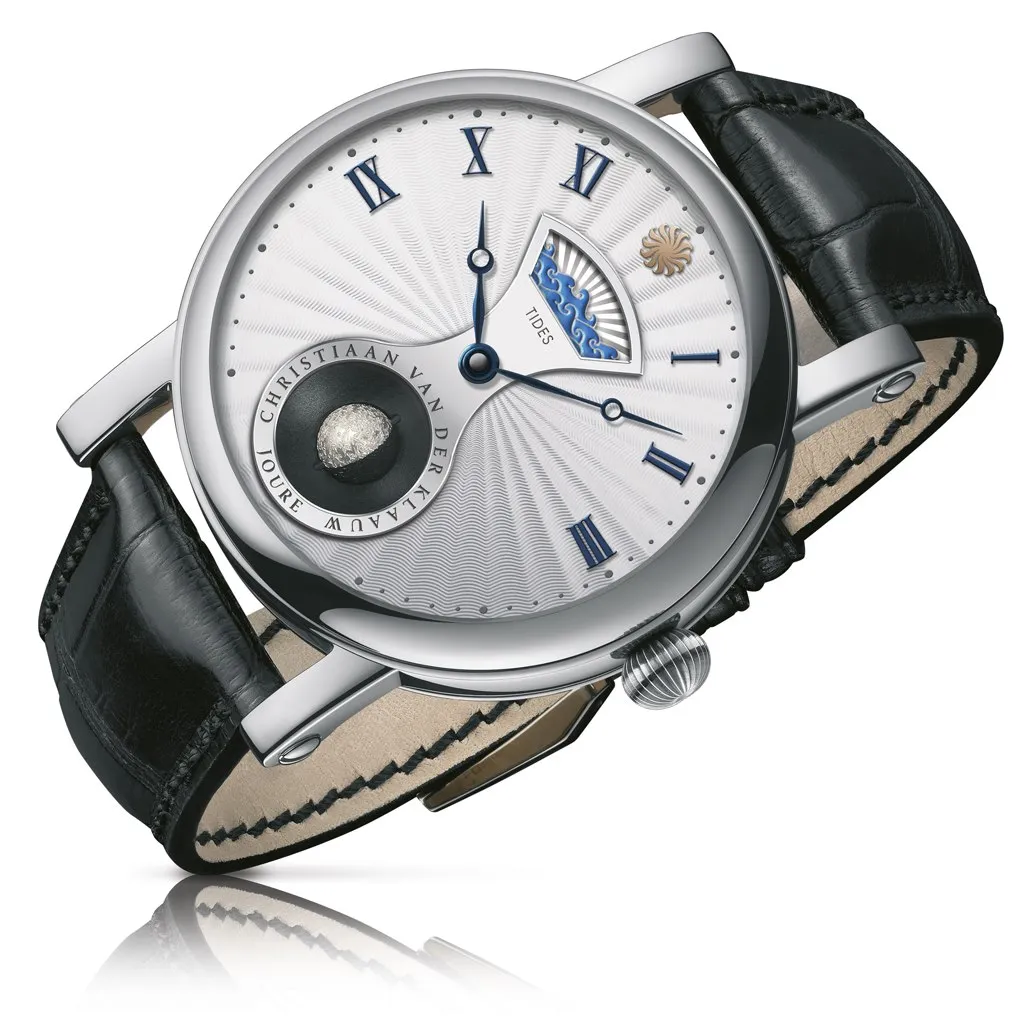
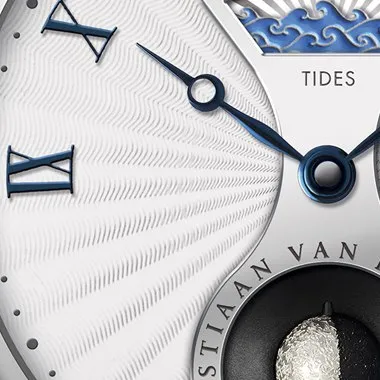
When you look at the dial you see two separate towers. At twelve o’clock rises the tide (Tides) indicator, and at six o’clock the three-dimensional moon sphere. These two towers are not independent of each other; both answer to the same invisible master, the Moon.
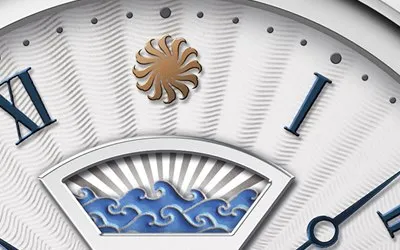
The indicator at twelve does not merely say "the water is high" or "the water is low." According to the angular position of the Moon and the Sun in the sky, it simulates the living, dynamic height of the sea at that moment, the rhythm of its rise and retreat. This little window on your wrist, in truth, shows an ocean breathing in and out.
A Moon of Eleven Thousand Years: The Mathematics of a Sphere
What raises this watch to the summit of watchmaking history is that three-dimensional moon sphere turning at six o’clock. For the Moon’s dance in the sky is not as round a number as it seems.
The Moon’s full cycle, the time that passes from one new moon to the next (the synodic month), is exactly 29.530589 days: 29 days, 12 hours, 44 minutes and about 3 seconds. For centuries watchmakers have tried to imitate this stubborn decimal with a single toothed wheel.
Ordinary moon-phase watches, to make the task easier, use a 59-tooth wheel that treats this span as 29.5 days. The difference looks small, only 0.030589 days per month; but this little untruth accumulates, and the watch falls a full day behind the real Moon in the sky roughly every two years and eight months. More precise astronomical watches bring the month closer with a 135-tooth wheel, to 29.53125 days; so the time it takes to drift by a single day rises to 122 years. That is an accuracy beyond a human lifetime, yet it is still finite.
Christiaan van der Klaauw, however, turns not a flat disc but a three-dimensional sphere, and so abandoned the traditional gearing altogether. The micro planetary differential gear train behind the sphere, with its fractional gear ratios, imitates the synodic month with almost zero error. This mechanism’s deviation from the true Moon is only about 0.64 seconds per month. For that tiny difference to accumulate into a single full day, the sphere would have to turn, without ever stopping, for a full 11,000 years.
Consider it: longer than the pyramids, longer than the invention of writing, longer than every known civilisation. That little silver sphere on your wrist follows the Moon with a fidelity longer than the whole of humanity’s written history.
The Breath of the Ocean: Spring Tide and Neap Tide
So according to what does that tide indicator rise and fall? The answer is hidden in a threefold alignment in the sky.
When the Moon, the Earth and the Sun line up along the same straight line, at the moments of new moon and full moon, the gravitational forces of the two bodies face the same direction and add together. The sea reaches its highest level; this is called the spring tide. It was this swollen sea, the joining of these forces, that met the soldiers at Omaha on the morning of D-Day. When the Moon and the Sun stand at a right angle to each other relative to the Earth, at the first and last quarters, their forces cancel one another; the amplitude of the tide falls to its least. This is called the neap tide.
Christiaan van der Klaauw’s patented tide module reads these angular changes through the motion of an eccentric cam taken from the three-dimensional moon sphere. The hand on the dial writes, live, on a mechanical scale, how far the ocean will swell or draw back at that moment. This watch, then, measures not only the time but the mood of the sea.
The Art of the Dial and the Heart of the Calibre
This engineering marvel is, in equal measure, a work of handcraft. The circular guilloche patterns engraved by hand into the silver surface of the dial recall the waves curling under the wind on the open sea, that endless rippling of the ocean. As the light travels across the dial, it is as if you are travelling across a sea.
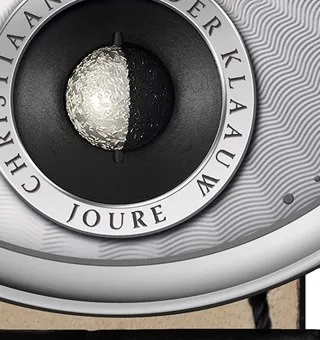
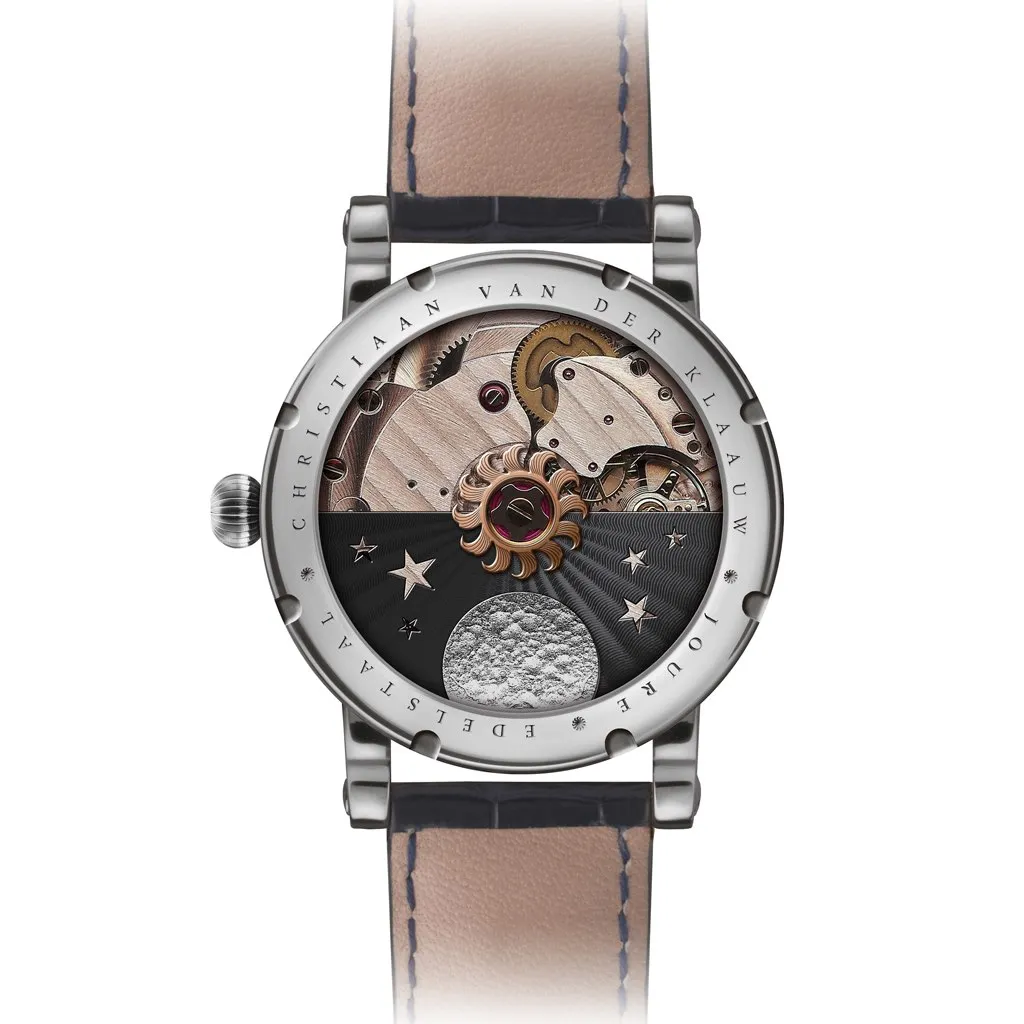
The small moon sphere at six o’clock is carved from titanium; it is light, for one half of it has been coated by hand in black rhodium and given to the darkness of night, while the other half has been left silver and given to the brightness of the full moon. As the sphere turns, just like the Moon in the sky, it becomes first a slender crescent, then a full circle.
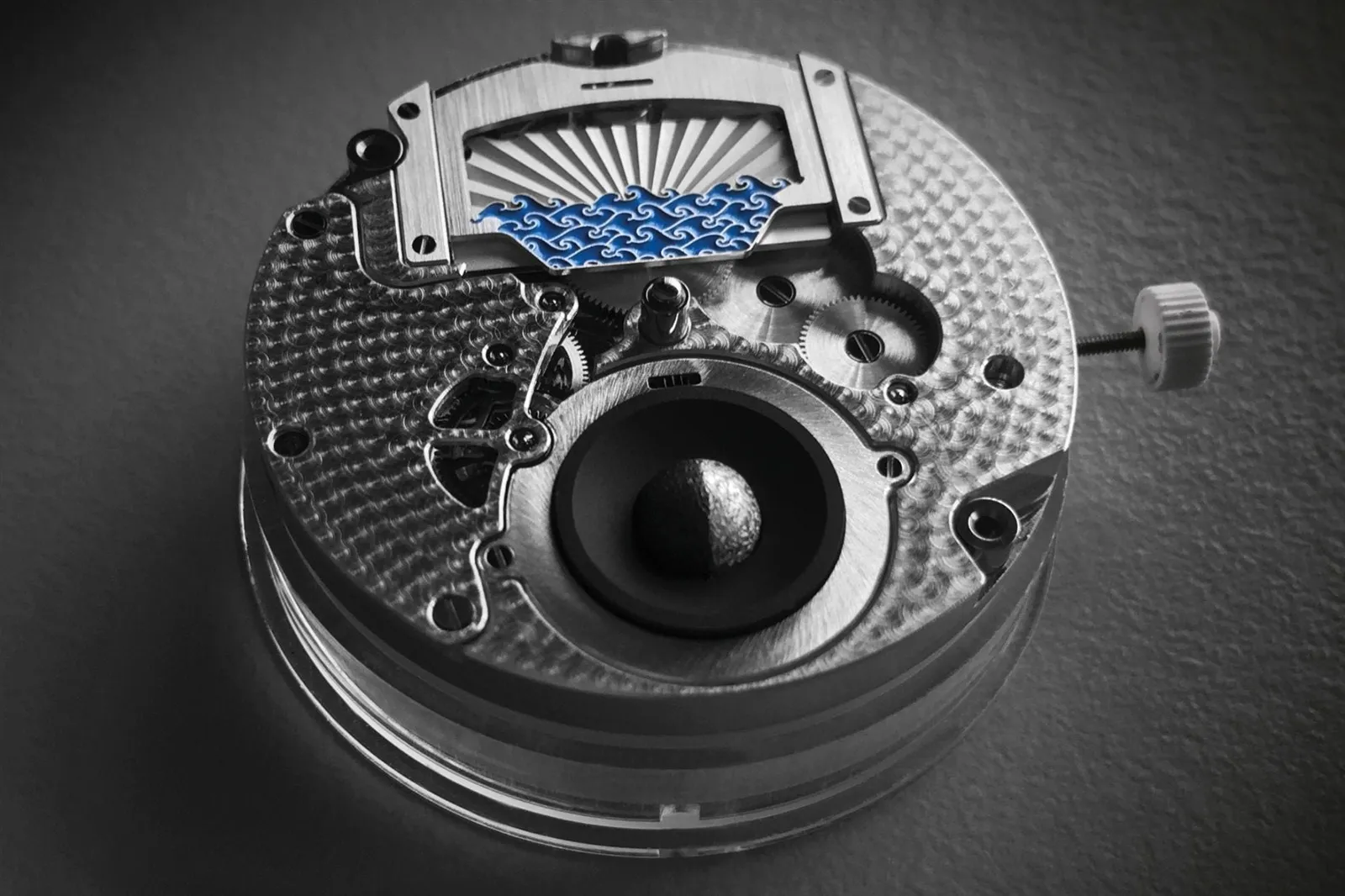
At the heart of the watch beats an automatic calibre customised by Christiaan van der Klaauw with its own module. Seen through the sapphire caseback, the hand-engraved motifs of the Sun, the Moon and the stars appear on the great rhodium-plated rotor. As the watch runs, this little vault of heaven turns quietly, together with you.
Perhaps the whole matter is this: a human being is made small before what cannot be measured, and is reconciled with what can. Once, at Omaha, thousands of people were left to the mercy of an unmeasurable sea; they looked to the sky, wondering when the water would rise and when it would draw back.
The Real Moon Tides turns that fear into a stillness. It does not tame the ocean, but it makes it intelligible; it fits the pull of the Moon, the swelling of the sea, the order of night and day onto a single wrist. And with every glance it gently reminds you: above your head, unaware of you yet holding you within it, an order is turning. Even while you sleep, that little silver sphere goes on turning, with a fidelity that will last eleven thousand years.