
A tale is told. In the centuries before electric light was born, when nights were an absolute darkness, there lived a master whose eyes could not see but whose ears saw what his eyes could not. His hearing was so keen that from the sound of water he could tell its depth, and from the ring of a bell the flaw in its casting. A king, forever unable to know the hour in the blackness of his chamber, summoned to his palace the greatest watchmakers of the land and this blind seer, and asked one thing: 'Give the night a voice; let me hear the hour in the dark.'
The watchmakers built a device of tiny hammers and bells; and the blind master, opening not his eyes but his ears, chose from among countless sounds the four notes that rang to him the truest and most beautiful: E, G, F and B. Those four notes were engraved into the memory of watchmaking. There the legend ends; but the truth beneath it is real: striking watches were born so that time could be heard by ear in the dark, so that it could be perceived where the eye cannot see. Centuries passed, bells became gongs, palaces became ateliers. And generations later, in 2025, the oldest watch house in the world, Blancpain, gathered those very four notes into a single masterpiece and gave the night its fullest voice: the Grande Double Sonnerie.

E: The First Voice Given to the Dark
The first note is the thing that king desired: a voice given to the dark. The best known of striking watches is the minute repeater: press a lever on the side and the watch chimes the current time; the hours in a deep tone, the quarters in a double note, the minutes in a fine ring. You wake it, and it speaks only when asked. This is the answer to that night in the legend: close your eyes, press a lever, and hear the time.
But a sonnerie goes far beyond this: it strikes of its own accord, like a tower clock, with no one touching it. The Grande Sonnerie (great strike) sounds automatically on every hour and every quarter; and at each quarter it first repeats the current hour. The Petite Sonnerie is more restrained: it strikes the quarters but does not repeat the hour at every quarter. This Blancpain masterpiece holds all of these at once: a minute repeater on demand, an automatic grande sonnerie and a petite sonnerie. A slide on the side passes between grande sonnerie, petite sonnerie and silence. It is a living cathedral bell, fitted into a case just 8.5 millimetres thick.

G: The Secret of Two Melodies
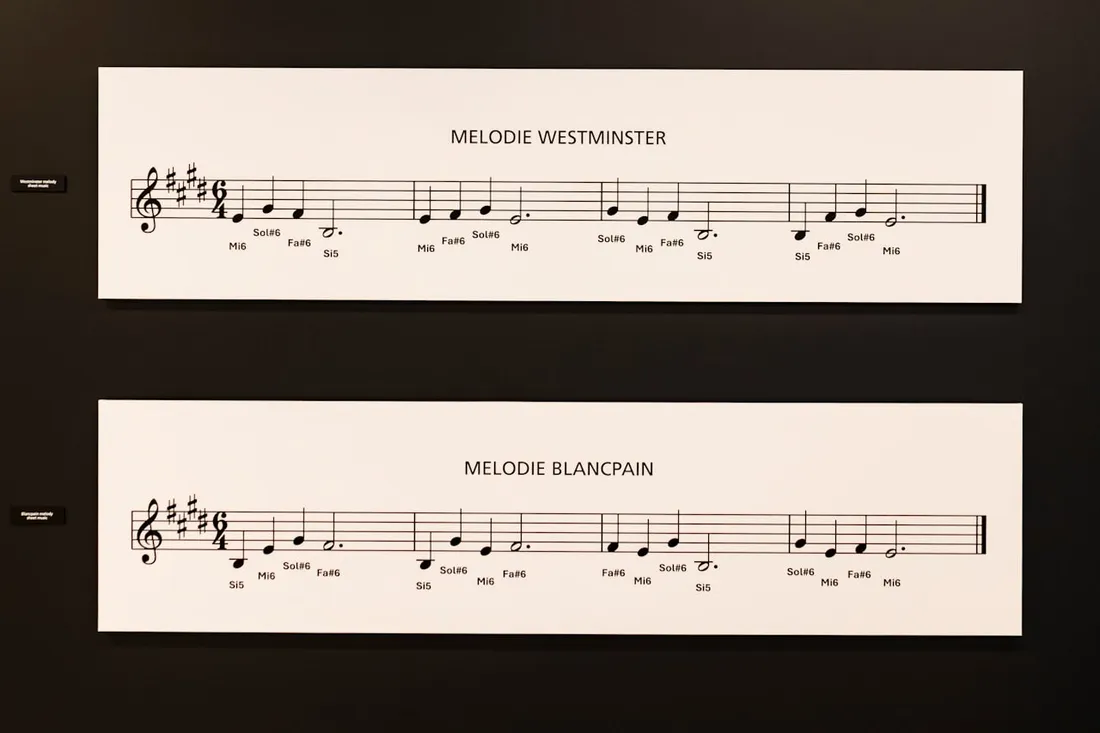
The second note is freedom of choice. The Grande Double Sonnerie is the first grande sonnerie whose owner can choose between two different melodies; a world first. Press the pusher at eight o'clock and the watch's voice changes. The first melody is the ancient and noble one: the famous Westminster chime, the very tune rung by Big Ben in London. The second comes from an unexpected place: an original melody composed by Eric Singer, the drummer of the legendary rock band KISS. So on your wrist, the most sacred tradition of high watchmaking stands side by side with the beat of a rock heart.
What makes these two voices possible are the four notes of the legend: four hammers and four gongs. While most striking watches make do with two, or at most three, hammer-and-gong pairs, Blancpain uses four; and this gives the sound a far richer, more layered colour. The four gongs are tuned to exactly those four notes: E, G, F and B. Picture a music box that can play two different songs, with a single tiny orchestra.

Rock Stars and Pure Harmony
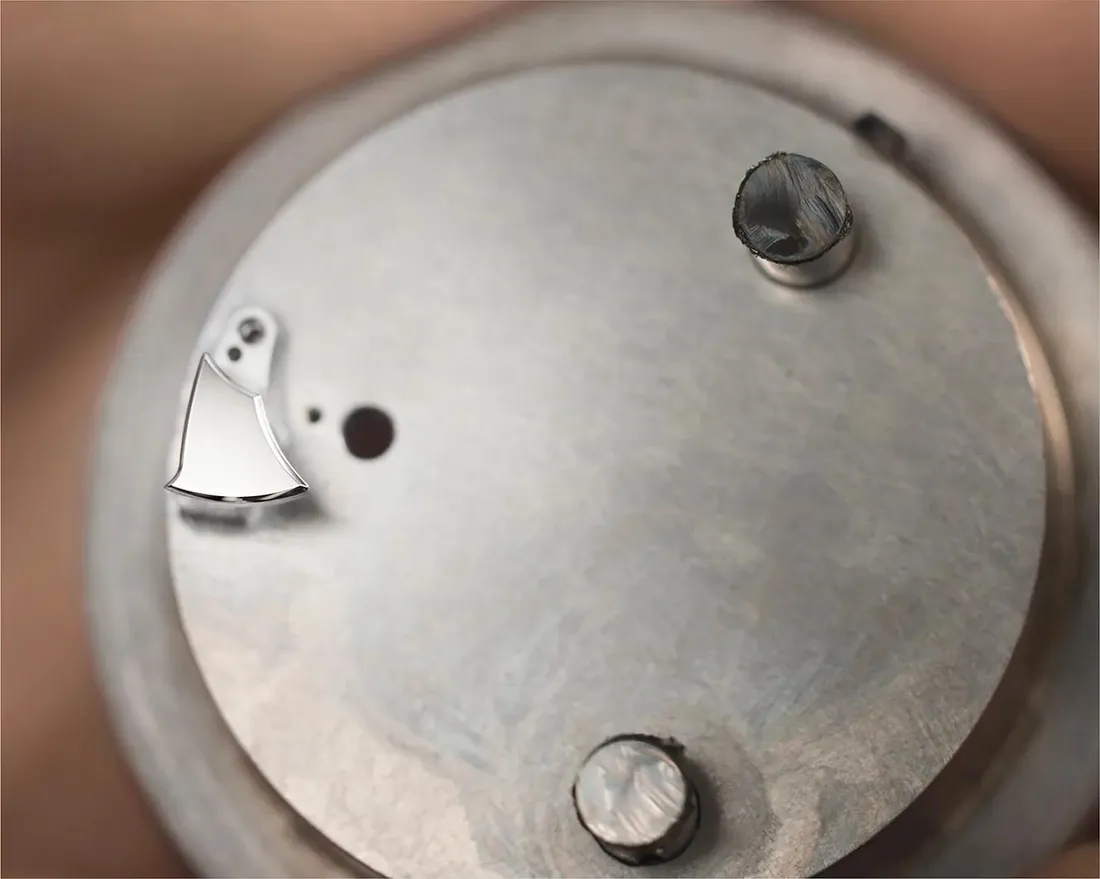
The human ear catches the smallest timing error in a melody, a deviation of as little as a tenth of a second. In a simple double chime small slips may be forgiven; but in a melody, harmony forgives nothing. This is why the teeth of the quarter-striking wheel inside the watch are worked almost like a microscopic record. Blancpain’s masters and engineers time the rhythm of the melody to perfection by making manual adjustments to the shape of those teeth on the order of a single micron, a hundredth of the width of a human hair.
So which song does this watch play? Here the story turns to its most unexpected chapter. Marc A. Hayek, the man at the head of Blancpain, is a close friend of Eric Singer, the drummer of the legendary rock band KISS, and Singer joined the project wholeheartedly. Together with the accomplished keyboardist Derek Sherinian he composed a wholly original melody for the watch. A drummer’s sense of rhythm and a keyboardist’s feel for harmony were coded into the micron-fine teeth of the wheels.
So two worlds sit side by side on your wrist: on one hand the noble, centuries-old Westminster hymn, on the other the original composition of a rock heart. When you press the button on the side of the case, the column wheel within builds a silent bridge between the two melodies and changes which song the watch will play.
F: The Discipline of Sound
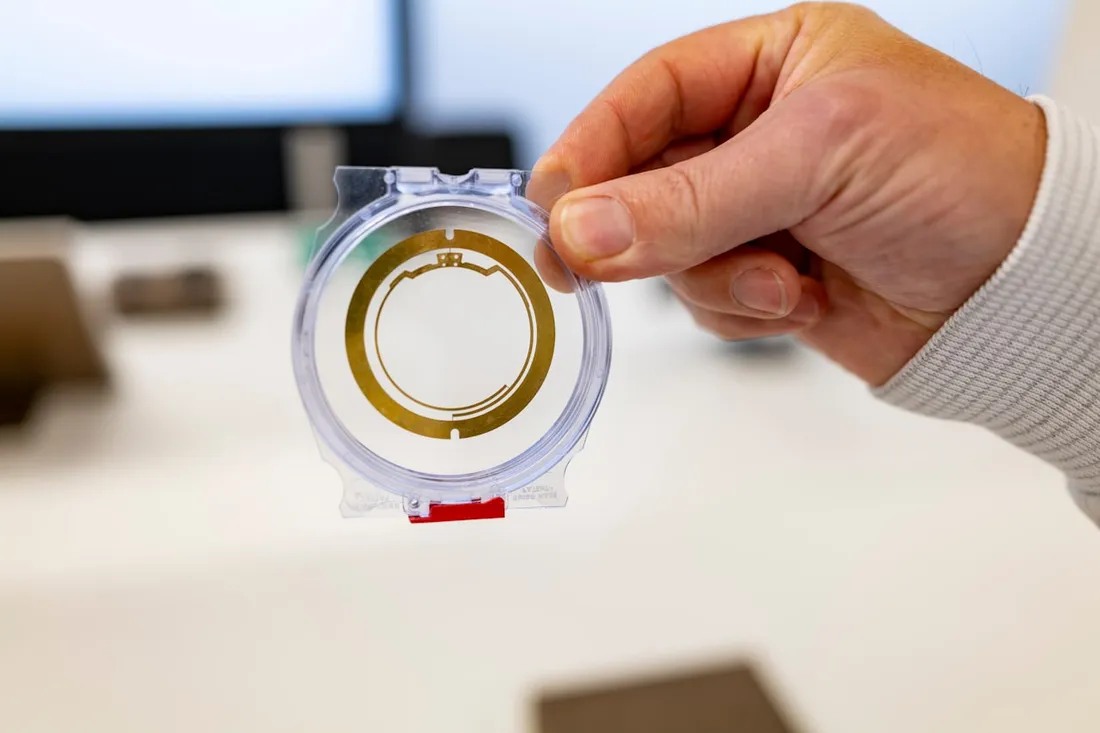
The third note is the blind master's legacy: the discipline of the ear. To make a striking watch is hard; but to make it sound beautiful is almost impossible. For sound is a realm ruled not by mechanics but by the ear. Blancpain's four gongs are hair-thin threads of rose gold coiled around the edge of the dial, their thickness varying along their length. For each to give the right note, the craftsmen measure the gong's frequency with a laser and tune the note not by filing, as in the traditional method, but by finely adjusting the gong's length. The gong is the watch's vocal cord.
This sound is the fruit not of crude mechanics but of patient craft: the hammers are polished one by one by hand, the bridges engraved with a burin, every surface finished by hand; for the slightest loss of vibration within means the fading of a note without. And, just as in the legend, the final word is spoken not by a machine but by a human ear: the master takes the finished watch to a wood-panelled acoustic chamber at Le Brassus, holds it to his ear and listens. The clarity of the sound, the balance of the notes, how long the chime hangs in the air: only a trained ear can judge these.
Vocal Cords and Eardrum: The Biology of Acoustics
So how does this mechanical organism speak so cleanly? In traditional minute-repeating watches, mechanical flyer governors are used to steady the speed of the strike; as they work, they give off a faint frictional whir, rather like the buzzing of a small bee in the background. To keep the melody pure, Blancpain developed a patented magnetic regulator. The system works like a Maglev train that glides without ever touching its rails: there is no mechanical contact at all, and the tempo of the hammers is held to a tenth of a second by silent magnetic fields alone. In the background you hear no interference; only the music itself remains.
And how does that sound reach the outside so clearly? In watches, sound waves are usually condemned to strike the metal case and be smothered. Blancpain all but reversed the principle by which the human eardrum, the tympanic membrane, passes sound to the brain through vibration: it set a special gold acoustic membrane into the frame of the case. The four great hammers striking the gold gongs within make this membrane vibrate like the cone of a loudspeaker, turning the energy of the mechanism into clear acoustic waves that spread freely into the air.



A Single Nucleus: A Mechanism Without Modules
Imagine a living organism whose every organ, vessel and vital function has been compressed into a single cell nucleus: a flawless whole that is not modular, that accepts not one part from outside, in which everything depends on everything else. The Grande Double Sonnerie is precisely such a structure.
Most grand complications are built modularly; you add the chronograph, the calendar or the striking module onto the base movement layer by layer. Blancpain’s engineers chose the harder path: they integrated all of the more than one thousand components onto a single main plate. This architecture is like the cell nucleus and the DNA helix within it; if a single wheel on that plate were to shift by one micron, the whole organism would collapse. Reaching this cellular integrity took eight years: 1,200 technical drawings were worn through at the bench, 21 new patents were born at the very limits of micro-engineering, and 13 of them were engraved permanently into the final body of the watch.


B: The Patience of Eight Years, and Two Masters
The fourth and final note is patience. The calibre 15GSQ is a vast mechanism forming 1,053 of a total 1,116 components, and every one of these parts, from its first drawing to its final polish, was designed, produced, assembled and decorated under Blancpain’s own roof. This universe of 1,053 parts does not merely strike; on its dial a flying tourbillon (a rotating cage that defeats gravity) also turns, alongside a retrograde perpetual calendar that knows the date, the month and the leap years. Three giants, all at once, in a height of only 8.5 millimetres.
What is more, the striking mechanism has its own reserve of energy: while the movement runs for 96 hours, the strike is good for 12 hours in grande sonnerie mode and 14 in petite sonnerie.

The Neurosurgeons of Time: Romain and Yoann
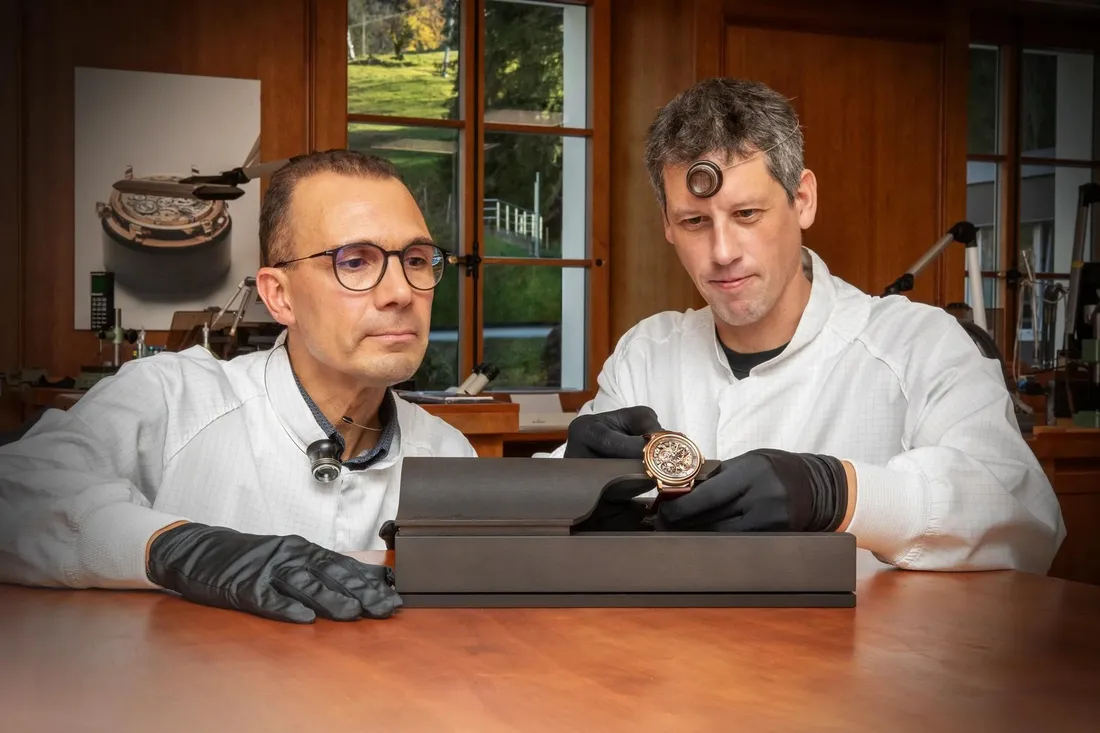
Do not confuse this watch with those that come off a line. It is brought into being by two masters who have devoted more than a decade of their careers to striking watches alone: Romain and Yoann. Normally a watchmaker works in isolation, bent over his loupe, sealed off from the world. But the Grande Double Sonnerie was of such daunting complexity that Romain and Yoann had to leave their sealed worlds and work shoulder to shoulder with the movement’s designers. There was no ready formula, no manual to follow.
Simply to be able to assemble this watch, they spent a full six months designing and making nothing but the assembly plans and the bespoke hand tools for its parts. Each watch represents twelve full months of uninterrupted labour in the hands of one of these two masters. When a master finishes his watch, the intimate moment arrives: Romain or Yoann engraves his own signature onto a microscopic gold plaque and sets it into the heart of the mechanism, to beat there forever.
This is why only two of this watch can be made each year. The oldest watch brand in the world, a house that since 1735 has never made a quartz watch, brings its masterpiece to life at Le Brassus, in Switzerland’s Vallée de Joux. Its price is 1.7 million Swiss francs; but what you pay for is not metal, but a year of a master’s life, an ear, and a three-hundred-year-old tradition itself.




The Codes Behind the Dial: GS, PS and SIL
The abbreviations GS, PS and SIL that you will see on the case are the mechanical command centre governing the striking modes of this masterpiece.
GS (Grande Sonnerie, the Great Strike): the watch is in its most magnificent state. At every quarter it strikes, on its own, first the current hour and then the quarter melody, turning time into a continuous feast of sound.
PS (Petite Sonnerie, the Small Strike): a more measured mode. At the quarters it strikes only the quarter melody, and on the hour only the hour.
SIL (Silence): this shuts off the automatic striking entirely. Even so, when you press the slide on the case, the watch will still read the current time back to you melodically, on demand.
For all this vast complexity, the watch is surprisingly ergonomic: 47 mm in diameter, 54.6 mm lug to lug and 14.5 mm thick, it sits well on the wrist. Most important of all, it is protected by five separate integrated safety systems that prevent the owner from accidentally forcing and breaking the mechanism.


The Final Touch: The Century-Old Soul of the Risoud Forest
The last word lies in the watch’s box, for this box is no ordinary piece of wood. It is made from the spruce of the legendary Risoud Forest in the Vallée de Joux. These are the special resonance spruces that the world’s finest violin and cello makers have sought out for centuries for their acoustic qualities.
Set into the box, the watch finds a natural soundboard. When the chimes begin, the fibres of the wood catch the sound waves, amplify them and spread them through the room. And so the box becomes the final link binding the watch to the cultural and artisanal heritage of the valley in which it was born.

Coda: The Four Notes Together
And at last the four notes come together. E gives the dark a voice, G offers a choice between two melodies, F makes the sound beautiful, and B carries the patience of eight years. At the touch of a pusher, the E, G, F and B chosen by that blind master in the legend cross the centuries and ring anew on your wrist; whether as the noble hymn of Westminster or the heart of a rock drummer.
This is why this watch does not merely measure time. It is the most mature form, three hundred years on, of the sound a king once longed to hear in the dark; a cathedral that fits on a wrist, forged not by fire but by patience and the ears of two masters. Each time its bell rings, it reminds you that a moment has come and gone, and therefore that you are alive; and then that sound, like a life, gently dissolves into the air and is gone. What remains is a silence, waiting for the next note.