A hill rises at the eastern end of Nice. Its name still remembers a castle, but there is no castle on it. French forces besieged the place in the early eighteenth century and levelled the fortress in 1706. Only the name survived.
Today the hill carries pines, an artificial waterfall and a terrace that takes in the whole bay. You climb it, you look out over the Baie des Anges, you count terracotta roofs, and then you raise your head.
What you are looking at, when you raise it, is a puzzle that people a few kilometres behind that hill have spent years trying to solve.
Nice is an old city and its name records a victory. Around the fourth century before Christ, Greek sailors out of Marseille founded a harbour on this shore and called the settlement Nikaia after a battle they had won. The Romans were not content with the coast. On the slope of Cimiez above the town they built Cemenelum, with an amphitheatre and a set of large baths, and you can still walk among those stones.
Down at the water there is a much younger layer. In the early nineteenth century the English community that wintered in Nice paid out of its own pocket for a walkway along the shore. Local people called it the road of the English for long enough that the name stuck: Promenade des Anglais.
The city did not belong to France until 1860. It joined after the Treaty of Turin and the vote that followed. Giuseppe Garibaldi had been born here in 1807 and objected to the transfer for the rest of his life. In the old town people still speak a language of their own, nissart, distinct from French. The flower market on the Cours Saleya sets up in the morning, socca made from chickpea flour is sold in the street, and the narrow lanes stay cool all afternoon.
format_quote"A city can be named for a victory, a road for its guests, a hill for a fortress that no longer stands. The name outlives the event."
Hasan Bekmezci
On another hill above the city, on Mont Gros, stands a building of an entirely different kind. The Observatoire de la Côte d’Azur opened in 1887. The banker Raphaël Bischoffsheim paid for it, Charles Garnier, who built the Paris Opera, designed its pavilions, and Gustave Eiffel solved the structure of the great dome. For all its weight, the dome was engineered to be turned by one person.
The seventy-six centimetre refractor installed beneath it was, on completion, the largest in the world. It held that title only a few years. The observatory left its real mark on the history of science not through a lens but through a calculation.
In May 2005, Nature published three papers in succession. The authors were Kleomenis Tsiganis, Rodney Gomes, Alessandro Morbidelli and Harold Levison, and the work was centred on this observatory at Nice. The scenario they proposed entered the literature under the name of the city: the Nice model.
It says the following. The solar system did not arrive at its present arrangement fully formed. Some time after it settled, Jupiter and Saturn passed through a resonance in which the ratio of their orbital periods was exactly two to one. A resonance means that two planets pull on each other at regular intervals, always from the same point in the cycle. Small nudges accumulate and the result grows, in the way a child on a swing rises if you push at the right instant every time.
That accumulation destabilised the orbits of Uranus and Neptune, scattered the outer disc of small bodies and sent a rain of material inwards. Planets changed places, the disc was thrown apart, and the arrangement was rebuilt. The calm order we see today is what came after the shaking.
format_quote"The sky was not handed to us as a finished painting. It went through a process, and the process left marks."
Hasan Bekmezci
How do we know any of this? Nobody can say they were there and saw it. The evidence sits above our heads.
The surface of the Moon is an archive. There is no atmosphere, no rain and no plate tectonics. An impact scar stays as it formed. The Earth erased its own childhood: wind, water and the constant renewal of the crust removed the old craters. The Moon removed nothing.
When the rocks brought back by the Apollo missions were dated, the samples that had melted during an impact and solidified again clustered in a narrow band of ages, near three point nine billion years. That clustering was read as the signature of a violent bombardment in that period, and it is precisely the event the Nice model sets out to explain.
The reading is not beyond dispute. It has been argued that most of the samples may come from the debris of a single enormous impact. The model itself has been revised over the years, and the instability has been placed much earlier than it first was. That is how science works, and it is not a weakness. What does not change in the middle of the argument is that the page we are reading is the surface of the Moon.
And we read the same page every time. The Moon is locked to the Earth and always shows us the same face.
format_quote"The Earth erased its own past; the Moon kept it. To learn about our own childhood we have to look up."
Hasan Bekmezci
Put an astronomer from the observatory at one table with an engraver who works on dials in a watch manufacture, and the conversation would very likely arrive at the same place.
The astronomer would say: we do not photograph the past. We have a surface, we have the ages of the marks on that surface, and we have equations. We fit them together and a story comes out. If the story is right, a new measurement does not break it; it supports it.
The engraver would answer: I do not put a photograph of the Moon on a dial either. I cut two discs of mother-of-pearl, I true their edges, I run one behind the other, and the gap between them makes the crescent. I am building a model too. The difference is that when my model runs correctly, the man looking through the glass sees the same thing as the sky.
Both are doing one job: turning what cannot be seen into an order that can.
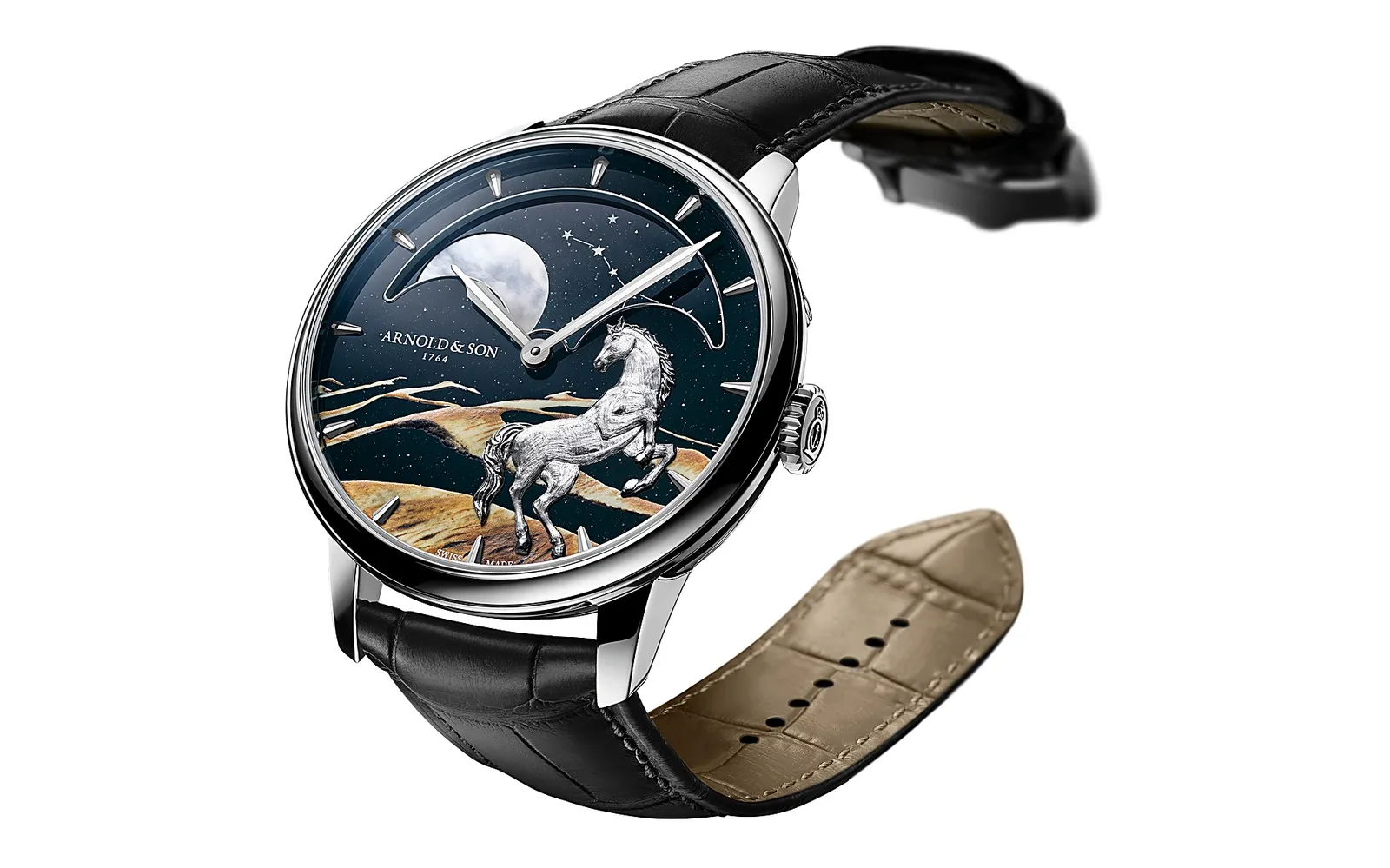
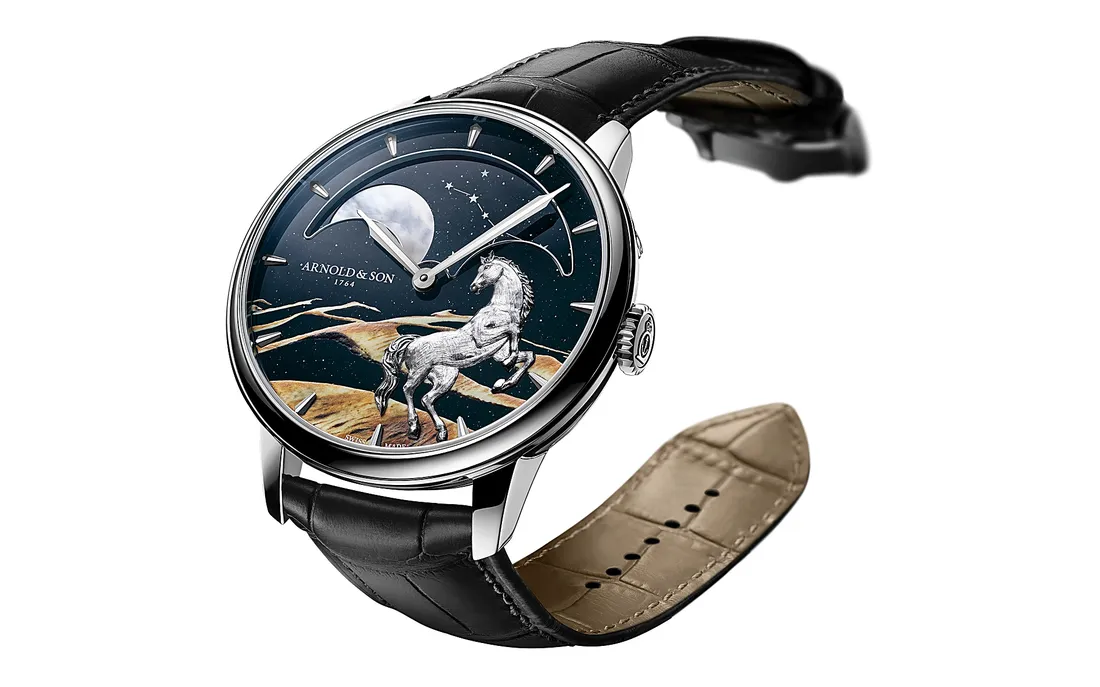
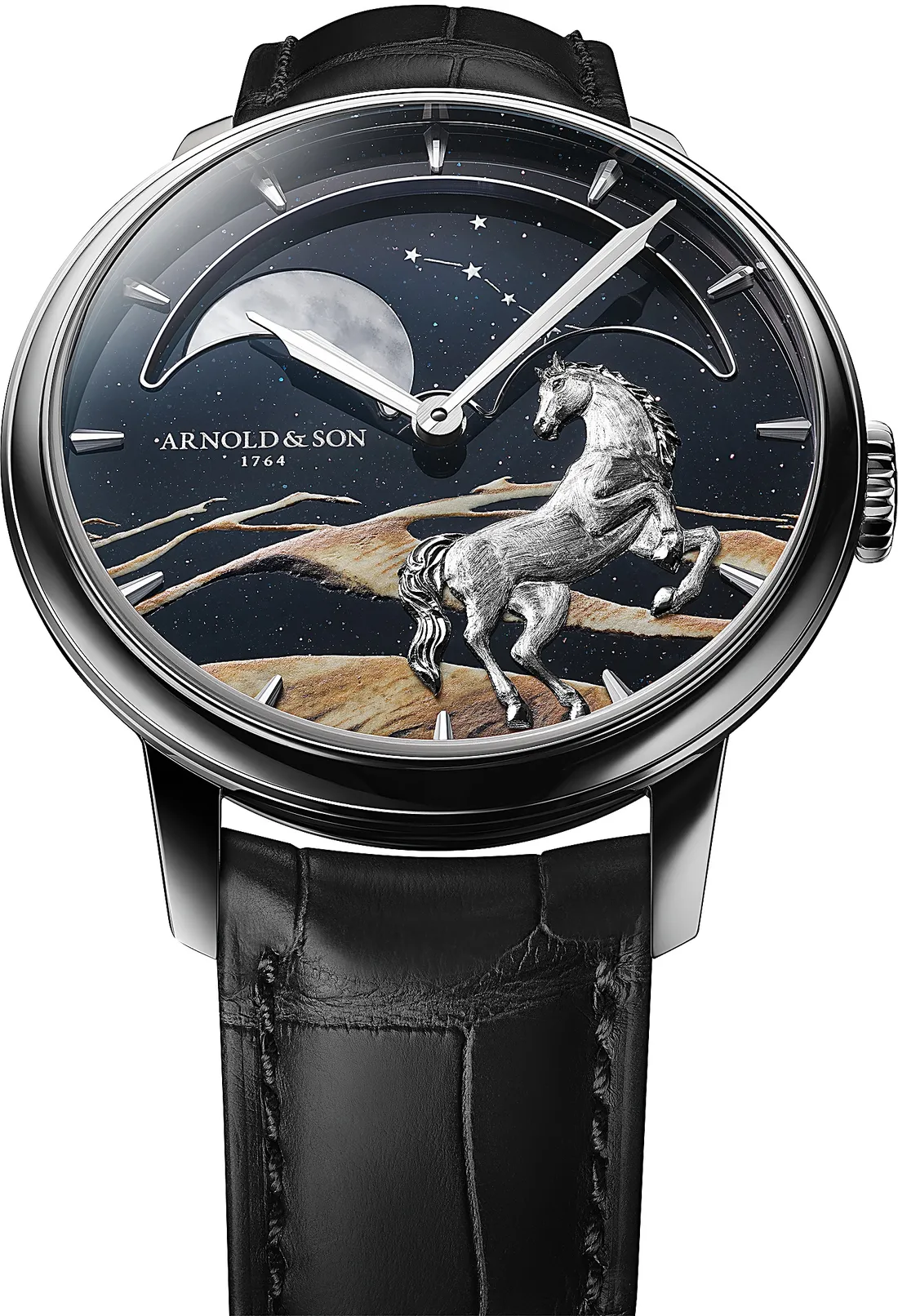
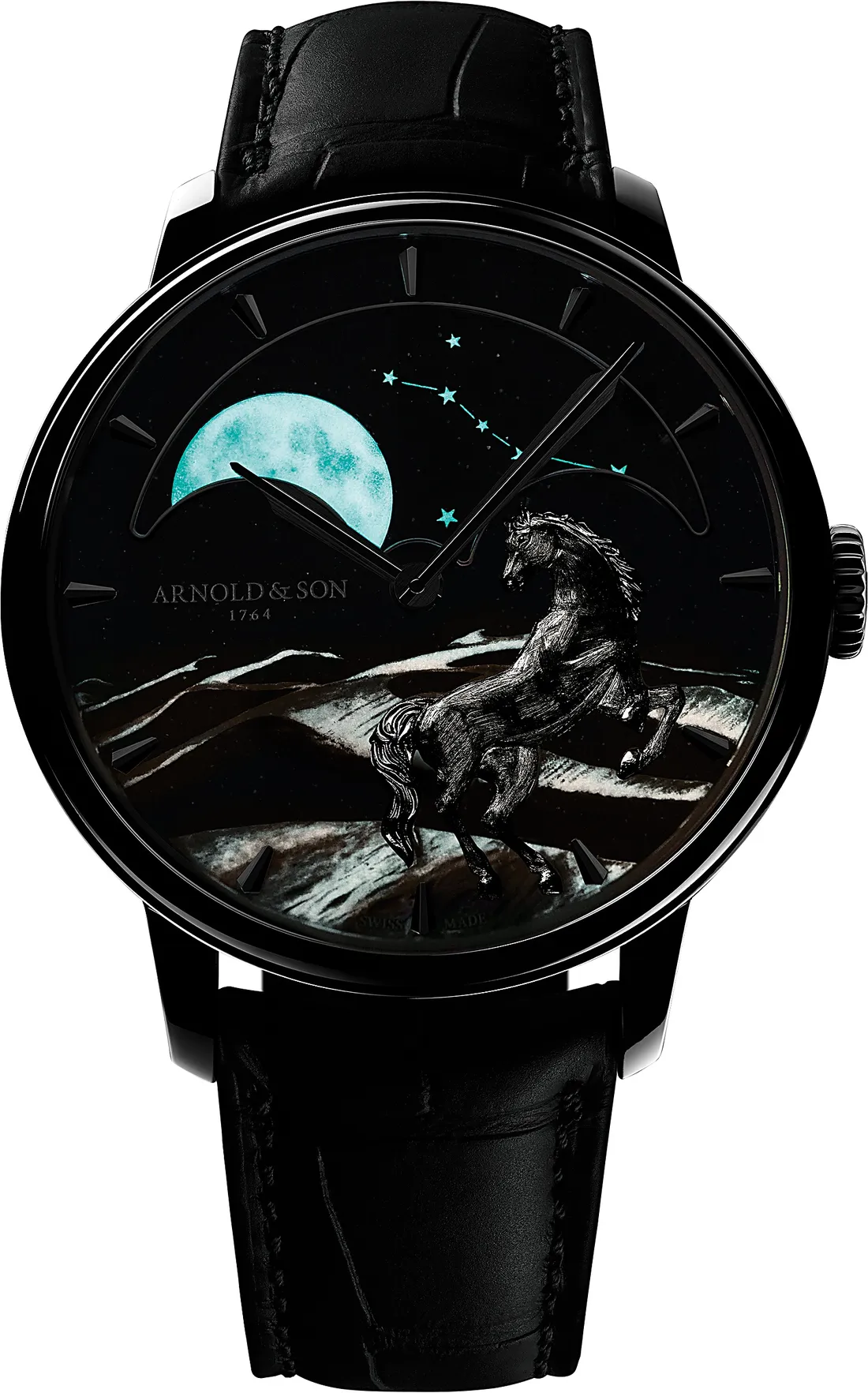
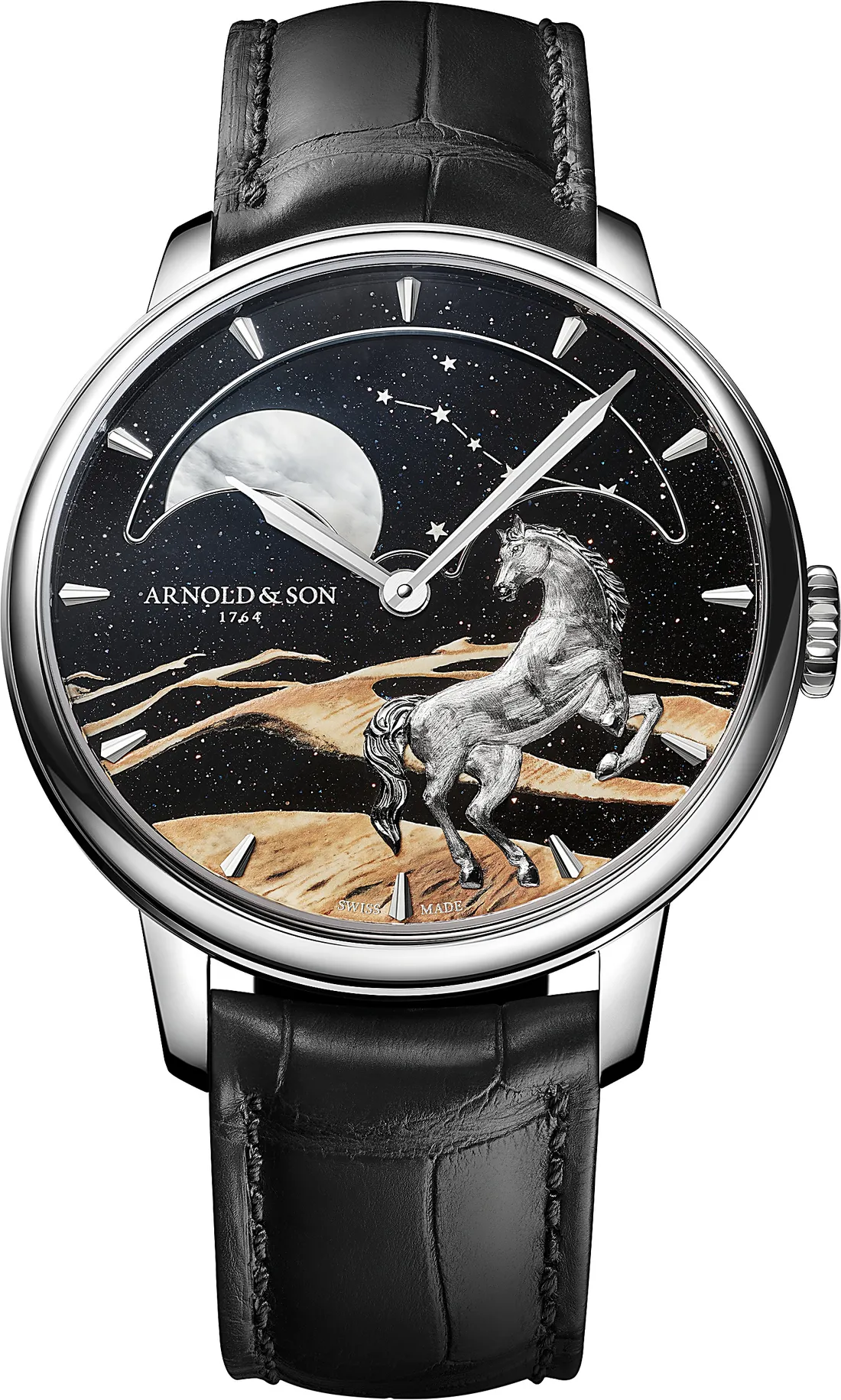
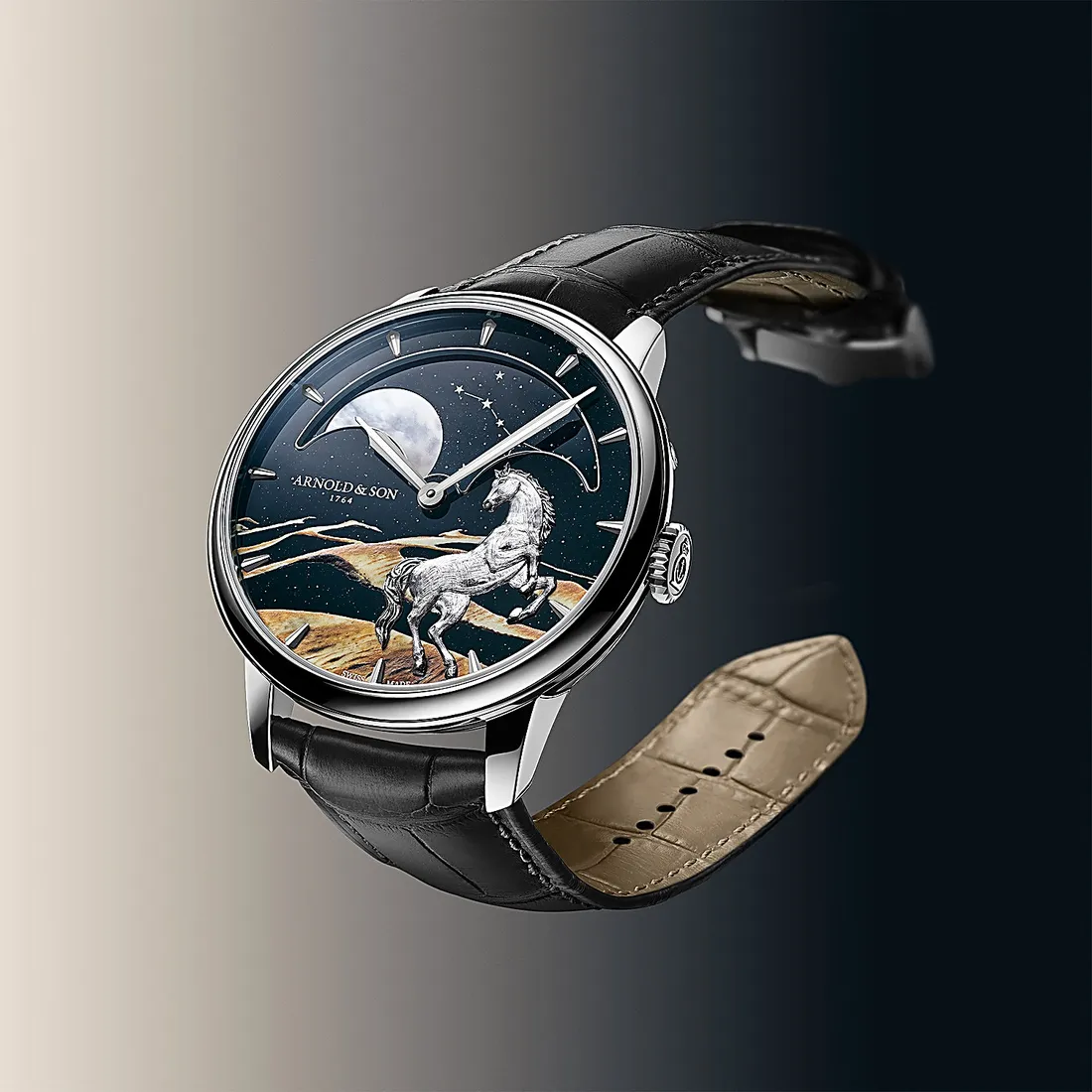
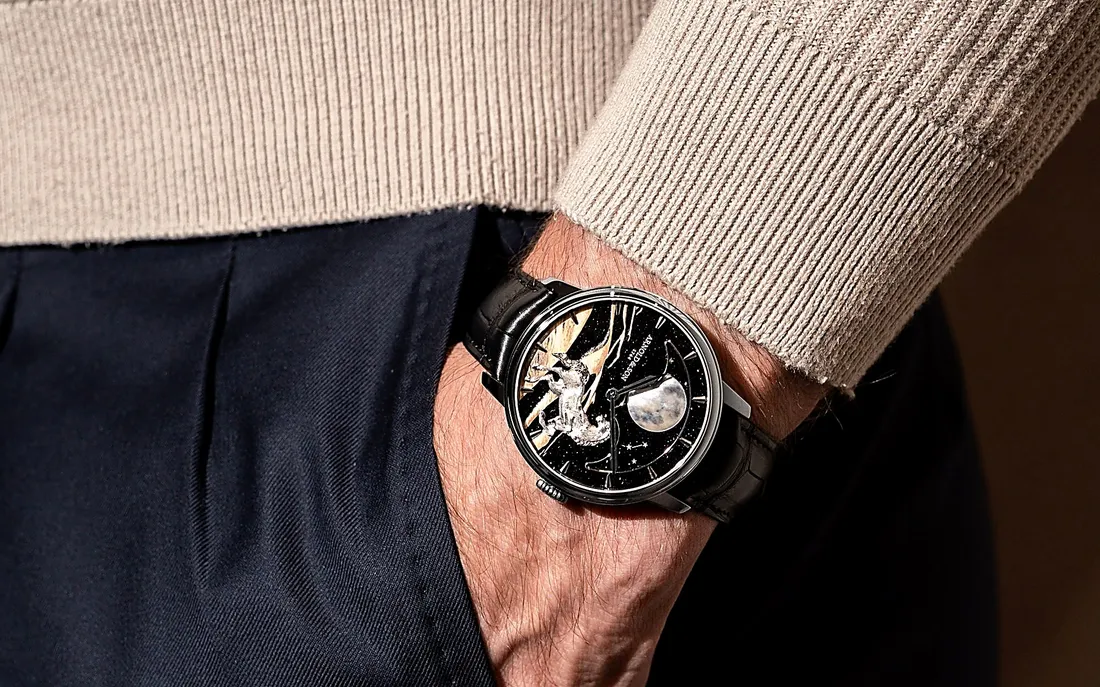
The Perpetual Moon 41.5 Platinum “Horse of the Dunes”, introduced by Arnold & Son in September 2026, is an instance of exactly that job. The sky of the dial is black aventurine glass, and the metallic flecks suspended in it serve as stars. A moon travels across the wide opening at the top, and it is not a painted picture: it is built from two discs of mother-of-pearl passing one behind the other. The discs shift colour in daylight and stay visible in the dark through the luminescent material laid over them. The constellation beside them is painted by hand and glows as well.
Below runs a landscape of dunes. The relief is hand-painted and charged with luminescent material, so it gives the colour of sand by day and the silhouette of the ridges by night. In the middle, a horse cast in eighteen-carat white gold and engraved by hand rears up. The landscape belongs to no particular geography, and that is deliberate.
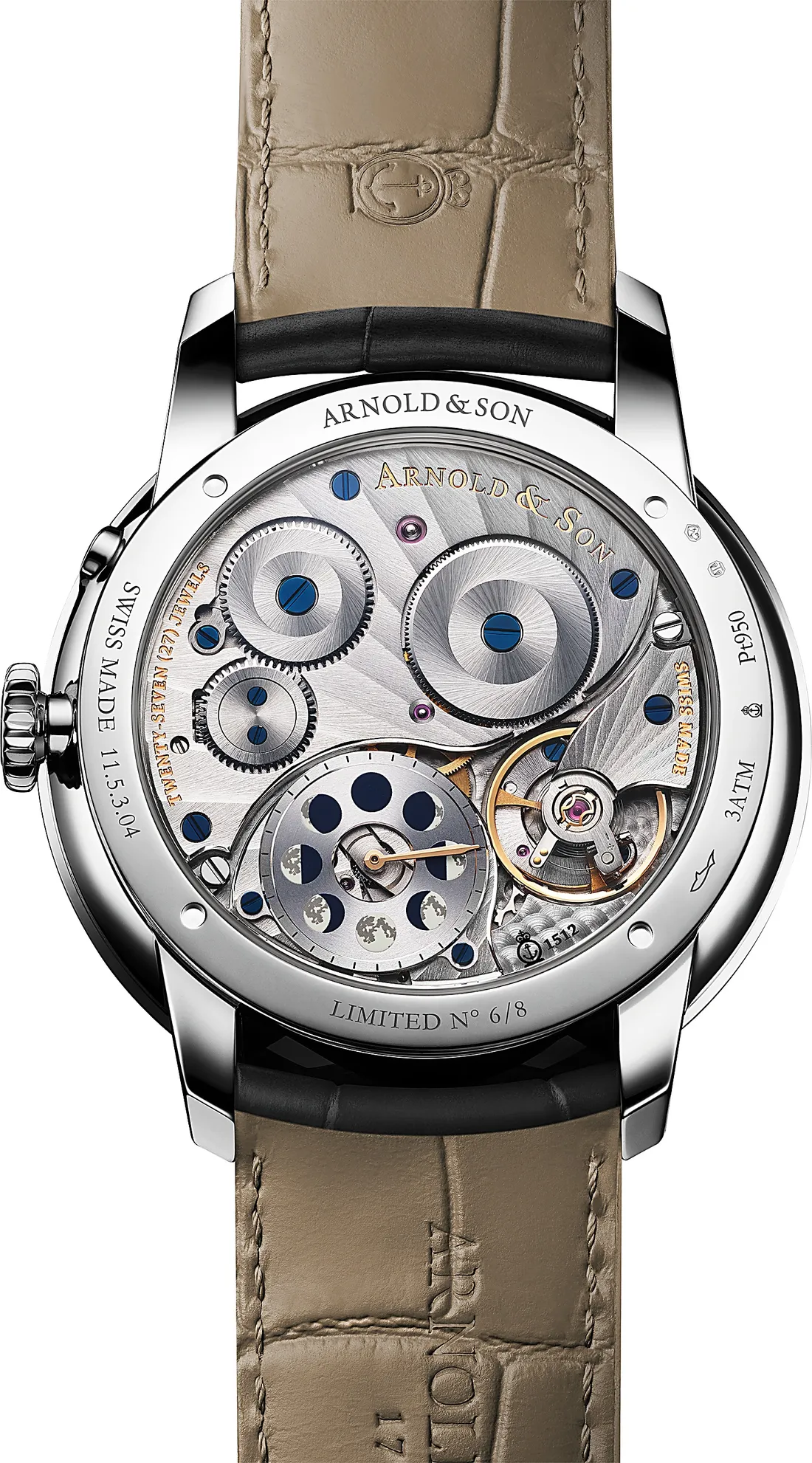
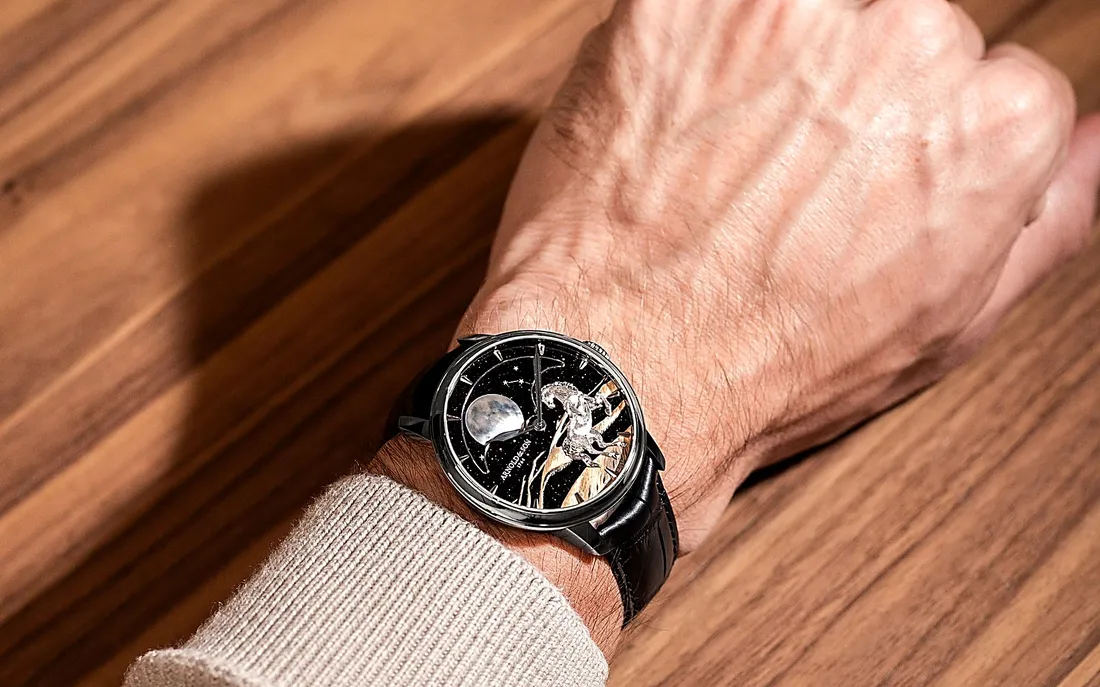
The case is platinum nine fifty, forty-one and a half millimetres across and eleven point six seven millimetres thick, under a domed sapphire crystal coated against reflection on both faces. Inside runs the house calibre A&S1512: twenty-seven jewels, thirty-four millimetres across, twenty-one thousand six hundred vibrations an hour, ninety hours of reserve. The strap is black alligator lined in sand beige, on a platinum pin buckle. The reference is 1GLBX.Z03A.C1479X and the edition runs to eight pieces.
The real point hides in one of the numbers. The Moon takes twenty-nine days, twelve hours and forty-four minutes to return from one phase to the same phase. That interval is not a whole number and no simple gear ratio catches it. In the Arnold & Son solution, the difference between the display and the sky reaches a full day only after a hundred and twenty-two years, provided the watch is wound regularly. Set it correctly today and you leave a working moon to a great-great-grandchild.
On the back the same information is given a second time, as a diagram rather than a picture. The phases are laid in order around a small dial above the movement, and a gold hand shows where in the cycle we stand. The front tells you about the sky and the back tells you about the mechanism. Two languages for one fact.
Seen from here the watch stops being an ornament.
The Moon keeps the record of a catastrophe. Every hollow on its surface is the mark of an impact, and that sequence of impacts is the labour of building the order we now live inside. Yet the same scarred surface became humanity’s first calendar. When to sow, when the fast begins, when the ship sails: all of it was read off the regular change of that face.
The trace of a destruction has turned into a measure. What looked like chaos left behind a rhythm whose seconds can be counted. We did not put that rhythm there. We noticed it, and we turned it into gearing. Reading the measure the Creator set is among the noblest things a person can do, and the work begins in humility: we did not invent the measure.
The man standing on the hill at Nice with his head raised, the astronomer under the dome on Mont Gros, and the craftsman in the manufacture aligning two discs of mother-of-pearl are doing the same thing. All three are looking, and trying to understand. The only difference is the size of the instrument in their hands.
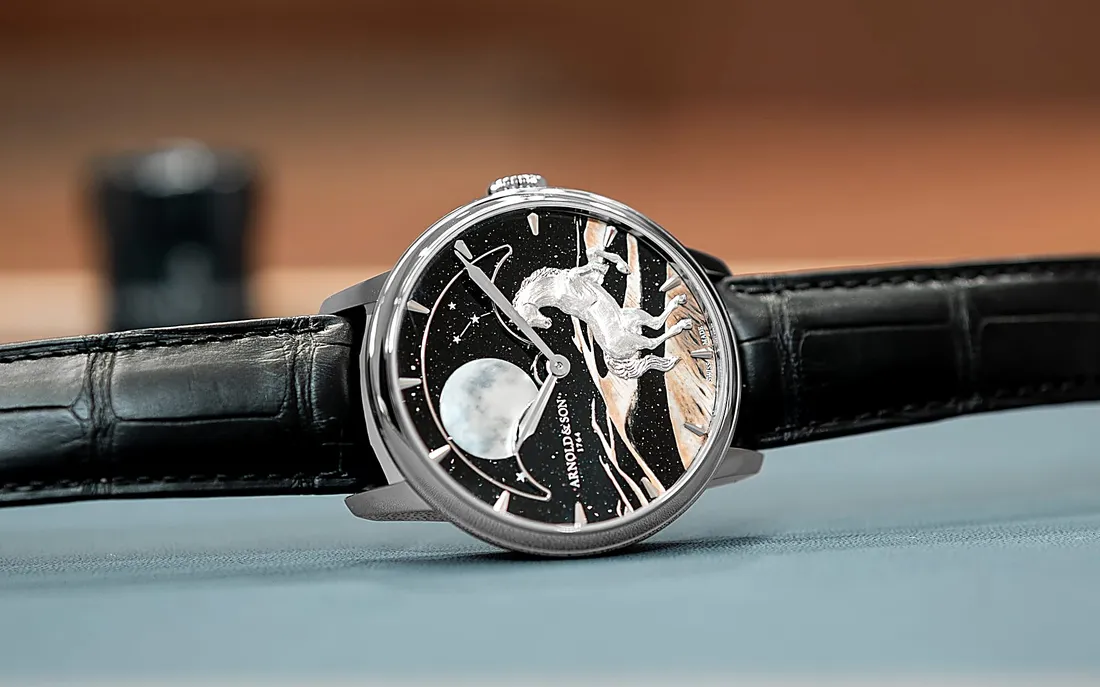
The watch on its maker’s own site: Arnold & Son, Perpetual Moon 41.5 Platinum “Horse of the Dunes”