Sit down on the bank of a river and you see the water running on without a break, fluid and smooth. We always imagined time like that. In the classical physics of Isaac Newton, time was an absolute river flowing at the same rate everywhere in the universe, without stopping, as smooth as water. And in everyday life the soft circular glide of the hands across a dial kept telling our brains the same tale of continuity.
But what if that smooth flow is entirely an illusion your own mind has made?
Watching a film at the cinema you see a running figure as unbroken movement. In truth there is no smooth liquid on the screen; there are twenty four still, separate frames a second. Your brain joins up the gaps between them and sells you the illusion of flow.
Classical watchmaking has been showing us that twenty-four-frame film for centuries. But go down to the most basic fabric of the universe, to the micro scale, and nature whispers a quite different and unsettling truth. In the exchanges that hold matter together nothing runs smoothly; energy is given, taken and leaps in packets.
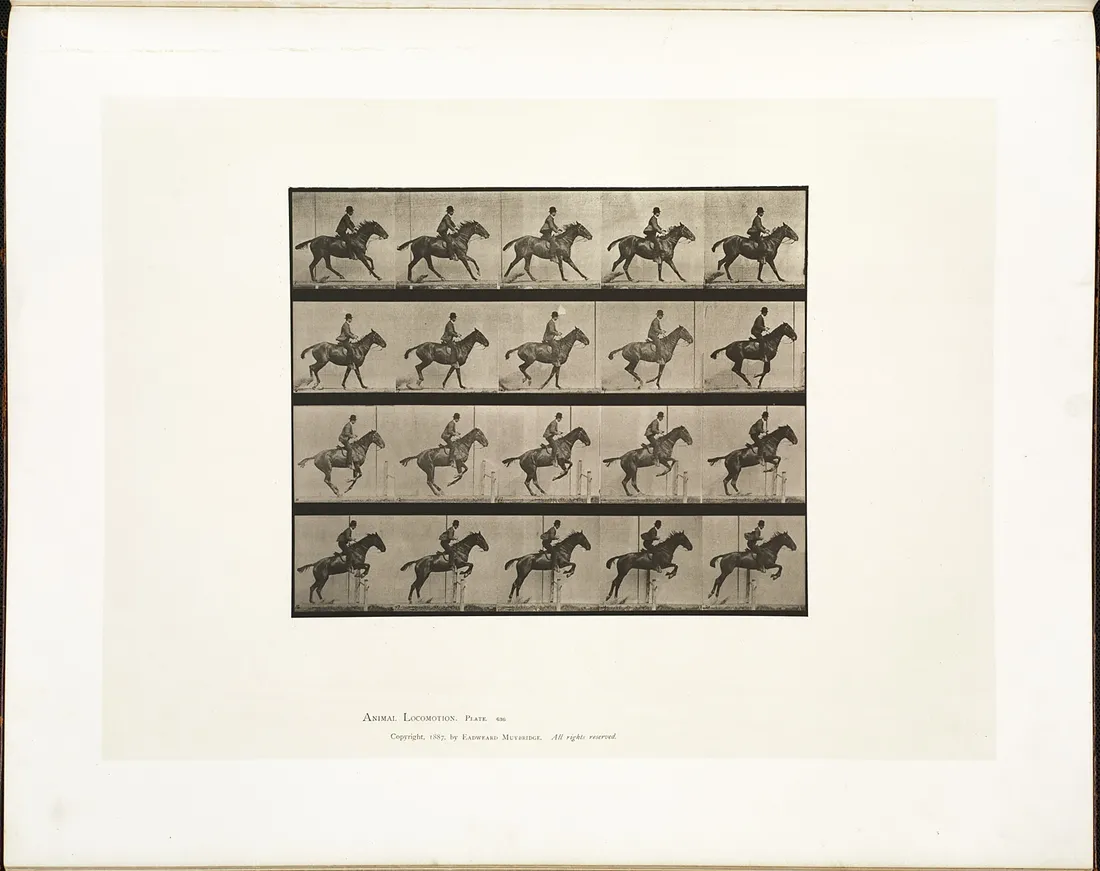
format_quote"Your brain joins up the gaps between the frames and sells you the illusion of flow."
Hasan Bekmezci
A famous sentence of Richard Feynman’s goes around: that anyone who thinks they understand quantum mechanics does not. That is a loose rendering attributed to him. The line that can actually be traced to him is plainer and heavier: in the Cornell lectures of nineteen sixty four he said he thought he could safely say that nobody understands quantum mechanics.
Feynman was right, because the human brain tries to understand the universe by looking at the objects of the macro world its eyes can see. Yet go down to the root of the word and everything grows simple. The Latin quantum means, quite simply, an amount: how much, how large a packet.
So why, when the Creator set the giant planets of the macro world into orderly orbits, did he place the unimaginable rules of the quantum in the subatomic world? What is the purpose hidden in those laws? What do they whisper to us?
First, quantisation. Imagine sliding down a ramp; in theory you can stop at any point along it. That is the continuous world of classical physics. Now take the ramp away and put a steep staircase in its place. You are either on the first step or on the second. There is no physical reality called step one and a half. You cannot travel between two steps; you either exist there or here.
What is the purpose, and what does it tell us? If the essence of matter were a continuous melt, the universe would turn into one enormous, unstable soup. By making energy and matter into packets, the Creator has placed an unshakeable measure, weight and quantity into the universe. Thanks to those packets atoms do not scatter, molecules do not come apart, and the universe stands in order. What it whispers is this: nothing in the universe is loose or random; every manifestation is appointed with a definite quantity and measure.
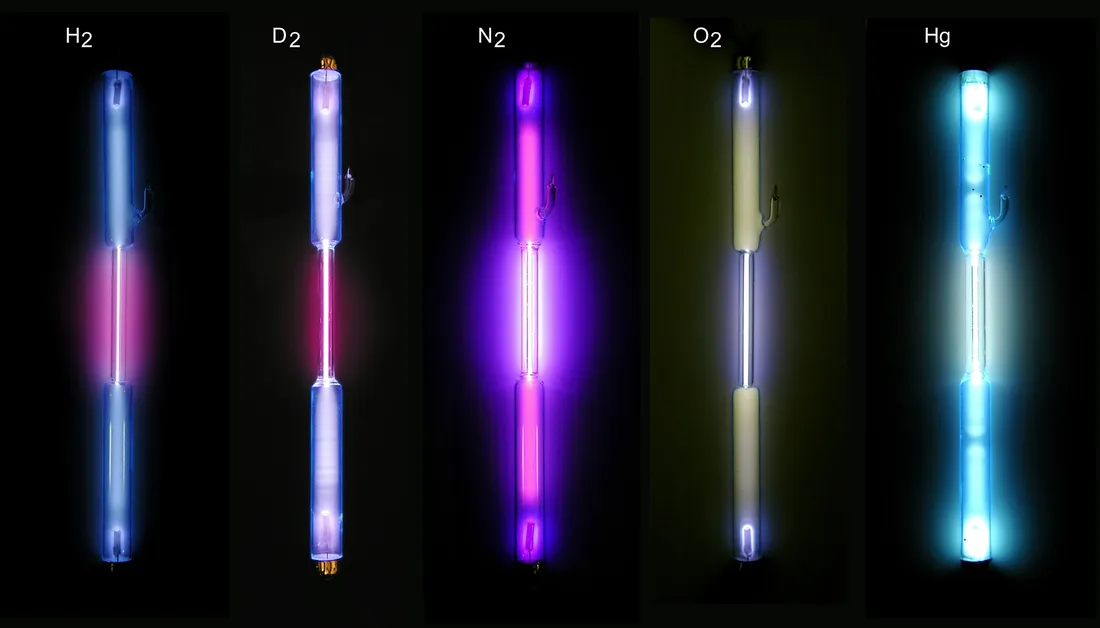
Then the quantum leap. Say you are on the ground floor of a building and you are going up to the second. In the classical world you walk up the stairs, or take the lift, covering every centimetre in between.
The electron turning about the atom does no such thing. It is in the first orbit; when it takes in energy it appears suddenly in the second orbit, without covering any of the distance between, without existing for an instant in the space between.
Think of it like this: you are sitting at your desk in Istanbul and, without opening the door, without walking the streets, without ever existing on the road between, you suddenly find yourself sitting in a cafe in Tokyo. Not going to B, but ceasing to be at A and being, at once, at B. That is the quantum leap.
What is the purpose here? That an electron leaps from orbit A to orbit B without crossing the distance shows that matter does not exist of itself. The Creator whispers this to us through the leap: change and transformation are not condemned to the heavy steps of the chain of causes. At every instant, by the touch of the divine will, existence is undone in state A and made again in state B. The leap is the seal, at the micro scale, of an intervention beyond cause and effect.
The third is entanglement. Imagine twins, one on the far side of the ocean and one here. When one of them is in pain, the other feels it at once in the heart, across the thousands of kilometres and the difference in the hour. Entanglement is something like that: if two particles at opposite ends of the universe are entangled, a measurement made on one agrees, every single time, with the result on the other, however far apart they are. Einstein called it spooky action at a distance.
A caution has to be entered here, because it is easy to misread. Nothing travels between the two particles: no message, no signal, no force. And yet, with nothing travelling, the results read at the two ends agree, and agree far more often than any arrangement settled beforehand could explain. That is what is spooky about it.
What is the purpose here? That the outcomes of two particles an enormous distance apart should match makes one think that distance is as nothing before divine knowledge. Space and time may separate you, but the essence of the universe is one great whole fed from a single source. Nothing is far from His knowledge and His compass; the farthest and the nearest are one in His sight.
Where do all these packets, leaps and entanglements in the quantum world take us?
If energy and matter are given and taken in packets, must space and time, the stage on which matter stands, also be divided? Can you slice time for ever? You cannot cut a loaf with a knife an infinite number of times; in the end the knife meets the atomic limit and there is no bread left.
In classical physics we thought of time as an imaginary line and supposed we could divide each of its instants for ever. The leaps of the quantum world put another possibility on the table: that for an event to happen, for one state to pass into another, time too may have a smallest step. A limit we might call the most basic frame rate of the universe.
At the end of the nineteenth century the German physicist Max Planck, studying how light and heat are radiated, noticed the historic moment at which physics struck a wall. Classical physics assumed that energy could be broken into infinitely small pieces, and for that reason its theoretical calculations ran into impossible dead ends where the energy of the universe shot off to infinity.
Planck discovered that nature does not permit that endless division, and by putting together the speed of light, the gravitational constant and the quantum of action he had found, he calculated the smallest scale of time written into the fabric of the universe: the Planck time. Count forty three zeros after the decimal point, then set down the figures five, three, nine. That much of a second.
What stopped us at the forty third zero? Why not fifty, or a hundred, or a hundred and fifty? To understand it, let us bring the resolution limit of nature to mind through two comparisons.
The first is the collapse of the pixel. Imagine an enormous screen. From a distance you see a vast, smooth landscape. You begin to move closer with a lens, you magnify, you magnify again. Why can you not go on magnifying for ever and see more detail? Because in the end you run into the smallest square of colour on the screen, the pixel. Try to go inside it and the image ends, the colour loses its meaning, and all that is left is the physical structure of the screen. The Planck time is like a single pixel of the fabric of space and time; to try to go below it is like cutting into a pixel with a knife in the hope of finding another picture inside.
The second is the microscope and the black hole, and this is the mechanism that physically stops us. In physics, if you want to measure a smaller interval of time you have to throw into it light of a correspondingly higher frequency, that is to say an enormous energy. As the interval shrinks, the energy you must squeeze in reaches an unimaginable density.
And Einstein’s general relativity says this: mass and energy are two faces of the same thing, and the more energy you compress into a point, the more you bend the fabric of space and time around it. Think of an immense trampoline. Put a light marble on it and the sheet dips a little. But put tons of weight on a single invisible point at its centre and the sheet bends there as far as it will go, a deep well opens, and the bent sheet closes in on itself.
At the Planck scale exactly this happens. The energy you focus on that microscopic area creates such a weight that space and time collapse inward at that tiny point and a minute black hole forms at once. The light you sent in to measure the time is held inside the black hole it made. Since the light cannot get out, no information can reach you. What stops us at the forty third zero is this shield of black holes, woven by the speed of light, gravity and the quantum of action joining hands.
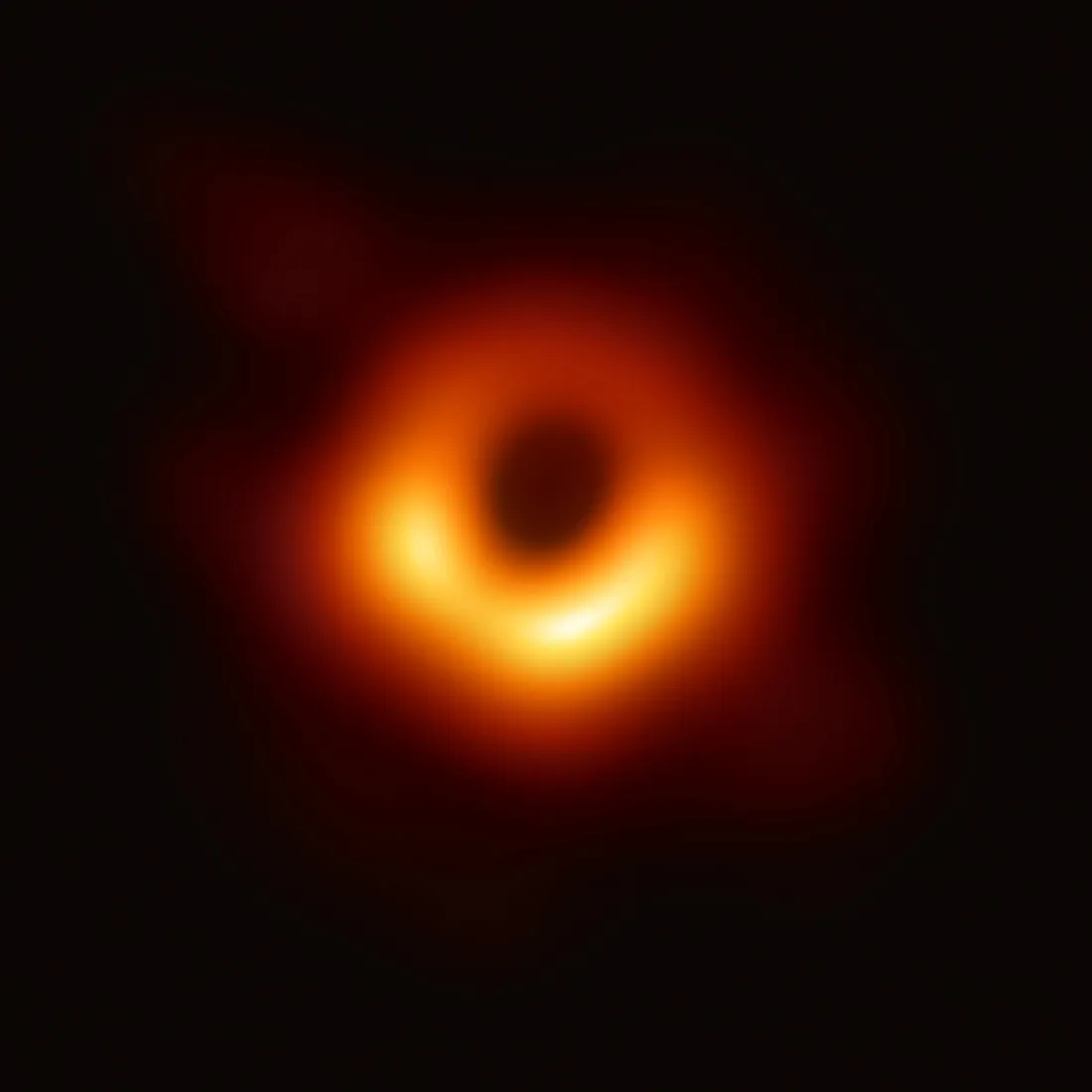
An honest note belongs here. Physics does not yet say that time really is divided into grains of Planck size. What is certain is that below this scale our two great theories, quantum mechanics and general relativity, stop holding at the same time, and that none of us can lay a ruler down there. There are reasons to believe in the grain, but it is not a measured fact; it is the most natural reading.
Even so, the limit itself whispers something. If time were a smooth river divided for ever, the universe could be taken for an endless mechanical wheel flowing of itself from eternity. The existence of a smallest step suggests instead that time has a beginning and is worked in packets.
This is what the limit whispers to us: time is not an unstoppable liquid flowing from eternity; it is a divine stitching, appointed anew at every instant, bent and brought into being one at a time. The flag of existence is passed from one instant to the next by a leap. And we, because our minds are slow, take these broken leaps for a smooth river.
format_quote"We, because our minds are slow, take these broken leaps for a smooth river."
Hasan Bekmezci
URWERK, the legendary house of avant-garde watchmaking, had in earlier icons such as the UR-100 series written onto the dial the speed of the Earth’s own rotation and the thousands of kilometres it covers in its orbit around the Sun: monuments to astronomy.
With the UR-300 Time Quantum the house knowingly and deliberately turns the language it built inside out. In its own words, the watch inverts the lens on our view of the URWERK universe. The movements of the planets, the lines of space and the orbital ornament are scraped off the dial. The subject of the UR-300 is not the circular illusion of the macro universe but the quantum nature of time itself.
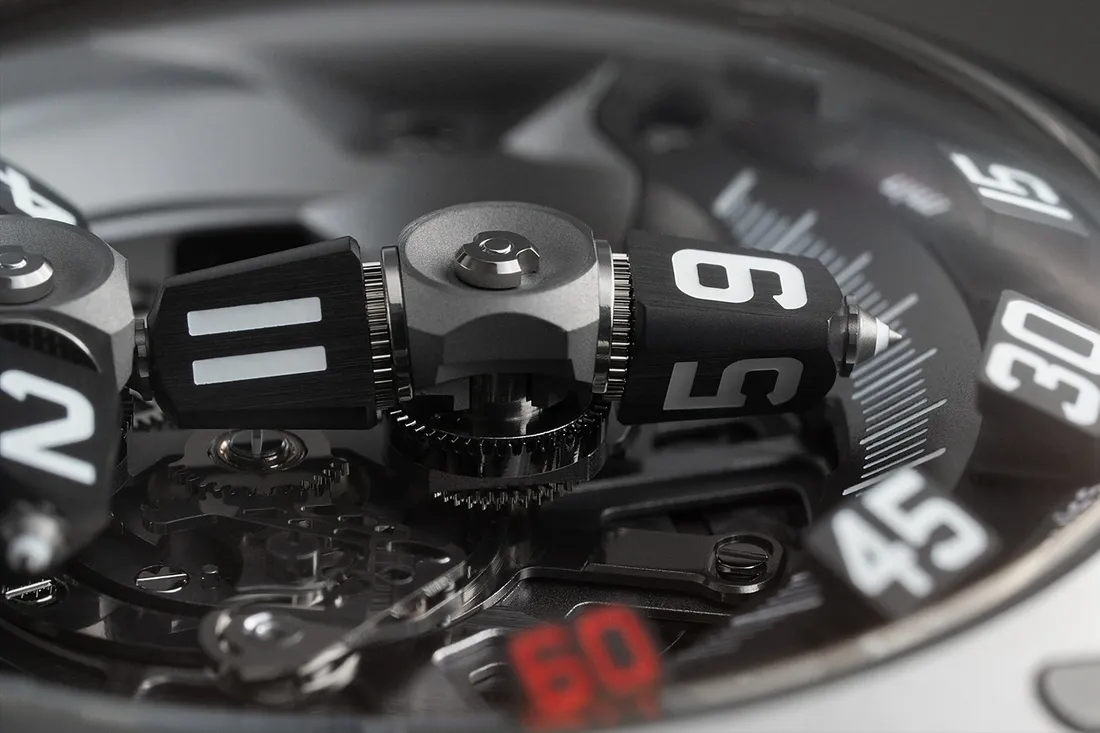
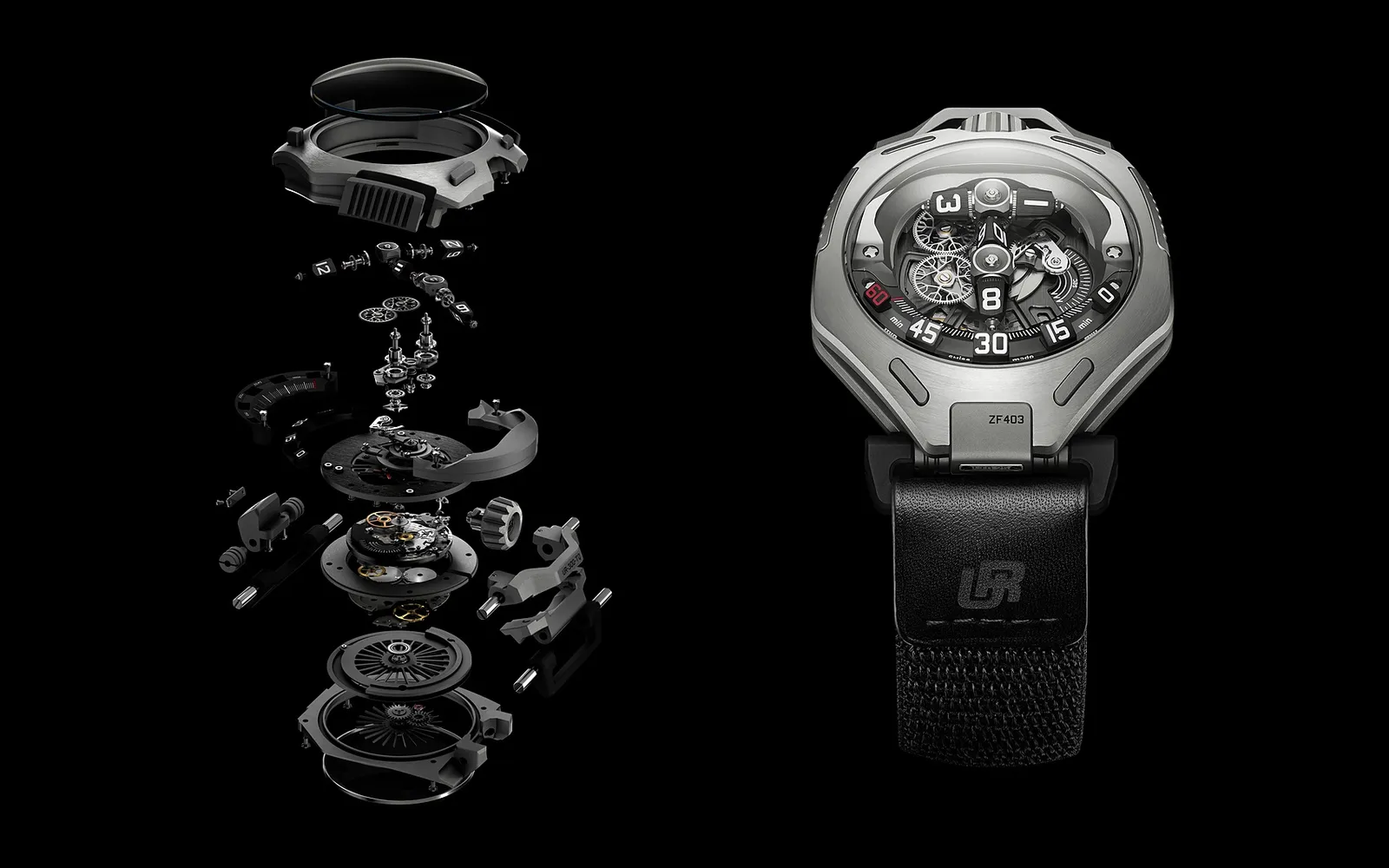
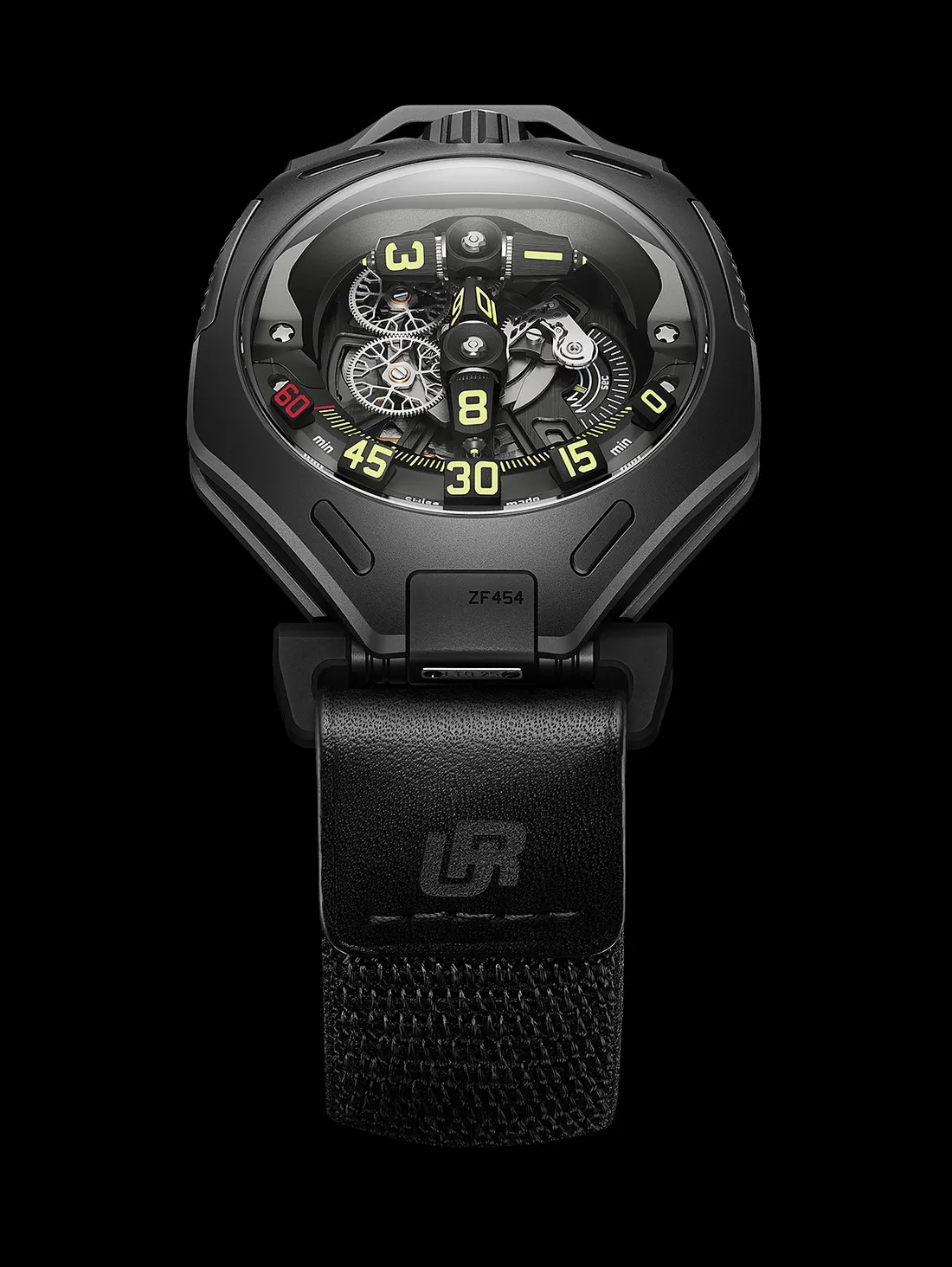
The first thing that comes to mind at the name URWERK is the satellites wandering along a circular path. The UR-300 breaks that circle. Two hour modules of linear construction, fixed perpendicularly to one another, form a massive T-frame at the centre. Time is no longer a round illusion; it is a sharp, upright, resolute architecture.
The second break is in the rhythm. In the house’s past, from the Opus V to the UR-150 Scorpion, the top of the hour was marked by a retrograde snap, the hand flicking hard backwards. The retrograde is a nostalgic, backward-looking spring. The UR-300 leaps forward instead. On the hour there is no backward flick and no circular turn; there is a quick-blink forward jump, and the hour display reconfigures completely.
The hour is carried on four tri-sided prisms. Four prisms, twelve faces, twelve hours. Going from eight to nine no numeral glides across the middle; the prisms pass into their new configuration without catching at any intermediate position.
Anyone who has read this far will find it hard not to think of the electron in front of this dial. That is a way of reading; but it does not come entirely from outside either, because it is the house itself that named the watch. Felix Baumgartner describes the world of the atom as a state of constant, temporary equilibrium, in which introducing energy breaks the structure down, reorganises it and shifts it into a new state; and it is that idea of transition, he says, that he wanted to translate into mechanics with the UR-300 Time Quantum.
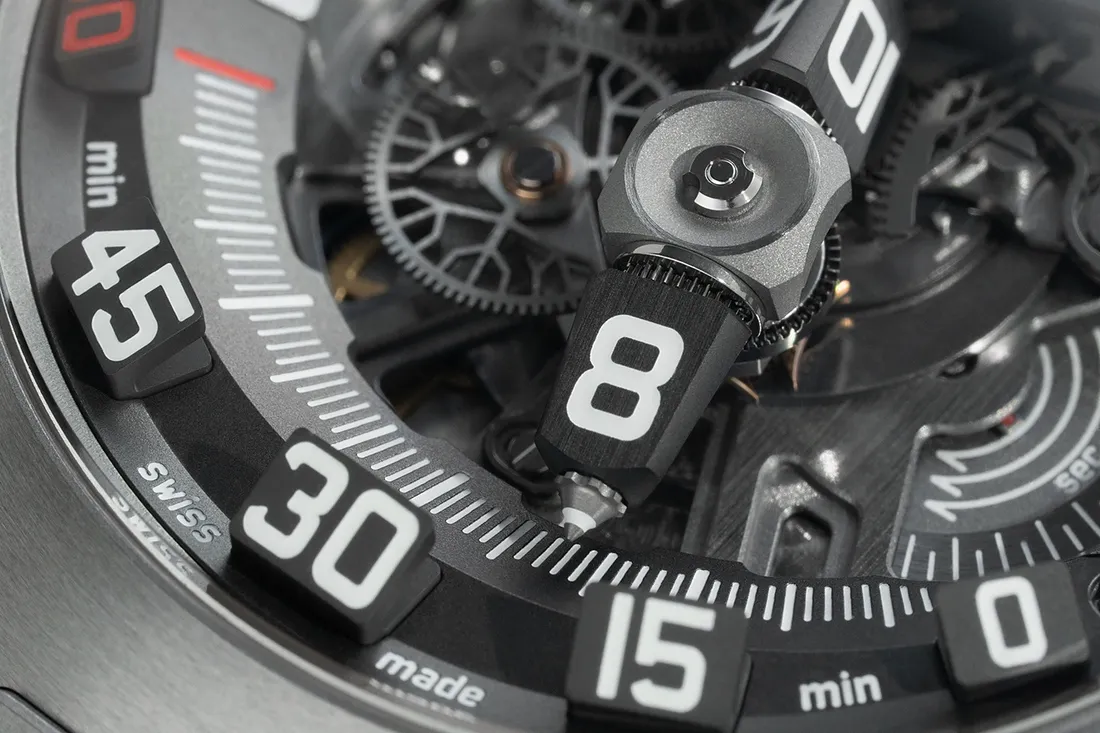
The rest of the dial is cut to the same logic. The minutes are read from zero to sixty along an arc of a hundred and eight degrees. The seconds are divided across three separate indicators, each counting twenty seconds along an arc of a hundred and twenty degrees. So the minute does not draw a circle, and neither does the second; both are cut into arcs.
On the titanium version the numerals read white. On the AlTiN version the yellow-green luminous details come into play, and in the dark the dial turns into something else entirely.
format_quote"The minute does not draw a circle, and neither does the second; both are cut into arcs."
Hasan Bekmezci
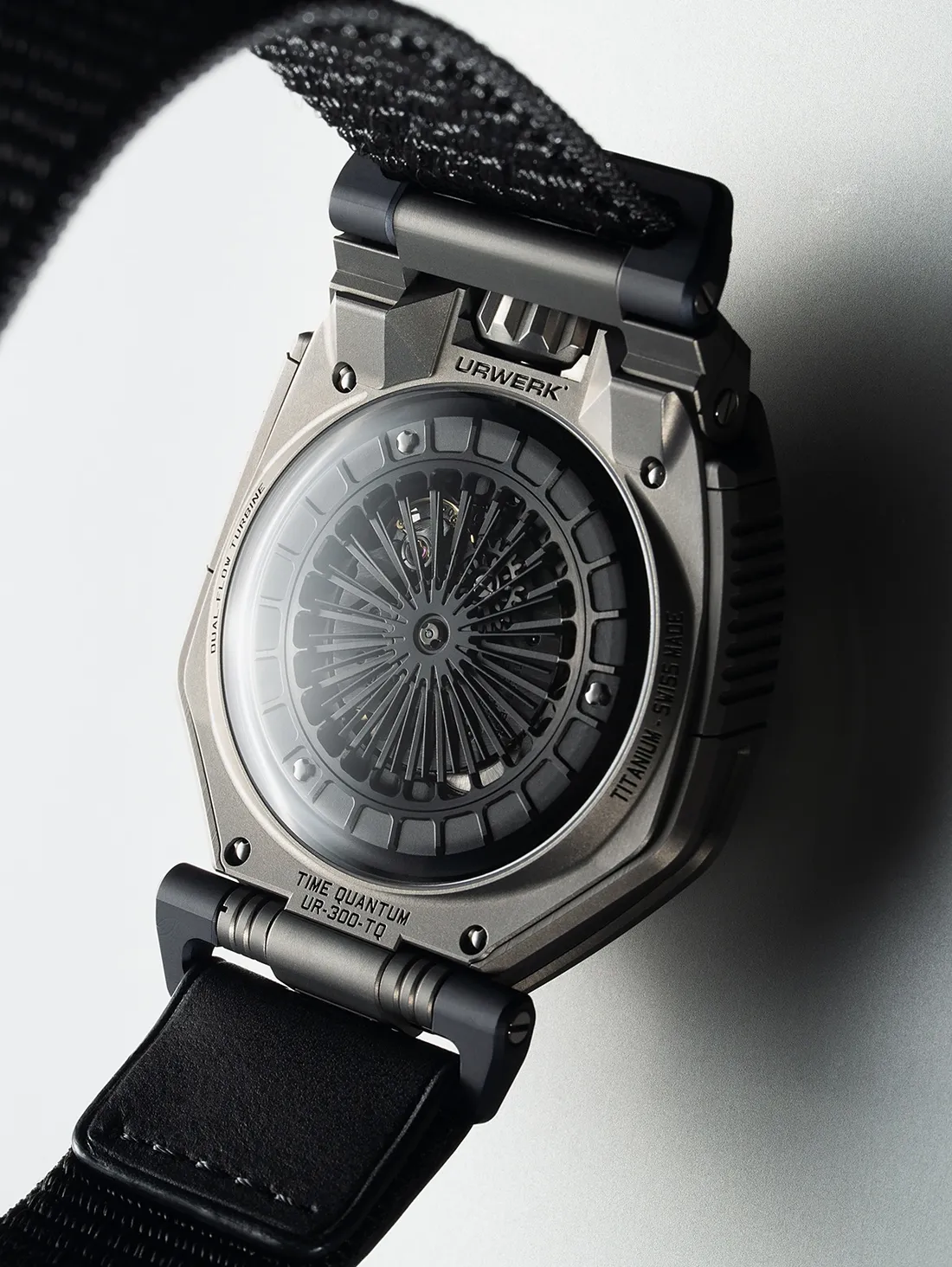
The movement is the UR-30.01, and it winds itself. Its rate is held by the house’s patented Dual Flow Turbines; it carries forty jewels, works with a Swiss lever escapement and beats four times a second, twenty eight thousand eight hundred times an hour. The power reserve is forty three hours. The echo between that figure and the forty three zeros of the Planck time is of course a coincidence, but it is not one that leaves you alone in front of the dial.
The case is satin-finished and microblasted grade 5 titanium, forty five point two millimetres by fifty eight point eight, eighteen point two five thick. Sapphire crystals with anti-reflective coating front and back, water resistant to thirty metres. The lugs are flexible, in anodised aluminium, and connect to a nylon strap. The crown has two positions, screws down, and sits inside a new protection system.
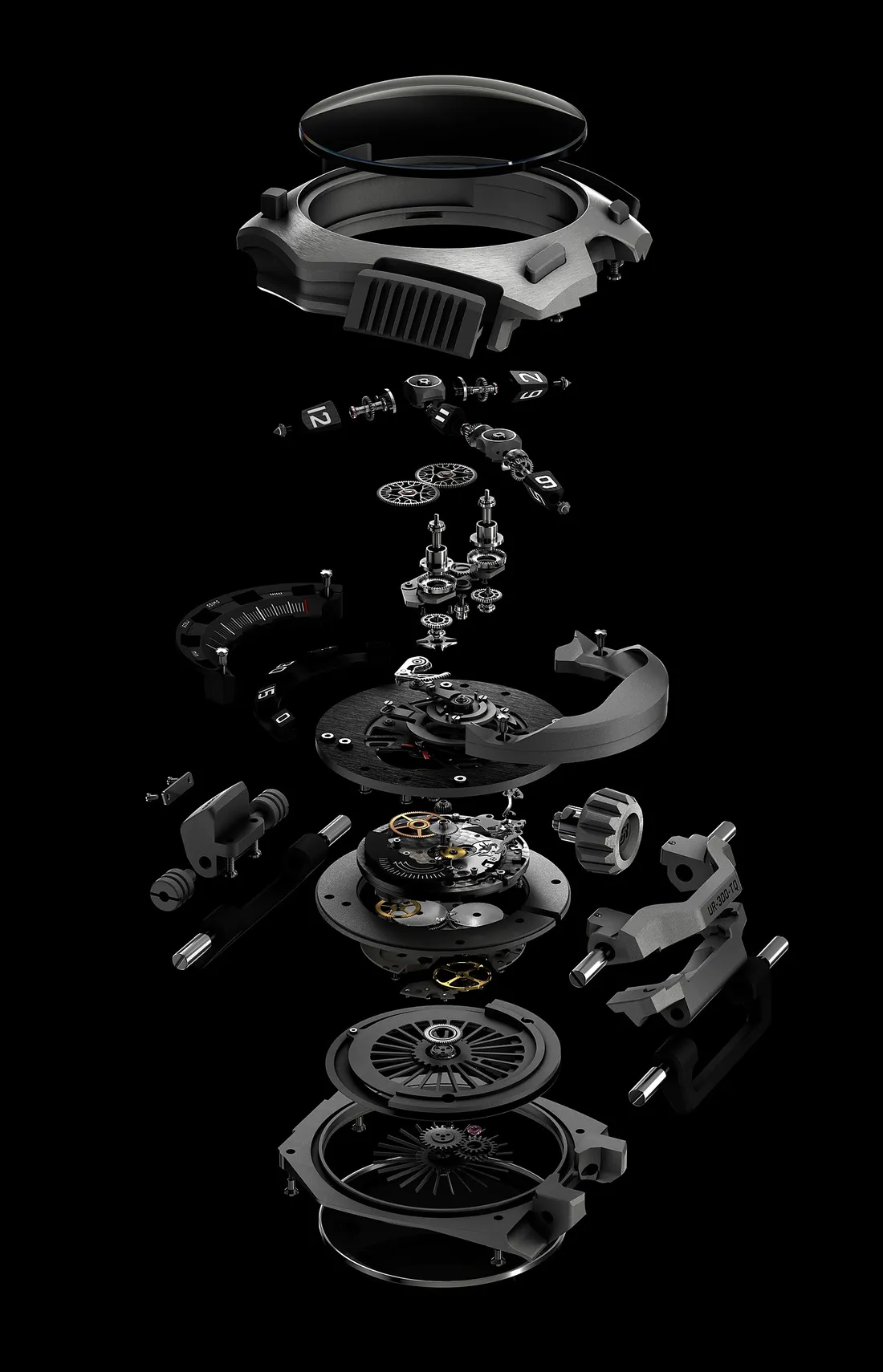
The URWERK UR-300 Time Quantum amounts to a brave manifesto that breaks the sweet circular tale we were told about time flowing.
Cleared of the movements of the planets, of astronomical indications and of circular sweeps, this dial strikes us with the fact that time is not a smooth river but a fabric that is set up again instant by instant, from the Planck wall all the way to the quantum leap.
Time does not flow; time leaps. And the URWERK UR-300 Time Quantum, which makes that leap concrete on your wrist at every hour, is an avant-garde masterpiece where craft meets quantum physics and divine order.
The watch on its maker’s own site: URWERK, UR-300 Time Quantum