In the depths of the universe, beyond human perception and beyond the sense of physical touch, an enormous silent storm is breaking at every moment. When you put your hand on a wall you do not actually touch the wall as you imagine you do; the repulsion between atoms will not allow it. And yet through this world we take to be solid and concrete, the most mysterious ghosts in the universe are streaming without pause: neutrinos.
Wolfgang Pauli, who proposed the particle in 1930, called it a neutron. When Chadwick found the real neutron in 1932 and took that name, the Italian physicist Enrico Fermi gave it the diminutive instead: neutrino, the little neutral one. It belongs to the lepton family of the standard model; its electric charge is zero, its mass is very close to zero but not zero, and its spin is one half. Like the electron, it cannot be broken into smaller building blocks.
Physics sorts neutrinos into three flavours. The electron neutrino is the commonest, released in the nuclear reactions of the Sun and in beta decays. The muon neutrino is born in the reactions of cosmic rays striking the atmosphere. The tau neutrino appears in high-energy particle accelerators and in enormous cosmic explosions.
One of the most staggering properties of these particles is the phenomenon called neutrino oscillation. A neutrino travelling through empty space can turn from one flavour into another; what sets out as an electron neutrino may arrive as a muon neutrino. That discovery proved that neutrinos have a mass different from zero, however small, and it won the 2015 Nobel Prize in Physics.
About sixty five billion solar neutrinos pass every second through an area the size of a thumbnail. As you read this line, trillions of them are going through your body, through the chair you are sitting on, through the core of the earth and through the oceans on its other side, without meeting any obstacle at all.
So what does it mean that trillions of these ghost particles pass through us at every moment, and why do they pass?
Imagine you are in the innermost room of a palace; the doors are locked, the windows bolted, the walls built of steel metres thick. You suppose you have sealed yourself off from the outside world entirely. And yet the architect of that palace is letting the scent of the great garden outside, the breath of the wind and the warmth of the sun filter in through the atomic gaps in those walls. Trillions of neutrinos flowing through our bodies every second is of that kind. The Creator placed the human being at the centre of the universe and, by pouring the energy of the nuclear storm exploding in the heart of the Sun through our existence like an invisible river, made us an unshakeable part of that vast cosmic web.
Seen another way, as a conductor sends micro-vibrations into the air to hear the rhythm of every heart in the hall, this flow is a cosmic tuning. The Kur’an teaches that creation is not an effort but a command; between the willing and the being there is no distance. The divine will, which works through chains of causes in the world of matter, spreads those instantaneous manifestations through the universe and makes neutrinos its invisible officials, messengers running at very nearly the speed of light. They are the subatomic functionaries that pass through the heart of stone, of soil, of everything living and not living.
These officials, passing without interruption through every point of our bodies and our existence, are the material counterpart of what the Kur’an teaches: that the human being is closer to the one who made them than they are to themselves. These invisible particles, which pierce even the material shell we take to be the hardest and most impassable thing there is, are the subatomic mirror of that nearness.
That billions of neutrinos a second enter and leave the most private cell of every living thing in the universe is a microphysical witness that the owner of all this keeps watch over every moment and every being.
format_quote"These invisible particles, which pierce even the material shell we take to be the hardest thing there is, are the witness that nothing goes unwatched."
Hasan Bekmezci
Light, which is to say photons, is reflected or absorbed by interacting with the electrons of a material. Protons and neutrons hold to one another through the strong nuclear force. Neutrinos never answer to the electromagnetic force or to the strong nuclear force at all. They interact with the material world only through the weak nuclear force and through gravity, which at their scale is weaker still.
And the reach of the weak nuclear force is smaller than the diameter of an atomic nucleus, of the order of a billionth of a billionth of a metre. Which is why the chance of a neutrino striking a nucleus head on is next to nothing even while crossing a block of lead trillions of kilometres thick. The transparency is not a defect; it is the definition of the particle.
A photon born of nuclear fusion in the centre of the Sun spends between ten thousand and a hundred and seventy thousand years colliding trillions of times among the dense layers of plasma before it reaches the surface. The sunlight that reaches our eyes is the delayed echo of very old reactions in the core.
An electron neutrino born in that same fusion reaction, on the other hand, leaves the Sun’s enormous mass and plasma within seconds, as though none of it were there. It crosses empty space at a speed just short of the speed of light and reaches us in eight minutes and twenty seconds. Which is why, for scientists, neutrinos are a live broadcast from the heart of the Sun. They are our key to understanding how the Sun is working right now.

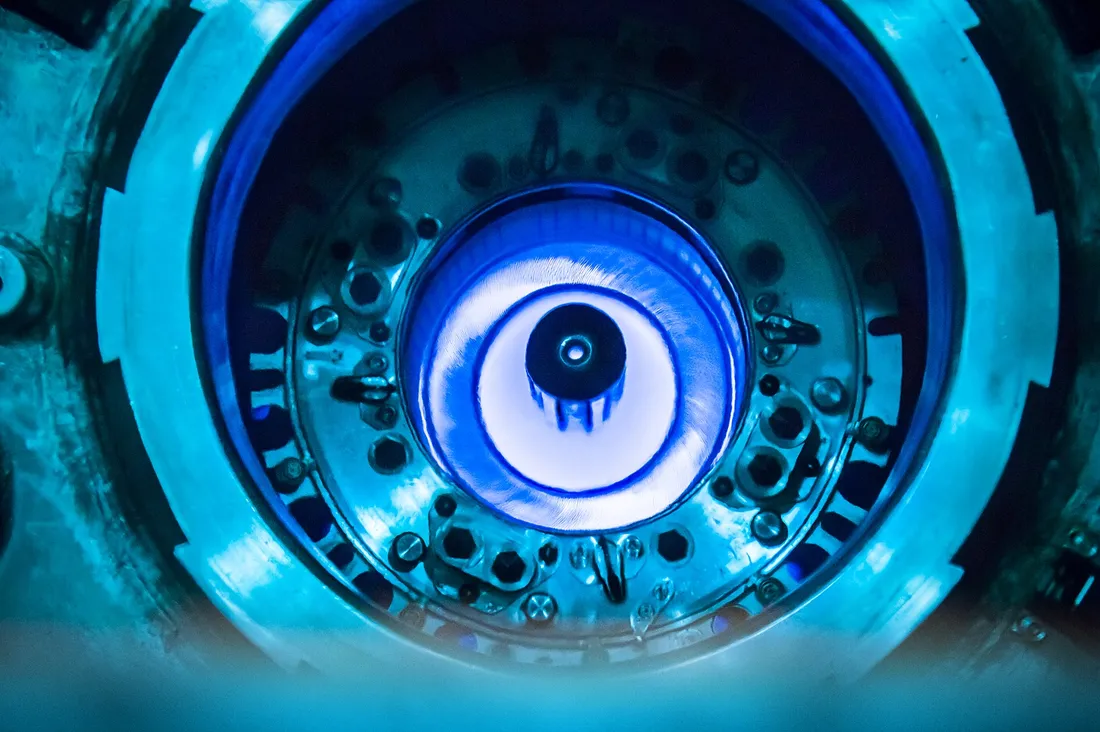
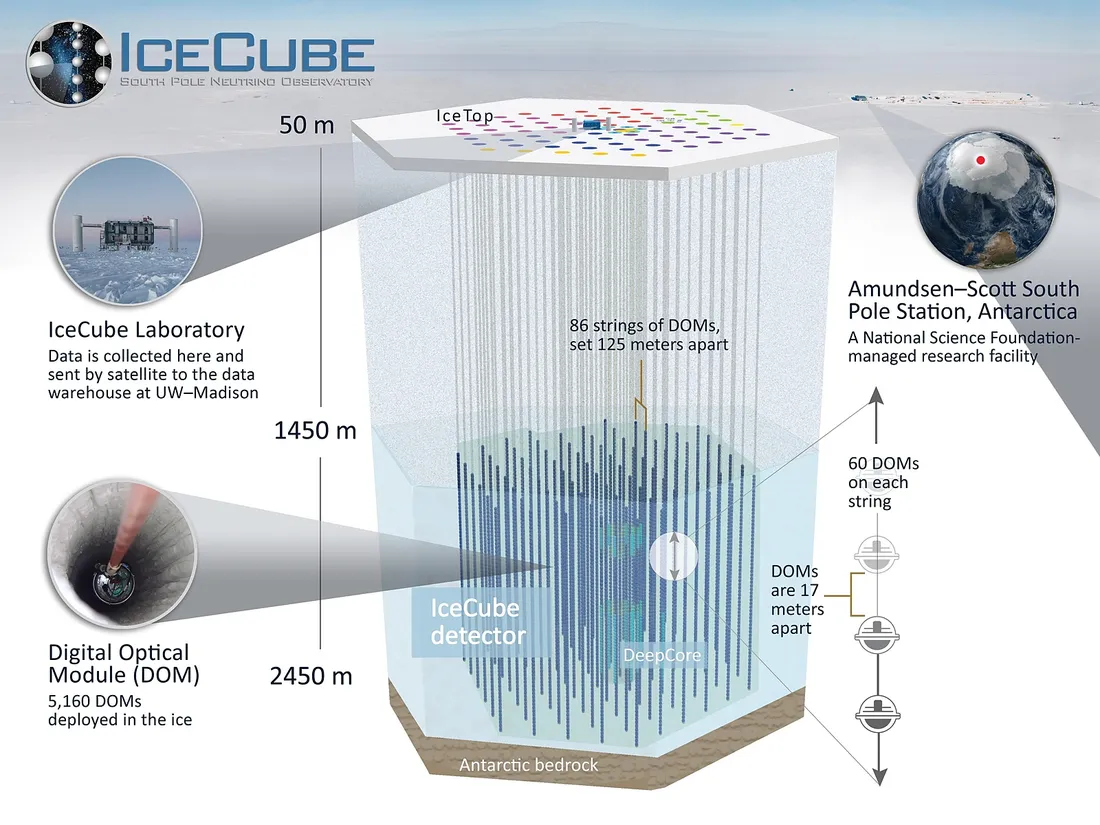
Detecting them takes enormous engineering. The IceCube Neutrino Observatory, lowered into the Antarctic ice at depths between about one and a half and two and a half kilometres, and Super-Kamiokande in Japan, use vast masses of pure water and ice to hunt for the one-in-a-billion collisions of these ghosts.
When a neutrino does, rarely, strike a neutron or a proton in a nucleus, a charged secondary particle comes out. That particle is not faster than light; nothing is. But it moves faster than light moves through that water, because light travels more slowly in water than in vacuum. Like the cone an aircraft leaves behind as it passes the sound barrier, this particle leaves a cone of light behind it: the eerie blue glimmer called Cherenkov radiation. Only by following that blue light do scientists know they have seen a neutrino.
So why is there such a particle at all? What wisdom can there be in the creation of something that barely interacts with matter, something whose presence and whose absence are indistinguishable to human senses?
Neutrinos are released as hydrogen turns into helium in the cores of stars like the Sun. Without them, the reactions governed by the weak nuclear force could not be balanced, and stars could not give out heat and light steadily for billions of years.
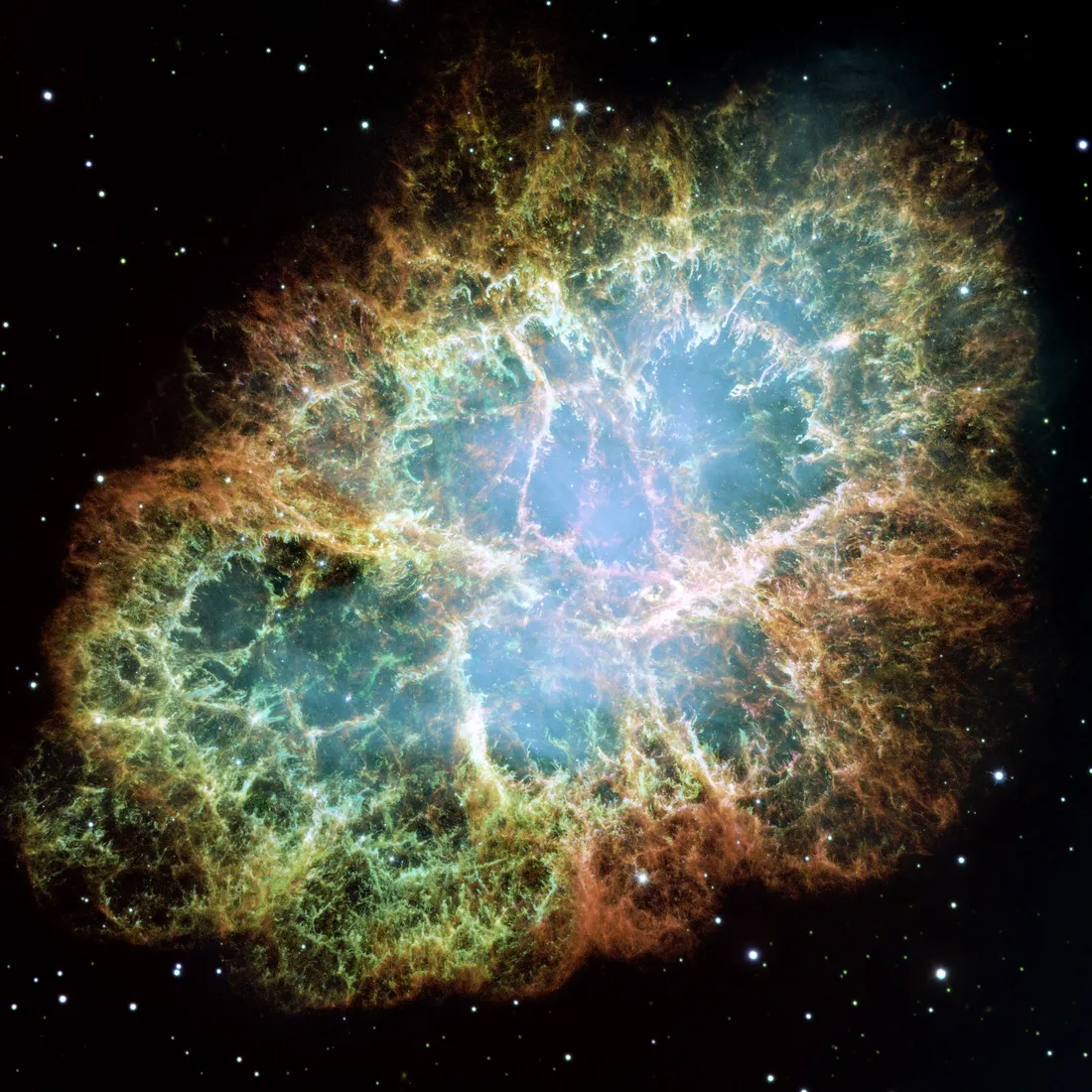
More important still is the enormous mechanism that runs while a giant star at the end of its life explodes as a supernova. When such a star has spent its fuel, its core begins to collapse under its own gravity. Protons and electrons in the core combine under extreme pressure and turn into neutrons. In that moment of transformation an unthinkable flood of neutrinos is born. The collapsing core is so dense that even neutrinos, which hardly interact with matter at all, are trapped in it for a while.
More than ninety nine per cent of the energy released in the explosion is carried out by neutrinos. Those trillions upon trillions of neutrinos, pressed into the core, build such a pressure against the star’s outer layers that the force which blows those layers into space is these invisible particles.
Imagine you have put a bomb inside an enormous steel safe. When the bomb goes off, what throws the doors of the safe outwards is not the visible fire of the blast but the invisible pressure that passes through the steel and gives the safe its last shove. This is exactly the office neutrinos hold.
Without that invisible push the star could not explode; it would fall in on itself and become a black hole. The iron cooked in the star’s core, which is to say the red cells in our blood; the calcium, which is to say our bones; the oxygen, which is to say our breath; the carbon, which is to say the structure of our cells; and the silicon, which is to say the rock we stand on, would all stay locked in the heart of that collapsing star and never scatter into space. None of the material needed for new star systems, for planets and for the human body could spread through the universe.
The neutrino is, in the full sense of the word, the hidden midwife at the elemental birth of the universe; like the midwife who brings a child in the womb into life, it is the unseen hand that delivers into space the elements of life cooked in the womb of a star.
format_quote"The neutrino is, in the full sense of the word, the hidden midwife at the elemental birth of the universe."
Hasan Bekmezci
The cosmic neutrino background, accumulated in the universe since the Big Bang, plays a vital part in the total balance of mass and energy.
Think of a cathedral; the enormous blocks of stone and the columns are what you see. But what holds that cathedral up is the micro-grains spread as mortar between the stones, which from the outside are not visible at all.
Although the mass of a single neutrino is smaller even than a millionth of an electron’s, their total number in the universe is so vast, hundreds of millions in every cubic metre, that they act as a hidden regulator in the clustering of galaxies, in the shaping of the cosmic web and in the balancing of the rate at which the universe expands. Without neutrinos, the gravitational architecture of the universe and the galactic fabric could not have been built to this fineness.
The human being takes the enormous concrete buildings, the steel armour and the shelters of their own making to be impassable, solid and unshakeable. They take their own body and the material world to be the only reality in the universe. And yet trillions of particles a second slip through the most solid and hardest matter there is as a hair is drawn out of butter.
From which this thought arises: the world of matter we see as solid and unshakeable is in fact as thin as a permeable curtain. The forces we cannot touch with our senses and cannot see are far more dominant, far more encompassing and far more effective than visible matter. The neutrino is a document for contemplation, one that makes us think that nothing in this estate is superfluous, and that the wheels of the universe are tied to one another with invisible threads even when no human eye sees them and no human hand holds them.
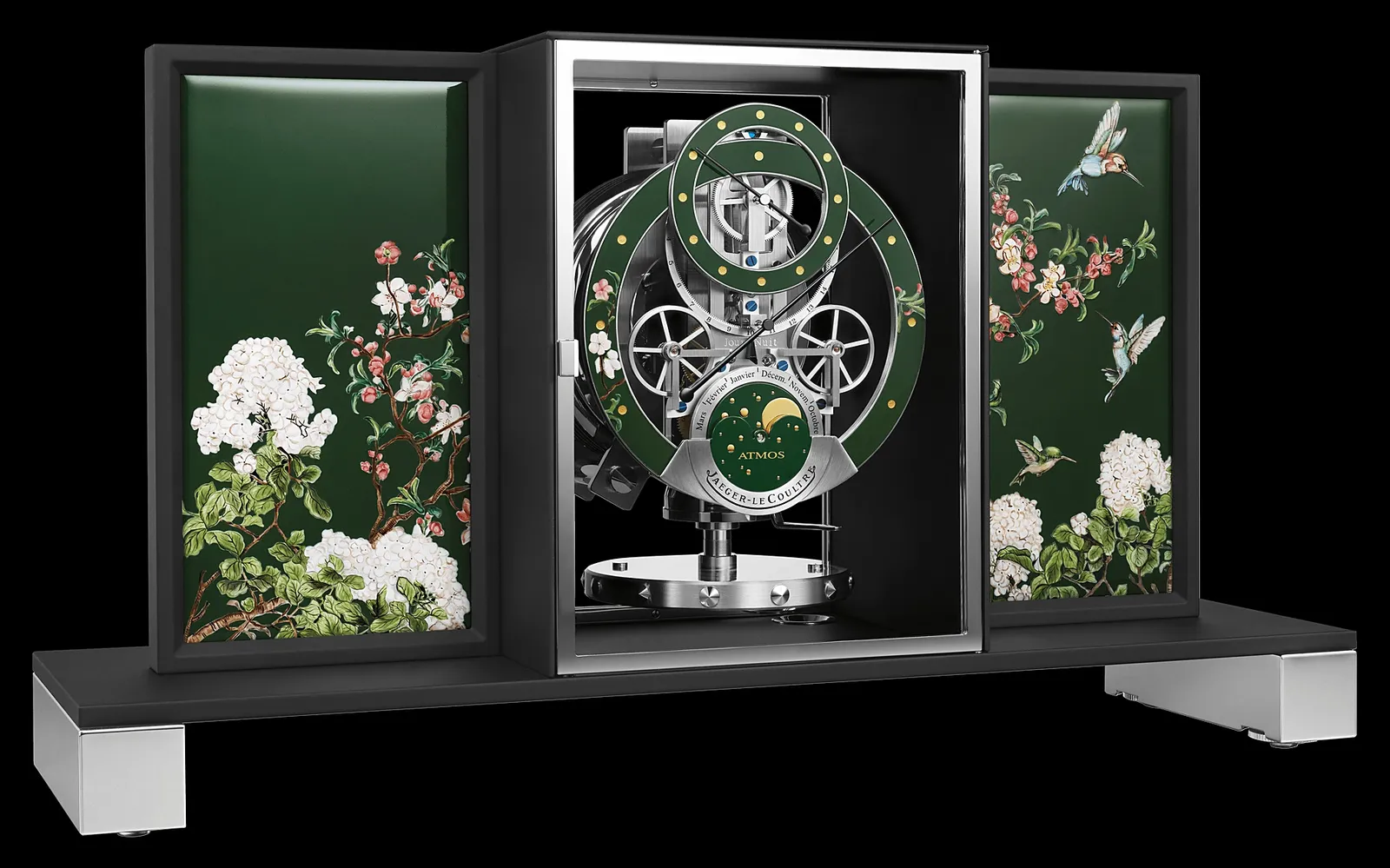
That neutrinos cross the universe in an invisible and silent flow, barely touching matter at all, coincides exactly with the philosophical core of the Jaeger-LeCoultre Atmos, the most stubborn engineering dream in the history of watchmaking.
The Atmos is a masterpiece that needs no winding lever, no battery, no electricity and no external source of energy, running on nothing but micro-variations in the temperature around it. The newest interpretation of it is the Atmos Régulateur Enamel Colibris, shown in Milan in April 2026 and made in only three pieces.
Entering the minds of the watchmakers at Le Sentier, one meets a discipline of thermodynamics. They had asked themselves this question: can a mechanism be made efficient enough to be wound by the breath of the air itself, with no need of a human touch, a battery or even a mainspring barrel one has to turn?
The answer is hidden in a hermetically sealed gas capsule behind the mechanism. The historic filling of that capsule is ethyl chloride, a fluid with an unusually sensitive expansion and contraction across the small fluctuations of room temperature, and able to run that thermal cycle for years without chemical wear. When the ambient temperature rises by a degree or two the gas expands and pushes the capsule out like the bellows of an accordion; when the temperature falls, it contracts and draws it back in.
That breathing of the capsule is what winds the mainspring. A change of a single degree gives the clock about forty eight hours of running. The breath of a room that warms by day and cools a little by night becomes an unbroken spring of life for the clock.
Its consumption is so small that by the Maison’s own reckoning sixty million Atmos clocks would use the energy of a single fifteen watt bulb. To reach that, the watchmakers all but abolished friction. Where the balance of an ordinary wristwatch vibrates twenty eight thousand eight hundred times an hour, the Atmos vibrates a hundred and twenty times an hour, two hundred and forty times more slowly. Like the invisible neutrinos of the universe, the Atmos too comes quietly to life fed by air and by unseen thermal energy.
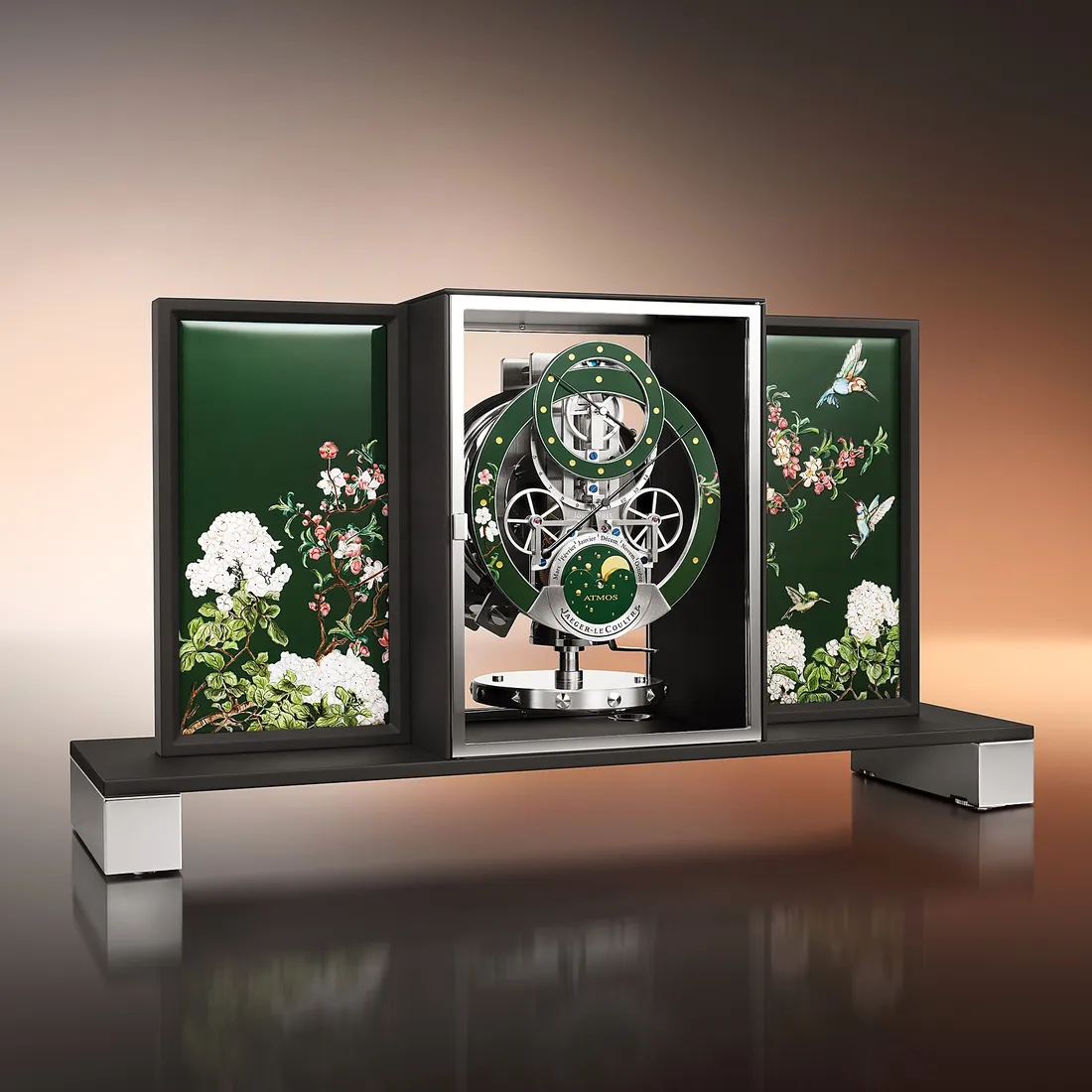
At the heart of the clock beats the Jaeger-LeCoultre calibre 582, conceived and produced entirely in the Atmos atelier. It has three hundred and eighty six components and thirty jewels.
The display is a regulator; in this layout, used historically in precision astronomical reference clocks, hours and minutes are read on separate dials, because two hands turning on the same centre hide one another. The architecture rises in concentric rings: a suspended twenty four hour disc is held in a pyramid layout by three open-worked guide rollers. Day and night are read on the disc, and the names of the months, in French, on the band around it.
The moon phase indication completes the lower part of the dial. Traditional moon phase mechanisms drift by about a day every two and a half years. The watchmakers of Jaeger-LeCoultre set this astronomical gear ratio to a mathematics so fine that this indication needs three thousand eight hundred and twenty one years to accumulate an error of one day. A precision that outlasts a human life and whole ages of civilisation is a salute to the unfailing rhythm of the universe.
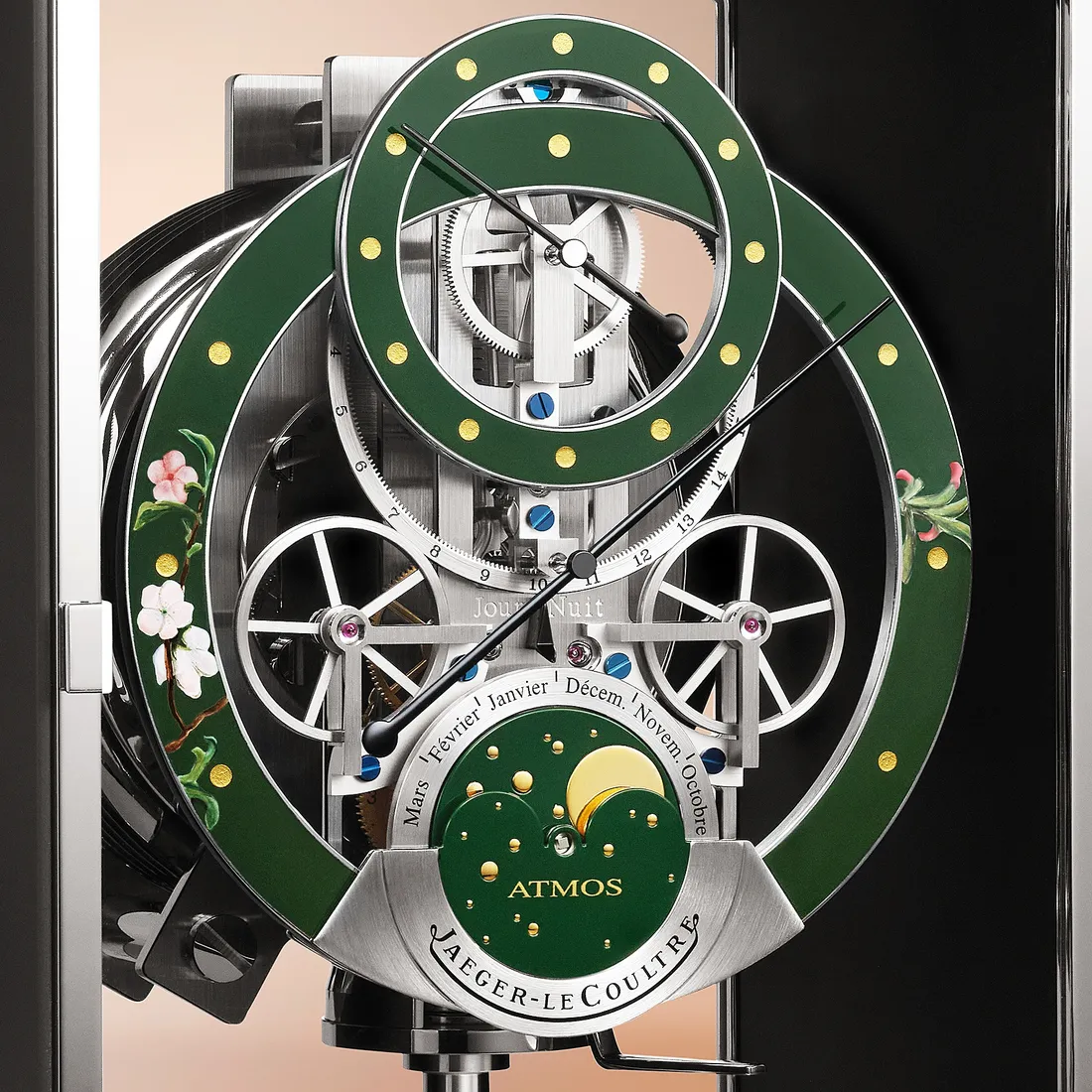
As for the panels: each measures a hundred and ninety six millimetres by a hundred and five point two, worked on a steel base. Steel was chosen because the plate would have to go in and out of kilns above eight hundred degrees many times over.
First a counter-enamel layer is laid on the back. Without it, the dark green coats accumulating on the front would warp and crack the plate by their own tension. Then, by the dry enamelling technique, powdered pigment is sifted onto the plate, and the process is repeated until the depth of colour is even. On a flat, wide surface a single shift of tone finishes the whole scene.
Fifteen layers for the dial and fifteen for each of the two panels; forty five firings in all. Each firing demands perfect cooling and flattening afterwards. This decoration alone took two hundred and thirty hours.
The hour and minute markers are made by the paillonné technique: twenty four carat gold leaf is cut into minute fragments, each one set exactly in place and sealed beneath layers of translucent enamel. The gold has to be buried inside the enamel without losing its brilliance; one degree too much heat puts it out.


The hummingbirds on the doors are not only a visual feast; they are a deep tie to the inner mechanics of the clock.
Hummingbirds are delicate creatures that beat their wings, depending on the species, fifty to eighty times a second, vibrating without pause at an unbelievable frequency. It is that high-frequency beat of the wings that lets the bird hang at a single point in the air. The small body standing motionless before a flower is in fact doing the most exhausting work in the world.
That dizzying, ceaseless vibration in a hummingbird’s wings recalls the state the mevlevi dervishes enter during the sema, and the turning of the subatomic world of the universe. Just as the bird hangs in the air in absolute surrender while it beats its wings, the Atmos, with that slow and reverent oscillation a hundred and twenty times an hour, draws a ring of its own in the middle of time. The trembling joy of the hummingbird and the stillness of the mechanism are two different frequencies of the same hidden remembrance in the world of being.
The iridescent greens and reds in the wings of the birds on the doors were got by laying powdered enamel coat upon coat under a microscope and firing it in kilns above eight hundred degrees. And here is the strange part: the colour in a real hummingbird’s feather is not a pigment either. Those feathers make the colour by refracting light layer by layer. Which is to say that the enameller, without knowing it, has copied the feather’s own method; both of them make colour by counting layers.

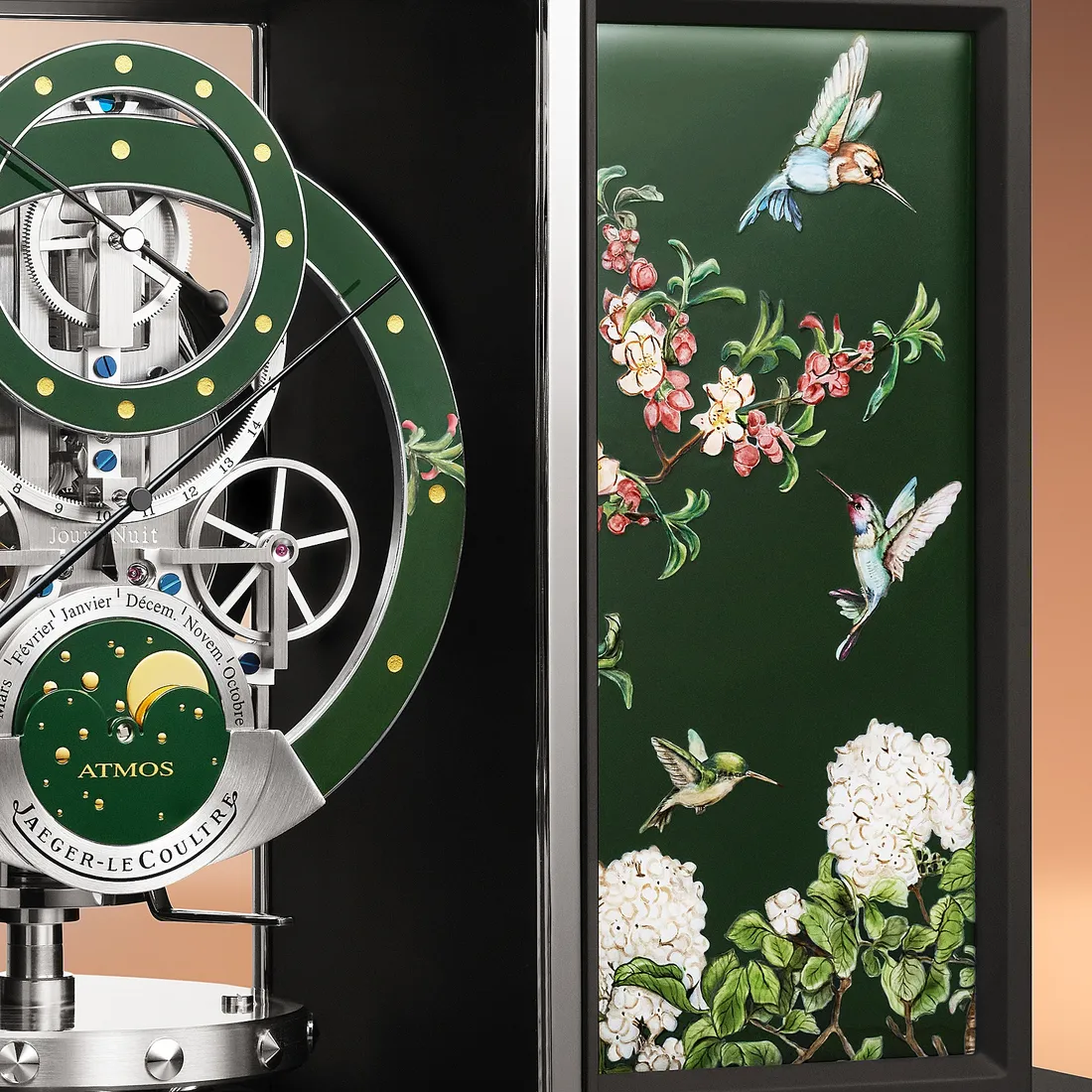

Looking at the Jaeger-LeCoultre Atmos Régulateur Enamel Colibris, we find on one common ground the invisible flow of the neutrinos that slip silently out of the depths of the universe and out of exploding stars, the unerring astronomical mind good for three thousand eight hundred and twenty one years, and this mechanical genius that breathes and winds itself on one degree of change in the air of the room.
format_quote"The trembling joy of the hummingbird and the stillness of the mechanism are two different frequencies of the same hidden remembrance."
Hasan Bekmezci
The clock on its maker’s own site: Jaeger-LeCoultre, Atmos Régulateur Enamel Colibris, Ref. Q5604305