Imagine an ancient astronomer looking into the absolute silence of the midnight sky, closing his eyes and dreaming the invisible gearing of the universe. For that astronomer the universe was not a heap of matter flung together by chance but an immense divine mechanism behind which an endless wisdom, a measure and a Power worked away, tick by tick. The Creator set up an order of five enormous phenomena, not so that we would merely watch the sky, but so that we would read the fine engineering, the philosophy and His own majesty behind it.

The first is gravitational time dilation. Without gravity the stars and the planets would scatter away into empty space. That time should stretch and bend with gravity is the dynamic balance of the universe; by slowing time around black holes it prevents the universe from collapsing out of control. With this law the Creator strikes a blow at human pride: time is not an absolute and independent god; it is a perishable created thing that bows to the mass He Himself made, and that can stretch and bend.
Think of time as a smooth run of marbles across a stretched trampoline. Put a vast heavy cannonball in the middle of it and the fabric of the trampoline forms a deep well downwards. The marbles, which is to say light and time, take a longer path around that well and their steps slow. Beside immense masses time comes nearly to the point of freezing.
format_quote"Time is not an absolute and independent god; it is a perishable created thing that can stretch and bend."
Hasan Bekmezci
The second is entropy and the arrow of time. Without the tendency of disorder to increase there could be no movement, no chemical reaction and no life in the universe. That stars give off heat, that cells make energy, that water runs, all of it comes from the desire of energy to spread from the higher to the lower. With this law the Creator set the seal of the perishable on the world; nothing stays the same, everything ages, disperses and makes room for the next. Eternity is not in this world but in the next.
Imagine a drop of milk let fall into a cup of hot coffee. In the first instant the milk has a definite shape in the coffee. But within seconds it mixes, disperses, and the whole cup takes one colour. Nobody has ever seen that milk gather itself and become a single drop again. The arrow of time is the direction in which that milk spreads through the coffee; there is no going back.
The third is the neutron stars, the pulsars. These extraordinarily dense bodies, formed by the collapse of enormous stars, turn hundreds of times a second and flash radiation into space at a flawless frequency. They are vast cosmic lighthouses, the unwavering survey points of space, there so that deep space journeys do not lose their way. Out of immense chaos and explosion the Creator draws a rhythm that does not waver to within a millionth of a second, displaying His names the All-Knowing and the All-Wise, and showing that even in the greatest masses there is an absolute measure.
Imagine an enormous steel ball the size of a city, but weighing more than the sun. This vast mass turns about itself like a drill bit hundreds of times a second, and with every turn it flashes light into space like a lighthouse. Even the atomic clocks on earth bow in respect before the rhythmic steadiness of these cosmic clocks.
The fourth is the event horizon. That boundary around a black hole is the last line at which gravity imprisons even light. It takes the swallowing power of the black hole inside a cosmic frame and so protects the order of the universe outside it, and life. The event horizon is the line the Creator has set before the human mind: this far you may see, beyond it is My unseen. It reminds a person of their helplessness and that their understanding has a limit.
Imagine a boatman rowing at the edge of an immense waterfall. The current of the water quickens as it nears the line where the fall begins. There is a line such that, the instant you cross it, the speed of the current exceeds your maximum speed of rowing. However hard you try, you can no longer come back; even light is buried in darkness past that line.
format_quote"The event horizon reminds a person of their helplessness and that their understanding has a limit."
Hasan Bekmezci
The fifth is the supernova explosions. At the instant of the great explosion there were only the lightest gases. Had the giant stars that reach the end of their lives not burst as supernovae, neither the iron in our blood, nor the calcium in our bones, nor the gold in the ground could have formed. Supernovae are the alchemical furnaces of the universe. Here the Creator shows the miracle of drawing life out of death; the magnificent death of one star makes the raw material of billions of new planets and of life. We are, in the fullest sense of the word, stardust.
We can liken a giant star to a closed furnace holding nothing but simple raw materials. When the star reaches the end of its life and bursts with an enormous noise, the pressure and the heat inside that furnace reach billions of degrees. This cosmic furnace melts worthless gases and turns them into heavy elements like gold, platinum, iron and diamond, and scatters them across the whole universe like a blessing.
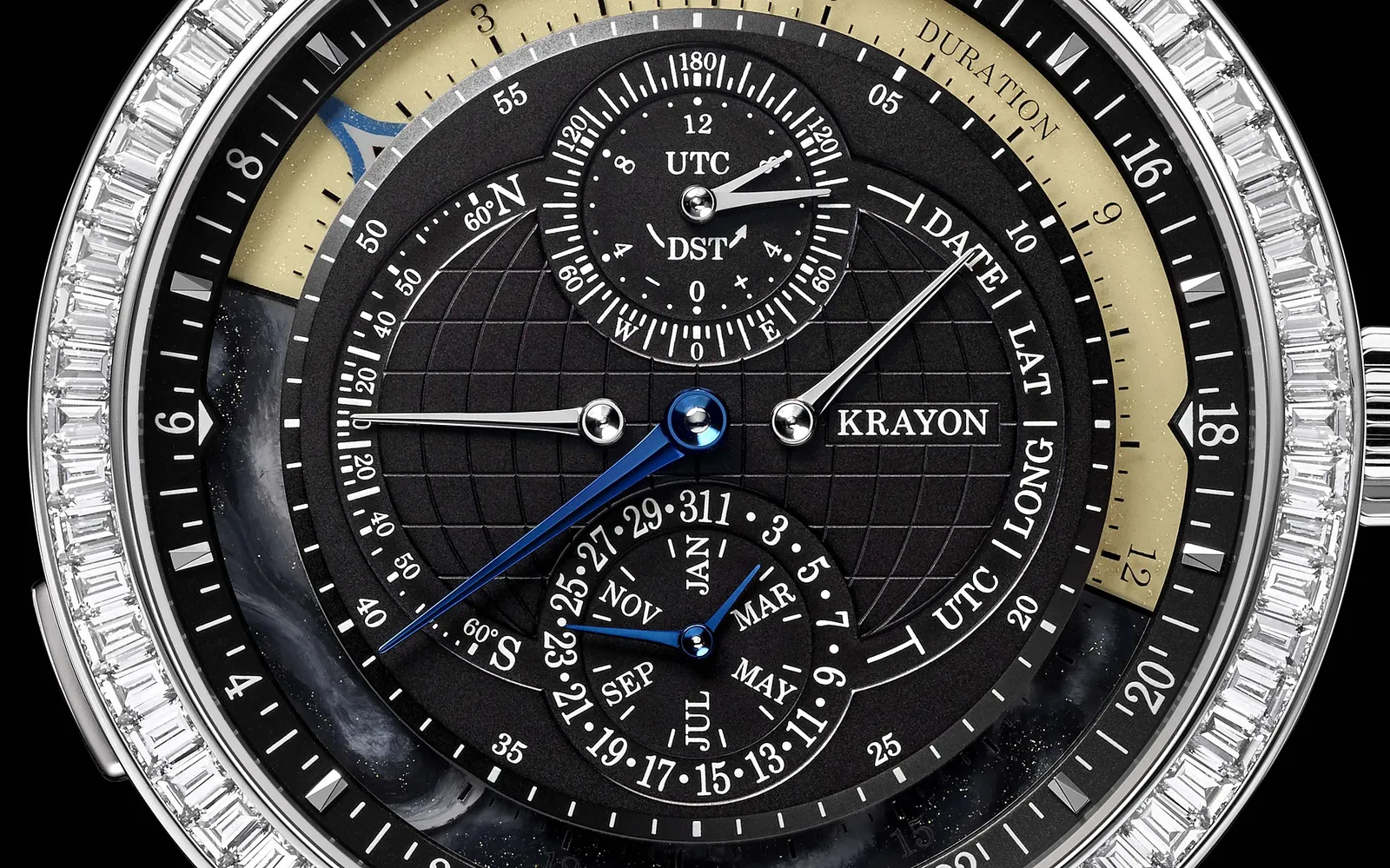
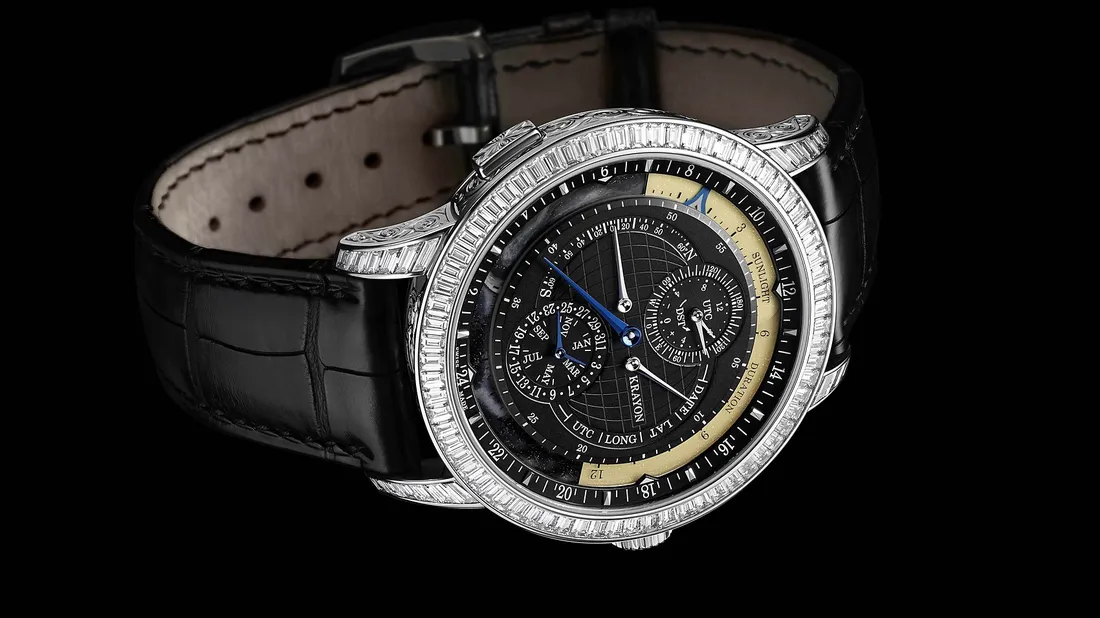
All these divine wisdoms, analogies and cosmic laws that the ancient astronomer dreamed turn, in the hands of the Swiss watchmaker Rémi Maillat, into a mechanical work of art. The Krayon Everywhere Horizon is a single piece, made after the maison’s first Everywhere and built through conversation with its owner, and it took the innovation prize at the GPHG. The Universal Sunrise Sunset calibre inside it is the first and only mechanism to calculate, mechanically, the times of sunrise and sunset at any point on earth; it is built of five hundred and ninety five components, winds itself and beats three times a second.
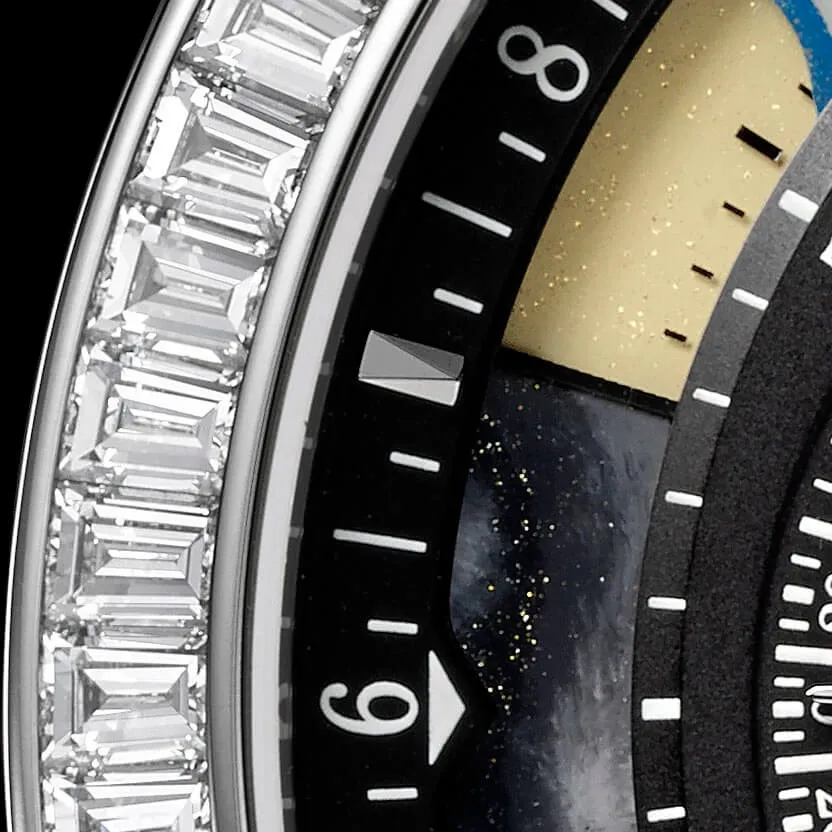
The trace of bending time on the dial is the curved surface that surrounds the case and the baguette diamonds set by hand along it; the curved twenty four hour scale on the dial keeps alive on the wrist the fact that time is not a straight ruler but a supple fabric that bends in the presence of gravity. The irreversible door of entropy is the turning day and night disc on the dial. That fine line between the blue of the night and the yellow of the day recalls, like the drop of milk that mixes into the coffee, the one-way flow of time that does not rewind, and that every second that passes is an irreversible mark left in the universe.

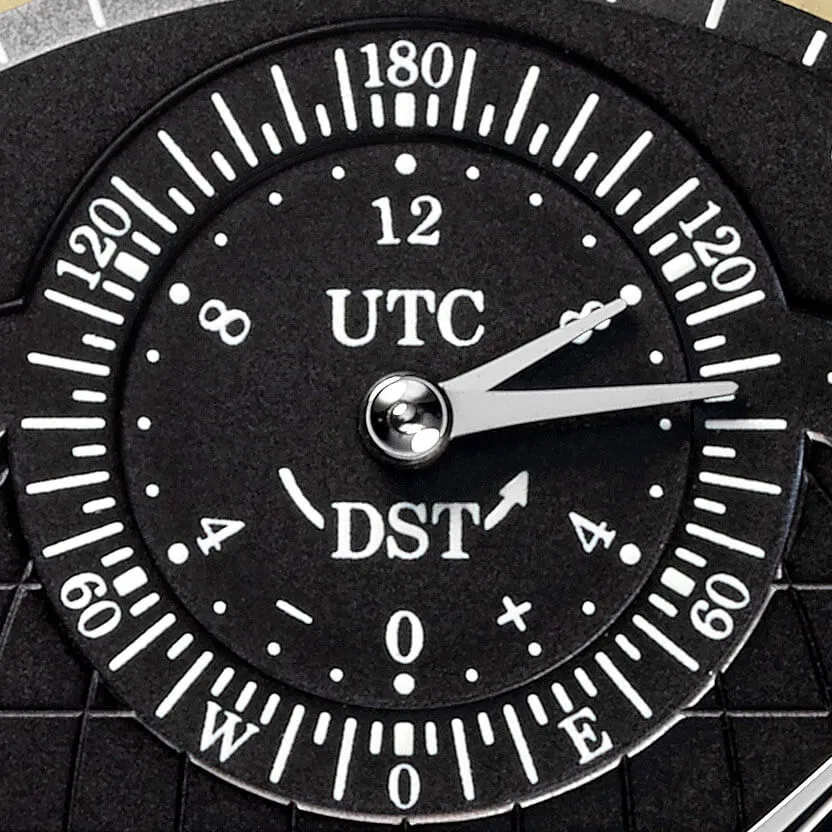
What answers to the precision of a pulsar is the set of parameters given to the mechanism itself. The wearer enters the latitude and longitude of the place they stand in, the offset of their time zone from UTC, the date and the month; the train of wheels combines those five inputs and computes the times of sunrise and sunset at that point. The latitude can be set between sixty degrees north and sixty degrees south, because beyond those limits there is not a sunrise and a sunset every day through the year. The time zone is entered in half-hour steps, which is necessary for countries on half zones such as India. When daylight saving begins, the arrow on the dial is followed to make the one hour correction. All of these settings are made through the single crown, over whichever function the selector on the dial is showing.
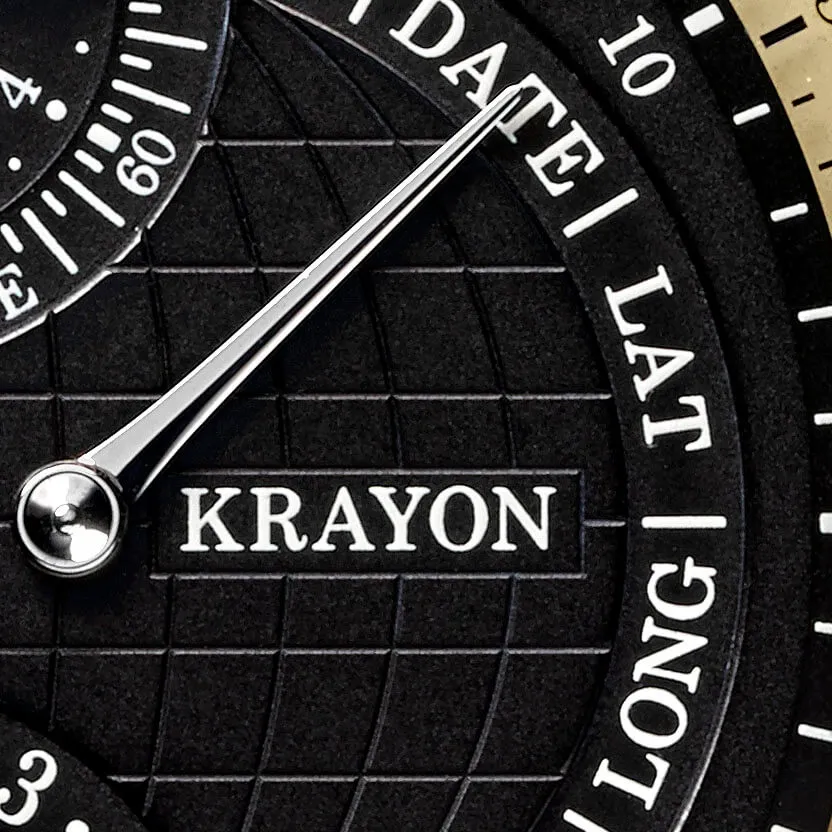
What answers to the event horizon on the dial is the line of horizon that gives the watch its name. The moment the symbol of the sun crosses the line dividing night from day it disappears from view; the light gives its place to the keeping of the night. And the inheritance of the supernovae is in the very matter of the watch: every heavy atom that makes up the case, the worked texture of the dial and the diamonds was cooked in the cosmic furnaces of those ancient giant stars that burst billions of years ago. The master, working this stardust he holds in his hands, carries to the human wrist the art of the Creator as it shows itself in matter.
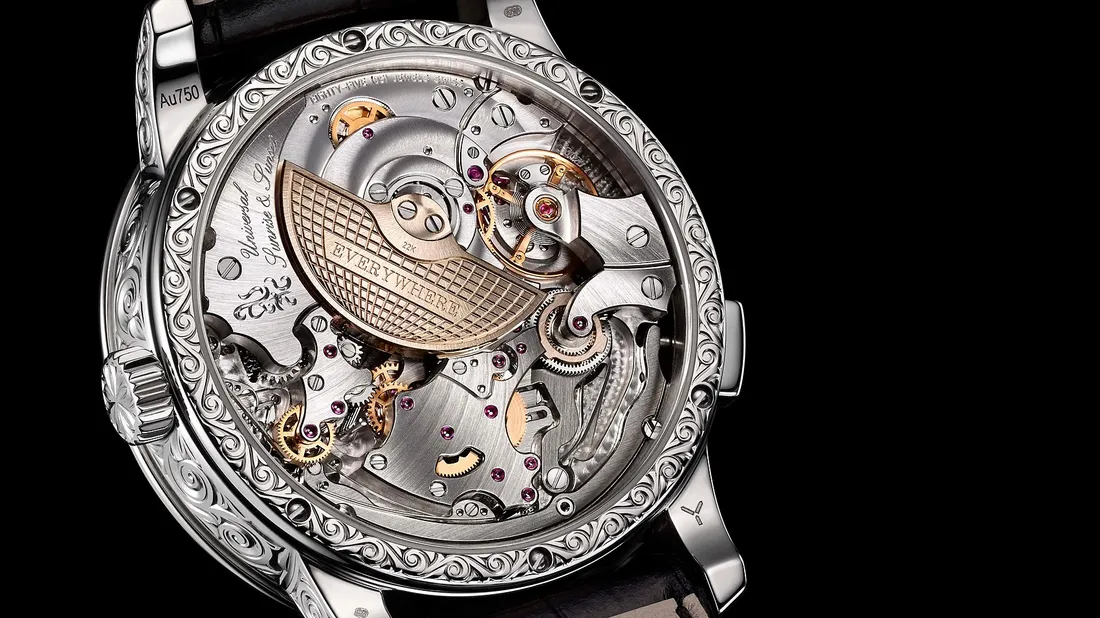

The Krayon Everywhere Horizon is not merely an instrument on your wrist that shows the time; it is a mechanical salute offered by human intelligence to that divine intellect, computing onto a single line of horizon the five enormous wisdoms, the philosophy and the mathematical order that the Creator placed in the universe.
format_quote"A mechanical salute offered by human intelligence to that divine intellect."
Hasan Bekmezci
The watch on its maker’s own site: Krayon, Everywhere Horizon