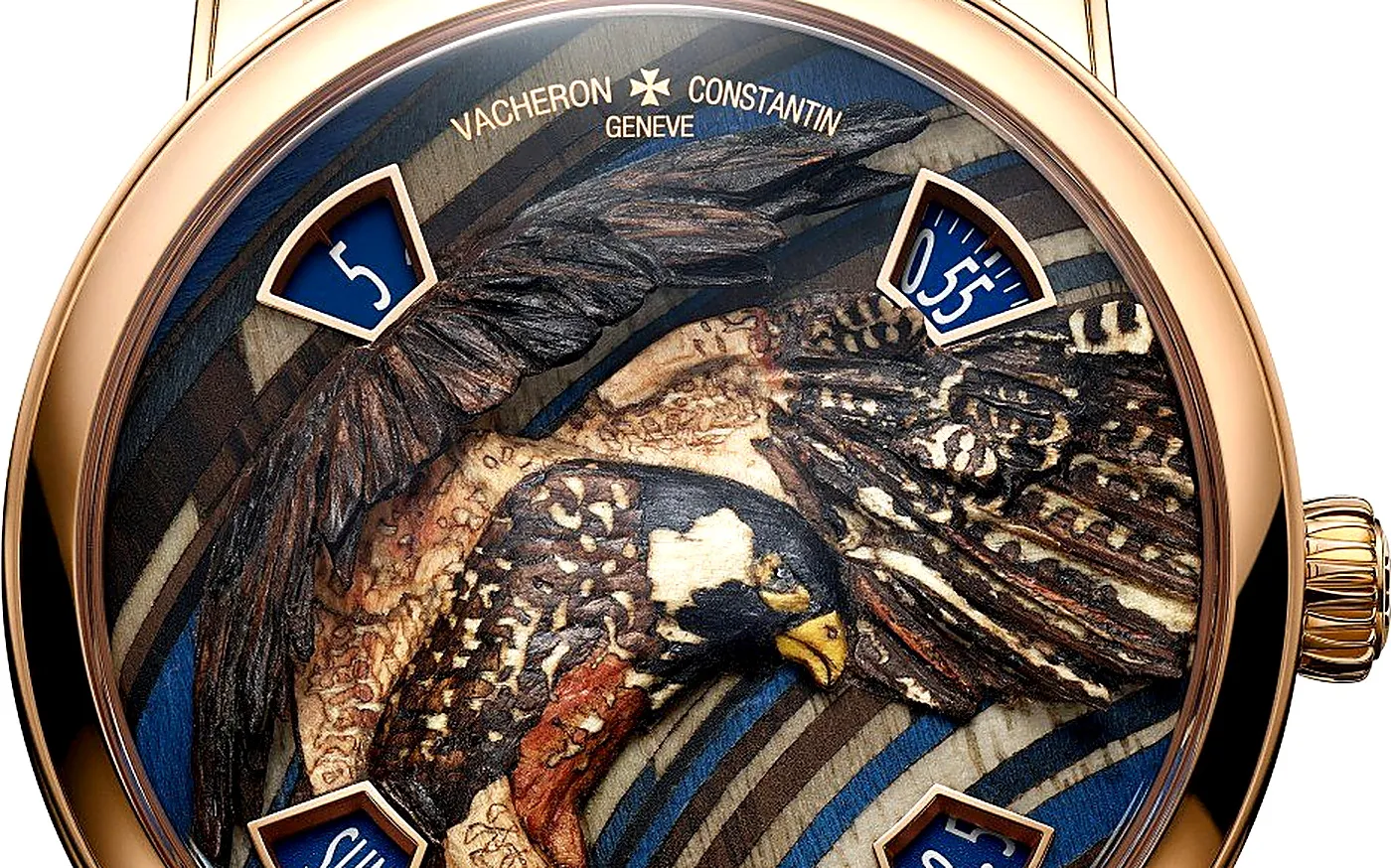
I was on a bare summit just above the clouds, where the rock ends and the sky begins. I was watching the air rise off the sea of mist filling the valley when the silhouette of the sky’s real owner appeared: a falcon.
In that effortless glide, which seemed to argue with gravity, there was no hesitation and not one wasted movement of a feather. It worked the huge masses of air thrown up by the storm with its wingtips, the way a sail does, measuring the sky with invisible rulers.
Then it stopped. It hung in the middle of the wind, fixed in place like a statue. In the brief moment our eyes met I saw absolute concentration and an unshakeable will. It was not simply a bird in flight; it was an engineering decision drawn on the canvas of the sky.
Relative to the size of its head, its eyes are among the largest visual organs in the animal world. It sees into the ultraviolet, which is closed to us. Thanks to a double fovea in each retina it can magnify the smallest detail a thousand metres below like a telescope while simultaneously scanning a wide panorama. A human eye processes something like sixty frames a second; a falcon resolves more than twice that, which means a movement we perceive as fluid arrives to it as separate instants.
In the stoop, past three hundred kilometres an hour, cone-shaped structures in its nostrils break the pressure of the air forced into its lungs. That detail is what inspired the cone in the air intake of the modern jet engine. With hollow but honeycombed bones, feathers that cut air like a blade and a wing geometry that reduces drag to almost nothing, this animal was not built to move through the sky. It was built to belong to it.
The falcon’s place in the ecosystem follows from the same precision. Apex predators do not take their prey at random; they go for the sick, the weak and the old. That preference limits the spread of disease through a population and keeps the gene pool strong. By holding down numbers of rodents and small vertebrates they protect farmland and the floor of the forest from being stripped.
And there is this: a bird of prey is a health report on a region. When an ecosystem starts to fail they are the first to disappear, because they sit at the top of the chain and every loss below them accumulates upwards. Their presence certifies that a place is well. Their absence is the first sign of a collapse nobody can see yet.
format_quote"A bird of prey is a health report on a region. Its absence is the first sign of a collapse nobody can see yet."
Hasan Bekmezci
That silhouette came down to the scale of a dial in Geneva in the summer of 2026. Vacheron Constantin announced a set of six pieces under the title Métiers d’Art Tribute to the Animal Kingdom, all of them out of the house’s One of Not Many Crafts Programme, which pairs a craftsperson from outside watchmaking with the watchmakers of Geneva and forces their technique to fit inside forty-two millimetres for the first time.
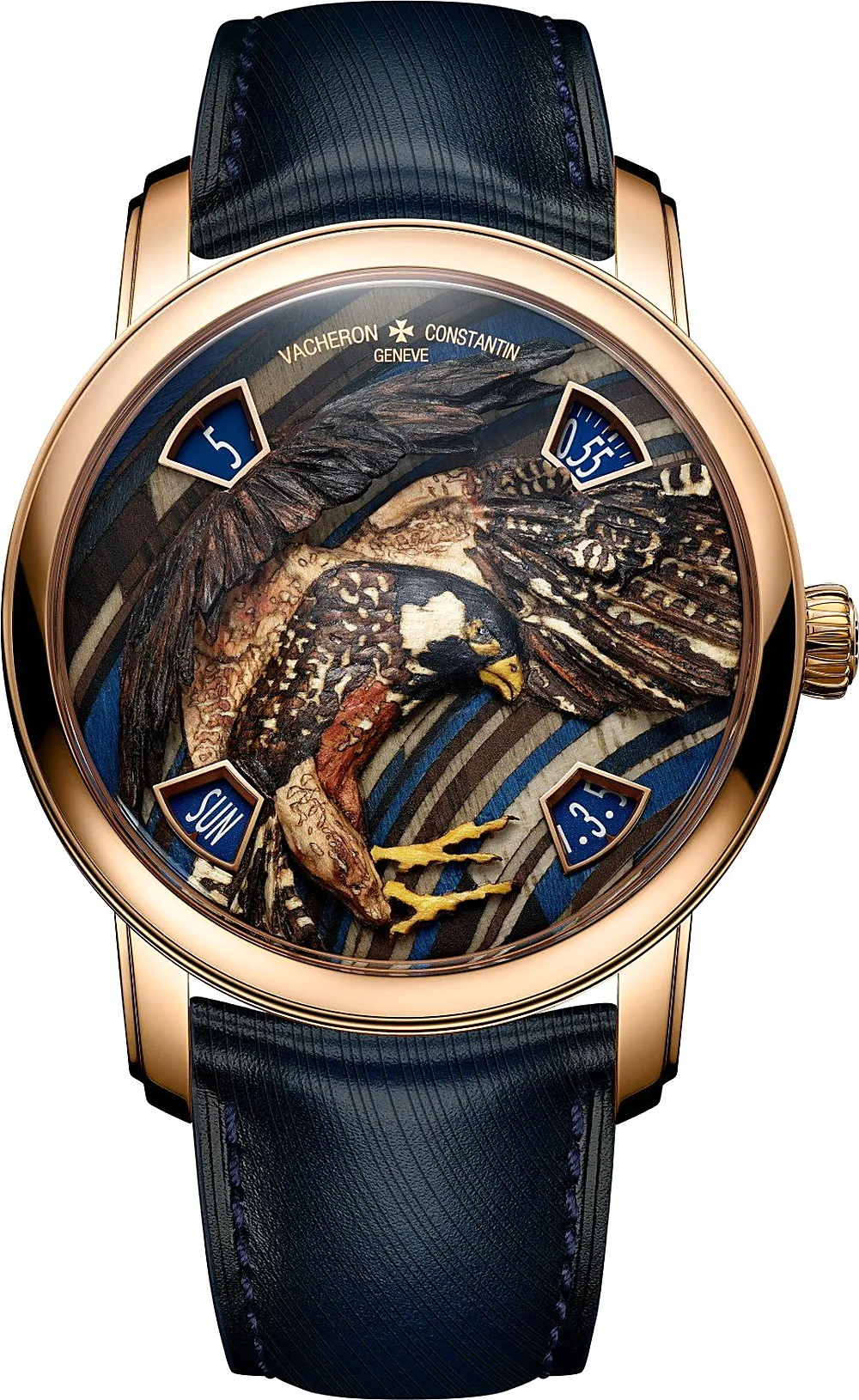
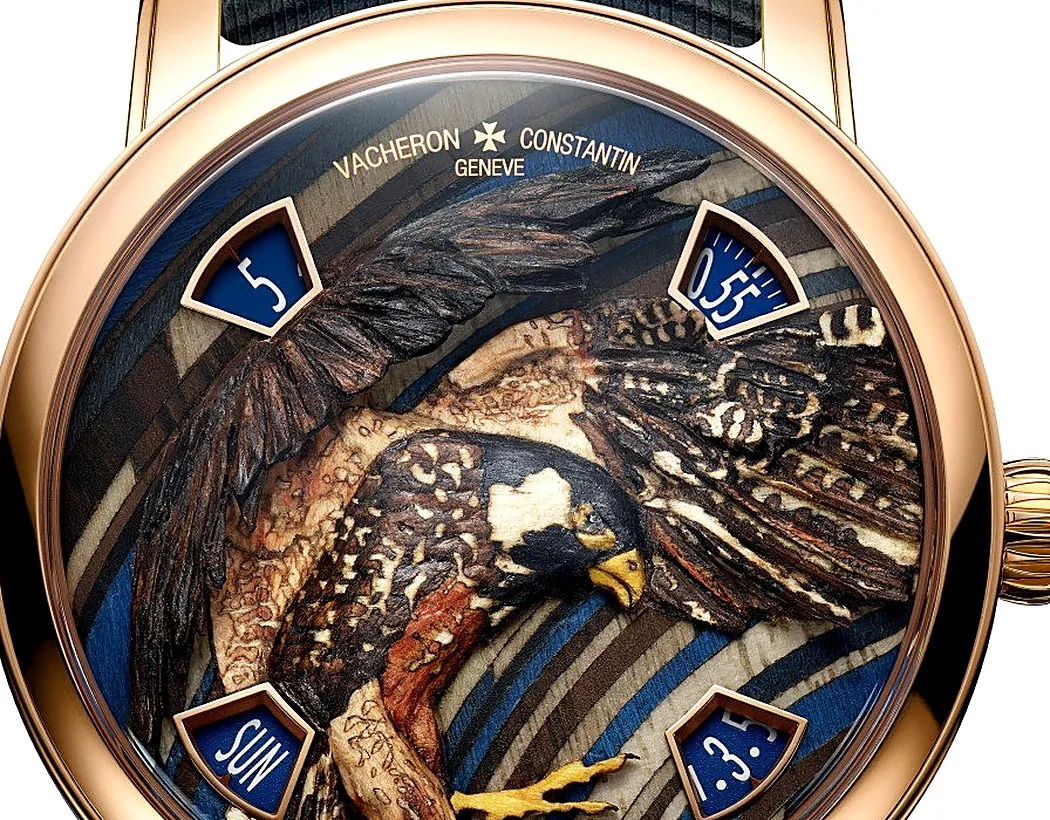
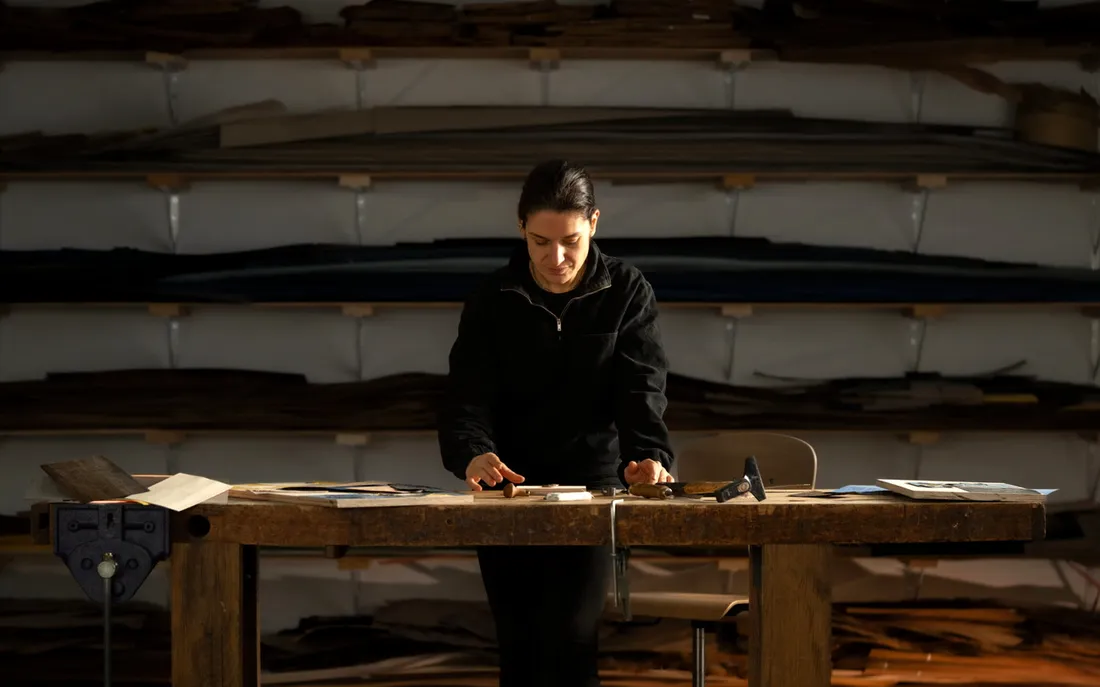
The piece that fell to the falcon is called Woodenwings, reference 7630A/000R-H203, and the artisan behind the dial is the marquetry specialist Anna Le Corno.
Marquetry means building a surface by laying thin veneers of different woods side by side. Furniture has known the technique for centuries, but in furniture a piece is a few centimetres across. Here, Le Corno assembled hundreds of pieces cut from twelve different species, most of them barely distinguishable to the eye. The usable surface of a watch dial rarely reaches thirty millimetres, which means every feather is a cut of less than a millimetre.
And here is the crucial part: not one shadow on this dial is painted. The dark band across the wing is ebony, the pale flecks on the breast are maple, the transitional tones on the head are walnut. The artist is not mixing colour; she is choosing timber. To obtain the gradation between the light tip and the dark base of a single feather, the right grain has to be cut at the right angle. This is closer to laying mosaic than to painting, except that you do not make the tesserae. They come out of a forest.
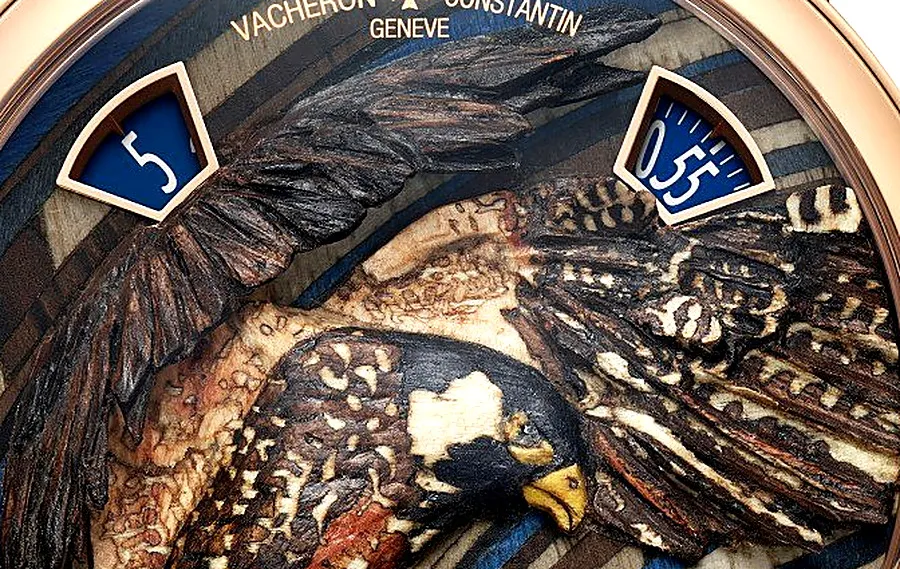
format_quote"On this dial the artist does not mix colour; she chooses timber. The palette is not in a paint box, it is in a forest."
Hasan Bekmezci
Using wood on a watch dial creates a problem of its own. Wood takes up moisture, swells as it does and shrinks as it dries. In furniture that movement is tolerated. On a dial it means hundreds of pieces shifting at once inside thirty millimetres, and one opened joint ruins the whole image. The veneers are therefore stabilised before they are cut, then glued individually to a carrier and thinned down as a single body afterwards. The final thickness of the dial is whatever the movement behind it will allow.
The sky behind the bird is not wood. It is a set of circular guilloché patterns finished in blue. Guillochage is the cutting of an unbroken geometric texture into metal on a hand-turned rose engine, and its job here is to draw the wind itself. The contrast between warm timber and cold blue metal is what lifts the bird off its ground.
The most radical decision on the dial is the absence of hands. Inside runs Vacheron Constantin’s calibre 2460 G4: two hundred and thirty-seven parts, self-winding, 28,800 vibrations an hour, forty hours of reserve. The G4 refers to four indications, all four pushed to the rim of the dial. Jumping hour at upper left, dragging minute at upper right, jumping day at lower left, dragging date at lower right. A jumping indication waits and then falls into place in one movement; a dragging one slides without ever being caught at it.
The point is not technical display. A hand crossing this dial would cut the wing in two once a minute. The moment the centre is cleared the dial stops being an instrument and becomes a canvas. The 12.9 millimetre height of the forty-two millimetre case exists for the same reason: roughly four millimetres of air sit between the marquetry and the sapphire, so the wing is never pressed against the glass.
format_quote"On one surface, the speed of a second sits beside the lifetime of a tree."
Hasan Bekmezci
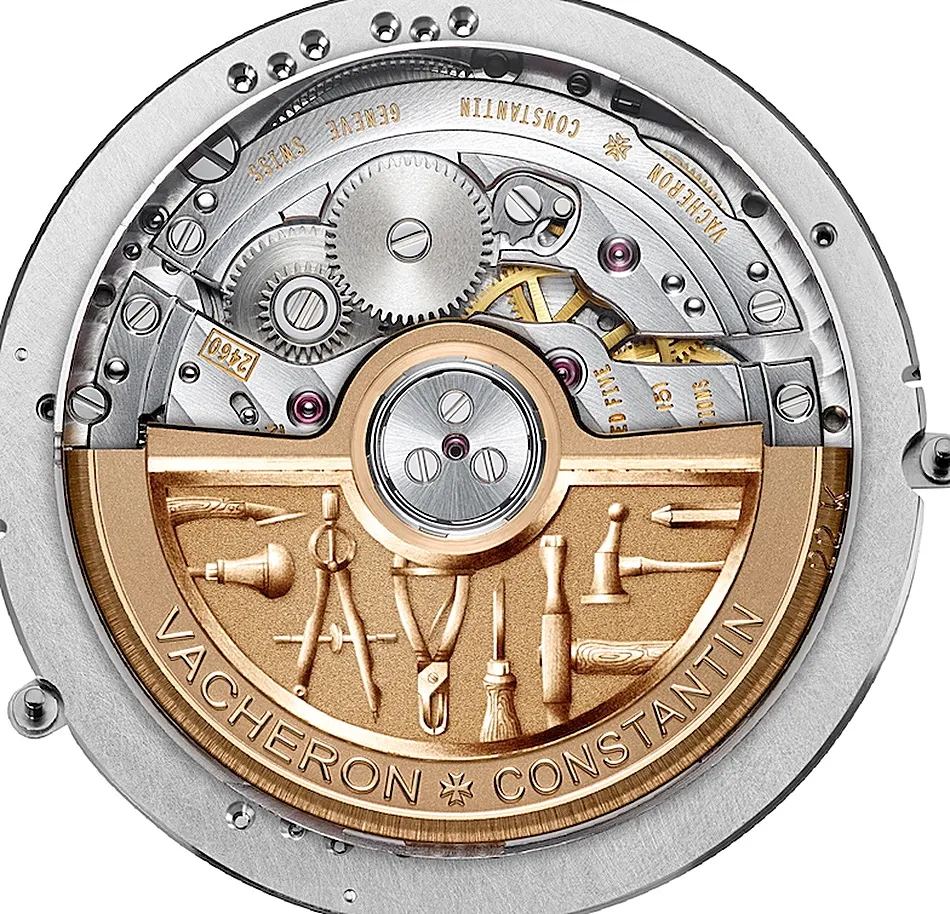
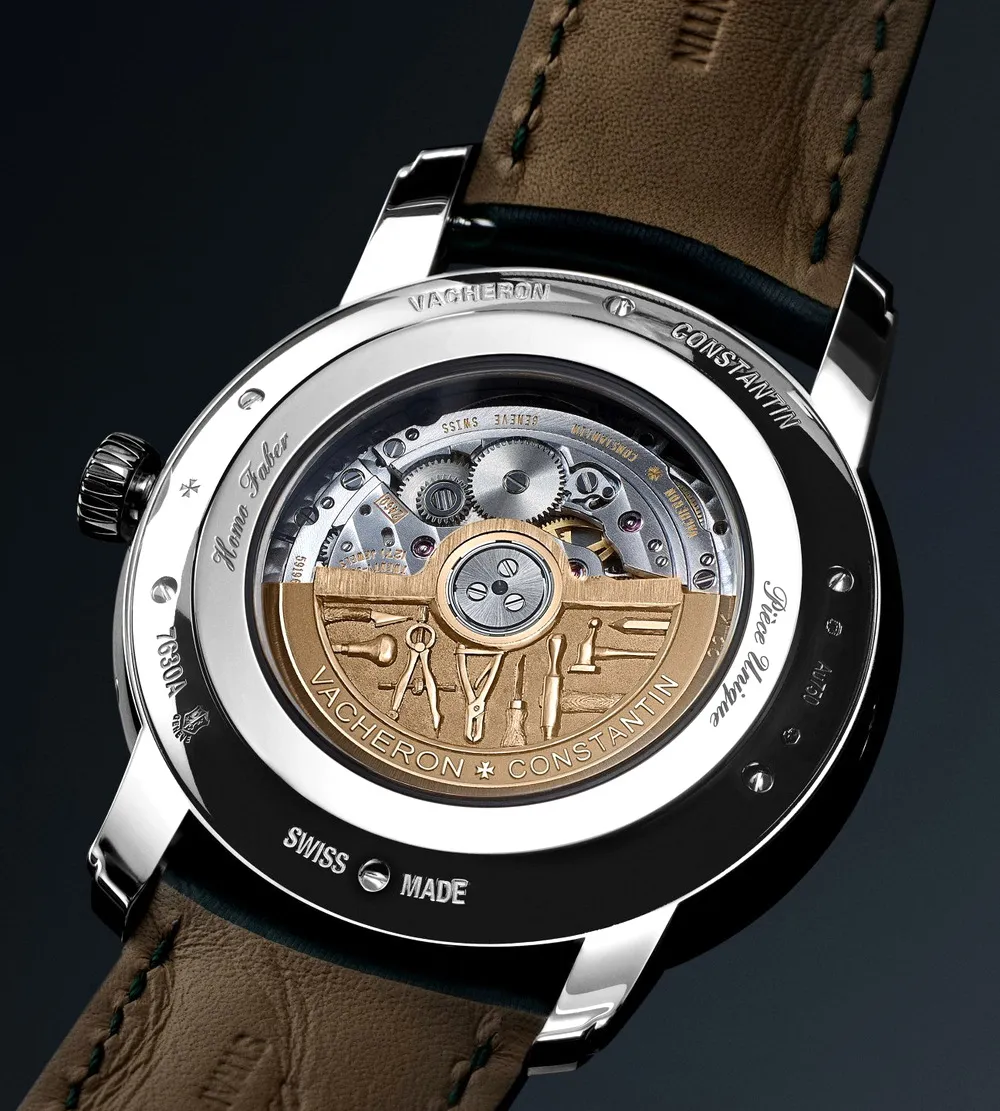
That small engraving under the display back sums up the argument of the whole collection. Vacheron placed the instruments of the hand behind the movement rather than its own crest.
The real tension inside Woodenwings is this: the fastest animal in the sky told in the slowest material on the ground. A falcon stoops at three hundred kilometres an hour. The walnut and ebony on its dial grew over decades, were dried, and were then sliced to less than a millimetre. On one surface, the speed of a second sits beside the lifetime of a tree.
Figures move through the windows and whisper that time is passing, while the wooden falcon holds its wing open. It is a reminder to glide above the noise of the day and to look at things from slightly higher up.