Time is one of the most mysterious notions there is, the one that has occupied the human mind most through history, the one on which philosophies, theories and acts of worship have been built. We perceive time in the ticking of a wall clock, in the falling of the leaves of a calendar or in the lines on our faces, as a fixed, absolute and linear river. Yet the truth, running from modern physics back to ancient doctrine, tells us something else entirely: time is not an absolute thing but a relative garment, shaped by mass, by speed and by gravity, which the Creator has put on the universe.
And in human nature, in spite of that mortal and relative time, there is an unshakeable longing for eternity. From the moment he set foot on the earth, afraid of vanishing, of being forgotten and of being crushed beneath the time that flows away, man has raised pyramids, built monuments and tried to fix time upon mechanical wheels. The perpetual calendar complication of high watchmaking is the concrete cry of that native longing at a micro-mechanical level. By designing a mechanism that outlives him, that works out the leap years and the changing lengths of the months by itself for centuries, man wants to drop an anchor into eternity.
To understand how relative and how layered time is, it is enough to lift our heads to the sky, to the Sun. The story of a photon released every second in the nuclear furnace at the heart of our star is an immense lesson in contemplation.
A photon formed in the core of the Sun moves at the speed of light, and yet advances by striking and being scattered by other particles countless times among the dense layers of plasma. Physicists call it the random walk. Getting out of the core to the surface of the Sun takes it between ten thousand and a hundred and seventy thousand years. Once it reaches the surface, crossing the hundred and fifty million kilometres of empty space to reach our eyes takes only eight minutes and twenty seconds.
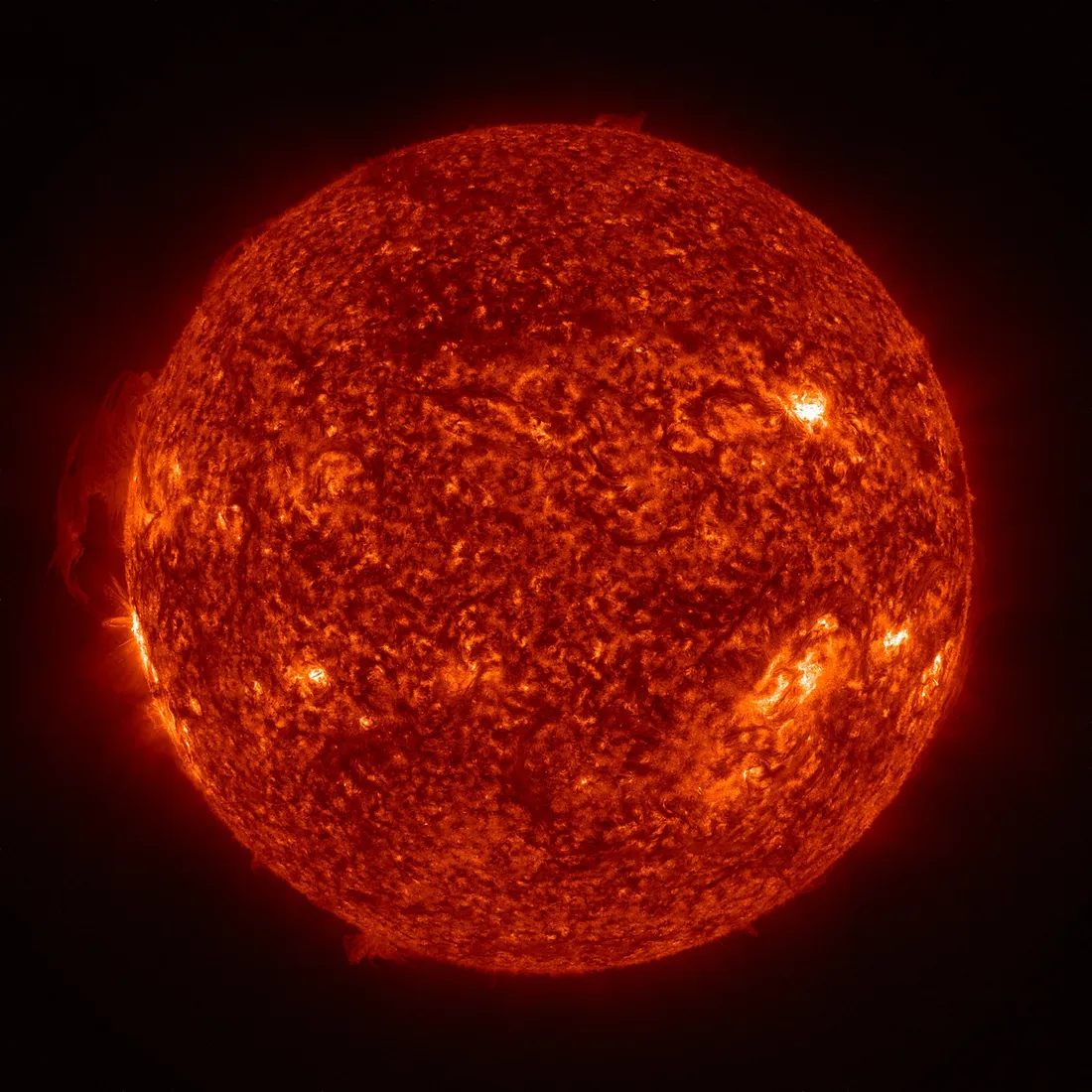
Now let us stop and think. When the particle of light that is warming our faces at this moment set out from the core of the Sun, what state was humanity in on the earth?
While that photon made its way through the merciless darkness of the core, civilisations were founded and empires fell on the earth, nomadic tribes settled, written history began, humanity went through two world wars, the Industrial Revolution happened and high watchmaking was invented. That photon reaches our eyes after a journey in time that witnessed the whole written history of the human race.
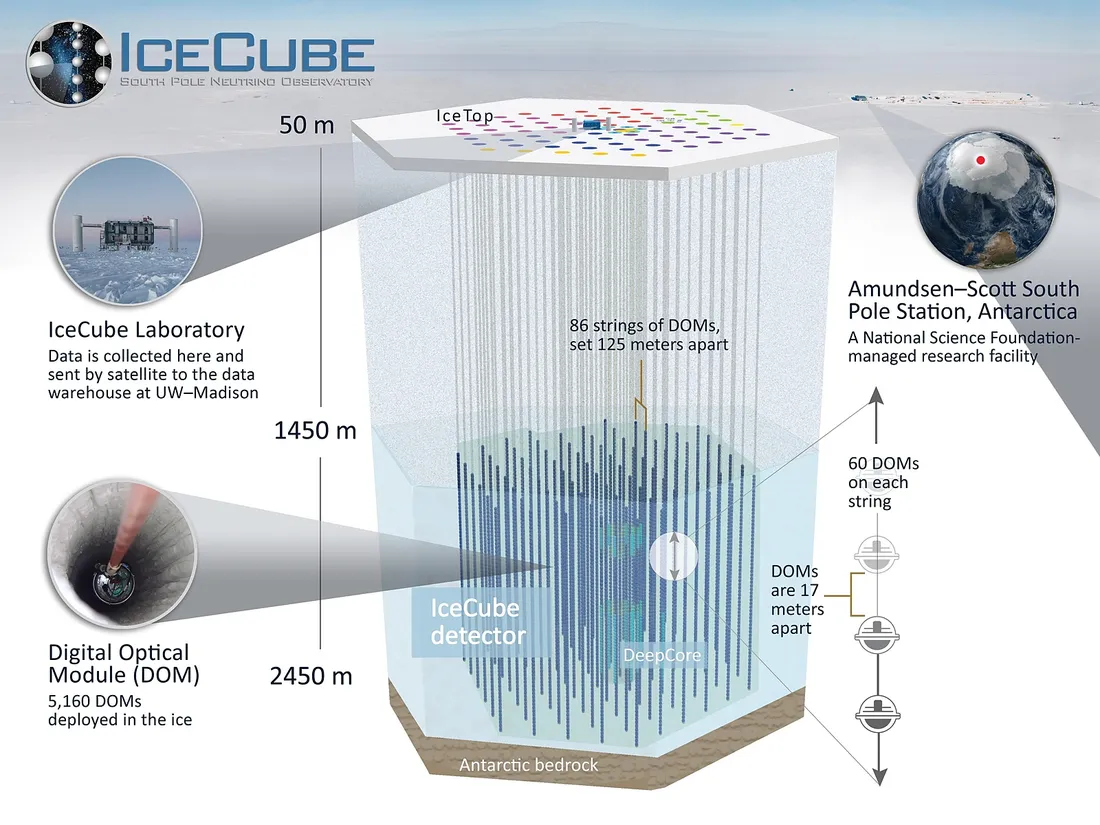
And yet the neutrinos born in the same fusion reaction, in the same instant and at the same point, leave the core in a few seconds without interacting with that dense mass at all, and reach our planet directly at nearly the speed of light. Of two things that left the same source, one is jammed for thousands of years under the heavy load of time, and the other is at its destination eight minutes later.
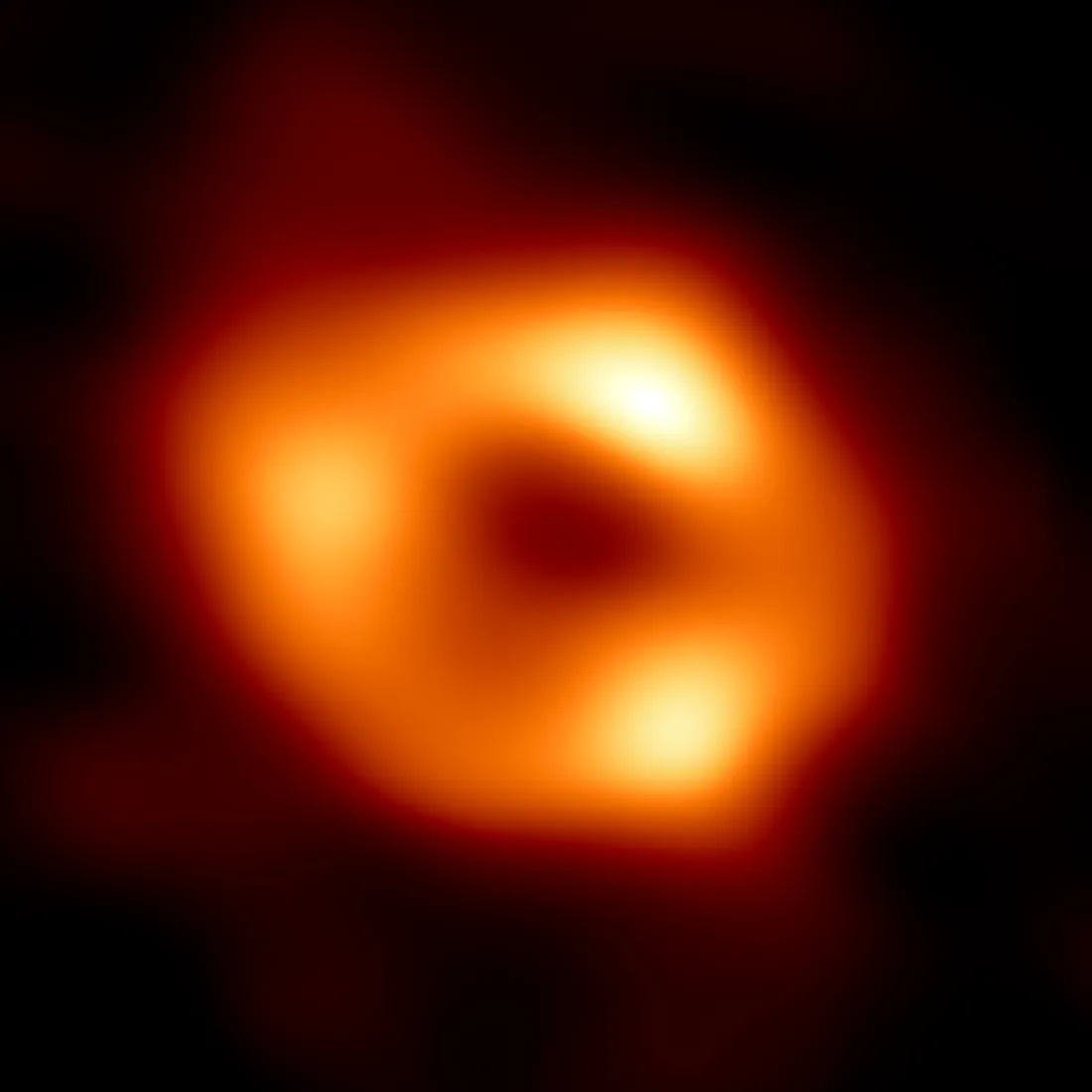
This elasticity of time means it runs at a different rate at every point of the universe. As Albert Einstein set out in the General Theory of Relativity, a few seconds passing near a black hole, where gravity is strong, can correspond to a far longer stretch in another corner of space.
format_quote"Of two things that left the same source, one stays on the road for thousands of years and the other is at its destination eight minutes later."
Hasan Bekmezci
That time is relative stands, far beyond being a discovery of twentieth century physics, on the horizon the Kur’an opened centuries ago. The book tells that the rate at which time flows changes entirely in different cosmic dimensions, and that the notions of year and day as we have them on earth turn into another scale altogether on other levels.
In the sura of the Pilgrimage it is told that a single day in the sight of the Creator is like a thousand years of the reckoning of human beings. By the calendar of this world a thousand years is an immense age for human history, in which empires are founded and fall, climates change, and languages and civilisations come and go. Going a thousand years back, to the year 1026, the Crusades had not yet begun; the Seljuks were still a confederation of tribes moving into Khorasan, and more than a decade would pass before they founded their state. A single day on the divine scale takes in that thousand-year sequence of civilisations, the rise and the setting of kingdoms.
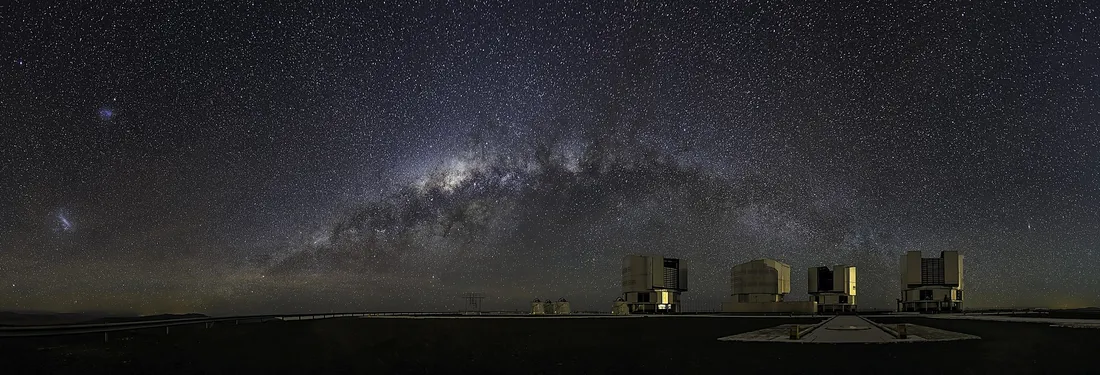
In the sura of the Ascending Stairways the scale widens further and speaks of a day whose measure is fifty thousand years. What does a single day of fifty thousand years correspond to on the cosmic clock? To an astronomical age in which the tilt of the earth’s axis completes a whole cycle, in which ice ages come and reshape the ground, in which stars go out and new nebulae are born. In fifty thousand years the Sun covers only a tiny arc of its two-hundred-and-thirty-million-year circuit of the galactic centre; and yet the shapes of the constellations in the sky become unrecognisable, because each of the nearer stars has gone its own way.
And in the sura of Jonah the human view of this life is drawn in a striking image: on the day they are gathered, it will be as though they had stayed in the world only an hour of a single day. This shows how short, how dim and how like an instantaneous dream this life will seem once we have passed into the dimension that follows death.
And here a deep question for contemplation arises. If the realm after death, or the passages between dimensions, were bound one to one and heavily to the clock of this world, what state would the first human being who ever died be in?
The billions who have died since the time of the prophet Adam, since the first ages of history, if they had waited in that dimension by ordinary earthly time, would have suffered exhaustion and an unimaginable torment of waiting through tens of thousands of earthly years.
What is told instead is this: with death, the linear and crushing weight of earthly time is lifted, and time takes on an elasticity of dimension. Just as a person who lies down to sleep runs about in a dream for hours, lives joys or terrors, and wakes to find that only ten minutes have gone by, so the intermediate realm has a relativity of its own, independent of the clock of this world. The first human being to die and the one who dies as the last hour breaks will both feel, on waking there, that no more has passed than an hour of a single day. This elasticity and relativity of time is a divine mercy that saves the human soul from the suffocating nightmare of an endless wait.
format_quote"The elasticity of time is a divine mercy that saves the human soul from the suffocating nightmare of an endless wait."
Hasan Bekmezci
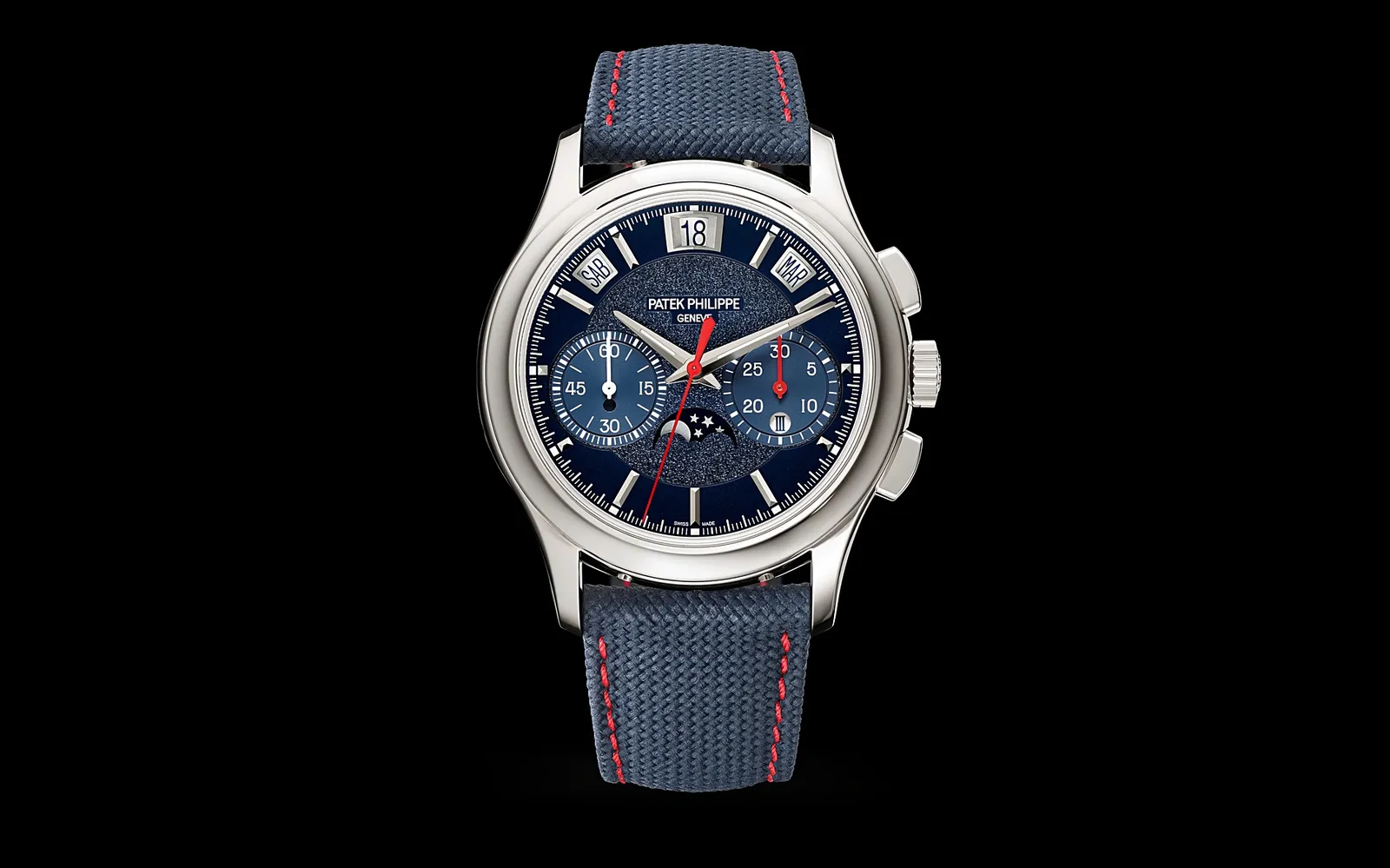
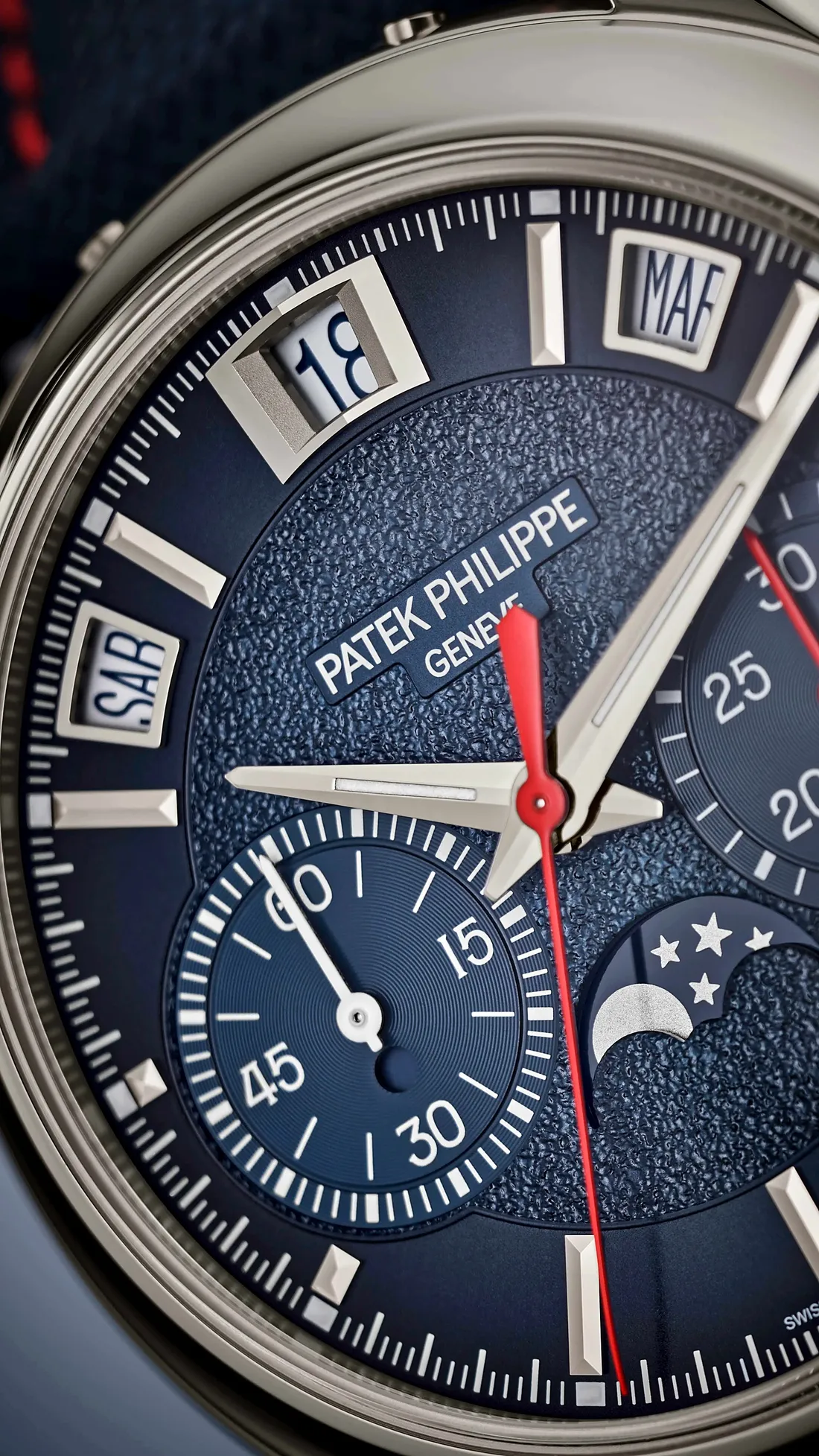
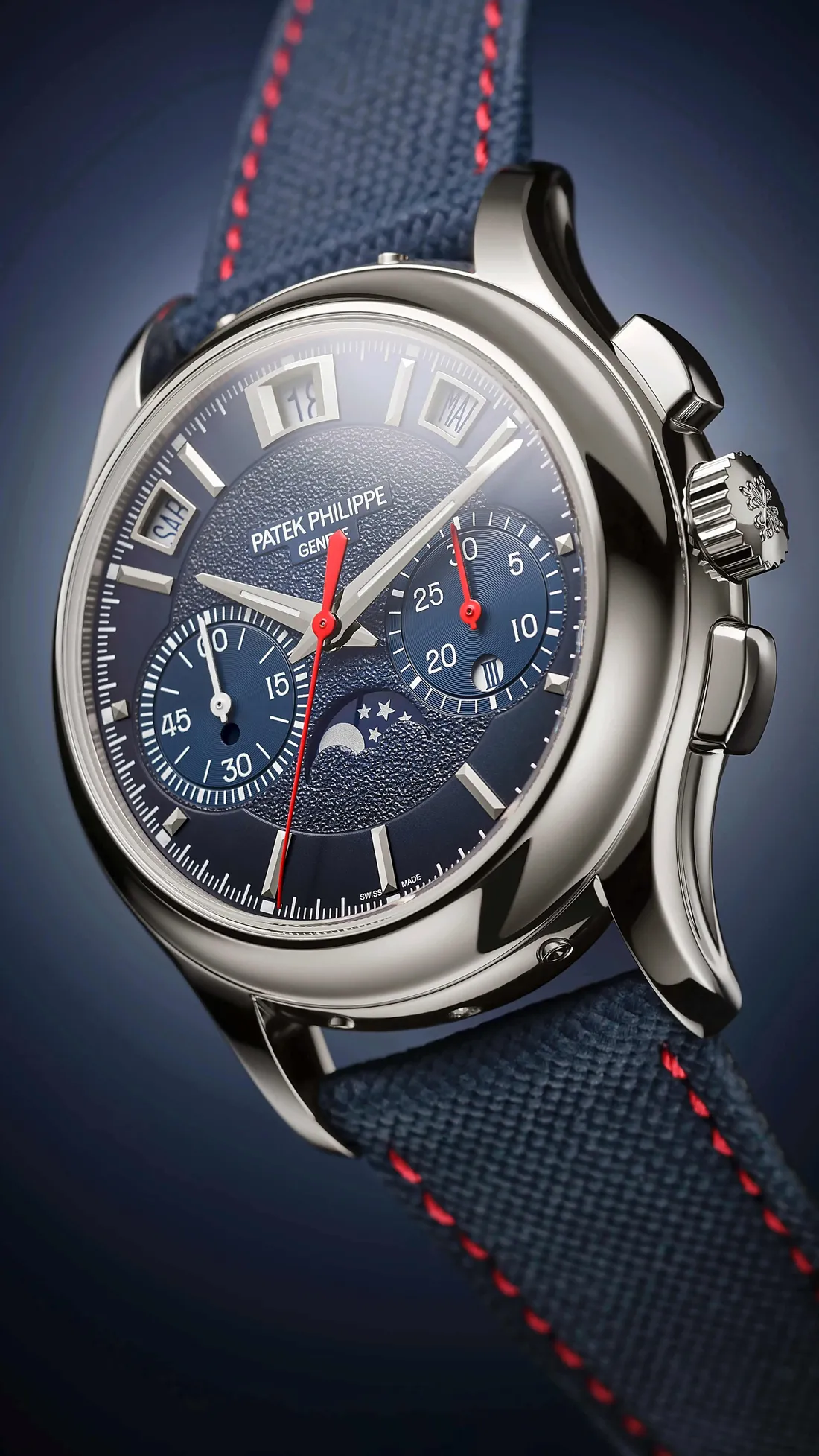
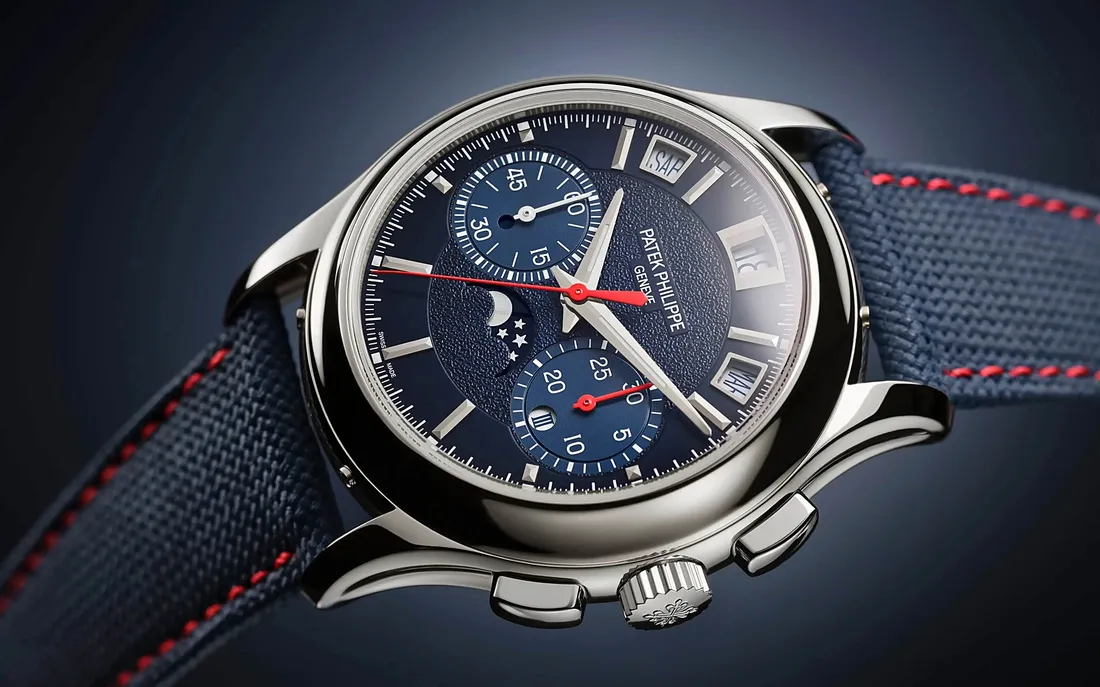
The most recent masterpiece to stand for the human search for eternity inside relative time, and for human mechanical genius, is the Patek Philippe Ref. 5978P-010, presented on the occasion of the Watch Art Grand Exhibition Milan 2026.
First, what is a perpetual calendar? An ordinary wristwatch, calendar models included, knows that a month has thirty or thirty one days, but does not know that February has twenty eight, or twenty nine once every four years. So at the end of every February, and at the end of every thirty-day month, you have to pull out the crown and wind the date forward by hand.
A perpetual calendar is like a small computer with a mechanical memory. As long as you keep the watch wound and running, it tells the thirty-day months from the thirty-one-day ones perfectly, it knows that February runs twenty eight days, and, most importantly, it works out the leap year that comes every four years by itself and gives February its twenty ninth day.
Imagine a mechanical mind in your hand that uses no battery at all, that is made entirely of metal wheels, springs and levers, and that will not lose its place in the calendar for decades even if you never touch it. An ordinary calendar is like a forgetful child waiting every month for your hand to put it right; a perpetual calendar is like a wise astronomer who knows the flow of centuries by heart.
So why is this complication so hard to make, and why can not every artisan and every house manage it?
At the heart of the mechanism sits a special programme disc, notched to different depths, usually a four-year leap-year cam. That cam is what lets the mechanism read how many days each month will run, and the tolerance between those micro wheels is finer than a human hair.
The second matter is energy. Passing from the last day of a month to the first, the mechanism has to advance several indications at once, the day, the date, the month and the leap year. At that instant a very large amount of energy is drawn out of the movement all at once. If the wheels are not calculated correctly the mechanism jams or the watch stops.
The third is assembly. In a calibre of five hundred parts like this one, a single millimetric error of friction or a wrongly set spring puts the whole calendar out. The rare watchmakers in the world who can assemble this complication without fault go through years of specialisation.
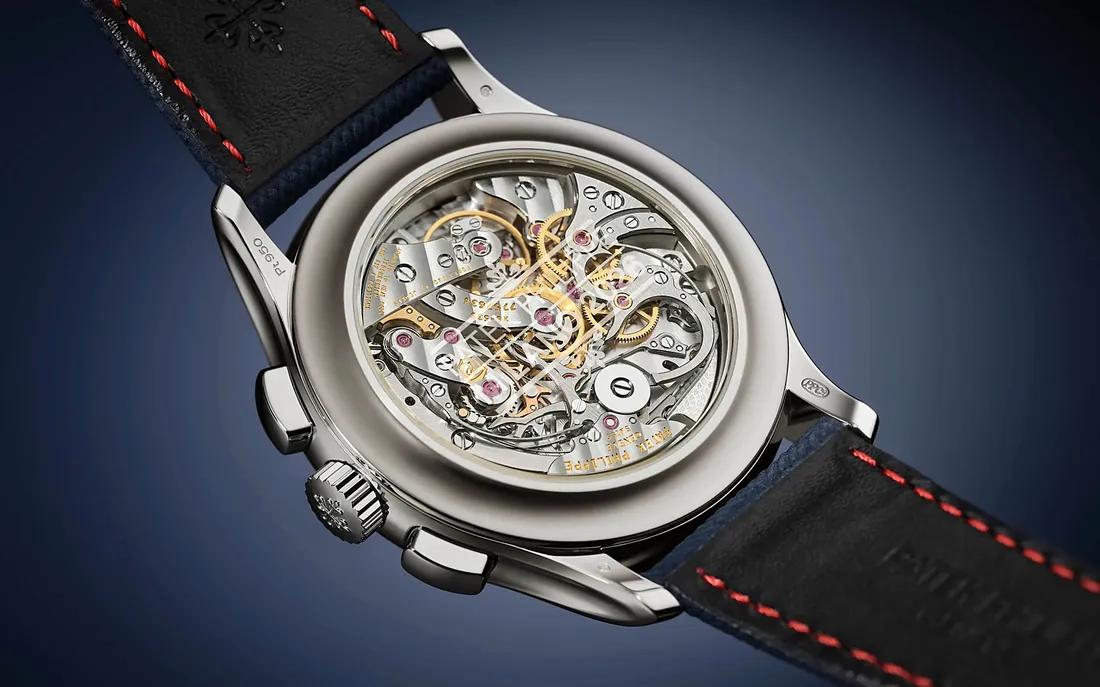
For the first time in the history of Patek Philippe a manually wound chronograph movement and an instantaneous perpetual calendar have come together under one roof; that is the maison’s own statement. The calibre that resulted is the CH 29-535 PS QI, built from five hundred parts on forty two jewels. It is thirty two millimetres across and eight point one millimetres thick, beats at twenty eight thousand eight hundred vibrations an hour, carries a Breguet balance spring, and runs fifty five to sixty five hours with the chronograph disengaged. Only a hundred and twenty were made.
What instantaneous means here is this. At the moment the watch shows midnight, the day, date, month, leap year and day-and-night indications on the dial do not creep slowly forward but change all at once in a single jump; the figure reported in the press is thirty milliseconds, three hundredths of a second. In the maison’s own description, what allows all the displays to synchronise precisely and at the same instant is the energy-management mechanisms of the calibre.
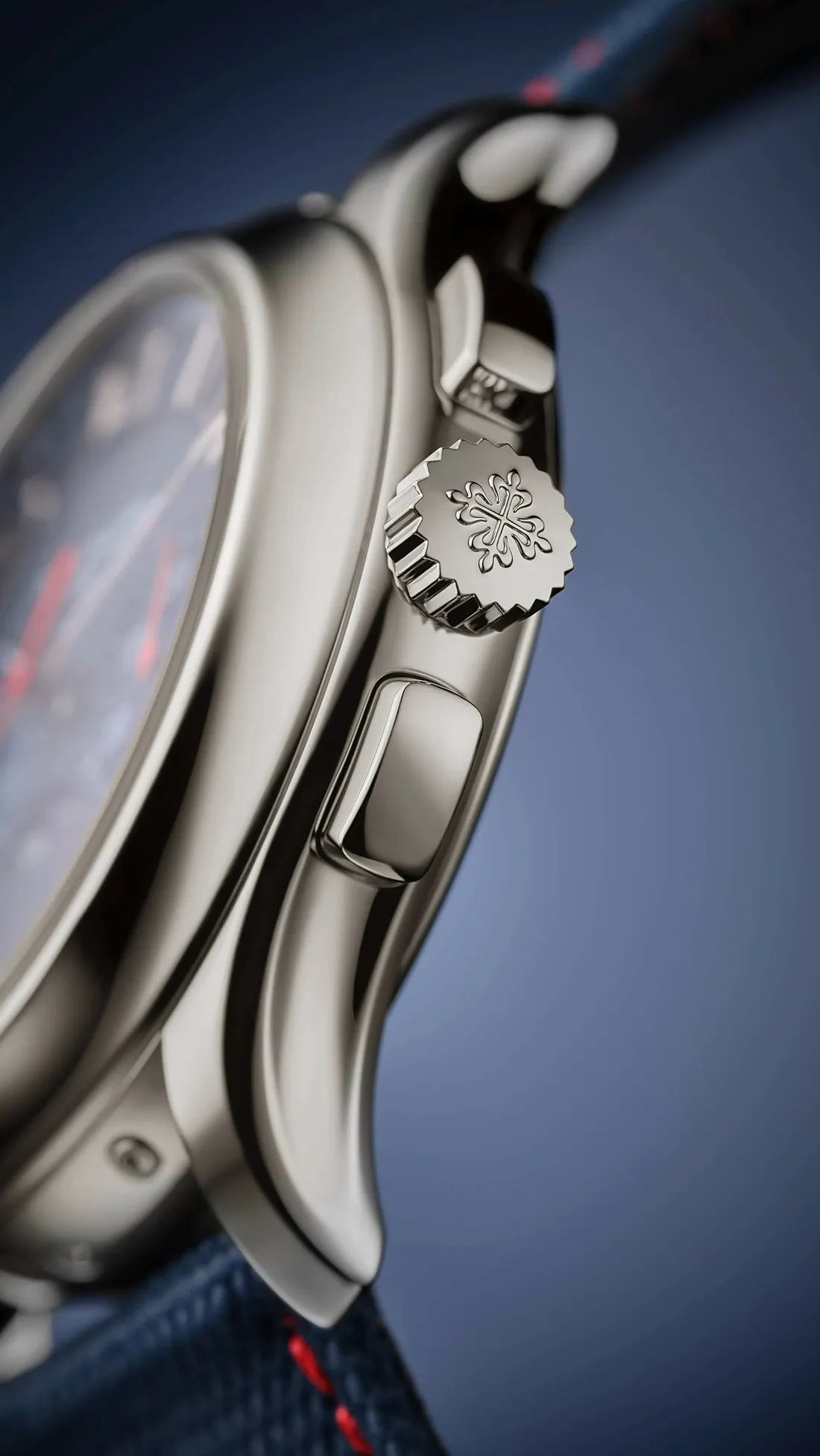
The chronograph side stays loyal to tradition: a classical hand-wound architecture with a column wheel and a horizontal clutch. The minute counter jumps instantaneously too. This family of calibres was protected by six separate patents when it was introduced.
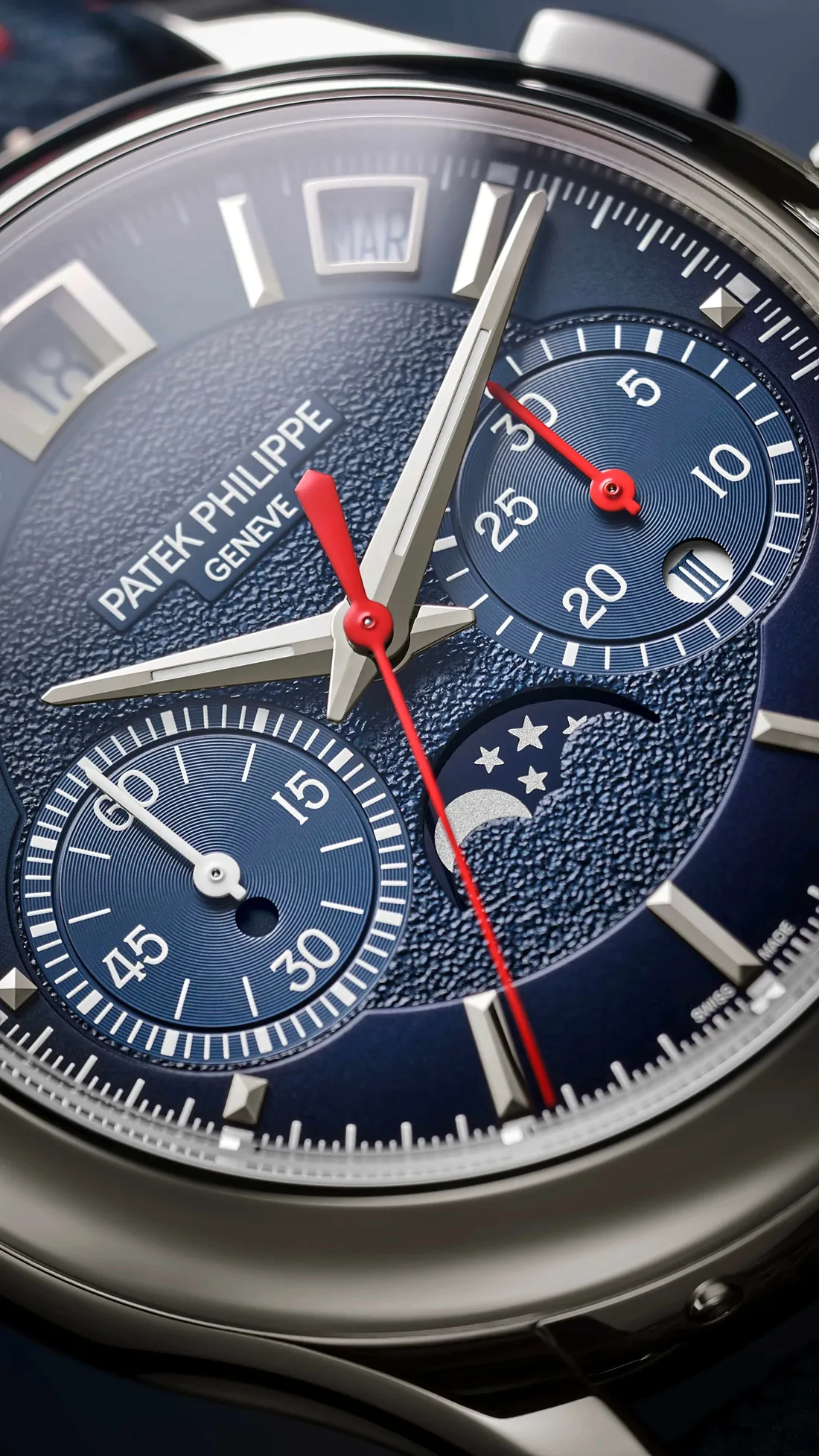
The case is forty two millimetres across, fourteen point two four millimetres thick, and polished platinum from end to end. It has a concave bezel, scalloped lugs, and the maison’s signature diamond set between the lugs at six o’clock. It resists water to thirty metres.
The dial is sunburst navy blue, its rim darkening towards black and its centre textured. The hour markers are white gold, faceted and baton-shaped; the hands are white gold again, dauphine in form and coated with white luminescent material. The chronograph hands are varnished red, and in all that navy calm they are the one sharp accent.
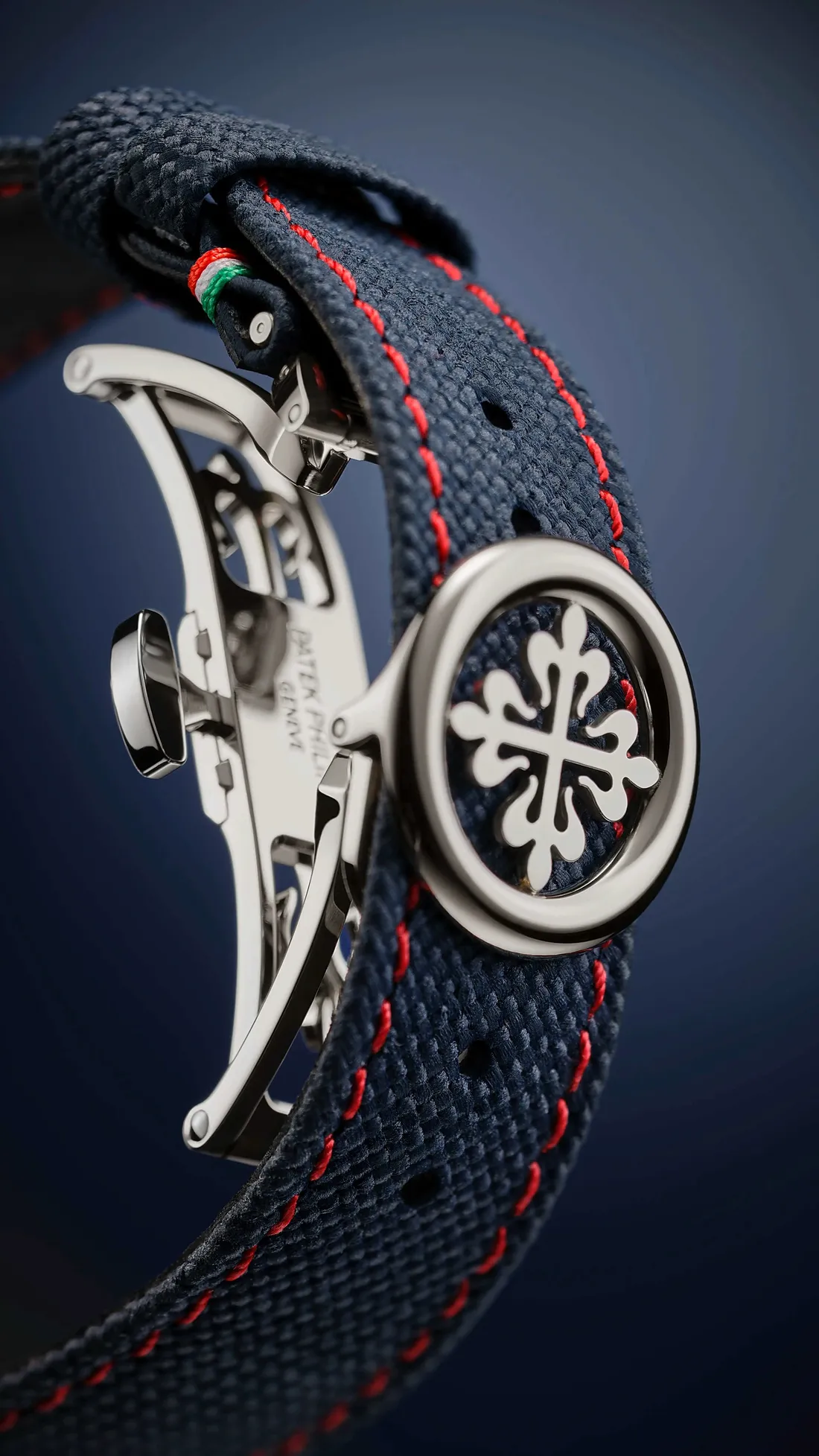
The strap is navy composite with a fabric pattern, run through with red stitching. The stopping point on the chronograph scale is in the colours of the Italian flag. The clasp is platinum, triple-bladed and patented.
Think of that photon, born in the core of the Sun, shut inside the layers of plasma for thousands of years, and reaching our planet only in the last scene of human history. Think of the neutrinos that set out at the same instant and arrived in eight minutes. And imagine that you are holding in your hand a five-hundred-part platinum Patek Philippe Ref. 5978 that carries the calendar forward at midnight in a single jump.
However perfect the watch may be, it is only a servant measuring a time that was created and made relative. What a human being is looking for when he writes perpetual calendar on the dial of a watch is in truth the reflection of the longing for eternity in his own soul.
Real eternity is not inside mechanical wheels or platinum cases; it is in the sight of the Eternal and the Everlasting, who made time, who makes this life in the intermediate realm seem an hour long, and who granted a human being this power of contemplation. As time flows away, it is not the watches on our wrists but the journey our souls make towards eternity that will leave a mark.
format_quote"What a human being is looking for when he writes perpetual calendar on a dial is the reflection of the longing for eternity in his own soul."
Hasan Bekmezci
The watch on its maker’s own site: Patek Philippe, Ref. 5978P-010