In the darkest stretch of my life, when everything inside me was in pieces, I took refuge in a freezing ocean. I was diving into the kelp forests off the Cape of Good Hope, looking in the silence for an appetite for living that I had mislaid.
Then one day, among the fronds, I saw a dark shape that had covered itself in shells like armour. As I came closer the shells fell away one by one, and out from underneath slid a creature with eight arms: a female octopus.
For the first days she fled from me. But every day I went back into her world with no tank and no equipment, carrying nothing. Then one day she reached out an arm. That soft, gracefully curling limb touched my finger with its suckers, and a bridge was built between two separate worlds.
She was not simply a sea animal. When she tested my skin with the suckers at my fingertips, and then climbed my chest out of curiosity and laid her head over my heart, every confusion in the world stopped. That small body was carrying a piece of engineering it knew nothing about.
Inside that body sits a chemistry built to survive cold and pressure: blue blood.
Human blood, and most life on land, carries oxygen with iron-based haemoglobin, and iron turns rust red when it binds oxygen. The octopus instead carries copper-based haemocyanin, and the moment copper binds oxygen the blood turns a clear sapphire blue. This is not merely a difference of colour. Iron-based haemoglobin stiffens in cold water and loses its ability to release oxygen; copper-based haemocyanin stays fluid even in freezing seas. It is also not packed inside red cells but circulates freely in the plasma, which eases the strain on cell membranes under deep-sea pressure.
To move that blue blood, three hearts beat in its body. Two branchial hearts push blood through the gills to load it with oxygen; the systemic heart distributes it. Two-thirds of its neurons are not in the brain but in the arms. Each arm smells, touches and decides for itself, like an independent secondary mind. There is not a single bone in the animal, which is why it can pass through openings narrower than its own beak. Faced with a current it does not stiffen; it takes the shape of the water.
format_quote"Each of the eight arms decides for itself. A mind distributed through a body is more supple than a mind gathered in one place."
Hasan Bekmezci
The heaviest part of the story comes at the end. When a female octopus is ready to lay, she fixes hundreds of thousands of translucent eggs to the roof of her den and never leaves them. She stops eating for months. At the cost of consuming her own body, she blows fresh water over the eggs, cleans the silt from them, and puts herself between them and any predator that approaches. On the day the young hatch, the spent mother takes her last breath.
Her place in the ecosystem is just as complete. By holding crab and crustacean numbers in check she keeps rocky habitats from collapsing. For moray eels, sharks and larger hunters she is the richest protein available, and her boneless body makes her easily digestible. When she dies, that body becomes a resource for the scavengers and microorganisms of the sea floor. A cycle that balances while it lives and feeds the bottom even as it ends.
format_quote"A cycle that balances while it lives and feeds the sea floor even as it ends."
Hasan Bekmezci
That kelp forest off the Cape came down to the scale of a dial in Geneva in the summer of 2026. Vacheron Constantin announced a set of six pieces titled Métiers d’Art Tribute to the Animal Kingdom, all of them produced under the house’s One of Not Many Crafts Programme, which pairs a craftsperson from outside watchmaking with the watchmakers of Geneva.
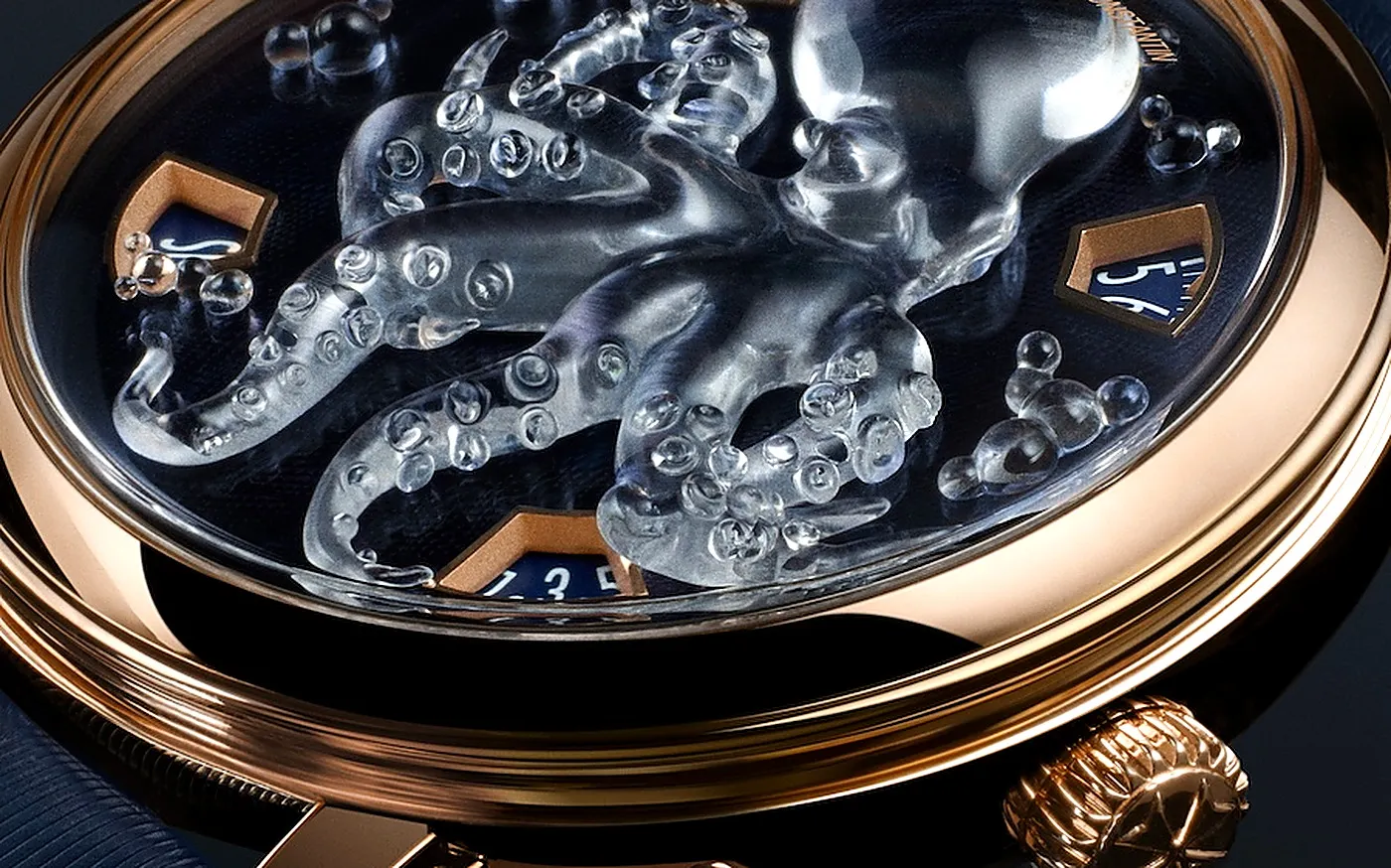
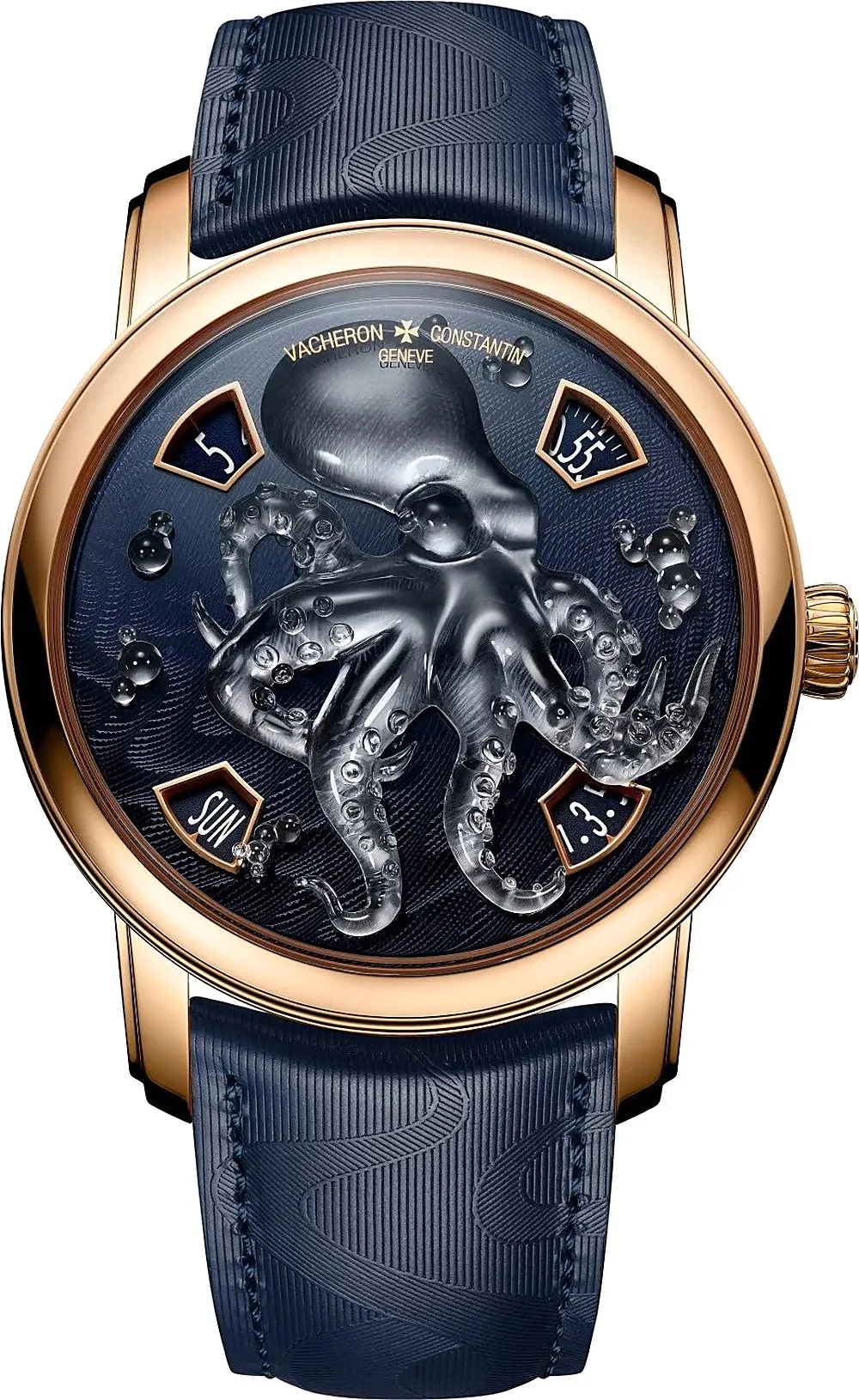
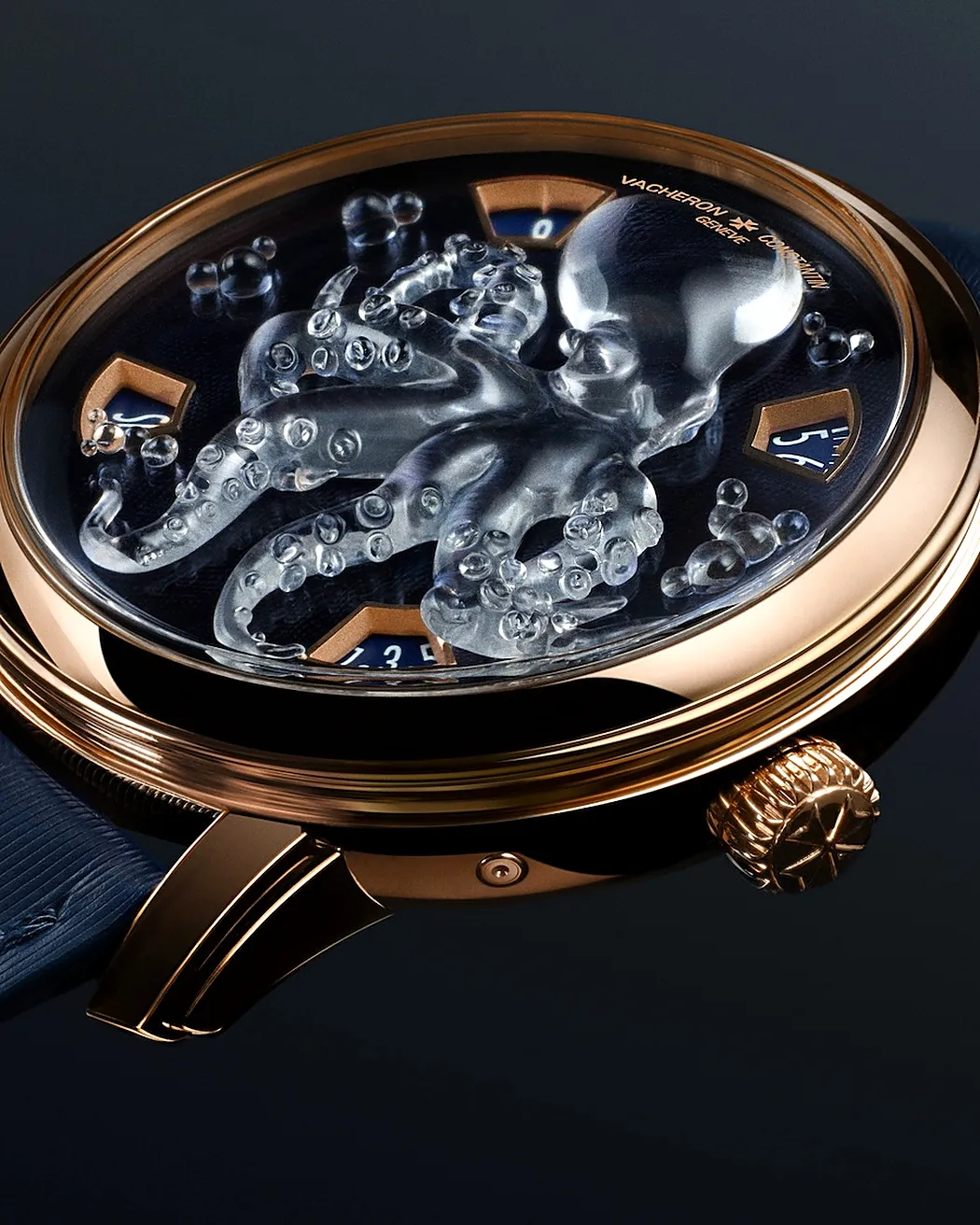
The piece that fell to the octopus is called Glassoctopus, reference 7630A/000R-H205, and its dial is the work of the Italian glass artist Simone Crestani.
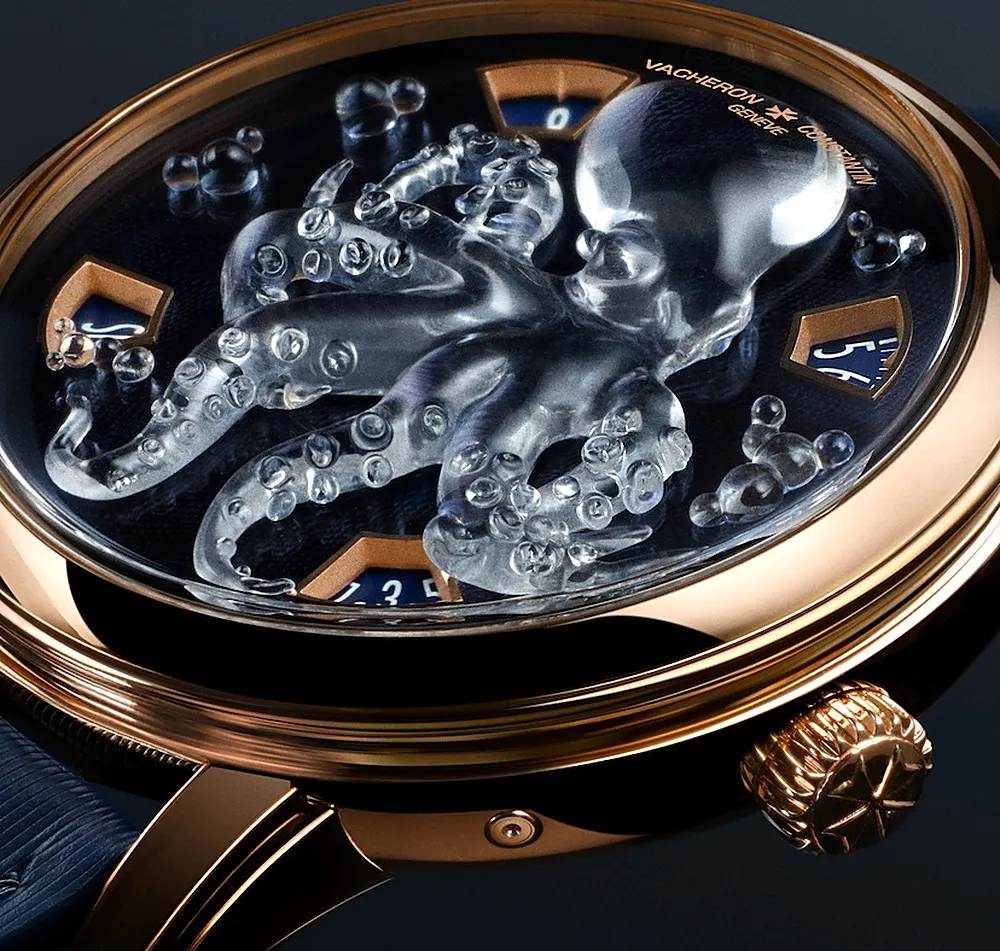
Crestani is not a glassblower but a sculptor who works at the flame. He softens borosilicate rod in a torch and shapes the material while it is still moving. The cruelty of the technique lies in its window: the interval in which glass is workable is measured in seconds. Too cool and it cracks, too hot and it runs. The eight arms, the taper at the end of each one and the swelling dome of the mantle all have to be resolved inside that window, and at a scale that fits into a watch case. No mould is involved anywhere; the form is a joint decision taken by the hand and the flame.
The result is something unusual in watchmaking: a transparent figure. Enamel closes a surface, engraving subtracts from one. Glass both reveals the surface beneath it and bends it.
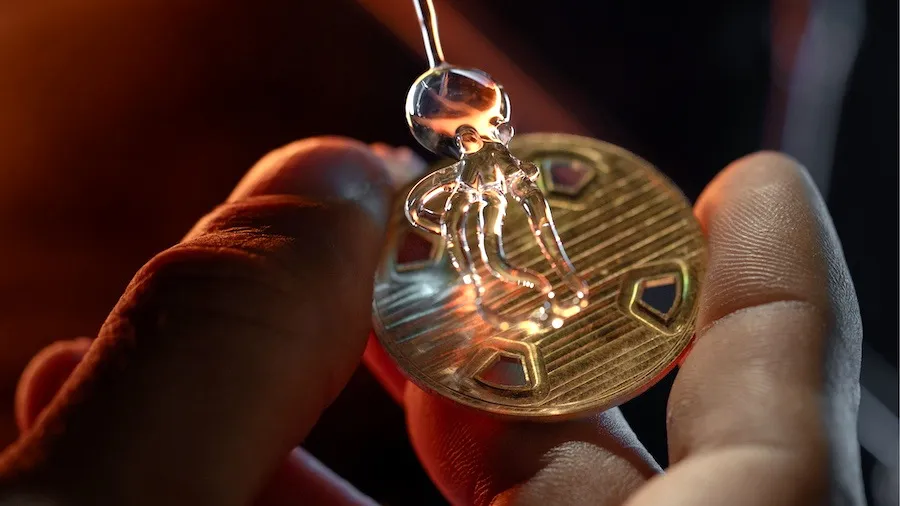
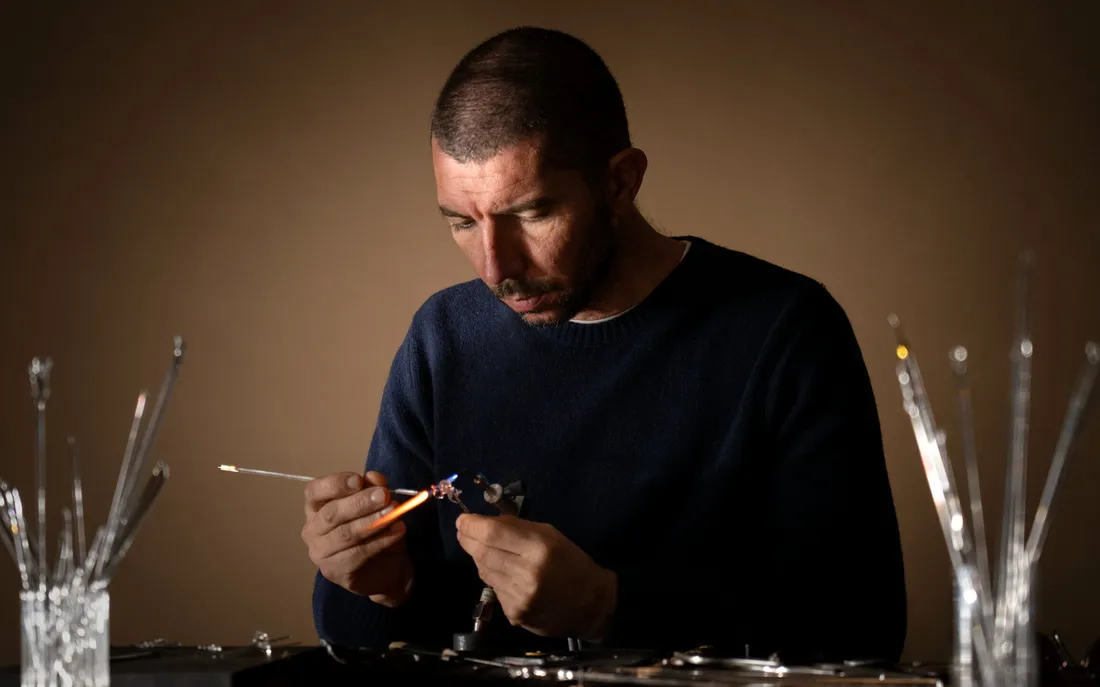
format_quote"Enamel closes a surface and engraving subtracts from one. Glass both reveals what lies beneath and bends it."
Hasan Bekmezci
Beneath the glass lies hand-guilloché 3N gold. Guillochage means cutting an unbroken geometric texture into metal on a hand-turned rose engine, where a single hesitation ruins the whole surface. Here that texture does two jobs at once. It stands in for the refraction of light in deep water, and, because it is seen through glass, it is permanently distorted. The octopus never moves, yet the dial shows something different at every angle.
The choice of 18K 5N pink gold for the case is not incidental either. The warmth of pink gold set against the cold grey of clear glass is what separates the figure from its ground. In white gold the glass would simply disappear.
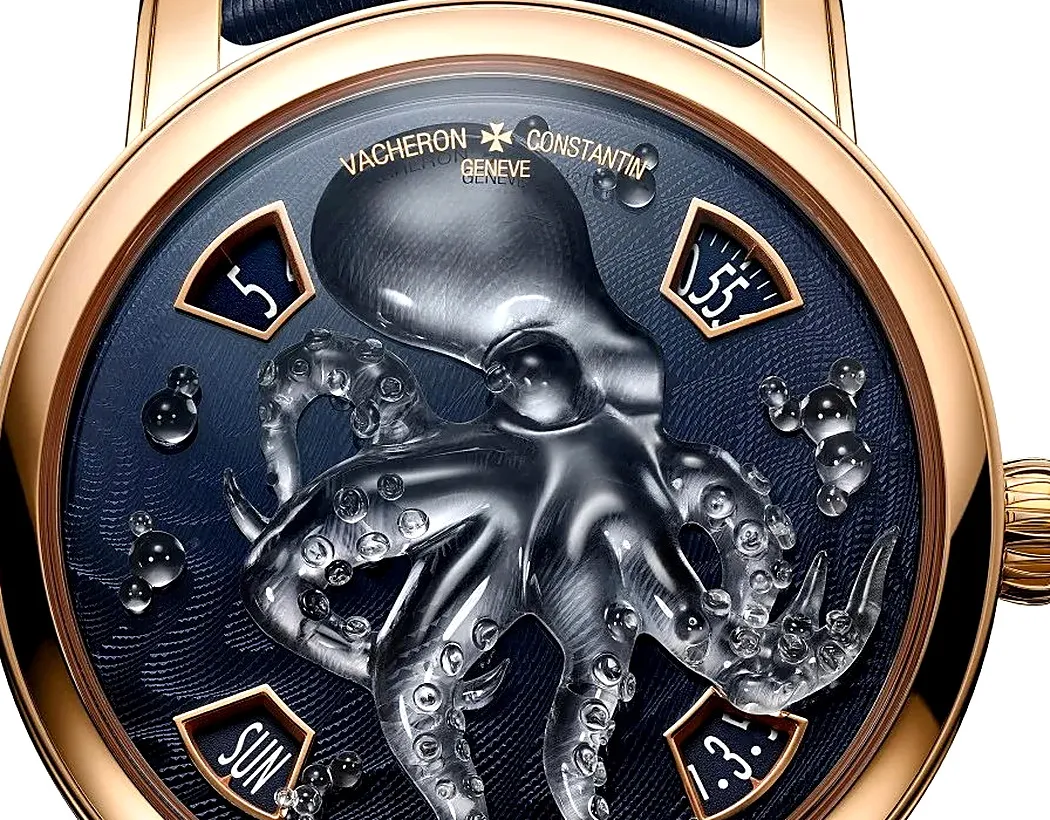
The most radical decision on this dial is the absence of hands. Inside runs Vacheron Constantin’s calibre 2460 G4: two hundred and thirty-seven parts, self-winding, 28,800 vibrations an hour, forty hours of reserve. The G4 stands for four indications, and all four have been pushed to the edge rather than left at the centre. Jumping hour at upper left, dragging minute at upper right, jumping day at lower left, dragging date at lower right.
The point of the arrangement is to clear the middle. A hand travelling across this dial would cut through the animal’s arms once a minute. The 12.9 millimetre height of the forty-two millimetre case serves the same purpose: roughly four millimetres of air have been left between the figure and the sapphire, so the glass body is not pressed against the crystal and genuinely hangs, as if suspended in water.
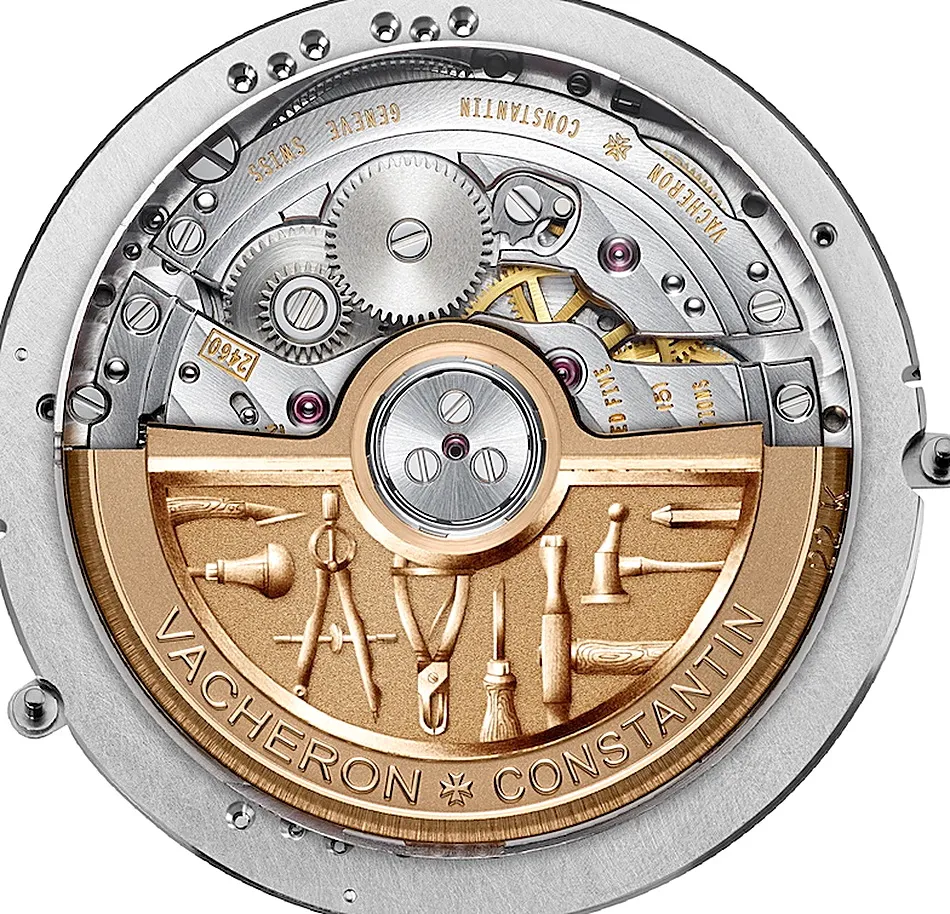
Through the display back, a relief of craftsmen’s tools appears on the rotor, identical across all six pieces in the series. Vacheron put the instruments of the hand behind the movement rather than its own crest.
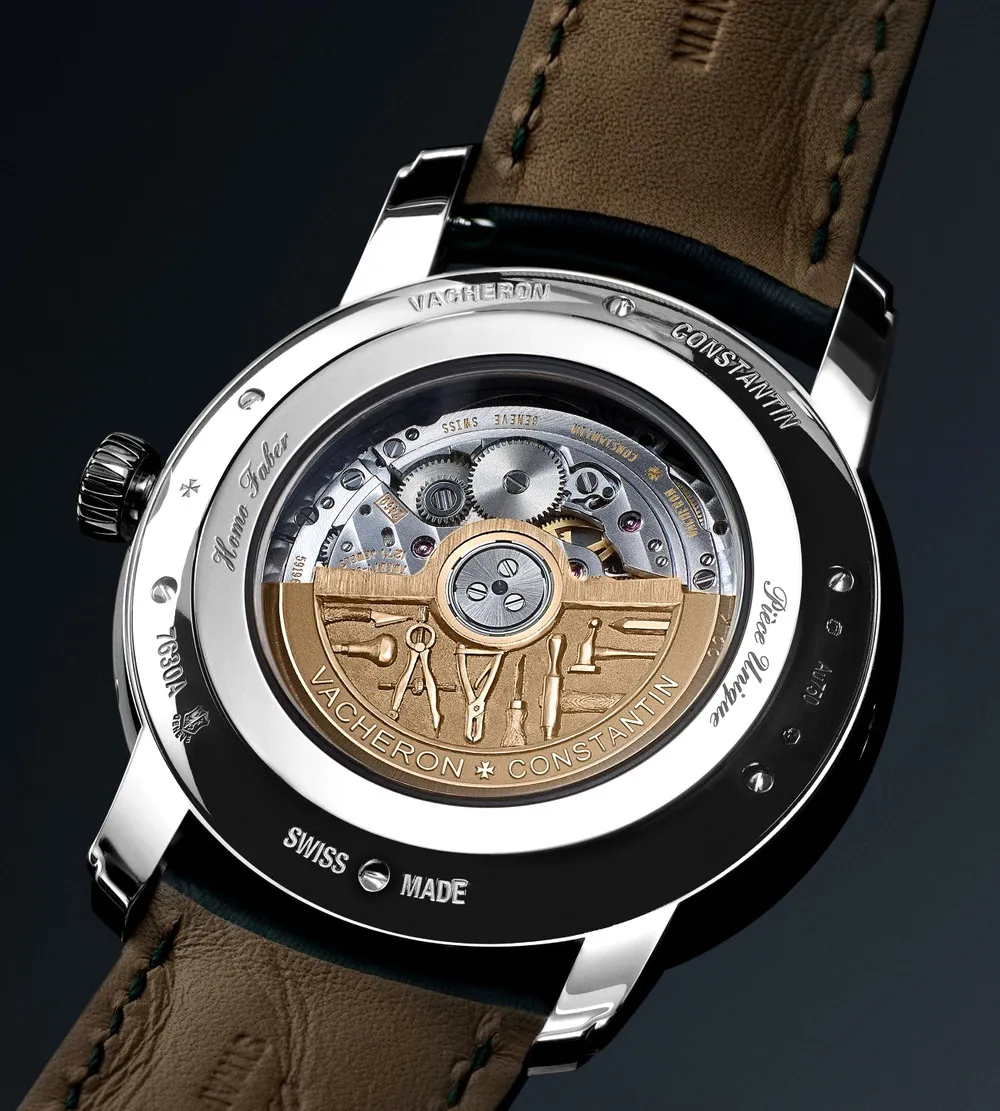
Glassoctopus is not a diving watch and has no business with water at all. What it does is remind you of something: it tells the story of an animal that converts its own lifespan into the first day of its young, and it tells it in a material that can break.
That is exactly why glass is the right choice. Gold endures, steel resists, enamel holds. Glass, if it falls, is finished. An octopus lives the same way: a few years, then a story that ends in a single season. Vacheron recorded that life in a substance as fragile as the life itself.
When you look at the transparent body under the sapphire, you do not see hands sweeping the hours. You see figures moving in windows. The octopus stays where it is, going nowhere, its eight arms wrapped around its own portion of time.