Wonder is the first rule of being a philosopher; it is the sharpest milestone in a human being’s awakening within the cosmos, the one that takes the breath away before existence itself. In this universe a human being is not merely a passing traveller; he is the only observer looking for light inside blind darkness and for sound inside silence. Let us now push open the door of that deep philosophical wonder and listen to the mesmerising, almost alchemical story of how an ordinary wound turns into a dazzling pearl in the most intimate and darkest womb of the ocean.
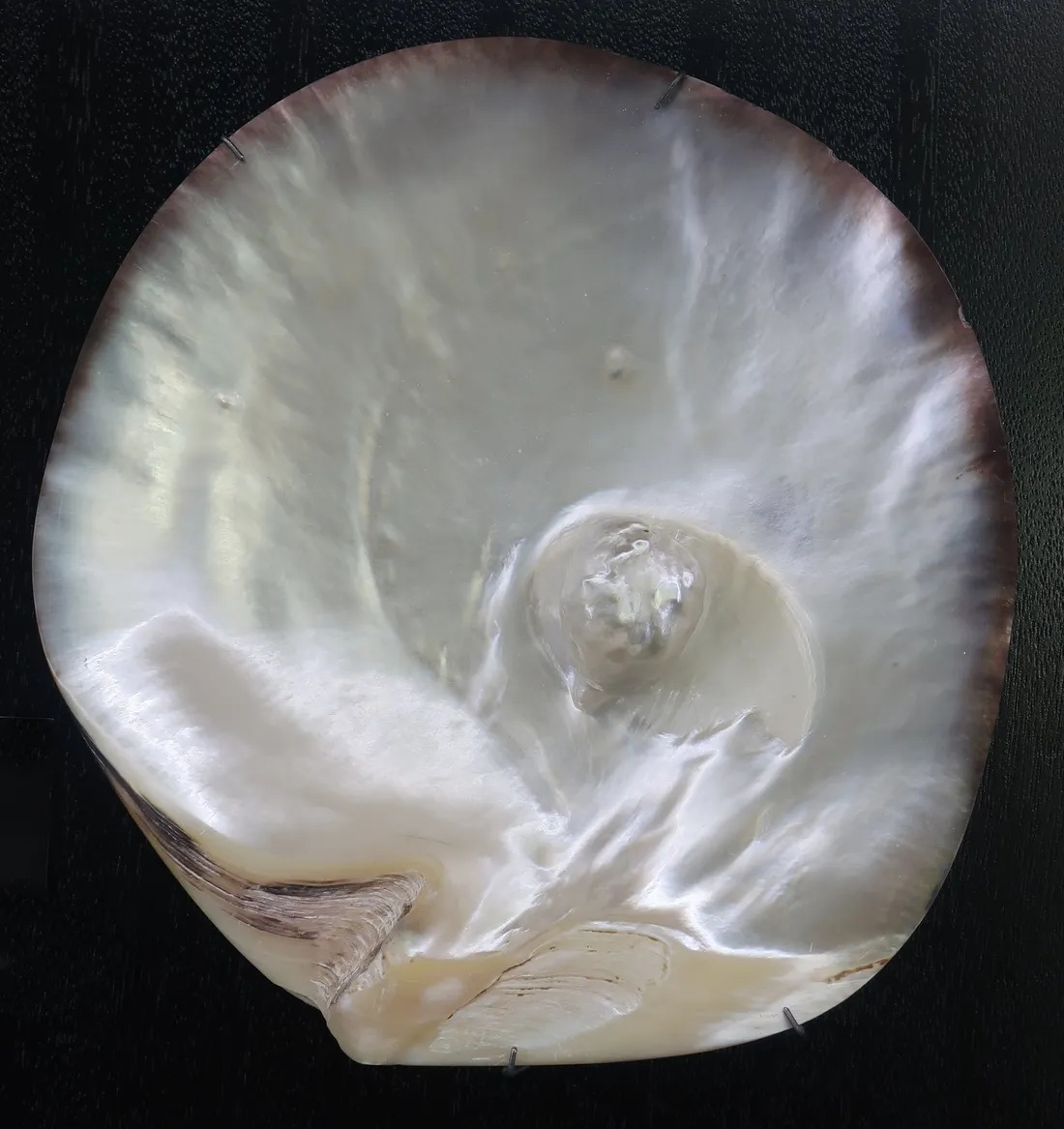
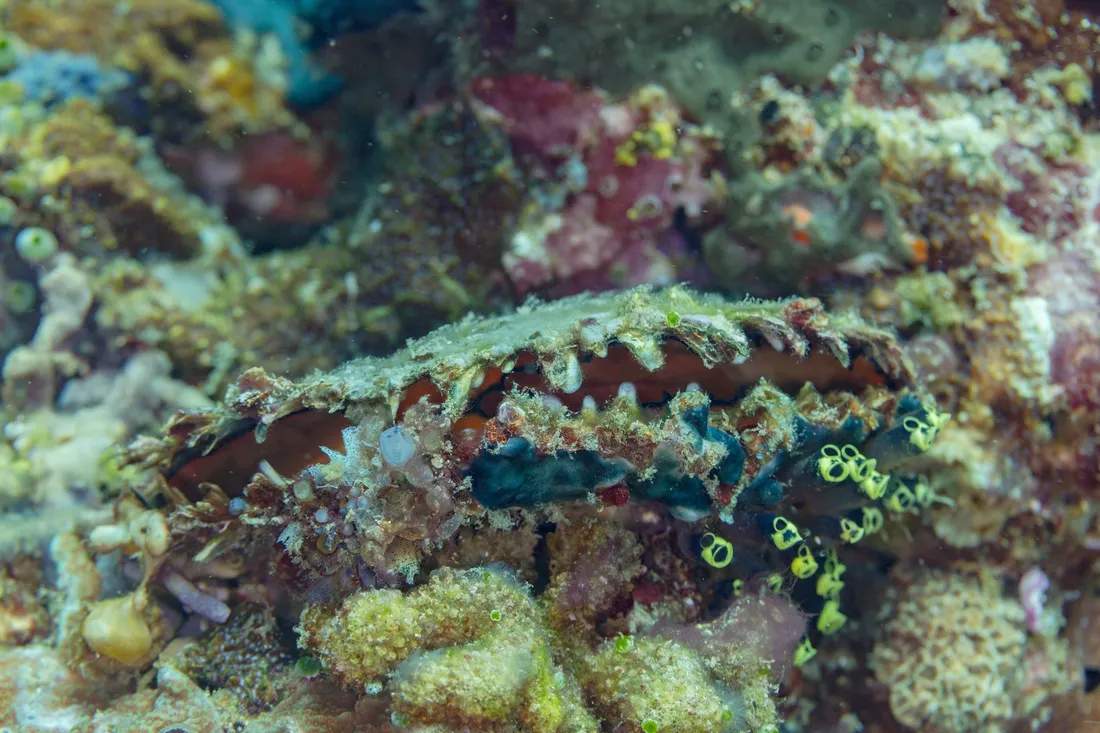
In the ocean, in waters where sunlight fades away and pressure rises with every metre, the struggle to survive begins between the shells of the molluscs. Pearl oysters in fact live not in the deep but in shallow water, from a couple of metres down to about forty; the true pitch darkness is inside the closed shell. And into the shell of one of them, out of the outer world, carried by those hard currents, a foreign guest slips: a tiny parasite that bores its way through the shell. What happens is this: the wound the parasite opens, or some other blow, tears a fragment loose from the thin layer of tissue on the outer face of the animal’s own mantle and drives it deep into the flesh.
When that wound opens in the delicate flesh of the mollusc it is a torment and a threat. An ordinary creature would want to reject that threat; but the divine and tragic reflex in the nature of the oyster takes over. The animal cannot destroy the fragment of tissue that has fallen into its depths; nor can it throw it out. The displaced fragment closes upon itself and builds a small sac, the thing that is called a pearl sac, and the sac begins to secrete inward. And so the oyster takes the most paradoxical decision of its life: to wrap that pain, to make it beautiful, and to turn it into a part of its own self. Literally so: the tissue that weaves the pearl is a piece broken off the animal’s own body.
format_quote"The oyster takes the most paradoxical decision of its life: to wrap that pain, to make it beautiful, and to turn it into a part of its own self."
Hasan Bekmezci
To render this foreign guest harmless the oyster begins to secrete a miraculous fluid from its glands. That fluid is the most flawless microscopic engineering in nature: a perfect matrix in which calcium carbonate, as aragonite crystals, interlocks with an organic protein called conchiolin.
To understand it better, let us look into nature’s workshop. Those microscopic aragonite crystals, filtered out of sea water, are in truth hard, glittering, minute bricks of limestone; alone they are hard but brittle, a raw material rather than a beauty. Conchiolin is the flexible, sticky, organic protein that binds those bricks to one another; like an architect’s mortar, it is the elastic binder that keeps the hard crystals in place and stops them from cracking.
The oyster weaves these two substances in microscopic layers, one upon another, thousands and tens of thousands of times. Think of it as a perfect technique of bricklaying: a course of hard aragonite bricks is laid, a thin course of conchiolin mortar is spread over it, then brick again, then mortar again. Each brick is about half a thousandth of a millimetre thick.
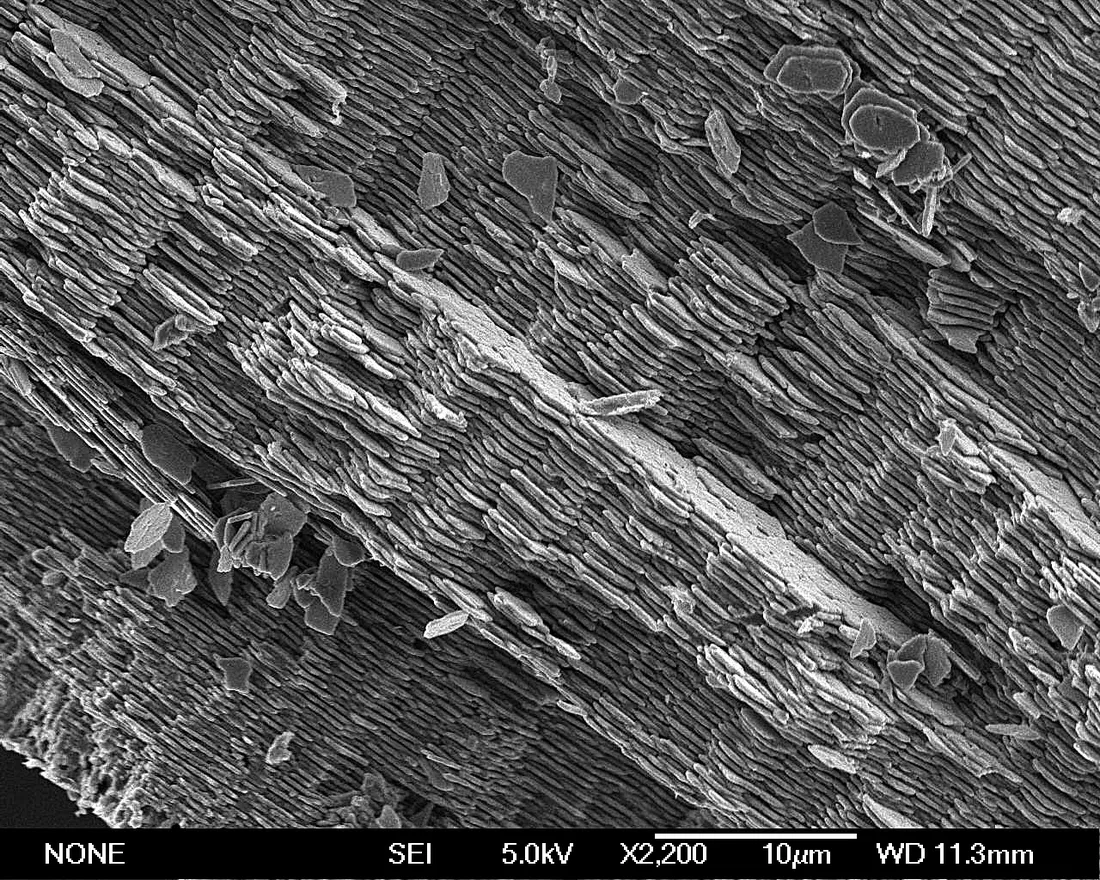
The greatest secret of this flawless matrix, this order, is the relation it builds with light. The layers of nacre are so thin and so regular that their thickness approaches the wavelength of visible light; a single beam filtering in from outside is reflected separately by each of those layers, and those reflections cancel one another at some colours and reinforce one another at others. The nacreous, shifting play of colour our eyes see, those glowing pinks, milky whites and rainbow glints, is in truth light bending and dancing between these crystal layers.
That painful wound left in the dark slowly yields under patience, under time, under this endlessly layering alchemy of nacre. As the years pass, that minute sac turns into a flawless pearl that shines underwater like a piece of the moon, with a shifting play of colour upon it. A pearl is in truth the name of what a wound and a pain become when they are strained through chemistry and time. It is a miracle of existence, woven stubbornly and slowly in the silent pressure of deep seas.
format_quote"A pearl is in truth the name of what a wound and a pain become when they are strained through chemistry and time."
Hasan Bekmezci
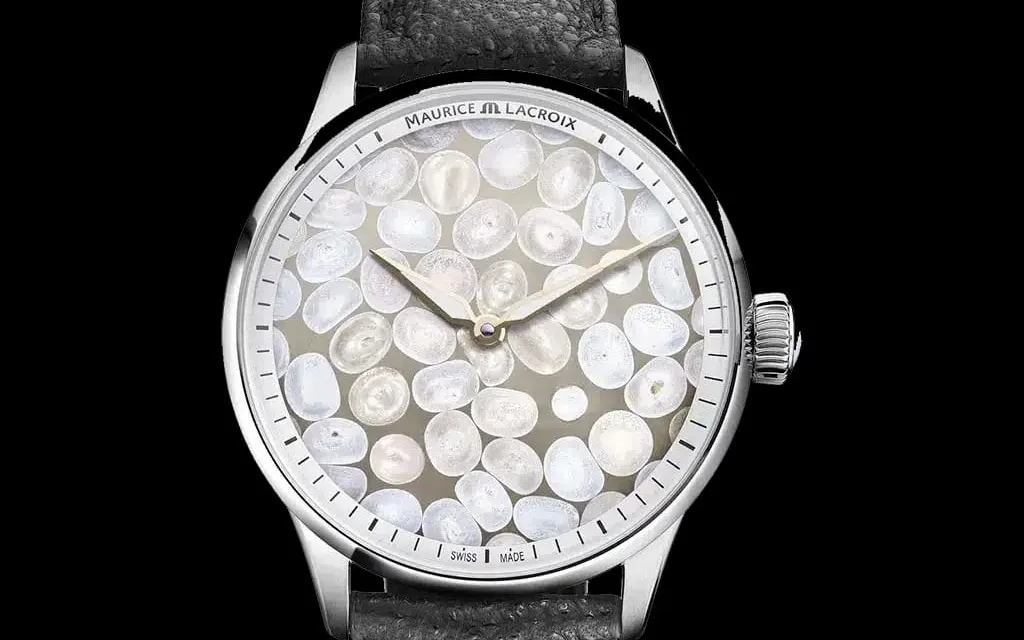
And that miracle of the pearl, made patiently by nature in the sea, has turned into a mechanical poem to be carried on the wrist at the point where the paths of the Swiss watchmaker Maurice Lacroix and the New York artistic duo Ficus Interfaith crossed. Made entirely as a unique piece for the prestigious TimeForArt auction, in support of the art programmes of the Swiss Institute in New York, this masterpiece adapts the pearl’s story from the depths into the craft of watchmaking with a flawless hand. The watch’s full name is the 1975 Master Skeleton, and the ring of its caseback is engraved 1975 Masterpiece, Ficus Interfaith, Maurice Lacroix and Swiss Made 1/1.
On one side the real pearls woven in the darkness of the deep sea, which is to say a wound wrapped in nacre and light broken into colour; on the other the signature terrazzo technique of Ficus Interfaith, which is to say plates of nacre set like mosaic in epoxy resin; and beneath both, the stainless steel case of Maurice Lacroix and its mechanical summit.
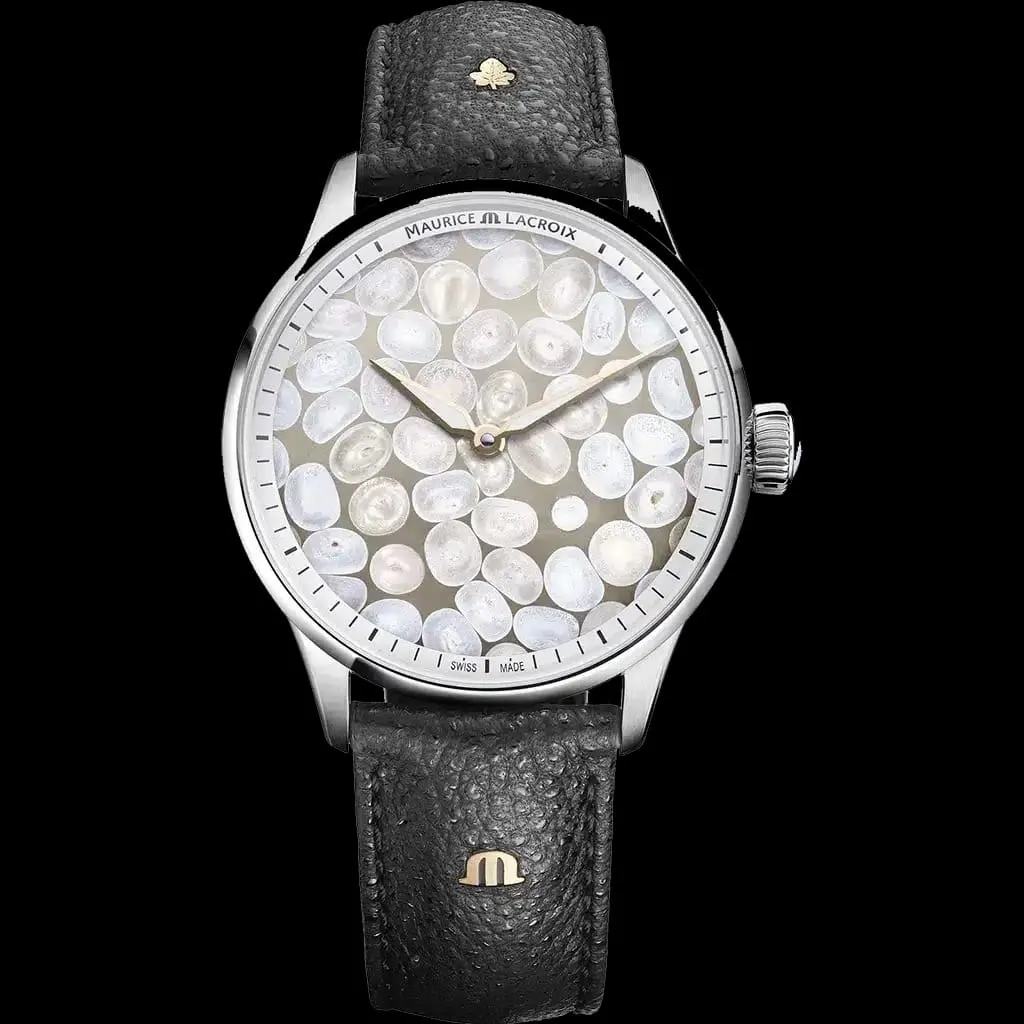
The greatest element that writes this watch into horological history in letters of gold is the radical and singular technique used to make its dial: the terrazzo technique. The innovative New York artistic duo Ficus Interfaith has carried the terrazzo method, used in traditional architectural flooring, down to a microscopic scale, to the scale of a watch dial.
First natural pearls are chosen with care and arranged into a particular composition in the hands of the artists of Ficus Interfaith. Then those pearls are meticulously imprisoned and frozen inside a specially formulated high-strength epoxy resin, exactly as a mollusc secretes its nacre. And at last that hardened, revolutionary block is cut by craftsmen into ultra-thin plates and polished by hand until its surface reaches a mirror smoothness.
The dial that results is a living ocean surface on which the nacreous, milky, shifting interiors of the pearls interlock like mosaic and change colour with the angle of the light. Every single piece is an unrepeatable painting made jointly by nature and the human hand. And this surface is translucent: between the pearls, the wheels of the ML234 skeleton calibre lying below show faintly through.
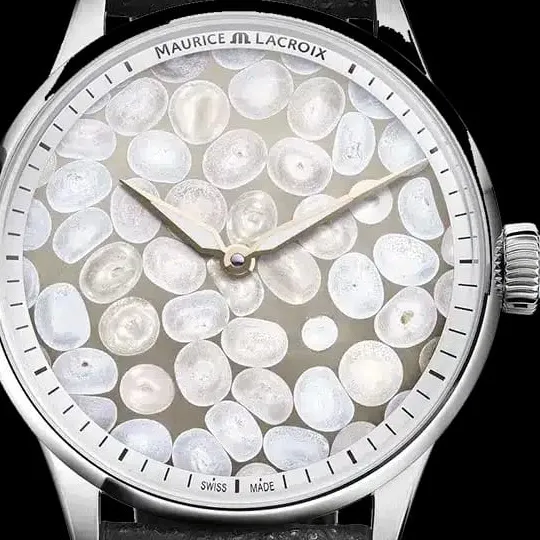
format_quote"Every single piece is an unrepeatable painting made jointly by nature and the human hand."
Hasan Bekmezci
In this meeting of art and mechanics, Maurice Lacroix frames the organic, untamed aesthetic that Ficus Interfaith offers within a flawless Swiss engineering. The stainless steel case, with its elegant lines, provides a minimalist architecture that brings the complex and mesmerising pearl texture of the dial forward without smothering it; it is forty-three millimetres across, 12.95 millimetres thick, and water resistant to fifty metres.
The fine touches in the detail of the strap, and the brand’s own sense of aesthetics, turn the watch from a mere measurer of time into a contemporary sculpture carried on the wrist. The strap is made in Japan by an old method that adds several hand-applied coats of lacquer to a traditional tanning; the glittering, raised surface they call black diamond comes from that. Beneath the caseback the self-winding ML234 skeleton calibre turns for fifty hours and shows the hours and the minutes alone; and the cabochon-cut pearl on top of the crown carries the story of the dial out beyond the case.
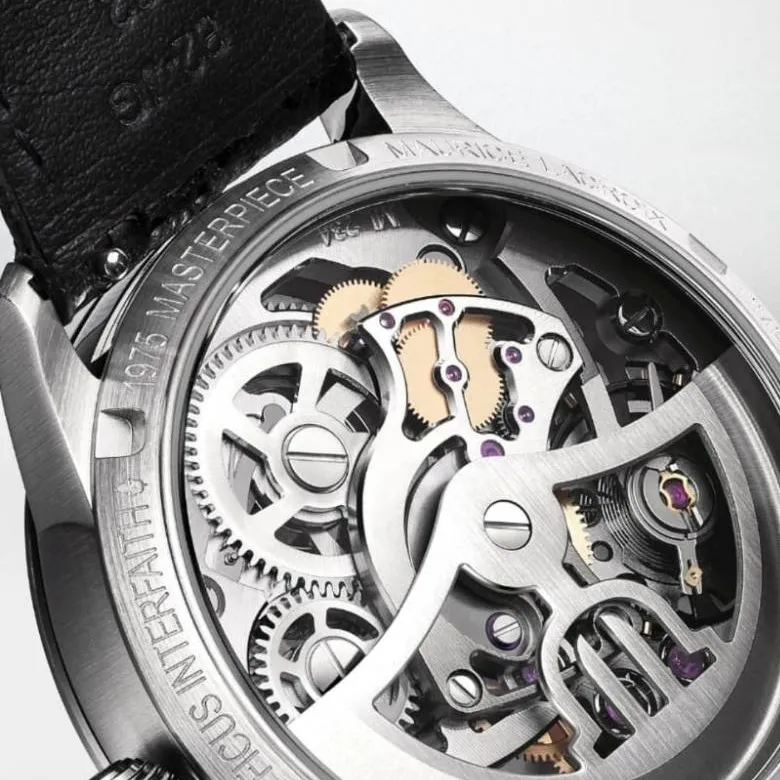
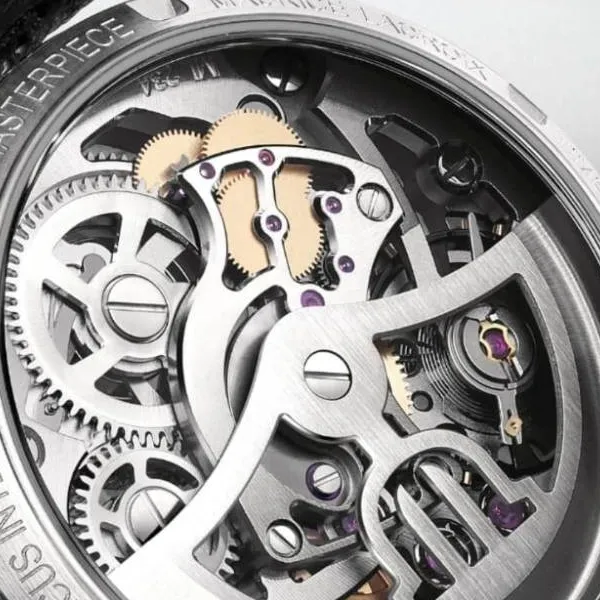
One of them is the alchemy of nacre, the layers of calcium carbonate and conchiolin wound around a foreign grain inside the dark and silent shell of the ocean; the other is the rebirth of that nacre as a dial that defies time, through the terrazzo technique of Ficus Interfaith and the craft of Maurice Lacroix.
The Pearl Buoy is an absolute artistic triumph, made for observers who have not lost the faculty of wonder and who want to carry the beauty hidden in the depths of the cosmos on their wrist.
The watch, with its full specification: Maurice Lacroix 1975 Master Skeleton x Ficus Interfaith Pearl Buoy