format_quote"In Edo the length of an hour was not fixed: an hour of summer daylight was longer than an hour of winter daylight. So for the runners of the Tōkaidō the only meaningful question was never "what time is it" but "how long did it take". That second question is the chronograph’s entire trade."
PART I: DAYBREAK AT NIHONBASHI
A September morning in 1843. The planks of the Nihonbashi bridge still held the dew. Sōhachi was twenty-one, and inside the lacquered box on his back were three sealed letters belonging to a rice merchant in Osaka. The bell in the Kokuchō tower struck again and again, and the city woke. Sōhachi pulled the strap of the box over his shoulder, tapped the stone at the eastern end of the bridge once, and began to run.
His trade was called hikyaku: flying foot. The Tōkaidō, which tied Edo to Kyoto, ran some five hundred kilometres through fifty-three post stations. An ordinary traveller took two weeks over it. The hikyaku did not travel the road; he shared it out. At every station the box passed to the next man, the tired one stopped and the rested one sprang away. That is how the express post, the haya-hikyaku, could close the same distance in three and a half days, and by the middle of the nineteenth century some runs were down to two. The box never slept. Only the man carrying it did.
When Sōhachi reached Hakone, Kihei, the station keeper, was sitting outside the door. Before he took the box, the old man asked his usual question.
"How many hours did it take you?"
"I do not know," said Sōhachi, his breath still uneven. "The bell struck six when I left. I heard nine as I came in. But the bell of Odawara does not say the same thing as the bell of Edo."
Kihei laughed. "Nor should it. In this country the hour is the sun’s business. They divide the span from sunrise to sunset into six, and the night into another six. So an hour of daylight is long in summer and short in winter. An hour in Kyoto is not even the same length as an hour in Edo, because the sun rises there on a different minute."
format_quote"In this country the hour is the sun’s business. If what you measured was the name of the hour, you have measured nothing."
"Then what am I measuring?" the young man asked.
"The difference," said Kihei. "If what you measured was the name of the hour, you have measured nothing, because that name is different at every point of the road and in every month of the year. But measure the difference between two moments and the difference holds everywhere. A merchant will never ask you at what hour you arrived. He asks in how many days."
The craftsmen of the period solved this strange system mechanically, in the Japanese clocks called wadokei: some with two separate escapements, one set for the day and one for the night; others with movable hour numerals that were slid along by hand as the seasons turned. The post stations had a simpler method: an incense stick that burned at a known rate. The length that had burned away gave the time that had passed. A time with no name, only a length.
Sōhachi had no need to know what the fields beside the road were as he crossed the Musashino plain, but those fields carry the second half of this article. A low plant with small white flowers grew there, and its roots were dug in autumn.
PART II: THE ROOT OF MURASAKI
Murasaki, the Japanese word for purple, is first of all the name of a plant: Lithospermum erythrorhizon. Its leaves are unremarkable and its flowers small and white; the value is in the roots. They are lifted in autumn, dried for two or three months, ground and prepared for the dye bath; silk is mordanted in ash lye and then dipped again and again. The colour does not arrive in one dip, it arrives in layers. The quantity of root needed to saturate a bolt of silk is the one hard fact that kept purple expensive throughout history.
Purple was therefore a colour of rank in Japan for centuries. Under the ranking system established at the start of the seventh century it belonged to the highest grade, and it stood among the shades closed to ordinary use. During the Edo period (1603 to 1868) the plant was farmed on a large scale on the Musashino plain west of present-day Tokyo. The purple of Kyoto leaned towards red; that of Edo leaned towards blue. The difference lay in the water, the ash and the habit. In time that bluish purple became the signature of a city: Edo murasaki, Edo purple.
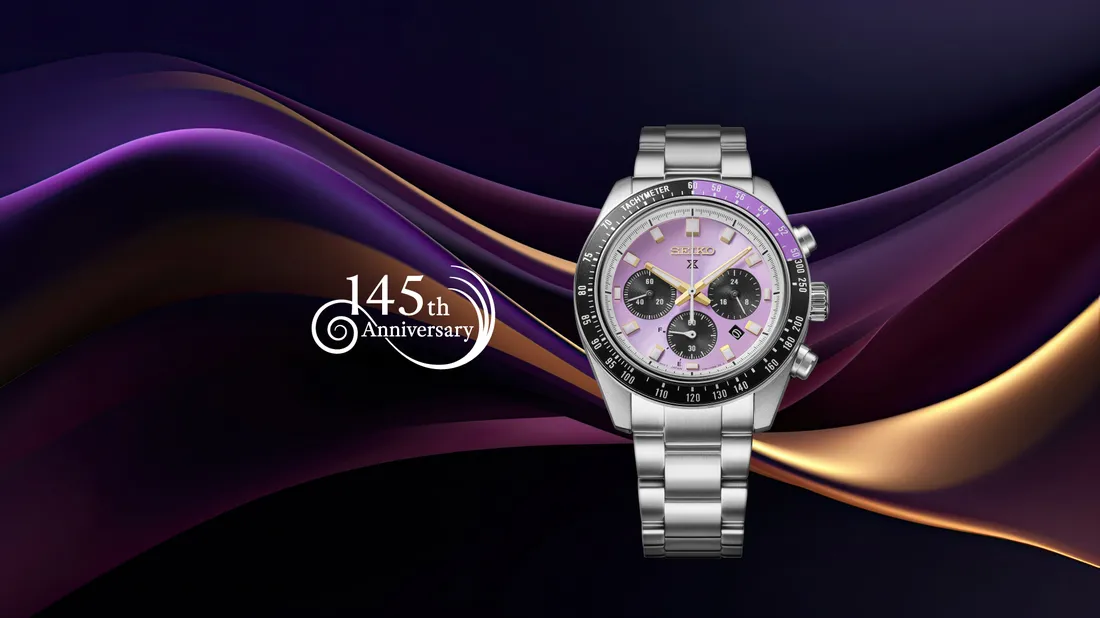
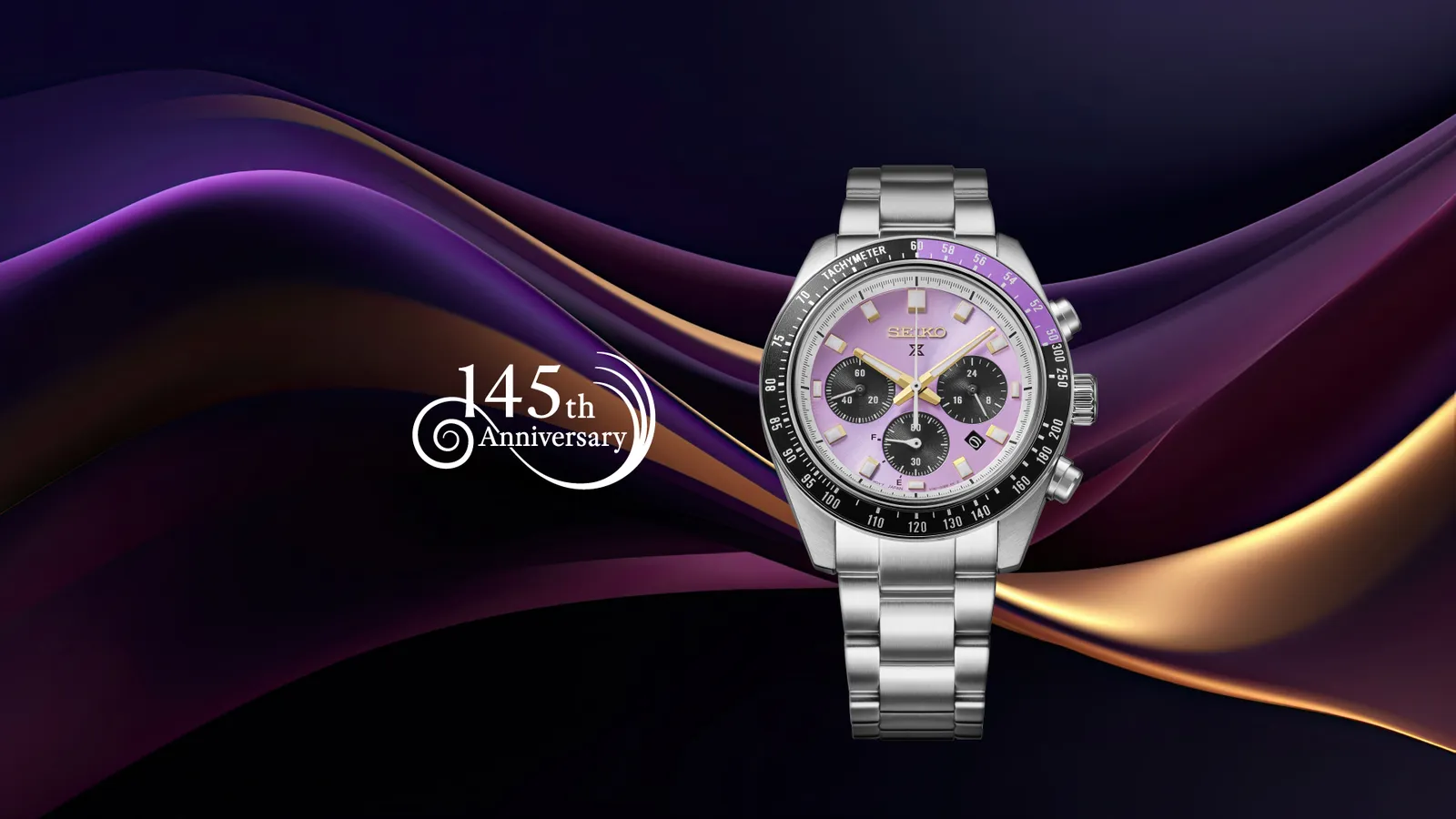
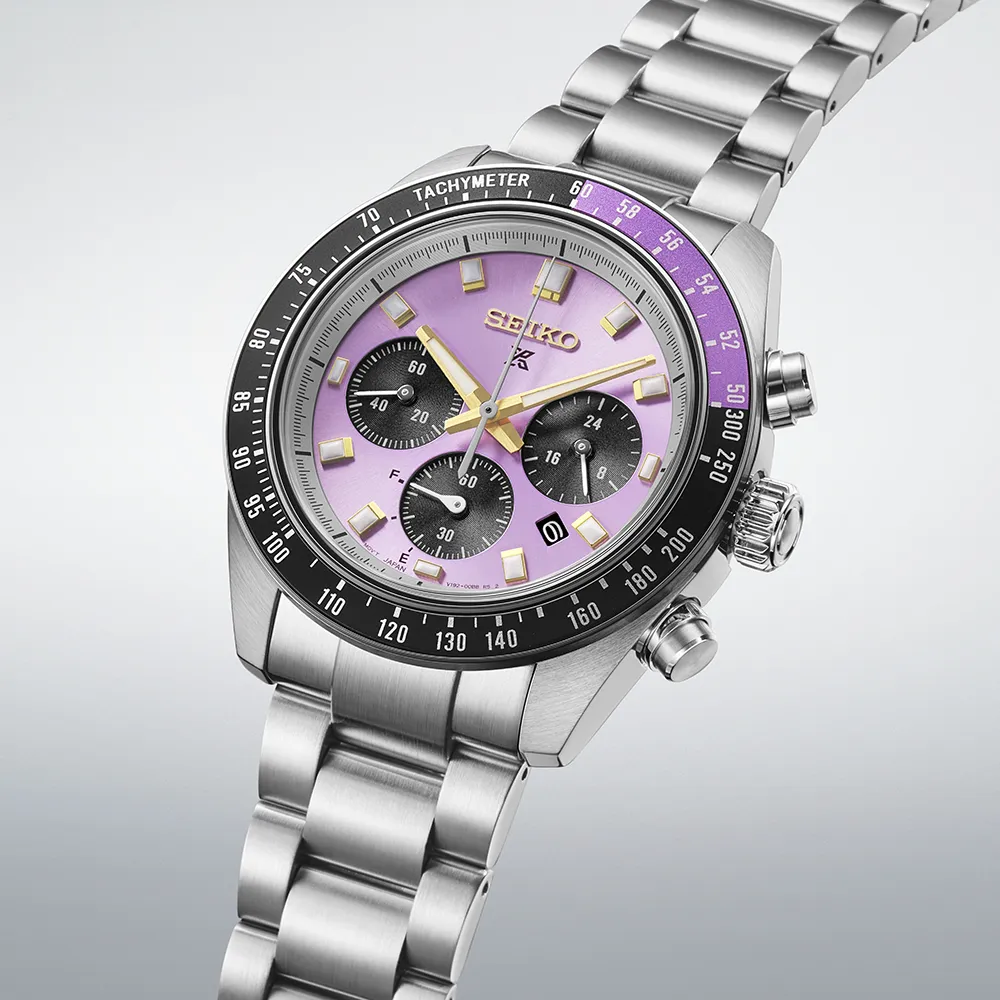
Seiko’s choice of that colour is not decoration but the declaration of an address. In 1881, at the age of twenty-one, Kintarō Hattori opened a watch shop in the Ginza district of Tokyo. The company turned 145 in 2026, and six limited editions were prepared for that birthday, all of them sharing Edo purple. Ginza is a short walk from Nihonbashi. The bridge Sōhachi ran across and the shop where this watch was born stand in the same neighbourhood.
PART III: GINZA, 2026
Two people are sitting in a coffee shop in Ginza. Watanabe is retired now; in 1964 he was on Seiko’s timing team at the Tokyo Olympics. Across from him, Aoi takes lap times at Fuji Speedway. A chronograph with a purple dial lies on the table.
"What is this thing descended from?" Aoi asks.
"Two ancestors," says Watanabe. "One is 1964. We were the official timekeeper of the Games that year, and for the first time the whole measuring chain ran on electronics and printed results; the judge’s memory was taken out of the circuit. That same year Seiko released its first wrist chronograph. The other ancestor is 1969: calibre 6139, one of the first self-winding chronographs in the world, and the source of the name Speed-Timer. The Prospex Speedtimer is the child of those two dates."
Aoi turns the watch over. There is no battery hatch in the case back.
"There is a V192 in there," says Watanabe. "Solar. The dial works as a window onto a cell beneath it, and it does not need the sun; a desk lamp will do. Fully charged, it runs about six months in the dark. For a chronograph that matters more than it sounds. On a mechanical chronograph every minute you leave the counter running is eaten out of the mainspring; on a light-driven one there is no such budget. You can leave the counter open as long as you like."
"And the accuracy?"
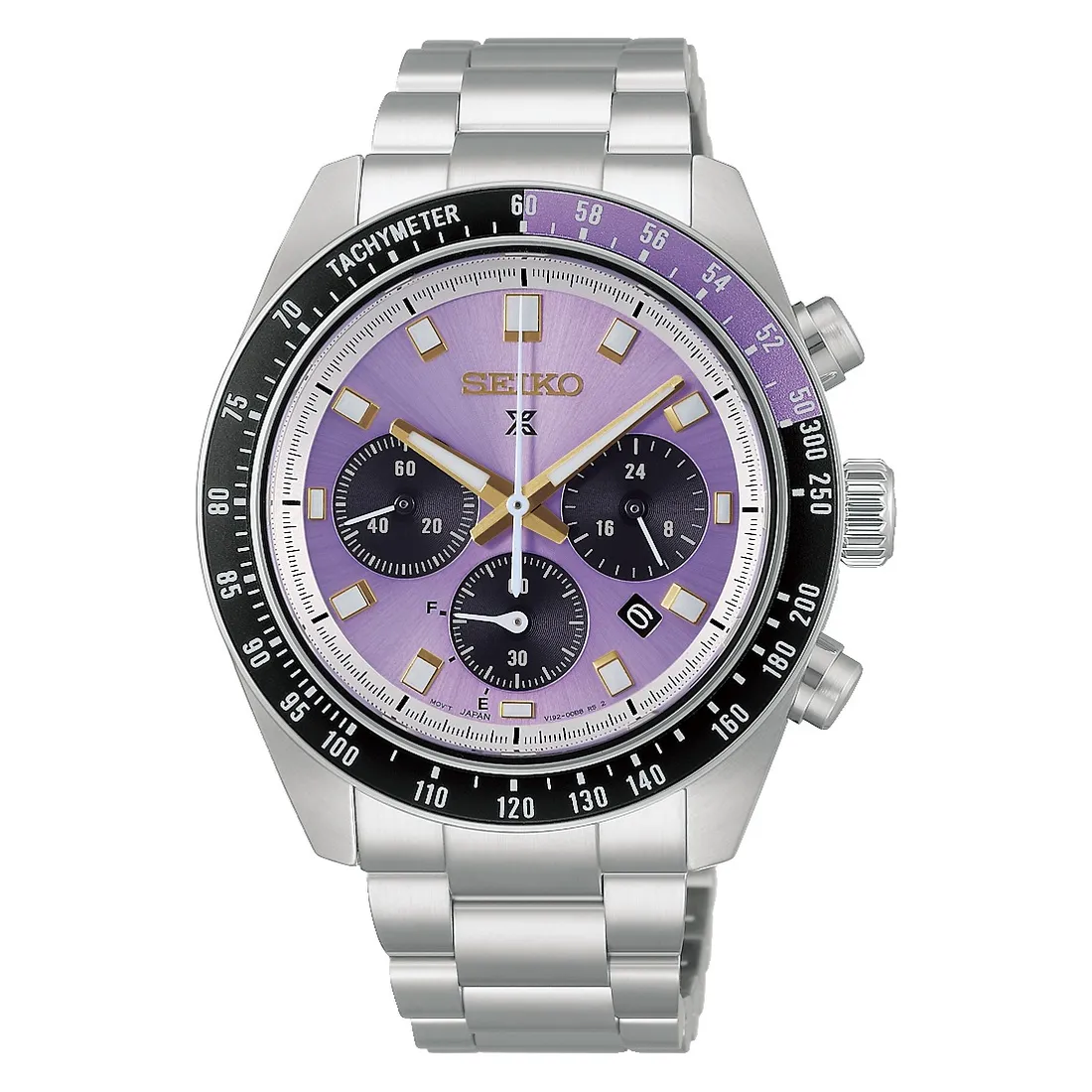
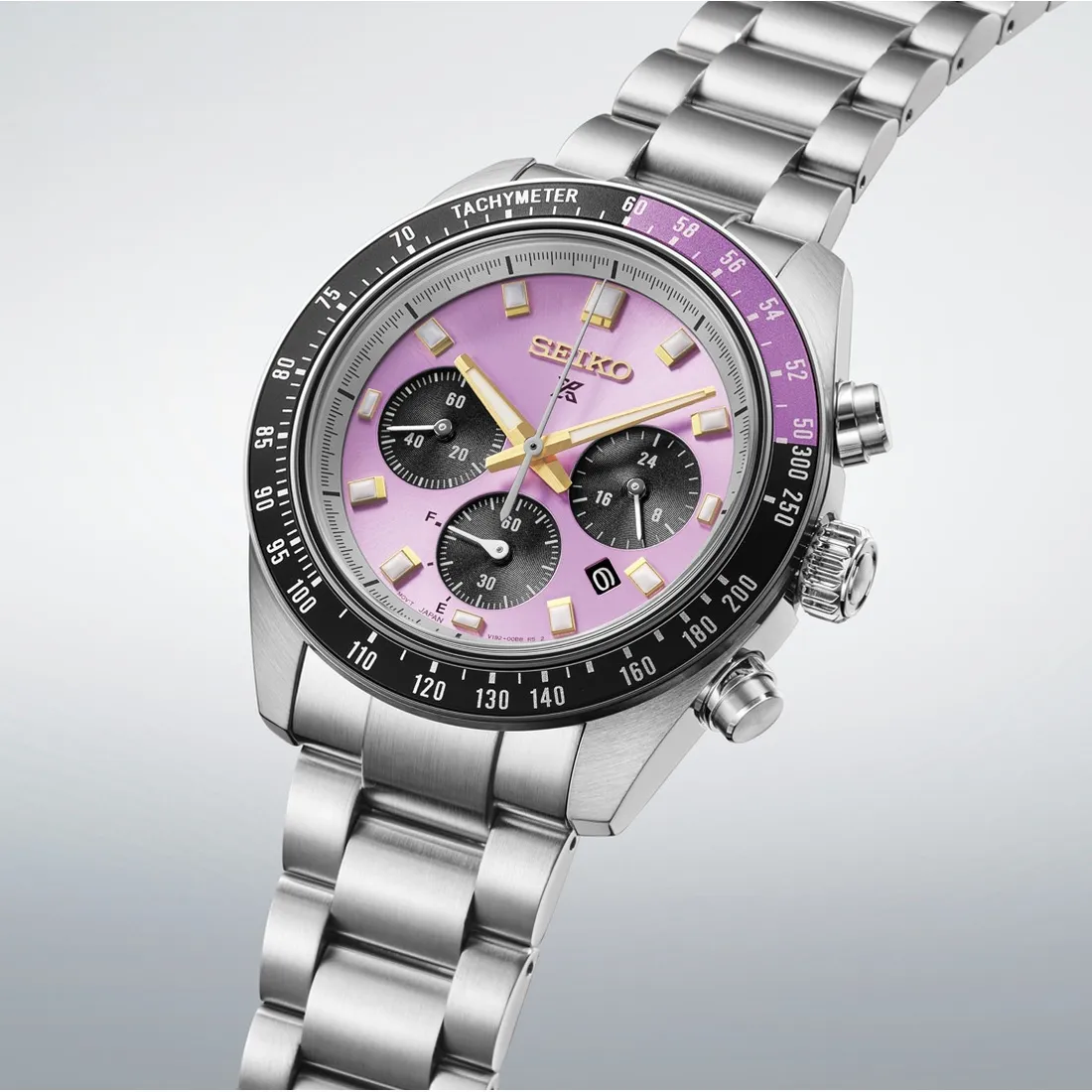
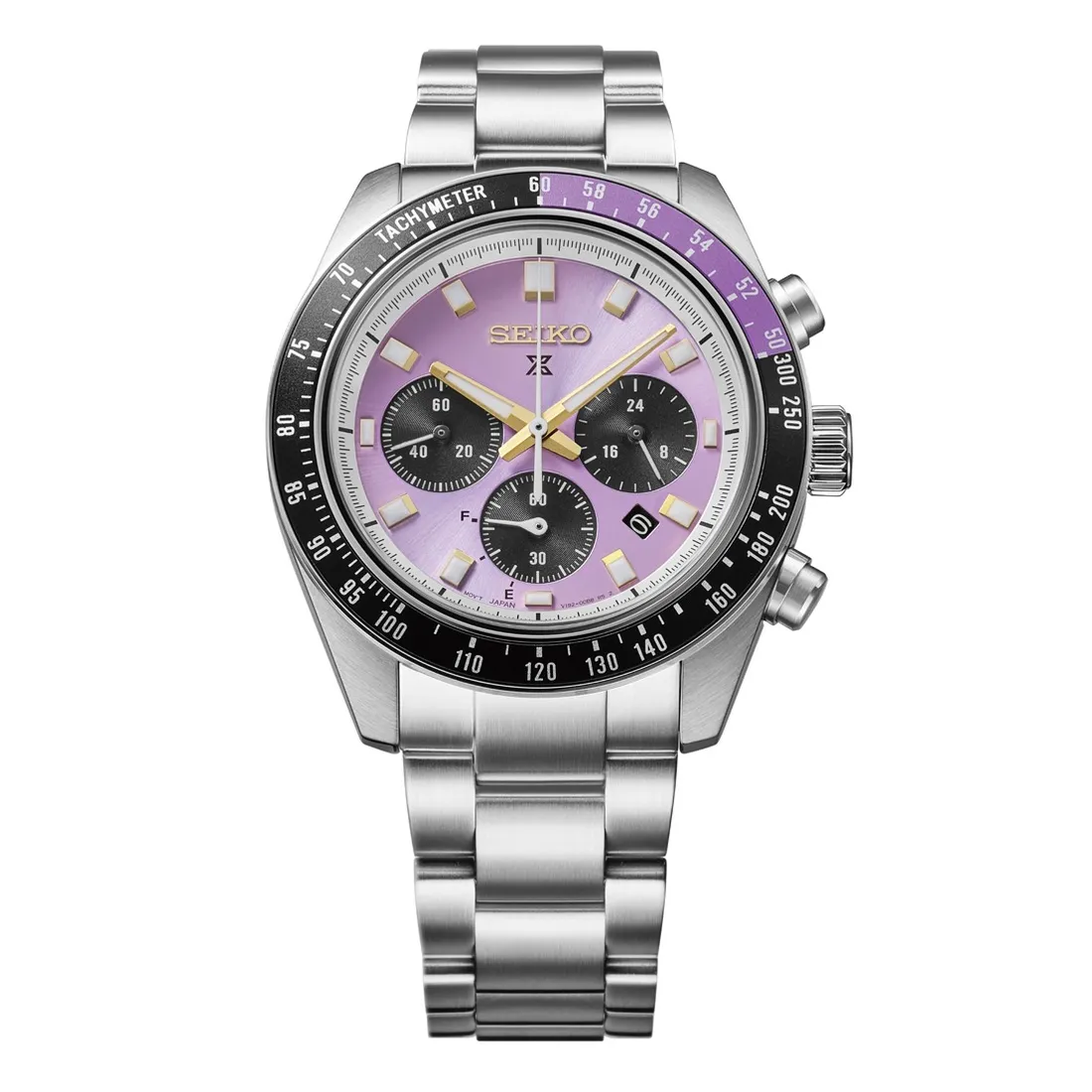
"Plus or minus fifteen seconds a month. The chronograph measures up to sixty minutes and reads in fifth-of-a-second steps. The register at nine adds up the minutes, the dial at three is a twenty-four hour indication, and the small seconds at six doubles as the charge gauge: F is full, E is empty."
format_quote"On a mechanical chronograph every minute you leave the counter running is eaten out of the mainspring; on a light-driven one there is no such budget."
"So is the purple section of the bezel just decoration?" Aoi asks.
"Not decoration, a working zone," says Watanabe. "The bezel carries a tachymeter. Time a distance of one kilometre with the chronograph and the number where the hand stops gives you your speed per hour. The scale starts at sixty and crowds together as speed rises. The purple covers exactly those first fifteen seconds, which is to say the highest speeds. In a race that is where your eye goes first. The colour has been put on the fastest end of the scale."
"And purple is your 145 years."
Watanabe nods. "A century ago they dug roots out of the ground to get this colour. Now we anodise it onto an aluminium ring. What changed is not the colour but the road to it."
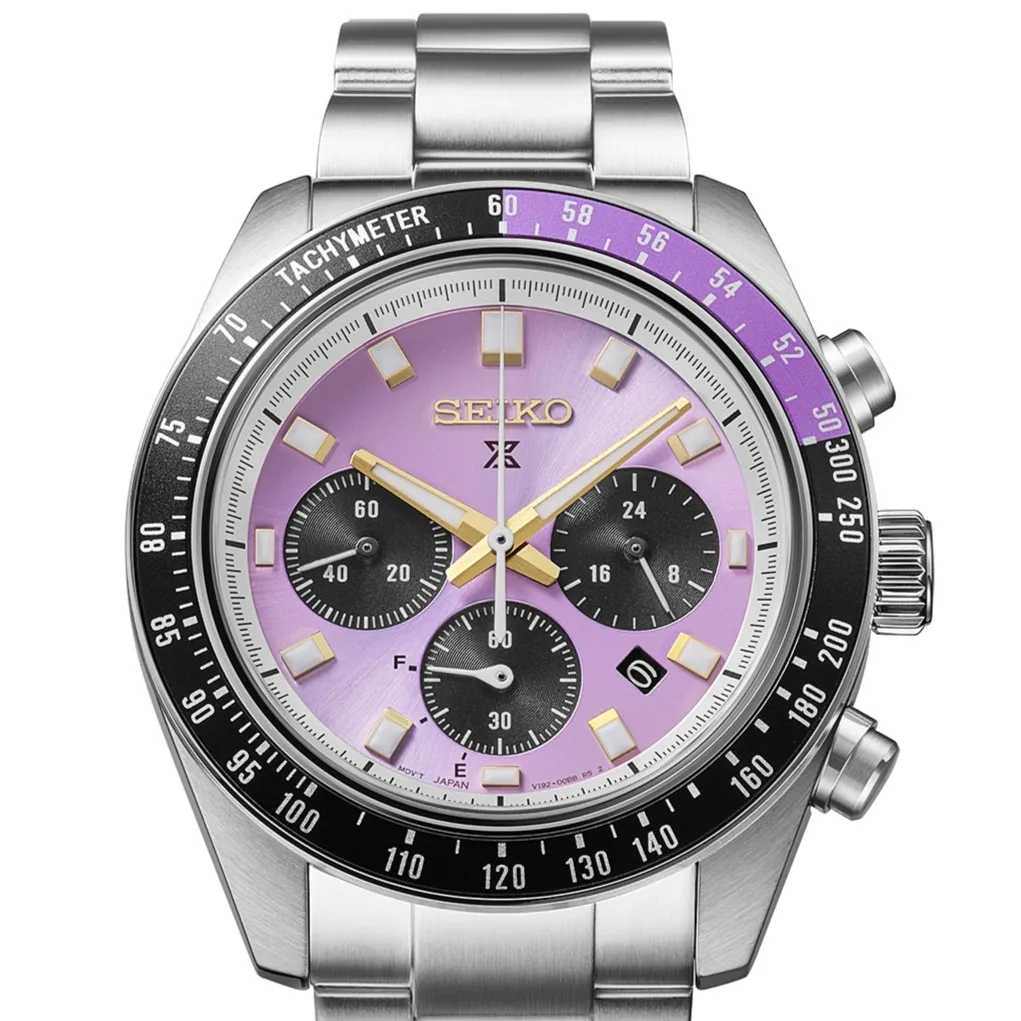
The case is 41.4 mm across and 13.0 mm thick, and measures 45.9 mm from lug to lug, which makes it sit more modestly than the figures imply. The domed sapphire crystal is anti-reflective coated on its inner surface. Water resistance is ten bar, a hundred metres; the case back screws down and carries the words LIMITED EDITION. Magnetic resistance is 4,800 A/m. The hour and minute hands and the indices are filled with LumiBrite. The steel bracelet is 21 mm wide and closes on a three-fold clasp with a push-button release.
PART IV: THE RECORD
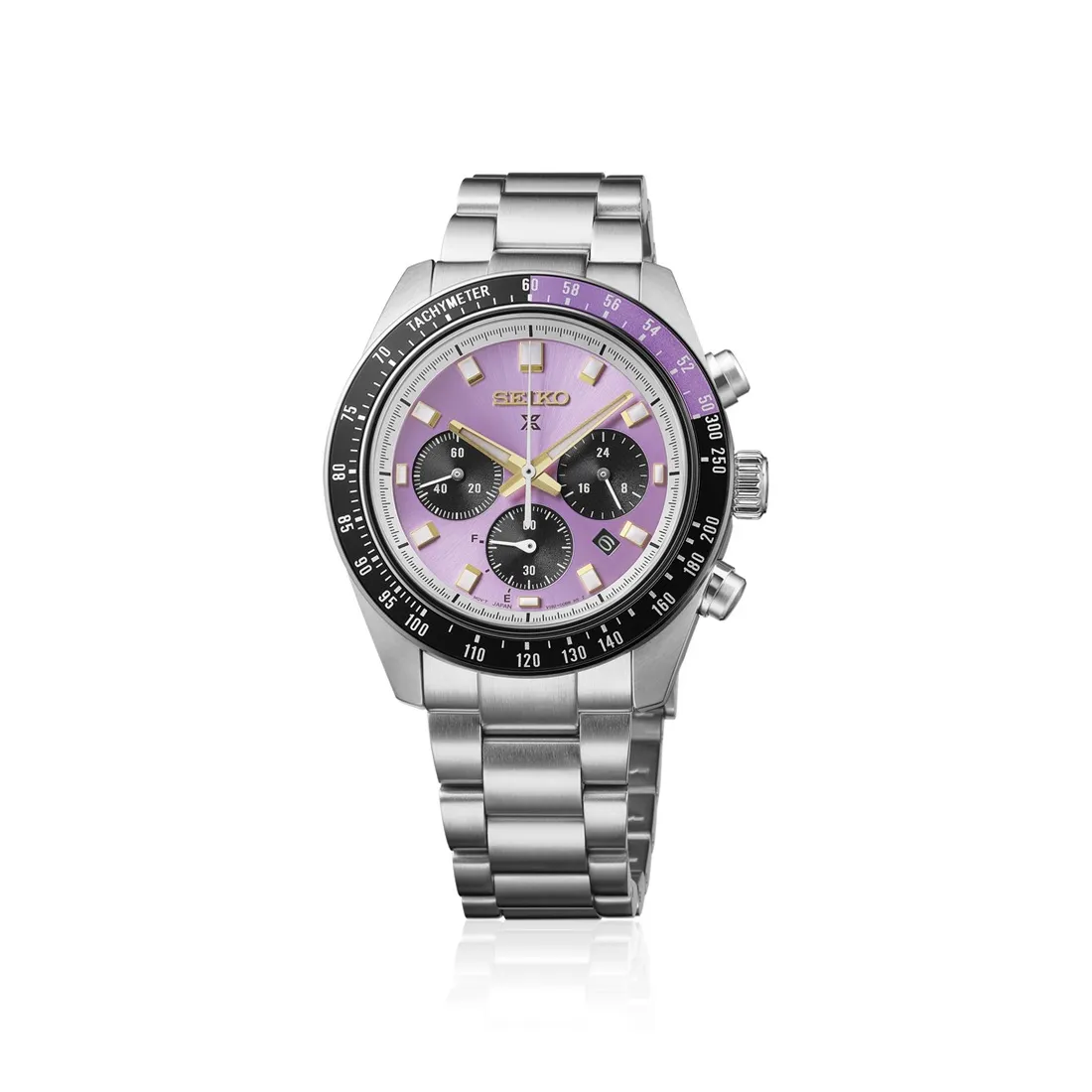
Model: Seiko Prospex Speedtimer Solar Chronograph, reference HBJ005 (HBJ005P1).
Limited edition: Seiko 145th Anniversary Limited Edition, 8,000 pieces; LIMITED EDITION engraved on the case back.
Movement: calibre V192, solar powered, approximately six months of running from a full charge; accuracy plus or minus fifteen seconds a month.
Functions: chronograph to sixty minutes, read in fifth-of-a-second steps; twenty-four hour indication; small seconds doubling as a charge gauge; date; tachymeter scale.
Case: stainless steel, 41.4 mm diameter, 13.0 mm thick, 45.9 mm lug to lug.
Crystal: domed sapphire with anti-reflective coating on the inner surface.
Dial and bezel: Edo purple sunray dial with gold-coloured accents; two-tone black and purple aluminium tachymeter bezel.
Durability: 10 bar (100 metres) water resistance, 4,800 A/m magnetic resistance, screw-down case back.
Bracelet: 21 mm steel bracelet with a three-fold push-button clasp; LumiBrite on the hands and indices.
Availability: October 2026, around USD 750 / EUR 790.
When Sōhachi’s box reached Osaka nobody asked him at what hour he had arrived. They asked in how many days. A hundred and eighty years later, the watchmaker of that same city builds an instrument that reads the answer to the same question down to a fifth of a second, and finishes it in the colour of a plant whose dye comes out of its roots. All the distance in between is only the same question, measured more finely.
format_quote"Nobody asked him at what hour he had arrived. They asked in how many days."
Hasan Bekmezci