In a Garage Smelling of Oil: The Call of the Road
On the edge of the city, the old stone garage smelled of oil, leather and warm metal in the late afternoon sun. Under a single hanging bulb stood a 1960s sports car, its bodywork freshly polished; with its long nose, flowing fenders and low stance, it looked as though it were still speeding. Vincent, the master restorer, had been bringing such cars back to life for thirty years. He straightened up from under the hood, wiped his brow and dried his hands on an oily cloth.
His young apprentice Théo had drifted off into the light glancing off the chrome headlamps. Théo once thought watches were mere jewellery, objects of show; that was before he walked into this garage. Here he was learning that time, like an engine, is born of parts, of oil and of patience.
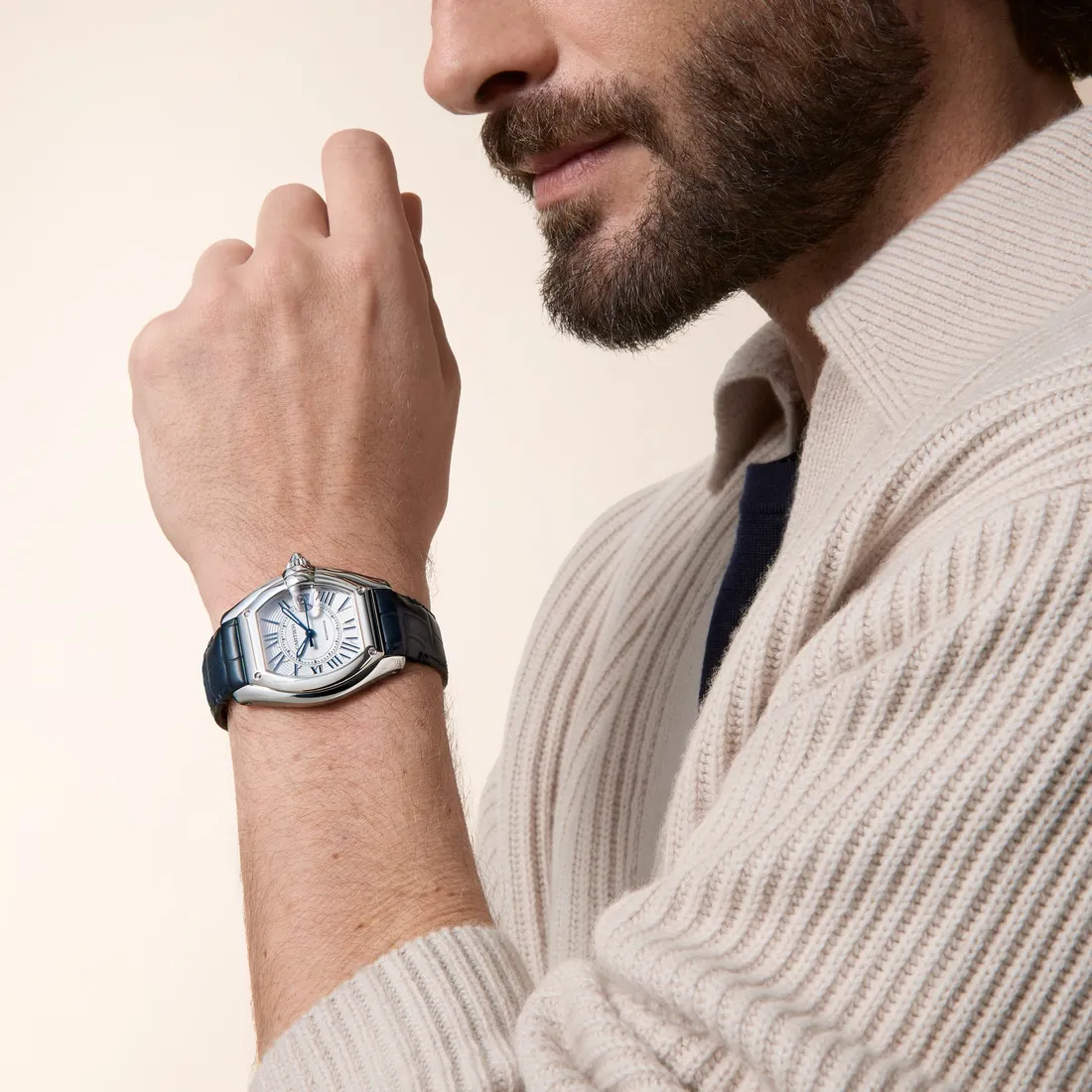
'This car carries the soul of an era,' said Vincent, running his hand along the hood. 'Chrome, leather, the open road and the feeling of belonging to nothing. People called it freedom.' Théo came closer, and just then his eye caught the watch on his master's wrist: barrel-shaped, gently curved, with a ring of numerals around the dial that recalled a speedometer.
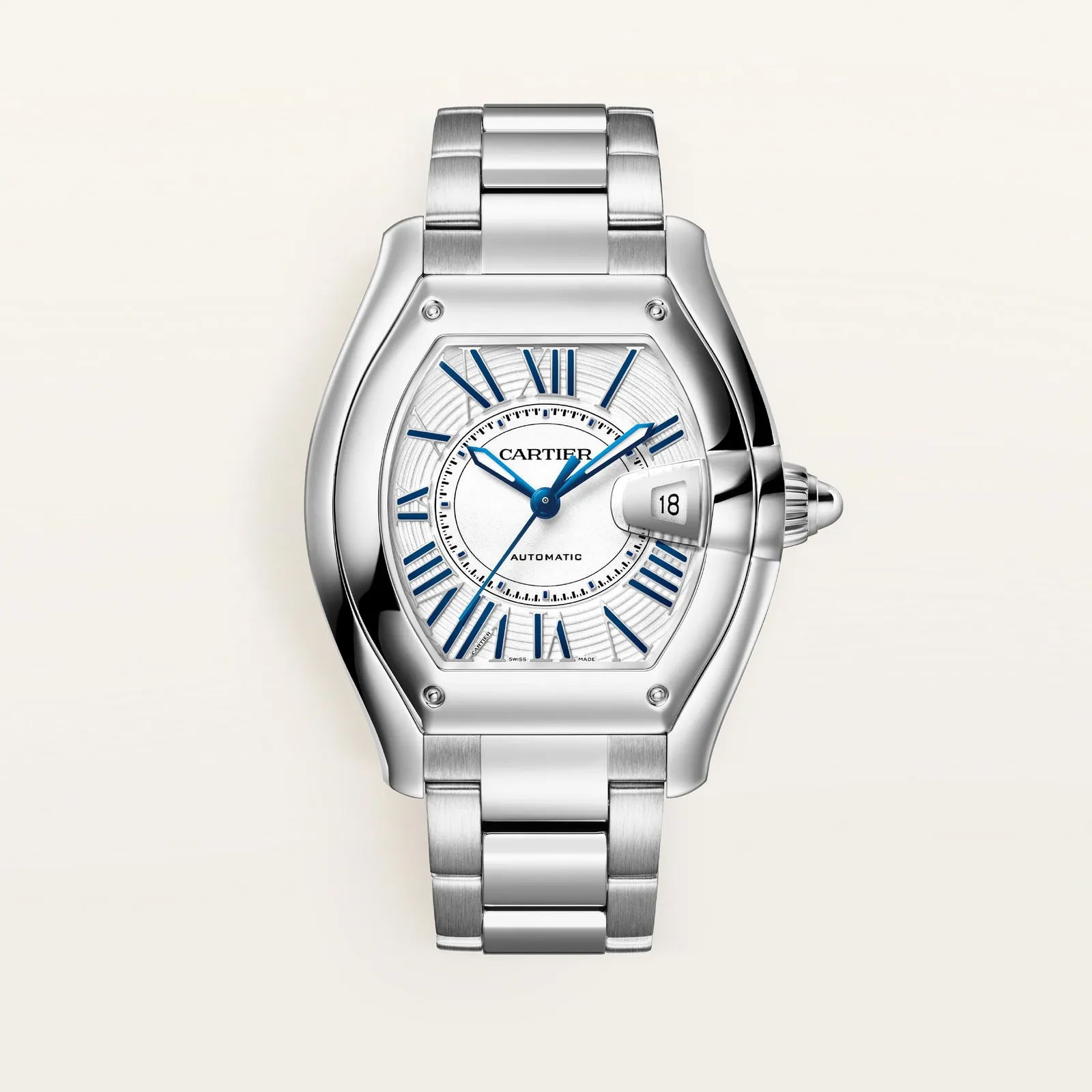
'Master,' he said hesitantly, 'that watch looks just like this car.' Vincent smiled and slipped it off his wrist. 'Good eye, son. This is the Roadster, a legend Cartier brought back to life in 2026. Even the name is no accident: a roadster is an open, two-seat sports car built purely for the pleasure of the road. Cartier took that word, and that spirit, and carried it onto the wrist.'
format_quote"The Roadster is not the name of a watch; it is the name of a longing for the open road, for speed, for freedom."
Vincent
The Soul of an Automobile: The Language of the Dial
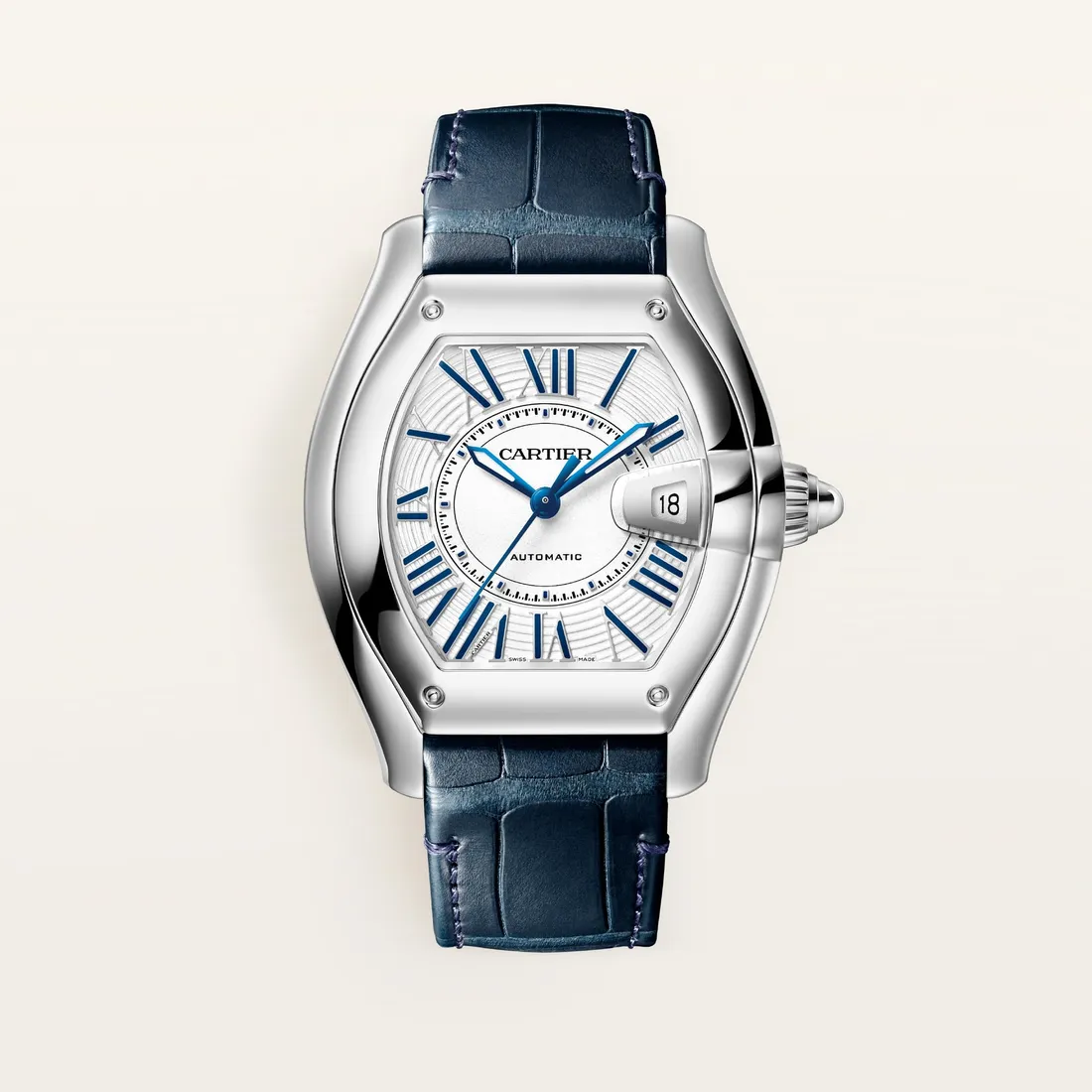
Vincent laid the watch in Théo's palm. 'Look closely,' he said. 'The case is a barrel, a tonneau shape. It has no sharp corners; it wraps the wrist like the body of a car cutting through the wind. Making a watch round or square is easy; capturing this soft, flowing line takes real craft.'
'Now look at that thin ring of numerals at the edge of the dial,' he went on. 'It is called the minute track, but Cartier drew it in the spirit of a car's speedometer. The figures are as clear and bold as those on a dashboard. And the large Roman numerals can be read at a single glance in daylight; a driver cannot take his eyes off the road for more than a second to read the time.'
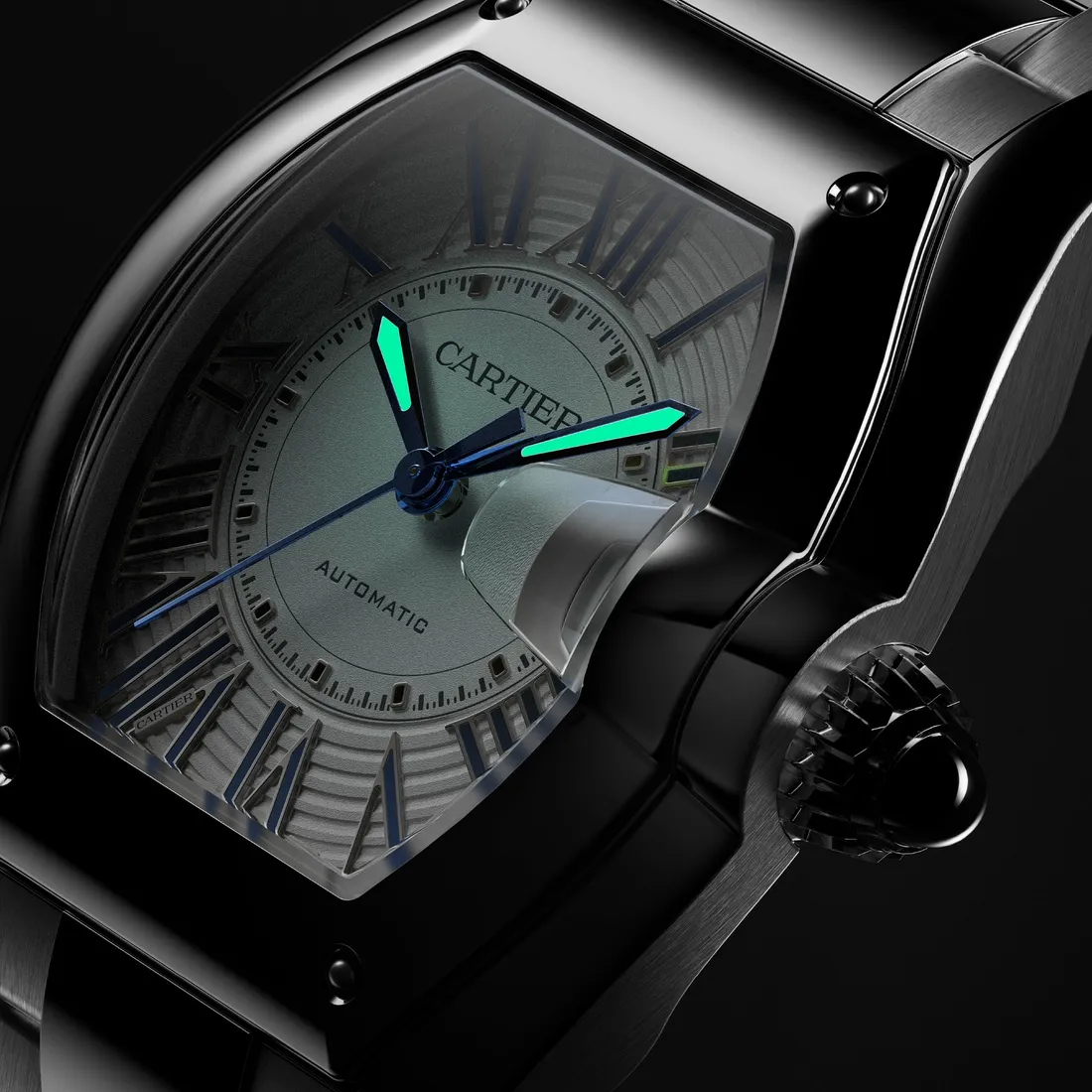
Théo held the watch up to the light. 'And the little window at three?' 'That is the date,' said Vincent, 'and there is a magnifier over it. A tiny lens set into the glass enlarges the figure and makes it legible, like a detail read beneath an instrument crystal. The blued, sword-shaped hour and minute hands are another century-old Cartier signature. And there is a secret woven among the numerals: Cartier loves to hide its own name in the language of the dial.'
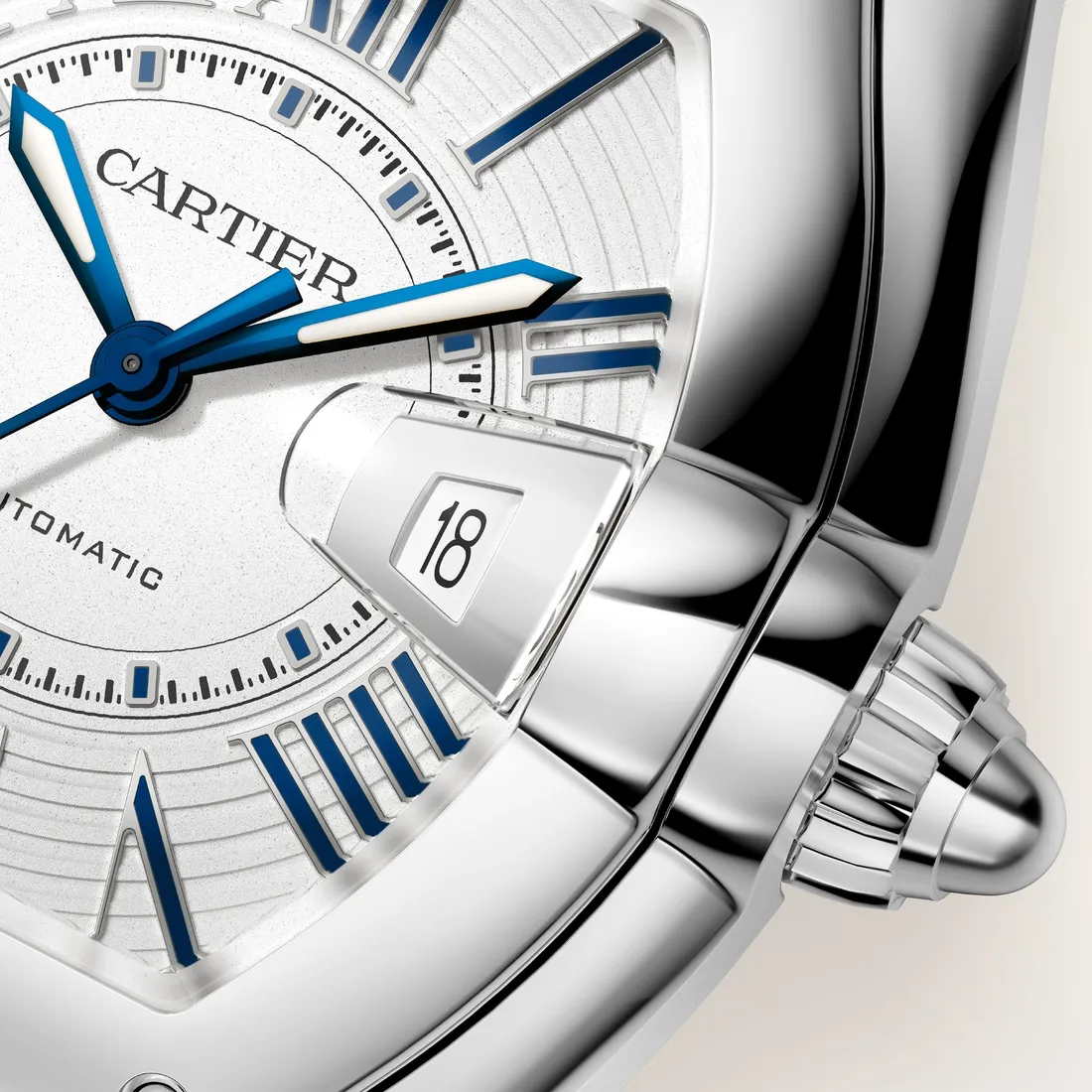
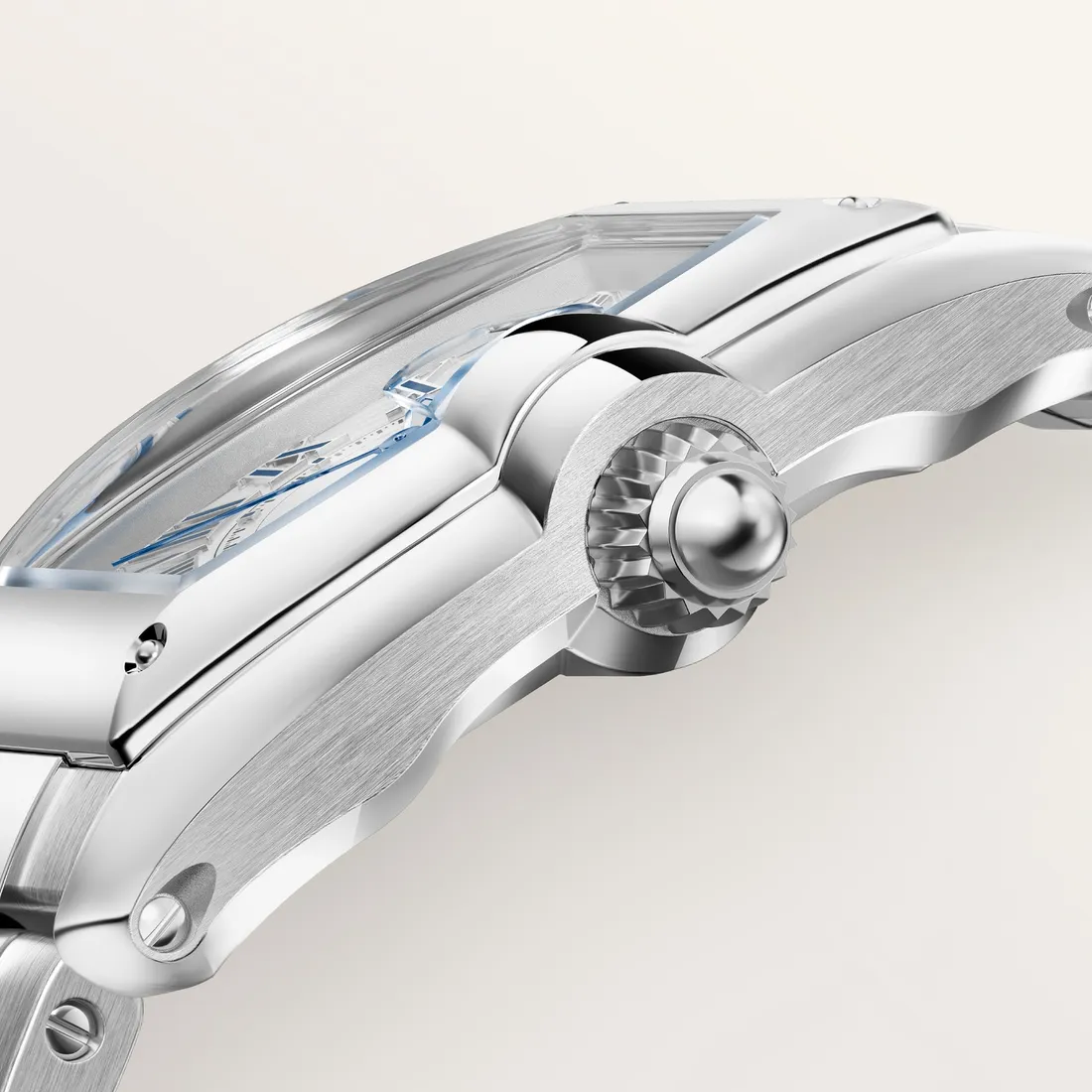
'But here is the detail that truly makes a Roadster a Roadster,' said Vincent, moving his finger to the crown. 'Look at this conical, torpedo-like winding crown. At its tip sits a blue stone: a polished, round-cut cabochon. That cabochon is a signature Cartier has carried since 1906. Every time your hand reaches for it, it feels like touching a gear knob. Here Cartier has turned a watch into a driver's cockpit: every detail designed to be touched, and to be driven.'
format_quote"True design is that bold character which lets you recognise an object at the very first glance."
Vincent
The Driver's Cockpit: The Heart and the Handling
'An engine is what makes a car,' said Théo, now caught up in the thrill of learning. Vincent nodded. 'Right. And in the chest of this watch beats a Cartier-made automatic calibre: the 1847 MC in the Large, the 1899 MC in the Medium. Those letters, MC, stand for Manufacture Cartier; the movement is not bought in from outside, but designed and built under Cartier's own roof. Automatic means this: with every motion of your wrist a rotor turns inside and winds the mainspring on its own. You never wind it by hand each day; as long as you live, it lives.'
'And how does the strap come off?' asked Théo. Vincent turned the watch over. 'This is my favourite part. Beneath the strap is a hidden mechanism called QuickSwitch. You press a small tab and the strap releases in seconds, with no tool at all. In the morning you wear steel to the office, in the evening you switch to alligator for dinner. One watch, two souls.'
'And do not forget,' he added, 'beneath all this elegance is a sturdy heart: water resistant to 100 metres. It comes in steel, two-tone and yellow gold, in two sizes of 38 and 34.9 millimetres. A slim wrist or a large hand: the Roadster offers everyone that dashboard clarity.'
format_quote"A good movement is like a good engine: you never see it, yet you feel it at every moment."
Vincent
From 2002 to 2026: The Return of an Icon
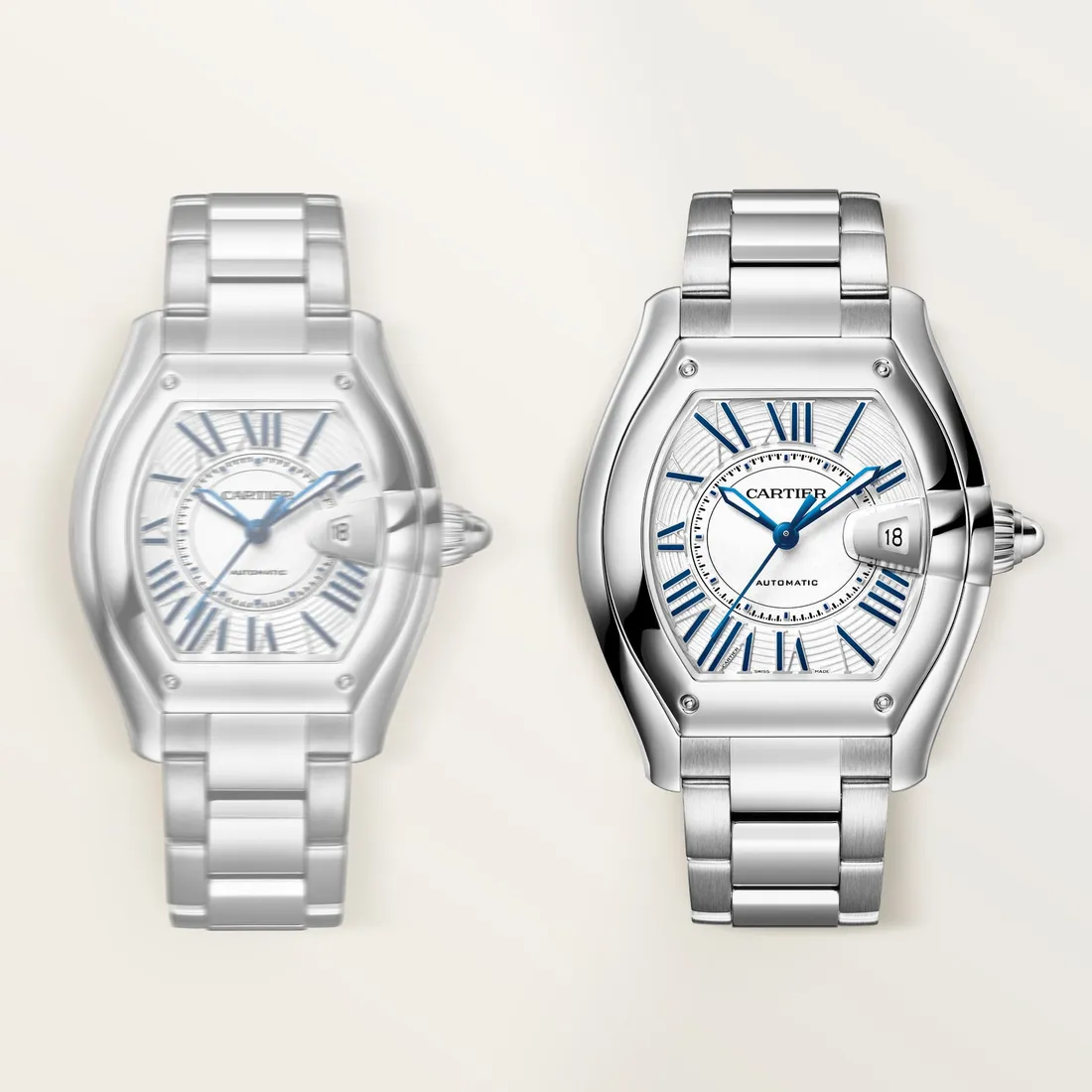
Vincent showed Théo the case back. 'This watch has a past, too,' he said. 'The Roadster was first born in 2002. In those years it became a whole generation's first serious Cartier; elegant but unshowy, sturdy but refined. It was the dream of a young lawyer, a new doctor, of everyone just setting out on the road. Then, in the early 2010s, Cartier quietly withdrew it from the collection, and the Roadster turned into a legend for enthusiasts; a name sought after and talked about in second-hand windows.'
'Now, years later,' said Vincent, his eyes bright, 'it has returned with its lines refined and its proportions brought up to date. The same soul in a more mature body. Like certain cars, certain watches are timeless; they never go out of fashion, they only wait for the right moment.'
format_quote"Some icons never die; they only wait for the right road, and the right moment."
Vincent
Time and Motion
Théo fastened the watch to his wrist. The curved case settled onto it as though it belonged there. Looking at the dial, for a moment he imagined himself at the wheel of that restored car, an empty road stretching out before him. Vincent gently closed the door of the car he had been working on; the sound echoed off the stone walls of the garage.
'Time is like the road, son,' said Vincent. 'You look ahead, it flows on, and it never comes back. What matters is not how fast you go, but how you drive that road. And the Roadster is a travelling companion that whispers exactly this to your wrist: motion, freedom, and that unceasing flow of time.'
The last light slipping through the half-open garage door glinted at the same instant on the chrome of the car and on the curved case of the watch. In that moment Théo understood why a watch can show not only the time, but a feeling.