Most of us now sense, deep down, that we are not alone in the universe. The stars outnumber every grain of sand on every shore; and in this immensity, that life should have flared only once, only here, is the faintest of all probabilities. So let us grant, for a moment, that life has taken hold in the most unexpected places.
In the incandescent plasma oceans of the Sun, within rivers of fire millions of degrees hot, there lives a being of pure energy: his name is Kael. For him, time is the rhythm of the bursting of sunspots. On the dark face of the Moon, in vast basalt caves at a cold near absolute zero, there lives a being of crystalline consciousness: her name is Lumina. She measures time by the vibration of frozen hydrogen crystals. Fire and ice; two neighbours who cannot speak directly, yet have been aware of each other for thousands of years.
And in a misty Swiss valley, as the old watchmaker Aris sets the final wheel of a calibre into place, he is perhaps, without knowing it, building an instrument not only for us but for them. For what this watch measures is precisely the knowledge Kael and Lumina need in order to find each other.
The First People Who Read the Sky
Humankind, too, has always looked to the sky with this same searching. In the ages before systems of timekeeping existed, the first communities watched the dance of the celestial spheres and wove powerful stories around it. The earliest astronomers were also mathematicians; instruments built upon their formulas could mechanically compute the positions of heavenly bodies. For the interplay between the orbits of the Sun, the Earth and the Moon set the rhythm of life: the tides, the seasons, the harvests.
Horology, too, first evolved to make sense of this order around us. With nearly two centuries of accumulated mastery, Jaeger-LeCoultre has commanded every form of the expression of time, from the most ordinary to the most esoteric. And this watch is one of the summits of that journey; perhaps the most cosmic instrument we have ever strapped to a wrist.
Time by the Stars: The Sidereal Day
For Kael and Lumina, time flows not by our solar clock but by the measure of the stars. One of Jaeger-LeCoultre's signature complications is exactly this: sidereal time, measured against the stars. Our solar day is 24 hours, the time it takes the Earth to turn until the Sun is directly overhead again. But as the Earth spins on its axis it also travels around the Sun; so when it finishes one full rotation, it must turn just a little extra to face the Sun once more.
Subtract that little extra and what remains is one full rotation of the Earth relative to the distant fixed stars: the sidereal day, about 23 hours and 56 minutes. So the stars rise about four minutes earlier each night than the night before. Imagine running on a track; the finish line is always in the same place, the stars, but there is a second marker that slowly shifts that line, the Sun. A true astronomical watch reads the universe not only by our measure, but by the measure of the stars; just as those who live out there read it.
The World's First Four-Faced Wristwatch
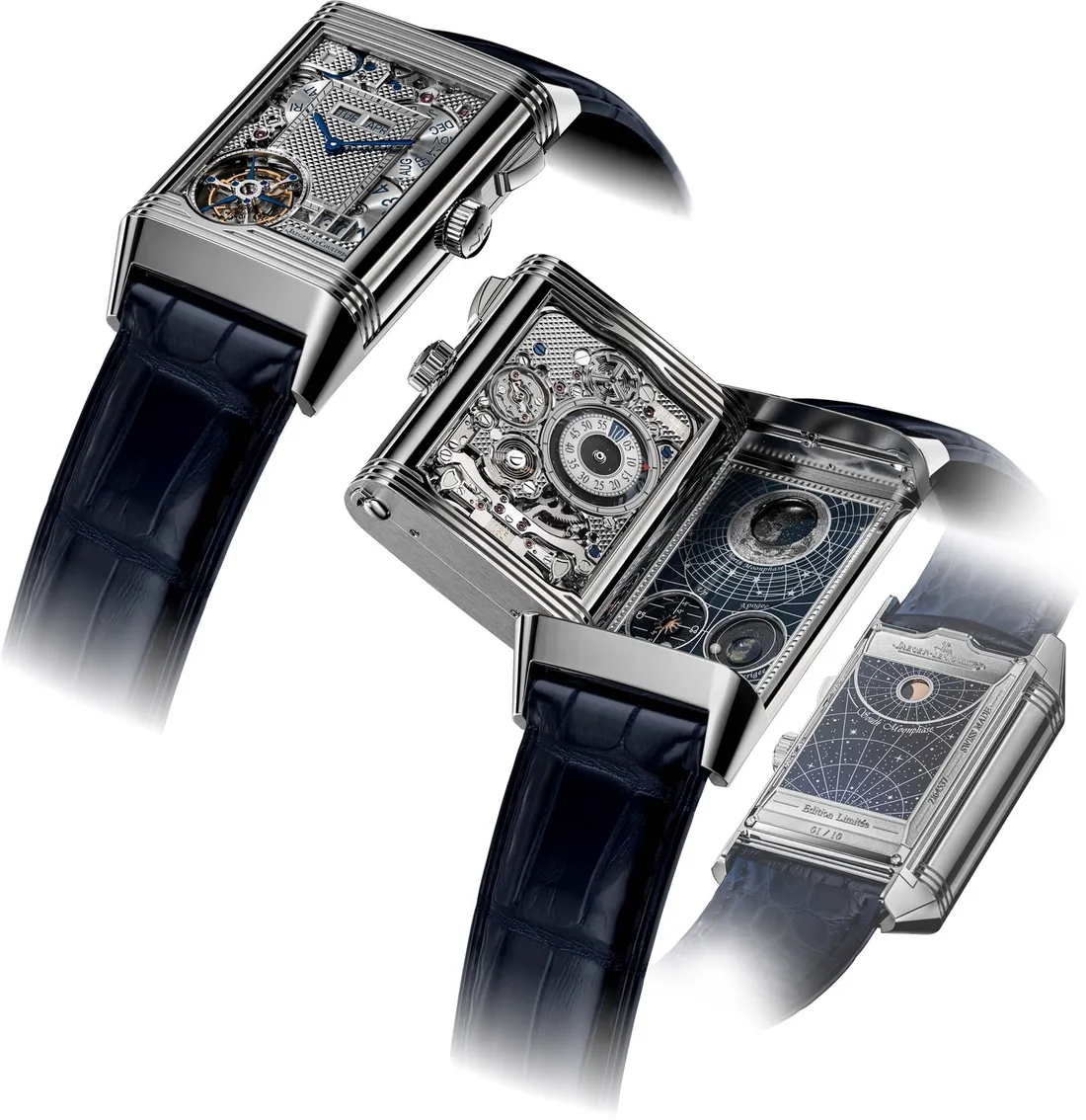
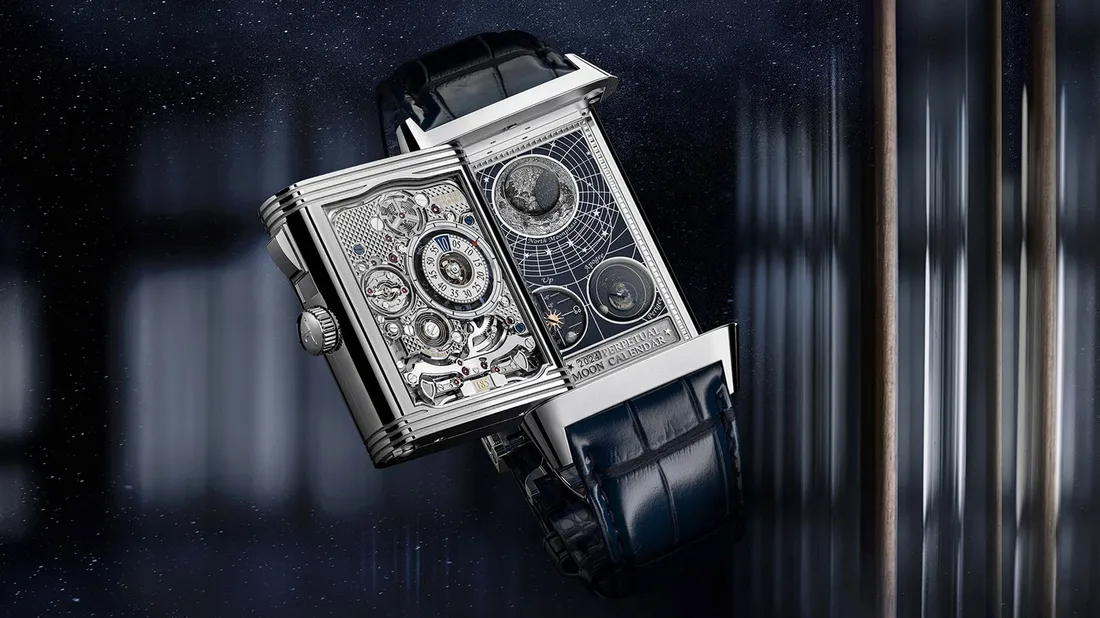
The founding idea of the Reverso in 1931 was simple: to protect the shattering crystals of officers playing polo by swivelling the case on its axis and bringing its solid back to the front. Ninety years later, Jaeger-LeCoultre took that same act of turning and transformed it into a cosmic theatre. The Reverso Hybris Mechanica Calibre 185 Quadriptyque is the first wristwatch in history with four separate functional display faces.
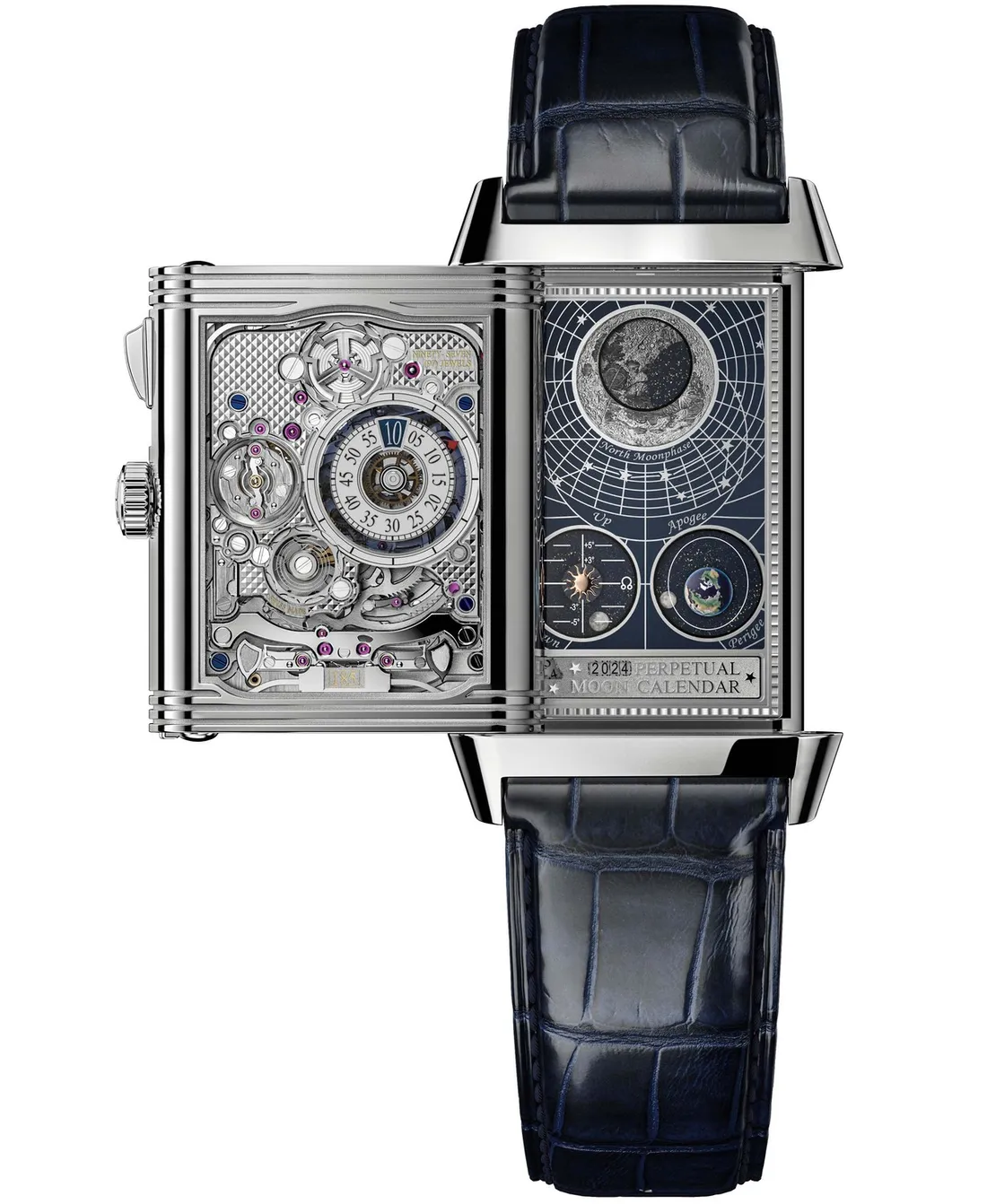
A Reverso has two sides: the swivelling case and the cradle beneath it. Jaeger-LeCoultre turned all four of these surfaces into working dials. Eleven complications, twelve patents, more than six years of development; all fitted into a white gold case of 51 x 31 x 15 millimetres. Opening and closing like a book, this watch tells a different layer of the universe on each of its faces.
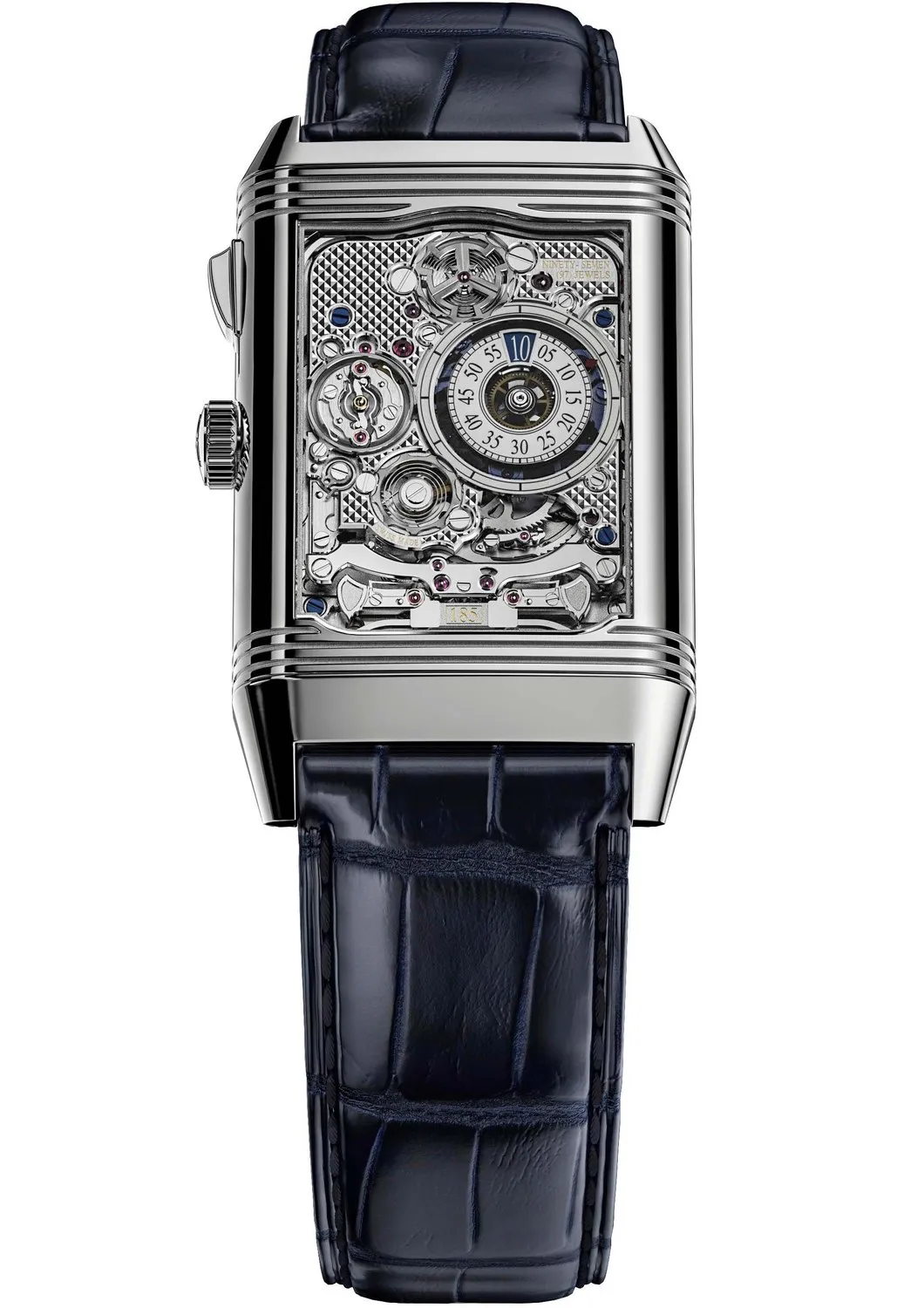
The First Face: The Everyday Face of Time
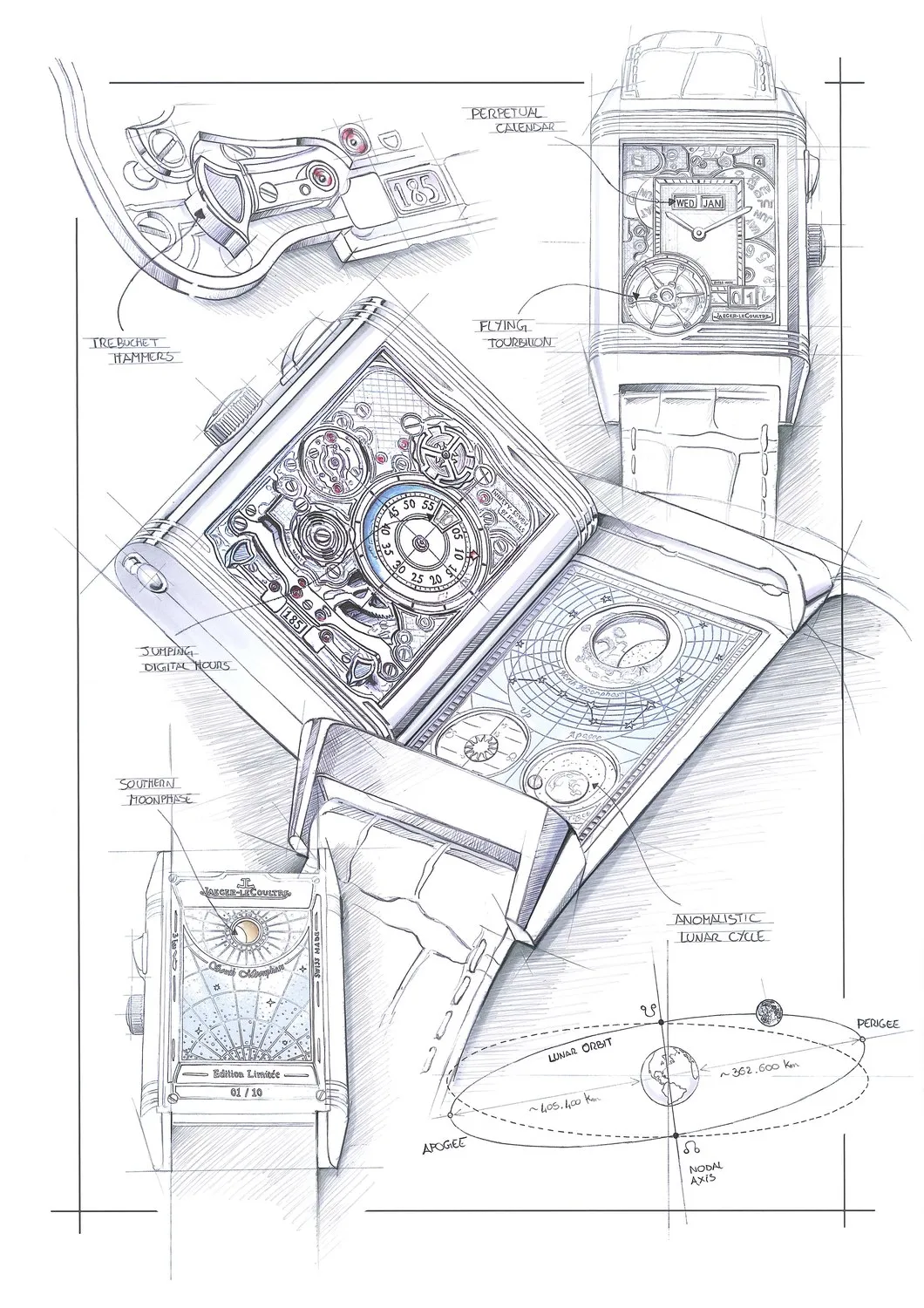
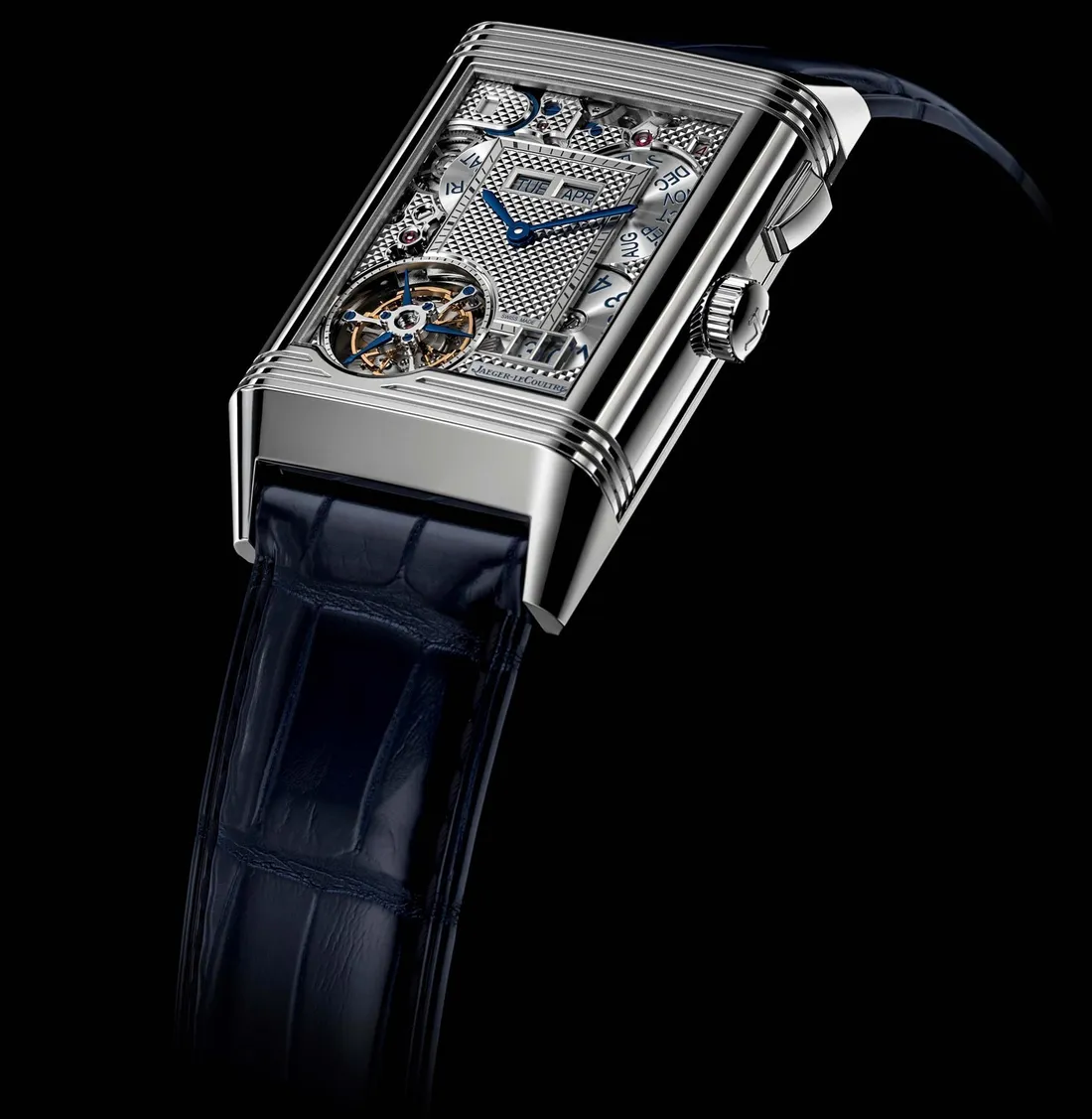
The first face is the most familiar: it shows the time and the day. But its calm is deceptive. In the lower part of the dial there is a flying tourbillon turning in its own cage, averaging out the harm gravity does to the watch's precision by constantly rotating the escapement. And this tourbillon shares the same face with an instantaneous perpetual calendar.
A perpetual calendar is like a mechanical brain that has memorised the Gregorian calendar. It knows which months have 30 days and which 31, whether February has 28 or 29, which years are leap years, and it shows the correct date until the year 2100 without a single manual correction. Imagine a machine woven from tiny steel and brass parts, with a memory of up to four years.

The Second Face: The Face That Strikes Time
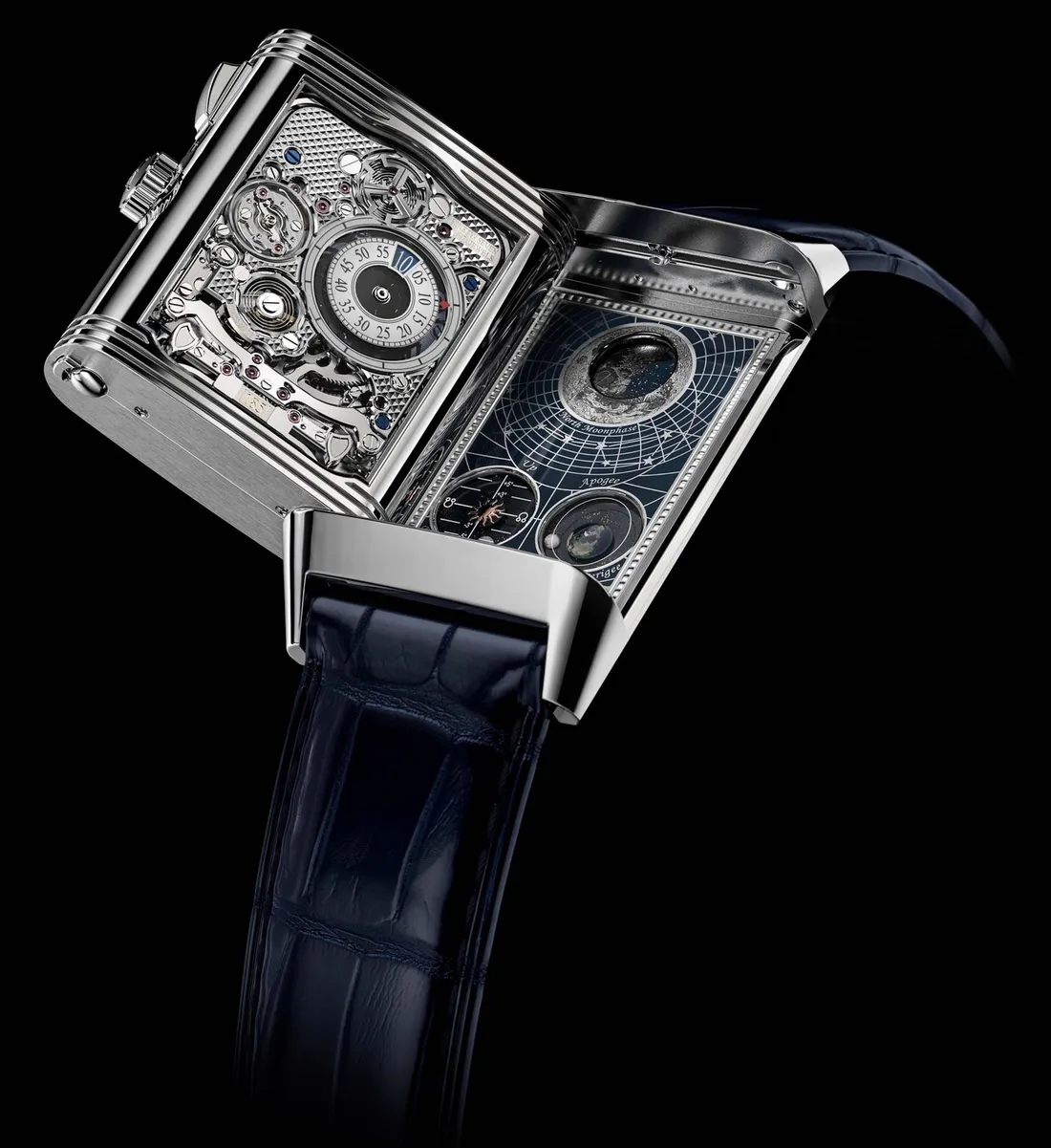
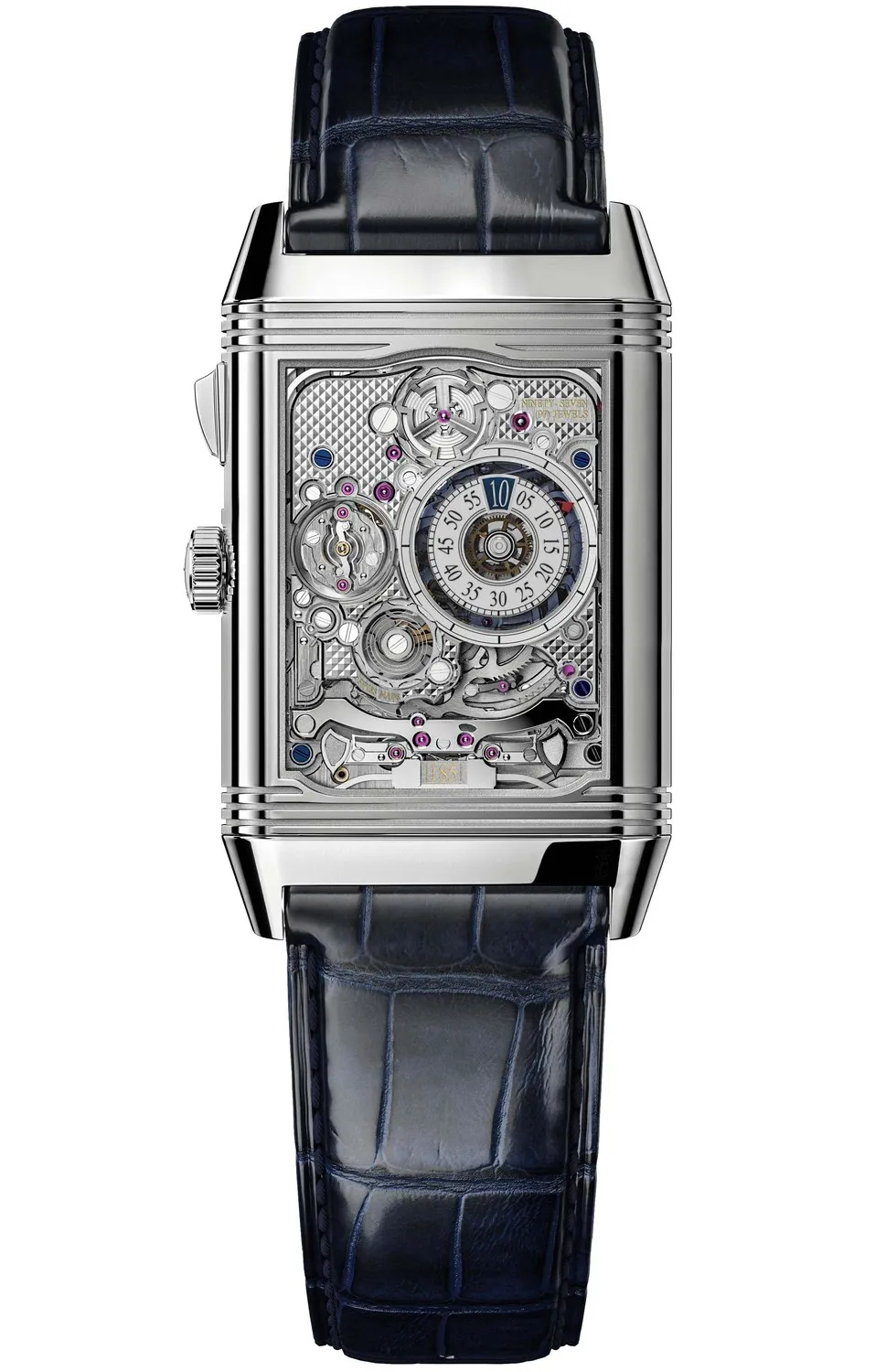
When you turn the watch over, the second face appears. Here sits a minute repeater: at the press of a slide, tiny hammers strike small gongs inside the watch to tell you the current time in sound, almost in music. It strikes the hours with a deep tone, the quarters with double notes, and the minutes with a light chime. A two-century-old magic conceived so you may hear the time even in the dark.
On the same face, above the skeletonised movement, there is also a secondary jumping-hours and peripheral-minutes display. And perhaps the single rhythm that Kael and Lumina send each other in the darkness is the sound of these gongs; a silent telegraph running from one corner of the universe to another.
The Third Face: A Sky Laboratory
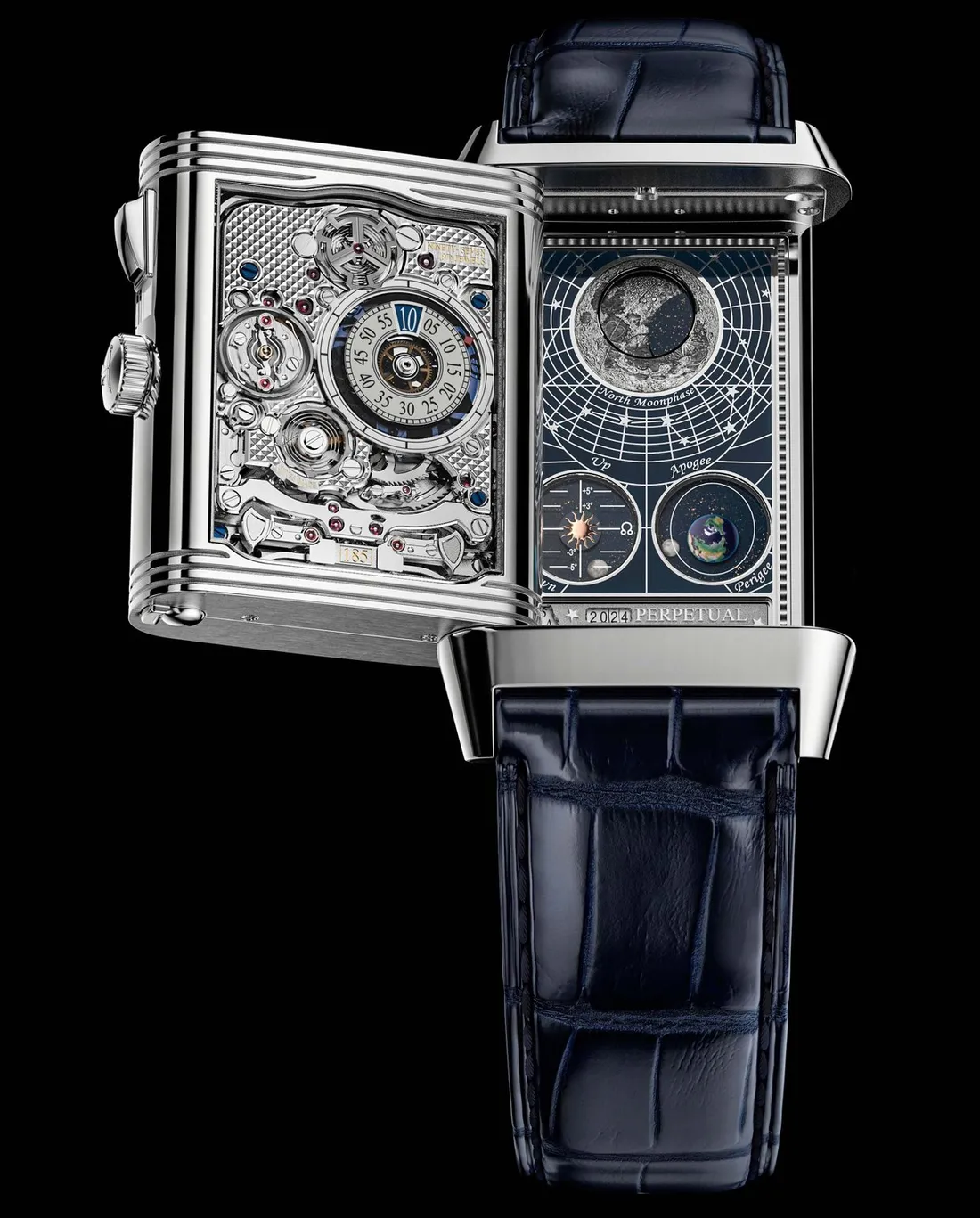
The inner face of the cradle is the heart of the watch, and it seems made directly for them. Here the Moon is simulated not only by its lit shape in the sky, but by its three-dimensional orbital motion in space. For the Moon's journey around the Earth cannot be explained by a single notion of a month; depending on your reference point, there are three different cycles. For the first time in history, Jaeger-LeCoultre united these three, the synodic, draconic and anomalistic cycles, in a single wristwatch. The last two indications are patented. And these three are precisely the rhythms that govern the lives of Kael and Lumina.

The Synodic Cycle: The Dance of the Phases (29.53 days)
The first cycle is the classic lunar phase we all know. The synodic cycle shows the Moon's position relative to the Sun: New Moon, First Quarter, Full Moon, Last Quarter. An analogy: picture a dancer circling a lamp, with you at the very centre. How much of her lit side you see depends on where she stands relative to you. These are the phases; the period is 29.53 days.
On the watch this is shown by a laser-engraved Moon gradually covered and revealed by a moving blue lacquer disc flecked with gold. The astonishing part lies in the accuracy. Ordinary moon-phase indicators drift one day every 32.5 months; the Quadriptyque's cycle asks for a single adjustment only after 1,111 years. For a span longer than all of human history that lived before you, this watch breathes in step with the Moon without straying by even a day. The Moon kept this rhythm long before the first astronomer; the watch has only learned to read it.
Lumina can leave her crater only when the Moon is plunged into total darkness, in the New Moon phase. When that blue lacquer veil draws fully over the Moon on the dial, her safe zone begins; only in this darkness do she and Kael call out to each other.

The Draconic Cycle: The Light Swallowed by the Dragon (27.21 days): Eclipses
The second cycle is the secret of eclipses. The Moon's orbit does not exactly coincide with the Earth's orbit around the Sun; there is an angle of about 5 degrees between them. The Moon crosses this plane at two points, one rising and one descending; these are the nodes. Picture two hula hoops slightly tilted against each other; they meet at only two points.
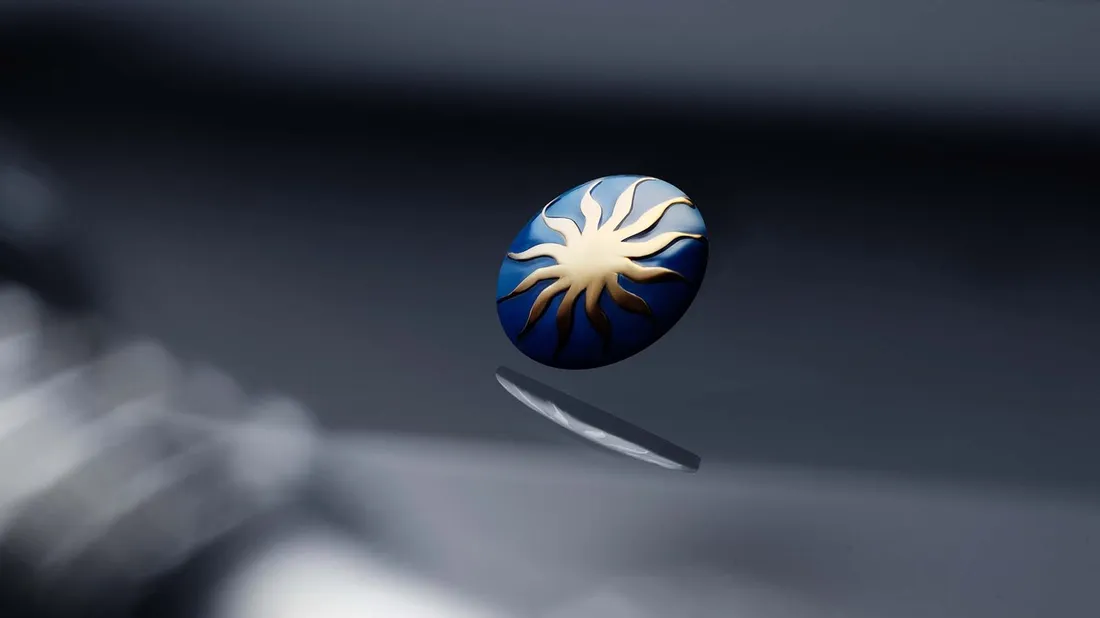
For an eclipse, the Moon must be exactly at a node, the Sun, Earth and Moon must align at the same moment, and the Moon must be in the new or full phase. When these coincide, a full Moon brings a lunar eclipse, a new Moon a solar eclipse. The indicator, with a three-dimensional micro-sculpted pink-gold Sun and a hemispherical Moon around it, announces how near this intersection has come. The name of this cycle is no accident: it comes from the dragon believed, in old legends, to swallow the Sun or the Moon during an eclipse.
And the eclipse is the single, rare instant in which Kael and Lumina can unite their energies. As the dragon hand nears the ancient node symbols, the door between them opens.

The Anomalistic Cycle: The Breathing of the Moon (27.55 days): the Supermoon
The third cycle concerns distance. The Moon's orbit is not a perfect circle but an ellipse. At its closest point, perigee, it is about 362,600 kilometres away and appears at its largest and brightest, the Supermoon. At its farthest, apogee, it withdraws to about 405,400 kilometres and becomes the smallest, faintest Micromoon. When a full Moon meets perigee, it can appear up to 14 percent larger. Picture a runner on an oval track; as they near the inner edge they speed up and are closer to you.
Perigee is a threat to Lumina: when the Moon draws closest to the Earth, the Earth's pull shakes her crystal cities and earthquakes begin; her people descend into underground shelters. At apogee they breathe deeply again, for they are safe. In the counter, a tiny Moon on an eccentric orbit and an enamel-painted globe of the Earth show this breathing in and out.

Three Cycles Together: An Instrument Made for Them
The display of the synodic, draconic and anomalistic cycles together in a single watch had never been seen before in the history of watchmaking. When these three come together, the watch can tell you when the next eclipse will fall, when the Moon will shine as a Supermoon, and exactly how it will look in the sky at that moment. So this dial is, in truth, a calendar of when Kael and Lumina may meet. We strap it to our wrist; they live inside the very rhythm. The same instrument is carried on both shores of the universe.

The Fourth Face: The Sky in the Mirror
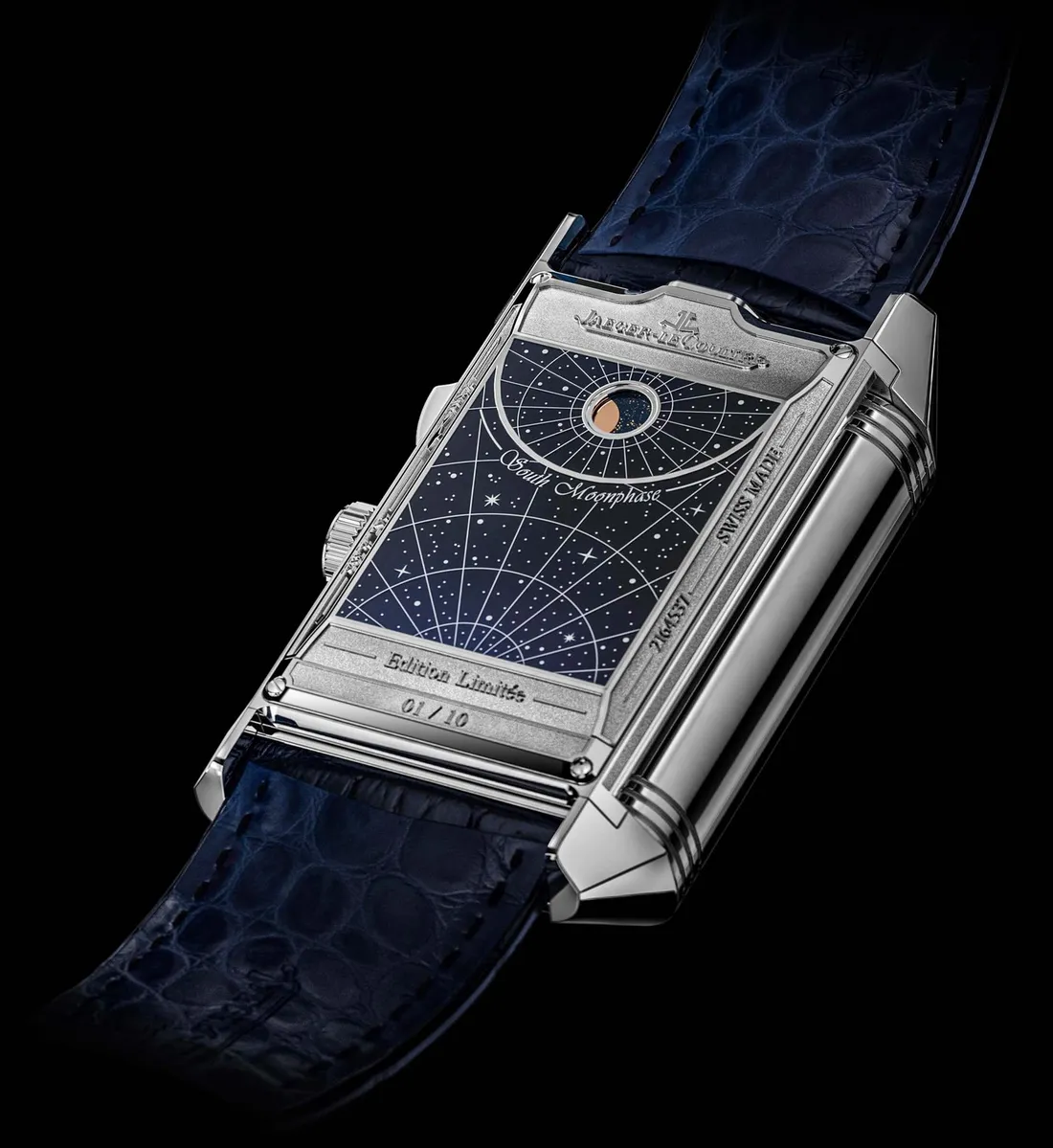
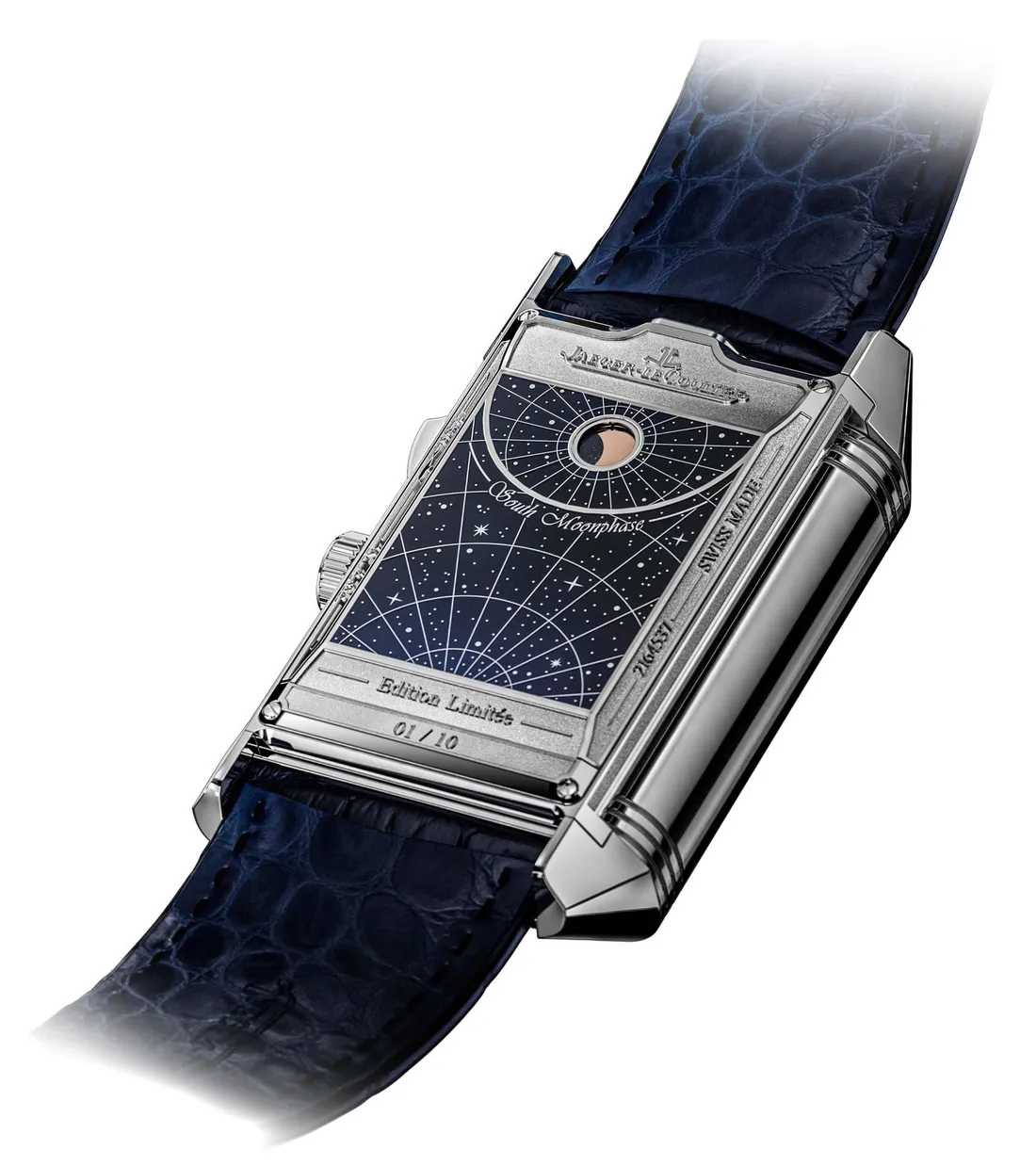
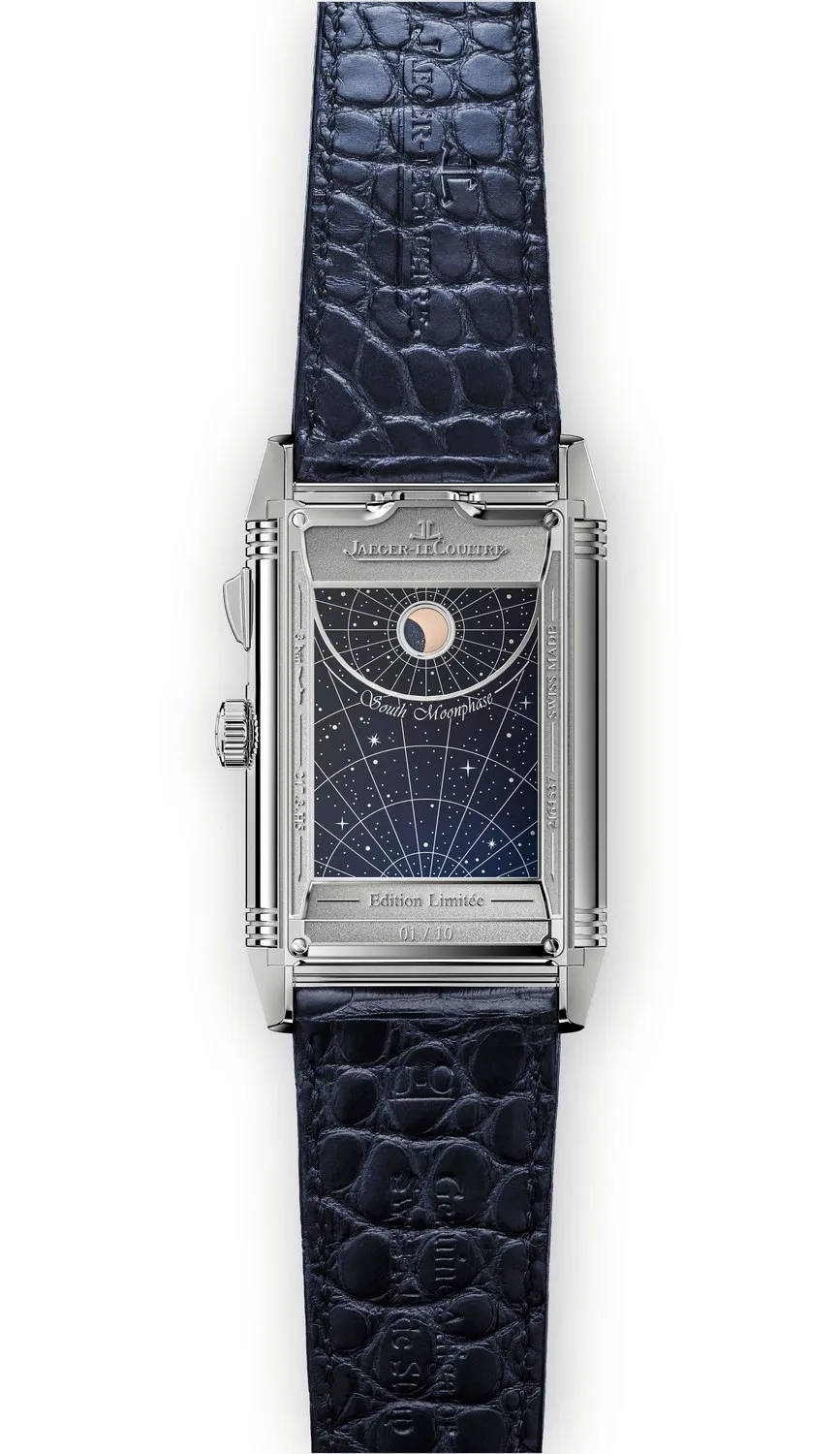
Most moon-phase indicators are made from the Northern Hemisphere's view. The fourth face of the Quadriptyque shows the Southern Hemisphere moon phase. But why a separate indicator? Because observers in the Northern and Southern Hemispheres see the Moon inverted relative to each other. In the North, as the Moon waxes its right side lights, like a letter D; in the South, its left side, like a letter C.
This face also carries a rotating night-sky map: it shows the stars seen from the Southern Hemisphere, the Southern Cross constellation and the Milky Way first among them. Upon this engraved and polished blue sky a pink-gold Moon circles; all made by hand in Jaeger-LeCoultre's Atelier des Metiers Rares. This inverted sky on the back is, for Kael and Lumina, the mirror-reflection of the planet's other half; from this disc they watch the balance there too.
The Midnight Pin: The Bridge Between Two Worlds
So how do these astronomical indications in the cradle receive their information from the main movement? Here the watch's most elegant secret comes into play. Every midnight, at exactly 00:00, a tiny pin extends from the movement in the main case and touches a corrector in the cradle, advancing its displays by one step. Two separate mechanical worlds, the case and the cradle, speak once a day without a single wire. Like two trains that meet only once a day, to the very second, passing a package from hand to hand.
And this is the most elegant moment of all: when the pin taps the corrector at midnight with a click, the whole sky of the cradle advances one step. If the draconic hand stands at a node that night, the coronal burst Kael has hurled from the Sun strikes straight into Lumina's crater; light and ice unite in the red darkness of the eclipse. Two separate mechanical worlds speaking once a day is, in truth, the meeting of two ancient beings.
Eleven Complications, Twelve Patents, Six Years
The price of holding so much together is an unimaginable mechanical density. Calibre 185 gathers eleven complications, ninety-seven jewels and a rhythm of 28,800 vibrations per hour (4 Hz) into a single body; fully wound, it runs for about 50 hours. It took more than six years to develop and left twelve patents in its wake. Think of it as a city plan: hundreds of moving parts working at once, passing one another without touching, all in a harmony measured to fractions of a millimetre.

Atelier des Metiers Rares: Painting the Sky by Hand
All four faces of this watch are miniature works of art. The moons are laser-engraved to capture the very texture of the lunar surface; the sky discs are coated in blue lacquer flecked with gold. The hardest is the tiny globe of the Earth: a drop of enamel whose blue oceans and green continents are painted by hand, under a microscope, with brushes finer than a human hair. The star maps are engraved and polished one by one.
And all this delicacy is carried out under the shadow of a single truth: one slip of a brush can destroy days of work in an instant. The masters of the Metiers Rares unite the patience of an astronomer with the hand of a painter; first they understand the universe, then they fit it into the palms of their hands.

The Two Shores of Time
If one day there is no one left on Earth to wind this watch, that pin will stop, the dragon hand will freeze, and the bridge between the two shores will close. This is why every watch lover, each time they turn the crown, keeps alive not only the steel but that delicate balance in the sky.
And when a person looks upon this four-faced universe, they understand that the human hand could make only an imitation. The Moon kept these three rhythms long before the first watchmaker, before the first astronomer, perhaps even before Kael and Lumina. The hand that drew its ellipse, tilted its orbit by exactly five degrees, wound the first spring, had already written the flawless measure that both shores read. Calibre 185, at most, is a gesture of respect toward that measure.
This piece, which will fall to only 10 people, is less a wristwatch than a vault of heaven that holds the two shores of the universe to the same rhythm.