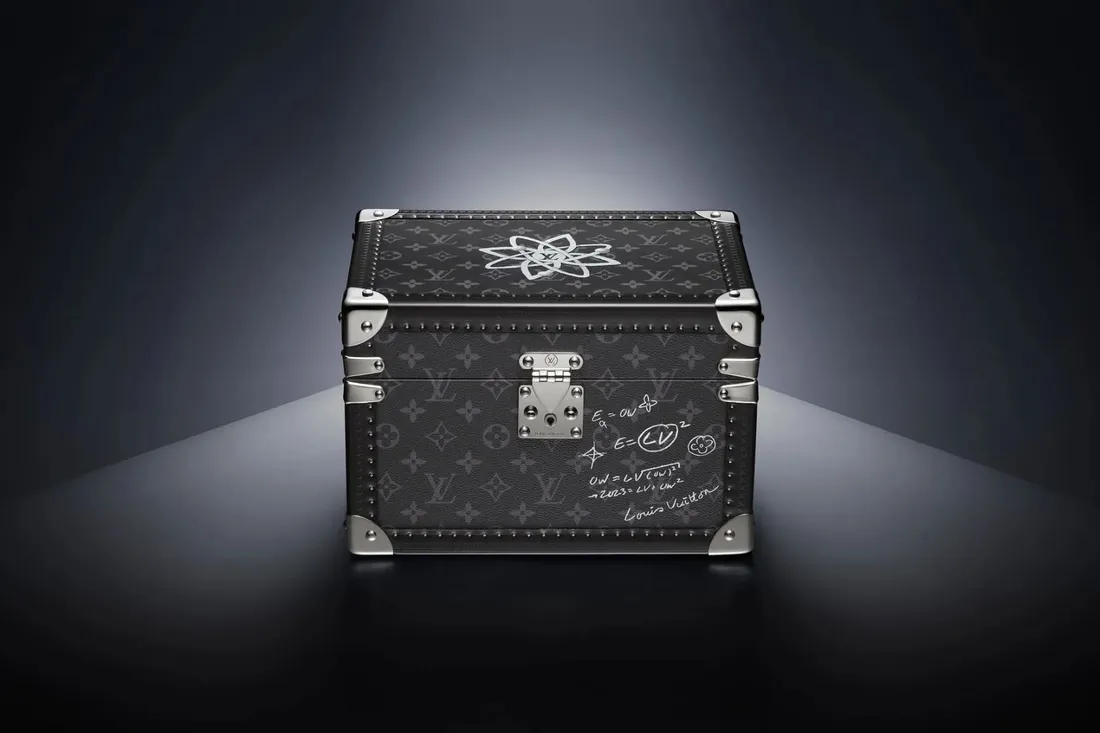
A watch has one duty: to measure time. But what if the dial of that watch carries the face of the man who proved that time is not absolute at all, that it bends and stretches with speed and with mass? The Louis Vuitton Tambour Einstein Automata is built on exactly this elegant contradiction. A single piece, with no twin anywhere in the world.
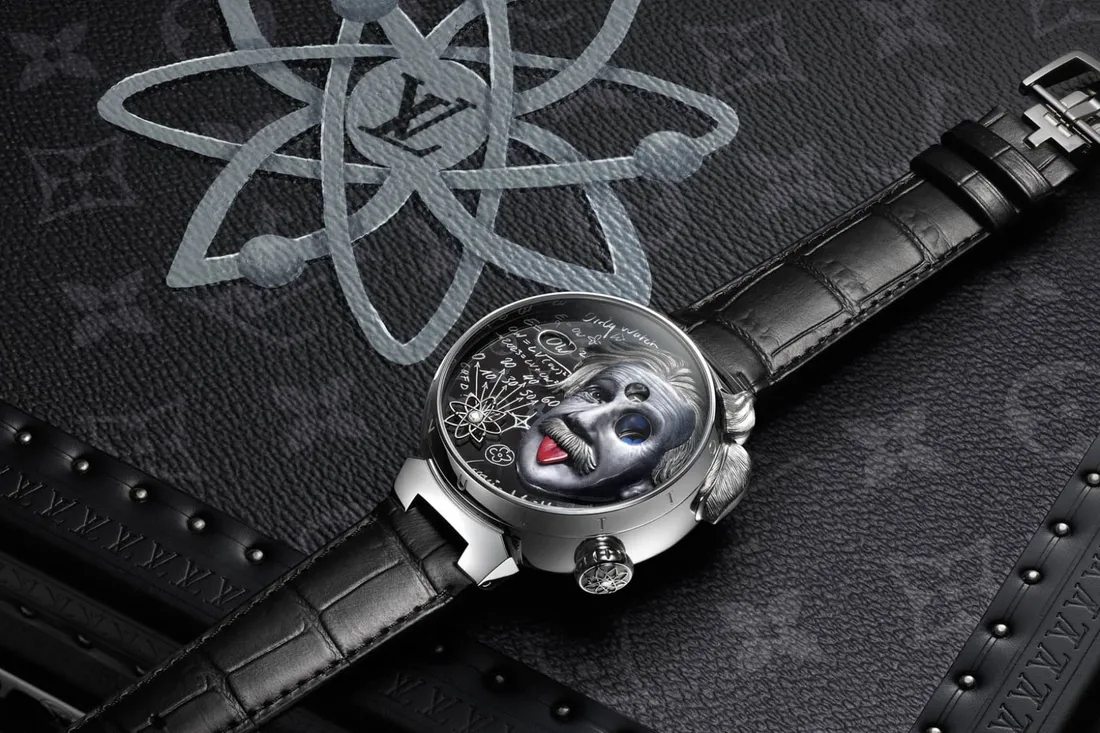
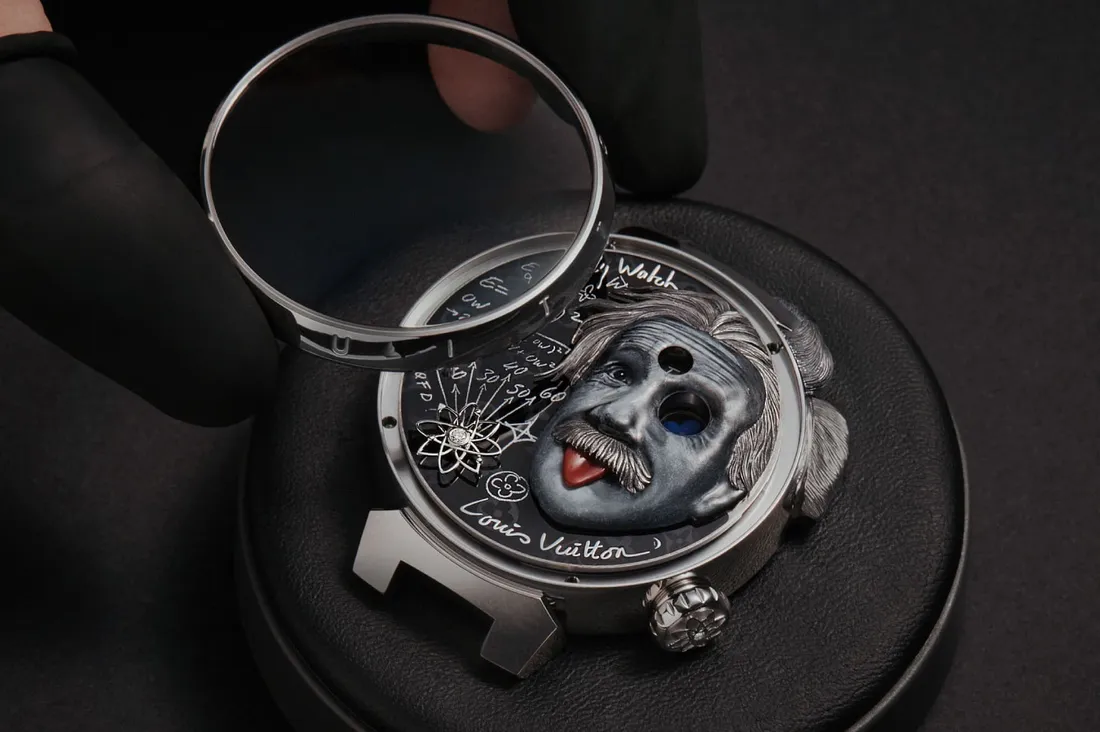
On this dial Albert Einstein is far more than a portrait. Hours jump from a tiny window on his forehead, his eye winks at you, an electron orbiting an atom counts the minutes. And when you press that rebellious pusher shaped like a lock of his hair, the greatest genius of the twentieth century sticks out his tongue. In this piece I want to tell you both how that genius rewrote the universe, and how Louis Vuitton folded that legacy onto a single wrist.
The Man Who Broke Absolute Time
Before Einstein, time was a flawless metronome ticking at the same rate in every corner of the universe. In Newton’s cosmos, space was an empty stage and time the unchanging clock above it. Einstein arrived and turned the stage itself into a player.
1905 went down in history as the miracle year. Just twenty six years old and working as a clerk in a patent office, Einstein published four papers that year. Each one alone would have crowned a scientist’s career. The photoelectric effect, which showed that light behaves as both wave and particle and would earn him the Nobel Prize, Brownian motion, which proved that atoms are real, special relativity, and the most famous equation in the universe: E=mc².
E=mc² whispers a startling secret: mass and energy are two faces of the same coin. If a drop of rain’s worth of mass could be turned entirely into energy, it would be enough to light a city. This vast power sleeping inside matter is also the answer to how the stars have blazed for billions of years.
Special relativity was even more unsettling. If the speed of light is the same for everyone, then time itself has to stretch. A clock moving quickly runs slower than one at rest. A twin who travels on a spaceship near the speed of light comes home younger than the sibling who stayed on Earth. Time is not a universal river in which everyone flows together; each of us carries our own pocket watch.
In 1915, with general relativity, Einstein delivered the final blow. Gravity is not a force but the bending of space and time by mass. Place a heavy ball in the middle of a stretched trampoline; the marbles around it roll inward, not because they are pulled, but because the surface itself is curved. Planets orbit the Sun through exactly this curved spacetime. As John Wheeler put it, matter tells spacetime how to curve, and spacetime tells matter how to move.
In 1919, during a solar eclipse, starlight was measured bending by precisely the amount Einstein had predicted. When the world woke the next morning, an unknown patent clerk had become the most famous person on the planet.
format_quote"Einstein turned the universe from an empty stage into a living, stretching, breathing fabric. Time was no longer a single clock everyone obeyed, but a rhythm each body carries within itself."
The Genius Who Stuck Out His Tongue
When you picture Einstein’s face, the first image that comes to mind is probably that wild haired photograph with his tongue out. That frame has a story of its own.
The date is 14 March 1951. Einstein is celebrating his seventy second birthday. As he leaves an event at Princeton and climbs into his car, photographers crowd around him and insist on one last smile. Tired of posing all day, instead of smiling the genius sticks out his tongue at the cameras. The photographer Arthur Sasse captures the moment, and the frame becomes one of the most iconic images of the twentieth century.
The lovely part is that Einstein liked the picture so much that he ordered prints, had it cropped so that only he appeared, and sent it to friends as a greeting card. That tongue is the seal of a genius who stayed far from arrogance and kept a childlike mischief. The man who unravelled the secrets of the universe refused to pose like a stiff professor.
Louis Vuitton did not place a solemn scholar on the dial. It chose exactly this Einstein, the one sticking out his tongue. The whole soul of the watch hides in that small act of rebellion: on one hand a masterpiece of the highest watchmaking, on the other a playmate who winks and pokes out its tongue at you.
Time, the Watch and the Depth of the Joke
At the heart of this watch lies a very fine joke. The holy goal of mechanical watchmaking is to measure time perfectly, absolutely, unchangingly. And here is that watch, carrying the face of the man who proved time is not absolute. Relativity is, at its core, a theory of time, and time is exactly what a watchmaker chases all his life.
This is not only a poetic contrast. Every time the phone in your pocket finds your location, Einstein’s equations are quietly at work. The clocks aboard GPS satellites run faster than ours because of weaker gravity, and slower because of their high speed. Combined, the two effects produce a difference of about thirty eight microseconds a day. If engineers did not correct that gap with Einstein’s formulas, your navigation would drift some ten kilometres every single day. Relativity is the invisible hand that keeps the modern world’s clocks honest.
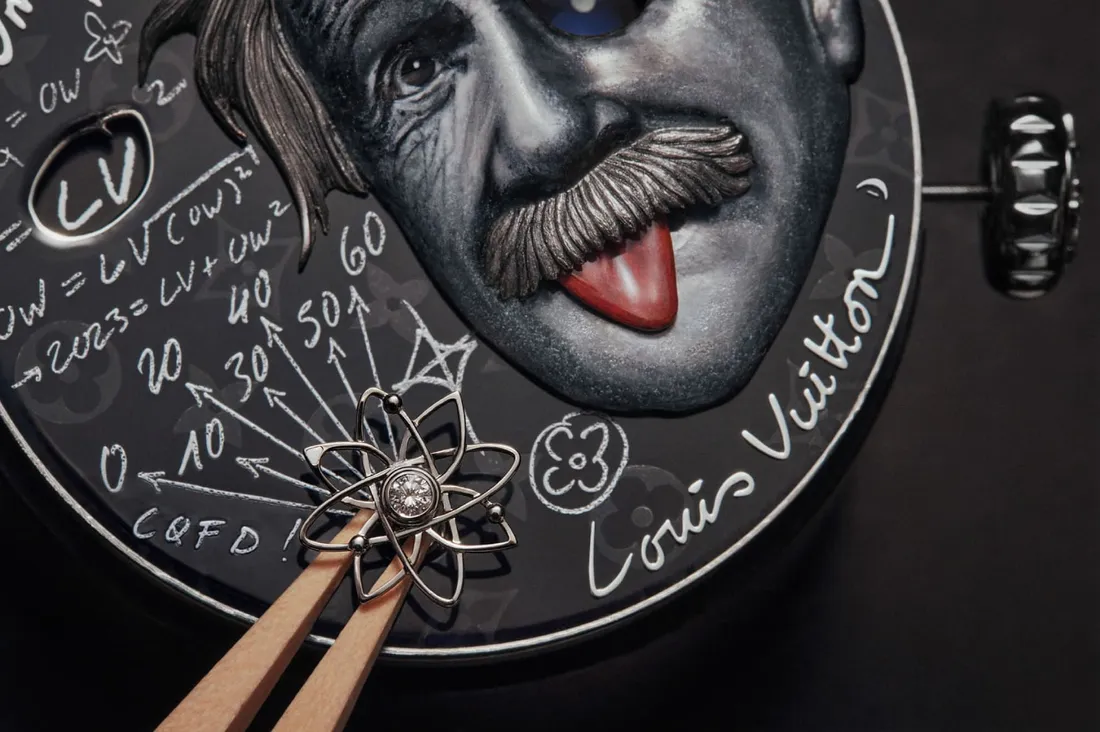
Look at the dial: an electron in an atom’s orbit marks the minutes by circling Einstein’s face. It is as if the universe is paying its respects to the man who redefined time, and time, quite literally, revolves around Einstein.
The Art on the Dial: Grisaille Enamel and Micro-Engraving
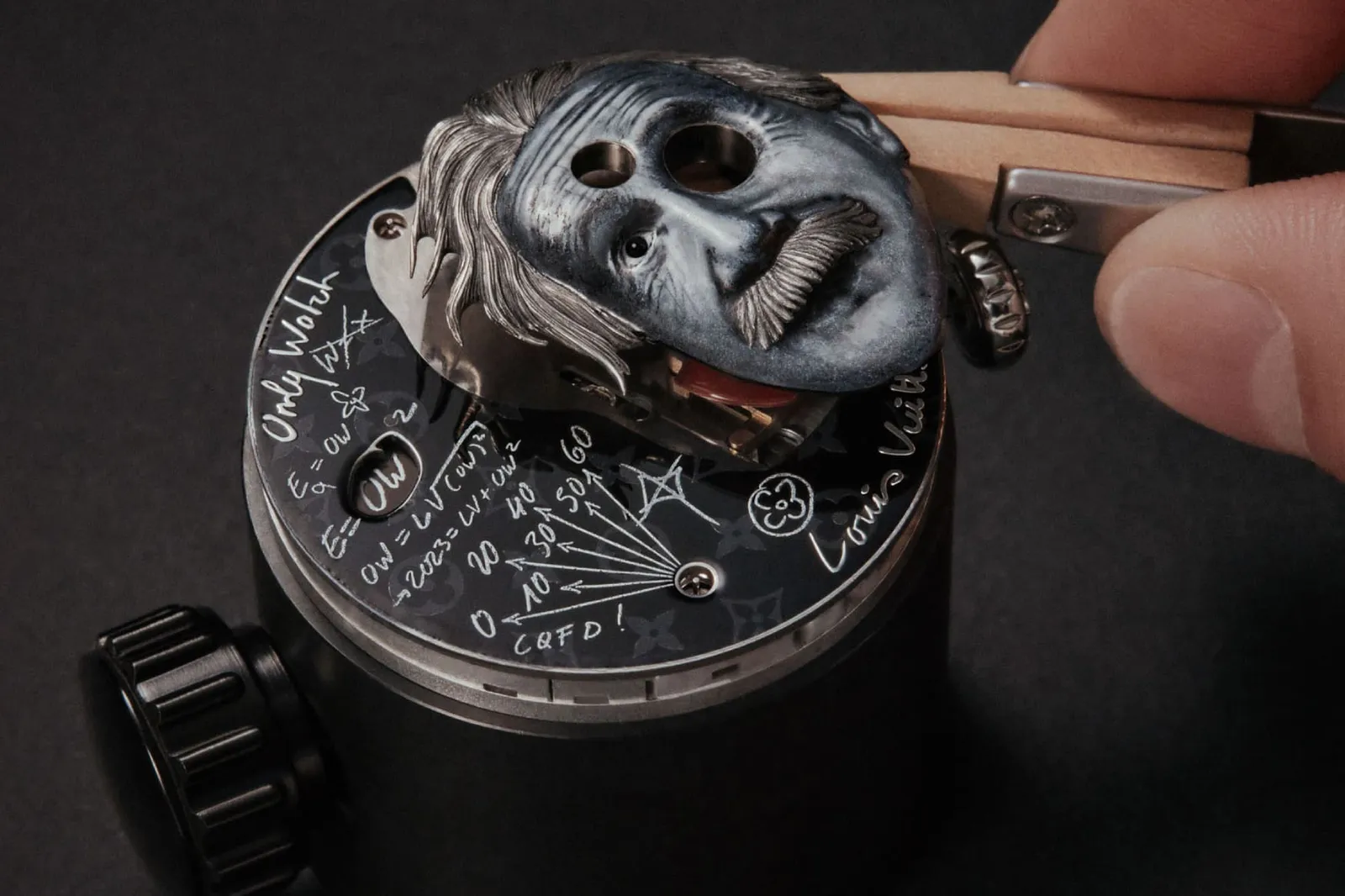
The true miracle of this dial is the labour beneath its visible surface. Einstein’s portrait is rendered in grisaille, an almost forgotten enamel art that survives from the sixteenth century workshops of Limoges. Nicolas Doublel, Louis Vuitton’s master enameller, brought the technique to life on one of the brand’s watches for the very first time.
The method is at once simple and dizzyingly difficult. First the dial is covered with a deep, pitch black enamel ground. Then, with brushes as fine as a single hair, the master applies a translucent white enamel powder called blanc de Limoges, layer upon layer. After each layer the dial returns to the kiln. The more layers there are, the brighter the white grows; the artisan paints with light itself, coaxing a face out of the darkness little by little.
This is an art of patience and nerve. Every firing is a gamble: one degree too hot, one second too long, and weeks of work can vanish in a single crack. Imagine working without being able to see inside the kiln, trusting only instinct and years of experience. Einstein’s face alone took fifty hours, and the whole dial a hundred and thirty. The wrinkles on his face, the depth in his gaze, all of it is born of that hard won three dimensionality.
The rest of the surface came from the hand of the micro-engraving master Dick Steenman. The blackboard effect on the dial is made of formulas and an atom model etched into a white gold plate with acid biting and micro-carving, then given a matte, rough texture that mimics real chalk dust. Einstein’s famous hair and moustache, the atom shaped minute hand, the crown and the pusher were all carved into white gold as well. You could say Doublel painted with fire while Steenman wrote with steel.
format_quote"Doublel painted with fire and Steenman wrote with steel. Across a single dial, through a hundred and thirty hours of silent handwork, the face of a genius was born again."
The Mechanism and the Singularity: One of One
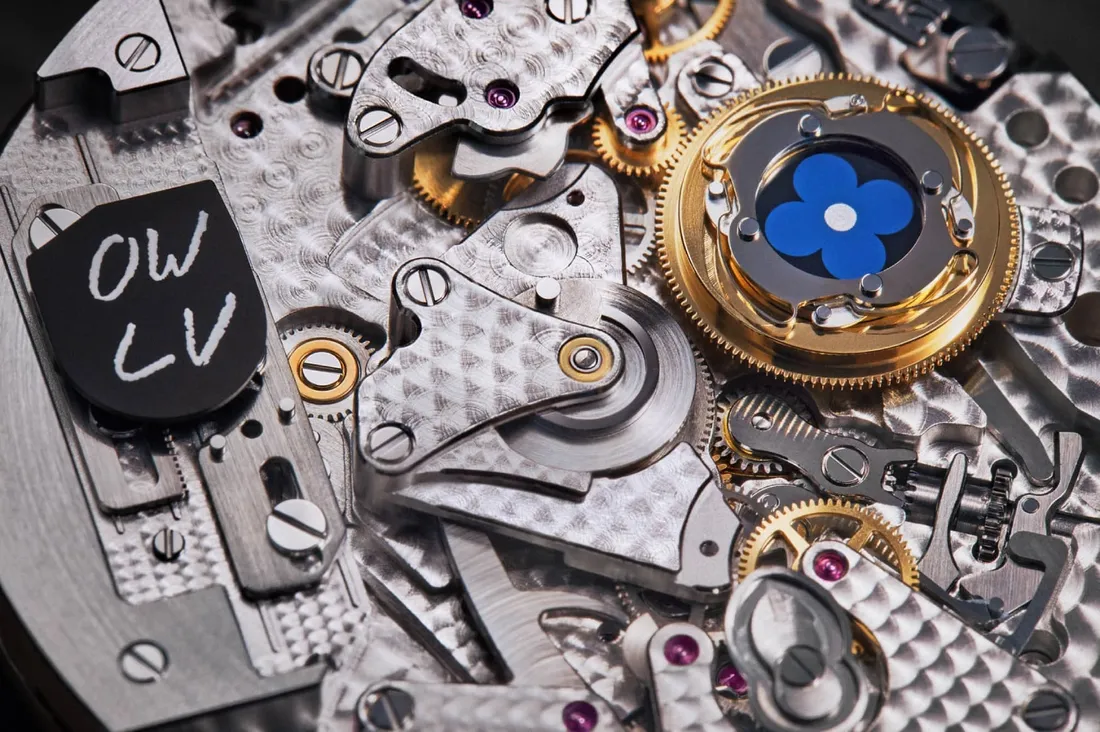
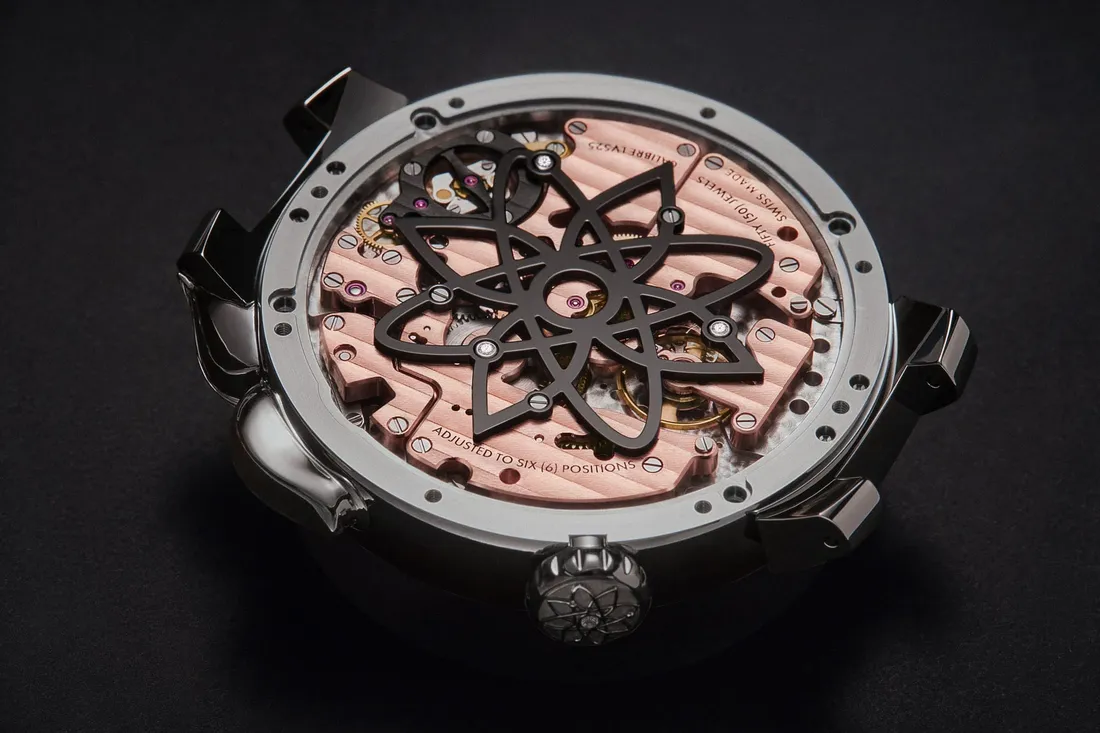
Behind all this theatre beats the LV 525 calibre, developed by La Fabrique du Temps, Louis Vuitton’s high watchmaking atelier in Meyrin, Geneva. It is a hand wound automaton movement with a hundred hour power reserve, already used in the award winning Carpe Diem.
The magic of the automaton arrives on demand. When you press the pusher shaped like a lock of hair, four things happen at once: the hours jump into view through the window on Einstein’s forehead, the atom’s electron sweeps across a retrograde minute scale, his left eye, its iris hiding the Louis Vuitton Monogram Flower, winks at you, and his tongue darts out. Like the timed performance of a mechanical comedian.
My favourite detail is the power reserve indicator. A small marker reads LV when the movement is fully wound, so the dial playfully spells out E=LV². As the spring unwinds, the marker turns to OW, for Only Watch. A living formula that changes with the tension of the mainspring.
So why only one piece? Because this watch was made for Only Watch 2023. Only Watch is a charity auction held every two years to fund research into neuromuscular diseases, above all Duchenne muscular dystrophy; every brand donates a single, unique watch. This Einstein will therefore never exist a second time, with an estimated value between three hundred and forty thousand and four hundred and forty thousand Swiss francs. On this one dial, a genius’s playfulness, the labour of master artisans and hope for sick children all meet in a single object. A meeting that Einstein, a man of deep love for humanity, would surely have approved.
The Tambour Einstein Automata is less a watch than a manifesto. It carries the face of the man who taught us that time is not absolute, and on your wrist it whispers that a single, fleeting, unrepeatable moment may be the most precious thing of all. Einstein proved that time can stretch; Louis Vuitton made that stretching time immortal, with a smile, a tongue and layer upon layer of enamel.