
A watch dial is often smaller than a coin. Yet on that tiny surface a master can build, out of powdered glass and fire, a painting that will not fade even centuries later. Two extraordinary automaton watches from Louis Vuitton, the Tambour Opera Automata and the Taiko Arty Automata, show us two faces of this magic: one the solemn opera stage of the East, the other the wild pop-art joy of the West.
But before we speak of the watches, we have to speak of the true hero behind their dials. Because the real complication here is not in the wheels; it is hidden in the fire. And there is one name who has tamed that fire and carried an almost forgotten art into the present day: Anita Porchet.
Painting With Fire
Enamel is, at heart, coloured glass ground into powder. The master sprinkles this powder finely over metal and places the dial in a kiln that can reach eight hundred degrees. The powder melts, turns to glass, and fuses to the metal. Think of the magnificent stained glass windows of the cathedrals; the art of enamel is to shrink that stained glass onto a watch dial and pass it through the fire again and again. The French call its most demanding form grand feu, the great fire.
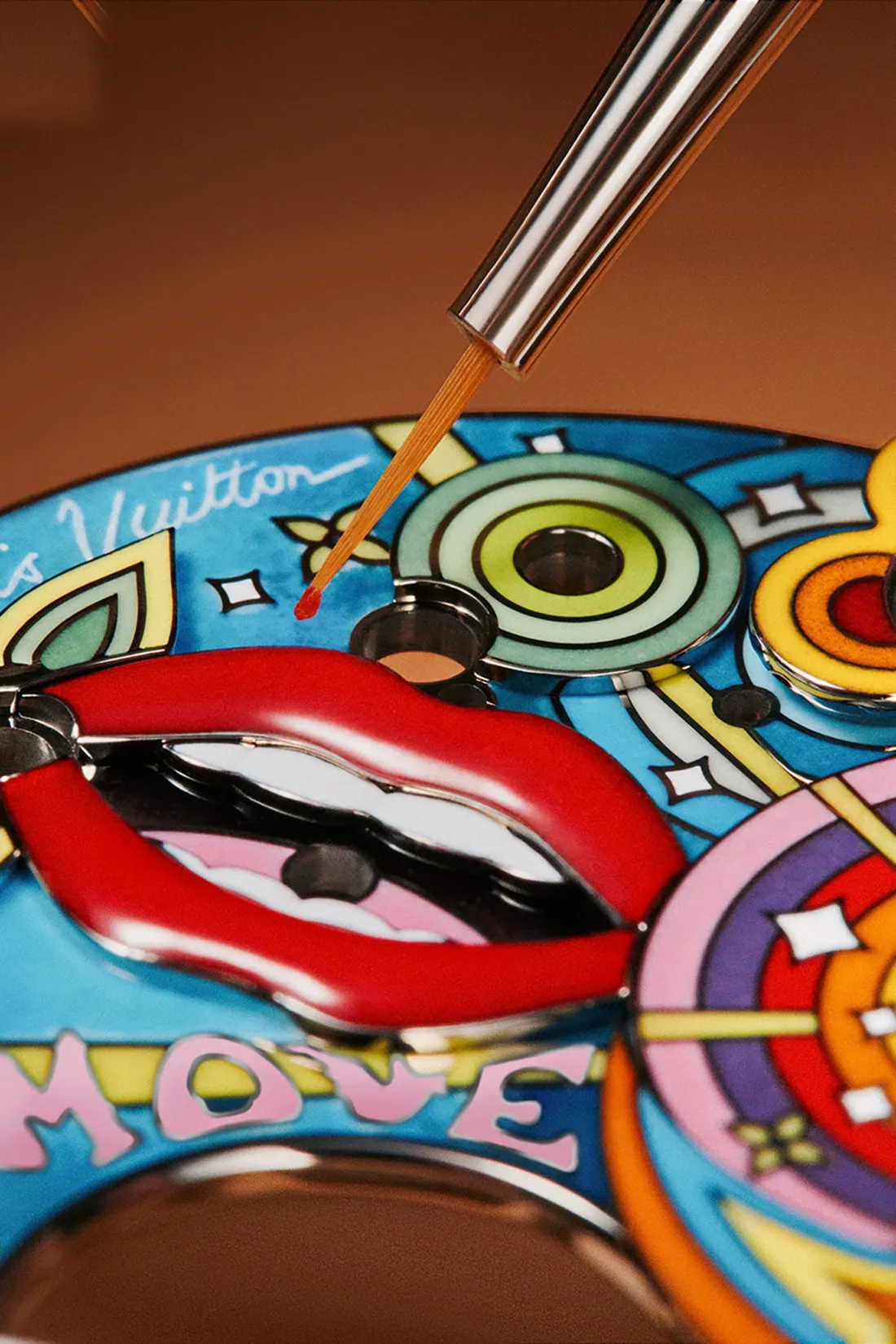
This art speaks several distinct languages. In cloisonné, the master bends wires as fine as a hair by hand to draw the outlines of the design, then fills each tiny cell with a different colour of enamel. It is like building a city out of little rooms and flooding each room with a different colour of molten glass. In champlevé, the design is first carved into the metal, and these hollows are then filled with translucent enamel; the light reflects up through the engraving beneath and gains depth. Miniature painting, in turn, is to paint a picture directly in enamel, with brushes as fine as a single hair.
But the true secret of this art lies in its danger. Every firing is a gamble. Colours change in the fire; the colour the master sees is not the colour that will come out of the kiln. One degree too hot, a few seconds too long, and weeks of work vanish in a single crack. The master works without being able to see inside the kiln, trusting only instinct and years of experience. Enamel is therefore an art of nerve as much as of patience.
A Vanishing Art and the Women Who Keep It Alive
Miniature enamel painting is one of the most fragile arts there has ever been. So much so that over the past century the number of masters who could truly practise it has rarely exceeded the fingers of one hand. Perfected in the workshops of eighteenth century Geneva, the art began to be forgotten as watches turned into mere instruments of timekeeping. Enamel dials enjoyed a brief golden age between the late 1940s and 1957, then sank back into darkness.
Suzanne Rohr, the greatest enamel master of the twentieth century, was forced to open her own studio in 1960 because she could not find work. Through those dark years the art was kept alive by a few devoted patrons, such as Philippe Stern at the head of Patek Philippe. The real dawn broke in the 1990s, driven, fittingly, by the interest of Japanese collectors. And it was precisely then, in 1993, that one woman set up her own studio with the backing of Patek Philippe: Anita Porchet.
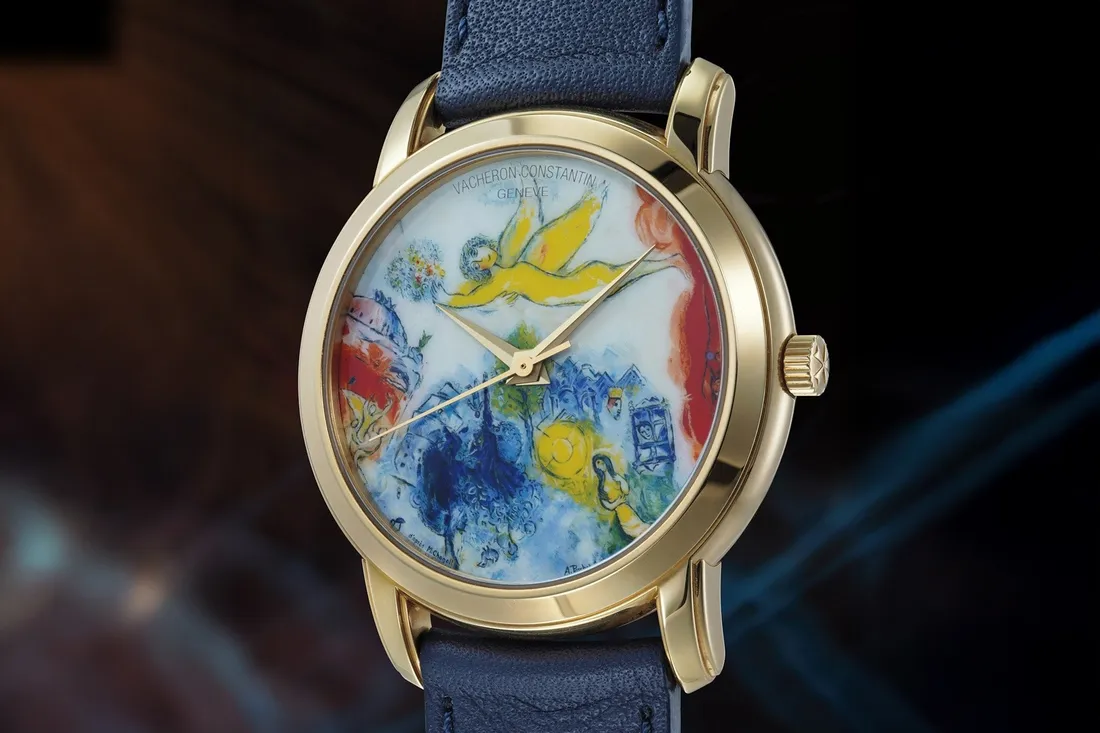
Porchet is today considered the most famous living enamel artist. She has worked for Patek Philippe, Vacheron Constantin, Chanel, Hermès, Audemars Piguet and Louis Vuitton. One of her most striking works is a dial she made for Vacheron Constantin, on which she brought the painter Marc Chagall’s vast fresco from the ceiling of the Paris Opera down onto a watch dial. She fitted a ceiling painting of some forty square metres onto a dial of ten square centimetres, and in enamel that will never fade.
The loveliest part of this story is this: while the most famous masters in watchmaking are usually men, the living legends of miniature enamel painting are almost entirely women. This chain, running from Suzanne Rohr to Anita Porchet, has been kept alive mostly by the hands of women for two hundred years. Porchet’s studio is one of the last bastions of this art, and both of her apprentices, the bright hopes of the next generation, are also women. When she completes a dial entirely by her own hand, she signs it A. Porchet; that signature is the most precious complication a watch can wear, because it tells the story of the human being behind it.
format_quote"The real complication here is not in the wheels; it is hidden in the fire. Anyone with enough money can order a tourbillon, but almost no one is left who can paint a mask in enamel and bring it out of the fire alive."
The Stage of the East: Tambour Opera Automata
Anita Porchet’s mastery comes to life on the dial of the Tambour Opera Automata, unveiled by Louis Vuitton in 2024. The watch draws its inspiration from 变脸 (biàn liǎn), the face changing art of Sichuan opera. On stage, with the sweep of a fan or a cape, performers change their masks in the blink of an eye, each mask expressing a different emotion or character.
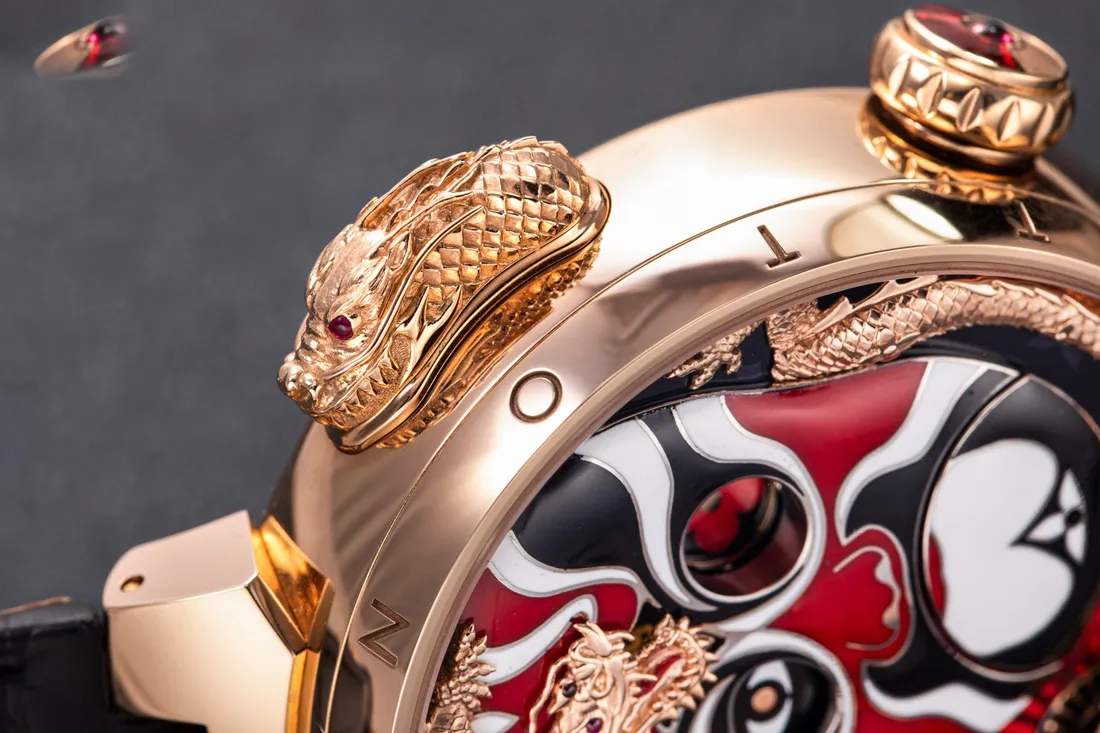
A stage is set on the dial as well. When you press the dragon shaped pusher at two o’clock, a sixteen second mechanical performance begins: the dragon swivels to reveal the jumping hours through a window in the mask’s forehead, its tail points to the retrograde minutes on the fan, the mask’s jaw opens and closes, the right eye frowns, and the left eye turns into a Louis Vuitton Monogram Flower. A tiny opera, staged on your wrist.
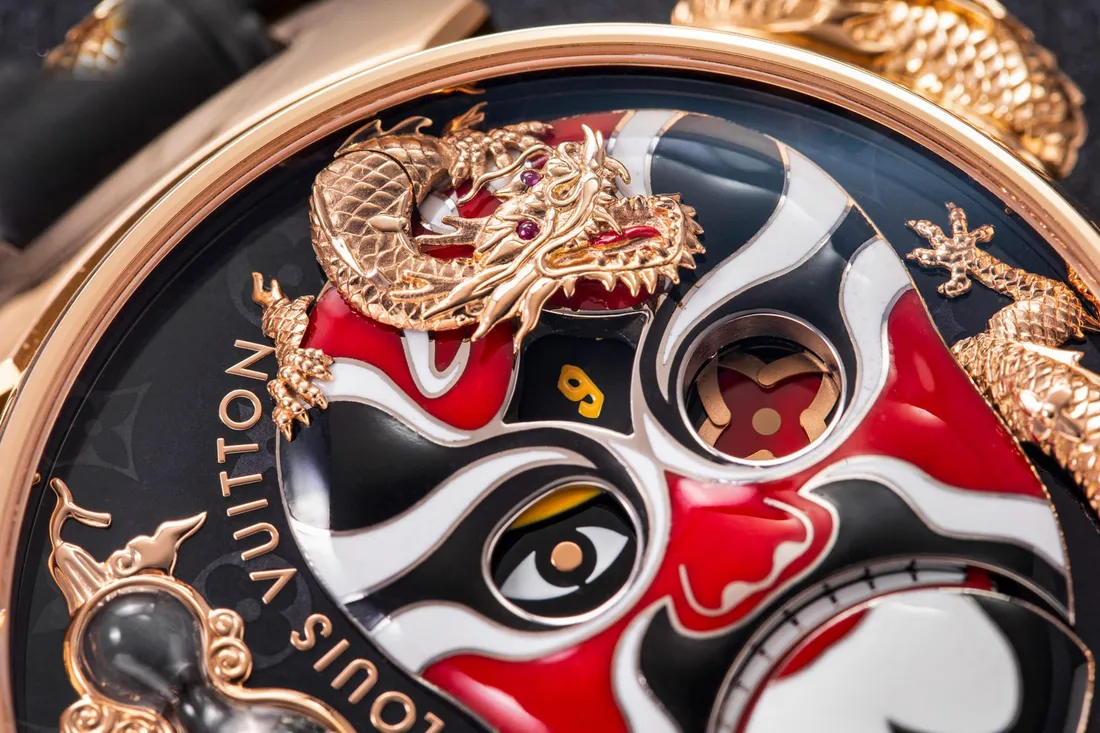
The craft of the dial is a feast of exactly the techniques we described. The mask is made in cloisonné enamel: hand bent white gold wires draw every contour of the mask, and red, black and white enamels are filled in between them. In Chinese opera, a predominantly red mask is the colour of a positive and virtuous character. The fan and the base of the dial are worked in champlevé; the fan is engraved with fine flutes that mimic the folds of paper, then covered in bright red enamel. Beneath the dark grey enamel of the dial hides a discreet Louis Vuitton Monogram pattern.
The engraving of the dial came from the hand of Dick Steenman, an artisan who joined Louis Vuitton’s high watchmaking atelier, La Fabrique du Temps. Steenman engraved the dragon on both the dial and the pusher; the dragon’s eyes are rubies and its tongue is painted red. The bottle gourd that indicates the power reserve is fronted with curved glass, showing the reserve like the level of a liquid inside.
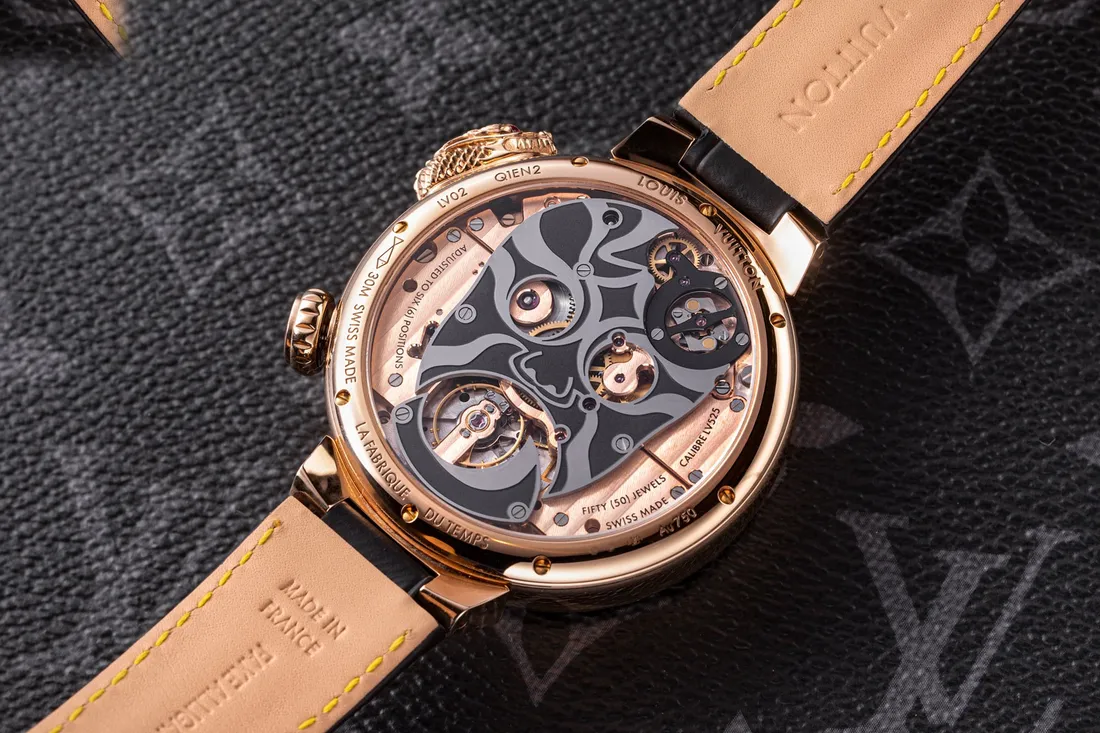
This performance is directed by the hand wound LV 525 calibre. More than a hundred of this vast movement’s four hundred and twenty six parts belong to the automaton alone. The calibre draws its power from La Fabrique du Temps’s minute repeater mechanism and, just as in a repeater, uses a centrifugal governor. This governor works like a silent orchestra conductor, keeping the automaton’s movements at exactly the right tempo, so the figures play neither too fast nor too slow. With a hundred hour power reserve and a case of forty six point eight millimetres in pink gold, it is a true presence on the wrist. It is made in very limited numbers, at a price of around five hundred and twenty thousand euros before taxes.
The Joy of the West: Tambour Taiko Arty Automata
Born of the same atelier but with an utterly different spirit, the Taiko Arty Automata is the other side of the coin. If the Opera is solemn and ceremonial, the Arty is quite literally an explosion of colour, a cry of joy. Tambour means drum in French; Taiko is a Japanese drum. Even its name promises a rhythm, a burst of exuberance.
The dial carries seven separate animations: spinning hearts, a winking eye, stars and clouds. Press the pusher at eight o’clock and they all spring to life at once. What is remarkable is this: the hours and minutes are squeezed into a tiny window at three o’clock. It is as if the designer said, joy first, and let the time come later. At six, a flying tourbillon turns, suspended in the air.
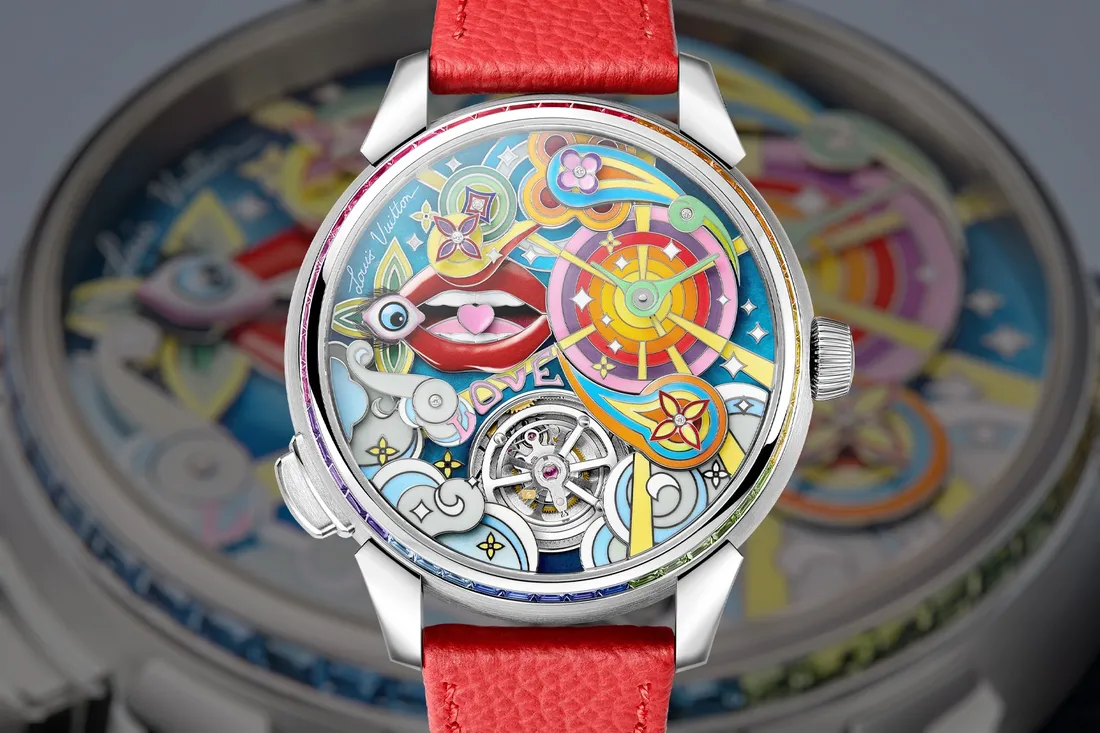
The craft here is dizzying too. The dial, worked in grand feu enamel, is made up of twenty parts spread across four different levels of height. Twenty three separate shades of enamel were used for a single dial, and the work takes an enameller two hundred and fifty hours. The most surprising detail: the eyelashes of the eye on the dial are made from tiny real bird feathers. Around the case runs a rainbow of forty eight baguette cut rubies and sapphires.
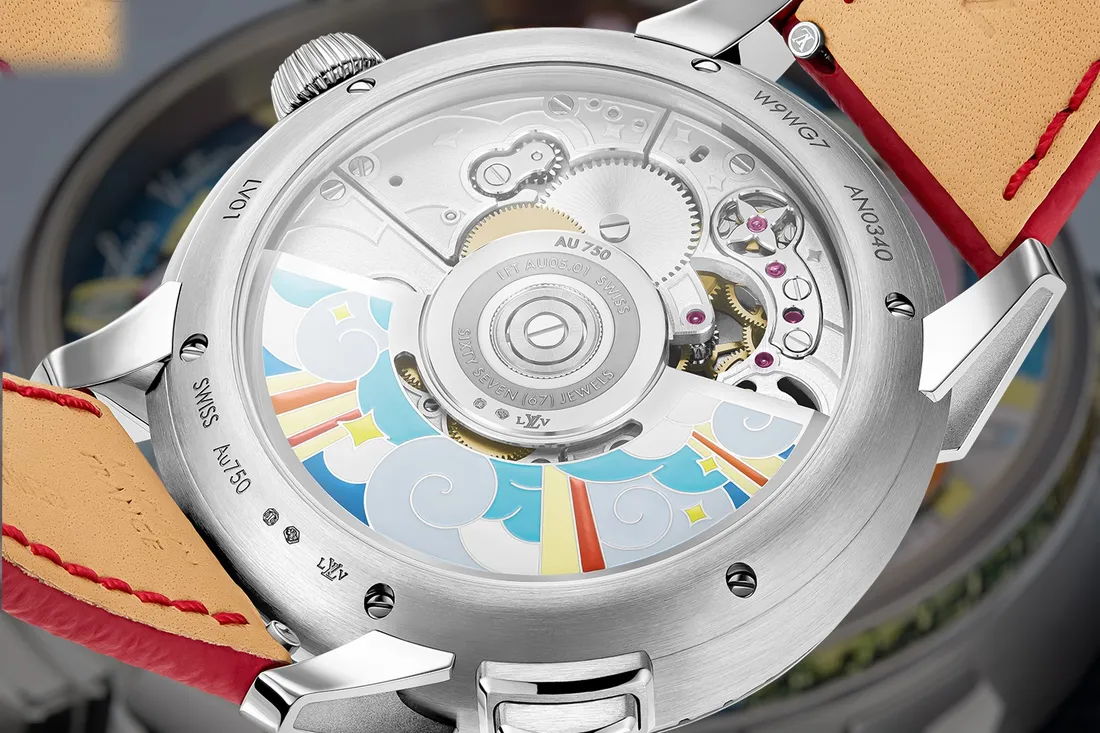
On the rotor, enamel gives way to another handcraft. The white gold rotor is decorated with relief cloud motifs in coloured lacquer, hand painted and baked. Why lacquer and not enamel? Because the rotor must stay perfectly flat, and the slightest warping that enamel firing might cause would upset its balance. The master knows which technique is right for which surface; that is what true mastery means.
Its movement is new as well: the LFT AU05.01 calibre is automatic and fitted with a flying tourbillon. It has a sixty five hour power reserve. With its forty two millimetre white gold case, it wears far more easily than the forty seven millimetre giants that came before it. This time Louis Vuitton has made not only a work of art, but a work of art you can comfortably carry on your wrist.
format_quote"One is the quiet opera aria of the East, the other the bright jazz explosion of the West. Yet both are born of the same fire, the same powdered glass, and the same patient hands."
Two Faces, One Fire
At first glance these two watches are complete opposites. One is pink gold, the other white gold. One is the red solemnity of Chinese opera, the other the pop-art joy of a rainbow. One is wound by hand, the other winds itself. One is East, the other West. And yet the face of each is the work of the same fire, the same molten glass, the same hair-fine brush.
The true value of both lies hidden in a human story. In a woman bending for hours over a dial, painting with fire, trusting her instinct because she cannot see inside the kiln. These watches do not merely tell the time; on a surface smaller than a coin, they keep alive an art that refuses to die, in the hands of a few women and in the fire they have dared to learn. Perhaps that is what true luxury is: a labour that never fades.