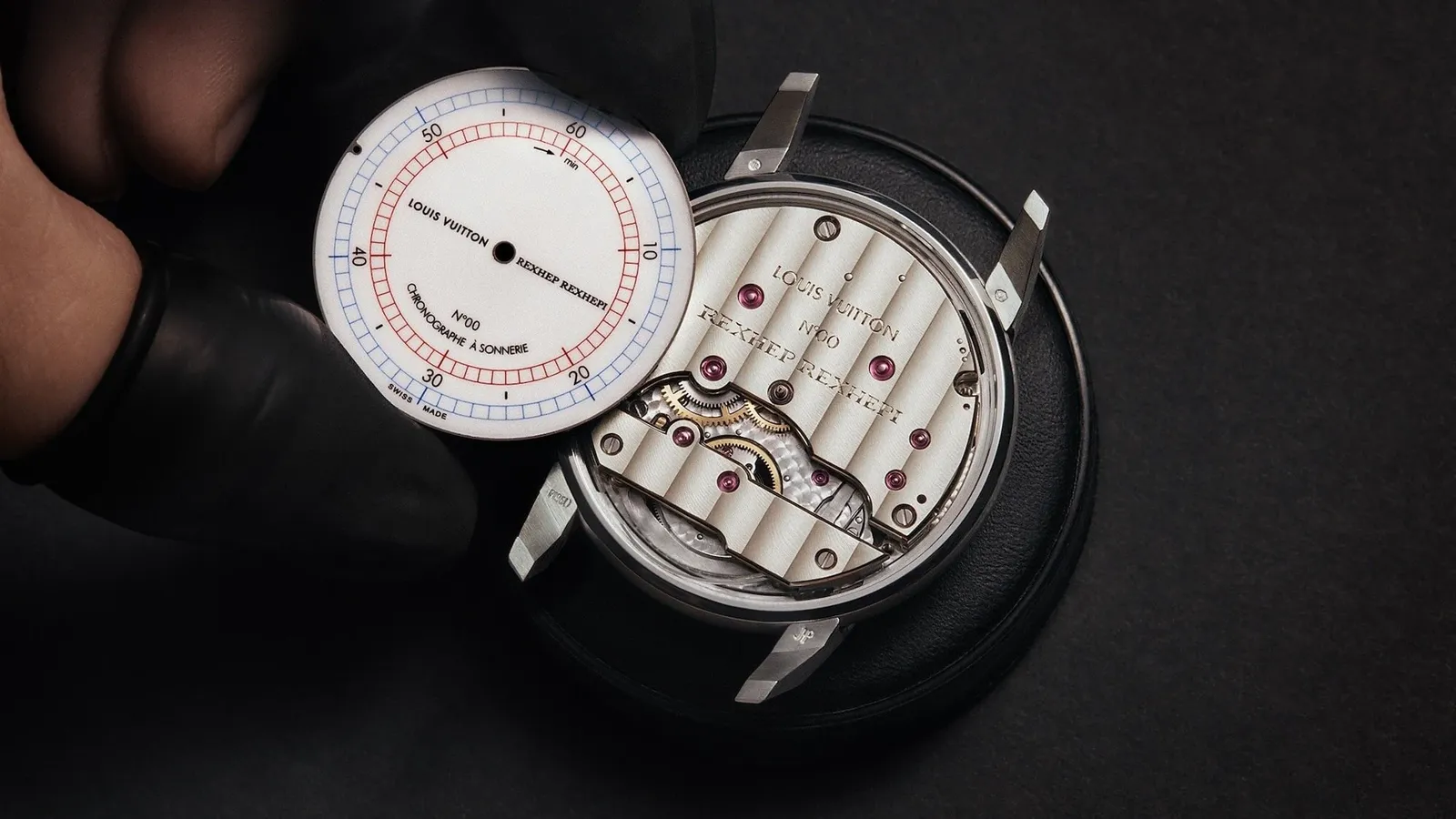
Picture a single musician asked to keep flawless time, to measure elapsed minutes like a stopwatch, and to ring a bell at the top of every minute, all at once, without his tempo drifting by even a second. The LVRR-01, born of the alliance between Louis Vuitton and Akrivia, is the engineering marvel that sets exactly this impossible balance on your wrist.
The LVRR-01 is a high complication masterpiece developed jointly by independent watchmaking's young genius Rexhep Rexhepi (Atelier Akrivia) and Louis Vuitton's haute horlogerie atelier, La Fabrique du Temps. By melting a tourbillon, a chronograph and a sonnerie, a chiming function, into a single caliber, it pushes the limits of micro engineering in acoustics, materials science and energy management.

format_quote"A single musician keeping flawless time, measuring the minutes and ringing a bell every sixty seconds: the LVRR-01 sets this impossible balance on your wrist."
Caliber Architecture and Energy Management
The greatest structural problem of highly complicated watches is the drop in torque, in power, that occurs when functions engage. In the LVRR-01 a tourbillon turns without pause while, the moment the chronograph starts and at every passing minute, the hammers strike the gong and consume an extraordinary amount of energy. Think of a house wired to a single fuse: run the air conditioner, the oven and the iron at once and the voltage sags, the lights dim. Had all these functions drawn on a single power source, the watch's amplitude would collapse and it would stop.
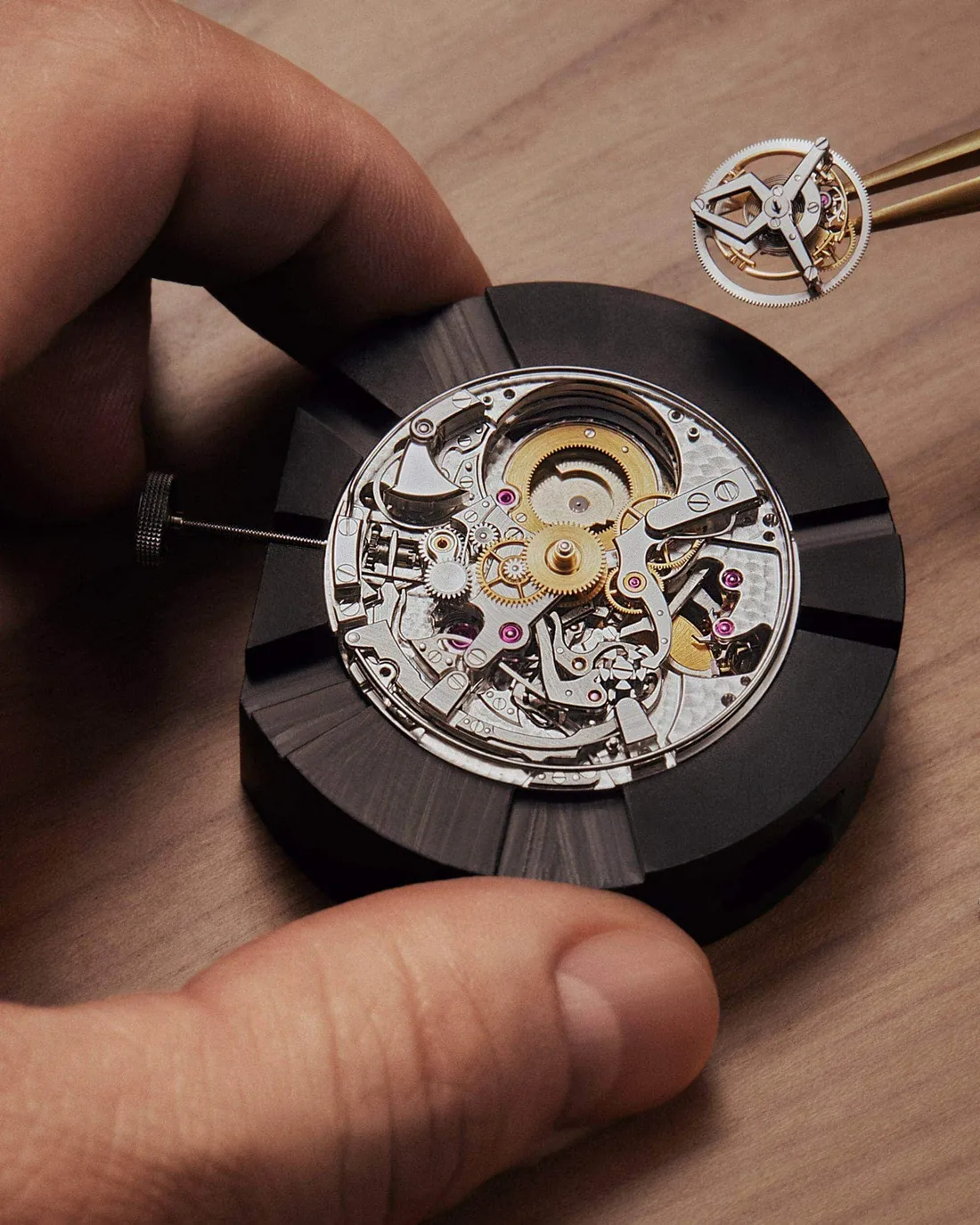
To prevent this fatal power loss, Atelier Akrivia built the caliber around a twin barrel architecture. This hand wound movement of 391 components devotes 55 parts to the tourbillon cage alone. The 41 jewel caliber runs at 21,600 vibrations per hour, that is 3 Hz, and offers a 72 hour, three day, uninterrupted power reserve when fully wound. The first barrel feeds the going train and the tourbillon cage and supplies the chronograph's base energy; the second barrel is entirely isolated from the timekeeping system and powers only the chiming mechanism, the hammers and the gong.
Here lies the stroke of genius: both barrels are wound through a single crown. Turn it clockwise and you wind the time barrel; turn it counterclockwise and you wind the sonnerie barrel. The two systems stay mechanically isolated from one another, so that not even the millisecond precision of the chronograph is disturbed while the watch chimes.
The Synergy of the Chronograph and the Five Minute Tourbillon
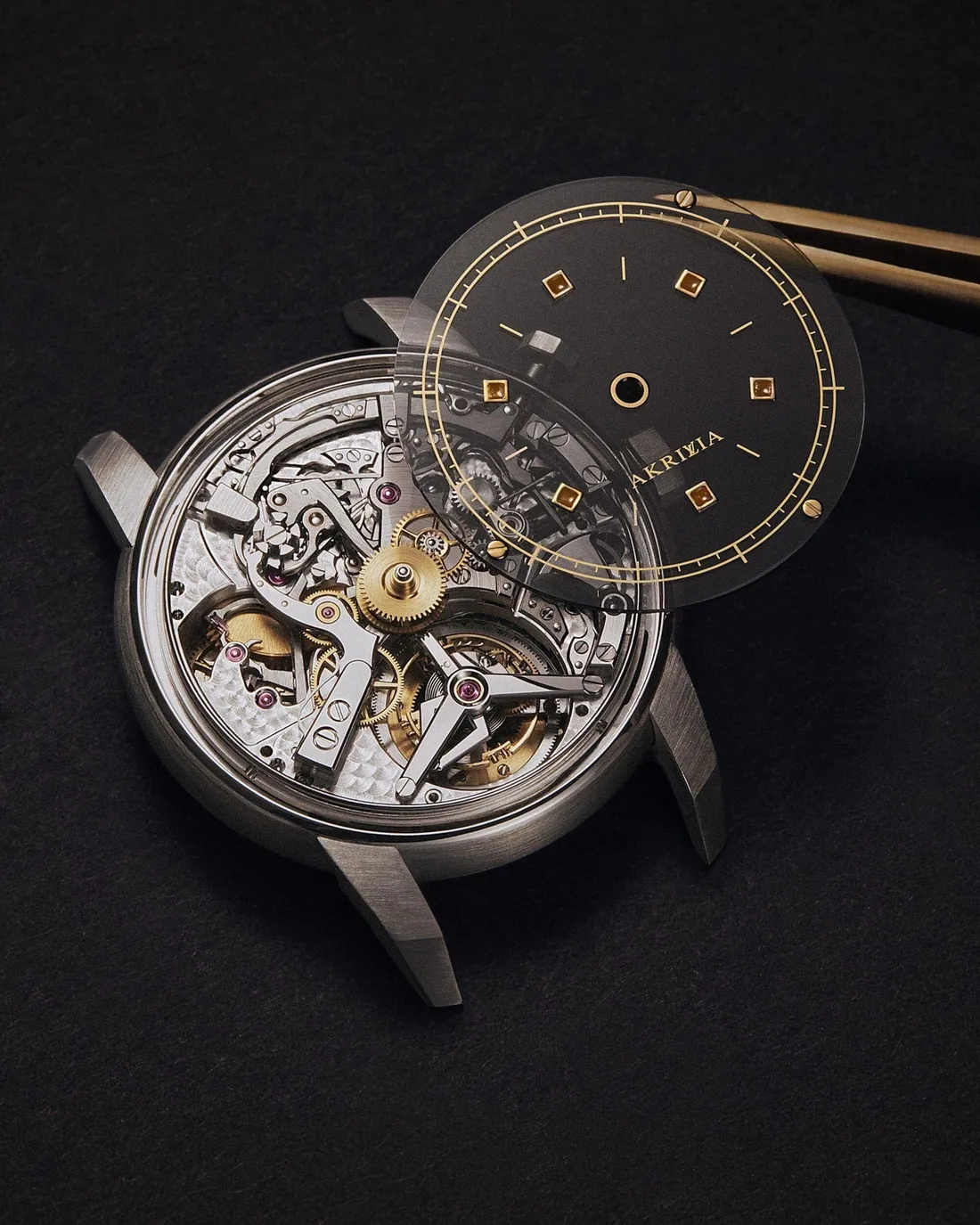
What makes the LVRR-01 unique is that its chiming mechanism does not work on demand (a minute repeater) or on the hour (a grande sonnerie) as in traditional watches, but is tied directly to the chronograph. A single pusher (a monopusher) at two o'clock starts, stops and resets the chronograph. From the instant the central chronograph seconds hand moves, the mechanism tracks every passing sixty seconds. At the split second the chronograph wheel completes a full turn, that is sixty seconds, a mechanical lever releases the chiming barrel; a single hammer inside strikes a handmade steel gong and produces a clear chime. Without ever glancing at the dial, you hear the minutes pass.
The real engineering nightmare, though, lies in the tourbillon. A traditional tourbillon cage completes one turn on its axis in one minute; for this watch Rexhep Rexhepi designed the cage to make one turn every five minutes. Like a figure skater spreading her arms and slowing her spin: the more slowly the cage turns, the more critical the friction and resistance become at the moment the barrel delivers its energy. Rexhep hand cut every bridge of the cage from titanium and steel, bringing its weight far below one gram. The slowly turning cage spends energy so frugally that, even when the chronograph and the sonnerie engage at the same time, the balance of the main timekeeping system is never shaken.
Acoustic Engineering and a Tribute to Master Casemaker Jean-Pierre Hagmann
Chiming watches are usually built in titanium or gold cases, because platinum (Pt) is extremely dense (21.45 g/cm³) and, by its molecular nature, swallows sound waves; it is, so to speak, a deaf metal. Strike a bell of steel and you hear a clear ring; cast the same bell in lead and you get only a muffled thud. To sound, platinum behaves like that lead. To overcome this deafness, the case of the LVRR-01 was shaped by the hands of the legendary casemaker Jean-Pierre Hagmann, whose recent passing left the watchmaking world in mourning; it is one of his final great masterpieces. Hagmann summed up his approach to the craft like this:
format_quote"I can do anything with my hands, but it takes a great deal of thought and contemplation. Before starting a project I do research, I find books on the subject and I study people who make things, so that I can learn from them."
Jean-Pierre Hagmann
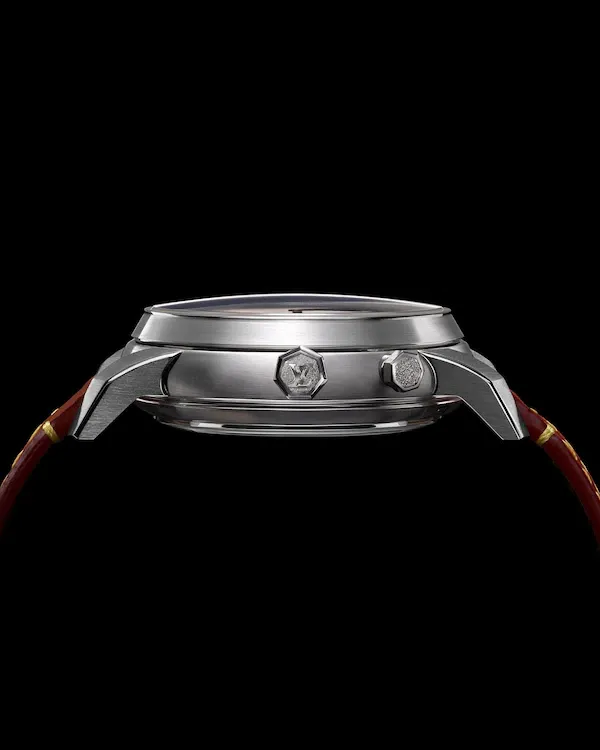
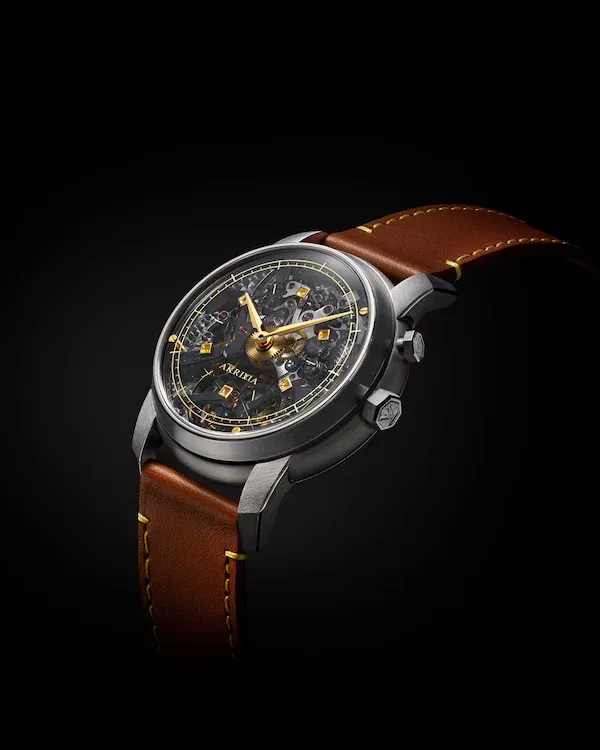
Louis Vuitton's iconic drum shaped Tambour case is reinterpreted here; it measures 39.9 mm in diameter and 12.2 mm thick and is water resistant to 3 ATM, that is 30 metres. The strap is made of natural calfskin and carries a 950 platinum ardillon buckle.
Hagmann recalculated the inner volume of the case micron by micron. Rather than muffle the sound, he shaved the case walls from within to create an acoustic resonance chamber that amplifies it like the body of a guitar. He forged and compressed the metal by hand using traditional methods rather than a CNC machine, making its molecular structure ring more clearly; and to carry the sound outward without loss, he screwed the steel gong ring directly to the lower components of the case.
As the signature of his deep research and handwork, the master's personal quality stamp, JPH, sits behind the lug. That mark is one of the most precious legacies the great master, no longer with us, has left to the history of horology.
Two Dials and a Combination of Precious Metals
The watch presents both Akrivia's purebred watchmaking language and Louis Vuitton's design heritage in a double sided body. On the front dial, beneath a semi transparent fumé sapphire crystal, lies a base plate of Pd210, a special palladium alloy. Palladium (Pd) is an ultra luxurious element far rarer than gold; unlike brass it does not oxidise over time, and even when reduced to a plate microns thin it resists bending to a surprising degree. The hour markers, the logo and the dial foot cabochon on the front are made of 3N, that is 916/1000, yellow gold, as is the central hour wheel ring. At six o'clock turns that five minute tourbillon cage.
Turn the watch over and a traditional white Grand Feu enamel dial appears, again worked onto a Pd210 base. The enamel powder is fired in four to six layers in kilns between 800°C and 900°C. Cracking at the slightest variation in heat, with masters losing seven of every ten attempts in the kiln, this process is like a porcelain master's gamble with the fire; in return it yields a milk white ground that never fades and shines as on the first day even three centuries later. The chronograph's twin scales for hours and minutes are read across this surface.
Presentation and Packaging
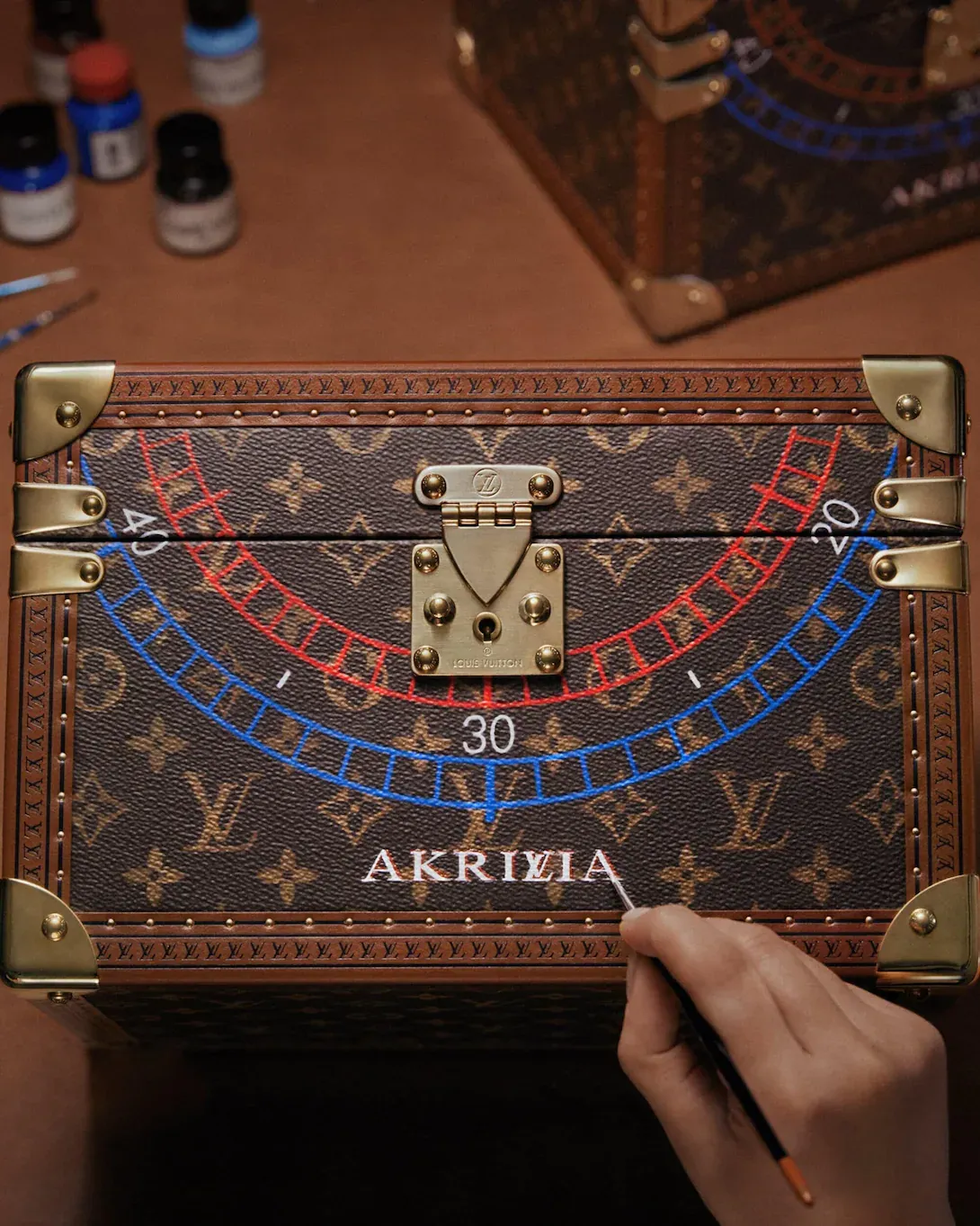
The LVRR-01 Chronographe à Sonnerie arrives in a special box that pays homage to Louis Vuitton's century old heritage of trunk making. The watch is presented inside a miniature Louis Vuitton trunk, designed specifically for haute horlogerie and bearing the iconic Monogram Canvas pattern, handmade and hand painted.
With a production strictly limited to just 10 pieces, the LVRR-01 is the most concrete proof of the kind of masterpiece that can enter the history of watchmaking when the financial power of industrial luxury meets the uncompromising craft of independent micro artisanship.
format_quote"When the financial power of industrial luxury meets the uncompromising craft of independent micro artisanship, what emerges is not merely a watch but the living legacy of a legend."